
Elimination of cervical cancer as a global public
Elimination of cervical cancer as a global public health problem 12 December 2018 1|
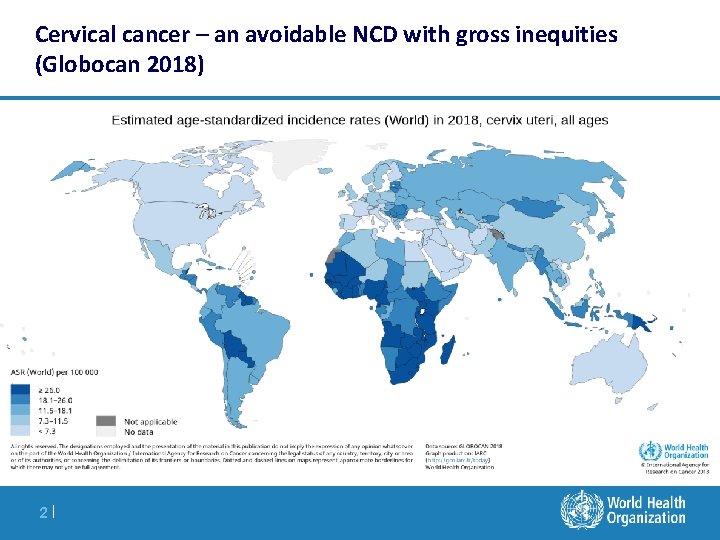
Cervical cancer – an avoidable NCD with gross inequities (Globocan 2018) 2|
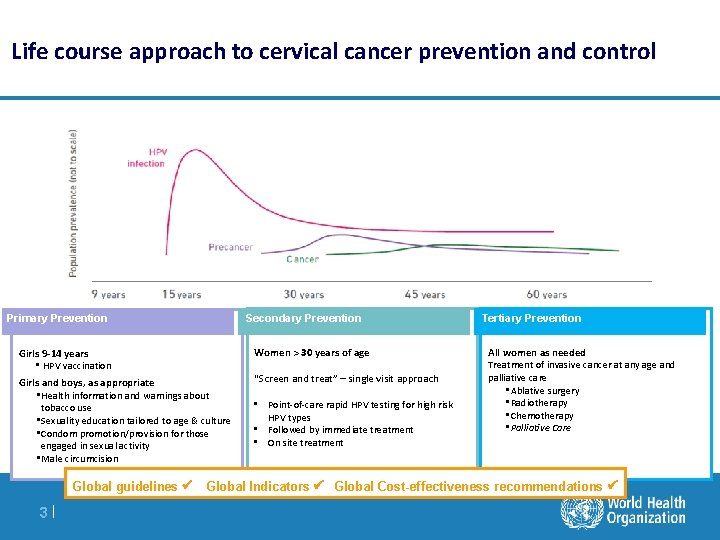
Life course approach to cervical cancer prevention and control Primary Prevention Secondary Prevention Women > 30 years of age Girls 9 -14 years • HPV vaccination Girls and boys, as appropriate • Health information and warnings about tobacco use • Sexuality education tailored to age & culture • Condom promotion/provision for those engaged in sexual activity • Male circumcision Global guidelines 3| “Screen and treat” – single visit approach • Point-of-care rapid HPV testing for high risk HPV types • Followed by immediate treatment • On site treatment Tertiary Prevention All women as needed Treatment of invasive cancer at any age and palliative care • Ablative surgery • Radiotherapy • Chemotherapy • Palliative Care Global Indicators Global Cost-effectiveness recommendations
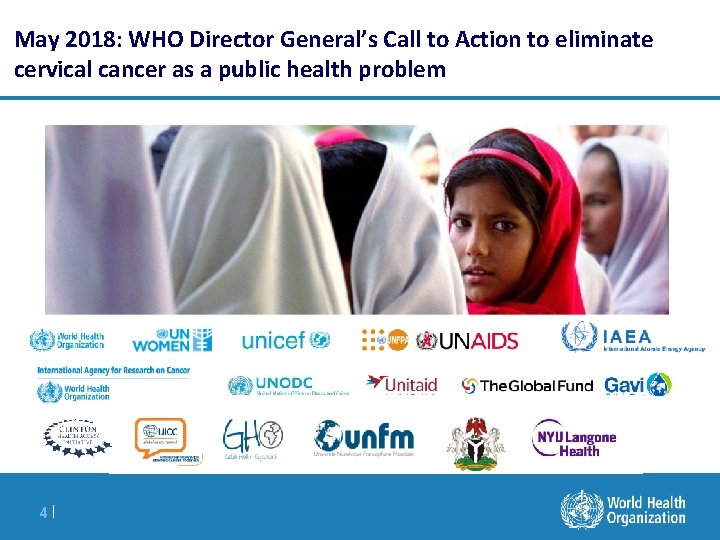
May 2018: WHO Director General’s Call to Action to eliminate cervical cancer as a public health problem 4|
Definitions on Control, Elimination and Eradication The Dahlem Workshop in March 1997 discussed the hierarchy of possible public health intervention with infectious diseases (Dowdle 1998). Dowdle WR. The principles of disease elimination and eradication. Bull World Health Organ 1998; 76 Suppl 2: 23 -5. http: //www. who. int/bulletin/volumes/84/2/editorial 10206 html /en/ 5|
Elimination § of disease: reduction to zero of the incidence of a specific disease in a defined geographical area as a result of deliberated efforts, continued intervention measures required (Example: Measles in the Americas). § of infection: reduction to zero of the incidence of infection caused by a specific agent in a defined geographical area as a result of deliberated efforts, continued intervention measures required (Example: Chagas). § as a public health problem: this term should only be used if clear target definitions are commonly agreed - continued intervention measures required (Example: Target definitions for Leprosy). 6|
Key questions that must be addressed § What will the cervical cancer threshold to achieve elimination as a public health problem be (4 or 10/100000)? § What combination of screening and vaccination strategies can lead to elimination (for different thresholds)? § When could elimination be reached, for different strategies and countries? § What is the most efficient/cost-effective strategy to reach elimination? 7|
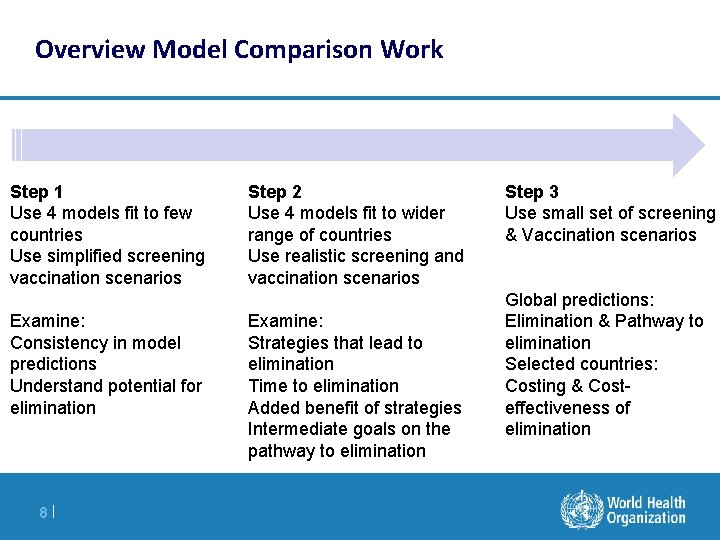
Overview Model Comparison Work Step 1 Use 4 models fit to few countries Use simplified screening vaccination scenarios Examine: Consistency in model predictions Understand potential for elimination 8| Step 2 Use 4 models fit to wider range of countries Use realistic screening and vaccination scenarios Examine: Strategies that lead to elimination Time to elimination Added benefit of strategies Intermediate goals on the pathway to elimination Step 3 Use small set of screening & Vaccination scenarios Global predictions: Elimination & Pathway to elimination Selected countries: Costing & Costeffectiveness of elimination
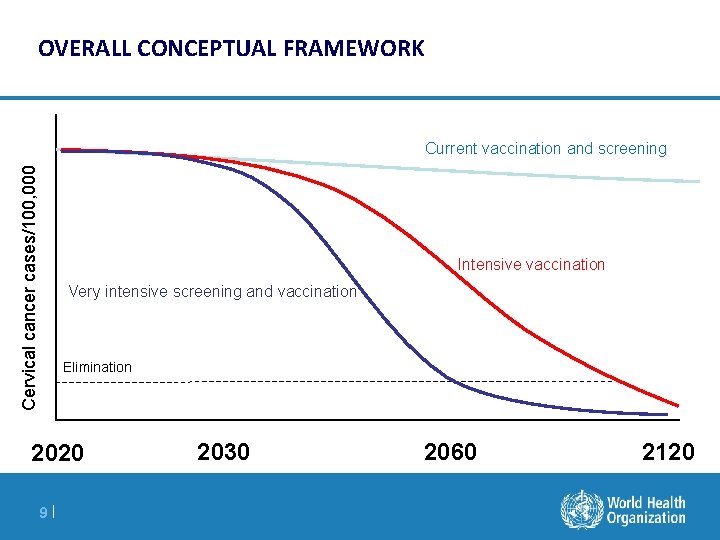
OVERALL CONCEPTUAL FRAMEWORK Cervical cancer cases/100, 000 Current vaccination and screening Intensive vaccination Very intensive screening and vaccination Elimination 2020 9| 2030 2060 2120
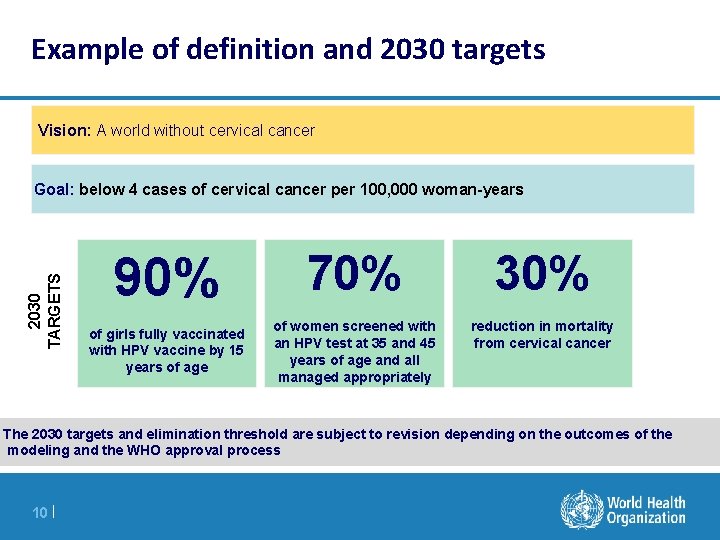
Example of definition and 2030 targets Vision: A world without cervical cancer 2030 TARGETS Goal: below 4 cases of cervical cancer per 100, 000 woman-years 90% 70% 30% of girls fully vaccinated with HPV vaccine by 15 years of age of women screened with an HPV test at 35 and 45 years of age and all managed appropriately reduction in mortality from cervical cancer The 2030 targets and elimination threshold are subject to revision depending on the outcomes of the modeling and the WHO approval process 10 |
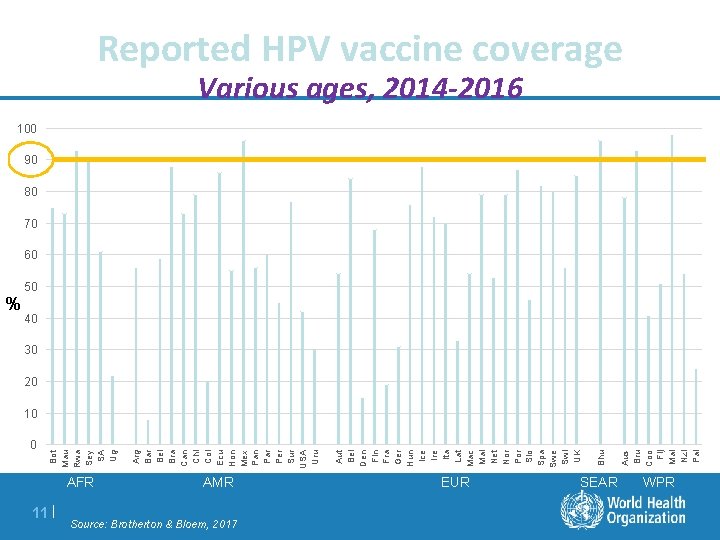
0 AFR 11 | AMR Source: Brotherton & Bloem, 2017 Aus Bru Coo Fij Mal Nzl Pal EUR Bhu Aut Bel Den Fin Fra Ger Hun Ice Ire Ita Lat Mac Mal Net Nor Por Slo Spa Swe Swi UK Arg Bar Bel Bra Can Chi Col Ecu Hon Mex Pan Par Per Sur USA Uru % Bot Mau Rwa Sey SA Ug Reported HPV vaccine coverage Various ages, 2014 -2016 100 90 80 70 60 50 40 30 20 10 SEAR WPR
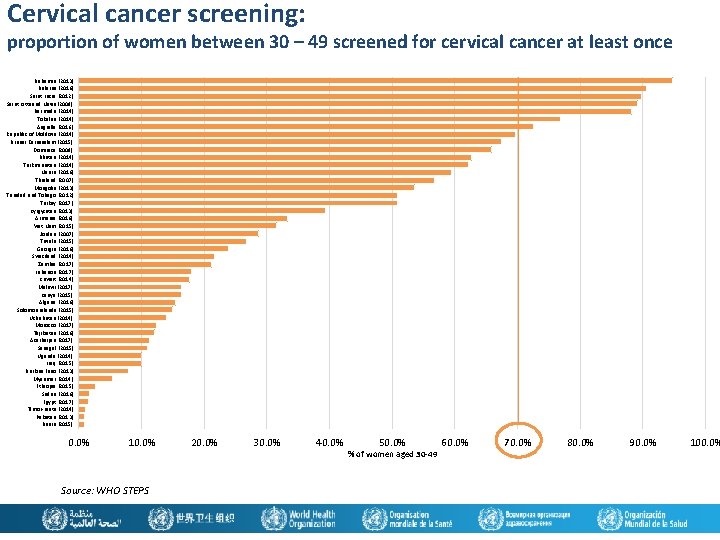
Cervical cancer screening: proportion of women between 30 – 49 screened for cervical cancer at least once Bahamas (2013) Belarus (2016) Saint Lucia (2012) Saint Kitts and Nevis (2008) Bermuda (2014) Tokelau (2014) Anguilla (2016) Republic of Moldova (2014) Brunei Darussalam (2015) Dominica (2008) Bhutan (2014) Turkmenistan (2014) Nauru (2016) Thailand (2007) Mongolia (2013) Trinidad and Tobago (2012) Turkey (2017) Kyrgyzstan (2013) Armenia (2016) Viet Nam (2015) Jordan (2007) Tuvalu (2015) Georgia (2016) Swaziland (2014) Zambia (2017) Lebanon (2017) Kuwait (2014) Malawi (2017) Kenya (2015) Algeria (2016) Solomon Islands (2015) Uzbekistan (2014) Morocco (2017) Tajikistan (2016) Azerbaijan (2017) Senegal (2015) Uganda (2014) Iraq (2015) Burkina Faso (2013) Myanmar (2014) Ethiopia (2015) Sudan (2016) Egypt (2017) Timor-Leste (2014) Pakistan (2013) Benin (2015) 0. 0% 10. 0% Source: WHO STEPS 20. 0% 30. 0% 40. 0% 50. 0% % of women aged 30 -49 60. 0% 70. 0% 80. 0% 90. 0% 100. 0%
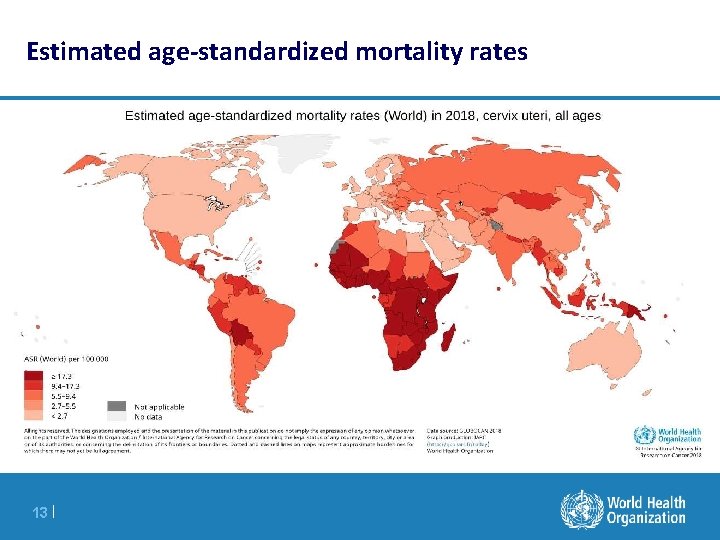
Estimated age-standardized mortality rates 13 |
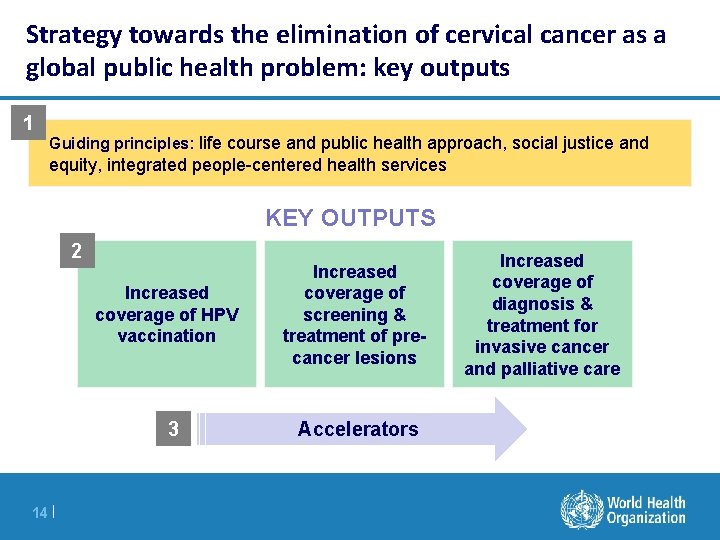
Strategy towards the elimination of cervical cancer as a global public health problem: key outputs 1 Guiding principles: life course and public health approach, social justice and equity, integrated people-centered health services KEY OUTPUTS 2 Increased coverage of HPV vaccination 3 14 | Increased coverage of screening & treatment of precancer lesions Accelerators Increased coverage of diagnosis & treatment for invasive cancer and palliative care
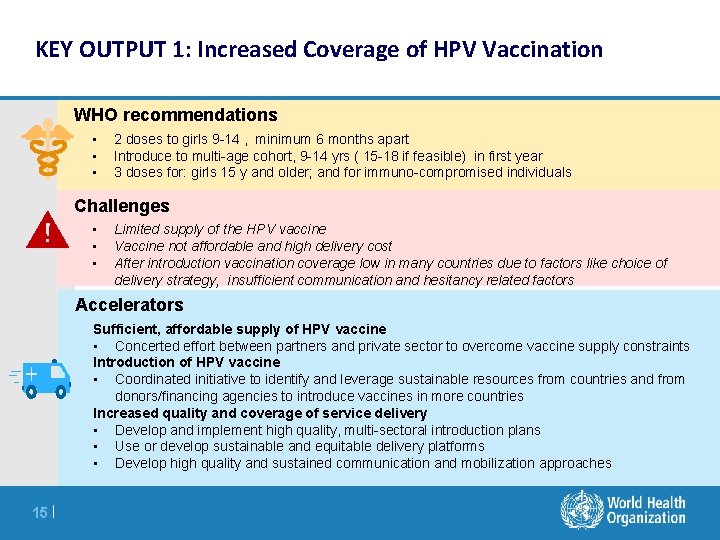
KEY OUTPUT 1: Increased Coverage of HPV Vaccination WHO recommendations • • • 2 doses to girls 9 -14 , minimum 6 months apart Introduce to multi-age cohort, 9 -14 yrs ( 15 -18 if feasible) in first year 3 doses for: girls 15 y and older; and for immuno-compromised individuals Challenges • • • Limited supply of the HPV vaccine Vaccine not affordable and high delivery cost After introduction vaccination coverage low in many countries due to factors like choice of delivery strategy, insufficient communication and hesitancy related factors Accelerators Sufficient, affordable supply of HPV vaccine • Concerted effort between partners and private sector to overcome vaccine supply constraints Introduction of HPV vaccine • Coordinated initiative to identify and leverage sustainable resources from countries and from donors/financing agencies to introduce vaccines in more countries Increased quality and coverage of service delivery • Develop and implement high quality, multi-sectoral introduction plans • Use or develop sustainable and equitable delivery platforms • Develop high quality and sustained communication and mobilization approaches 15 |
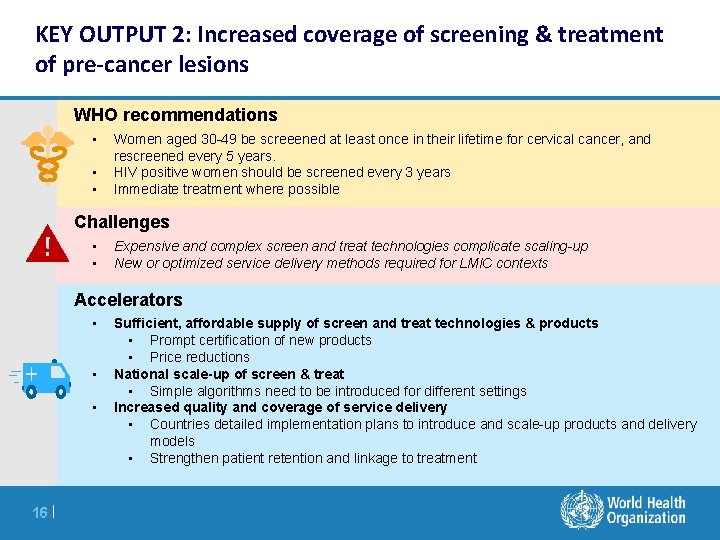
KEY OUTPUT 2: Increased coverage of screening & treatment of pre-cancer lesions WHO recommendations • • • Women aged 30 -49 be screeened at least once in their lifetime for cervical cancer, and rescreened every 5 years. HIV positive women should be screened every 3 years Immediate treatment where possible Challenges • • Expensive and complex screen and treat technologies complicate scaling-up New or optimized service delivery methods required for LMIC contexts Accelerators • • • 16 | Sufficient, affordable supply of screen and treat technologies & products • Prompt certification of new products • Price reductions National scale-up of screen & treat • Simple algorithms need to be introduced for different settings Increased quality and coverage of service delivery • Countries detailed implementation plans to introduce and scale-up products and delivery models • Strengthen patient retention and linkage to treatment
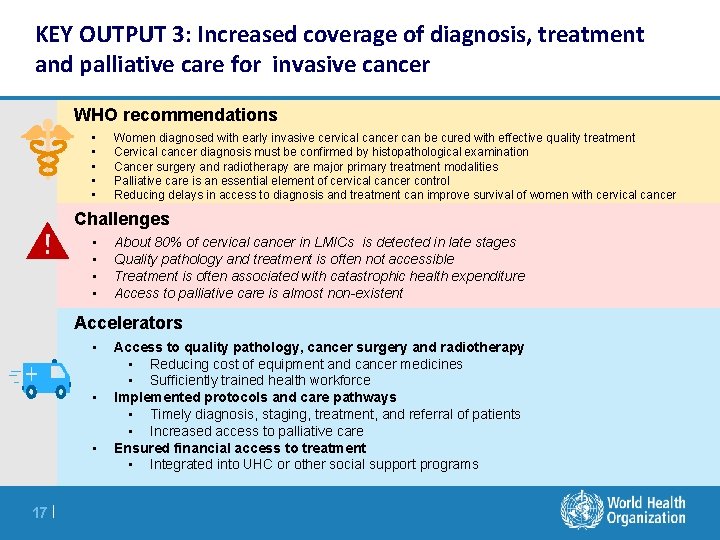
KEY OUTPUT 3: Increased coverage of diagnosis, treatment and palliative care for invasive cancer WHO recommendations • • • Women diagnosed with early invasive cervical cancer can be cured with effective quality treatment Cervical cancer diagnosis must be confirmed by histopathological examination Cancer surgery and radiotherapy are major primary treatment modalities Palliative care is an essential element of cervical cancer control Reducing delays in access to diagnosis and treatment can improve survival of women with cervical cancer Challenges • • About 80% of cervical cancer in LMICs is detected in late stages Quality pathology and treatment is often not accessible Treatment is often associated with catastrophic health expenditure Access to palliative care is almost non-existent Accelerators • • • 17 | Access to quality pathology, cancer surgery and radiotherapy • Reducing cost of equipment and cancer medicines • Sufficiently trained health workforce Implemented protocols and care pathways • Timely diagnosis, staging, treatment, and referral of patients • Increased access to palliative care Ensured financial access to treatment • Integrated into UHC or other social support programs
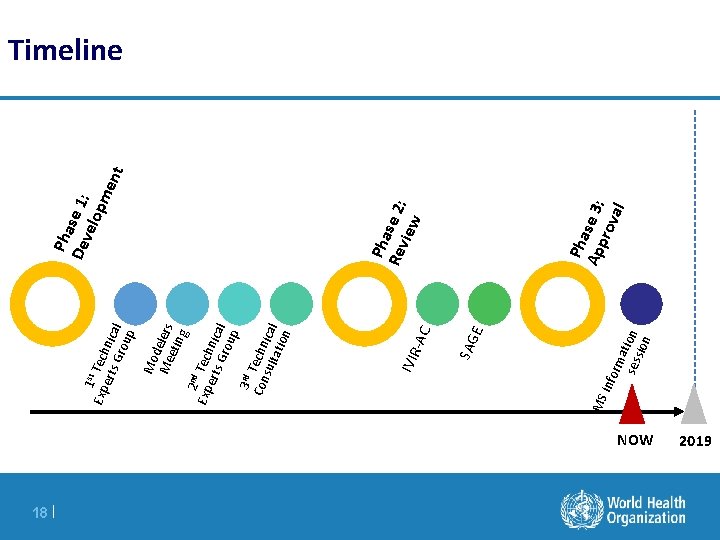
18 | MS rma ses tion sion info E SAG -AC IVIR Mo d Me elers etin g 2 nd Exp Tech erts nic Gro al up 3 rd Con Techn sult ical atio n 1 st Exp Tech erts nic Gro al up Pha App se 3: rov al Pha Rev se 2: iew nt Pha Dev se 1: elo pm e Timeline NOW 2019
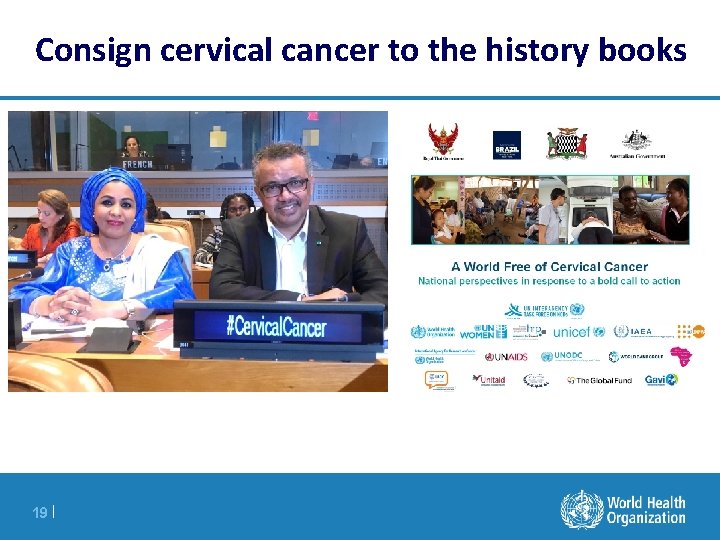
Consign cervical cancer to the history books 19 |
Why are these events important? § Building political support for elimination – – – WCC 2018; IPVS 2018; FIGO 2018 – signals support of the expert communities Civil society support critical to engage Member States Civil society support critical to motivating WHO leadership to be aspirational Head of State champions critical to raise the profile on the global stage Head of State commitments foster cross party and pan-government support § How can you help? – Share the developments with your governments and convey the sense of a growing coalition of civil society in support of the elimination agenda – across health fields; geographies from community to global organisations – Build your own regional or national coalitions to advocate collectively in 2019 – Press for similar Head of State support – Press for a national commitment to elimination of cervical cancer 20 |
Continuing country work § Missions of the Joint Global Programme – Uzbekistan: 23 -25 October 2018; Mongolia: 13 -15 November 2018 – Tanzania: 3 -7 December 2018; Morocco: 17 -19 December 2018 – Bolivia; Ghana; Guinea; Kenya; Madagascar; Malawi; Myanmar; Nigeria; Senegal; Sierra Leone; Zambia; Zimbabwe : early 2019 § Developing cervical cancer strategies in JGP countries – Costing of those plans advanced in 10 AFRO countries – Investment case in development, critical for the engagement on UHC in 2019 § Growing support for scale up of screening and treatment of pre-cancers – PEPFAR supporting 8 AFRO countries; new call for country proposals eg Mozambique – Coming soon in Q 1 2019 – announcement of Unitaid awards 21 |
- Slides: 21