
Eliminating Noise in a Cerebral Function Monitor Signal
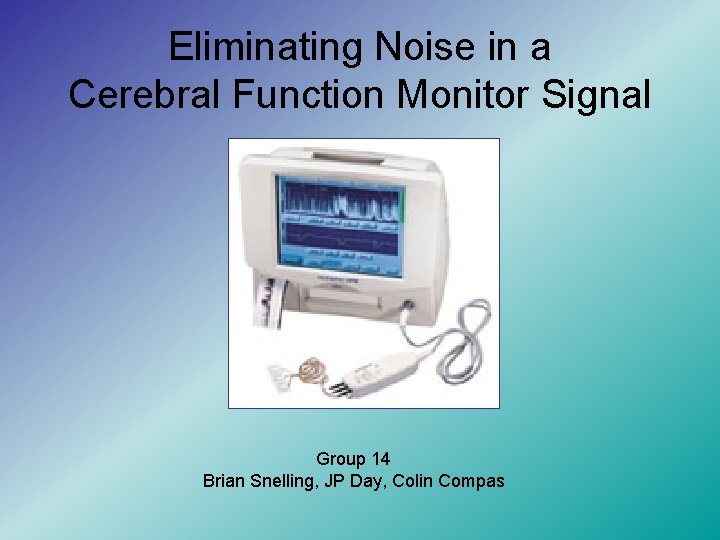
Eliminating Noise in a Cerebral Function Monitor Signal Group 14 Brian Snelling, JP Day, Colin Compas
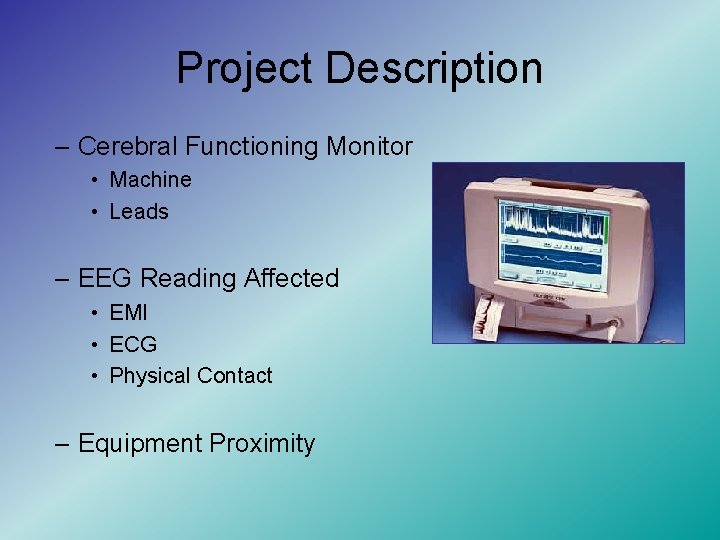
Project Description – Cerebral Functioning Monitor • Machine • Leads – EEG Reading Affected • EMI • ECG • Physical Contact – Equipment Proximity
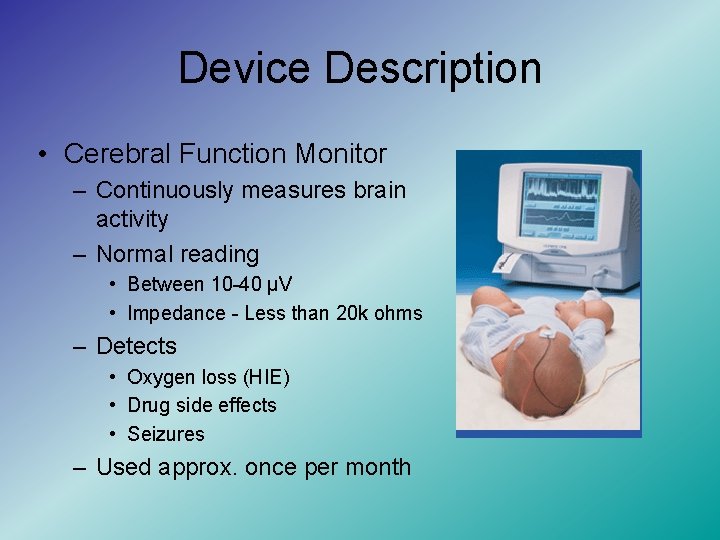
Device Description • Cerebral Function Monitor – Continuously measures brain activity – Normal reading • Between 10 -40 μV • Impedance - Less than 20 k ohms – Detects • Oxygen loss (HIE) • Drug side effects • Seizures – Used approx. once per month
Solutions • Move other equipment – Frequencies too high – Proximity • Remove ECG signal – Ranges Overlap • Shield Device – CFM is Licensed and Approved – Device Already has Shield • Shield Leads – Preliminary Testing – Options
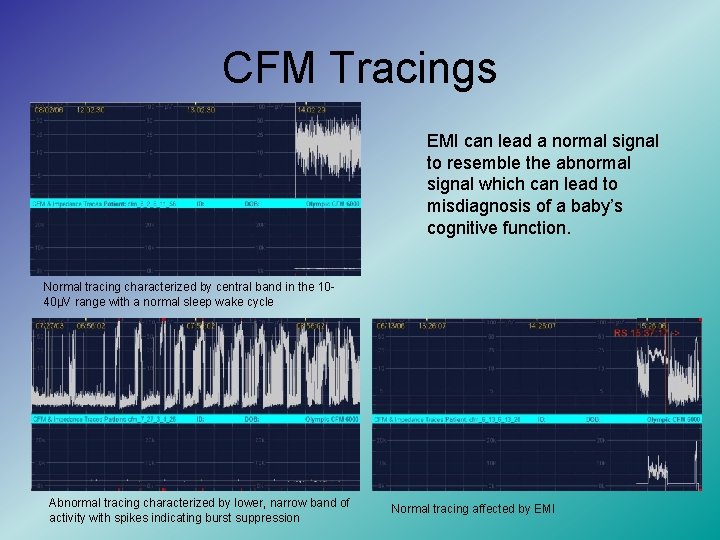
CFM Tracings EMI can lead a normal signal to resemble the abnormal signal which can lead to misdiagnosis of a baby’s cognitive function. Normal tracing characterized by central band in the 1040µV range with a normal sleep wake cycle Abnormal tracing characterized by lower, narrow band of activity with spikes indicating burst suppression Normal tracing affected by EMI
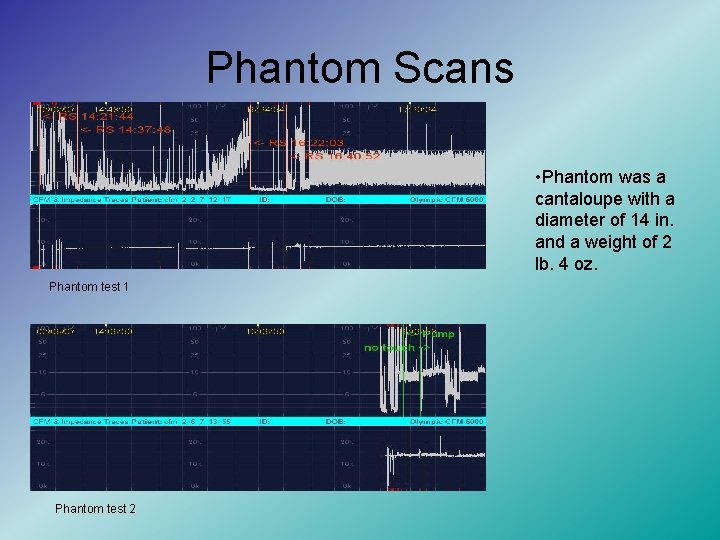
Phantom Scans • Phantom was a cantaloupe with a diameter of 14 in. and a weight of 2 lb. 4 oz. Phantom test 1 Phantom test 2
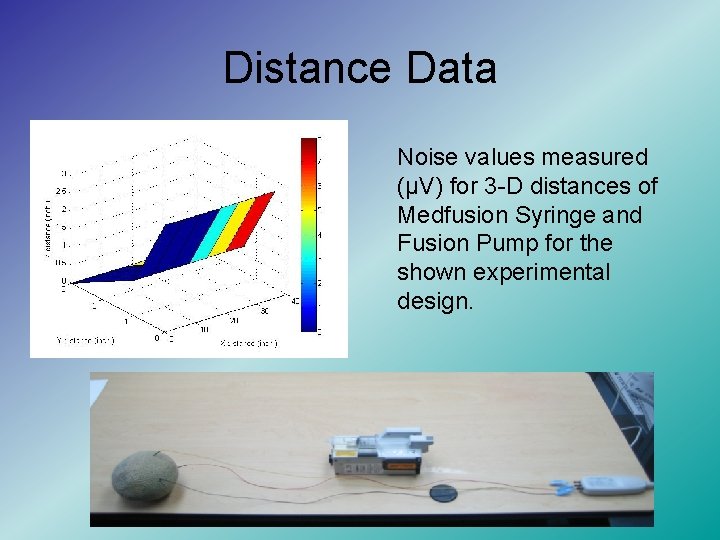
Distance Data Noise values measured (µV) for 3 -D distances of Medfusion Syringe and Fusion Pump for the shown experimental design.
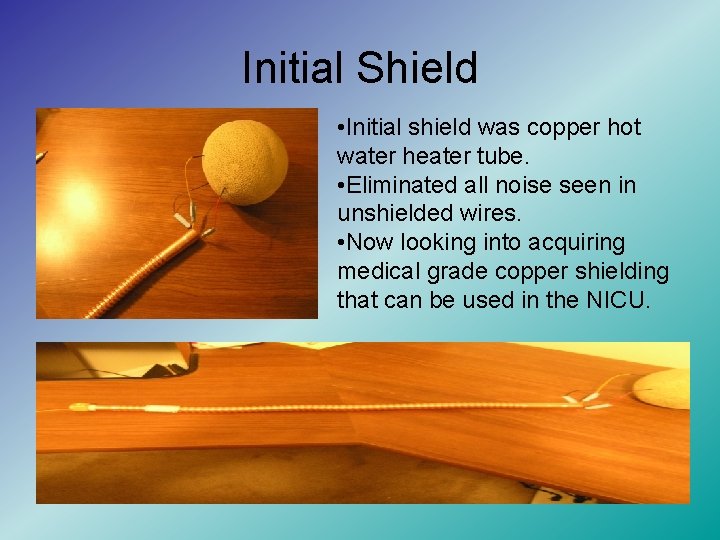
Initial Shield • Initial shield was copper hot water heater tube. • Eliminated all noise seen in unshielded wires. • Now looking into acquiring medical grade copper shielding that can be used in the NICU.
Misdiagnosis • Baby in need of treatment due to CNS injury due to hypoxia but the CFM reading is persistently over 10 µV and appears normal, disqualifying the baby for therapy – Failure to prevent brain injury • Baby with no brain activity but in whom interference generates a wave – The baby is actually too severely injured to benefit from cooling yet because of a false signal would be cooled

Completed Work • Isolated noise signal with melon – Collected Data – Used Medfusion Pump • Eliminated Noise Signal – Copper Tube – Crude Device • Contacted Ted Weiler – Head of R & D – Ruled out EMI causes – Will review our data • Generated 3 D noise graph
Current Work • Obtain medical grade copper mesh – Contact Dr. Wikswo • Characterize noise signal – Use signal generator – Work w/ Clinical Eng. Department • Contact Olympic Medical – Discuss lead shielding • Obtain list of “problem” devices – Dr. Walsh – Olympic Medical • Test other “problem” devices – Record noise signals
Future Work • Rerun noise test with medical grade copper mesh shield • Use shield with signal generator to control output signal • Insulate copper mesh shield • Implement system in incubator • Test in NICU setting • Continue working w/ Olympic Medical
References • Vries L, Hellstrom-Westas L. Role of cerebral function monitoring in the newborn. Archives of Disease in Childhood, 2007; 27. • Spitzer A. Neonatal Cerebral Function Monitoring. Neonatalogy Today, 2006; 1: 1 -12. • Gluckman P, Wyatt J, et al. Selective head cooling with mild systemic hypothermia after neonatal encephalopathy: multi-centre randomized trial. Lancet. 2005; 365: 663 -70. al Naqeeb N, Edwards AD, Cowan FM, Azzopardi D. Assessment of neonatal encephalopathy by amplitude integrated electroencephalography. Pediatrics 1999; 103(6): 1263– 1271. • • Archbald F, Verma UL, Tejani NA, Handwerker SM. Cerebral function monitor in the neonate. II: Birth asphyxia. Dev Med Child Neurol 1984; 26(2): 162– 168. • Greisen G. Tape-recorded EEG and the cerebral function monitor: amplitude-integrated, time-compressed EEG. J Perinat Med 1994; 22(6): 541– 546. • Thornberg E, Thiringer K. Normal pattern of the cerebral function monitor trace in term and preterm neonates. Acta Paediatr Scand 1990; 79(1): 20– 25. • Verma UL, Archbald F, Tejani NA, Handwerker SM. Cerebral function monitor in the neonate. I: Normal patterns. Dev Med Child Neurol 1984; 26(2): 154– 161.
- Slides: 13