
Eliminating Industrial Waste North Korea Shelby Denison Shannon
Eliminating Industrial Waste North Korea - Shelby Denison, Shannon Doane, and Trevor Zolotas
Industrial Waste and How to Eliminate It • Industrial waste is waste produced by industrial enterprises such as factories, industries, mills, and mining operations. • Waste would be considered leftover product labeled as useless and comes in many forms. • The waste can be eliminated by reusing the waste to make new products as well as using more efficient processes to reduce the leftover waste. 2
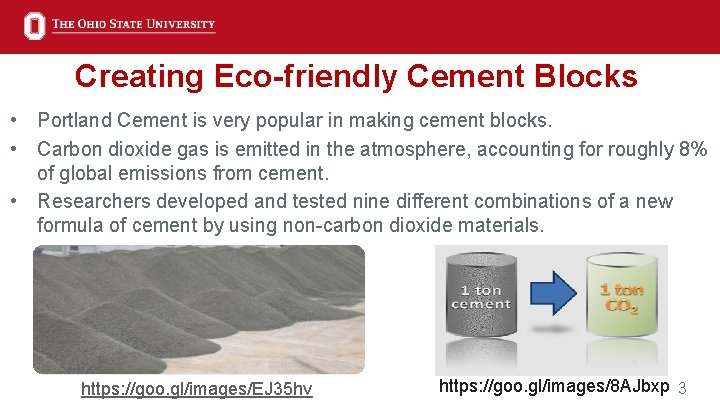
Creating Eco-friendly Cement Blocks • Portland Cement is very popular in making cement blocks. • Carbon dioxide gas is emitted in the atmosphere, accounting for roughly 8% of global emissions from cement. • Researchers developed and tested nine different combinations of a new formula of cement by using non-carbon dioxide materials. https: //goo. gl/images/EJ 35 hv https: //goo. gl/images/8 AJbxp 3
Cement Continued • By-pass dust (BPD) is a by-product collected from the kiln bypass. As a result, BPD contains numerous cement bound phases. • Plasterboard gypsum is obtained from a number of sources; construction and demolition sites once obtained the plasterboard is recycled (by grinding and sieving) and all contaminants such as paper and glass are eliminated • Basic oxygen slag, "steel slag dust, " is a by-product generated during the conversion of iron into steel. • Incinerator bottom ash aggregate (IBAA), is an ash product from incineration facilities. • Recycled crushed glass 4
Cement Continued • Recycled concrete aggregates are aggregates derived from the processing of materials previously used in construction. • Clay brick • Steel fibre • Polyvinyl alcohol (PVA) Fibre has high adhesive strength and consists of anticracking and reinforcement properties. • Ordinary Portland Cement- general type of cement • Ground granulated blast-furnace slag ‘GGBS’ is a cement substitute, it is a byproduct produced during the production of iron. 5
Cement Continued • Each formula was compacted into a one layer mold using a hydraulic compression machine. • Each mold was tested before being an approved formula. • Split tensile strength test- applies pressure to cement to test for cracking, for 14 to 28 days. https: //www. youtube. com/watch? v=9 g 71 xy. WSo. Y 0 • Slip/skid resistance test- a standard rubber material is attached to a pendulum friction tester, under wet and dry conditions. This tests for the probability of pedestrians slipping and vehicles skidding. 6
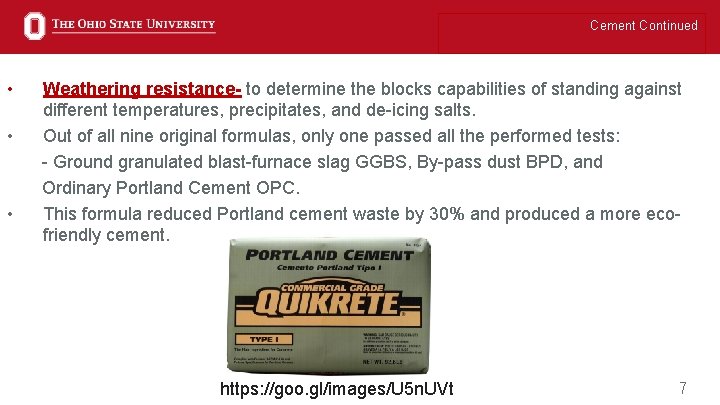
Cement Continued • Weathering resistance- to determine the blocks capabilities of standing against different temperatures, precipitates, and de-icing salts. • Out of all nine original formulas, only one passed all the performed tests: - Ground granulated blast-furnace slag GGBS, By-pass dust BPD, and Ordinary Portland Cement OPC. • This formula reduced Portland cement waste by 30% and produced a more ecofriendly cement. https: //goo. gl/images/U 5 n. UVt 7
Reducing Metallic pollution of Rivers • According to a case study evaluating the Aras river on the concentration of the elements Zn, Cu, Fe, Pb, Ni, Cd, and Hg , "Enhanced soil erosion, bed load dissolution, and runoffs may play a key role in remarkable augmentation of metallic ions concentration […] excessive use of pesticides which contain a variety of metallic ions (mainly Cu) […] may also result in an increase in the metals’ concentration. " • It was also found that industrial complexes, farm lands, and residential areas cause a sharp increase in the concentration of metallic pollution. 8
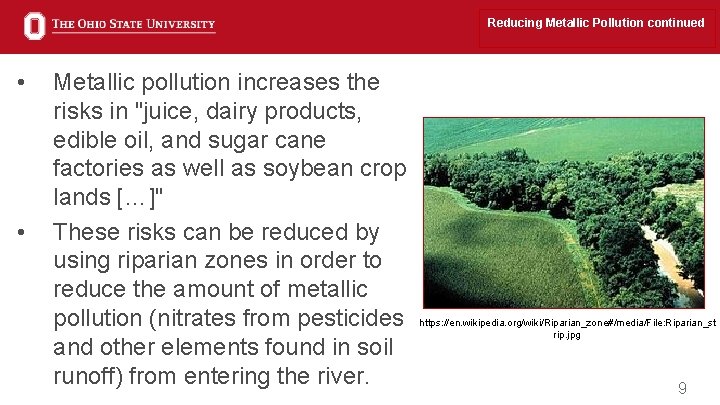
Reducing Metallic Pollution continued • • Metallic pollution increases the risks in "juice, dairy products, edible oil, and sugar cane factories as well as soybean crop lands […]" These risks can be reduced by using riparian zones in order to reduce the amount of metallic pollution (nitrates from pesticides https: //en. wikipedia. org/wiki/Riparian_zone#/media/File: Riparian_st rip. jpg and other elements found in soil runoff) from entering the river. 9
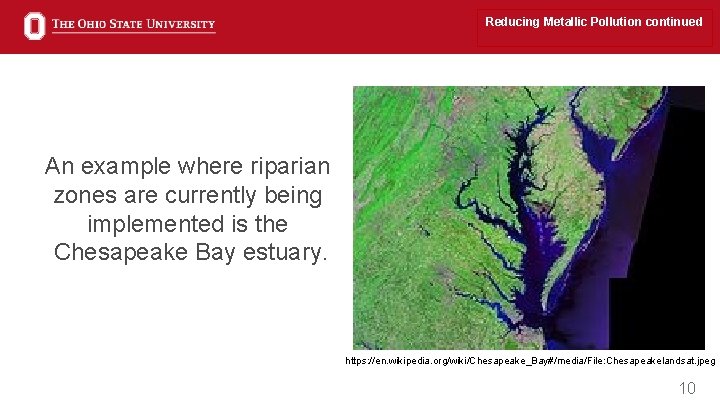
Reducing Metallic Pollution continued An example where riparian zones are currently being implemented is the Chesapeake Bay estuary. https: //en. wikipedia. org/wiki/Chesapeake_Bay#/media/File: Chesapeakelandsat. jpeg 10
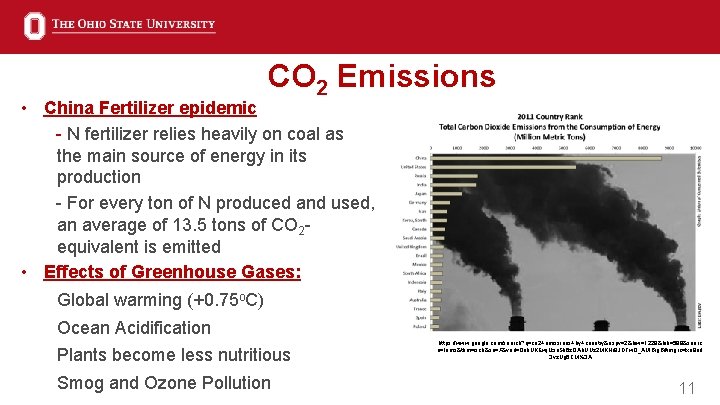
CO 2 Emissions • China Fertilizer epidemic - N fertilizer relies heavily on coal as the main source of energy in its production - For every ton of N produced and used, an average of 13. 5 tons of CO 2 equivalent is emitted • Effects of Greenhouse Gases: Global warming (+0. 75 o. C) Ocean Acidification Plants become less nutritious Smog and Ozone Pollution https: //www. google. com/search? q=co 2+emissions+by+country&espv=2&biw=1229&bih=588&sourc e=lnms&tbm=isch&sa=X&ved=0 ah. UKEwj. Ltsn. Sk 6 z. QAh. UUz 2 MKHf 9 JDFw. Q_AUIBig. B#imgrc=lxe 8 ud 3 vz. Ug 6 CM%3 A 11
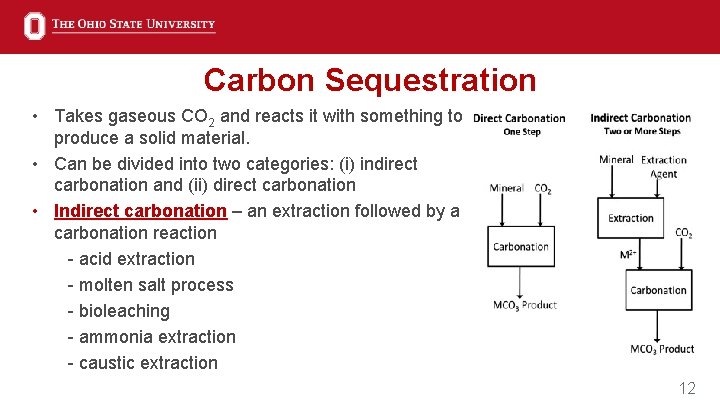
Carbon Sequestration • Takes gaseous CO 2 and reacts it with something to produce a solid material. • Can be divided into two categories: (i) indirect carbonation and (ii) direct carbonation • Indirect carbonation – an extraction followed by a carbonation reaction - acid extraction - molten salt process - bioleaching - ammonia extraction - caustic extraction 12
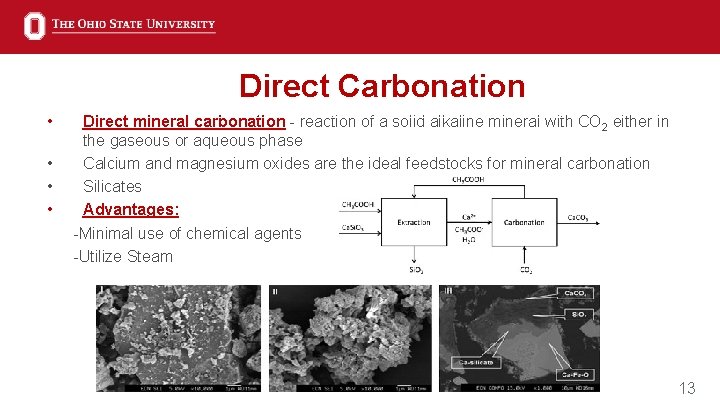
Direct Carbonation • Direct mineral carbonation - reaction of a solid alkaline mineral with CO 2 either in the gaseous or aqueous phase • Calcium and magnesium oxides are the ideal feedstocks for mineral carbonation • Silicates • Advantages: -Minimal use of chemical agents -Utilize Steam 13
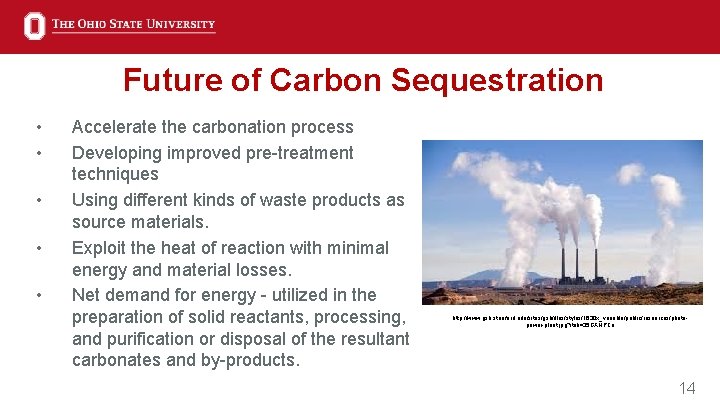
Future of Carbon Sequestration • • • Accelerate the carbonation process Developing improved pre-treatment techniques Using different kinds of waste products as source materials. Exploit the heat of reaction with minimal energy and material losses. Net demand for energy - utilized in the preparation of solid reactants, processing, and purification or disposal of the resultant carbonates and by-products. http: //www. gsb. stanford. edu/sites/gsb/files/styles/1630 x_variable/public/resources/photopower-plant. jpg? itok=35 GXHPCe 14
• • • References Nasehi, F, A H. Hassani, M Monavvari, A R. Karbassi, and N Khorasani. "Evaluating the Metallic Pollution of Riverine Water and Sediments: a Case Study of Aras River. "Environmental Monitoring and Assessment : an International Journal Devoted to Progress in the Use of Monitoring Data in Assessing Environmental Risks to Man and the Environment. 185. 1 (2013): 197 -203. Print. Ganjian, Eshmaiel, Ghassan Jalull, and Homayoon Sadeghi-Pouya. "Using Waste Materials and By-Products to Produce Concrete Paving Blocks. " Construction and Building Materials. 77 (2015): 270 -275. Print. https: //goo. gl/images/EJ 35 hv http: //whatsyourimpact. org/effects-increased-greenhouse-gas-emissions Zhang, W. F. , Dou, Z. X. , He, P. , Ju, X. T. , Powlson, D. , Chadwick, D. , Norse, D. , . . . Zhang, F. S. (January 01, 2013). New technologies reduce greenhouse gas emissions from nitrogenous fertilizer in China. Proceedings of the National Academy of Sciences of the United States of America, 110, 21, 8375 -80. Bobicki, Erin R, Qingxia Liu, Zhenghe Xu, and Hongbo Zeng. "Carbon Capture and Storage Using Alkaline Industrial Wastes. " Progress in Energy and Combustion Science. 38. 2 (2012): 302 -320. Print. https: //goo. gl/images/8 AJbxp https: //www. youtube. com/watch? v=9 g 71 xy. WSo. Y 0 https: //goo. gl/images/U 5 n. UVt 15

Questions? ? ? 16
- Slides: 16