
Eligibility Recruitment Selection Enrollment and Attendance ERSEA Welcome
Eligibility, Recruitment, Selection, Enrollment and Attendance (ERSEA) Welcome Orientation to the Head Start Program Performance Standards ERSEA 45 CFR 1302. 10 – 1302. 18 Protections for the Privacy of Child Records Subpart C of 1303. 20 – 1303. 24 1

Eligibility, Recruitment, Selection, Enrollment and Attendance (ERSEA) This section codifies in regulation many of the requirements in the Head Start Act regarding all aspects of ERSEA. Ø Community Needs Assessment Ø Eligibility Ø Recruitment Ø Selection Ø Enrollment Ø Attendance Ø Suspension and Expulsion Ø Fees 2
Eligibility, Recruitment, Selection, Enrollment and Attendance (ERSEA) 1302. 10 1302. 11 1302. 12 1302. 13 1302. 14 1302. 15 1302. 16 1302. 17 1302. 18 Purpose. Determining community strengths, needs and resources. Determining, verifying, and documenting eligibility. Recruitment of children. Selection process. Enrollment. Attendance. Suspension and expulsion. Fees. 3
1302. 10 Purpose • This subpart describes requirements for determining community strengths and needs. It contains requirements and procedures for eligibility determination, recruitment, selection, enrollment and attendance of children and the policy regarding fees. 4
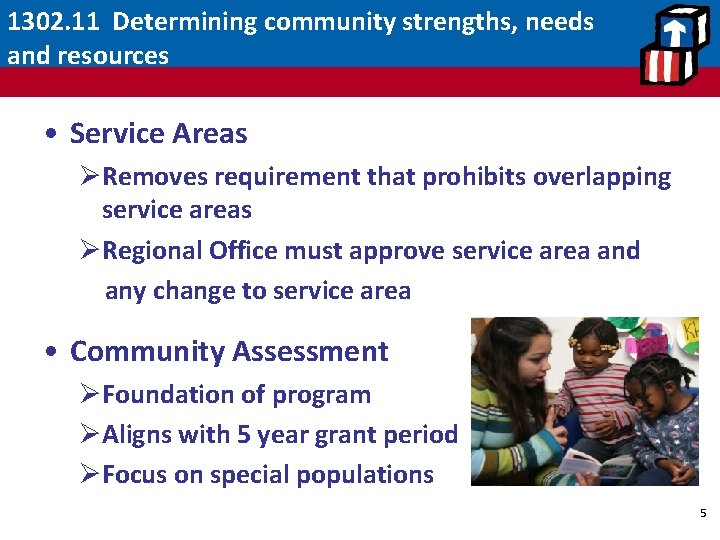
1302. 11 Determining community strengths, needs and resources • Service Areas ØRemoves requirement that prohibits overlapping service areas ØRegional Office must approve service area and any change to service area • Community Assessment ØFoundation of program ØAligns with 5 year grant period ØFocus on special populations 5
1302. 12 Determining, verifying, and documenting eligibility • Most provisions required by statute ØTherefore, not able to change in regulation • Only clarifying changes from 2015 Eligibility Rule ØRemoved separation between income and categorical ØWritten statements allowed from self-employed ØReporting on 100 -130 percent eligibility clarified 6
1302. 13 Recruitment of children Goal: Serve the most vulnerable children first • Focus on special populations Ø Children who are homeless Ø Children in foster care Ø Children with disabilities • Individualized to community needs ØProvides grantees flexibility ØGrantee must identify efforts to actively locate and recruit most vulnerable populations 7
1302. 14 Selection process Goal: Strengthen requirements for selection process and procedures Ø Related to individual community needs Ø Prioritize most vulnerable children New to programs: Ø Clarifies 10% of total funded enrollment must be children with disabilities Ø Must prioritize younger children if high-quality, full day pre-k available for HS eligible 4 year olds 8
1302. 15 Enrollment NEW for Grantees: Ø New provision allows reserving up to 3 percent of slots for 30 days for homeless and foster children and pregnant women Ø Must fill vacancies within 30 days – even at the end of the program year – 60 day rule no longer applies 9
1302. 16 Attendance NEW for Grantees: Ø Focus on implementing strategies to promote regular attendance Ø Homeless children can be served without required paperwork for up to 90 days as long as state licensing requirements are met Ø Must have system for ensuring child is safe if they are absent without explanation Ø Grantees are still required to analyze and address average attendance that falls below 85 percent 10
1302. 17 Suspension and expulsion Goal: Codifies long standing practice to not expel children from Head Start programs NEW section in HSPPS: Ø Prohibits expulsion and severely limits suspension Ø Provides steps for programs related to challenging behaviors Ø Elaborates on engaging mental health consultants described in 1302. 45 mental health and social and emotional well being regulation 11
1302. 18 Fees Goal: Serve most vulnerable children at no cost to families Ø Current requirement maintained: programs cannot charge a fee for Head Start services Ø Clarifies that fees can be paid for additional services outside of Head Start Ø Allows grantees to accept fees from non-Head Start enrolled families to support classrooms with diverse economic backgrounds 12
Subpart C of 1303 – Protections for the Privacy of Child Records Ø This subpart generally aligns with the Family Educational Rights and Privacy Act (FERPA) 1303. 21 Program Procedures – applicable confidentiality provisions Exceptions to this subsection: Ø If a program is subject to FERPA (e. g. school district), then the program does not comply with this subpart Ø If a child record is subject to IDEA confidentiality requirements, then the program follows those requirements for that child record and not this subpart 13
Subpart C of 1303 – Protections for the Privacy of Child Records 1303. 22 – 1302. 24 This subpart outlines the following requirements to protect the personally identifiable information (PII) in child records: Ø Parental consent including eight instances when consent is not required Ø Written agreements with third parties to protect PII when disclosing data 14
Subpart C of 1303 – Protections for the Privacy of Child Records Ø Parent rights in respect to their child records – Right to inspect, amend, request a hearing, copy of record, and (also, right to inspect written agreements) Ø Maintenance of records – Destroy in reasonable timeframe – Ensure only appropriate parties have access – Data systems are protected to current industry standards Ø Annual notice to parents 15
Personally Identifiable Information Ø Personally Identifiable Information (PII) – includes things like a child’s name, address, parent’s name, or any other information that is linked or linkable to the child Ø 1303. 22(f) - Limit on disclosing PII. A program must only disclose the information that is deemed necessary for the purpose of the disclosure. 16
ERSEA Questions 17
ERSEA 18
- Slides: 18