
Eli MO Eliminating Channel Feedback from MIMO May

Eli. MO: Eliminating Channel Feedback from MIMO May 2017 Yongsen Ma, Gang Zhou (William & Mary), and Shan Lin (Stony Brook University)
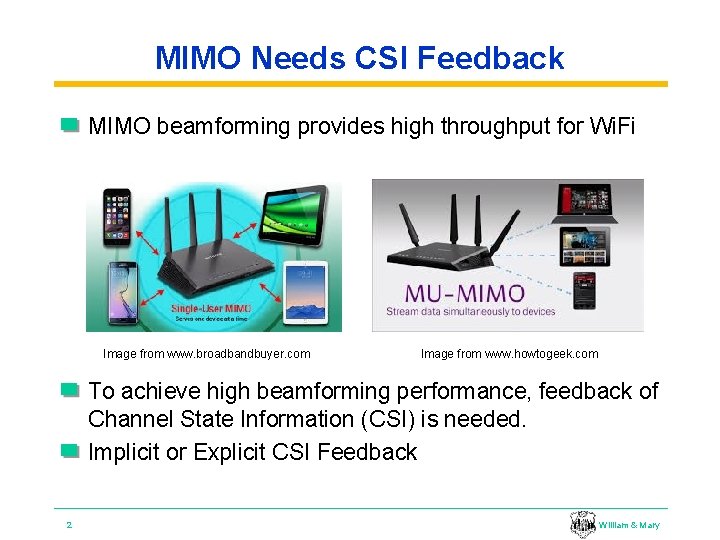
MIMO Needs CSI Feedback MIMO beamforming provides high throughput for Wi. Fi Image from www. broadbandbuyer. com Image from www. howtogeek. com To achieve high beamforming performance, feedback of Channel State Information (CSI) is needed. Implicit or Explicit CSI Feedback 2 William & Mary
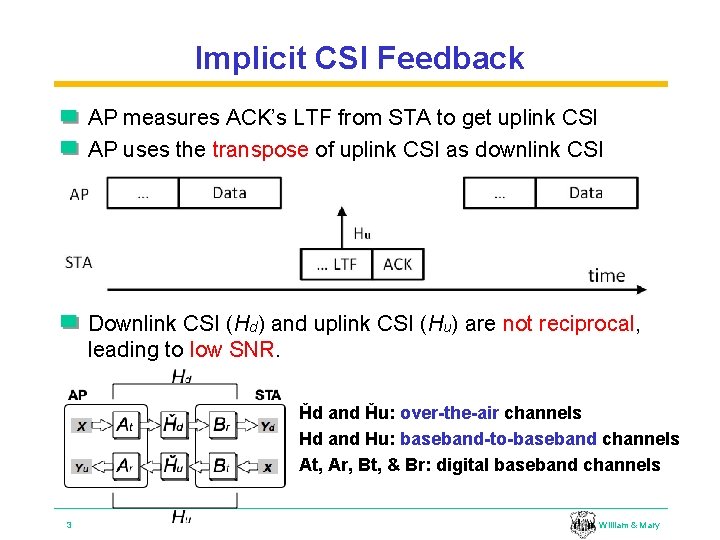
Implicit CSI Feedback AP measures ACK’s LTF from STA to get uplink CSI AP uses the transpose of uplink CSI as downlink CSI Downlink CSI (Hd) and uplink CSI (Hu) are not reciprocal, leading to low SNR. Ȟd and Ȟu: over-the-air channels Hd and Hu: baseband-to-baseband channels At, Ar, Bt, & Br: digital baseband channels 3 William & Mary

Explicit CSI Feedback STA measures NDP’s LTF to get downlink CSI STA sends measured downlink CSI to AP Measuring and transmitting CSI introduce high computation & communication overhead 4 William & Mary

Eliminating CSI Feedback Can we completely eliminate explicit CSI feedback? Ø And achieve as high SNR as explicit CSI feedback Ø With as low overhead as implicit CSI feedback ELIMO: two-way CSI estimation for Wi. Fi Ø AP estimates downlink CSI without explicit CSI feedback Ø STA does not send CSI to AP 5 William & Mary
Outline Introduction Eli. MO Two-way CSI Estimation Eli. MO Protocol Design Evaluation Conclusions 6 William & Mary
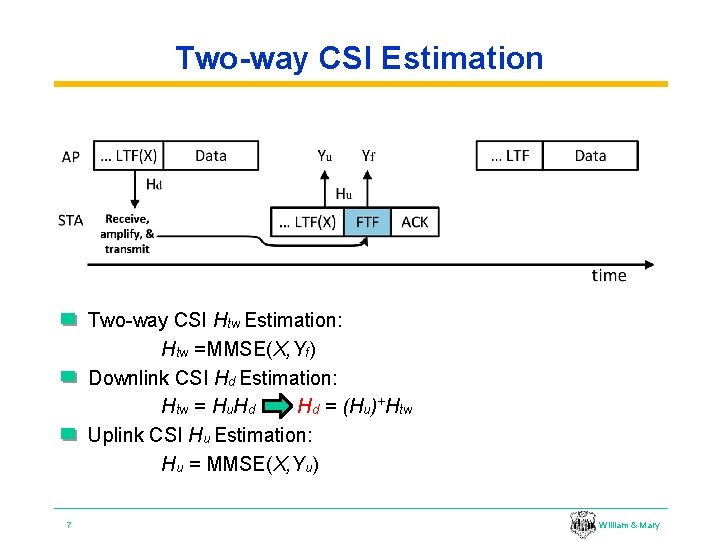
Two-way CSI Estimation Two-way CSI Htw Estimation: Htw =MMSE(X, Yf) Downlink CSI Hd Estimation: Htw = Hu. Hd Hd = (Hu)+Htw Uplink CSI Hu Estimation: Hu = MMSE(X, Yu) 7 William & Mary
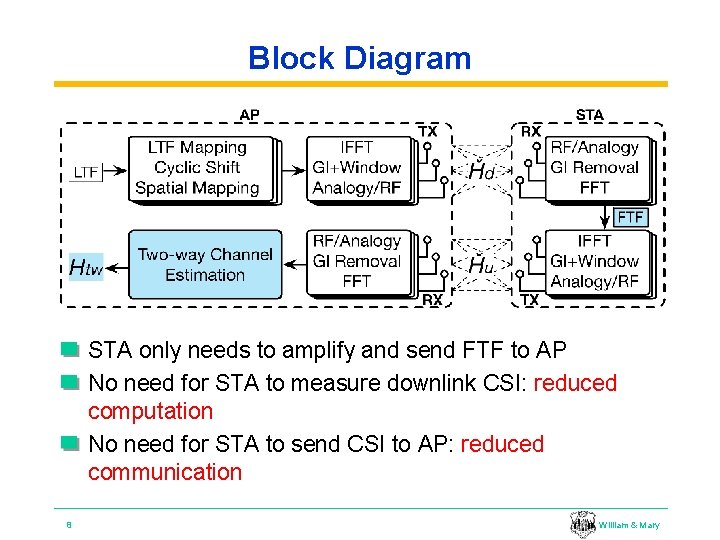
Block Diagram STA only needs to amplify and send FTF to AP No need for STA to measure downlink CSI: reduced computation No need for STA to send CSI to AP: reduced communication 8 William & Mary
Outline Introduction Eli. MO Two-way CSI Estimation Eli. MO Protocol Design Evaluation Conclusions 9 William & Mary
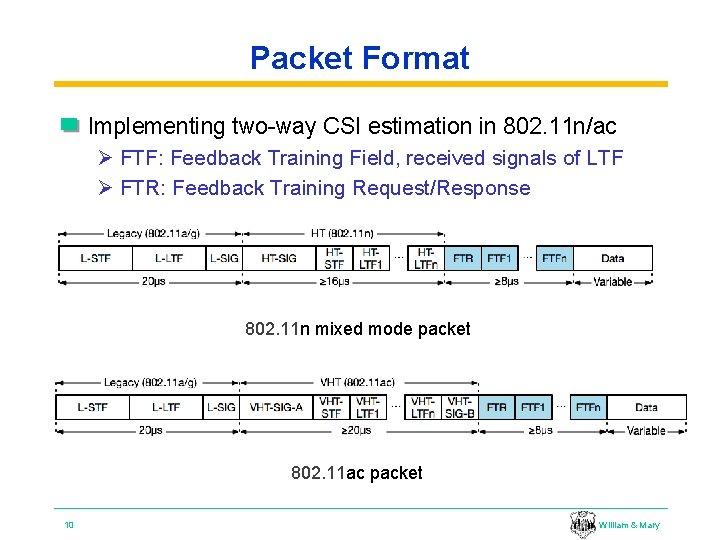
Packet Format Implementing two-way CSI estimation in 802. 11 n/ac Ø FTF: Feedback Training Field, received signals of LTF Ø FTR: Feedback Training Request/Response 802. 11 n mixed mode packet 802. 11 ac packet 10 William & Mary
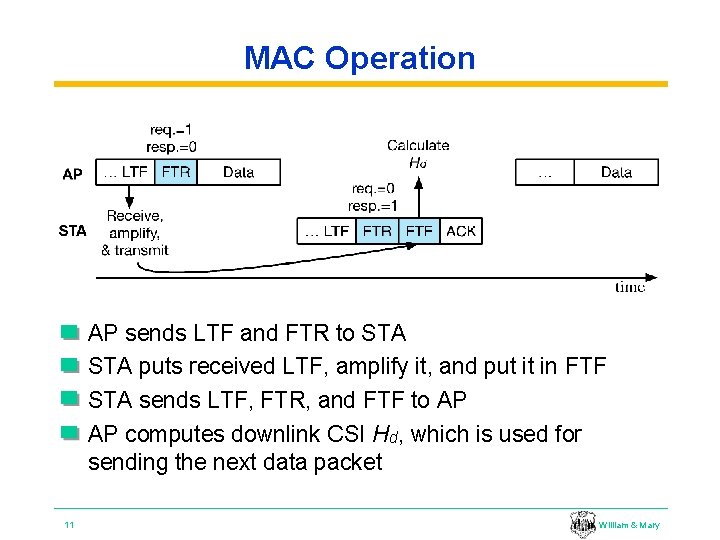
MAC Operation AP sends LTF and FTR to STA puts received LTF, amplify it, and put it in FTF STA sends LTF, FTR, and FTF to AP AP computes downlink CSI Hd, which is used for sending the next data packet 11 William & Mary
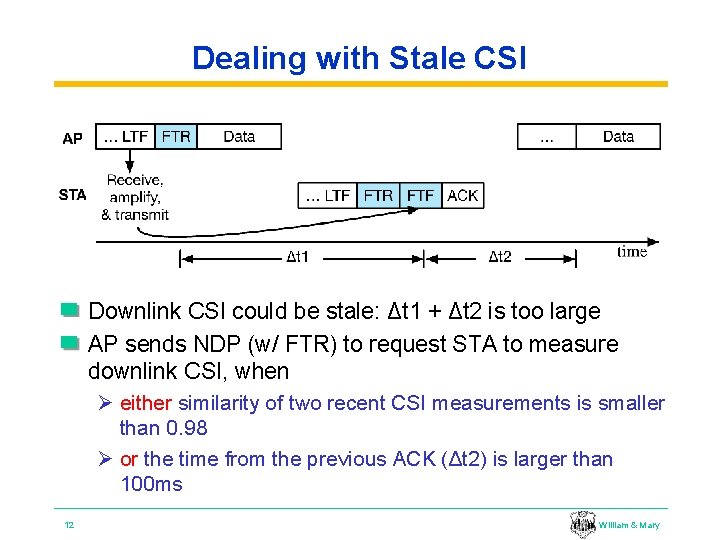
Dealing with Stale CSI Downlink CSI could be stale: Δt 1 + Δt 2 is too large AP sends NDP (w/ FTR) to request STA to measure downlink CSI, when Ø either similarity of two recent CSI measurements is smaller than 0. 98 Ø or the time from the previous ACK (Δt 2) is larger than 100 ms 12 William & Mary
Outline Introduction Eli. MO Two-way CSI Estimation Eli. MO Protocol Design Evaluation Conclusions 13 William & Mary
Evaluation Setup AP & STA are laptops with Intel Wi. Fi Link 5300 installed Ø The power signal of Wi. Fi chipset can not be programed to “amplify and transmit” in slide 7. So we use trace-driven simulation. Downlink/uplink CSI traces (Hd & Hu) Ø Frequency: 5 GHz; channel width: 20 MHz Ø AP: 3 external antennas; Ø STA: 3 internal antennas Ø Transmitting power: 17/15 d. Bm for the AP/STA Scenarios Ø Static: both AP and STA are static Ø Mobile: the STA is randomly moving (~1. 2 m/s); the AP is static 14 William & Mary
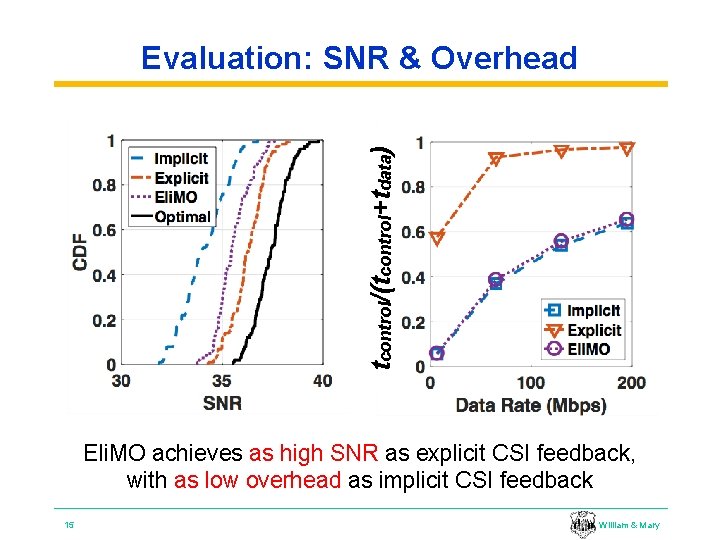
tcontrol/(tcontrol+tdata) Evaluation: SNR & Overhead Eli. MO achieves as high SNR as explicit CSI feedback, with as low overhead as implicit CSI feedback 15 William & Mary
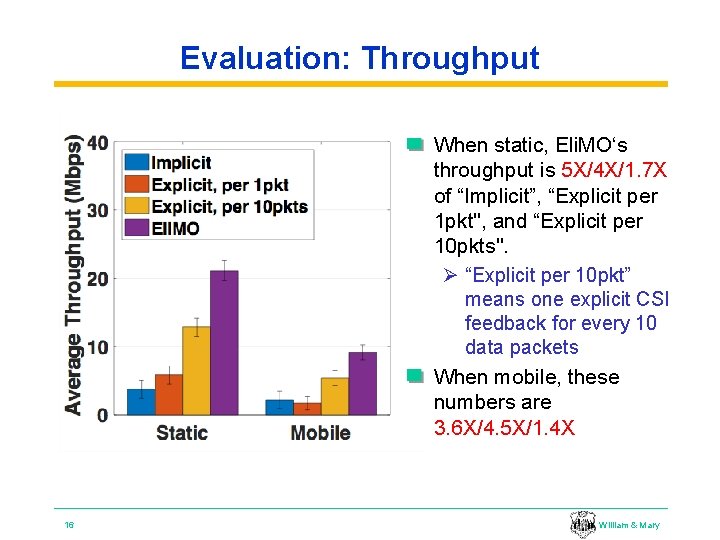
Evaluation: Throughput When static, Eli. MO‘s throughput is 5 X/4 X/1. 7 X of “Implicit”, “Explicit per 1 pkt", and “Explicit per 10 pkts". Ø “Explicit per 10 pkt” means one explicit CSI feedback for every 10 data packets When mobile, these numbers are 3. 6 X/4. 5 X/1. 4 X 16 William & Mary
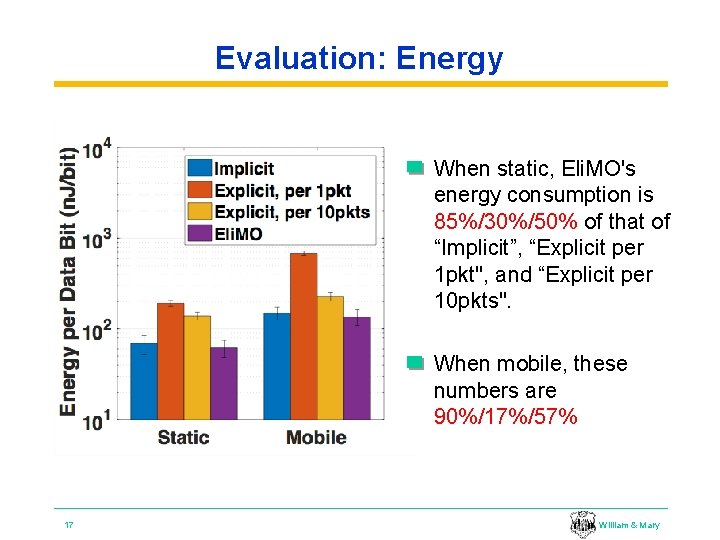
Evaluation: Energy When static, Eli. MO's energy consumption is 85%/30%/50% of that of “Implicit”, “Explicit per 1 pkt", and “Explicit per 10 pkts". When mobile, these numbers are 90%/17%/57% 17 William & Mary
Related Work Compressed CSI feedback, but still need CSI feedback Ø The same CSI for multiple packets, subcarriers, and/or antennae. [Mobi. Com’ 13] Ø Less bits to represent CSI [Mobi. Com’ 13] Ø Less frequent CSI feedback [Co. NEXT’ 14] No CSI feedback Ø Echo-MIMO [IEEE TOSP’ 08] is similar to us, but not compatible with Wi. Fi. • Narrow-band channels without frequency-selective effects • Over-the-air channels, not digital baseband channels • Pure theoretical analysis, not in a Wi. Fi compatible protocol, not tested with real devices 18 William & Mary
Conclusions Eli. MO uses two-way CSI estimation and Feedback Training Field to accurately estimate downlink CSI without explicit CSI feedback. Eli. MO is Wi. Fi compatible. Eli. MO significantly reduces computation, communication, and energy overhead for Wi. Fi receivers. This work has been supported by NSF CNS-1253506 (CAREER) and CNS-1553272 (CAREER). 19 William & Mary
- Slides: 19