
Eleventh Edition CHAPTER 1 VECTOR MECHANICS FOR ENGINEERS
- Slides: 6
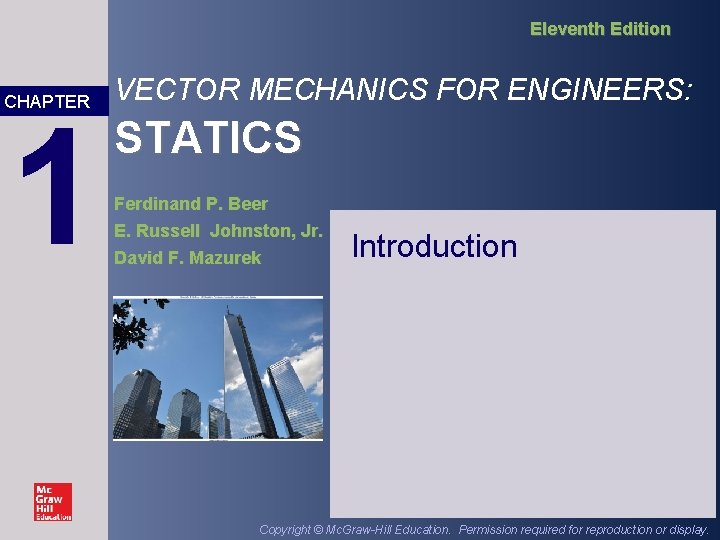
Eleventh Edition CHAPTER 1 VECTOR MECHANICS FOR ENGINEERS: STATICS Ferdinand P. Beer E. Russell Johnston, Jr. David F. Mazurek Introduction Copyright © Mc. Graw-Hill Education. Permission required for reproduction or display.
Eleventh Edition Vector Mechanics for Engineers: Statics Contents What is Mechanics? Systems of Units Method of Solving Problems Numerical Accuracy Copyright © Mc. Graw-Hill Education. Permission required for reproduction or display. 1 -2
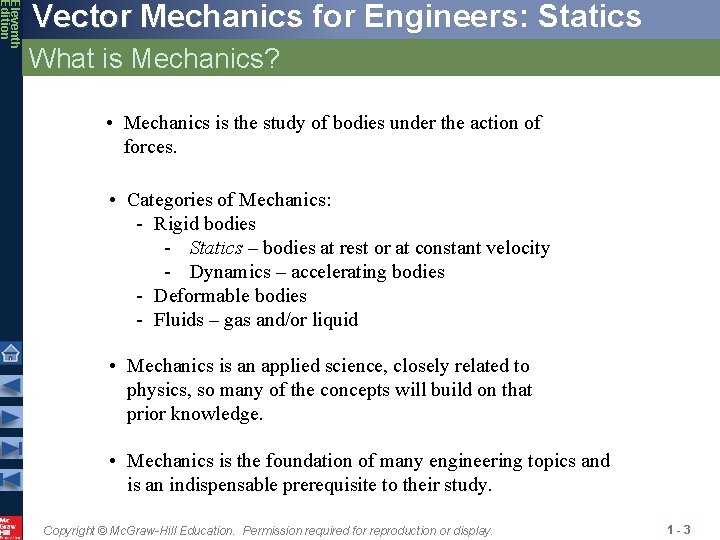
Eleventh Edition Vector Mechanics for Engineers: Statics What is Mechanics? • Mechanics is the study of bodies under the action of forces. • Categories of Mechanics: - Rigid bodies - Statics – bodies at rest or at constant velocity - Dynamics – accelerating bodies - Deformable bodies - Fluids – gas and/or liquid • Mechanics is an applied science, closely related to physics, so many of the concepts will build on that prior knowledge. • Mechanics is the foundation of many engineering topics and is an indispensable prerequisite to their study. Copyright © Mc. Graw-Hill Education. Permission required for reproduction or display. 1 -3
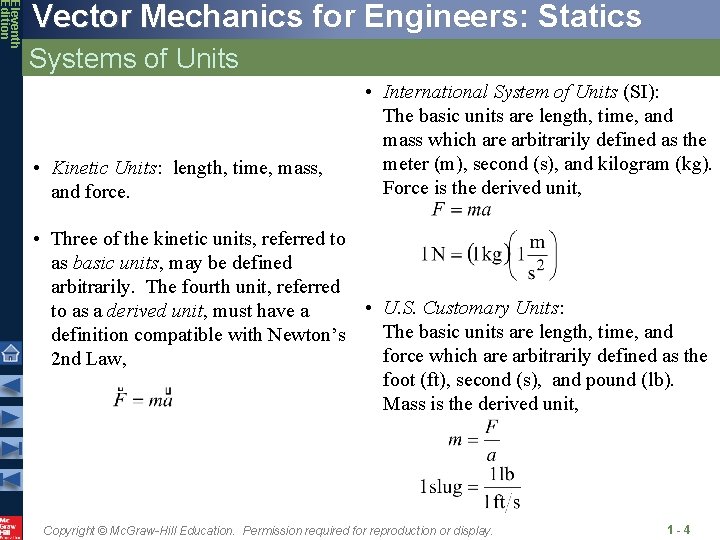
Eleventh Edition Vector Mechanics for Engineers: Statics Systems of Units • Kinetic Units: length, time, mass, and force. • International System of Units (SI): The basic units are length, time, and mass which are arbitrarily defined as the meter (m), second (s), and kilogram (kg). Force is the derived unit, • Three of the kinetic units, referred to as basic units, may be defined arbitrarily. The fourth unit, referred • U. S. Customary Units: to as a derived unit, must have a The basic units are length, time, and definition compatible with Newton’s force which are arbitrarily defined as the 2 nd Law, foot (ft), second (s), and pound (lb). Mass is the derived unit, Copyright © Mc. Graw-Hill Education. Permission required for reproduction or display. 1 -4
Eleventh Edition Vector Mechanics for Engineers: Statics Method of Solving Problems: SMART Methodology • Strategy: • Reflect and Think: Includes given data, specification of - Test for errors in reasoning by what is to be determined, and a figure verifying that the units of the showing all quantities involved. computed results are correct, Decide what learned concepts apply. - test for errors in computation by • Modeling: substituting given data and computed Create separate diagrams for each of results into previously unused the bodies involved with a clear equations based on the six principles, indication of all forces acting on each - always apply experience and physical body. intuition to assess whether results seem “reasonable” • Analysis: The six fundamental principles are applied to express the conditions of rest or motion of each body. The rules of algebra are applied to solve the equations for the unknown quantities. Copyright © Mc. Graw-Hill Education. Permission required for reproduction or display. 1 -5
Eleventh Edition Vector Mechanics for Engineers: Statics Numerical Accuracy • The accuracy of a solution depends on 1) accuracy of the given data, and 2) accuracy of the computations performed. The solution cannot be more accurate than the less accurate of these two. • The use of hand calculators and computers generally makes the accuracy of the computations much greater than the accuracy of the data. Hence, the solution accuracy is usually limited by the data accuracy. That is, remember what you learned about significant figures. • As a general rule for engineering problems, the data are seldom known with an accuracy greater than 0. 2%. Therefore, it is usually appropriate to record parameters beginning with “ 1” with four digits and with three digits in all other cases, i. e. , 40. 2 lb and 15. 58 lb. Copyright © Mc. Graw-Hill Education. Permission required for reproduction or display. 1 -6