
Elevation of Privilege Drawing Developers into Threat Modeling
- Slides: 9
Elevation of Privilege: Drawing Developers into Threat Modeling Adam Shostack Microsoft @adamshostack
Background • 15 years of structured security approaches at Microsoft – Threat modeling (“Threats to our Products”, 1999) – STRIDE: mnemonic for common threats Spoofing, Tampering, Repudiation, Info Disclosure, Denial -of-Service, Elevation of Privilege – Security Development Lifecycle, 2002 • Security experts versus others
Motivation: The game • Observations of threat modeling – A security expert only activity? – Smart people not steeped in security…stymied • Goal: a way to do and learn which is – Non-threatening – Enticing – Supportive • Protection Poker
Motivation: This talk • Share the journey • Hope to inform future game designers “Fortune favors the prepared mind” – Louis Pasteur
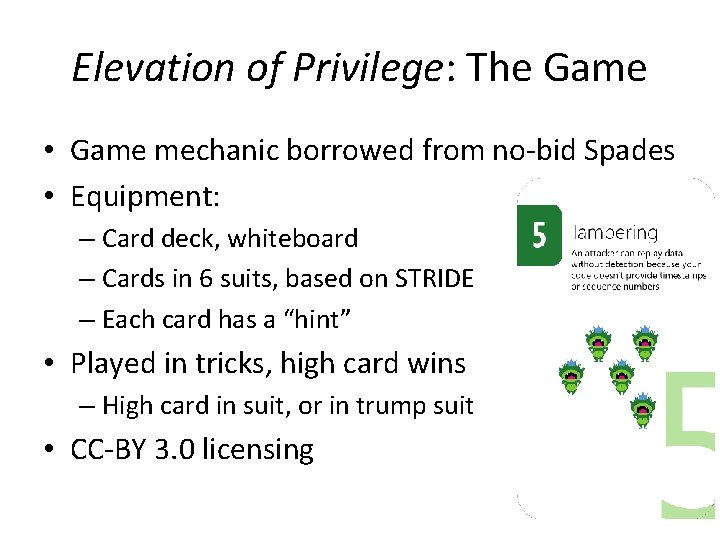
Elevation of Privilege: The Game • Game mechanic borrowed from no-bid Spades • Equipment: – Card deck, whiteboard – Cards in 6 suits, based on STRIDE – Each card has a “hint” • Played in tricks, high card wins – High card in suit, or in trump suit • CC-BY 3. 0 licensing
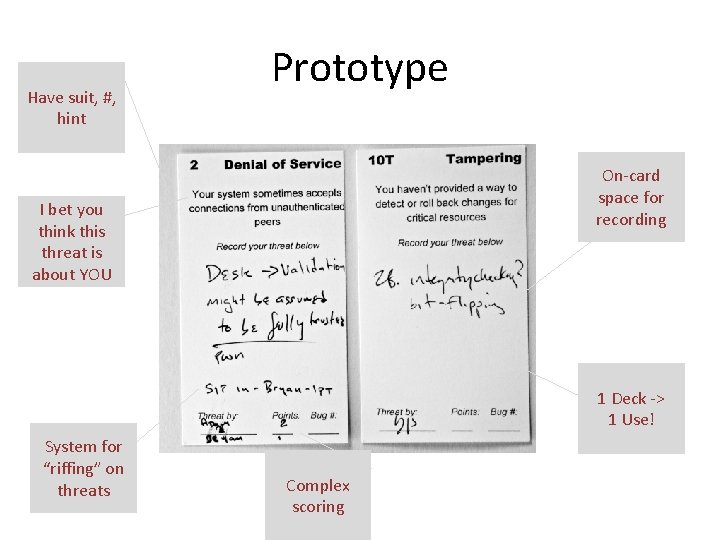
Have suit, #, hint Prototype On-card space for recording I bet you think this threat is about YOU 1 Deck -> 1 Use! System for “riffing” on threats Complex scoring
Design Tradeoffs • Card size • Game/Gamification – Points, Badges, Leaderboards? – Authenticity • • Hint construction Depth/Breadth Physical cards? Graphic design investment
Serendipity • Game more popular outside Microsoft – Can’t force play – Ask people to suspend of skepticism – Learning versus core job skill (see Smith, 2011) • Game results in real threat model – Learn as you do – Unusual feature
Questions? @adamshostack adam. shostack@microsoft. com Resources: http: //www. microsoft. com/security/sdl/adopt/eop. aspx Threat Modeling: Designing for Security (Wiley, 2014)