
ELEMENTS OF TEACHING LEARNING 1 The learner He
- Slides: 13
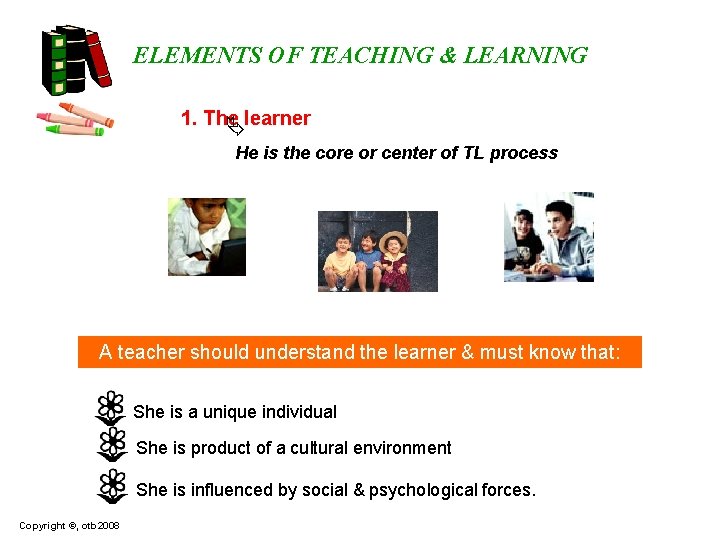
ELEMENTS OF TEACHING & LEARNING 1. The learner He is the core or center of TL process A teacher should understand the learner & must know that: She is a unique individual She is product of a cultural environment She is influenced by social & psychological forces. Copyright ©, otb 2008
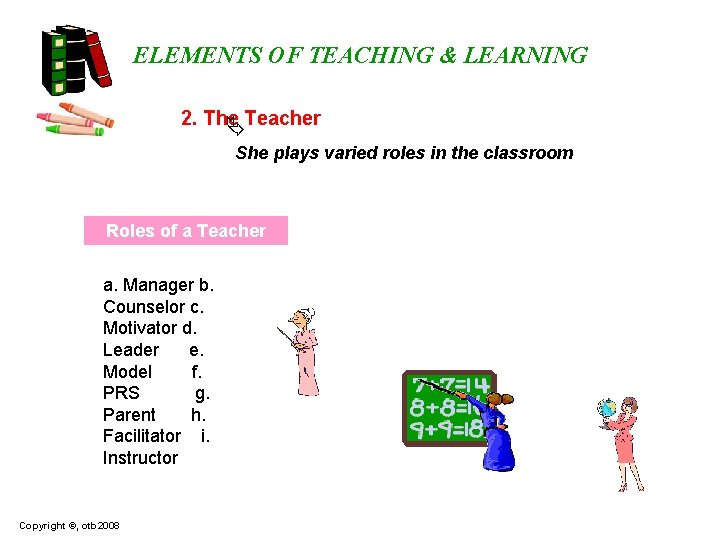
ELEMENTS OF TEACHING & LEARNING 2. The Teacher She plays varied roles in the classroom Roles of a Teacher a. Manager b. Counselor c. Motivator d. Leader e. Model f. PRS g. Parent h. Facilitator i. Instructor Copyright ©, otb 2008
Roles of a Teacher as a manager – managing discipline, time, physical environment, activities etc… b. Teacher as a counselor – talks & gives pieces of advice to students about family problems, personal problems, academic problems & other concerns c. Teacher as a motivator – arouses the interest of students to learn or perform better, increases their desires & drives to participate in class/activities. d. Teacher as a leader – leads, plans, controls, directs, delegates tasks in the class etc… e. Teacher as a model – shows good examples and practices the principle “walk the talk”
Roles of a Teacher f. Teacher as a PRS – builds good relationship, resolves conflicts in class, mediates students to administrations or parents to administration etc. . g. Teacher as a parent – acts like a “surrogate” mother or father in school who guides, nurtures, supports etc… h. Teacher as a facilitator– acts as a moderator towards the learning process or in activities. Guides learners for a more independent learning process. i. Teacher as a instructor – teaches necessary concepts, skills and values to students. She is responsible for managing all instructional activities in and outside the classroom.
ELEMENTS OF TEACHING & LEARNING 3. The Learning Environment It includes the venue for social interaction that includes way of doing things, solving problems, & acquiring information. It includes: a. Classroom b. Home c. Community Copyright ©, otb 2008
The Classroom is a place where there is an interaction between the Itteacher & the learners. It is a place where formal instruction takes place. is a venue for learning activities that affords the Ittransfer of learning from classroom to practice or in real actual life situations. Copyright ©, otb 2008
Four Factors in the Classroom Environment 1. Physical Environment Includes the room, its size, location, ventilation, lighting, instructional materials, chair arrangement, room acoustics, & provisions for orderliness, cleanliness and sanitation Copyright ©, otb 2008
Four Factors in the Classroom Environment 2. Intellectual Environment Includes learning atmosphere characterized by activities designed to challenge the intellect. Includes providing opportunities for development of thinking skills or “HOTS” as well as creative skills, problem-solving & related activities. Students should be trained to become independent & self-directed individuals. Copyright ©, otb 2008
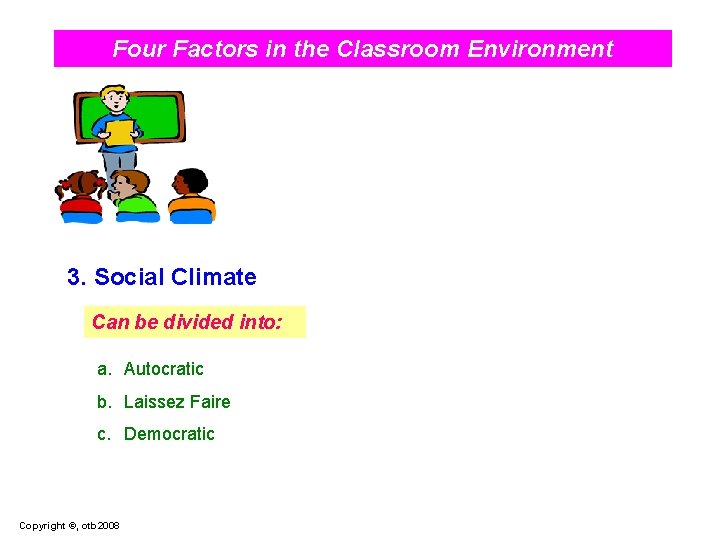
Four Factors in the Classroom Environment 3. Social Climate Can be divided into: a. Autocratic b. Laissez Faire c. Democratic Copyright ©, otb 2008
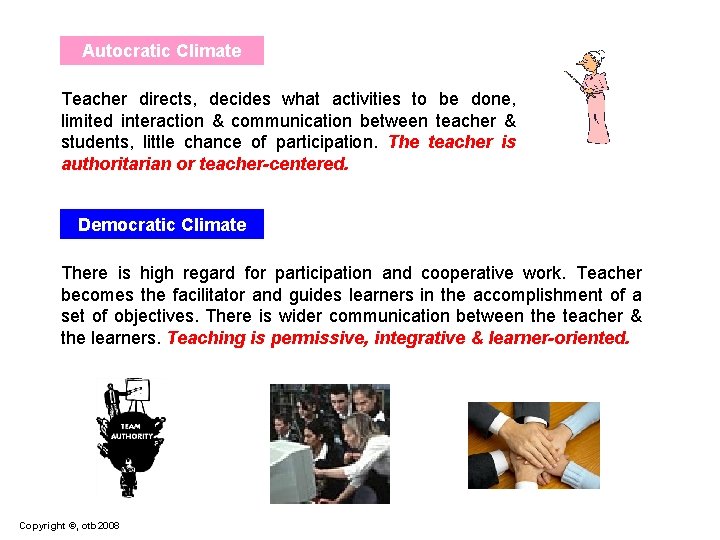
Autocratic Climate Teacher directs, decides what activities to be done, limited interaction & communication between teacher & students, little chance of participation. The teacher is authoritarian or teacher-centered. Democratic Climate There is high regard for participation and cooperative work. Teacher becomes the facilitator and guides learners in the accomplishment of a set of objectives. There is wider communication between the teacher & the learners. Teaching is permissive, integrative & learner-oriented. Copyright ©, otb 2008
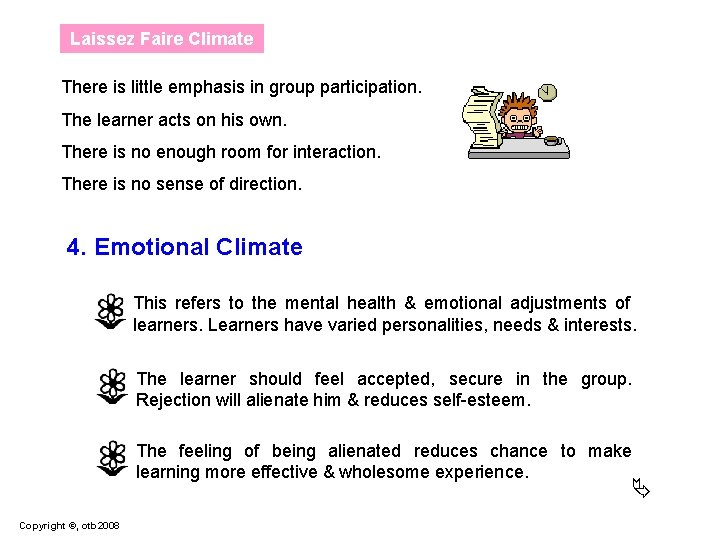
Laissez Faire Climate There is little emphasis in group participation. The learner acts on his own. There is no enough room for interaction. There is no sense of direction. 4. Emotional Climate This refers to the mental health & emotional adjustments of learners. Learners have varied personalities, needs & interests. The learner should feel accepted, secure in the group. Rejection will alienate him & reduces self-esteem. The feeling of being alienated reduces chance to make learning more effective & wholesome experience. Copyright ©, otb 2008
THE HOME It does not provide formal instruction but it involves acquisition of behavioral patterns, acceptance of standard norms, and development of necessary traits. It is where a child gets instruction on the specific ways of doing things. THE COMMUNITY It allows an environment that allows opportunities for interaction among members thus allow them to participate community activities. The community provides the interaction while the participation provides the meaning of the experience. Copyright ©, otb 2008
ELEMENTS OF TEACHING & LEARNING 4. The Curriculum referred to as course programs of study or Academic Curriculum – pertains to the formal list of courses or subjects offerings of the school. Extra Curriculum – refers to voluntary but planned activities sponsored by the school where students participate to a large degree. Implicit or Hidden Curriculum – emerges incidentally from the interaction between the students and the physical, social, and interpersonal environment of the school. Copyright ©, otb 2008