
ELEMENTS OF PROBABILTY A N Kolmogorov 1933 Carlos
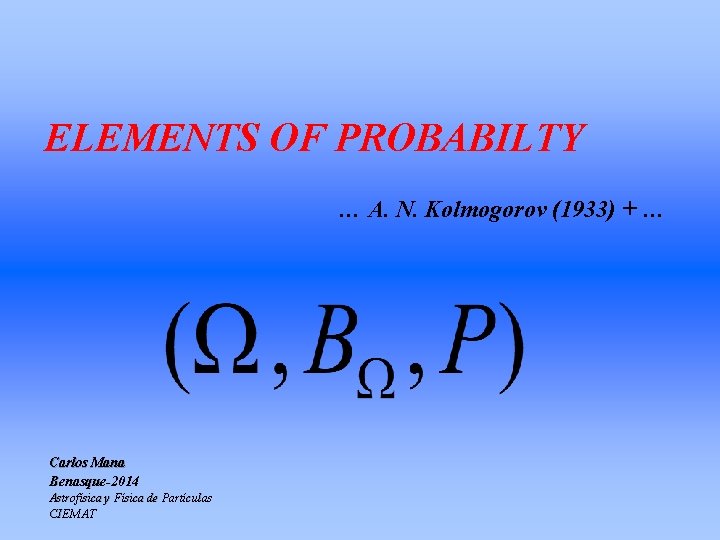
ELEMENTS OF PROBABILTY … A. N. Kolmogorov (1933) + … Carlos Mana Benasque-2014 Astrofísica y Física de Partículas CIEMAT
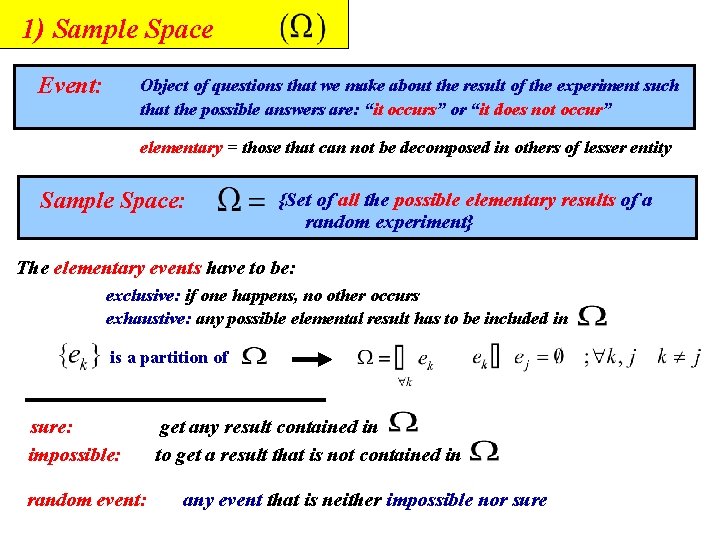
1) Sample Space Event: Object of questions that we make about the result of the experiment such that the possible answers are: “it occurs” or “it does not occur” elementary = those that can not be decomposed in others of lesser entity Sample Space: {Set of all the possible elementary results of a random experiment} The elementary events have to be: exclusive: if one happens, no other occurs exhaustive: any possible elemental result has to be included in is a partition of sure: impossible: random event: get any result contained in to get a result that is not contained in any event that is neither impossible nor sure
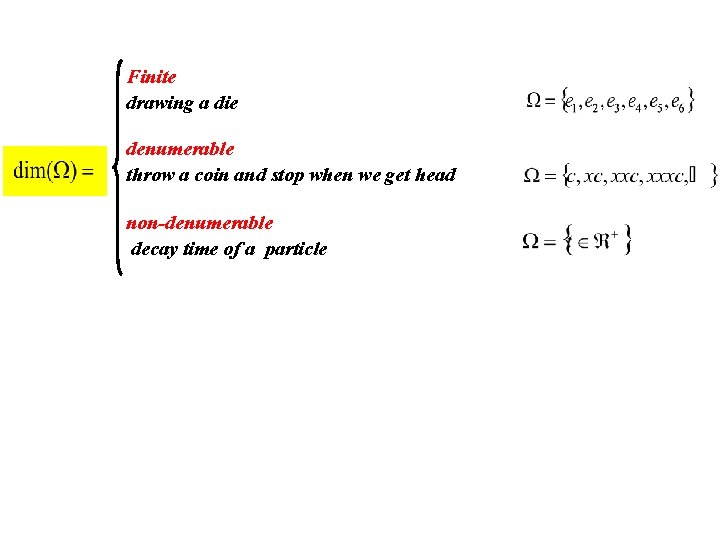
Finite drawing a die denumerable throw a coin and stop when we get head non-denumerable decay time of a particle
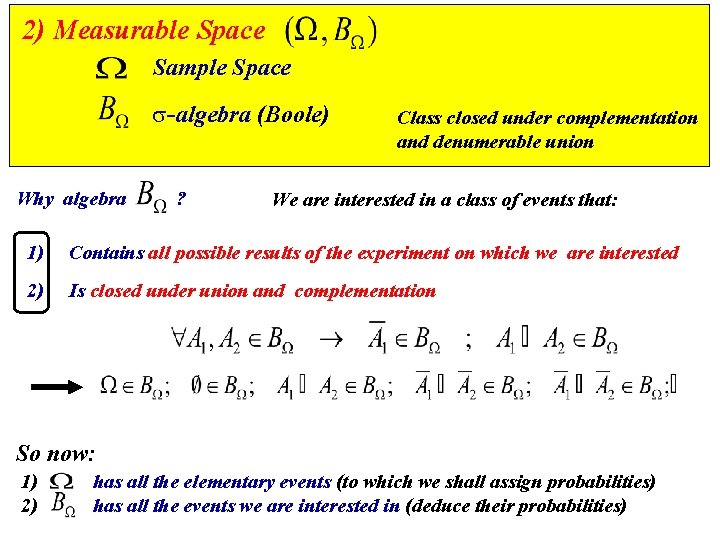
2) Measurable Space Sample Space -algebra (Boole) Why algebra ? Class closed under complementation and denumerable union We are interested in a class of events that: 1) Contains all possible results of the experiment on which we are interested 2) Is closed under union and complementation So now: 1) 2) has all the elementary events (to which we shall assign probabilities) has all the events we are interested in (deduce their probabilities)
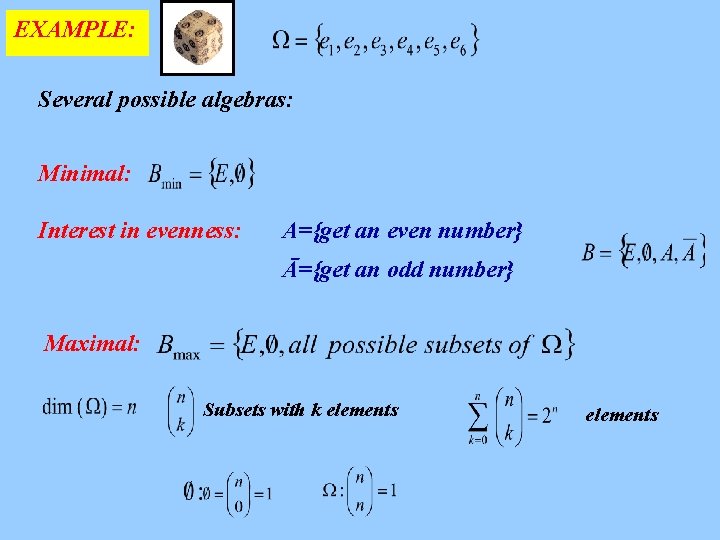
EXAMPLE: Several possible algebras: Minimal: Interest in evenness: A={get an even number} Ā={get an odd number} Maximal: Subsets with k elements
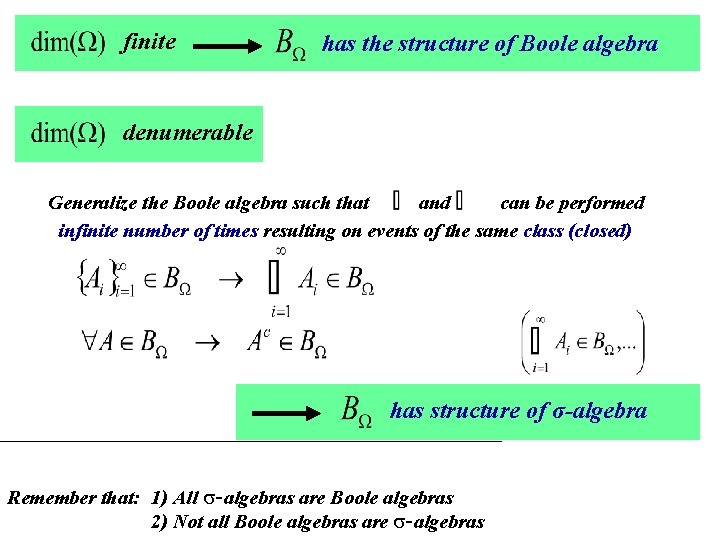
finite has the structure of Boole algebra denumerable Generalize the Boole algebra such that and can be performed infinite number of times resulting on events of the same class (closed) has structure of σ-algebra Remember that: 1) All -algebras are Boole algebras 2) Not all Boole algebras are -algebras
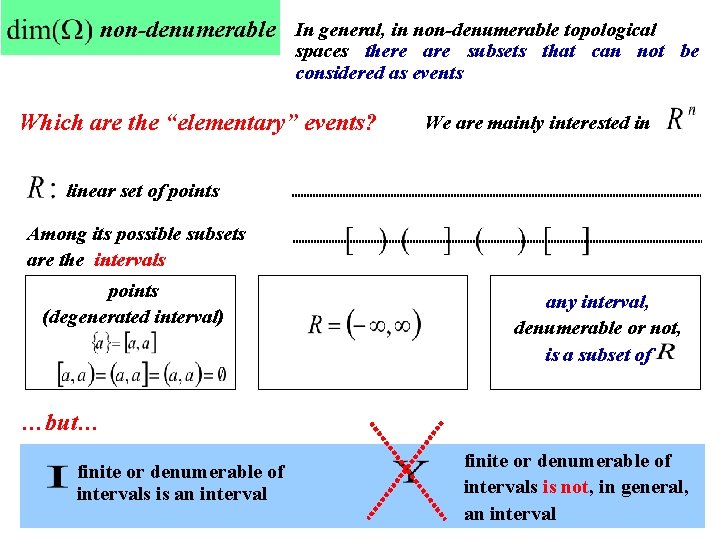
non-denumerable In general, in non-denumerable topological spaces there are subsets that can not be considered as events Which are the “elementary” events? We are mainly interested in linear set of points Among its possible subsets are the intervals points (degenerated interval) any interval, denumerable or not, is a subset of …but… finite or denumerable of intervals is an interval finite or denumerable of intervals is not, in general, an interval
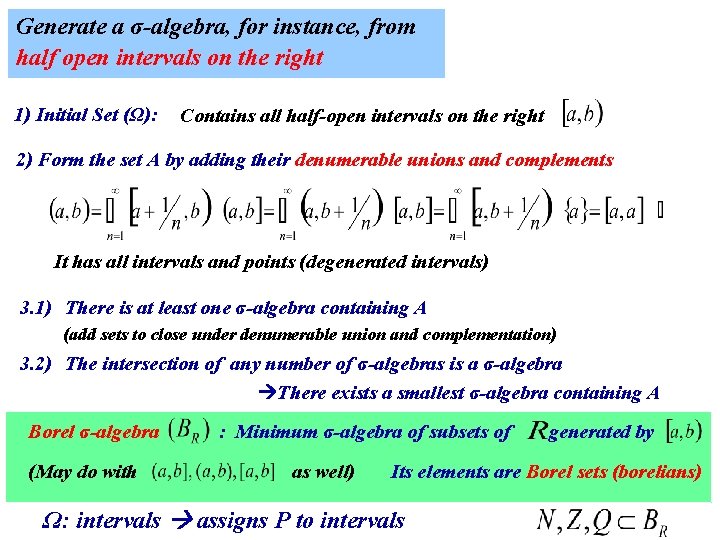
Generate a σ-algebra, for instance, from half open intervals on the right 1) Initial Set (Ω): Contains all half-open intervals on the right 2) Form the set A by adding their denumerable unions and complements It has all intervals and points (degenerated intervals) 3. 1) There is at least one σ-algebra containing A (add sets to close under denumerable union and complementation) 3. 2) The intersection of any number of σ-algebras is a σ-algebra There exists a smallest σ-algebra containing A Borel σ-algebra (May do with : Minimum σ-algebra of subsets of as well) generated by Its elements are Borel sets (borelians) Ω: intervals assigns P to intervals
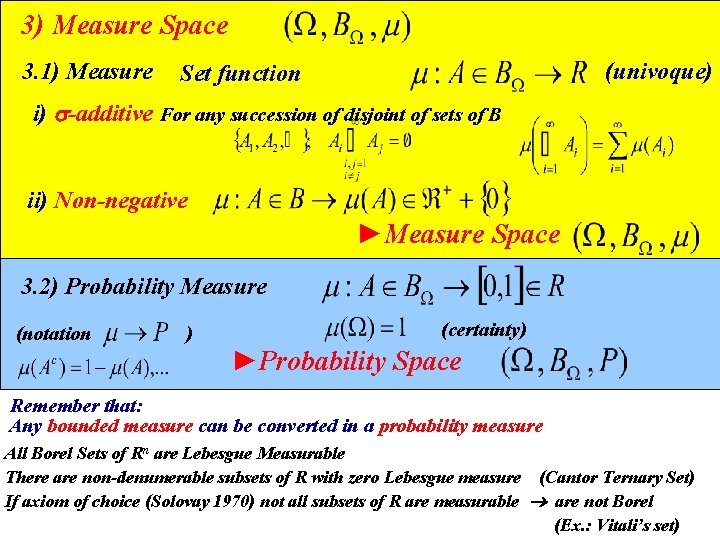
3) Measure Space 3. 1) Measure (univoque) Set function i) -additive For any succession of disjoint of sets of B ii) Non-negative ►Measure Space 3. 2) Probability Measure (notation ) (certainty) ►Probability Space Remember that: Any bounded measure can be converted in a probability measure All Borel Sets of Rn are Lebesgue Measurable There are non-denumerable subsets of R with zero Lebesgue measure (Cantor Ternary Set) If axiom of choice (Solovay 1970) not all subsets of R are measurable are not Borel (Ex. : Vitali’s set)
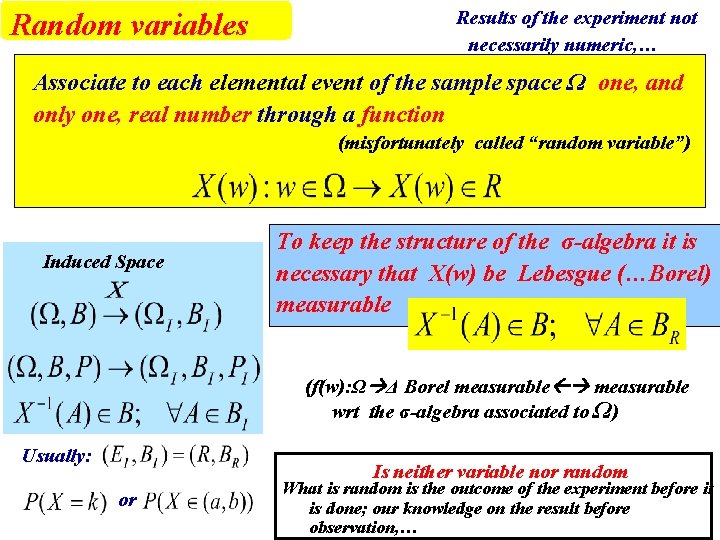
Random variables Results of the experiment not necessarily numeric, … Associate to each elemental event of the sample space Ω one, and only one, real number through a function (misfortunately called “random variable”) Induced Space To keep the structure of the σ-algebra it is necessary that X(w) be Lebesgue (…Borel) measurable (f(w): Ω Δ Borel measurable wrt the σ-algebra associated to Ω) Usually: Is neither variable nor random or What is random is the outcome of the experiment before it is done; our knowledge on the result before observation, …
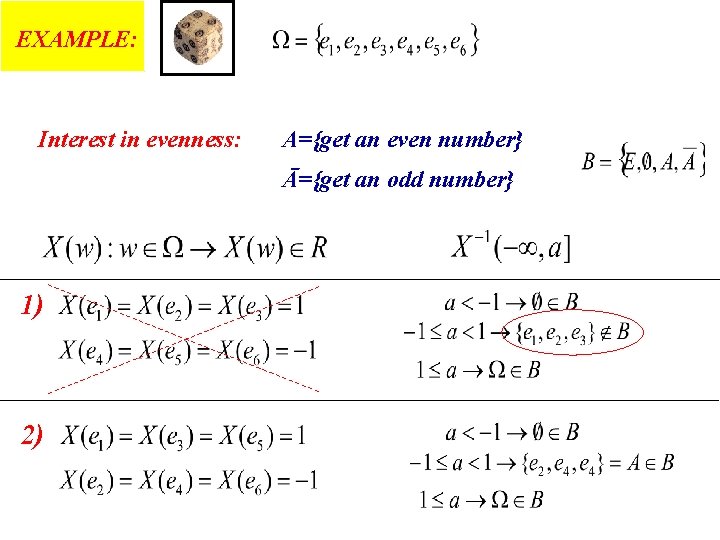
EXAMPLE: Interest in evenness: A={get an even number} Ā={get an odd number} 1) 2)
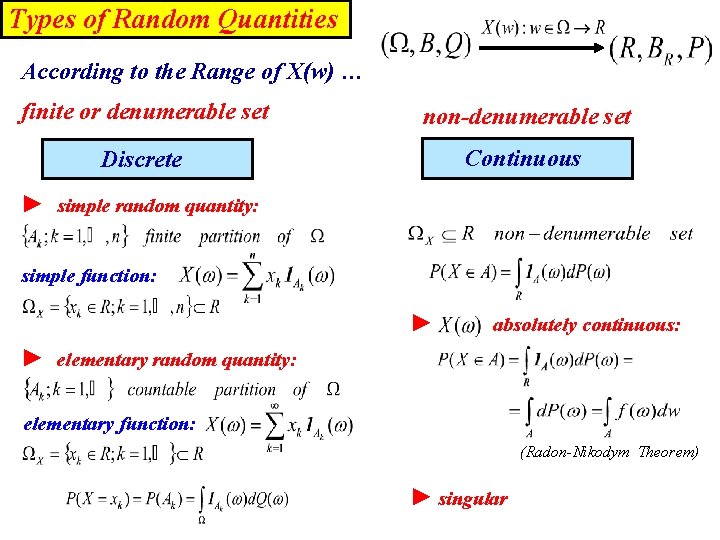
Types of Random Quantities According to the Range of X(w) … finite or denumerable set non-denumerable set Discrete Continuous ► simple random quantity: simple function: ► absolutely continuous: ► elementary random quantity: elementary function: (Radon-Nikodym Theorem) ► singular
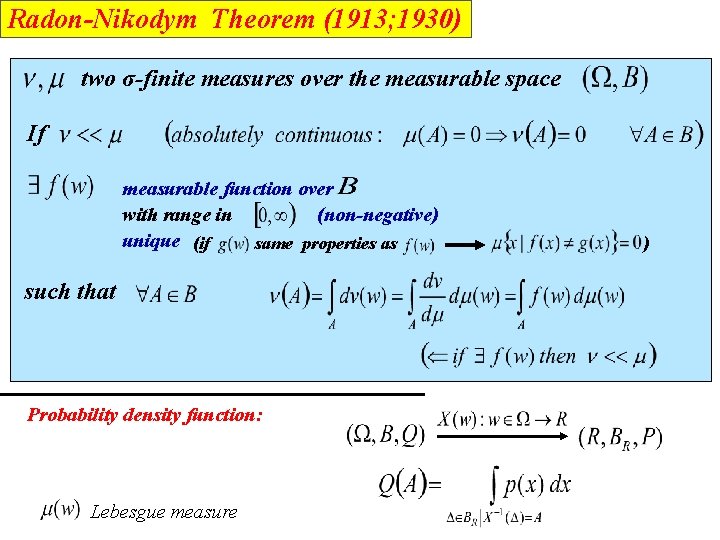
Radon-Nikodym Theorem (1913; 1930) two σ-finite measures over the measurable space If measurable function over with range in (non-negative) unique (if same properties as such that Probability density function: Lebesgue measure )
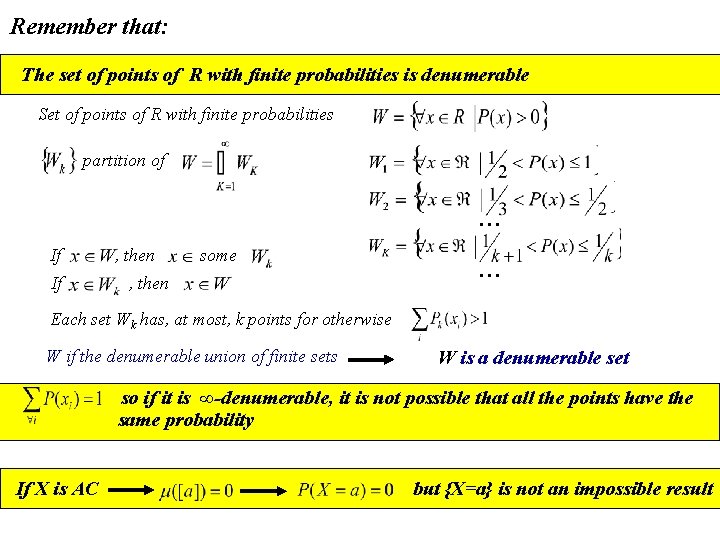
Remember that: The set of points of R with finite probabilities is denumerable Set of points of R with finite probabilities partition of If If , then some , then … … Each set Wk has, at most, k points for otherwise W if the denumerable union of finite sets W is a denumerable set so if it is ∞-denumerable, it is not possible that all the points have the same probability If X is AC but {X=a} is not an impossible result
DISTRIBUTION FUNCTION
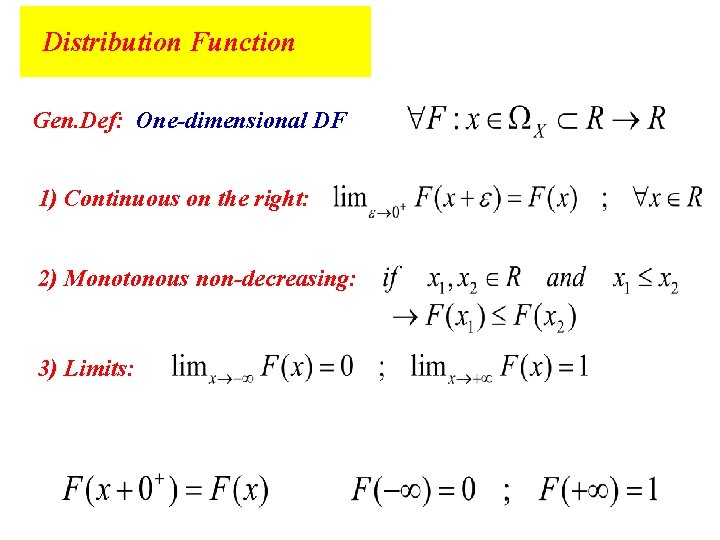
Distribution Function Gen. Def: One-dimensional DF 1) Continuous on the right: 2) Monotonous non-decreasing: 3) Limits:
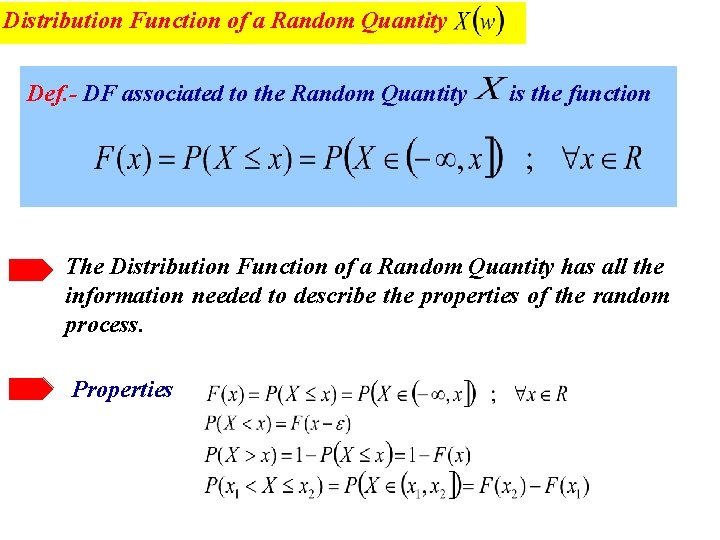
Distribution Function of a Random Quantity Def. - DF associated to the Random Quantity is the function The Distribution Function of a Random Quantity has all the information needed to describe the properties of the random process. Properties
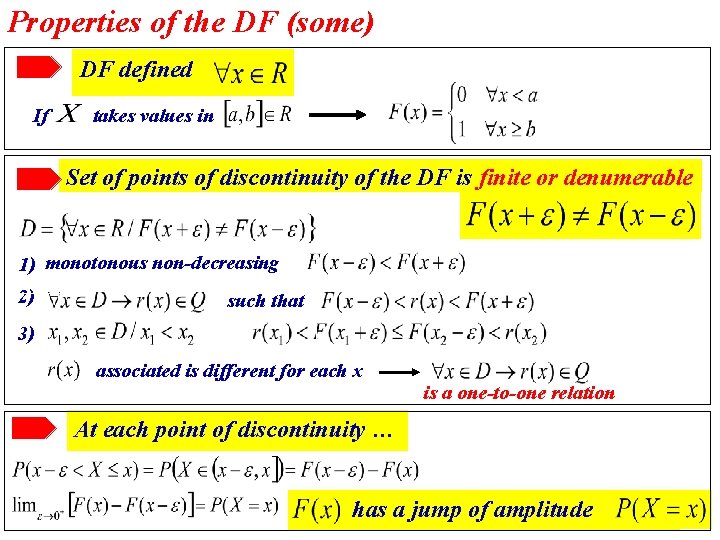
Properties of the DF (some) DF defined If takes values in Set of points of discontinuity of the DF is finite or denumerable 1) monotonous non-decreasing 2) monótona creciente such that 3) associated is different for each x is a one-to-one relation At each point of discontinuity … has a jump of amplitude
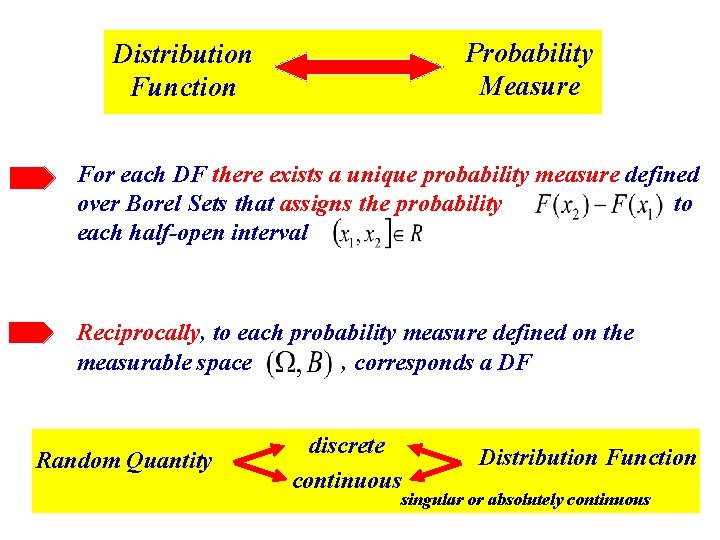
Probability Measure Distribution Function For each DF there exists a unique probability measure defined over Borel Sets that assigns the probability to each half-open interval Reciprocally, to each probability measure defined on the measurable space , corresponds a DF Random Quantity discrete continuous Distribution Function singular or absolutely continuous
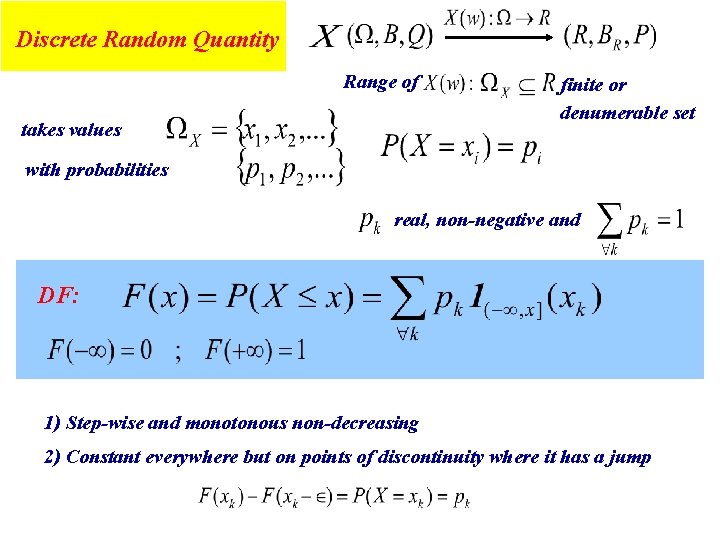
Discrete Random Quantity Range of takes values finite or denumerable set with probabilities real, non-negative and DF: 1) Step-wise and monotonous non-decreasing 2) Constant everywhere but on points of discontinuity where it has a jump
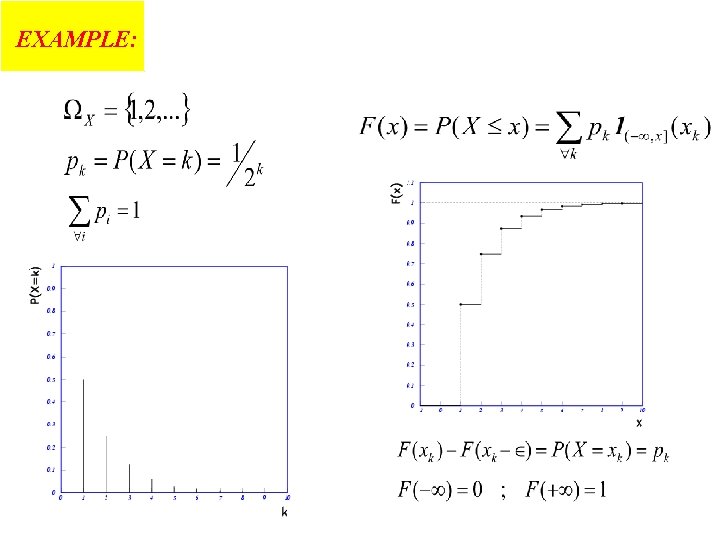
EXAMPLE:
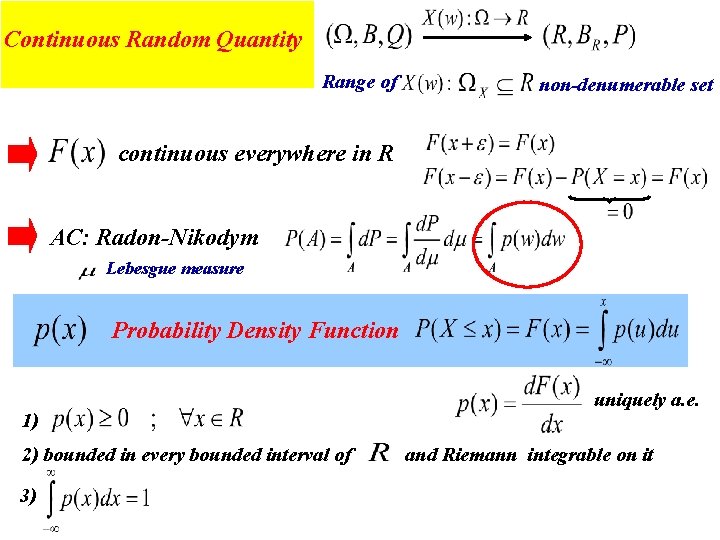
Continuous Random Quantity Range of non-denumerable set continuous everywhere in R AC: Radon-Nikodym Lebesgue measure Probability Density Function 1) 2) bounded in every bounded interval of 3) uniquely a. e. and Riemann integrable on it
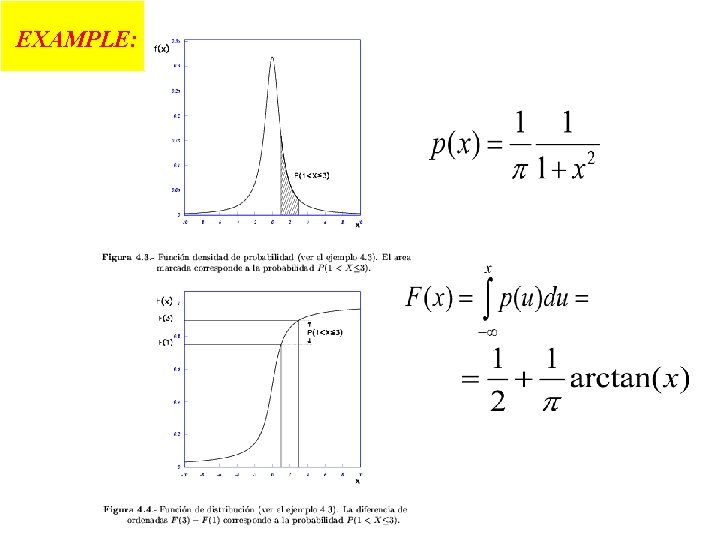
EXAMPLE:
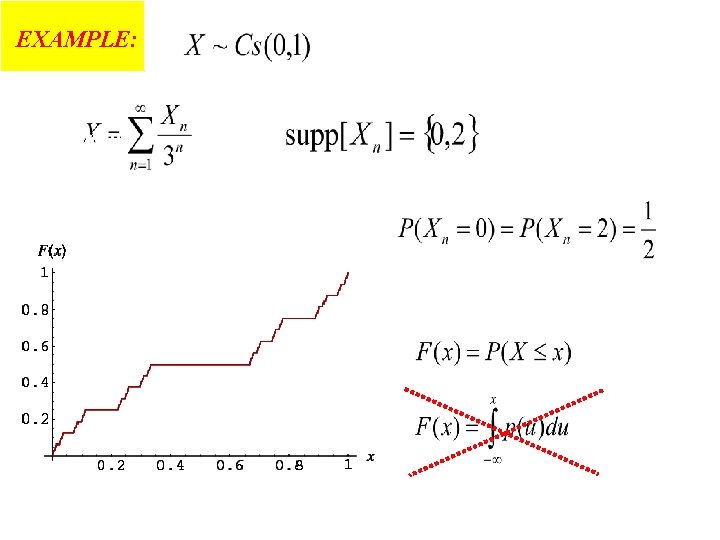
EXAMPLE: Example
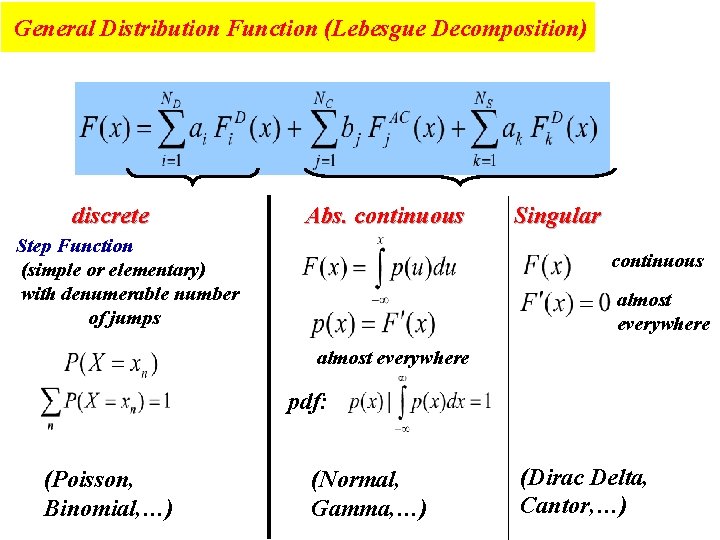
General Distribution Function (Lebesgue Decomposition) discrete Abs. continuous Step Function (simple or elementary) with denumerable number of jumps Singular continuous almost everywhere pdf: (Poisson, Binomial, …) (Normal, Gamma, …) (Dirac Delta, Cantor, …)
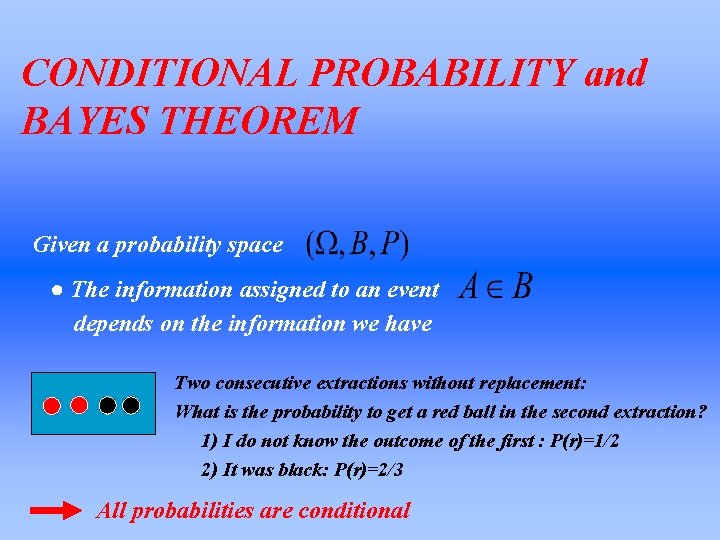
CONDITIONAL PROBABILITY and BAYES THEOREM Given a probability space ● The information assigned to an event depends on the information we have Two consecutive extractions without replacement: What is the probability to get a red ball in the second extraction? 1) I do not know the outcome of the first : P(r)=1/2 2) It was black: P(r)=2/3 All probabilities are conditional
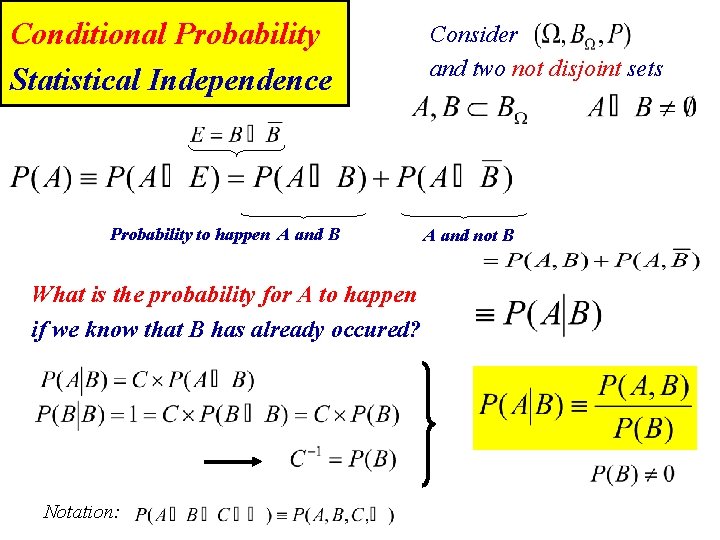
Conditional Probability Statistical Independence Probability to happen A and B What is the probability for A to happen if we know that B has already occured? Notation: Consider and two not disjoint sets A and not B
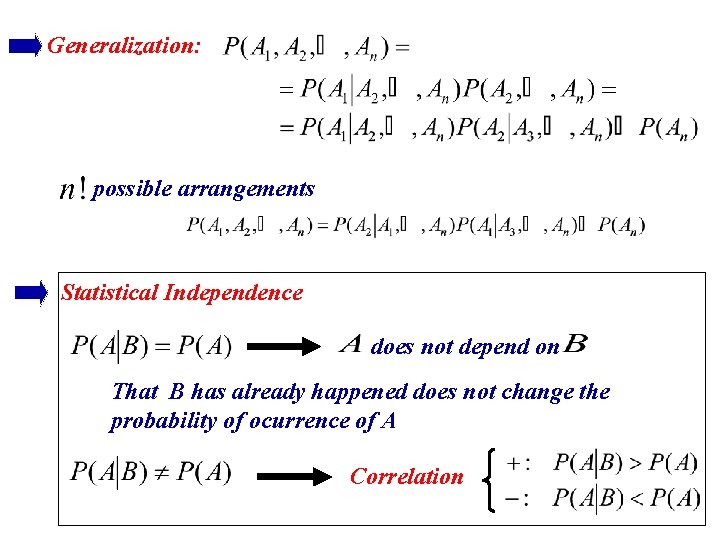
Generalization: possible arrangements Statistical Independence does not depend on That B has already happened does not change the probability of ocurrence of A Correlation
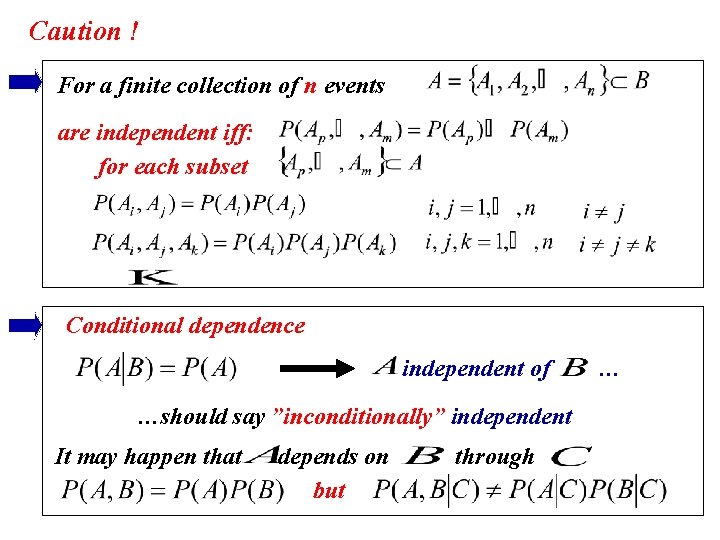
Caution ! For a finite collection of n events are independent iff: for each subset Conditional dependence independent of …should say ”inconditionally” independent It may happen that depends on but through …
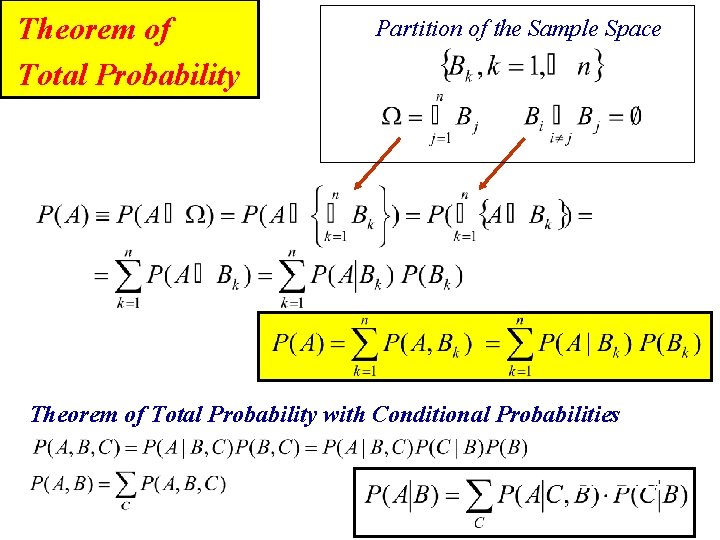
Theorem of Total Probability Partition of the Sample Space Theorem of Total Probability with Conditional Probabilities
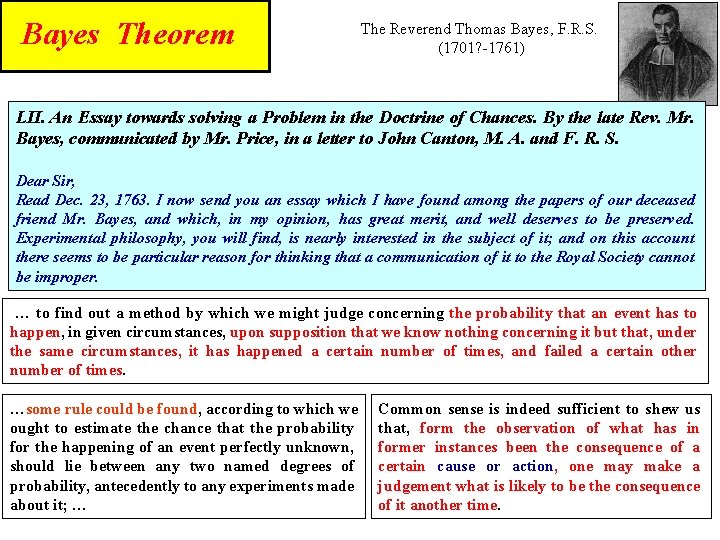
Bayes Theorem The Reverend Thomas Bayes, F. R. S. (1701? -1761) LII. An Essay towards solving a Problem in the Doctrine of Chances. By the late Rev. Mr. Bayes, communicated by Mr. Price, in a letter to John Canton, M. A. and F. R. S. Dear Sir, Read Dec. 23, 1763. I now send you an essay which I have found among the papers of our deceased friend Mr. Bayes, and which, in my opinion, has great merit, and well deserves to be preserved. Experimental philosophy, you will find, is nearly interested in the subject of it; and on this account there seems to be particular reason for thinking that a communication of it to the Royal Society cannot be improper. … to find out a method by which we might judge concerning the probability that an event has to happen, in given circumstances, upon supposition that we know nothing concerning it but that, under the same circumstances, it has happened a certain number of times, and failed a certain other number of times. …some rule could be found, according to which we ought to estimate the chance that the probability for the happening of an event perfectly unknown, should lie between any two named degrees of probability, antecedently to any experiments made about it; … Common sense is indeed sufficient to shew us that, form the observation of what has in former instances been the consequence of a certain cause or action, one may make a judgement what is likely to be the consequence of it another time.
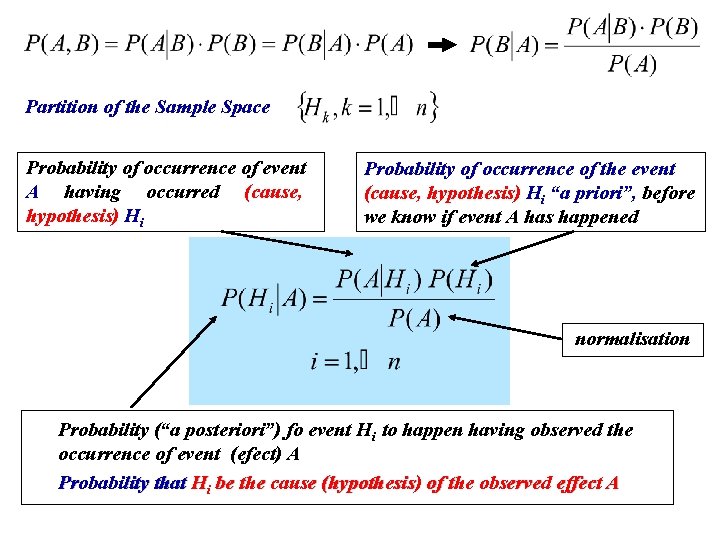
Partition of the Sample Space Probability of occurrence of event A having occurred (cause, hypothesis) Hi Probability of occurrence of the event (cause, hypothesis) Hi “a priori”, before we know if event A has happened normalisation Probability (“a posteriori”) fo event Hi to happen having observed the occurrence of event (efect) A Probability that Hi be the cause (hypothesis) of the observed effect A
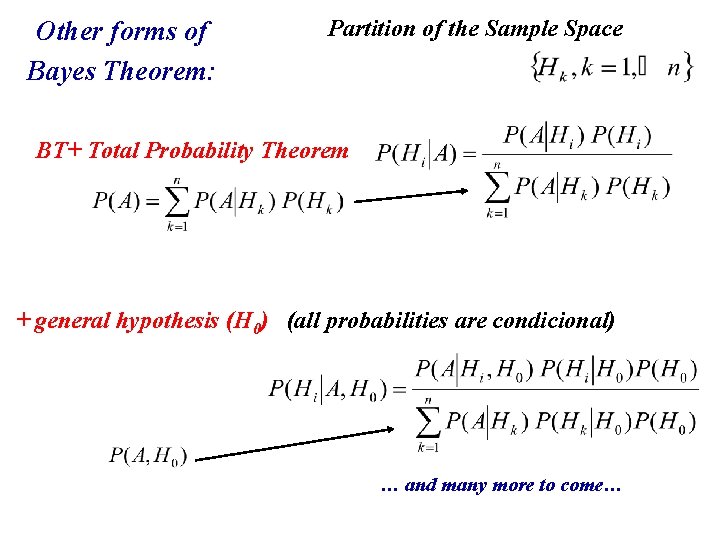
Other forms of Bayes Theorem: Partition of the Sample Space BT+ Total Probability Theorem + general hypothesis (H 0) (all probabilities are condicional) … and many more to come…
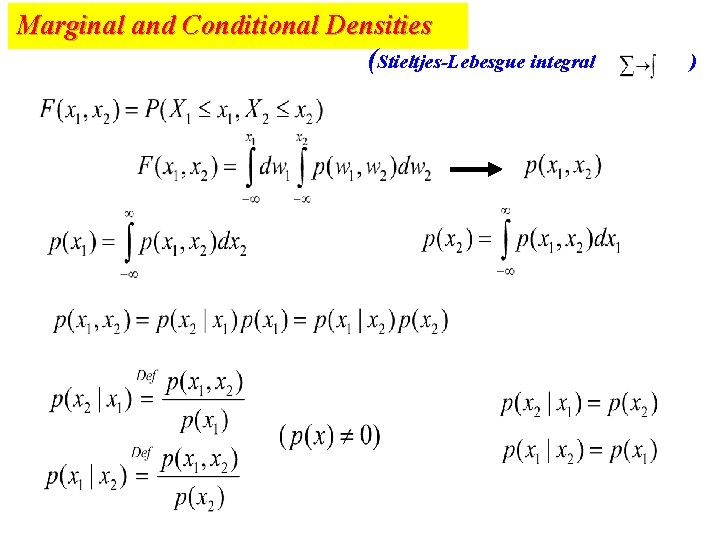
Marginal and Conditional Densities (Stieltjes-Lebesgue integral )
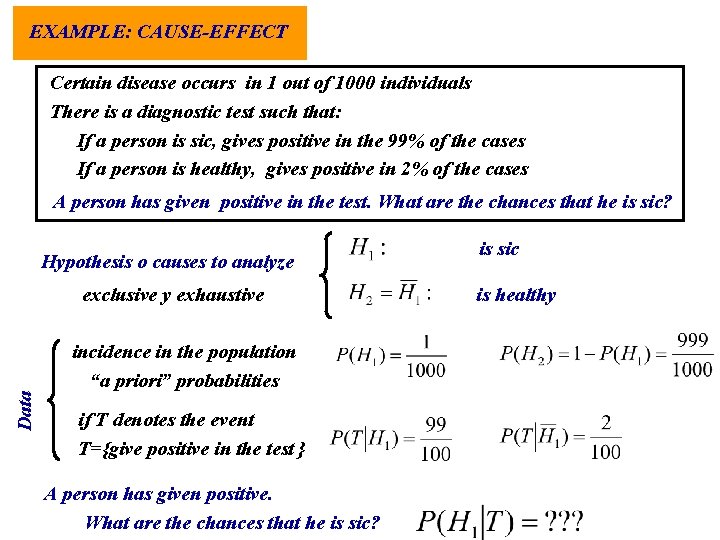
EXAMPLE: CAUSE-EFFECT Certain disease occurs in 1 out of 1000 individuals There is a diagnostic test such that: If a person is sic, gives positive in the 99% of the cases If a person is healthy, gives positive in 2% of the cases A person has given positive in the test. What are the chances that he is sic? Hypothesis o causes to analyze exclusive y exhaustive Data incidence in the population “a priori” probabilities if T denotes the event T={give positive in the test } A person has given positive. What are the chances that he is sic? is sic is healthy
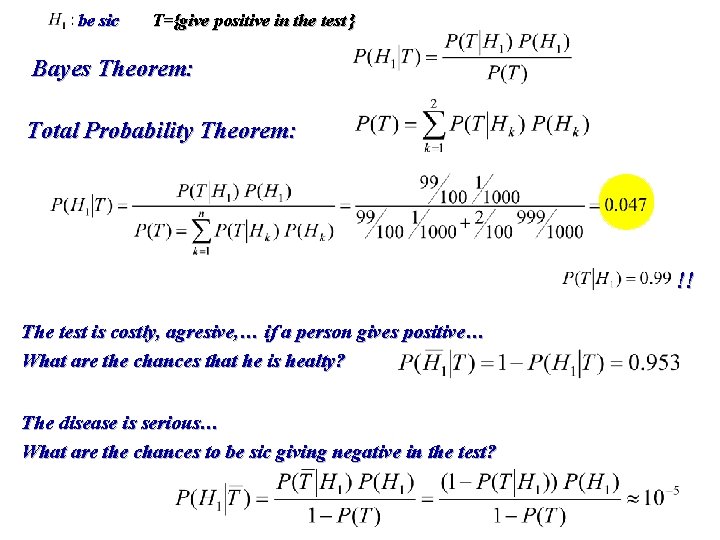
be sic T={give positive in the test } Bayes Theorem: Total Probability Theorem: !! The test is costly, agresive, … if a person gives positive… What are the chances that he is healty? The disease is serious… What are the chances to be sic giving negative in the test?
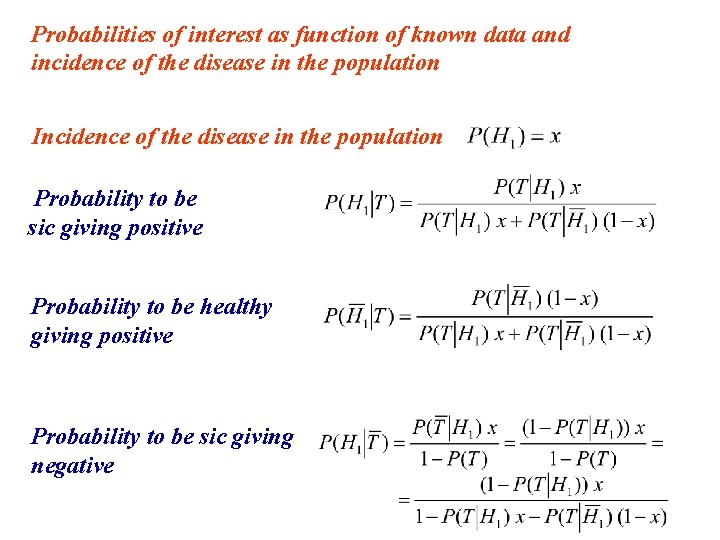
Probabilities of interest as function of known data and incidence of the disease in the population Incidence of the disease in the population Probability to be sic giving positive Probability to be healthy giving positive Probability to be sic giving negative
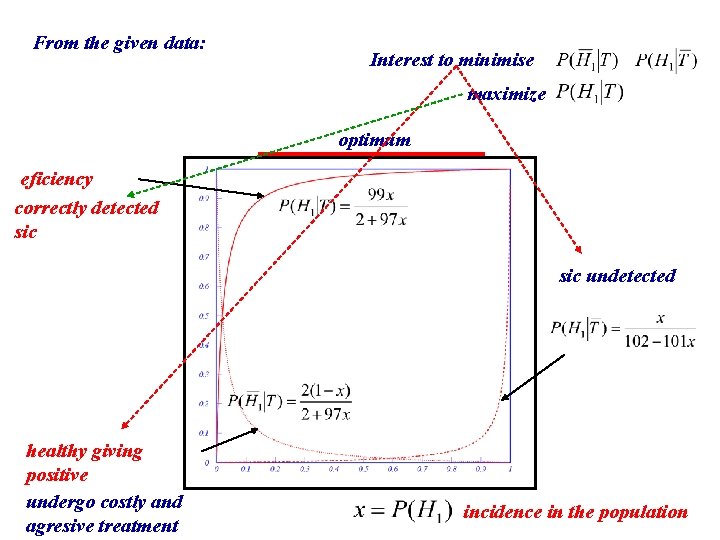
From the given data: Interest to minimise maximize optimum eficiency correctly detected sic undetected healthy giving positive undergo costly and agresive treatment incidence in the population
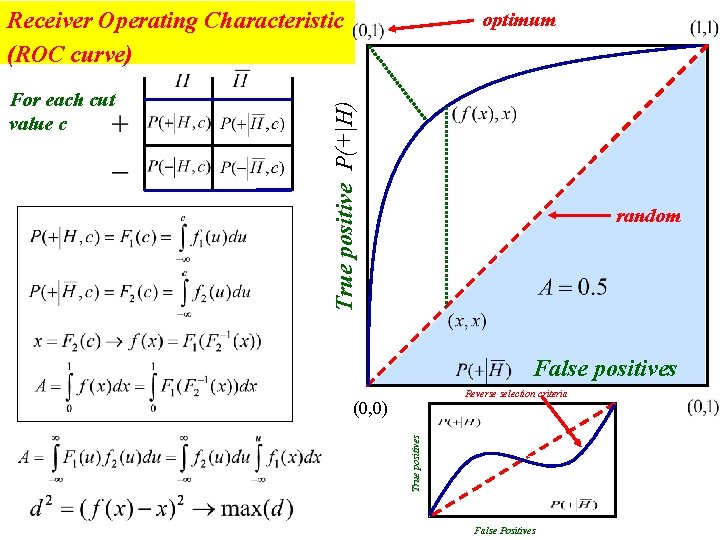
Receiver Operating Characteristic (ROC curve) True positive P(+|H) random False positives Reverse selection criteria (0, 0) True positives For each cut value c optimum False Positives

STOCHASTIC CHARACTERISTICS
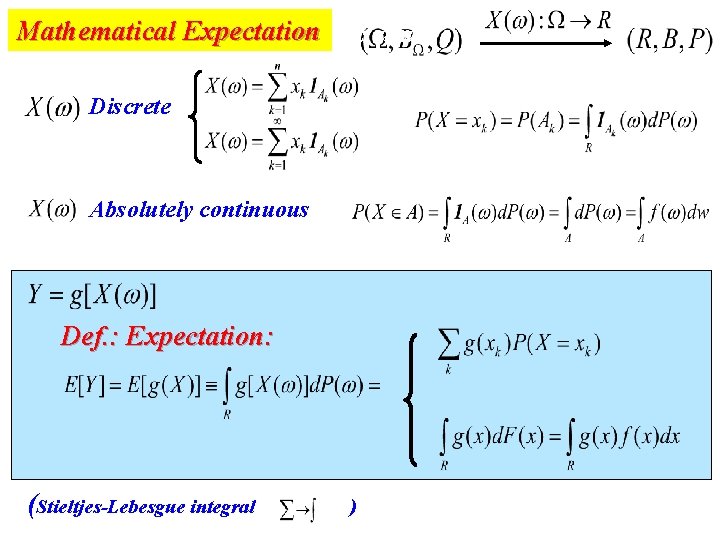
Mathematical Expectation As usual: Discrete Absolutely continuous Def. : Expectation: (Stieltjes-Lebesgue integral )
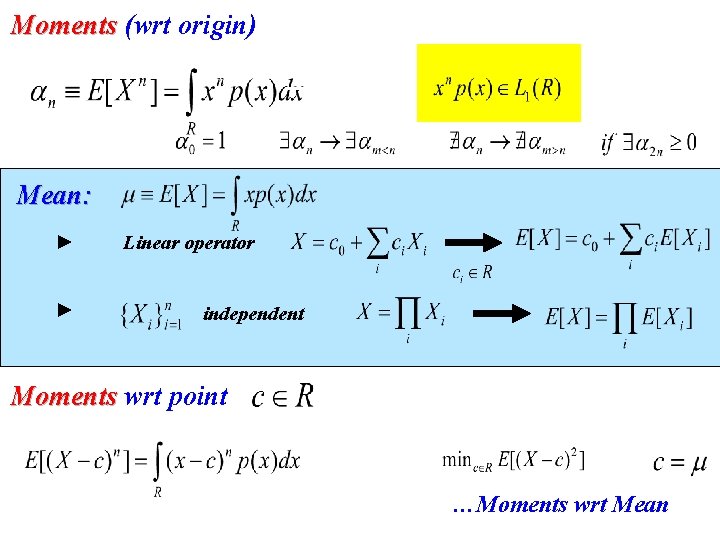
Moments (wrt origin) Mean: ► ► Linear operator independent Moments wrt point …Moments wrt Mean
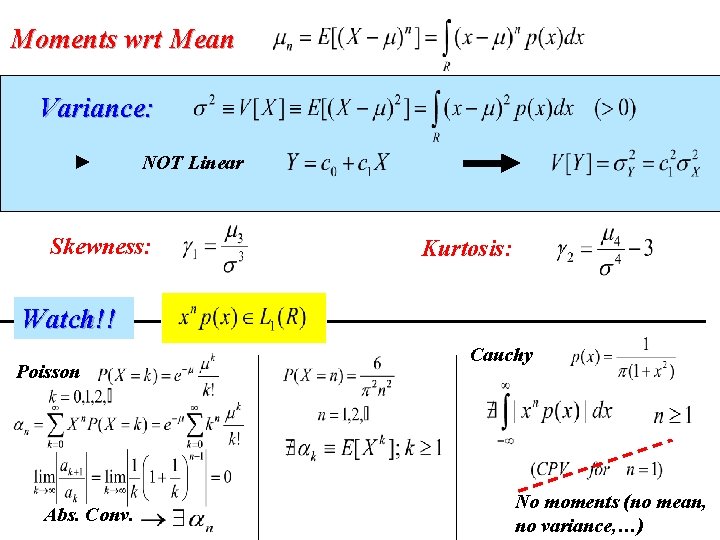
Moments wrt Mean Variance: ► NOT Linear Skewness: Kurtosis: Watch!! Poisson Abs. Conv. Cauchy No moments (no mean, no variance, …)
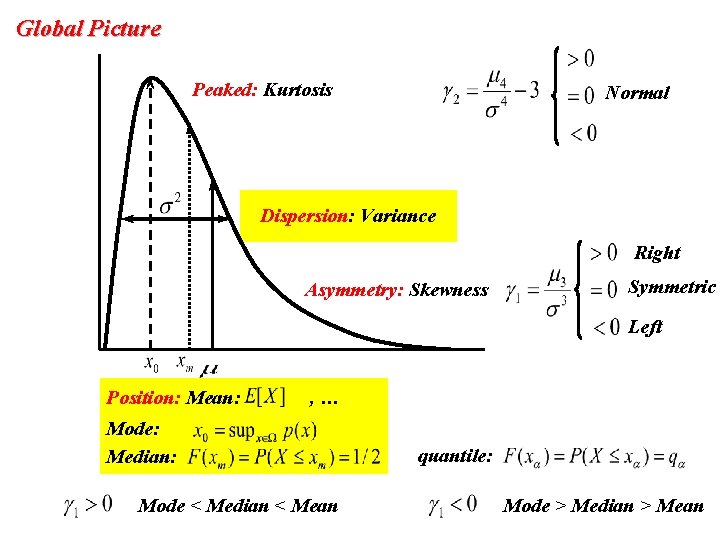
Global Picture Peaked: Kurtosis Normal Dispersion: Variance Right Asymmetry: Skewness Symmetric Left Position: Mean: , … Mode: Median: Mode < Median < Mean quantile: Mode > Median > Mean
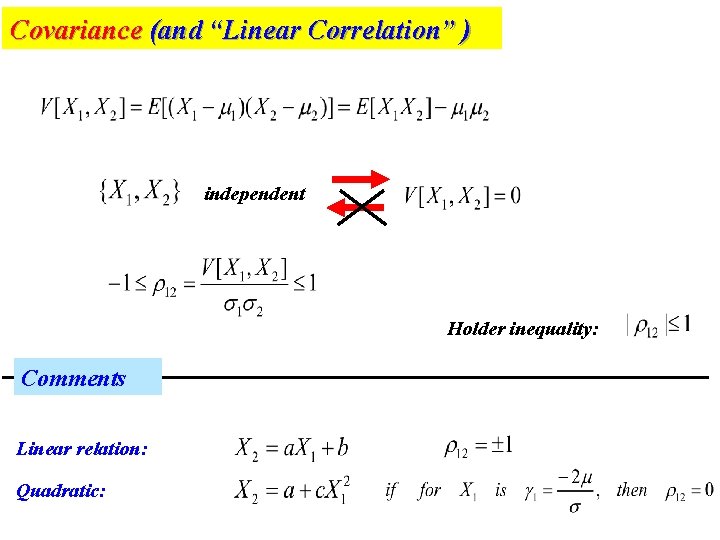
Covariance (and “Linear Correlation” ) independent Holder inequality: Comments Linear relation: Quadratic:

Useful expression: Taylor Expansion for the Variance of (mind for the re-maind-er…)
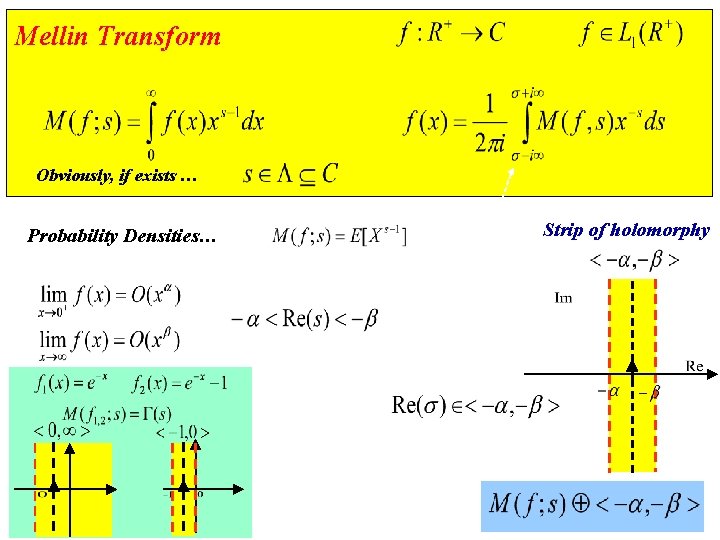
INTEGRAL TRANSFORMS Fourier (… Laplace) Transform Mellin Transform
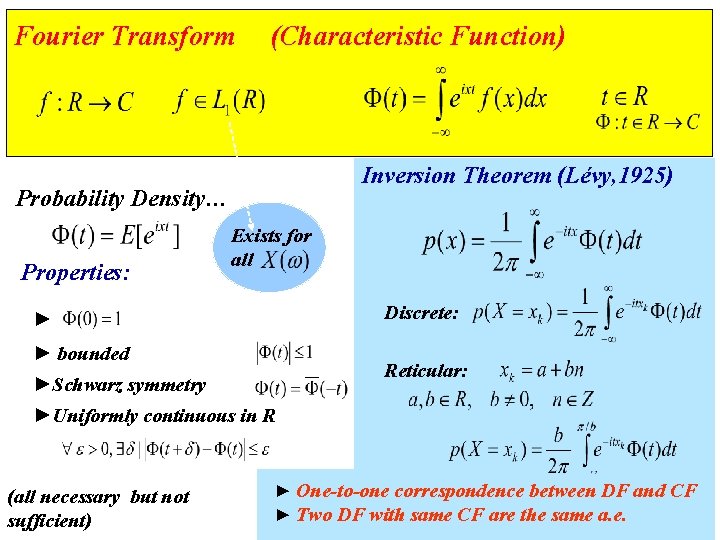
Fourier Transform (Characteristic Function) Inversion Theorem (Lévy, 1925) Probability Density… Properties: Exists for all Discrete: ► ► bounded Reticular: ►Schwarz symmetry ►Uniformly continuous in R (all necessary but not sufficient) ► One-to-one correspondence between DF and CF ► Two DF with same CF are the same a. e.
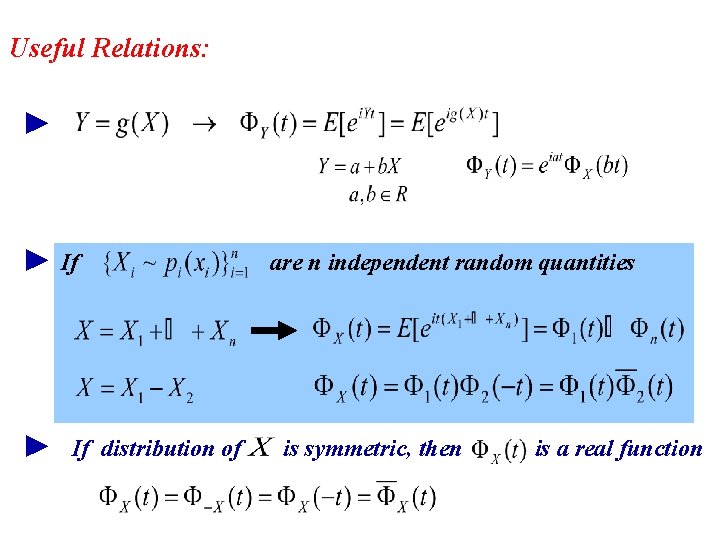
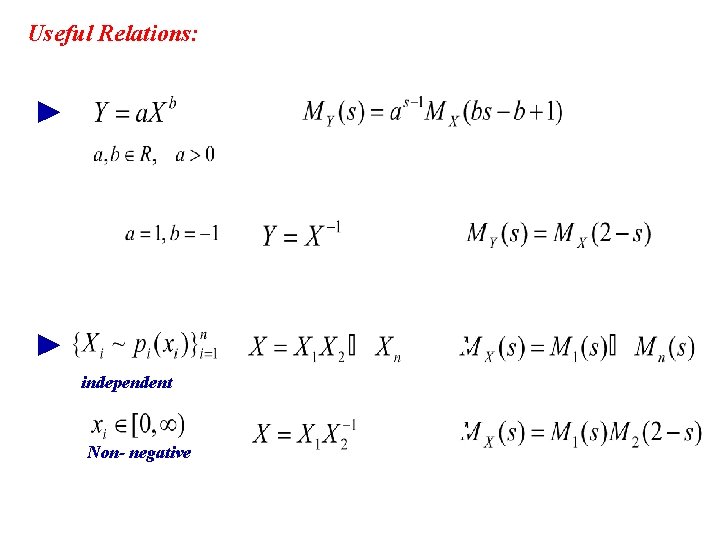
Useful Relations: ► ► If distribution of are n independent random quantities is symmetric, then is a real function
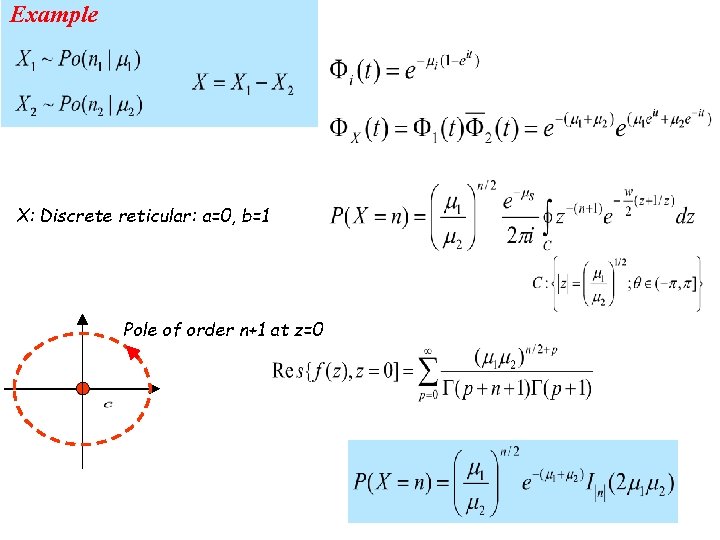
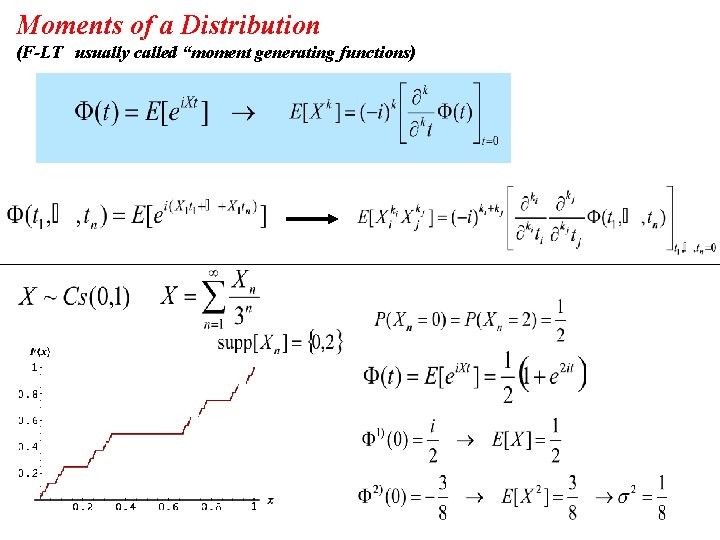
Example X: Discrete reticular: a=0, b=1 Pole of order n+1 at z=0
Some Useful Cases:
Moments of a Distribution (F-LT usually called “moment generating functions) Example
Mellin Transform Obviously, if exists … Probability Densities… Strip of holomorphy
Useful Relations: ► ► independent Non- negative
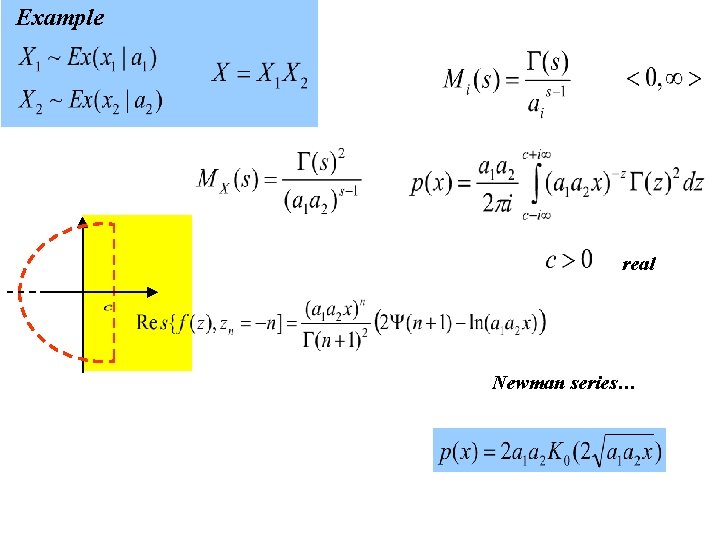
Example real Newman series…
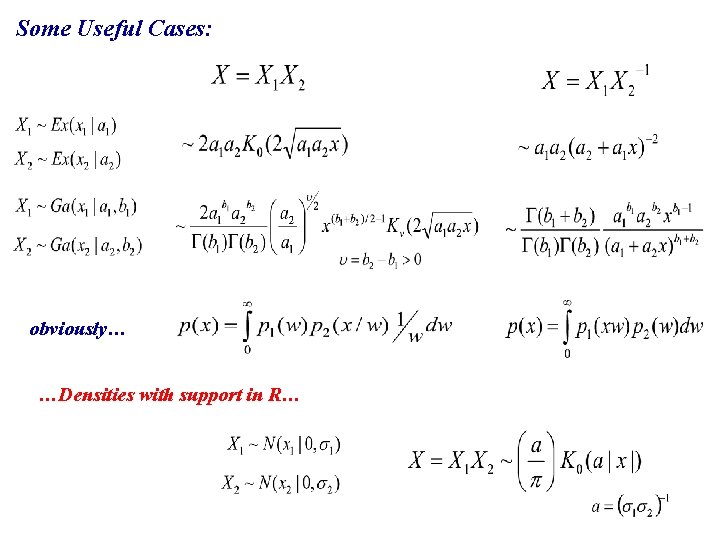
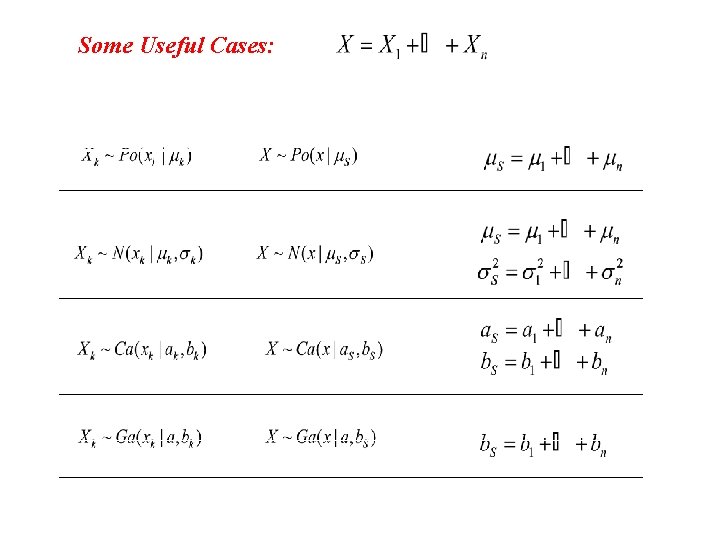
Some Useful Cases: obviously… …Densities with support in R…
DISTRIBUTIONS AND GENERALIZED FUNCTIONS
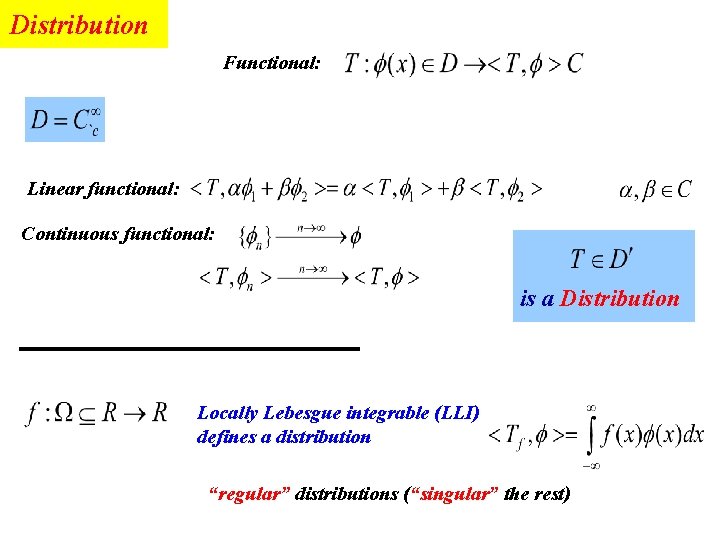
Distribution Functional: Linear functional: Continuous functional: is a Distribution Locally Lebesgue integrable (LLI) defines a distribution “regular” distributions (“singular” the rest)
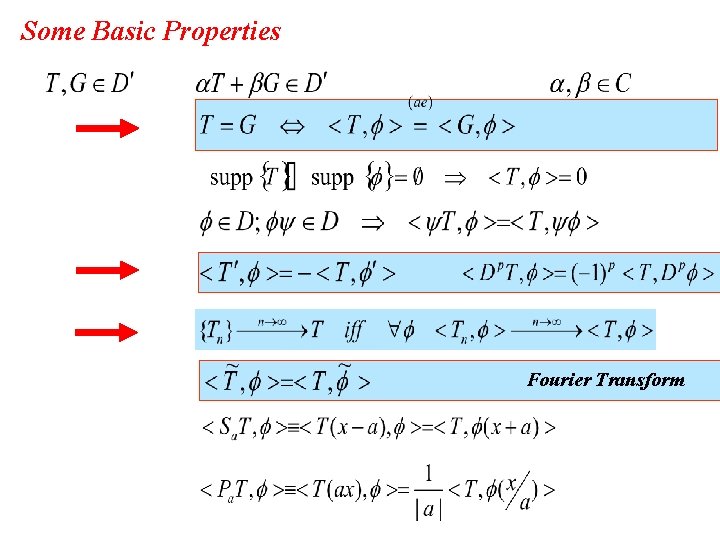
Some Basic Properties (see text for more) Fourier Transform
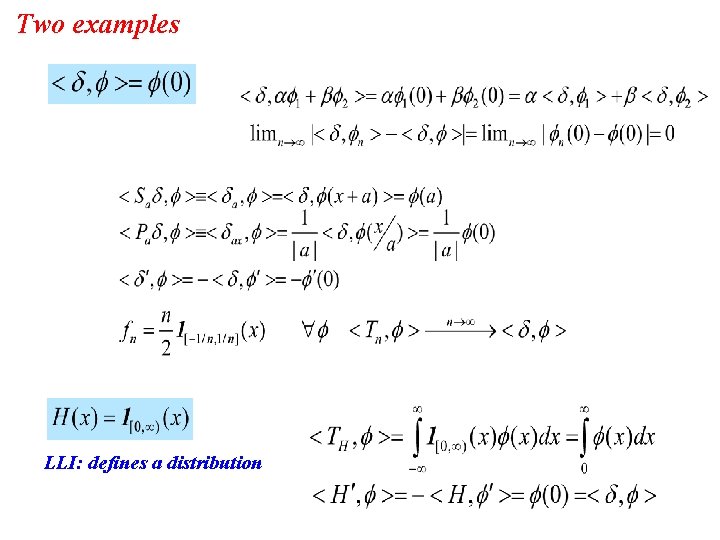
Two examples LLI: defines a distribution
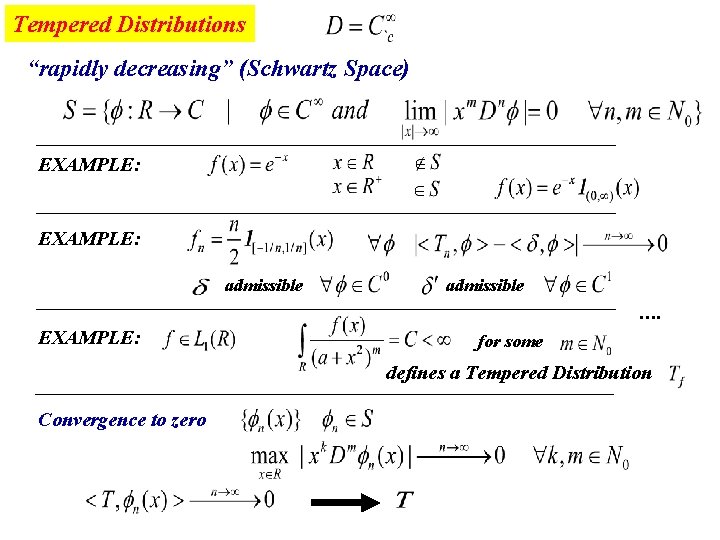
Tempered Distributions “rapidly decreasing” (Schwartz Space) EXAMPLE: admissible …. EXAMPLE: for some defines a Tempered Distribution Convergence to zero
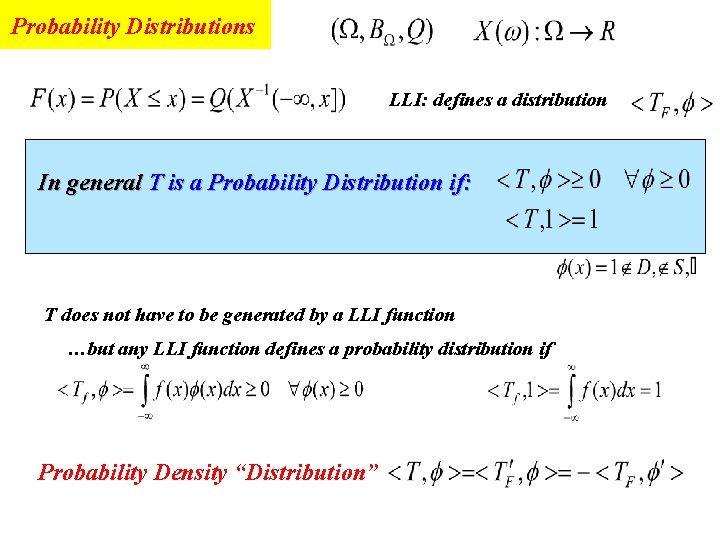
Probability Distributions LLI: defines a distribution In general T is a Probability Distribution if: T does not have to be generated by a LLI function …but any LLI function defines a probability distribution if Probability Density “Distribution”
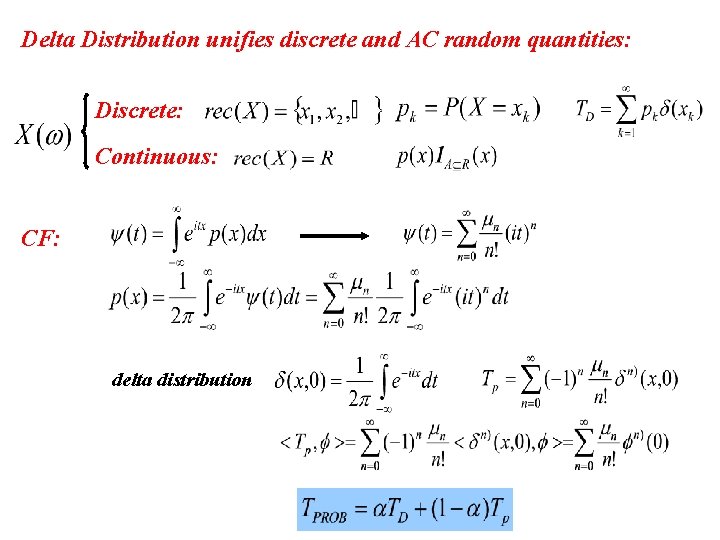
Delta Distribution unifies discrete and AC random quantities: Discrete: Continuous: CF: delta distribution
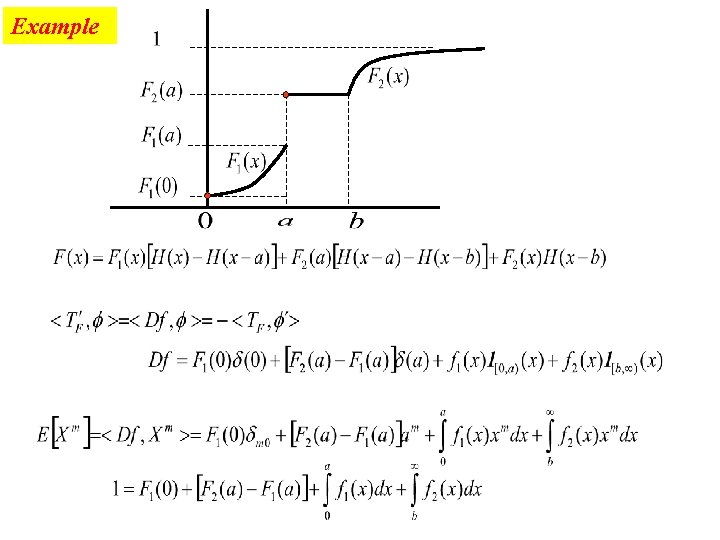
Example
LIMIT THEOREMS and CONVERGENCE
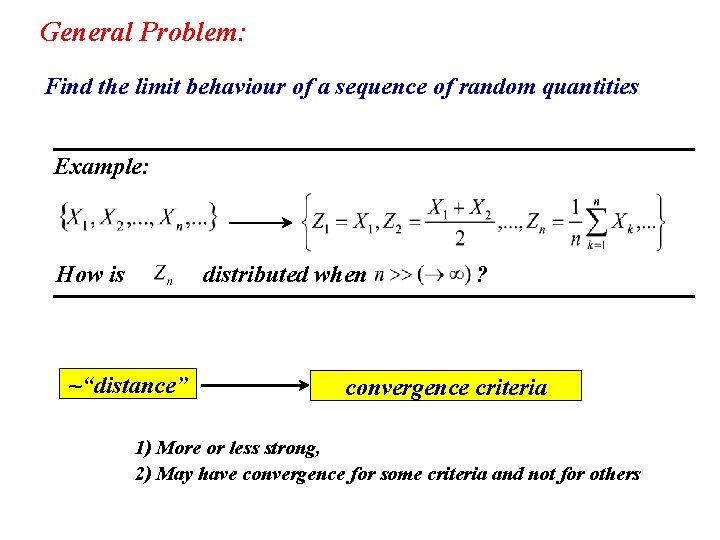
General Problem: Find the limit behaviour of a sequence of random quantities Example: How is distributed when ~“distance” ? convergence criteria 1) More or less strong, 2) May have convergence for some criteria and not for others
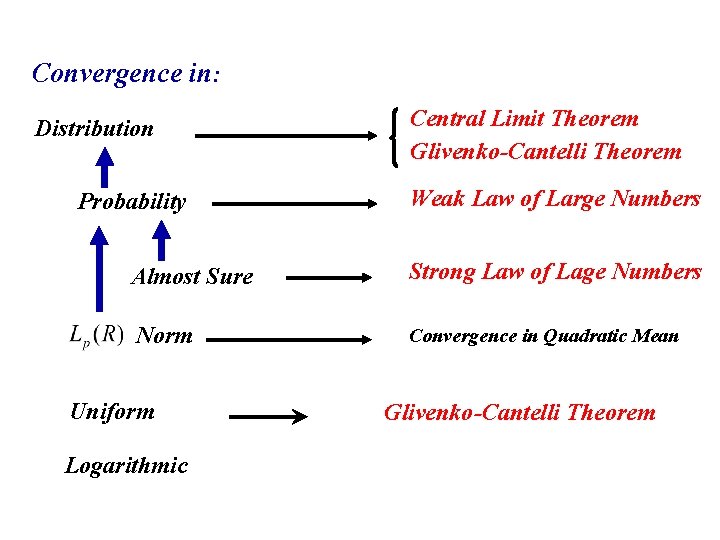
Convergence in: Distribution Probability Central Limit Theorem Glivenko-Cantelli Theorem Weak Law of Large Numbers Almost Sure Strong Law of Lage Numbers Norm Convergence in Quadratic Mean Uniform Logarithmic Glivenko-Cantelli Theorem
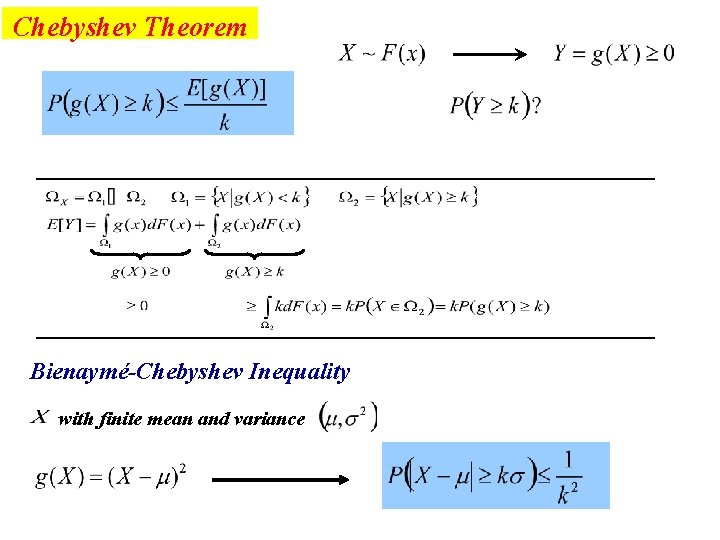
Chebyshev Theorem Bienaymé-Chebyshev Inequality with finite mean and variance
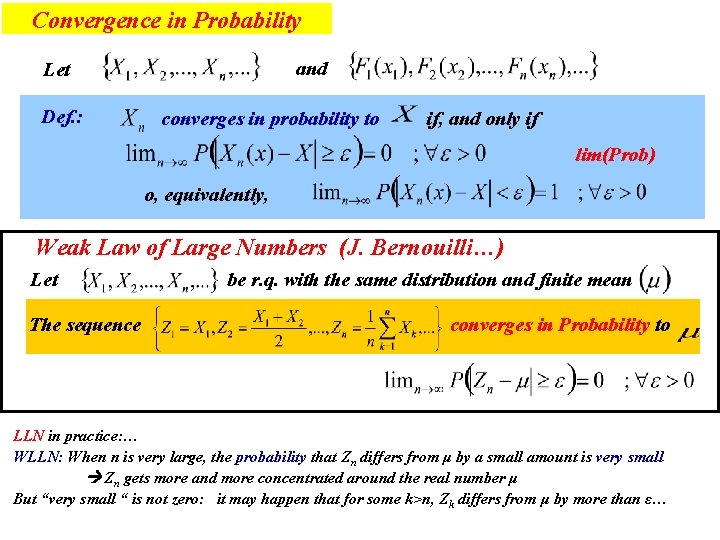
Convergence in Probability and Let Def. : converges in probability to if, and only if lim(Prob) o, equivalently, Weak Law of Large Numbers (J. Bernouilli…) Let The sequence be r. q. with the same distribution and finite mean converges in Probability to LLN in practice: … WLLN: When n is very large, the probability that Zn differs from μ by a small amount is very small Zn gets more and more concentrated around the real number μ But “very small “ is not zero: it may happen that for some k>n, Zk differs from μ by more than ε…
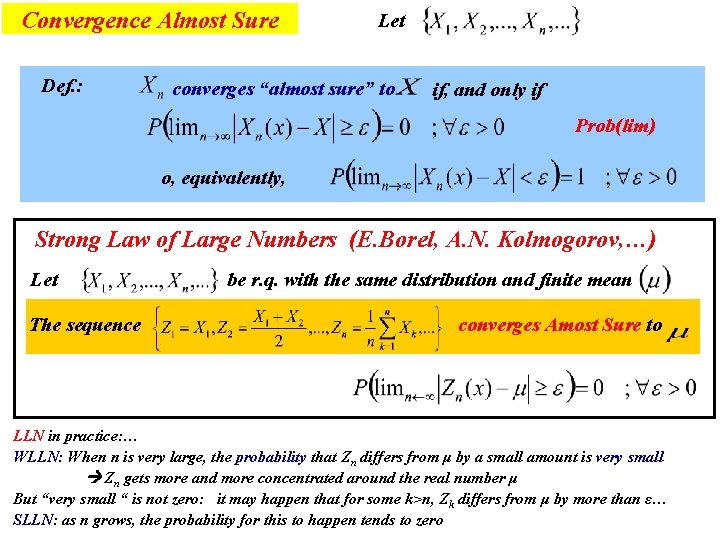
Convergence Almost Sure Def. : Let converges “almost sure” to if, and only if Prob(lim) o, equivalently, Strong Law of Large Numbers (E. Borel, A. N. Kolmogorov, …) Let The sequence be r. q. with the same distribution and finite mean converges Amost Sure to LLN in practice: … WLLN: When n is very large, the probability that Zn differs from μ by a small amount is very small Zn gets more and more concentrated around the real number μ But “very small “ is not zero: it may happen that for some k>n, Zk differs from μ by more than ε… SLLN: as n grows, the probability for this to happen tends to zero
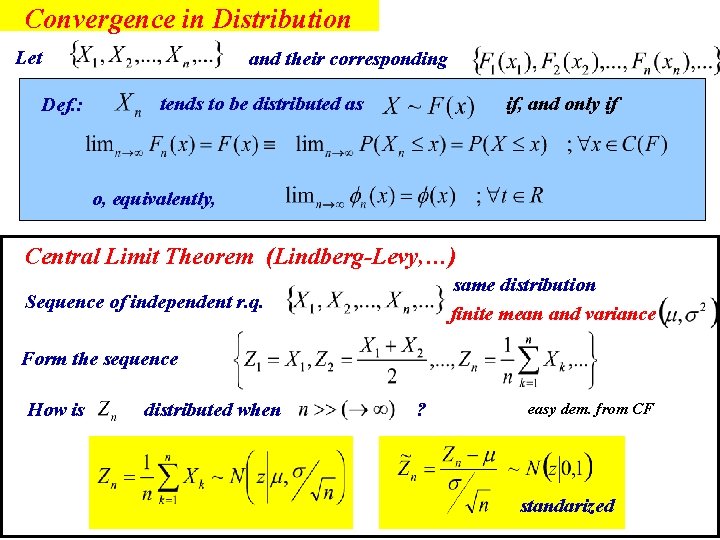
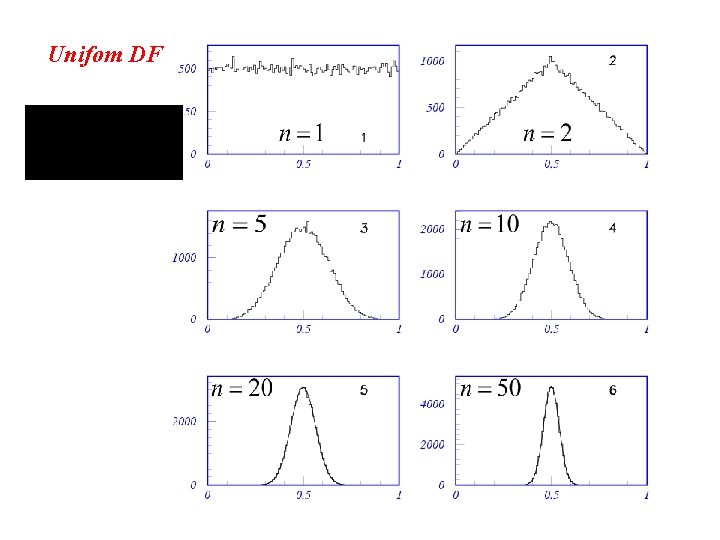
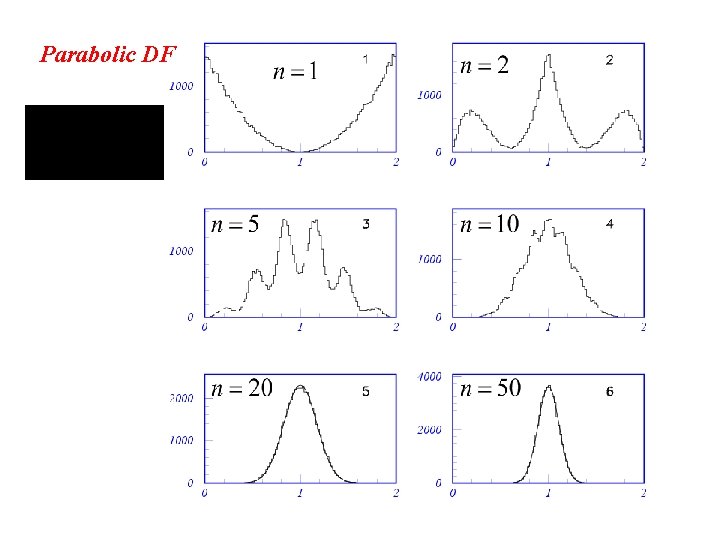
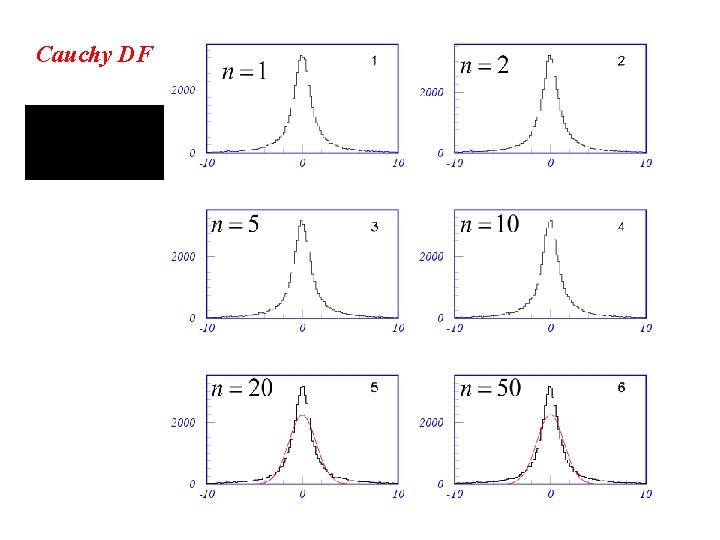
Convergence in Distribution Let Def. : and their corresponding if, and only if tends to be distributed as o, equivalently, Central Limit Theorem (Lindberg-Levy, …) same distribution finite mean and variance Sequence of independent r. q. Form the sequence How is distributed when ? easy dem. from CF standarized
Unifom DF
Parabolic DF
Cauchy DF
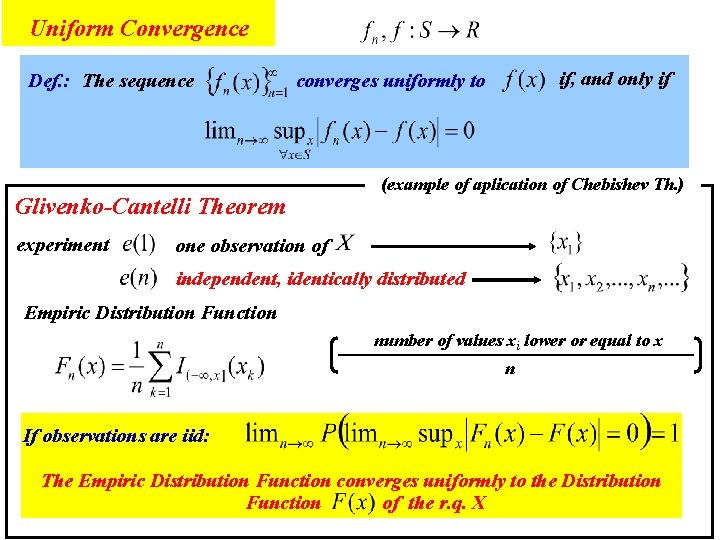
Uniform Convergence Def. : The sequence Glivenko-Cantelli Theorem experiment if, and only if converges uniformly to (example of aplication of Chebishev Th. ) one observation of independent, identically distributed Empiric Distribution Function number of values xi lower or equal to x n If observations are iid: The Empiric Distribution Function converges uniformly to the Distribution Function of the r. q. X

Demonstration of Convergence in Probability: Empiric Distribution Function 1) is a Bernouilli random quantity with Characteristic Function 2) Sum of iid Bernouilli random quantities is a Binomial r. q. 3) Bienaymé-Chebyshev Inequality
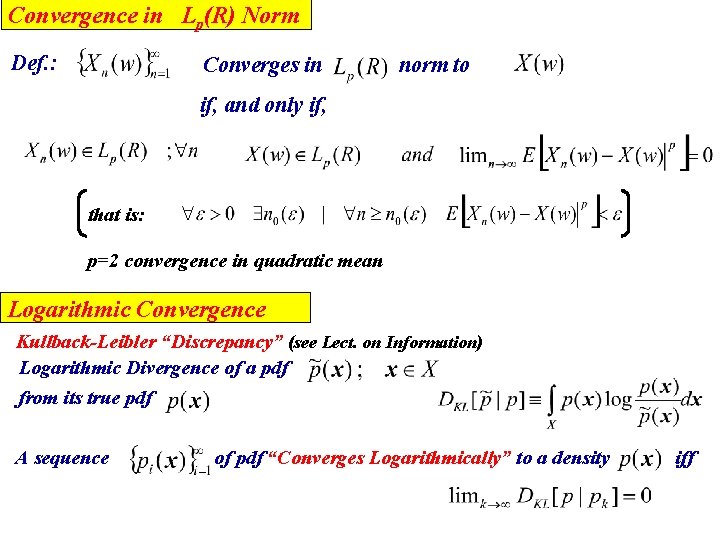
Convergence in Lp(R) Norm Def. : Converges in norm to if, and only if, that is: p=2 convergence in quadratic mean Logarithmic Convergence Kullback-Leibler “Discrepancy” (see Lect. on Information) Logarithmic Divergence of a pdf from its true pdf A sequence of pdf “Converges Logarithmically” to a density iff
- Slides: 77