
ELEMENTS OF POETRY SOUND DEVICES BT 2013 TAKE
ELEMENTS OF POETRY: SOUND DEVICES BT 2013
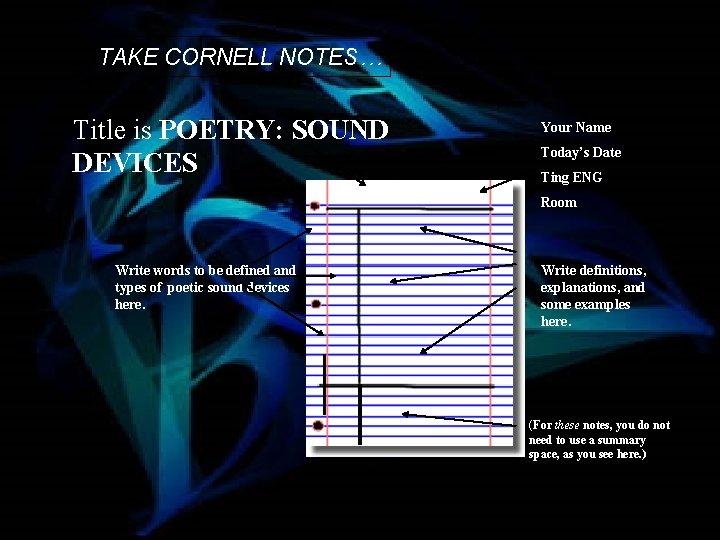
TAKE CORNELL NOTES… Title is POETRY: SOUND DEVICES Your Name Today’s Date Ting ENG Room Write words to be defined and types of poetic sound devices here. Write definitions, explanations, and some examples here. (For these notes, you do not need to use a summary space, as you see here. ) 2
• Sound makes poems memorable and adds to our enjoyment and understanding. • Your own experience affects the way you relate to the sounds in a poem. • Sound in poetry comes from the sounds of words and from • rhyme • rhythm • metre 3
• The sounds of particular words are formed by the combinations of letters within them. • Sounds repeated in words close to each other in the poem add to the pattern of a sound. • Some words echo the object or sound they represent. 4
• Rhyme is formed by matching or nearly matching vowel sounds. • Rhyme is the flow of words in the poem. • Metre is the measuring out of accented words, like the beats in music. 5
SOUND DEVICES 6
ONOMATOPOEIA Words that sound like their meaning --- the “sound” they describe. buzz… bang…hiss… roar… meow… woof… rumble… howl… snap… zip… zap… blip… whack … crack… crash… flutter… flap… squeak… whirr. . pow… plop… crunch… splash… jingle… rattle… clickety-clack… bam! 7
The repetition of initial consonant sounds, in two or more neighboring words or syllables. The wild and wooly walrus waits and wonders when we will walk by. Slowly, silently, now the moon Walks the night in her silver shoon; This way, and that, she peers, and sees Silver fruit upon silver trees… m “Silver” by Walter de la Mare N O I T A R E T I L AL fro How much wood would a woodchuck if a woodchuck could chuck wood? (almost ALL tongue twisters qualify as alliteration!) 8
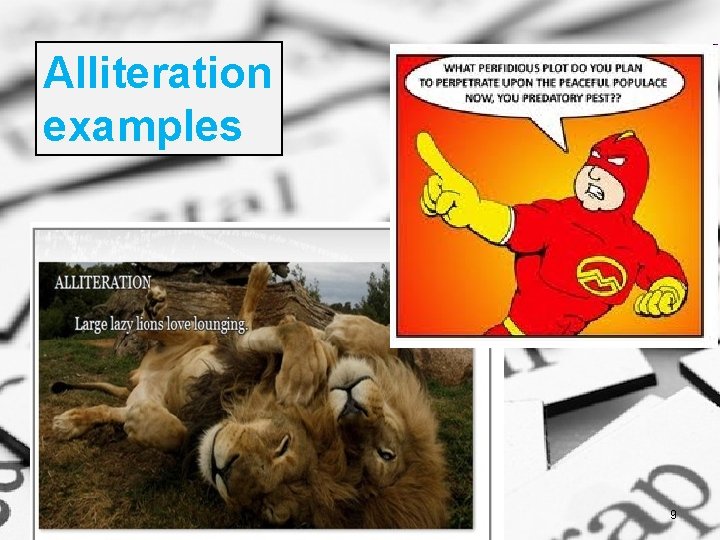
Alliteration examples 9
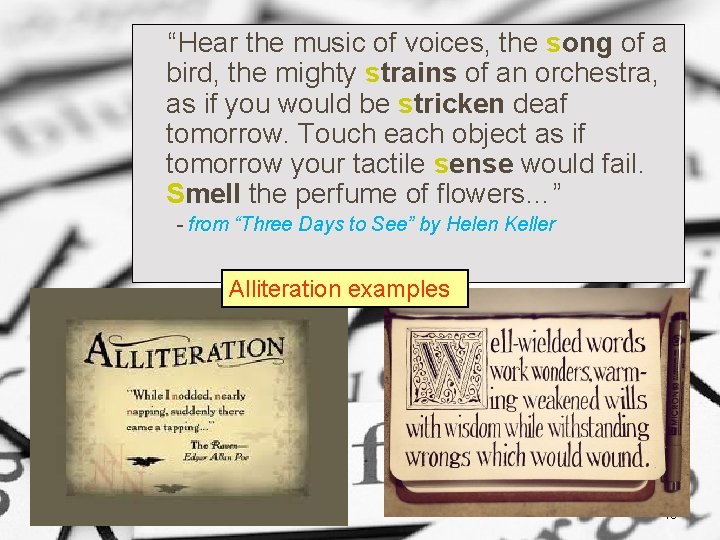
“Hear the music of voices, the song of a bird, the mighty strains of an orchestra, as if you would be stricken deaf tomorrow. Touch each object as if tomorrow your tactile sense would fail. Smell the perfume of flowers…” - from “Three Days to See” by Helen Keller Alliteration examples 10
ASSONANCE A repetition of vowel sounds within words or syllables. Fleet feet sweep by sleeping geese. Free and easy. Make the grade. The stony walls enclosed the holy space. 11

EXAMPLES OF ASSONANCE Poetry is old, ancient, goes back far. It is among the oldest of living things. So old it is that no man knows how and why the first poems came. --Carl Sandburg, Early Moon “…on a proud round cloud in white high night…” - E. E. Cummings “I made my way to the lake. ” 12
The Eagle by Alfred Lord Tennyson ASSONANCE EXAMPLE He clasps the crag with crooked hands; Close to the sun in lonely lands, Ring'd with the azure world, he stands. The wrinkled sea beneath him crawls; He watches from his mountain walls, And like a thunderbolt he falls. 13
L M N R Long vowels: though all vowels tend to be more melodious than consonants, long vowels (e. g. "moon, " "coat, " "crate, ") resonate in the ear more than the short vowels found in "hat, " "tin, " "fun, " "shed, " or "hot" Consonants that are fairly euphonious: The "liquids " (l, m, n, r) Soft f or v sounds The semi-vowels w or y th or wh EUPHONY Soothing or pleasant spoken sounds that are created by smooth consonants such as "ripple. ” 14
ds un ds • D isco • Ja r d rrin ant sou g so nd CACOPHONY Jabberwocky by Lewis Carroll 'Twas brillig, and the slithy toves Did gyre and gimble in the wabe; All mimsy were the borogoves, And the mome raths outgrabe. The word cacophony originates from the Greek word meaning "bad sound. " 15
PLOSIVES Hard sounds B D K P T G 16
FRICATIVES • Soft sounds F V TH L 17
SIBILANT S May be harsh and hissing or Soft and murmuring 18
ASSONANCE Examples: Free, easy Tame, mind Close repetition of similar vowel sounds usually in stressed syllables 19

flip / flop CONSONANCE Close repetition of identical consonant sounds before and after different vowels 20
REPETITION ngs Think of all the so words you know where eated – and lines are rep often a lot ! Words or phrases repeated in writings to give emphasis, rhythm, and/or a sense of urgency. Example: from Edgar Allen Poe’s “The Bells” To the swinging and the ringing of the bells, bells – Of the bells, bells Bells, bells – To the rhyming and the chiming of the bells! 21
RHYTHM AND METER • Rhythm is the sound pattern created by stressed and unstressed syllables. • The pattern can be regular or random. • Meter is the regular patterns of stresses found in many poems and songs. . • Rhythm is often combined with rhyme, alliteration, and other poetic devices to add a musical quality to the writing. 22
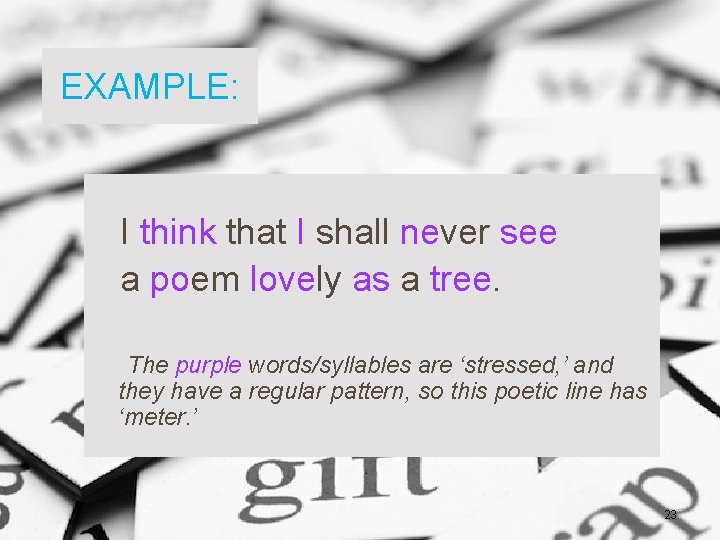
EXAMPLE: I think that I shall never see a poem lovely as a tree. The purple words/syllables are ‘stressed, ’ and they have a regular pattern, so this poetic line has ‘meter. ’ 23
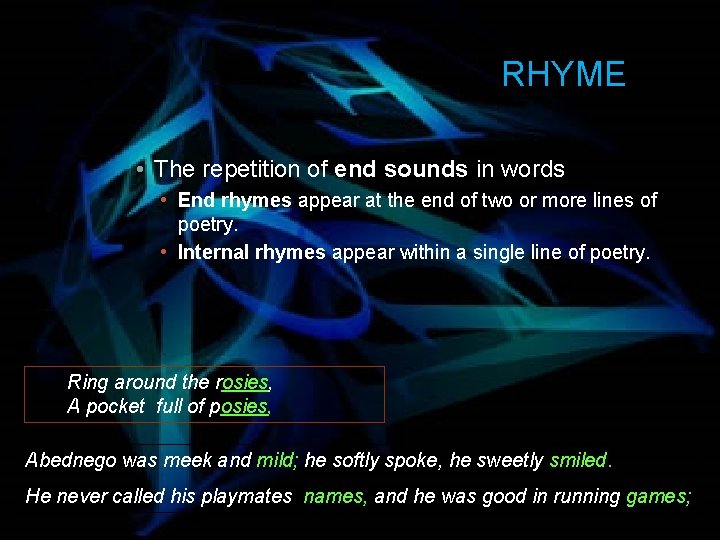
RHYME • The repetition of end sounds in words • End rhymes appear at the end of two or more lines of poetry. • Internal rhymes appear within a single line of poetry. Ring around the rosies, A pocket full of posies, Abednego was meek and mild; he softly spoke, he sweetly smiled. He never called his playmates names, and he was good in running games; 24
RHYME SCHEME “also = a. a. k n as” know • The pattern of end rhymes (of lines) in a poem. • Letters are used to identify a poem’s rhyme scheme (a. k. a rhyme pattern). • The letter a is placed after the first line and all lines that rhyme with the first line. • The letter b identifies the next line ending with a new sound, and all lines that rhyme with it. • Letters continue to be assigned in sequence to lines containing new ending sounds. This may seem confusing, but it isn’t. Really! 25
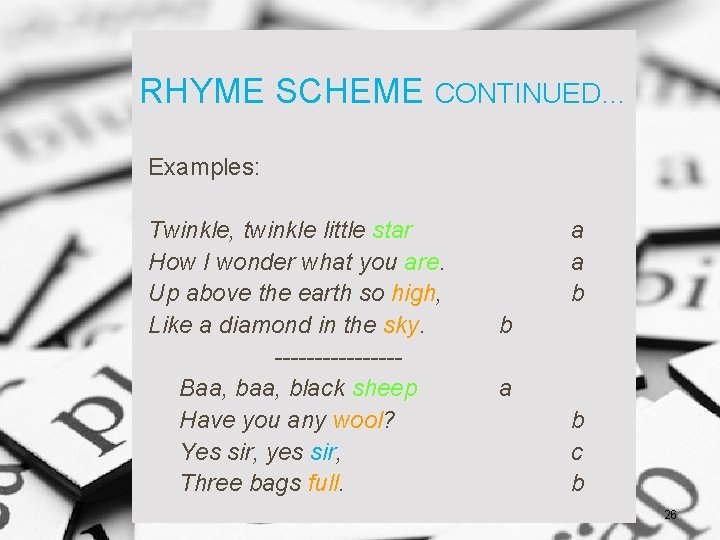
RHYME SCHEME CONTINUED… Examples: Twinkle, twinkle little star How I wonder what you are Up above the earth so high, high Like a diamond in the sky --------Baa, black sheep Have you any wool? wool Yes sir, yes sir, sir Three bags full a a b b a b c b 26
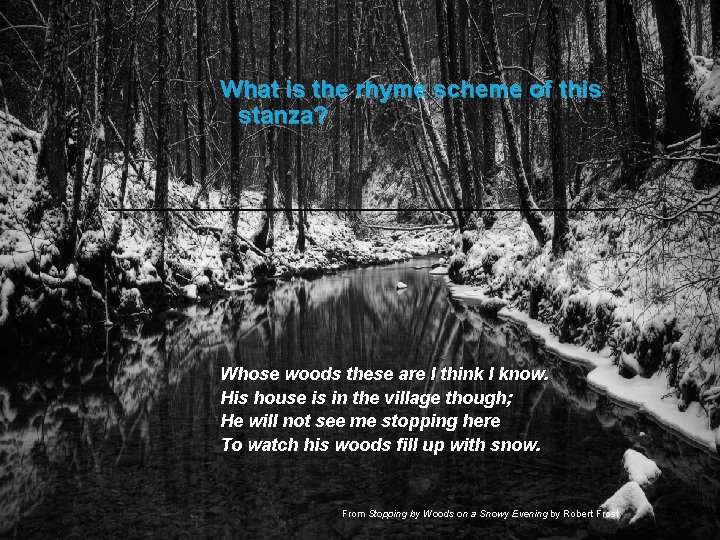
What is the rhyme scheme of this stanza? Whose woods these are I think I know. His house is in the village though; He will not see me stopping here To watch his woods fill up with snow. From Stopping by Woods on a Snowy Evening by Robert Frost 27
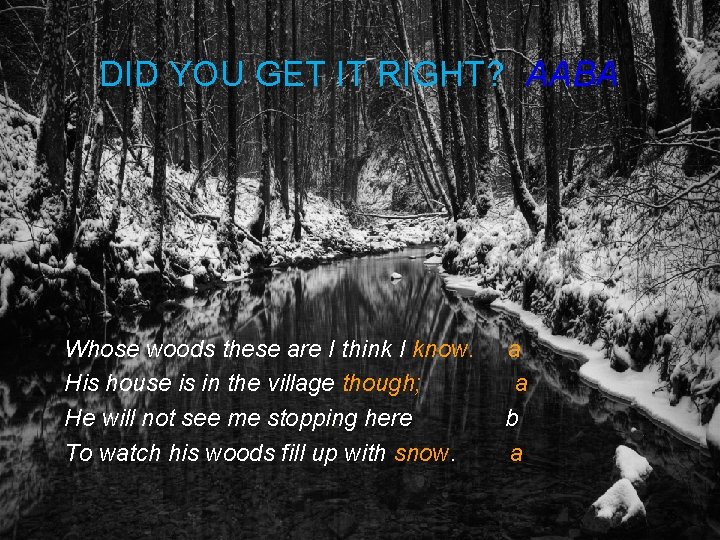
DID YOU GET IT RIGHT? AABA Whose woods these are I think I know. His house is in the village though; He will not see me stopping here To watch his woods fill up with snow. a a b a 28
RHYME • Rhyme is the repetition of the same stressed vowel sound any succeeding sounds in two or more words. • Rhyme scheme is the pattern of end rhymes that may be designated by assigning a different letter of the alphabet to each new rhyme
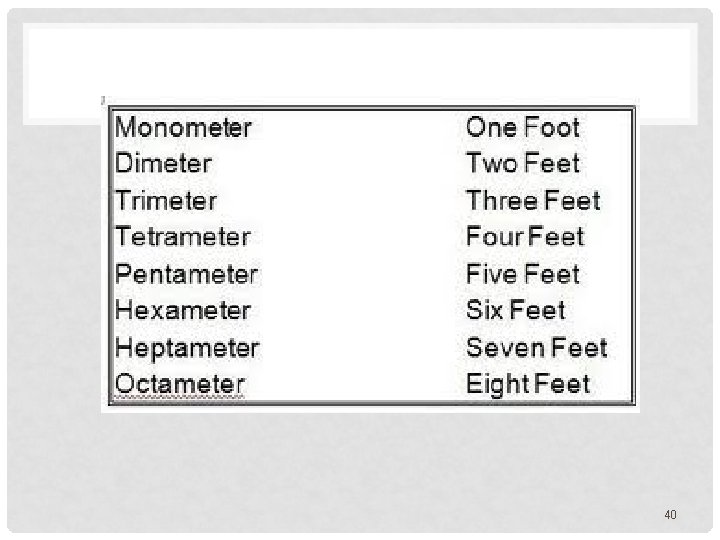
RHYTHM AND METER • Rhythm is the pattern of sound created by the arrangement of stressed and unstressed syllables in a line. Rhythm can be regular or irregular. • Meter is a regular pattern of stressed and unstressed syllables which sets the overall rhythm of certain poems. Typically, stressed syllables are marked with / and unstressed syllables are marked with . • In order to measure how many syllables are per line, they are measured in feet. A foot consists of a certain number of syllables forming part of a line of verse.
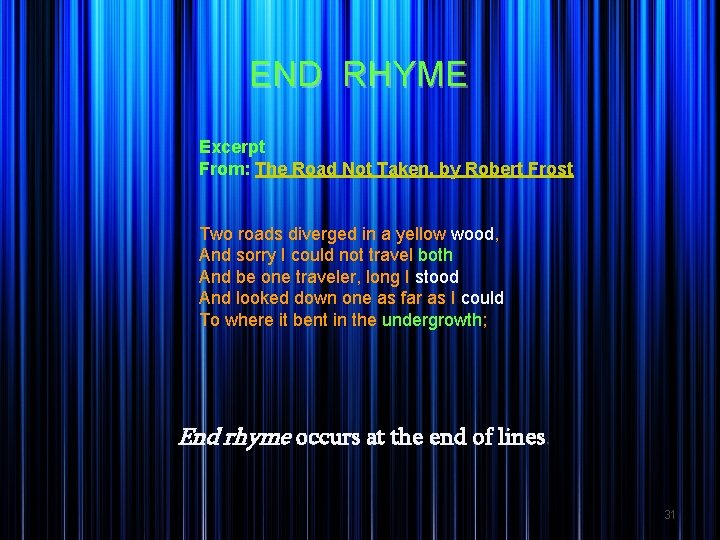
END RHYME Excerpt From: The Road Not Taken, by Robert Frost Two roads diverged in a yellow wood, And sorry I could not travel both And be one traveler, long I stood And looked down one as far as I could To where it bent in the undergrowth; End rhyme occurs at the end of lines. 31
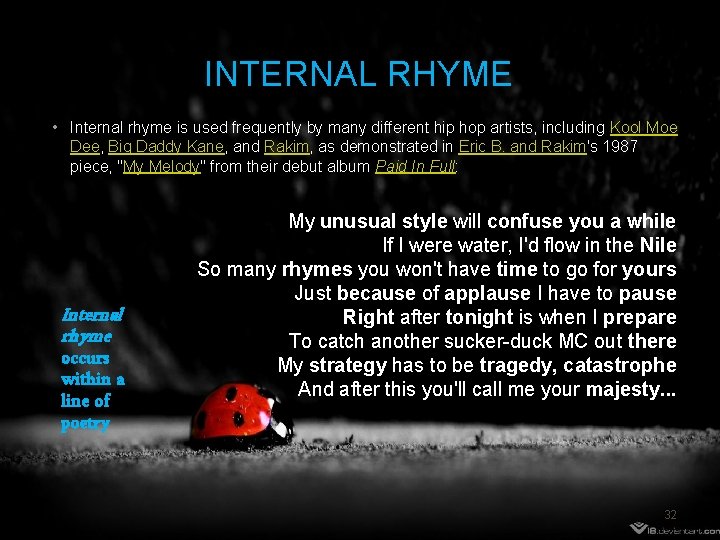
INTERNAL RHYME • Internal rhyme is used frequently by many different hip hop artists, including Kool Moe Dee, Big Daddy Kane, and Rakim, as demonstrated in Eric B. and Rakim's 1987 piece, "My Melody" from their debut album Paid In Full: Internal rhyme occurs within a line of poetry My unusual style will confuse you a while If I were water, I'd flow in the Nile So many rhymes you won't have time to go for yours Just because of applause I have to pause Right after tonight is when I prepare To catch another sucker-duck MC out there My strategy has to be tragedy, catastrophe And after this you'll call me your majesty. . . 32
SLANT-RHYME • Half-rhyme or slant-rhyme, sometimes called near-rhyme or imperfect rhyme. • The following example uses alternating half-rhymes (on/moon, bodies/ladies): When have I last looked on The round green eyes and the long wavering bodies Of the dark leopards of the moon? All the wild witches, those most noble ladies 33
MASCULINE RHYME Repeats only a single end syllable: eg: cat / hat 34
FEMININE RHYME Repeats a rhyme over two or more syllables Eg: flower / power 35
IAMBIC PENTAMETER • The most common type of meter is called iambic pentameter • An iamb is a foot consisting of an initial unstressed syllable followed by a stressed syllable. For example, return, displace, to love, my heart. • A pentameter is a line of verse containing 5 metrical feet.
SIGNIFICANCE OF IAMBIC PENTAMETER • Iambic Pentameter is significant to the study of poetry because • 1. It is the closest to our everyday speech • 2. In addition, it mimics the sound of heart beat; a sound common to all human beings. • 3. Finally, one of the most influential writers of our times uses iambic pentameter in all that he writes – William Shakespeare.
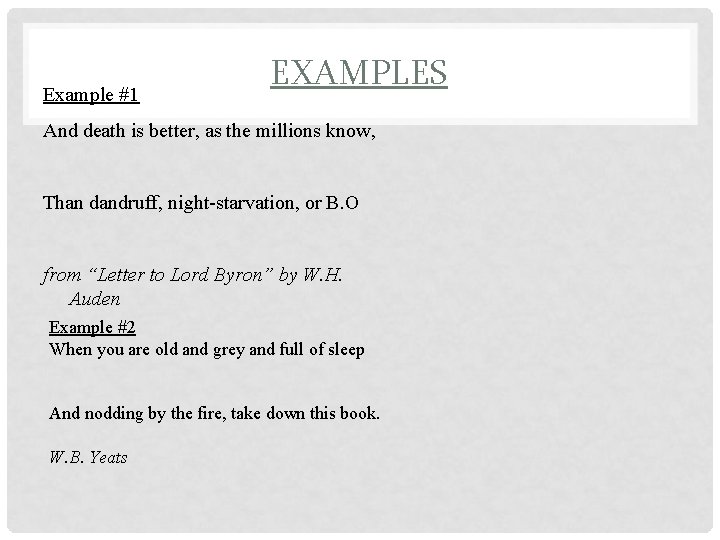
Example #1 EXAMPLES And death is better, as the millions know, Than dandruff, night-starvation, or B. O from “Letter to Lord Byron” by W. H. Auden Example #2 When you are old and grey and full of sleep And nodding by the fire, take down this book. W. B. Yeats

39
40
- Slides: 40