
Elements of Narration This graphic organizer is called





- Slides: 48
Elements of Narration
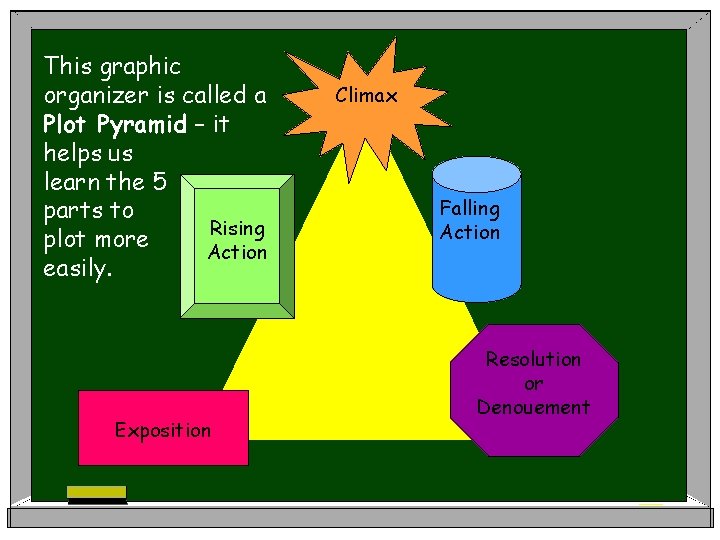
This graphic organizer is called a Plot Pyramid – it helps us learn the 5 parts to Rising plot more Action easily. Exposition Climax Falling Action Resolution or Denouement
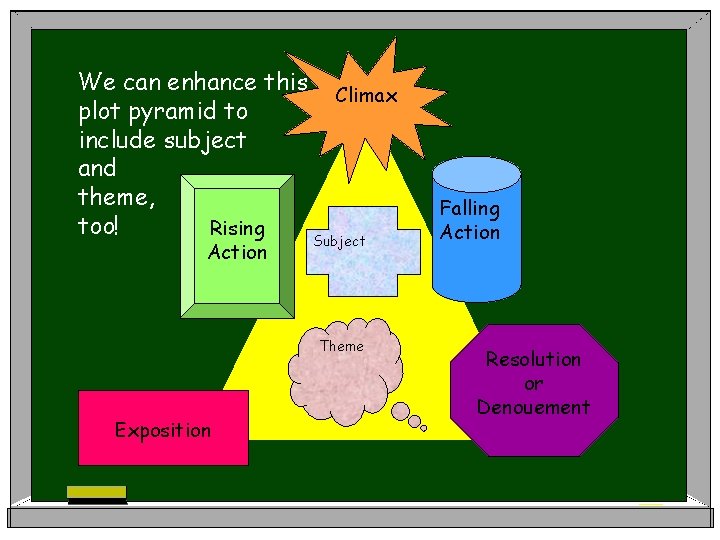
We can enhance this plot pyramid to include subject and theme, too! Rising Action Climax Subject Theme Exposition Falling Action Resolution or Denouement
Plot Before discussing elements of plot, we should define the term. § Plot is a series of related events.
Exposition § sets up the basic situation § establishes characters, setting, and plot
Rising Action any action between the exposition and climax § in this action, we find conflict and complications §
Rising Action § Conflict - a struggle or problem between opposing forces
Conflict 1. Internal – the conflict takes place within the main character. Man vs. himself 2. External - the conflict involves an outside force. Man vs. man Man vs. nature Man vs. society
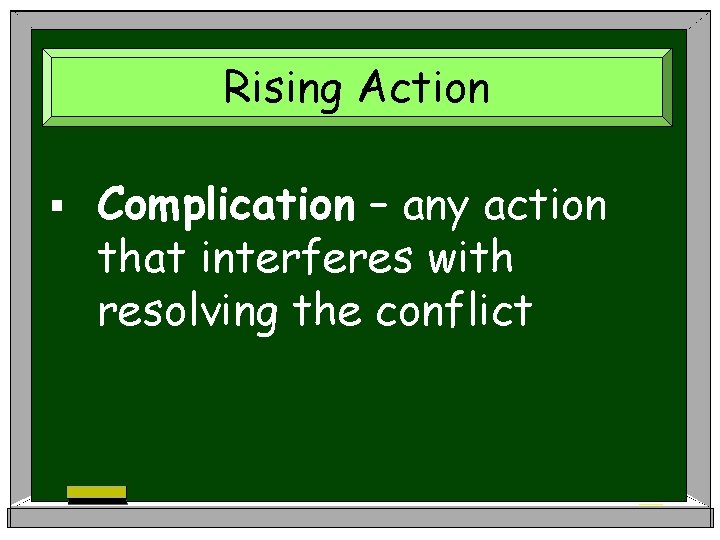
Rising Action § Complication – any action that interferes with resolving the conflict
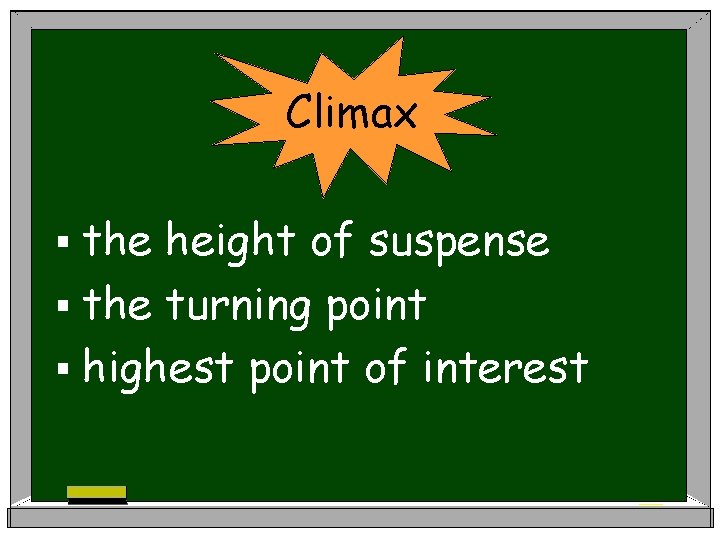
Climax § the height of suspense § the turning point § highest point of interest
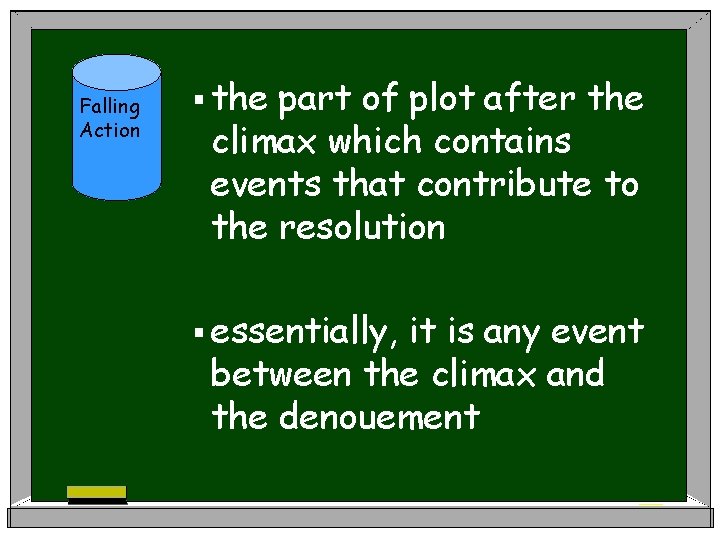
Falling Action § the part of plot after the climax which contains events that contribute to the resolution § essentially, it is any event between the climax and the denouement
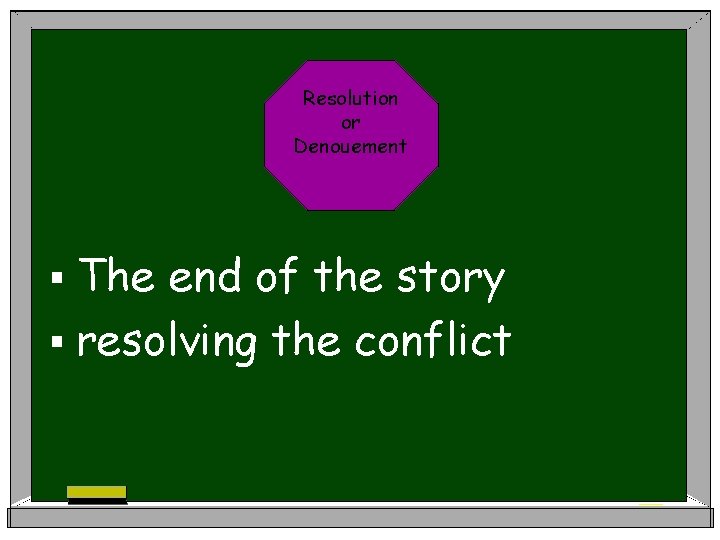
Resolution or Denouement § The end of the story § resolving the conflict
Subject § The topic of the short story usually stated in a word or two.
theme § the main idea of a story stated in a sentence or two § can be true of story and human nature. . . a universal truth
The difference between subject and theme. . . § The theme is the idea that an author wants to reveal about a subject.
Characterization § the process of making characters come alive through the written word
Methods of Characterization § Direct § when an author tells what a character is like
Methods of Characterization (cont. ) § Indirect § when an author shows us what a character is like through context clues
A writer has 5 different ways to indirectly characterize his/her characters. . .
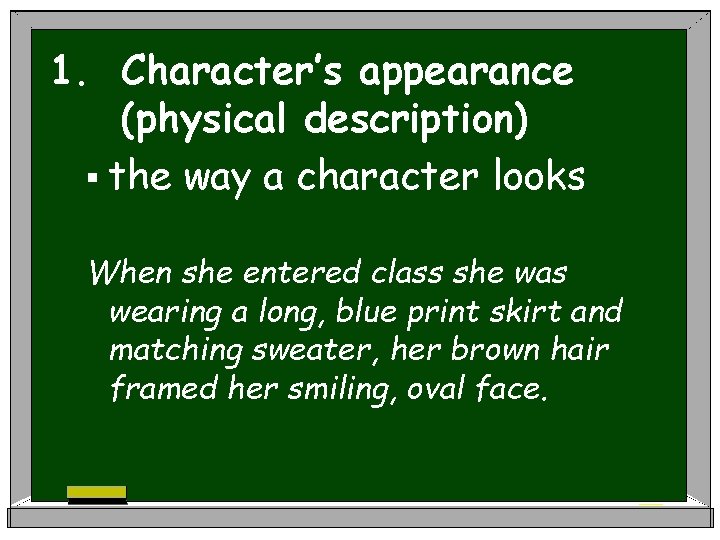
1. Character’s appearance (physical description) § the way a character looks When she entered class she was wearing a long, blue print skirt and matching sweater, her brown hair framed her smiling, oval face.
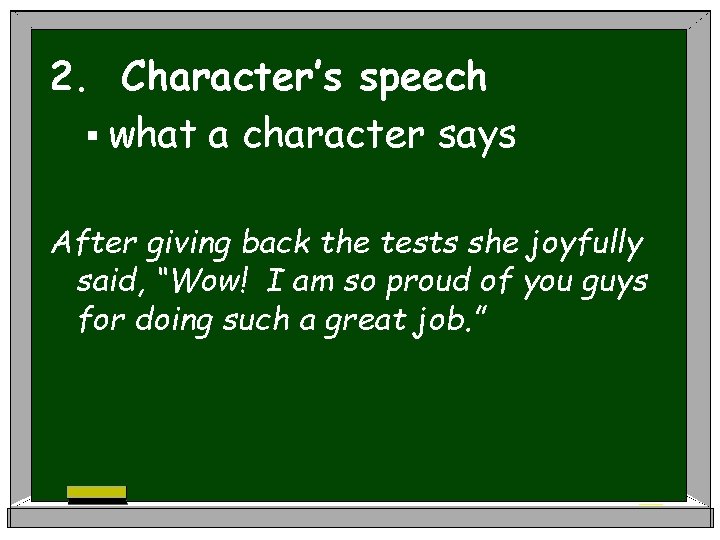
2. Character’s speech § what a character says After giving back the tests she joyfully said, “Wow! I am so proud of you guys for doing such a great job. ”
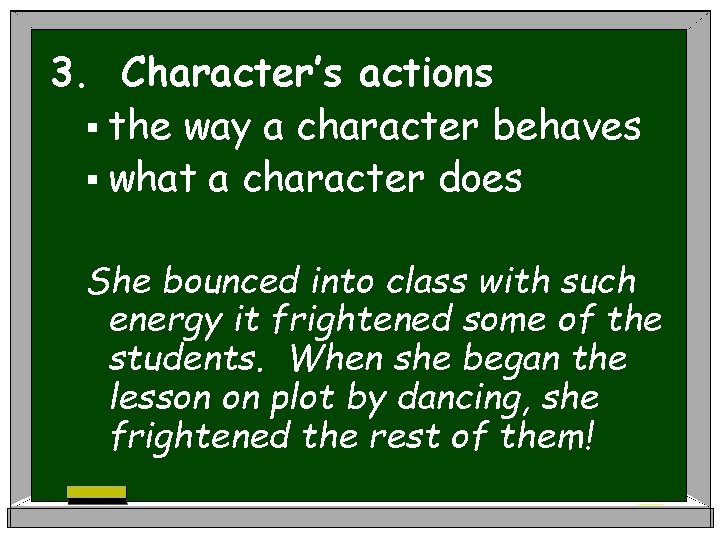
3. Character’s actions § the way a character behaves § what a character does She bounced into class with such energy it frightened some of the students. When she began the lesson on plot by dancing, she frightened the rest of them!
4. Character’s inner thoughts and feelings § what a character is thinking I wonder if anyone has figured out I can’t sing yet? That’s o. k. , I can do anything – I’m the teacher.
4. Opinions and reactions of other characters towards a particular character Mrs. Nardelli’s not so bad once you get to know her. I actually learned a lot from her and had some fun along the way.
Characters may be described as being a static character or a dynamic character.
Static vs. Dynamic § Static Character § § A character who doesn’t change, a character who stays the same. Dynamic Character § A character who changes as a result of something that happens in the story.
Characters may be described as being a round character or a flat character.
Round vs. Flat § Round Character §A multi-dimensional, complex character. § Flat §A Character character with few characteristics.
Point of View § point of view is also referred to as the narration technique § it is who is telling the story
Recognition of Point of View § First Person § character is telling the story § limited to knowing only what the character knows § may slant the presentation of events § (I)
§ I took the subway to Clancy Street, found a spot in front of Park View Apartments, and started to play my sax. I was hoping to attract an audience and, if I was lucky, earn some money. The morning started out great. This girl opened her window and applauded madly. Later, I had a duet with this big howling dog – what a riot! I had to move on, however, when a guy slammed his window shut and called the police – not a music lover. He said I was disturbing the peace. Give me a break! EOL 218
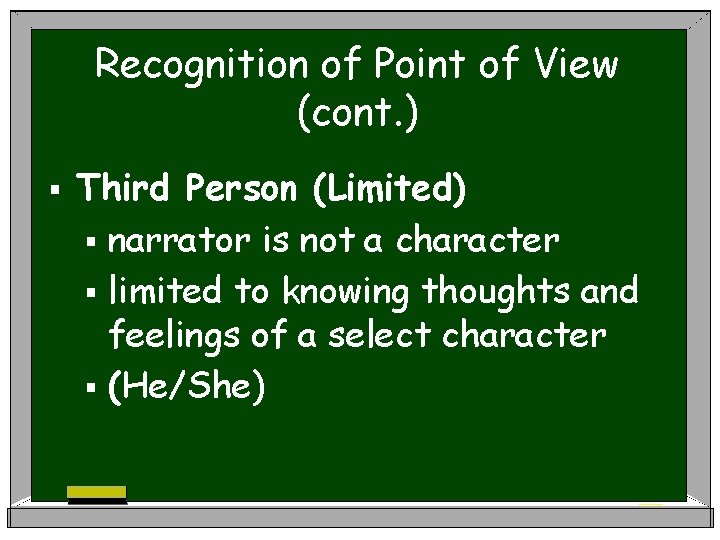
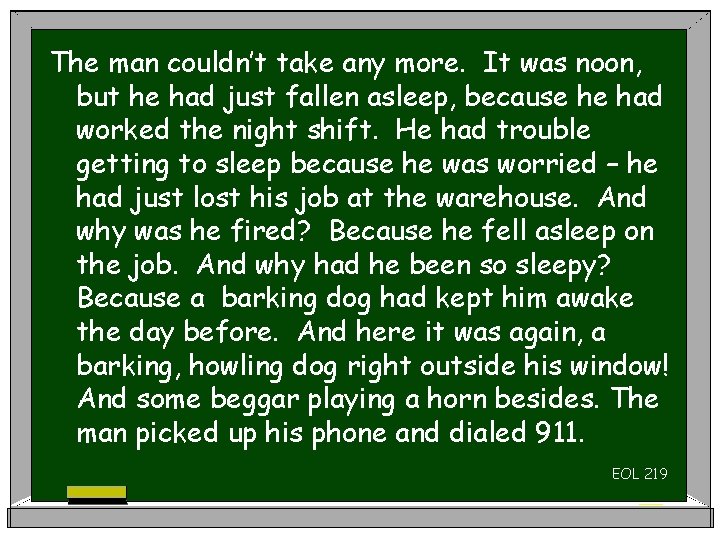
Recognition of Point of View (cont. ) § Third Person (Limited) § narrator is not a character § limited to knowing thoughts and feelings of a select character § (He/She)
The man couldn’t take any more. It was noon, but he had just fallen asleep, because he had worked the night shift. He had trouble getting to sleep because he was worried – he had just lost his job at the warehouse. And why was he fired? Because he fell asleep on the job. And why had he been so sleepy? Because a barking dog had kept him awake the day before. And here it was again, a barking, howling dog right outside his window! And some beggar playing a horn besides. The man picked up his phone and dialed 911. EOL 219
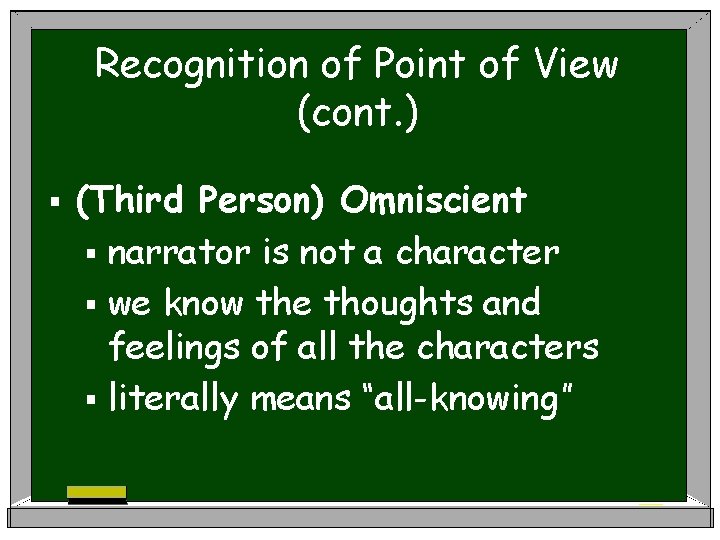
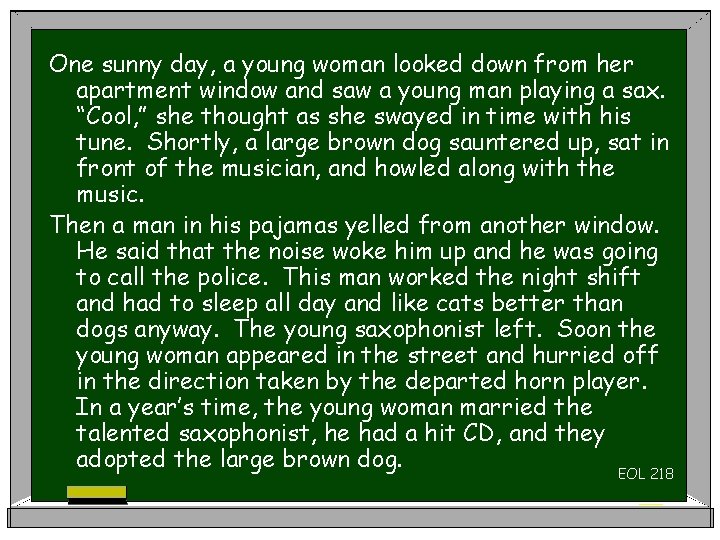
Recognition of Point of View (cont. ) § (Third Person) Omniscient § narrator is not a character § we know the thoughts and feelings of all the characters § literally means “all-knowing”
One sunny day, a young woman looked down from her apartment window and saw a young man playing a sax. “Cool, ” she thought as she swayed in time with his tune. Shortly, a large brown dog sauntered up, sat in front of the musician, and howled along with the music. Then a man in his pajamas yelled from another window. He said that the noise woke him up and he was going to call the police. This man worked the night shift and had to sleep all day and like cats better than dogs anyway. The young saxophonist left. Soon the young woman appeared in the street and hurried off in the direction taken by the departed horn player. In a year’s time, the young woman married the talented saxophonist, he had a hit CD, and they adopted the large brown dog. EOL 218
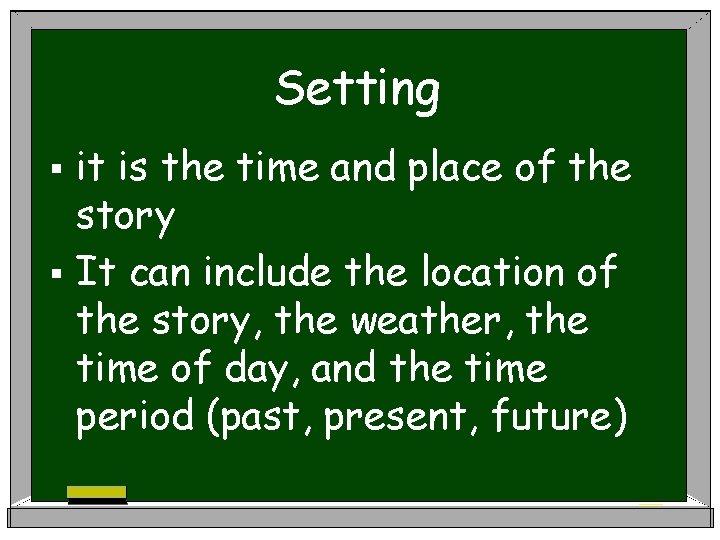
Setting it is the time and place of the story § It can include the location of the story, the weather, the time of day, and the time period (past, present, future) §
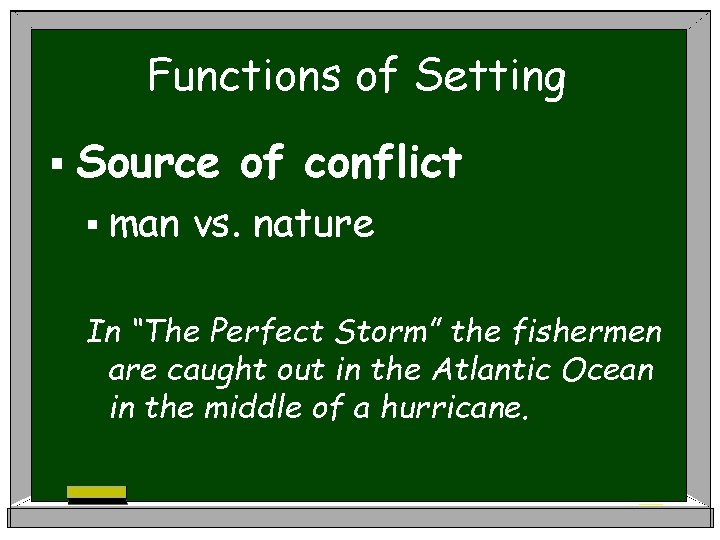
Functions of Setting § Source § man of conflict vs. nature In “The Perfect Storm” the fishermen are caught out in the Atlantic Ocean in the middle of a hurricane.
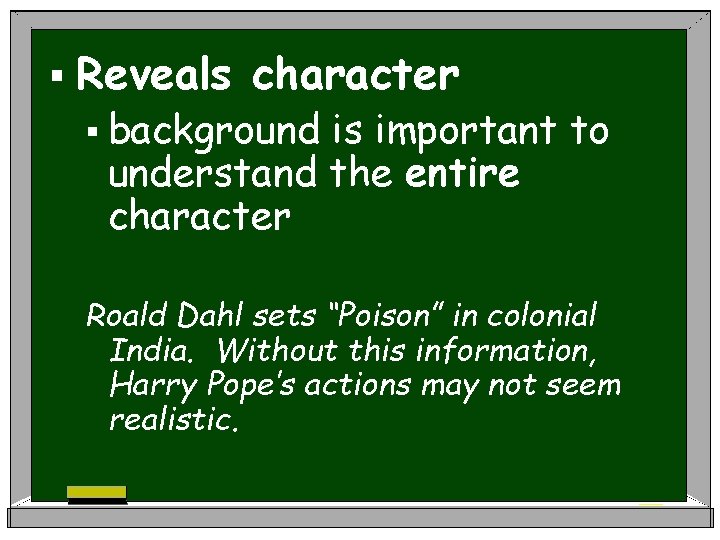
§ Reveals character § background is important to understand the entire character Roald Dahl sets “Poison” in colonial India. Without this information, Harry Pope’s actions may not seem realistic.
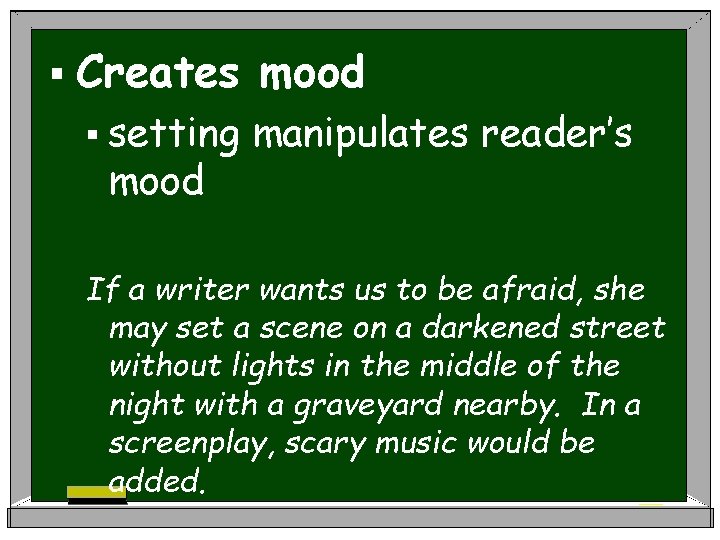
§ Creates § setting mood manipulates reader’s If a writer wants us to be afraid, she may set a scene on a darkened street without lights in the middle of the night with a graveyard nearby. In a screenplay, scary music would be added.
§ Provides § gives background readers a backdrop (frame) for the story Imagine a morning in late November. A coming of winter morning more than twenty years ago. Consider the kitchen of a spreading old house in a country town, with a black stove, a round table, a fireplace with two rocking chairs – and in the fireplace, the season's first roaring fire. “A Christmas Memory”
Irony it is a contradiction of the expected § built on the element of surprise §
Purposes of Irony § Verbal Irony § when you say one thing, but mean something else When your favorite English teacher walks into class Monday morning after a disastrous visit to the hair salon and you say, “Lovely hairdo this morning, Ms. M. ”
§ Situational § when Irony the reader expects one thing to happen, but the opposite occurs From a famous song about the subject “You win the lottery. . . and die the next day”
§ Dramatic Irony § when the audience/reader knows something that the character does not In fairytales like “Little Red Riding Hood” – we know that the “grandma” is really the wolf in disguise, but Little Red Riding Hood does not.
Misc. Terms § Antagonist: character in § Protagonist: the main character conflict with the main character
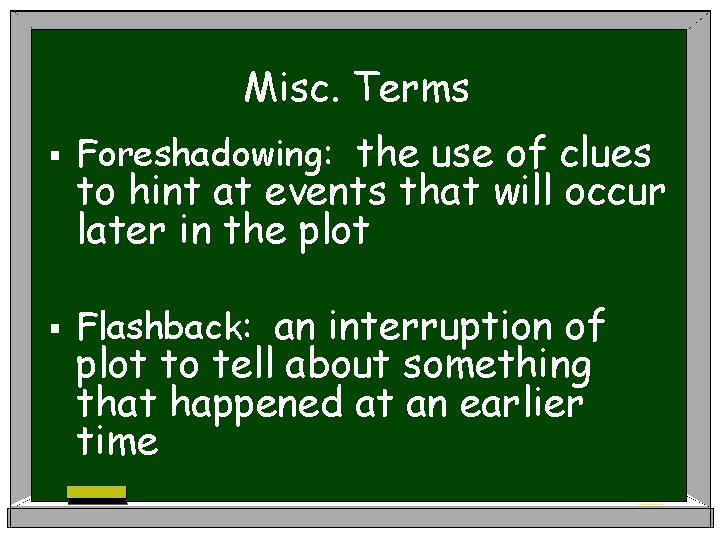
Misc. Terms § Foreshadowing: the use of clues § Flashback: an interruption of to hint at events that will occur later in the plot to tell about something that happened at an earlier time
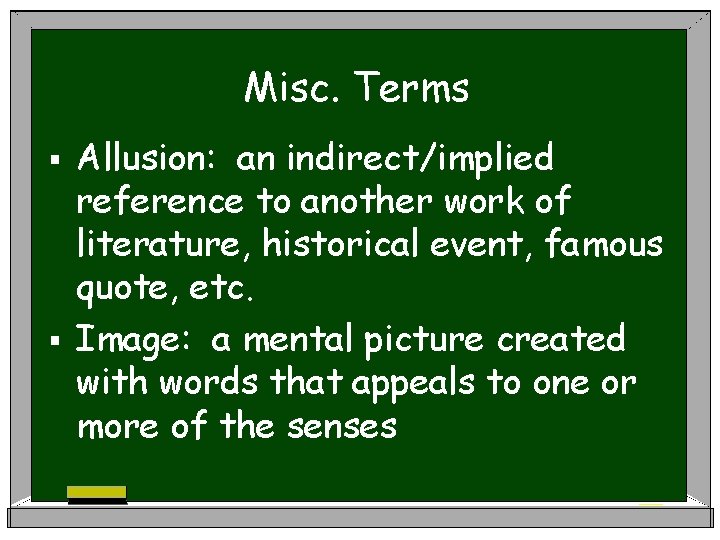
Misc. Terms Allusion: an indirect/implied reference to another work of literature, historical event, famous quote, etc. § Image: a mental picture created with words that appeals to one or more of the senses §
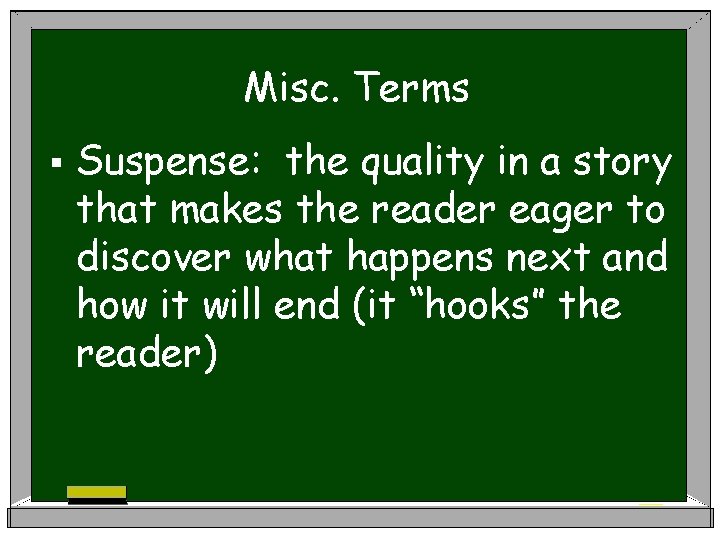
Misc. Terms § Suspense: the quality in a story that makes the reader eager to discover what happens next and how it will end (it “hooks” the reader)