
Elements of Modern Algebra L Gilbert and J
課 本 • 書名: Elements of Modern Algebra • 作者: L. Gilbert and J. Gilbert
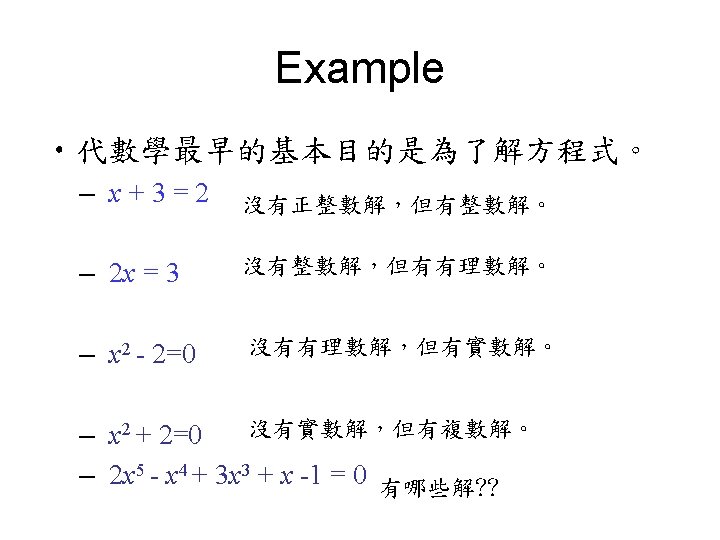
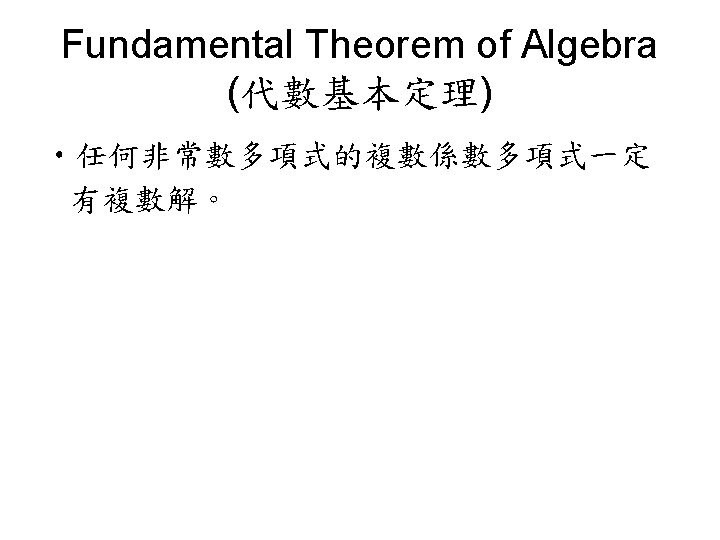
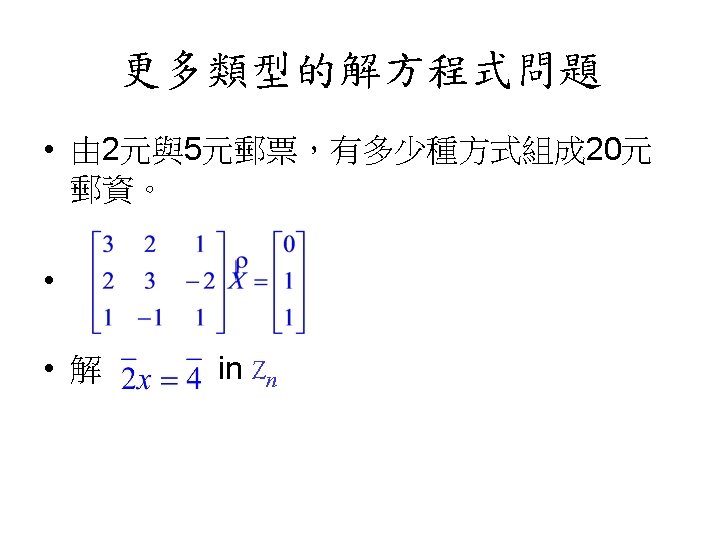
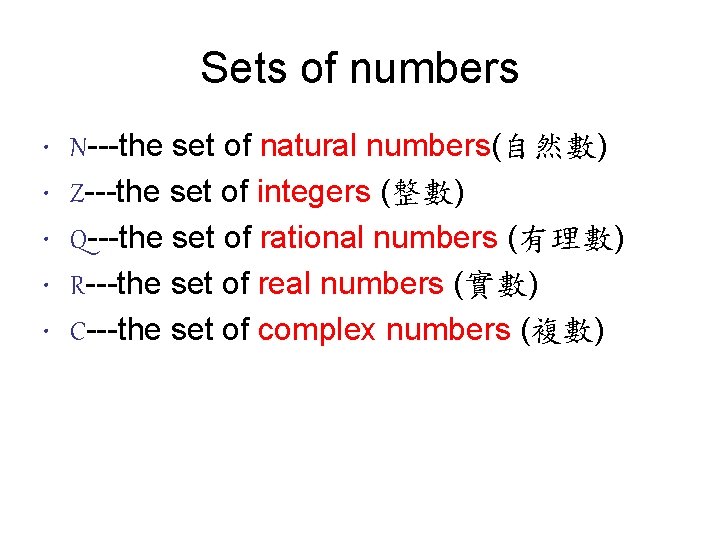
Sets of numbers • • • N---the set of natural numbers(自然數) Z---the set of integers (整數) Q---the set of rational numbers (有理數) R---the set of real numbers (實數) C---the set of complex numbers (複數)
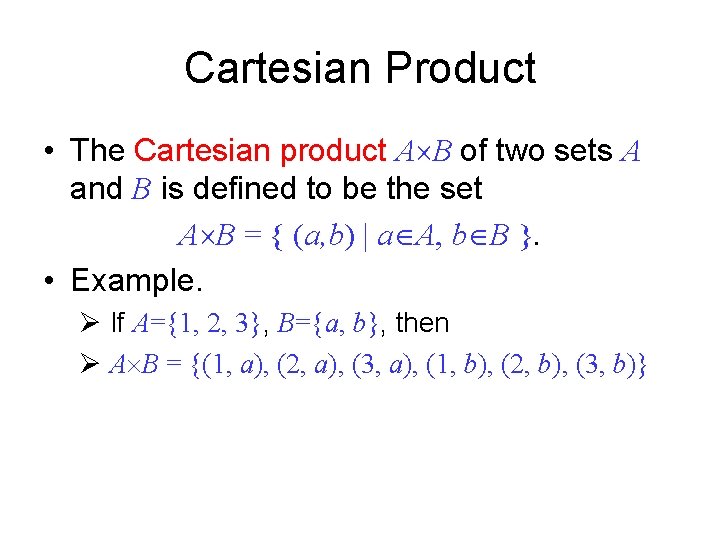
Cartesian Product • The Cartesian product A B of two sets A and B is defined to be the set A B = { (a, b) | a A, b B }. • Example. Ø If A={1, 2, 3}, B={a, b}, then Ø A B = {(1, a), (2, a), (3, a), (1, b), (2, b), (3, b)}

Mapping • If A and B are two sets, a mapping from A to B, written : A B, is a subset of A B such that for each a A, exactly one element b B, (a, b) ={(1, b), (2, a), (3, a)} A={1, 2, 3} 1 2 3 a B={a, b} b
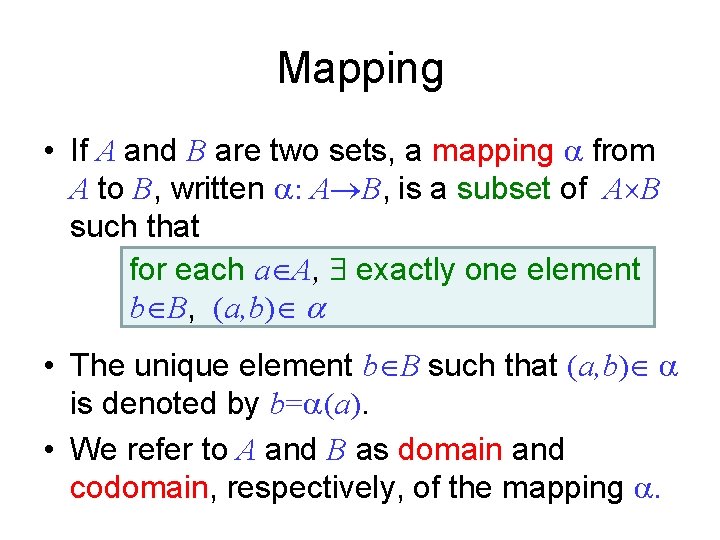
Mapping • If A and B are two sets, a mapping from A to B, written : A B, is a subset of A B such that for each a A, exactly one element b B, (a, b) • The unique element b B such that (a, b) is denoted by b= (a). • We refer to A and B as domain and codomain, respectively, of the mapping .
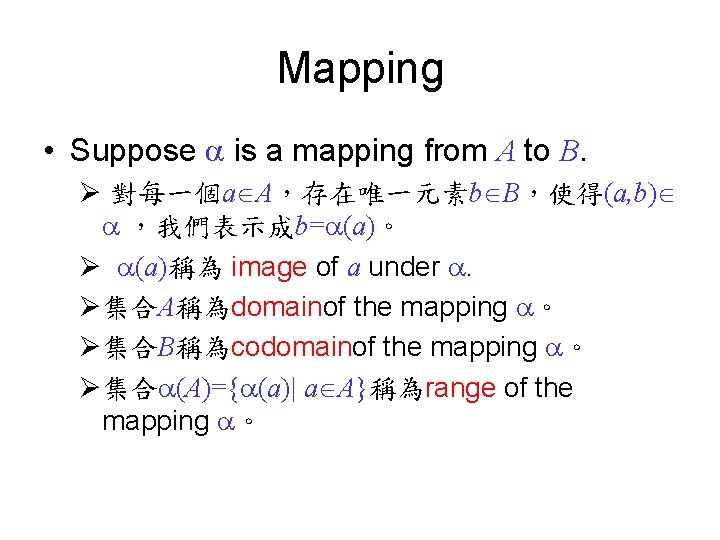
Mapping • Suppose is a mapping from A to B. Ø 對每一個a A,存在唯一元素b B,使得(a, b) ,我們表示成b= (a)。 Ø (a)稱為 image of a under . Ø集合A稱為domainof the mapping 。 Ø集合B稱為codomainof the mapping 。 Ø集合 (A)={ (a)| a A}稱為range of the mapping 。
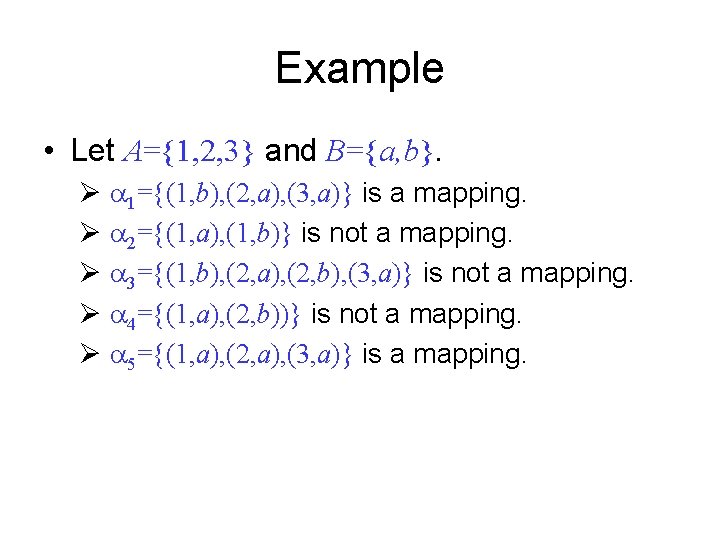
Example • Let A={1, 2, 3} and B={a, b}. Ø 1={(1, b), (2, a), (3, a)} is a mapping. Ø 2={(1, a), (1, b)} is not a mapping. Ø 3={(1, b), (2, a), (2, b), (3, a)} is not a mapping. Ø 4={(1, a), (2, b))} is not a mapping. Ø 5={(1, a), (2, a), (3, a)} is a mapping.
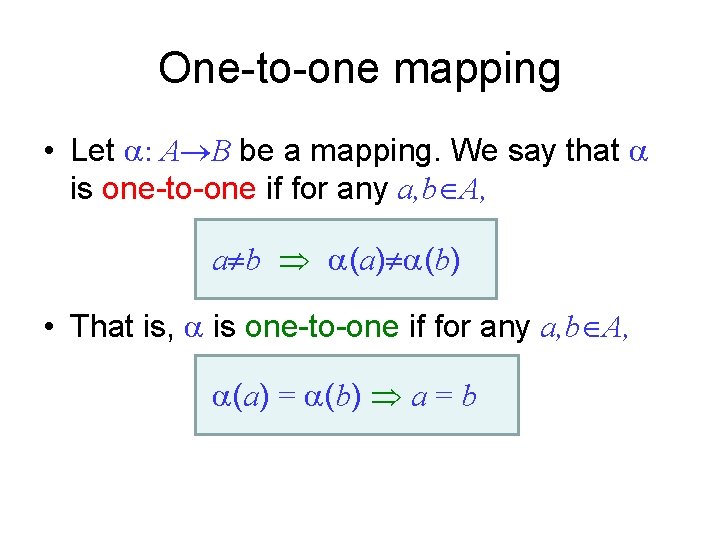
One-to-one mapping • Let : A B be a mapping. We say that is one-to-one if for any a, b A, a b (a) (b) • That is, is one-to-one if for any a, b A, (a) = (b) a = b
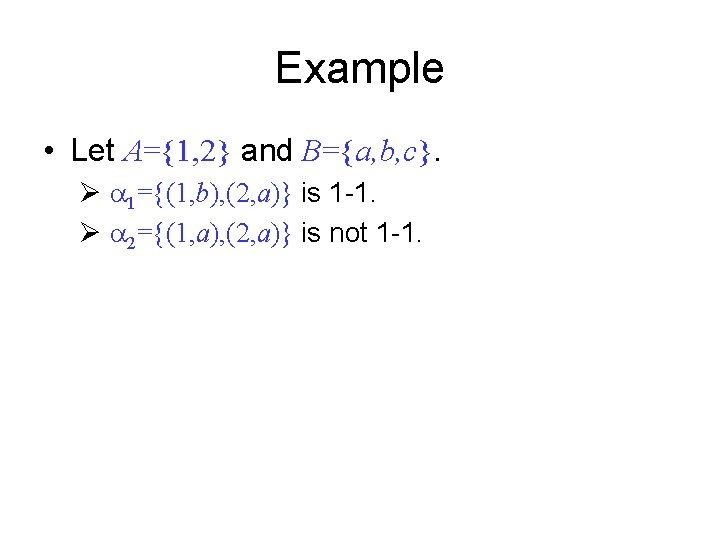
Example • Let A={1, 2} and B={a, b, c}. Ø 1={(1, b), (2, a)} is 1 -1. Ø 2={(1, a), (2, a)} is not 1 -1.
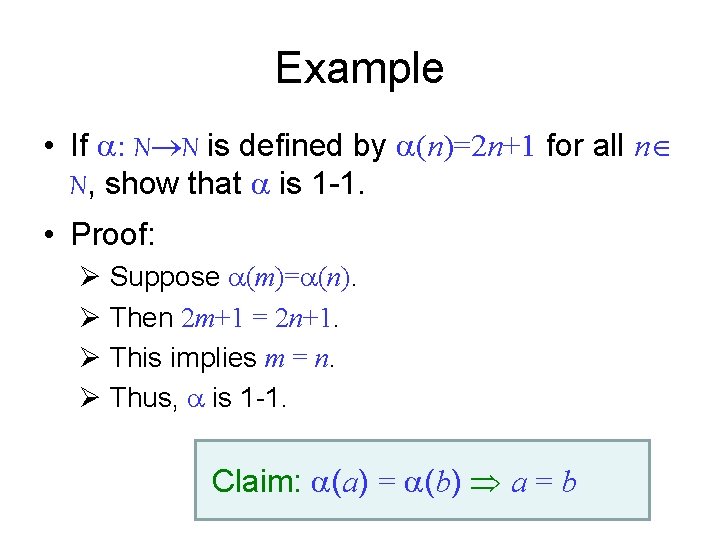
Example • If : N N is defined by (n)=2 n+1 for all n N, show that is 1 -1. • Proof: Ø Suppose (m)= (n). Ø Then 2 m+1 = 2 n+1. Ø This implies m = n. Ø Thus, is 1 -1. Claim: (a) = (b) a = b
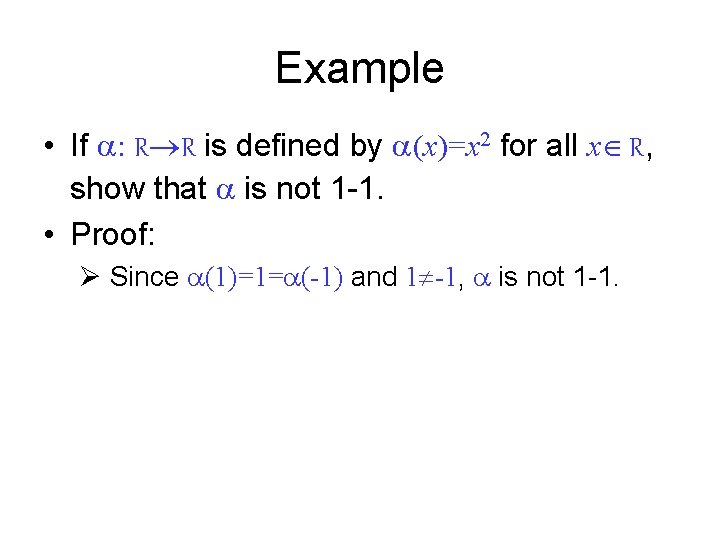
Example • If : R R is defined by (x)=x 2 for all x R, show that is not 1 -1. • Proof: Ø Since (1)=1= (-1) and 1 -1, is not 1 -1.
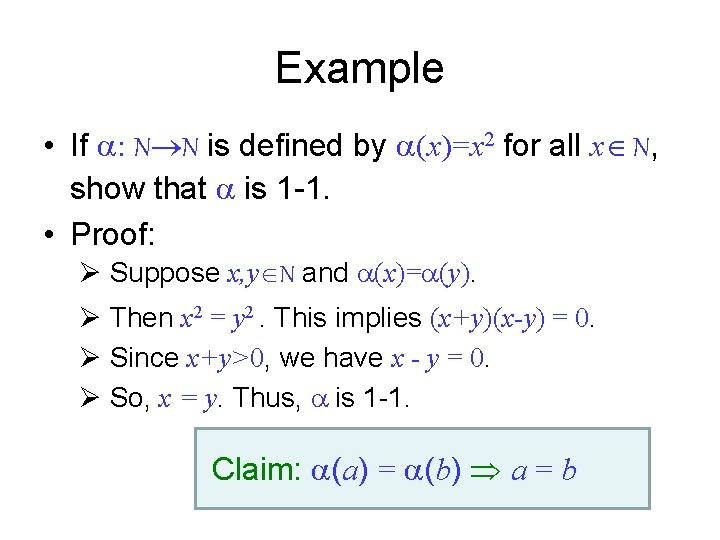
Example • If : N N is defined by (x)=x 2 for all x N, show that is 1 -1. • Proof: Ø Suppose x, y N and (x)= (y). Ø Then x 2 = y 2. This implies (x+y)(x-y) = 0. Ø Since x+y>0, we have x - y = 0. Ø So, x = y. Thus, is 1 -1. Claim: (a) = (b) a = b
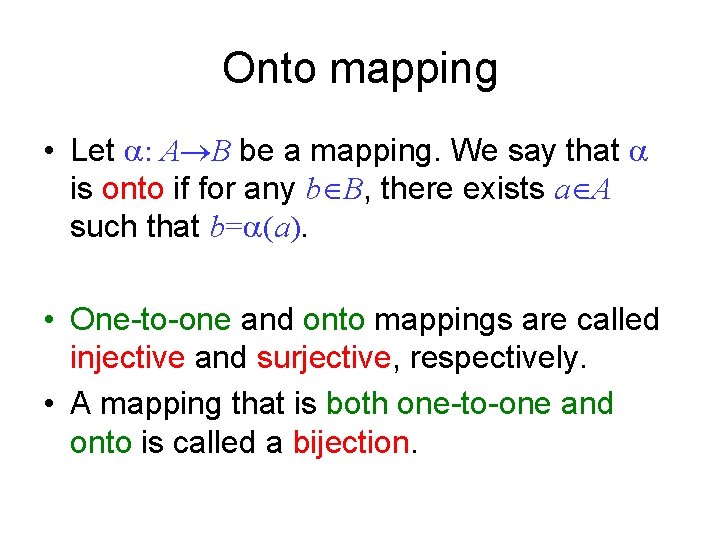
Onto mapping • Let : A B be a mapping. We say that is onto if for any b B, there exists a A such that b= (a). • One-to-one and onto mappings are called injective and surjective, respectively. • A mapping that is both one-to-one and onto is called a bijection.
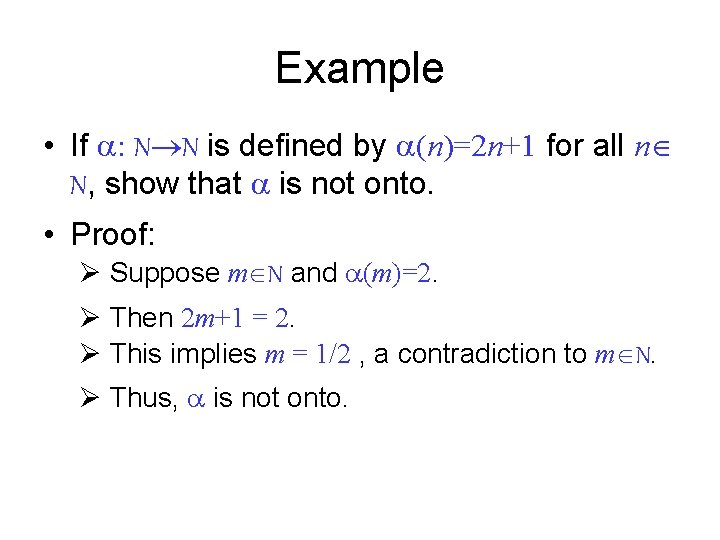
Example • If : N N is defined by (n)=2 n+1 for all n N, show that is not onto. • Proof: Ø Suppose m N and (m)=2. Ø Then 2 m+1 = 2. Ø This implies m = 1/2 , a contradiction to m N. Ø Thus, is not onto.
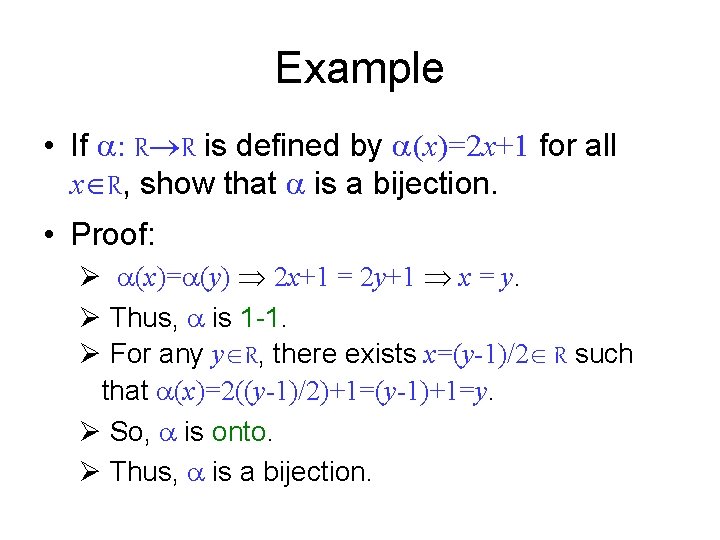
Example • If : R R is defined by (x)=2 x+1 for all x R, show that is a bijection. • Proof: Ø (x)= (y) 2 x+1 = 2 y+1 x = y. Ø Thus, is 1 -1. Ø For any y R, there exists x=(y-1)/2 R such that (x)=2((y-1)/2)+1=(y-1)+1=y. Ø So, is onto. Ø Thus, is a bijection.
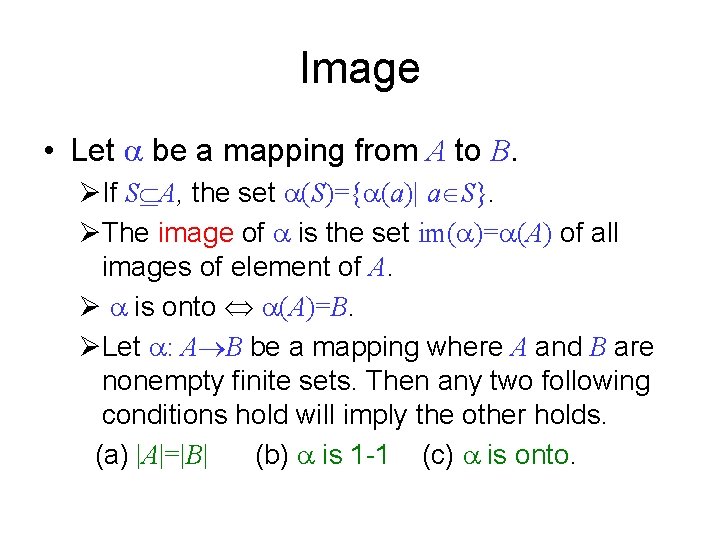
Image • Let be a mapping from A to B. ØIf S A, the set (S)={ (a)| a S}. ØThe image of is the set im( )= (A) of all images of element of A. Ø is onto (A)=B. ØLet : A B be a mapping where A and B are nonempty finite sets. Then any two following conditions hold will imply the other holds. (a) |A|=|B| (b) is 1 -1 (c) is onto.
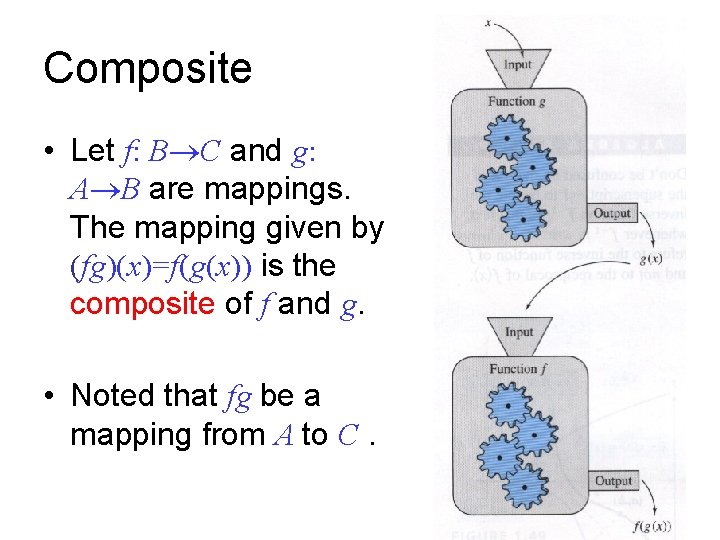
Composite • Let f: B C and g: A B are mappings. The mapping given by (fg)(x)=f(g(x)) is the composite of f and g. • Noted that fg be a mapping from A to C.
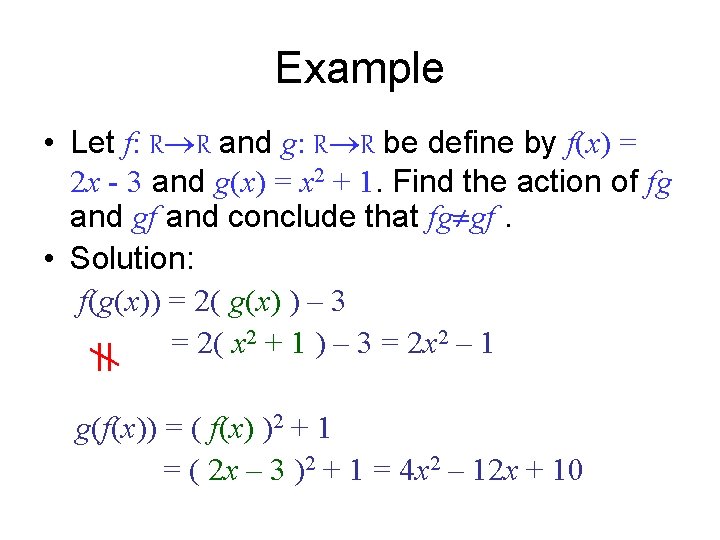
Example • Let f: R R and g: R R be define by f(x) = 2 x - 3 and g(x) = x 2 + 1. Find the action of fg and gf and conclude that fg gf. • Solution: f(g(x)) = 2( g(x) ) – 3 = 2( x 2 + 1 ) – 3 = 2 x 2 – 1 g(f(x)) = ( f(x) )2 + 1 = ( 2 x – 3 )2 + 1 = 4 x 2 – 12 x + 10
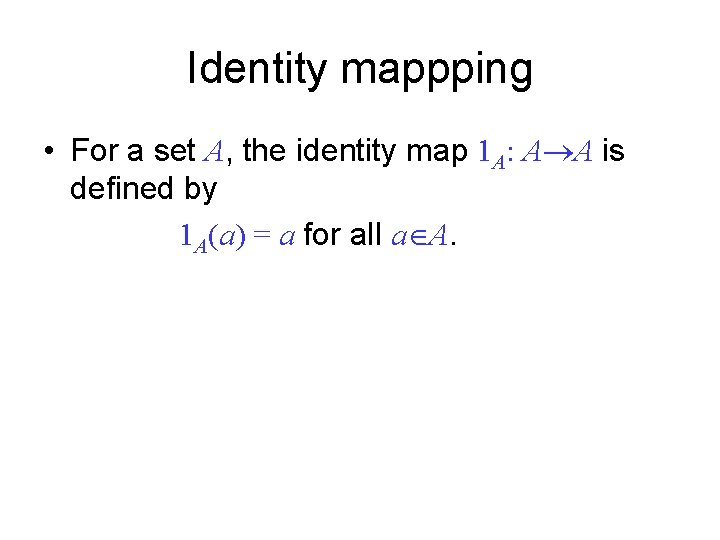
Identity mappping • For a set A, the identity map 1 A: A A is defined by 1 A(a) = a for all a A.
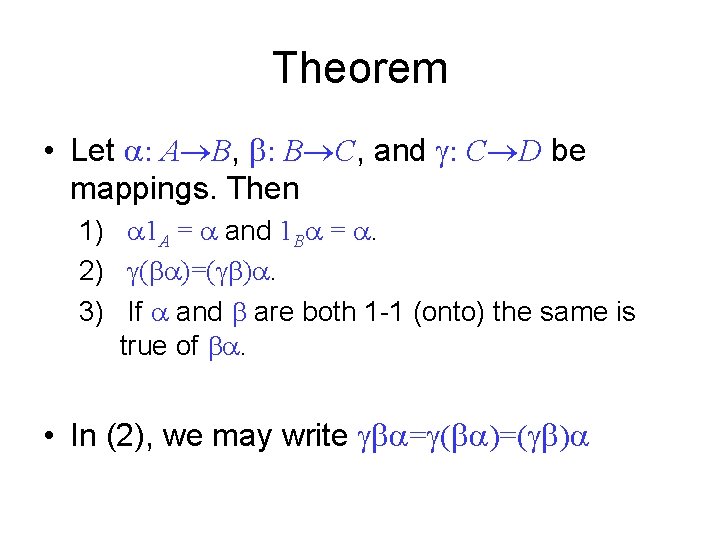
Theorem • Let : A B, : B C, and : C D be mappings. Then 1) 1 A = and 1 B = . 2) ( )=( ). 3) If and are both 1 -1 (onto) the same is true of . • In (2), we may write = ( )=( )
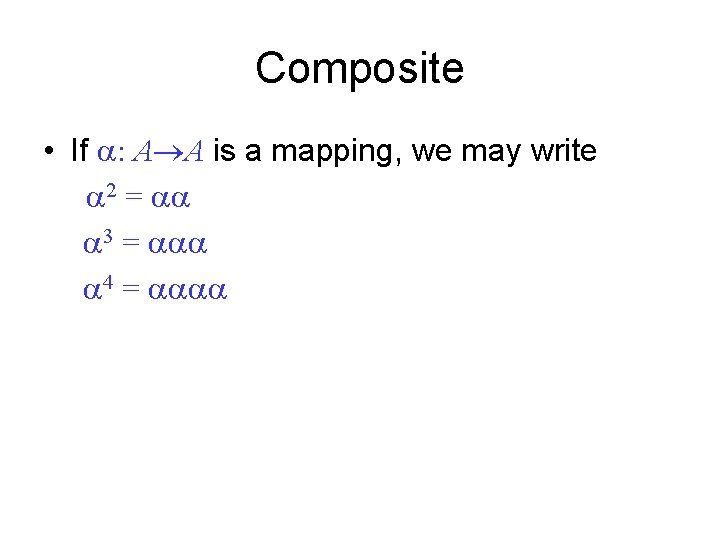
Composite • If : A A is a mapping, we may write 2 = 3 = 4 =
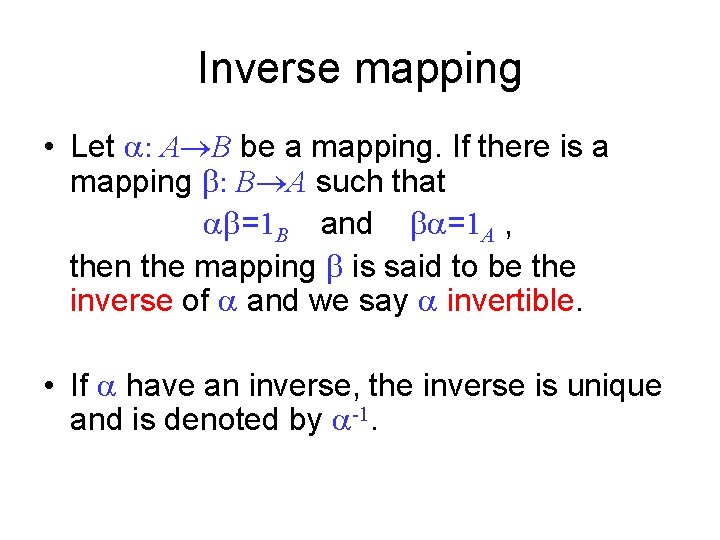
Inverse mapping • Let : A B be a mapping. If there is a mapping : B A such that =1 B and =1 A , then the mapping is said to be the inverse of and we say invertible. • If have an inverse, the inverse is unique and is denoted by -1.
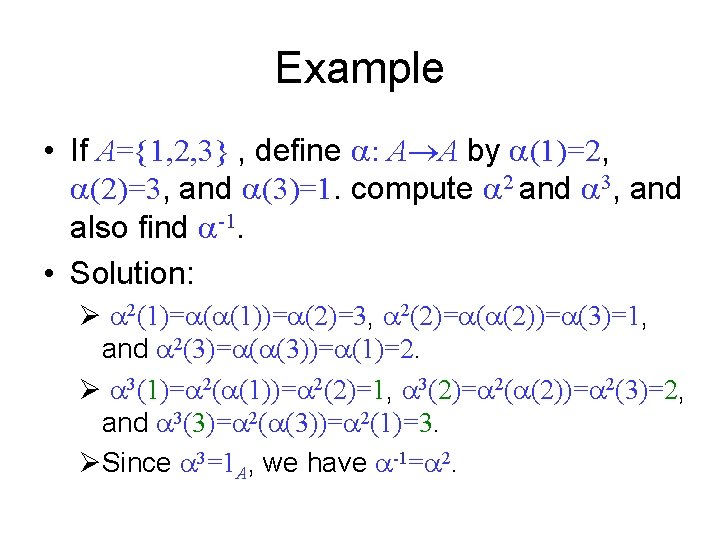
Example • If A={1, 2, 3} , define : A A by (1)=2, (2)=3, and (3)=1. compute 2 and 3, and also find -1. • Solution: Ø 2(1)= ( (1))= (2)=3, 2(2)= ( (2))= (3)=1, and 2(3)= ( (3))= (1)=2. Ø 3(1)= 2( (1))= 2(2)=1, 3(2)= 2( (2))= 2(3)=2, and 3(3)= 2( (3))= 2(1)=3. ØSince 3=1 A, we have -1= 2.
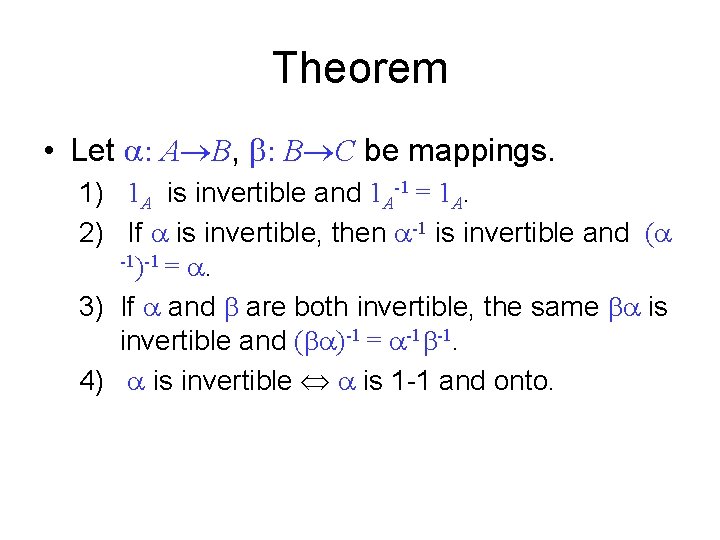
Theorem • Let : A B, : B C be mappings. 1) 1 A is invertible and 1 A-1 = 1 A. 2) If is invertible, then -1 is invertible and ( -1)-1 = . 3) If and are both invertible, the same is invertible and ( )-1 = -1 -1. 4) is invertible is 1 -1 and onto.
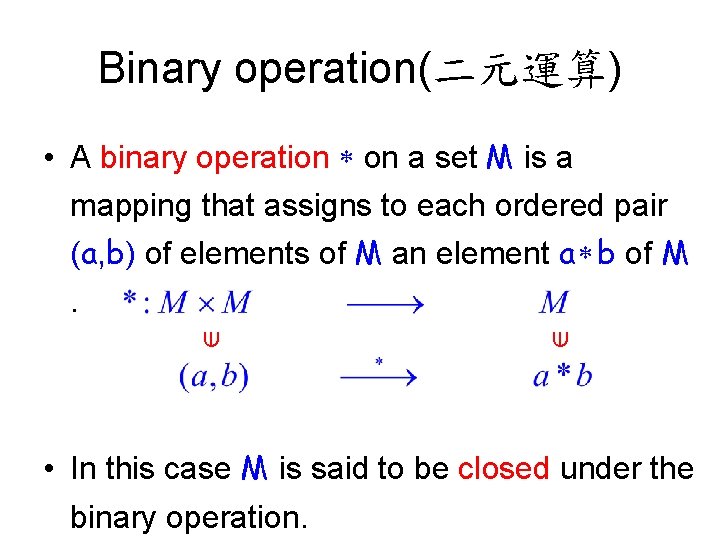
Binary operation(二元運算) • A binary operation on a set M is a mapping that assigns to each ordered pair (a, b) of elements of M an element a b of M . • In this case M is said to be closed under the binary operation.


Example • Some examples of binary operations on Z 1. x y=x+y-2 for (x, y) Z Z 2. x y=1+xy for (x, y) Z Z. • The defined by n m=nm is a binary operation on N.
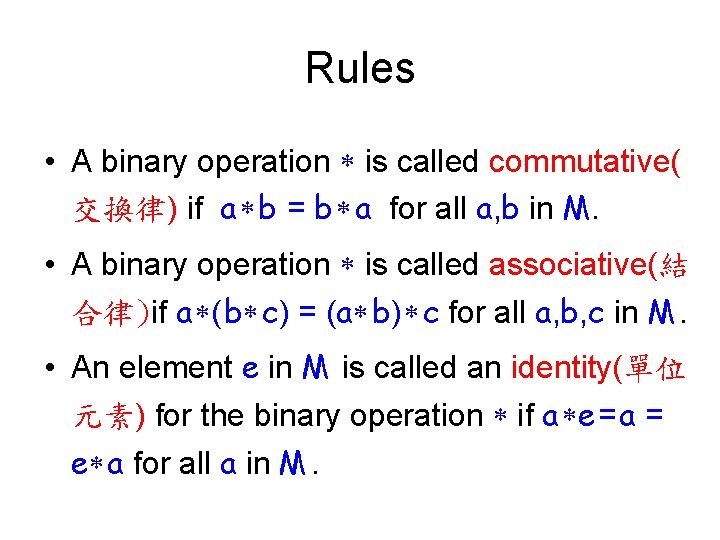
Rules • A binary operation is called commutative( 交換律) if a b = b a for all a, b in M. • A binary operation is called associative(結 合律)if a ( b c) = (a b) c for all a, b, c in M. • An element e in M is called an identity(單位 元素) for the binary operation if a e = a = e a for all a in M.
Example • 一般的”加法”滿足commutative與associative且 0 為identity. • 一般的”乘法”滿足commutative與associative且 1 為identity.

Example • Binary operation x y=x+y-2 on Z – commutative since x y=x+y-2=y+x-2=y x – associative since (x y) z = (x+y-2) z = x+y+z-4 x (y z) = x (y+z-2) = x+y+z-4 – 2 is the identity since x 2=x+2 -2=x and 2 x=2+x-2=x.
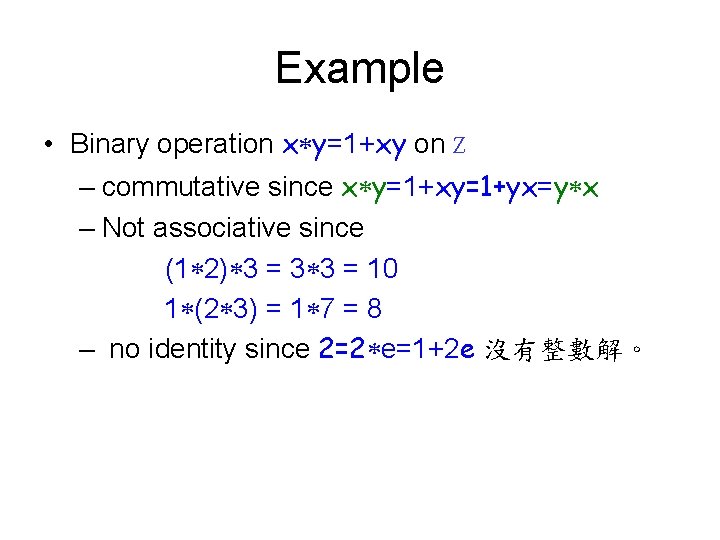
Example • Binary operation x y=1+xy on Z – commutative since x y=1+xy=1+yx=y x – Not associative since (1 2) 3 = 3 3 = 10 1 (2 3) = 1 7 = 8 – no identity since 2=2 e=1+2 e 沒有整數解。
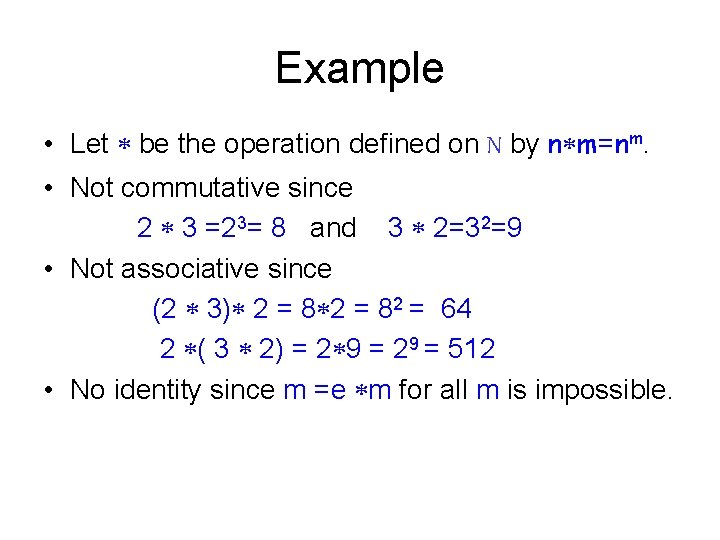
Example • Let be the operation defined on N by n m=nm. • Not commutative since 2 3 =23= 8 and 3 2=32=9 • Not associative since (2 3) 2 = 82 = 64 2 ( 3 2) = 2 9 = 29 = 512 • No identity since m =e m for all m is impossible.
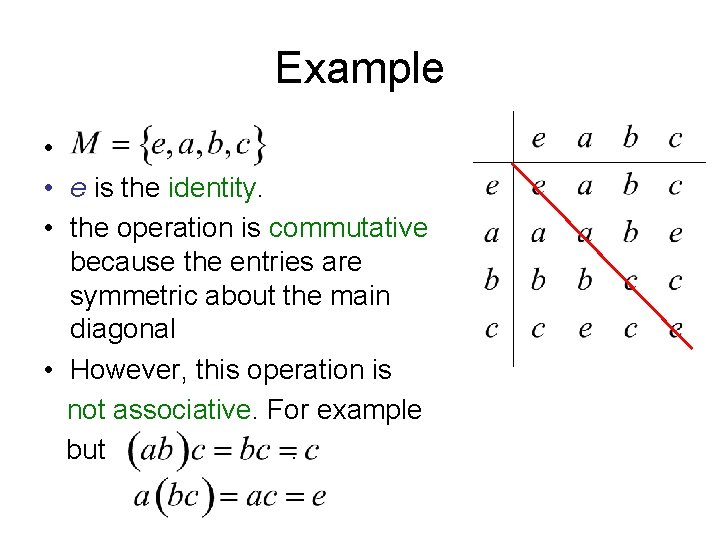
Example • • e is the identity. • the operation is commutative because the entries are symmetric about the main diagonal • However, this operation is not associative. For example but.
Theorem • If a binary operation has an identity, that identity is unique. • Proof: Ø Suppose e and e’ are identities. Ø e’ = e e’ because e is an identity. Ø e = e e’ because e’ is an identity. Ø Hence e’ = e.
inverse • Suppose is a binary operation with identity e on the set A and a A. If there exists an element b A such that – ab=1, then b is called a right inverse of a. – ba=1, then b is called a left inverse of a. – ab=1=ba, then b is called an inverse of a • If a has an inverse, then a is called an invertible element of A.
Relation • If A is a set, a subset * of A×A is called a relation on A. • We write a*b to mean (a, b) is an element of *.
Definition • A relation R on a set A is called reflexive if for all x A, (x, x) R.
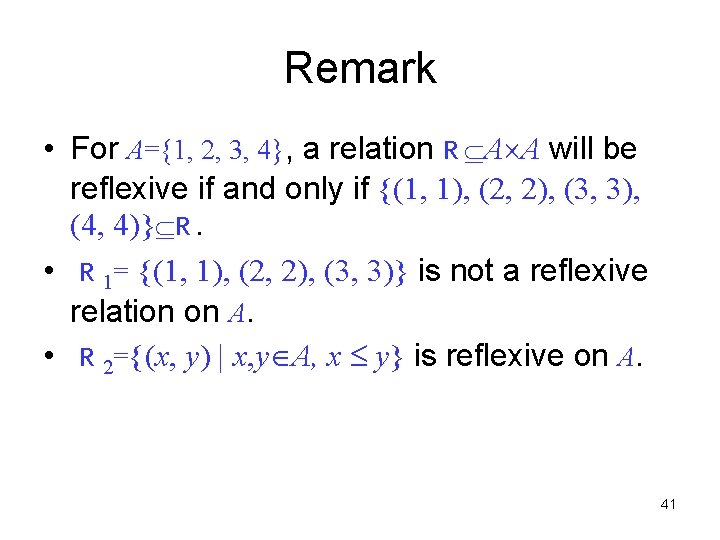
Remark • For A={1, 2, 3, 4}, a relation R A A will be reflexive if and only if {(1, 1), (2, 2), (3, 3), (4, 4)} R. • R 1= {(1, 1), (2, 2), (3, 3)} is not a reflexive relation on A. • R 2={(x, y) | x, y A, x y} is reflexive on A. 41
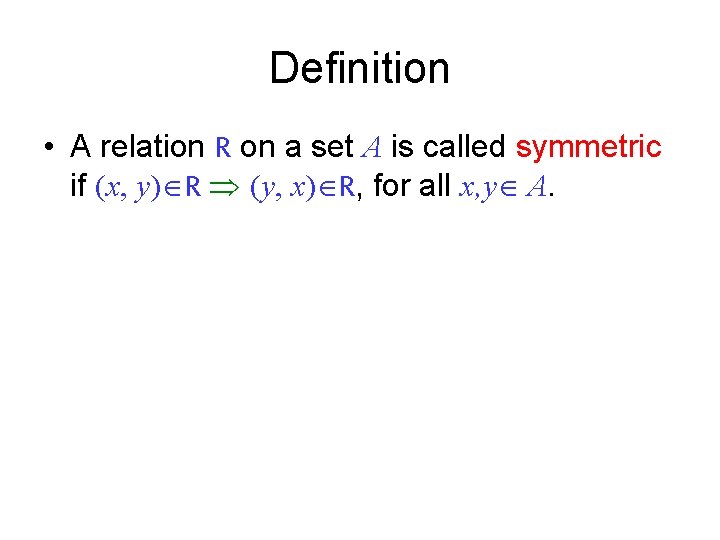
Definition • A relation R on a set A is called symmetric if (x, y) R (y, x) R, for all x, y A.
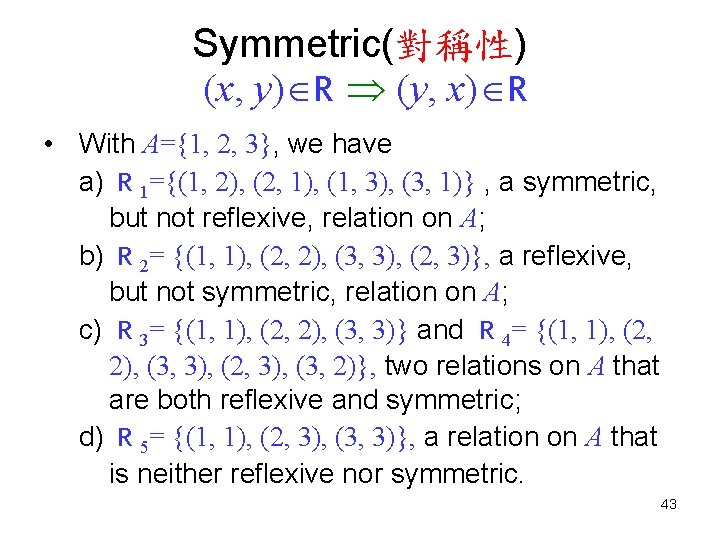
Symmetric(對稱性) (x, y) R (y, x) R • With A={1, 2, 3}, we have a) R 1={(1, 2), (2, 1), (1, 3), (3, 1)} , a symmetric, but not reflexive, relation on A; b) R 2= {(1, 1), (2, 2), (3, 3), (2, 3)}, a reflexive, but not symmetric, relation on A; c) R 3= {(1, 1), (2, 2), (3, 3)} and R 4= {(1, 1), (2, 2), (3, 3), (2, 3), (3, 2)}, two relations on A that are both reflexive and symmetric; d) R 5= {(1, 1), (2, 3), (3, 3)}, a relation on A that is neither reflexive nor symmetric. 43
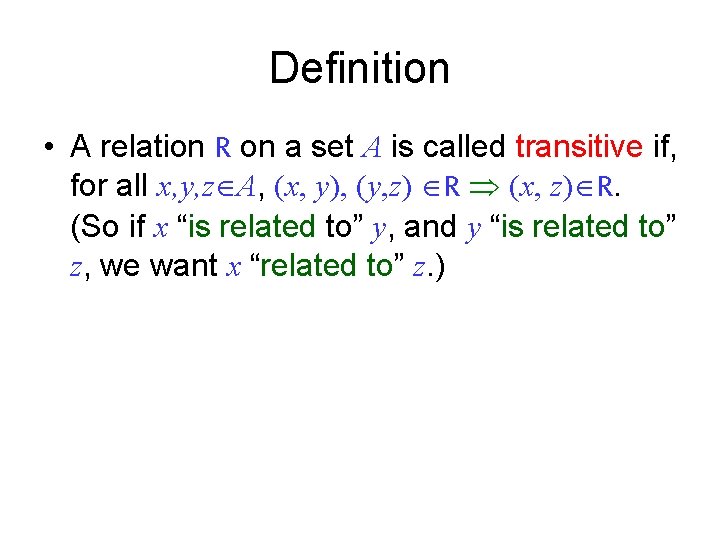
Definition • A relation R on a set A is called transitive if, for all x, y, z A, (x, y), (y, z) R (x, z) R. (So if x “is related to” y, and y “is related to” z, we want x “related to” z. )

Transitive(遞移性) (x, y), (y, z) R (x, z) R • • If A={1, 2, 3, 4}, then R 1={(1, 1), (2, 3), (3, 4), (2, 4)} is a transitive relation on A. The relation R 2={(1, 3), (3, 2)} is not transitive because (1, 3), (3, 2) R 2 but (1, 2) R 2. 45
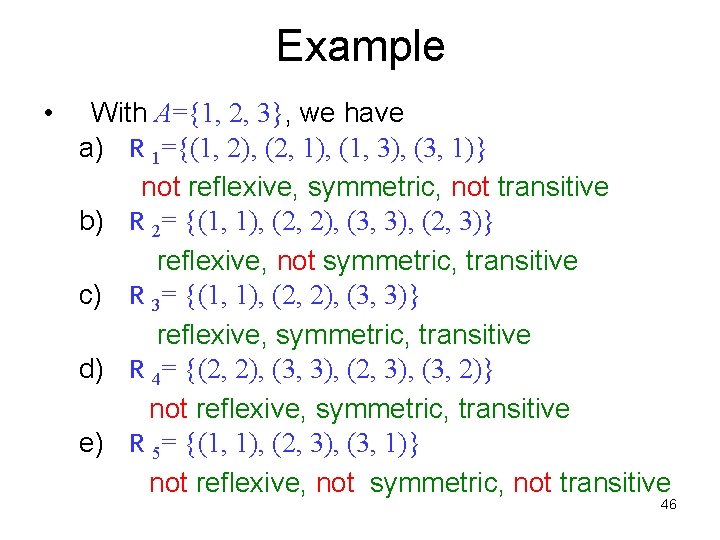
Example • With A={1, 2, 3}, we have a) R 1={(1, 2), (2, 1), (1, 3), (3, 1)} not reflexive, symmetric, not transitive b) R 2= {(1, 1), (2, 2), (3, 3), (2, 3)} reflexive, not symmetric, transitive c) R 3= {(1, 1), (2, 2), (3, 3)} reflexive, symmetric, transitive d) R 4= {(2, 2), (3, 3), (2, 3), (3, 2)} not reflexive, symmetric, transitive e) R 5= {(1, 1), (2, 3), (3, 1)} not reflexive, not symmetric, not transitive 46
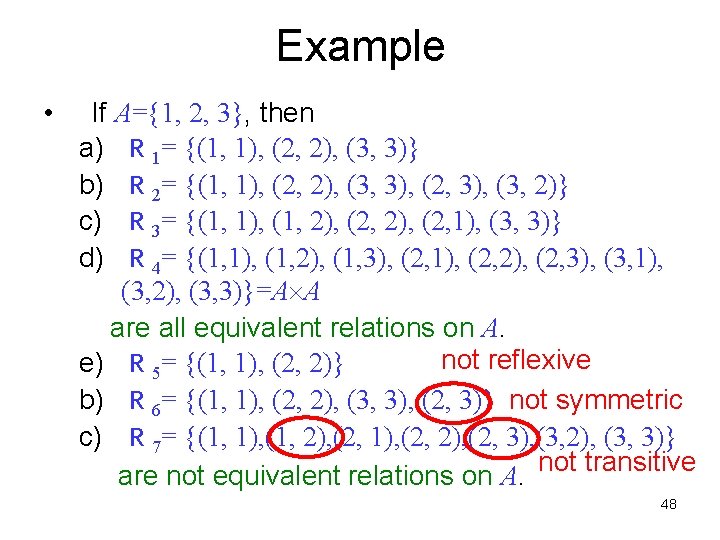
Example • If A={1, 2, 3}, then a) R 1= {(1, 1), (2, 2), (3, 3)} b) R 2= {(1, 1), (2, 2), (3, 3), (2, 3), (3, 2)} c) R 3= {(1, 1), (1, 2), (2, 1), (3, 3)} d) R 4= {(1, 1), (1, 2), (1, 3), (2, 1), (2, 2), (2, 3), (3, 1), (3, 2), (3, 3)}=A A are all equivalent relations on A. not reflexive e) R 5= {(1, 1), (2, 2)} b) R 6= {(1, 1), (2, 2), (3, 3), (2, 3)} not symmetric c) R 7= {(1, 1), (1, 2), (2, 1), (2, 2), (2, 3), (3, 2), (3, 3)} not transitive are not equivalent relations on A. 48
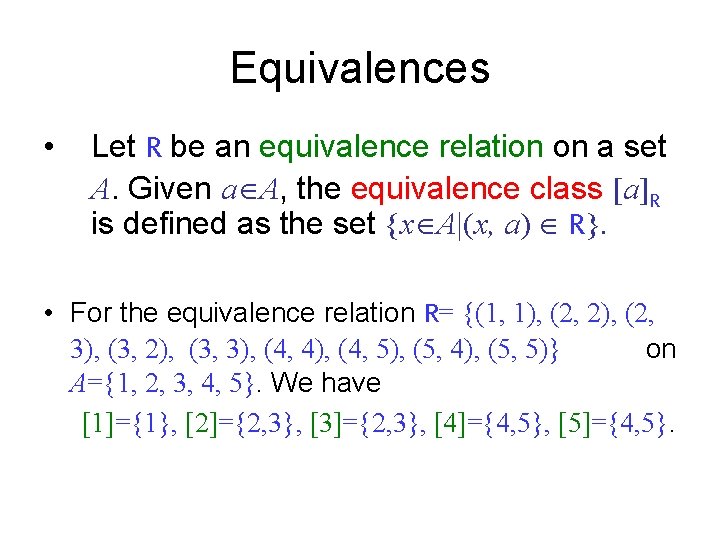
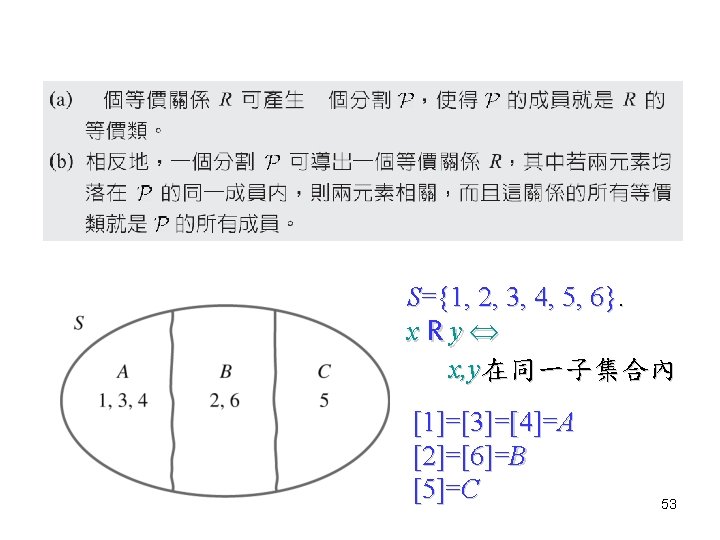
Equivalences • Let R be an equivalence relation on a set A. Given a A, the equivalence class [a]R is defined as the set {x A|(x, a) R}. • For the equivalence relation R= {(1, 1), (2, 2), (2, 3), (3, 2), (3, 3), (4, 4), (4, 5), (5, 4), (5, 5)} on A={1, 2, 3, 4, 5}. We have [1]={1}, [2]={2, 3}, [3]={2, 3}, [4]={4, 5}, [5]={4, 5}.
![定理 • 若R 為定義在集合S上的一個等價關係 (equivalence relation)且x, y S ,則 a) x [x]; b) x](http://slidetodoc.com/presentation_image/3536e510a6cca917654a72b00c71e7a3/image-50.jpg "定理 • 若R 為定義在集合S上的一個等價關係 (equivalence relation)且x, y S ,則 a) x [x]; b) x")
定理 • 若R 為定義在集合S上的一個等價關係 (equivalence relation)且x, y S ,則 a) x [x]; b) x R y if and only if [x]=[y]; c) either [x]=[y] or [x] [y]=. d) If [x] [y] then [x] [y]=. 50
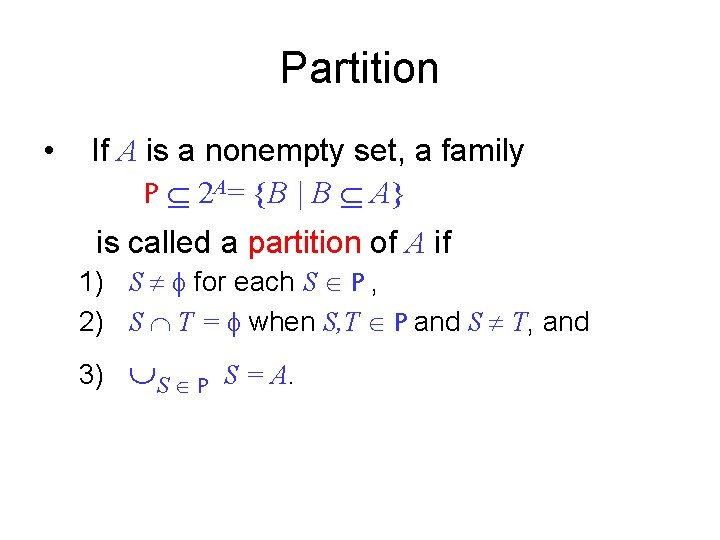
Partition • If A is a nonempty set, a family P 2 A= {B | B A} is called a partition of A if 1) S for each S P , 2) S T = when S, T P and S T, and 3) S P S = A.
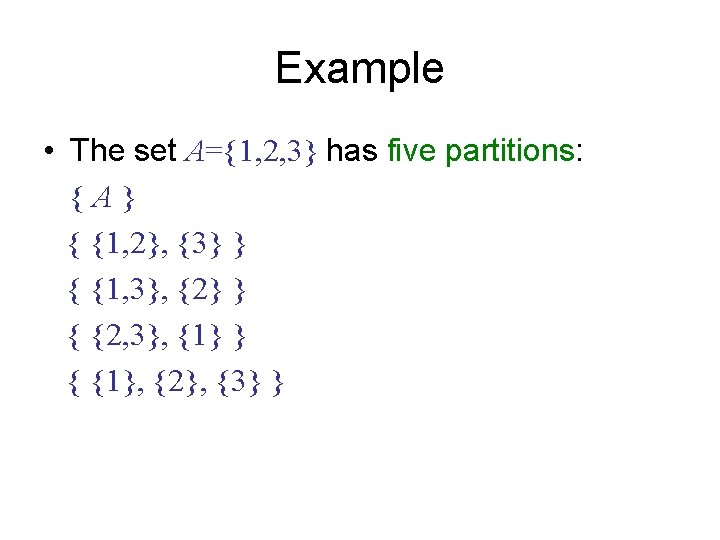
Example • The set A={1, 2, 3} has five partitions: {A} { {1, 2}, {3} } { {1, 3}, {2} } { {2, 3}, {1} } { {1}, {2}, {3} }
- Slides: 53