
Elements of Image Interpretation Class 4 Chapter 5










- Slides: 58
Elements of Image Interpretation Class 4 Chapter 5 Elements of Visual Image Interpretation
Elements of Image Interpretation Chapter 6 Review Quiz Review Mid-Term Jason’s Presentation Lecture Connecticut GIS Ruling Review of Erdas Lab
Elements of Image Interpretation Chapter 6 Review
Block vs Flightline of Vertical Aerial Photography 80 degree turn
Geometry of Overlapping Vertical Aerial Photographs • Principal Points • Conjugate Principle Points
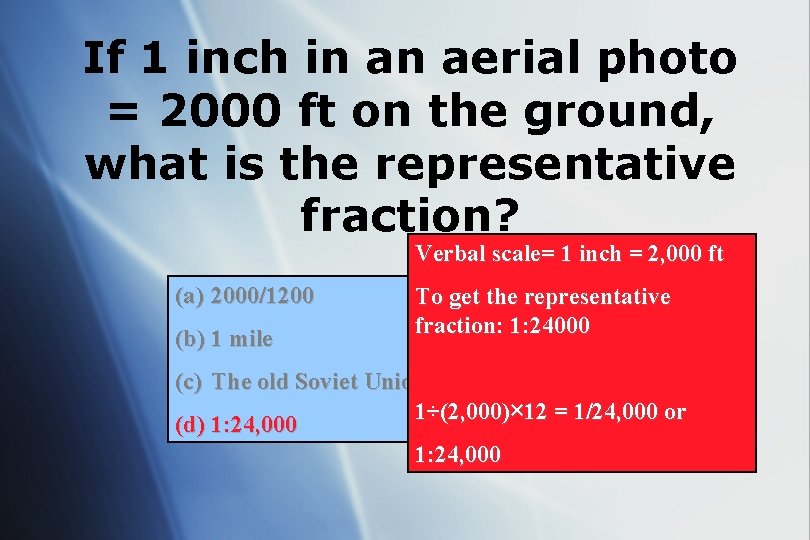
If 1 inch in an aerial photo = 2000 ft on the ground, what is the representative fraction? Verbal scale= 1 inch = 2, 000 ft (a) 2000/1200 (b) 1 mile To get the representative fraction: 1: 24000 (c) The old Soviet Union 1÷(2, 000)× 12 = 1/24, 000 or (d) 1: 24, 000
Triangulation Strangulation
Elements of Image Interpretation Quiz Review
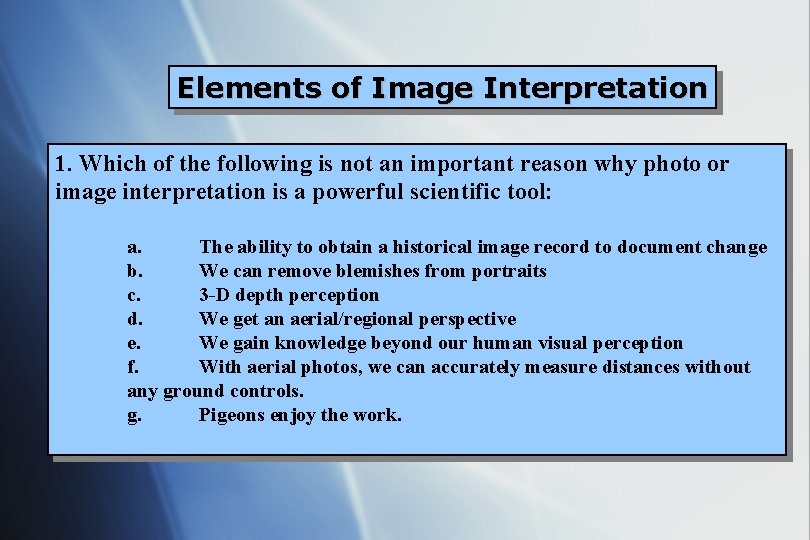
Elements of Image Interpretation 1. Which of the following is not an important reason why photo or image interpretation is a powerful scientific tool: a. The ability to obtain a historical image record to document change b. We can remove blemishes from portraits c. 3 -D depth perception d. We get an aerial/regional perspective e. We gain knowledge beyond our human visual perception f. With aerial photos, we can accurately measure distances without any ground controls. g. Pigeons enjoy the work.
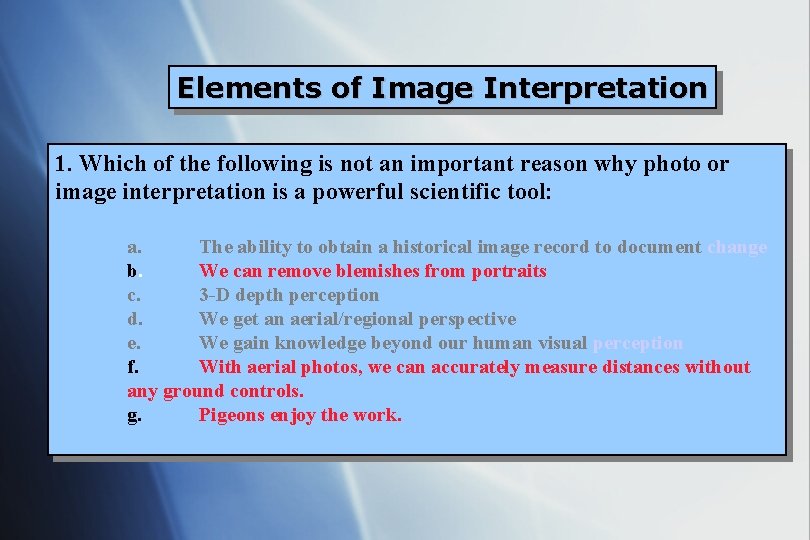
Elements of Image Interpretation 1. Which of the following is not an important reason why photo or image interpretation is a powerful scientific tool: a. The ability to obtain a historical image record to document change b. We can remove blemishes from portraits c. 3 -D depth perception d. We get an aerial/regional perspective e. We gain knowledge beyond our human visual perception f. With aerial photos, we can accurately measure distances without any ground controls. g. Pigeons enjoy the work.
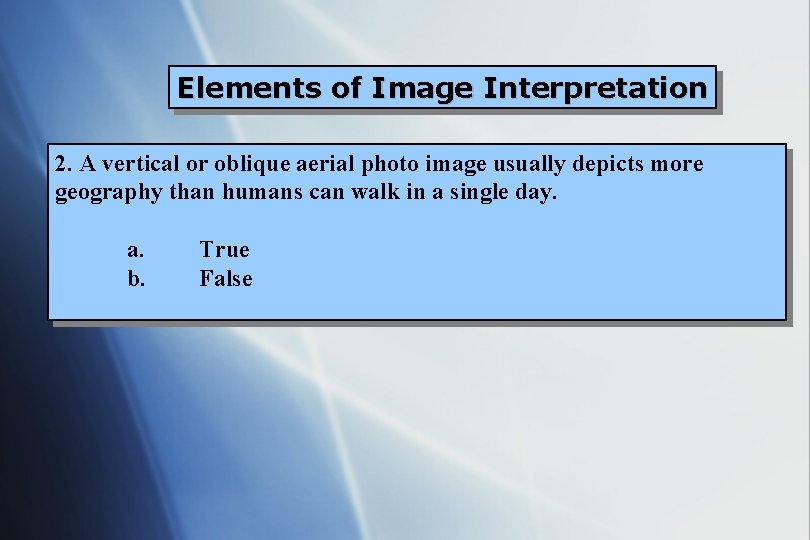
Elements of Image Interpretation 2. A vertical or oblique aerial photo image usually depicts more geography than humans can walk in a single day. a. b. True False
Elements of Image Interpretation 2. A vertical or oblique aerial photo image usually depicts more geography than humans can walk in a single day. a. b. True False
Elements of Image Interpretation 3. At a scale of 1: 63, 360, a single 9 x 9 in vertical aerial photo covers about 81 miles of geography. a. b. True False
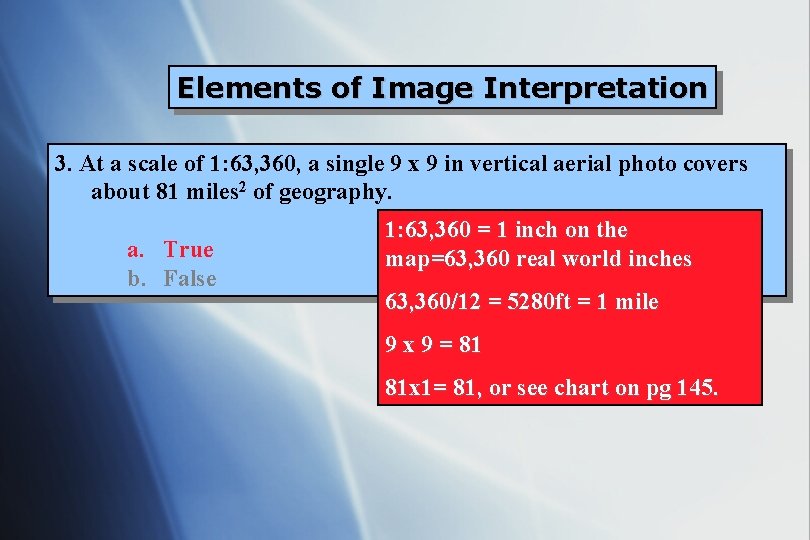
Elements of Image Interpretation 3. At a scale of 1: 63, 360, a single 9 x 9 in vertical aerial photo covers about 81 miles 2 of geography. a. True b. False 1: 63, 360 = 1 inch on the map=63, 360 real world inches 63, 360/12 = 5280 ft = 1 mile 9 x 9 = 81 81 x 1= 81, or see chart on pg 145.
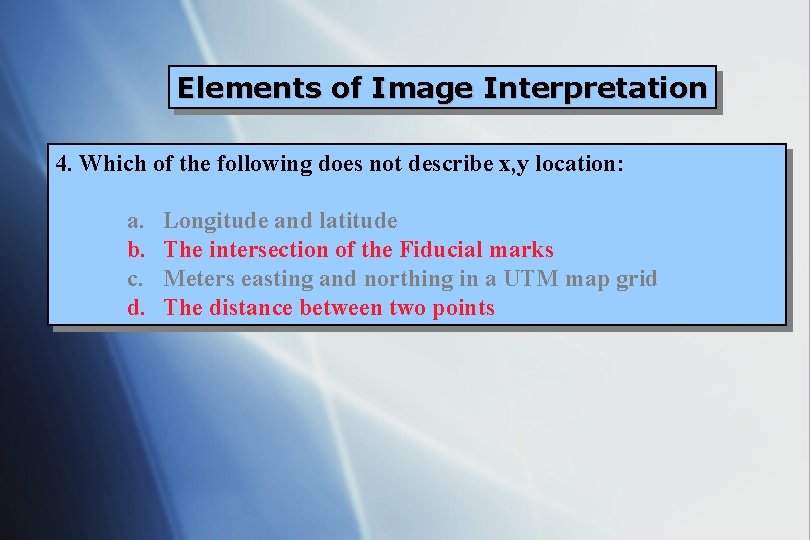
Elements of Image Interpretation 4. Which of the following does not describe x, y location: a. b. c. d. Longitude and latitude The intersection of the Fiducial marks Meters easting and northing in a UTM map grid The distance between two points
Elements of Image Interpretation 4. Which of the following does not describe x, y location: a. b. c. d. Longitude and latitude The intersection of the Fiducial marks Meters easting and northing in a UTM map grid The distance between two points
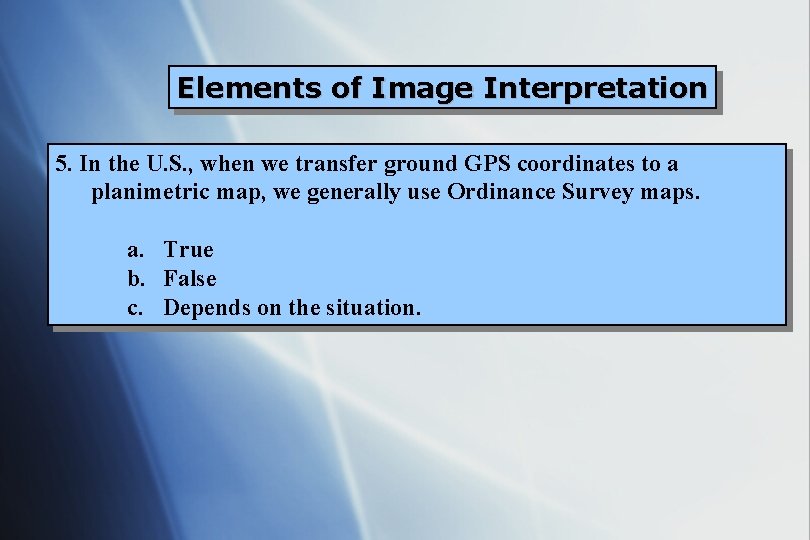
Elements of Image Interpretation 5. In the U. S. , when we transfer ground GPS coordinates to a planimetric map, we generally use Ordinance Survey maps. a. True b. False c. Depends on the situation.
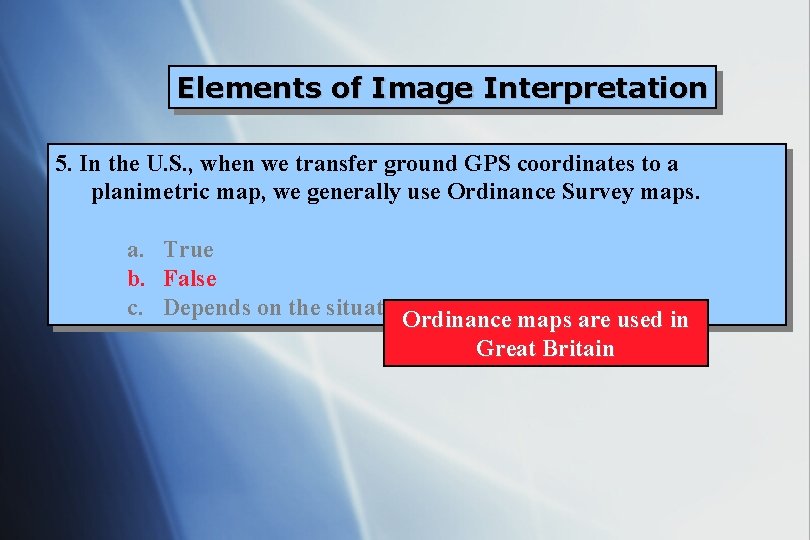
Elements of Image Interpretation 5. In the U. S. , when we transfer ground GPS coordinates to a planimetric map, we generally use Ordinance Survey maps. a. True b. False c. Depends on the situation. Ordinance maps are used in Great Britain
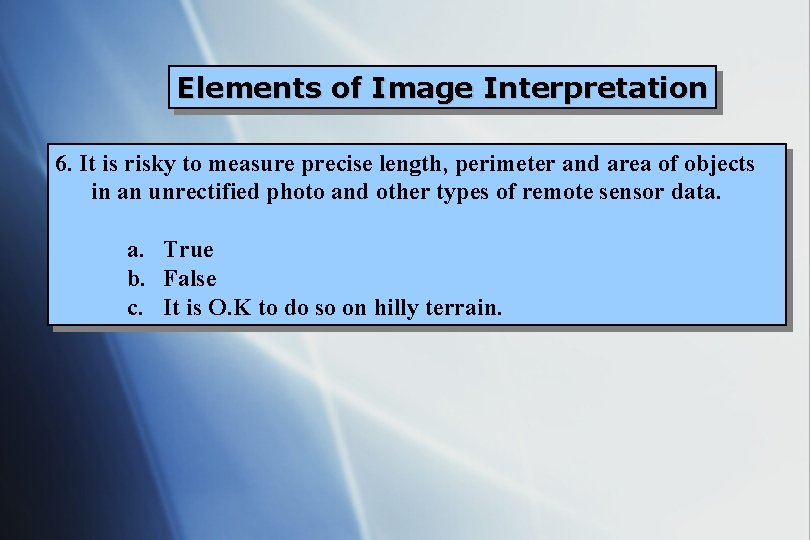
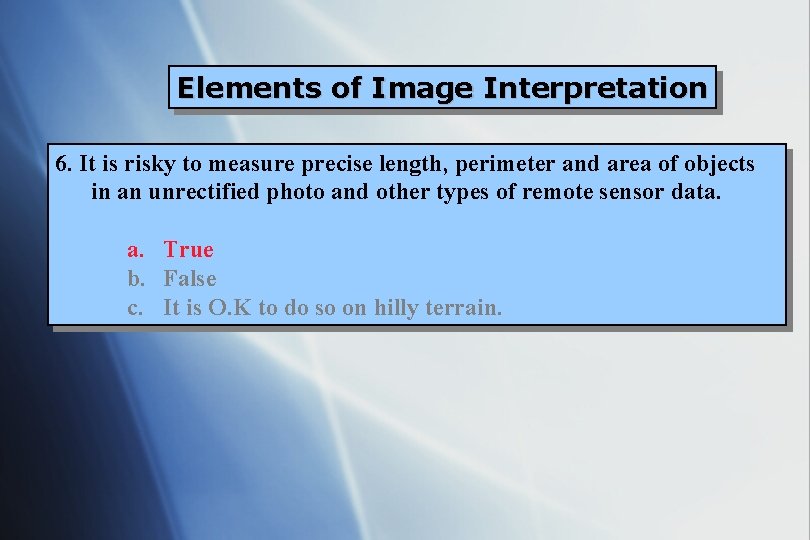
Elements of Image Interpretation 6. It is risky to measure precise length, perimeter and area of objects in an unrectified photo and other types of remote sensor data. a. True b. False c. It is O. K to do so on hilly terrain.
Elements of Image Interpretation 6. It is risky to measure precise length, perimeter and area of objects in an unrectified photo and other types of remote sensor data. a. True b. False c. It is O. K to do so on hilly terrain.
Elements of Image Interpretation 7. The following adjectives describe (a) size, (b) texture, (c) pattern or (d) shape: § § § Linear Curvilinear Circular Elliptical Radial Square Rectangular Triangular Hexagonal Pentagonal Star Amorphous
Elements of Image Interpretation 7. The following adjectives describe (a) size, (b) texture, (c) pattern or (d) shape: § § § Linear Curvilinear Circular Elliptical Radial Square Rectangular Triangular Hexagonal Pentagonal Star Amorphous
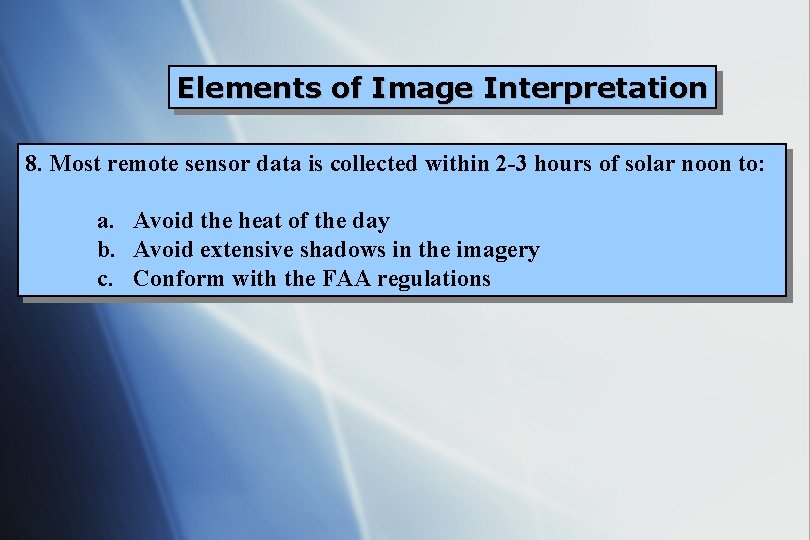
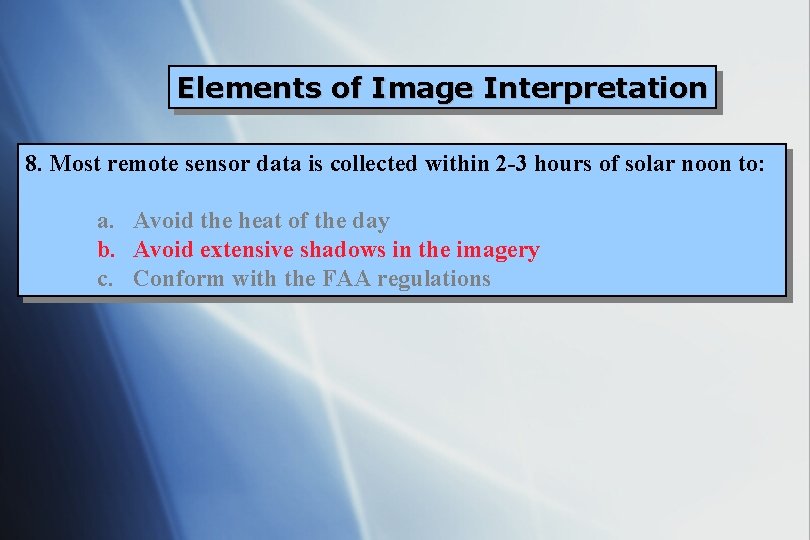
Elements of Image Interpretation 8. Most remote sensor data is collected within 2 -3 hours of solar noon to: a. Avoid the heat of the day b. Avoid extensive shadows in the imagery c. Conform with the FAA regulations
Elements of Image Interpretation 8. Most remote sensor data is collected within 2 -3 hours of solar noon to: a. Avoid the heat of the day b. Avoid extensive shadows in the imagery c. Conform with the FAA regulations
Elements of Image Interpretation 9. Spectral reflectance curves provide insight as to why certain objects appear as they do in black-and-white and color imagery. a. True b. False
Elements of Image Interpretation 9. Spectral reflectance curves provide insight as to why certain objects appear as they do in black-and-white and color imagery. a. True b. False
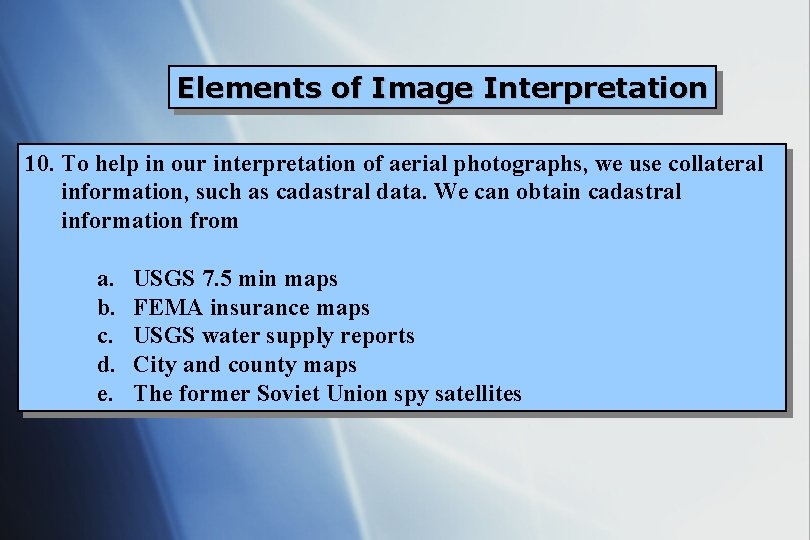
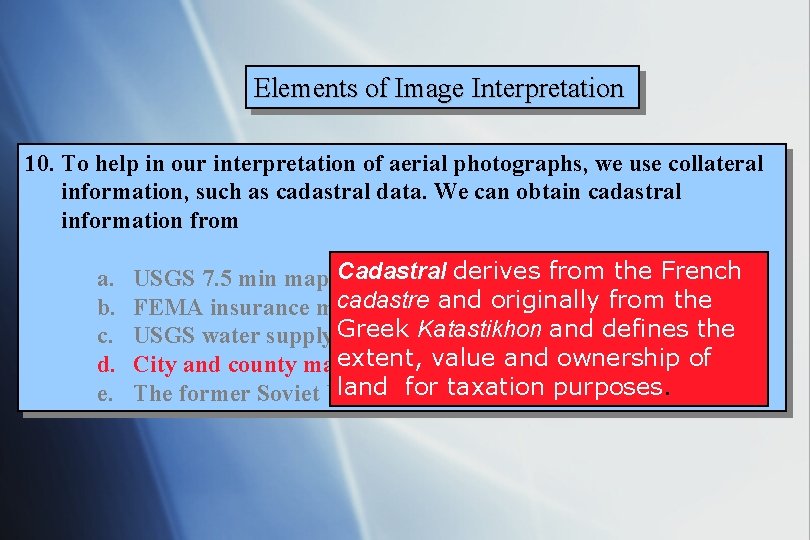
Elements of Image Interpretation 10. To help in our interpretation of aerial photographs, we use collateral information, such as cadastral data. We can obtain cadastral information from a. b. c. d. e. USGS 7. 5 min maps FEMA insurance maps USGS water supply reports City and county maps The former Soviet Union spy satellites
Elements of Image Interpretation 10. To help in our interpretation of aerial photographs, we use collateral information, such as cadastral data. We can obtain cadastral information from a. b. c. d. e. USGS 7. 5 min maps. Cadastral derives from the French cadastre and originally from the FEMA insurance maps USGS water supply Greek reports Katastikhon and defines the extent, value and ownership of City and county maps land spy forsatellites taxation purposes. The former Soviet Union
Review of Mid-Term Exam
5 Jason’s Review of Chapter Five
Elements of Image Interpretation My Review of Chapter 5
Elements of Image Interpretation Photo/image interpretation gives us: § An aerial/regional perspective § 3 -D depth perspectives § Knowledge beyond what we can see as humans § The ability to obtain a historical image record to document change
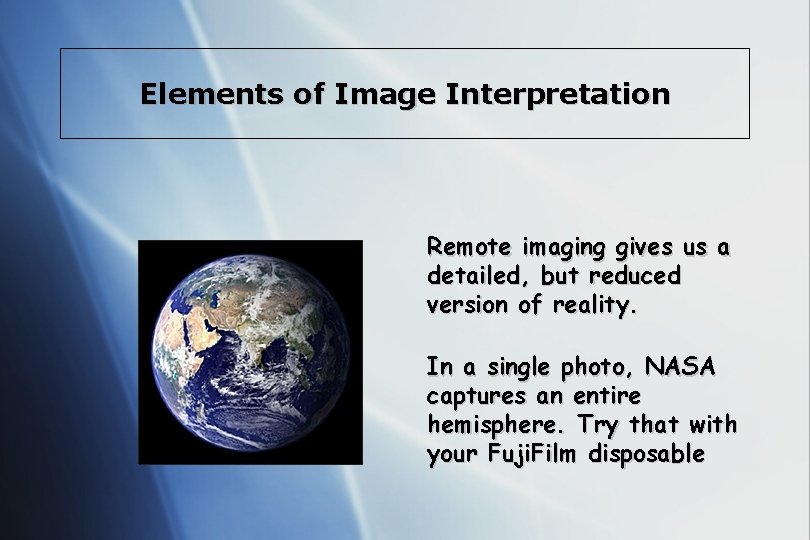
Elements of Image Interpretation Remote imaging gives us a detailed, but reduced version of reality. In a single photo, NASA captures an entire hemisphere. Try that with your Fuji. Film disposable
Elements of Image Interpretation Image interpretation takes us beyond the human visible perception of blue, green and red light. Just because we can’t see it, doesn’t mean it is not there. Sensors can measure X-rays, ultraviolet, near -infrared, mid-infrared, thermal infrared, microwave and radiowave energy.
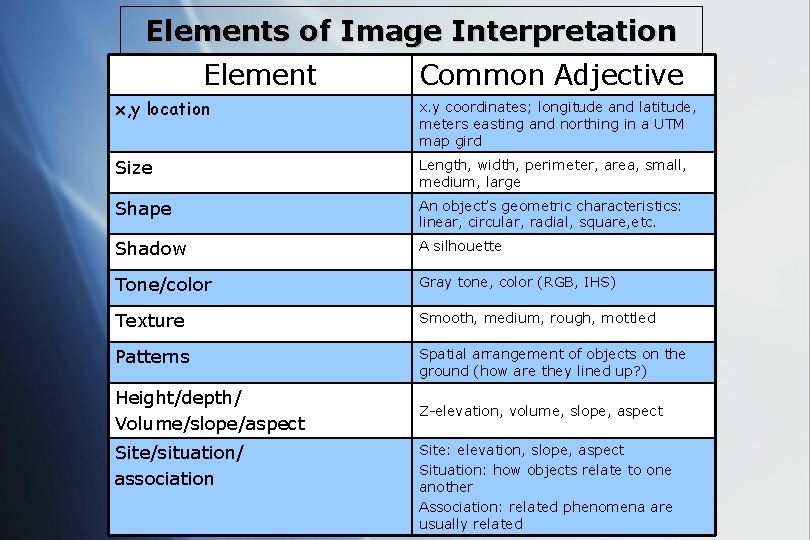
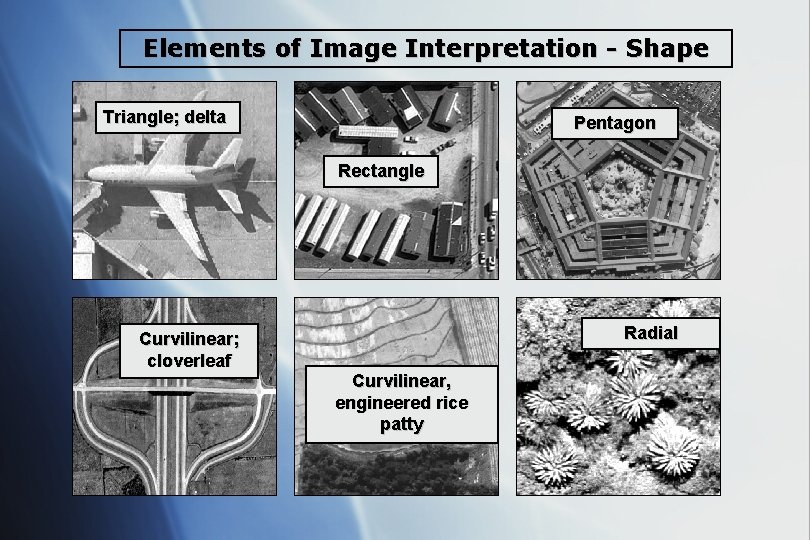
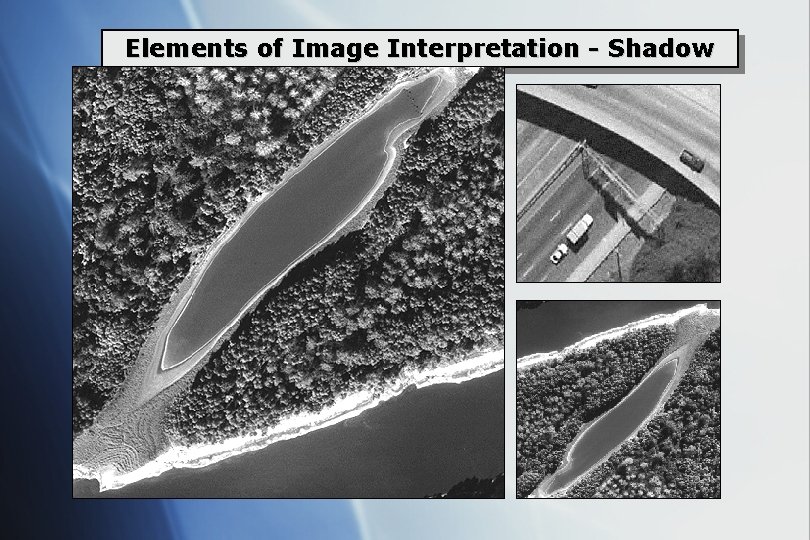
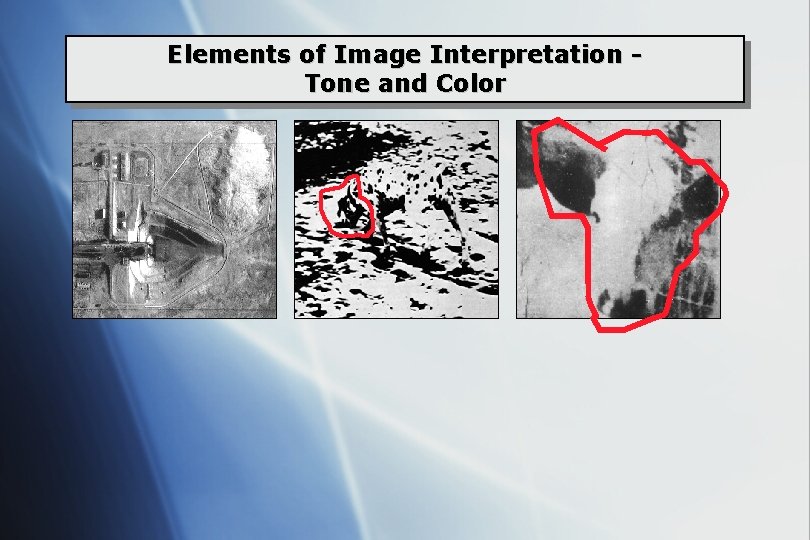
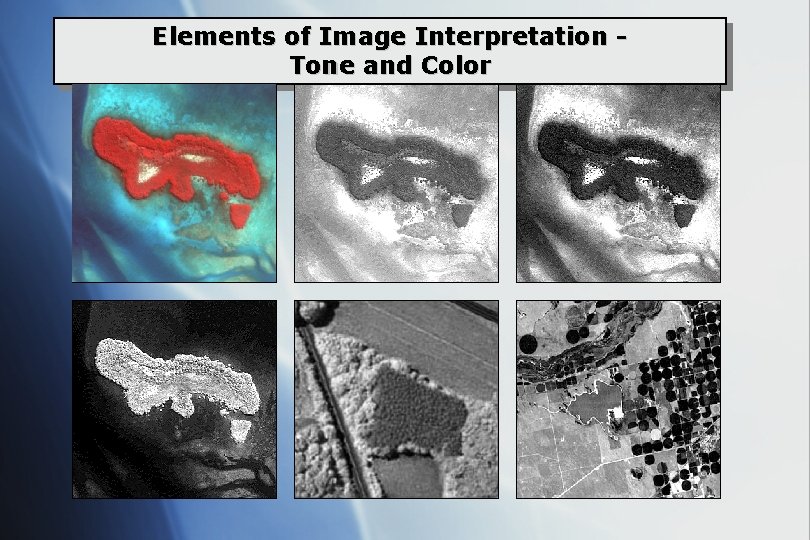
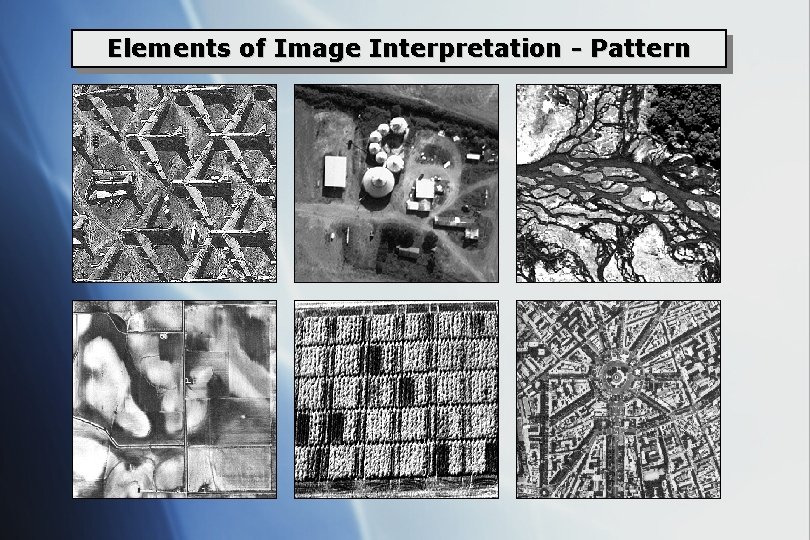
Elements of Image Interpretation Element Common Adjective x, y location x. y coordinates; longitude and latitude, meters easting and northing in a UTM map gird Size Length, width, perimeter, area, small, medium, large Shape An object’s geometric characteristics: linear, circular, radial, square, etc. Shadow A silhouette Tone/color Gray tone, color (RGB, IHS) Texture Smooth, medium, rough, mottled Patterns Spatial arrangement of objects on the ground (how are they lined up? ) Height/depth/ Volume/slope/aspect Z-elevation, volume, slope, aspect Site/situation/ association Site: elevation, slope, aspect Situation: how objects relate to one another Association: related phenomena are usually related
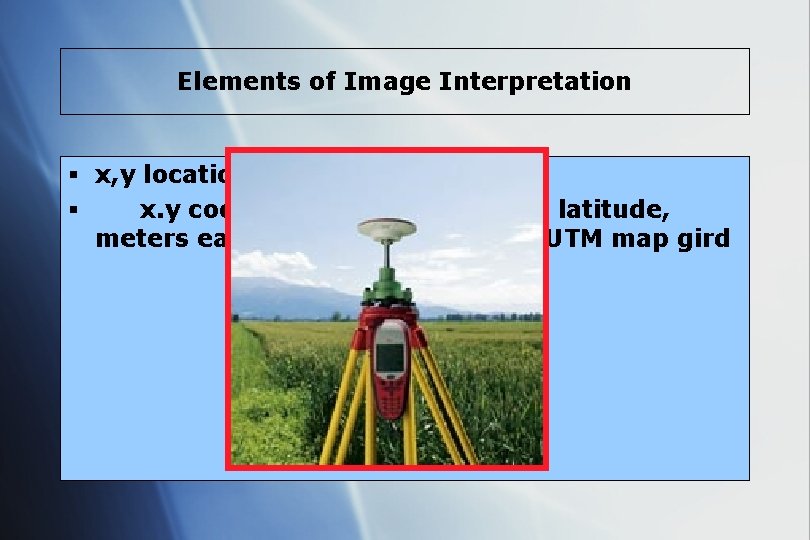
Elements of Image Interpretation § x, y location: § x. y coordinates; longitude and latitude, meters easting and northing in a UTM map gird
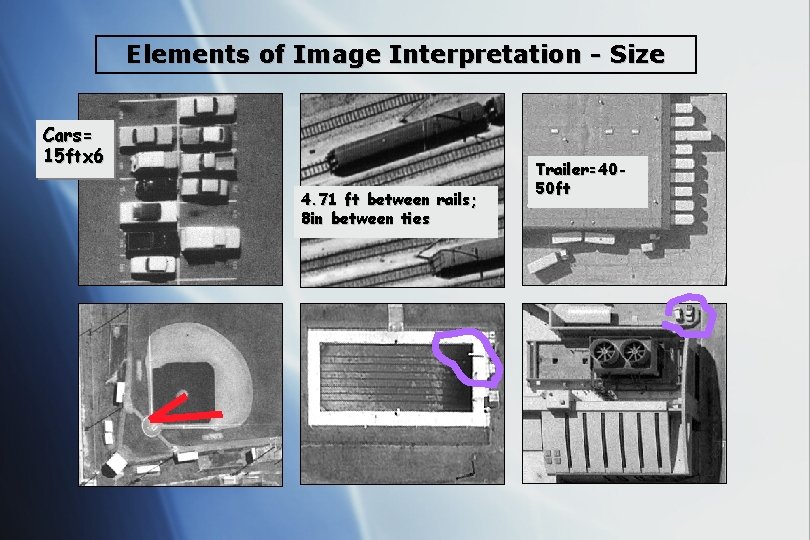
Elements of Image Interpretation - Size Cars= 15 ftx 6 4. 71 ft between rails; 8 in between ties Trailer=4050 ft
Elements of Image Interpretation - Shape Triangle; delta Pentagon Rectangle Curvilinear; cloverleaf Radial Curvilinear, engineered rice patty
Elements of Image Interpretation - Shadow
Elements of Image Interpretation Tone and Color
Elements of Image Interpretation Tone and Color
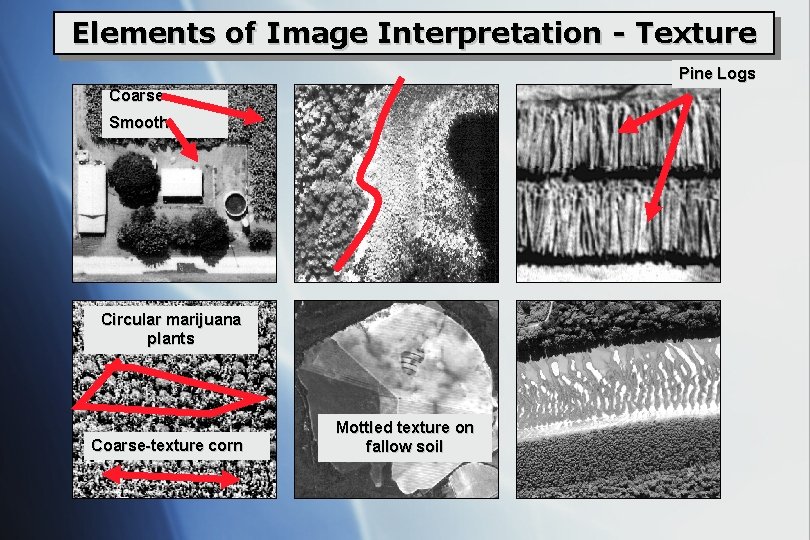
Elements of Image Interpretation - Texture Pine Logs Coarse Smooth Circular marijuana plants Coarse-texture corn Mottled texture on fallow soil
Elements of Image Interpretation - Patterns Trees and Other Patterns
Elements of Image Interpretation - Pattern
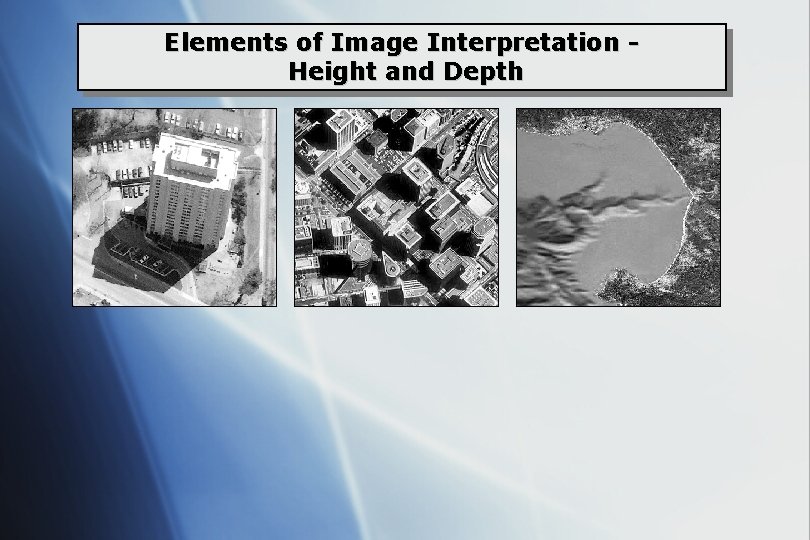
Elements of Image Interpretation Height and Depth Do You Want to Buy the Brooklyn Bridge?
Elements of Image Interpretation Height and Depth
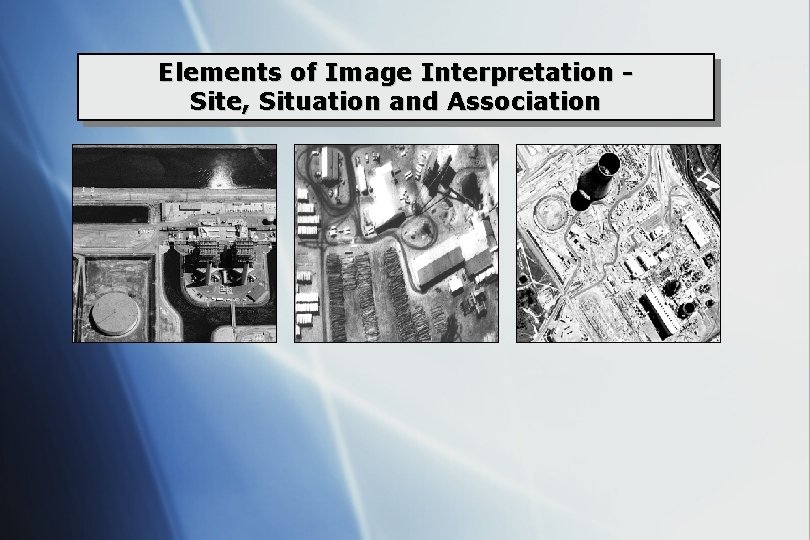
Elements of Image Interpretation Site, Situation and Association Along Comes Mary
Elements of Image Interpretation Site, Situation and Association
Elements of Image Interpretation Collateral Information A picture is not always worth 1, 000 words
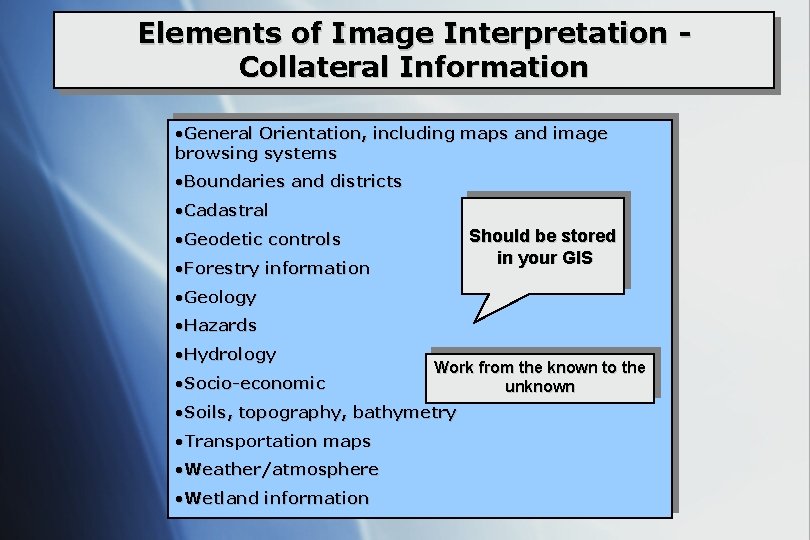
Elements of Image Interpretation Collateral Information • General Orientation, including maps and image browsing systems • Boundaries and districts • Cadastral Should be stored in your GIS • Geodetic controls • Forestry information • Geology • Hazards • Hydrology • Socio-economic Work from the known to the unknown • Soils, topography, bathymetry • Transportation maps • Weather/atmosphere • Wetland information
A GIS Side-Issue Connecticut GIS Ruling
A Technical Side-Issue Getting Familiar with ERDAS
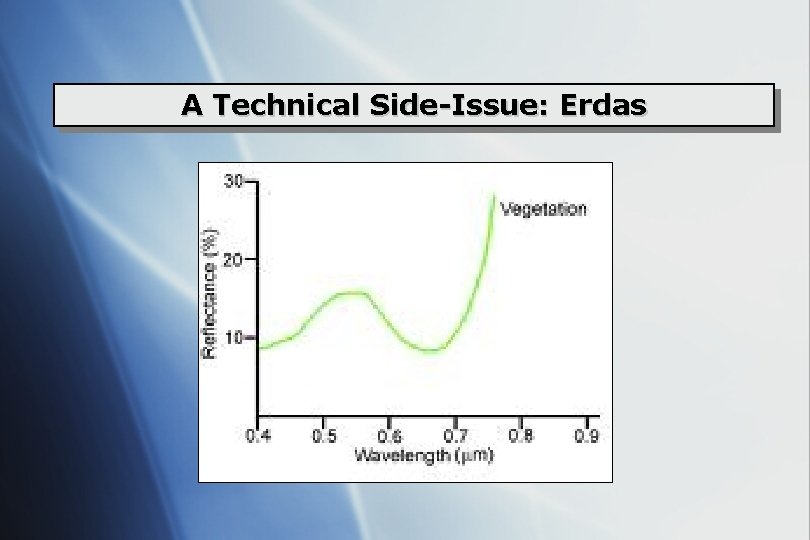
A Technical Side-Issue: Erdas Different objects reflect different amounts of light in different parts of the electromagnetic spectrum (EMS). For example, vegetation strongly reflects light in the green wavelengths of the visible part of the EMS which is why plants appear to be green to us. However, plants reflect even more Infra-red light than they do green light. A spectral signature is the name given to this pattern of differing reflectance in the different wavelengths of the EMS for an object.
A Technical Side-Issue: Erdas
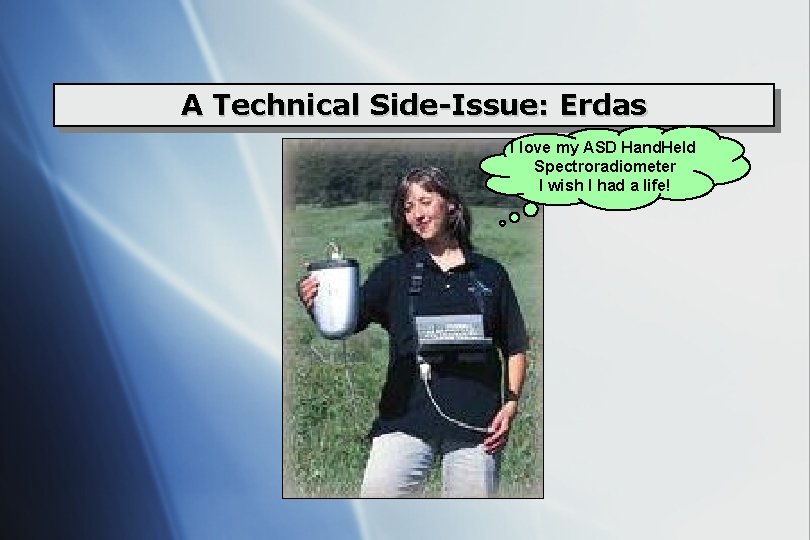
A Technical Side-Issue: Erdas Knowing about the spectral signatures of different types of features helps us interpret remotely sensed data We can measure the spectral signatures of objects on the ground using a Spectroradiometer such as the ASD (Analytical Spectral Devices) Hand. Held Spectroradiometer pictured below. This measures reflected light between the wavelengths of 300 and 1100 nm (0. 3 to 1. 1 m which relates to visible to near infra-red light). Measurements are calibrated against a white reference panel that is designed to be a near perfect reflector. Any subsequent measurements are then recorded relative to this panel as a percentage.
A Technical Side-Issue: Erdas I love my ASD Hand. Held Spectroradiometer I wish I had a life!
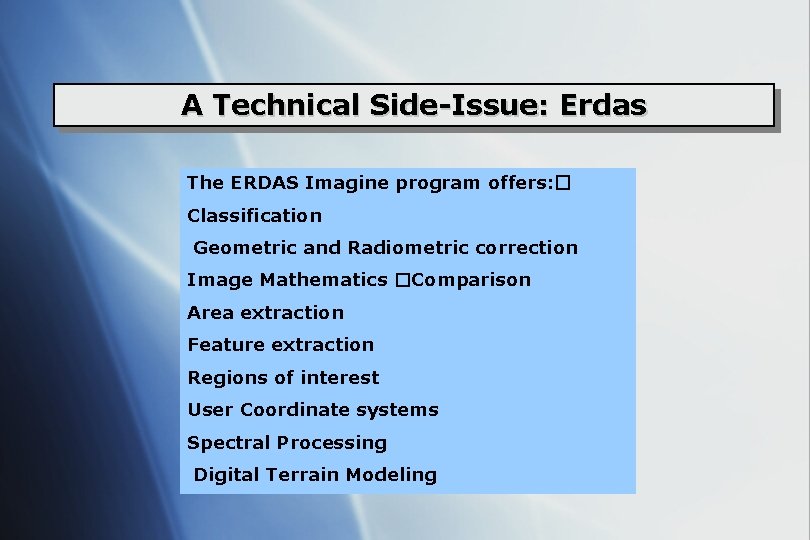
A Technical Side-Issue: Erdas The ERDAS Imagine program offers: � Classification Geometric and Radiometric correction Image Mathematics �Comparison Area extraction Feature extraction Regions of interest User Coordinate systems Spectral Processing Digital Terrain Modeling
Lab http: //www. cas. sc. edu/geog/rsbook/Exercises/Rse/e 02. html