
Elements of Effective Collaborative Learning Elements of Effective

Elements of Effective Collaborative Learning
Elements of Effective Collaboration • Positive Interdependence • Face to Face Interaction • Individual and Group Accountability • Social Skills • Group Processing
Positive Interdependence

Positive Interdependence � What it is � Students perceiving that they need each other to complete a task � What it is not � Individual work completed with peers � I sink, you swim; you sink, I swim � We sink or swim together � Members are responsible for own and each others’ learning � Members take responsibility only for self � Focus is on joint performance � Focus is on individual performance only � We � Me Members realize that their efforts are required in order for the group to succeed (NO FREE RIDERS) and that their potential contribution to the group is unique.

How to Structure Positive Interdependence Mutual Goals: group members know that they cannot succeed unless all other members of the group succeed Joint Rewards: when each group member receives the same tangible reward for successfully completing a joint task Shared Resources: when each member has only a portion of the information, materials, or resources necessary for the task to be completed Assigned Roles: when each group member is assigned complementary and interconnected roles.

Examples of Positive Interdependence � � � � Have team members rely on each other before relying on the teacher (3 before me) Group members use team responses (all group members raise their hands before the teacher responds, choral responses, all group members sign their names to a completed task Groups use team language (“we” and “our” vs. “I” “me” and “mine”) Collect one student’s paper to represent the entire group without telling the students whose paper will be collected Provide one writing tool or one text book for the entire group Assigning roles to group members and rotating the who has what role Randomly calling on one group member to explain the group’s answer Place groups in competition with one another, creating cooperation with the group to compete against another group
Promoting Face-to. Face Interaction
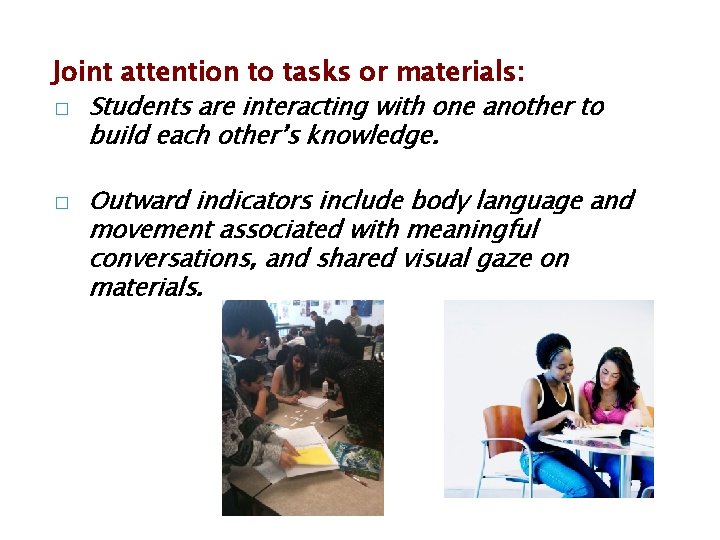
Joint attention to tasks or materials: � � Students are interacting with one another to build each other’s knowledge. Outward indicators include body language and movement associated with meaningful conversations, and shared visual gaze on materials.
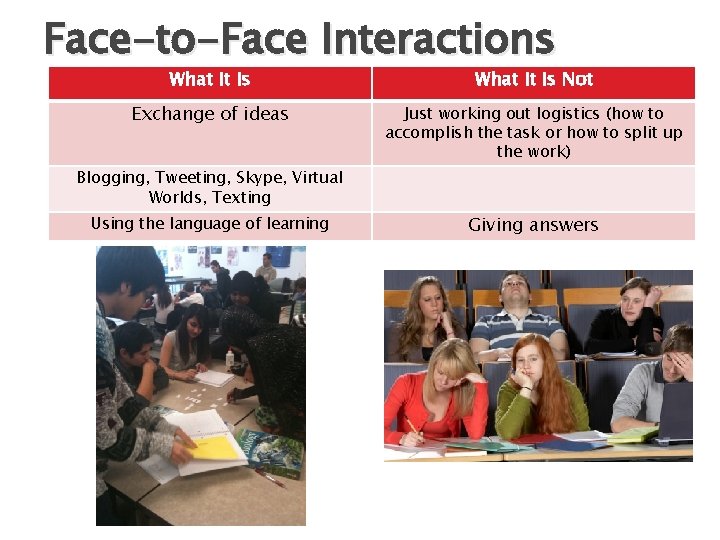
Face-to-Face Interactions What It Is Not Exchange of ideas Just working out logistics (how to accomplish the task or how to split up the work) Blogging, Tweeting, Skype, Virtual Worlds, Texting Using the language of learning Giving answers
Instructional Routines Writes – important gateway to meaningful interaction. � Quick ◦ Provides learners with the time to collect their thoughts and formalize their ideas before they engage in a discussion � Partner Discussions ‣ Role Playing Simulations � Head-to-Head Write Off ◦ Great for controversial topics � Interview � Whip Around Routine

� Individual and Group Accountability

Individual and Group Accountability What is Individual Accountability? It is: § Group work that requires all individuals to learn and § § contribute to the group A clear understanding of your individual role Did I do what I was supposed to do, how I was supposed to do it , the best that I could? Planned for and should include systems to monitor, give feedback about, and evaluate individual progress An individual assignment that is part of or in addition to the group assignment –may have an assigned role Self-assessed, group assessed, and teacher assessed

Individual and Group Accountability It is: What is Group Accountability? § “All for one and one for all”— The group draws its strength from the success of its individual members § Being responsible for your fellow group members and group outcome § A clear understanding of what the group is expected to accomplish Did we do what we were supposed to do, how we were supposed to do it , the best that we could? § Planned for and should include systems to monitor, give feedback about, and evaluate group progress § An assignment that requires group processes, shared learning, and an outcome that reflects group learning § Group assessed, and teacher assessed
Individual and Group Accountability What is Group Accountability? It isn’t: § An assembly-line division of labor § One or a few individuals getting stuck doing all the work § A collection of individual projects that are assessed as a whole § Evaluated solely by the final group outcome, project, or product—the group process is essential in the evaluation § A replacement for individual responsibility § Meant to cause more productive students cover for the less productive § Based on an assignment that requires only independence, not interdependence
What Instructional Routines Support Individual and Group Accountability? § § § Design tasks that require collaboration, interdependence, and individual work Give individuals the background and practice necessary to contribute and be successful in the group Establish clear expectations, timelines, and criteria for individual and group completion of tasks Provide periodic individual and group feedback on progress Provide individuals and groups with a way to monitor their own progress Use checklists and rubrics—student-created and completed
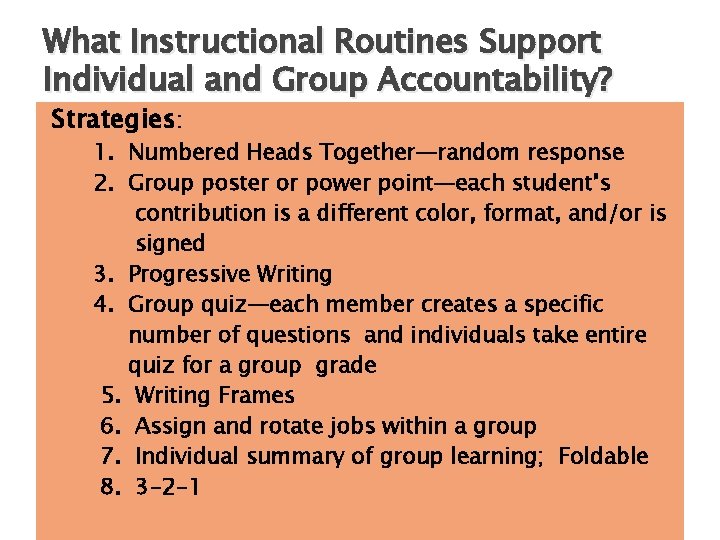
What Instructional Routines Support Individual and Group Accountability? Strategies: 1. Numbered Heads Together—random response 2. Group poster or power point—each student’s contribution is a different color, format, and/or is signed 3. Progressive Writing 4. Group quiz—each member creates a specific number of questions and individuals take entire quiz for a group grade 5. Writing Frames 6. Assign and rotate jobs within a group 7. Individual summary of group learning; Foldable 8. 3 -2 -1
Interpersonal and Small Group Skills

Appropriate Verbal Interactions � What it is ◦ Calm tone ◦ Turn-taking ◦ Clearly stated thoughts, facts or opinion � What ◦ ◦ it isn’t Bragging Over-talking others Interrupting others Rambling How to Create: Allow students the opportunity to write their thoughts to a prompt or create a visual representation of their understanding. This organization will prepare them to interact with others through clear statements with supporting details or information.

Appropriate Non-Verbal Interactions � What it is ◦ Active Listening Strategies ◦ Positive expressions and body posture ◦ Maintaining personal space � What it isn’t ◦ Disengagement with speaker or group ◦ Physical intimidation ◦ Horseplay How to Create: Active listening strategies can be taught by giving students key words or phrases that allow them to engage with others. These can be modeled first by the instructor, or provided through cues on the board or a paper. Generally, they relate to restating, clarifying, or summarizing what is being said by others.
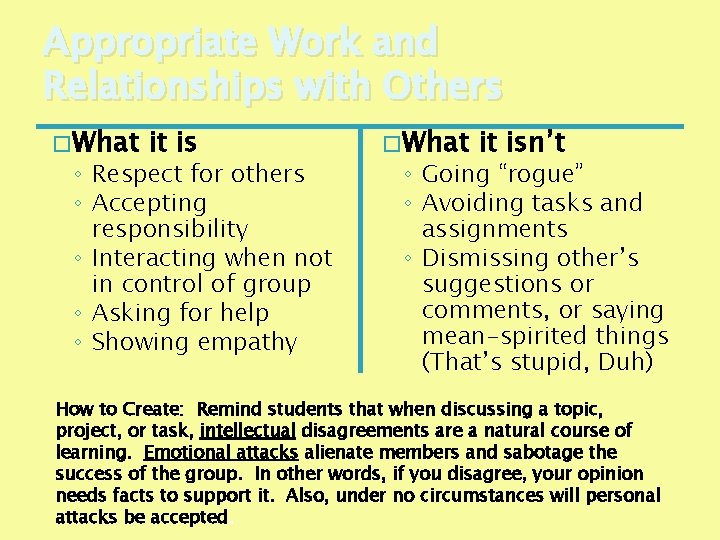
Appropriate Work and Relationships with Others � What it is ◦ Respect for others ◦ Accepting responsibility ◦ Interacting when not in control of group ◦ Asking for help ◦ Showing empathy � What it isn’t ◦ Going “rogue” ◦ Avoiding tasks and assignments ◦ Dismissing other’s suggestions or comments, or saying mean-spirited things (That’s stupid, Duh) How to Create: Remind students that when discussing a topic, project, or task, intellectual disagreements are a natural course of learning. Emotional attacks alienate members and sabotage the success of the group. In other words, if you disagree, your opinion needs facts to support it. Also, under no circumstances will personal attacks be accepted.
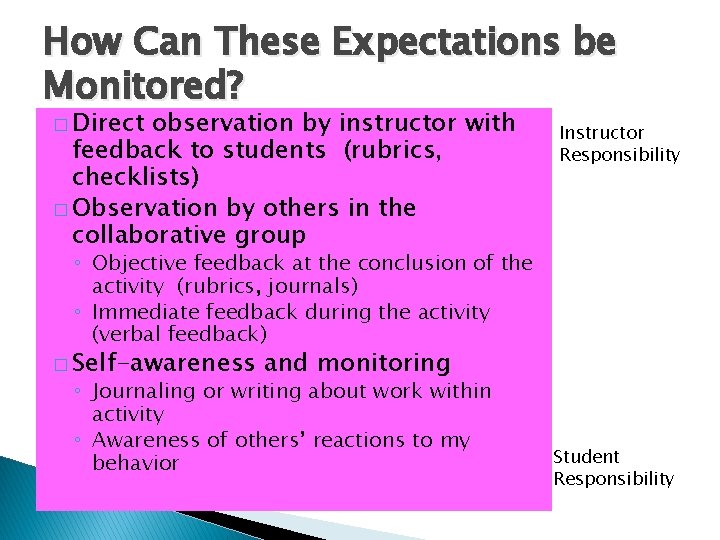
How Can These Expectations be Monitored? � Direct observation by instructor with feedback to students (rubrics, checklists) � Observation by others in the collaborative group Instructor Responsibility ◦ Objective feedback at the conclusion of the activity (rubrics, journals) ◦ Immediate feedback during the activity (verbal feedback) � Self-awareness and monitoring ◦ Journaling or writing about work within activity ◦ Awareness of others’ reactions to my behavior Student Responsibility

Group Processing

Group Processing “ It’s what you learn after you know it all that counts. ” - Coach John Wooden Former UCLA basketball Coach
Group Processing What it is: ü Frequent and regular conversations among students ü Students examining their own contributions and those of their group members ü Students discussing the progress they made toward their goal ü Students discussing what did and did not work ü Students talking about what they will do differently in the future

Group Processing What it is not: ü Infrequent communication about a student’s individual and group progress ü Any reflection that does not include a group discussion ü Not giving enough time for students to process their individual and group contributions ü Reflection questions that require a “yes” or “no” answer
Instructional Routines to Support Group Processing ü Self-Monitoring • Ex. – Likert Scale ü Learning Questionnaire Logs • Offer a question for students to reflect upon and respond to in their log ü Roundtable Activities • Allows each member to reflect on the group’s work and then discuss as a group

Group Processing – How to Monitor? ü Assigning reflection tasks with specific questions for ü Using forms or rubrics for students to complete ü Direct observation with feedback on how well the groups are working together to the groups and the class as a whole.
- Slides: 27