
Elements of content of a document INTRODUCTION PRESENTATION
- Slides: 7
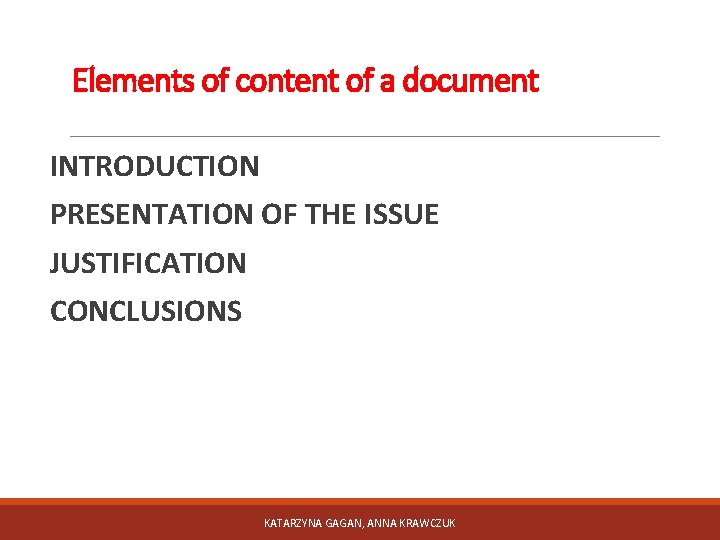
Elements of content of a document INTRODUCTION PRESENTATION OF THE ISSUE JUSTIFICATION CONCLUSIONS KATARZYNA GAGAN, ANNA KRAWCZUK
Elements of content of a document Not every document must include all parts. A properly worded document should always include at least two parts: the main and convincing. KATARZYNA GAGAN, ANNA KRAWCZUK
INTRODUCTION Its aim is to present to the recipient the issue that will be discussed in the document The introduction should be brief, just one or two sentences. If the matter has already been the subject of an exchange of letters, you only need to refer to previous correspondence. KATARZYNA GAGAN, ANNA KRAWCZUK
PRESENTATION OF THE ISSUE It immediately follows the introduction. This is the main part of the content of the document, also called the matrix (e. g. In administrative decisions). It contains an explanation of what the writer wants, otherwise – it presents a problem that is an issue of this document. It should be written concisely but comprehensively and unequivocally. KATARZYNA GAGAN, ANNA KRAWCZUK
JUSTIFICATION Here, the recipient must be convinced of the correctness of the position taken by the sender of the letter. It usually is the longest part of the letter, the motives and a detailed justification related to the matter should be included. Factual justification should demonstrate what facts were taken as proof, what evidence was included, what evidence was omitted, all of which testifies in favor of presented case. Legal justification provides the legal basis (regulations), confirming the validity of the position taken by the author of the letter. In justification, all arguments should be presented clearly, logically and consistently. This part of the content of the document should be very convincing, comprehensive and it should lead to conclusions. KATARZYNA GAGAN, ANNA KRAWCZUK
CONCLUSIONS They are final part of the content of the letter. It is the summary and re-emphasizing its essence. In general, we formulate them only when we ask for decision or opinion after the presentation and justification of the case. The objective is: ◦ causing a specific action of the recipient, ◦ creating the right impression, ◦ causing the recipient to take a stand, ◦ drawing conclusions ◦ they should also provide a brief summary of earlier arguments of the writer. KATARZYNA GAGAN, ANNA KRAWCZUK
In everyday business practice many documents are drawn up that inform us about the course of events, repeat certain facts. They are informational documents, such as: protocols, reports, notes. KATARZYNA GAGAN, ANNA KRAWCZUK