
Elements of Computing Systems Nisan Schocken MIT Press
- Slides: 40
Elements of Computing Systems, Nisan & Schocken, MIT Press www. idc. ac. il/tecs Operating Systems Building a Modern Computer From First Principles www. nand 2 tetris. org Elements of Computing Systems, Nisan & Schocken, MIT Press, www. nand 2 tetris. org , Chapter 12: Operating System 1 slide
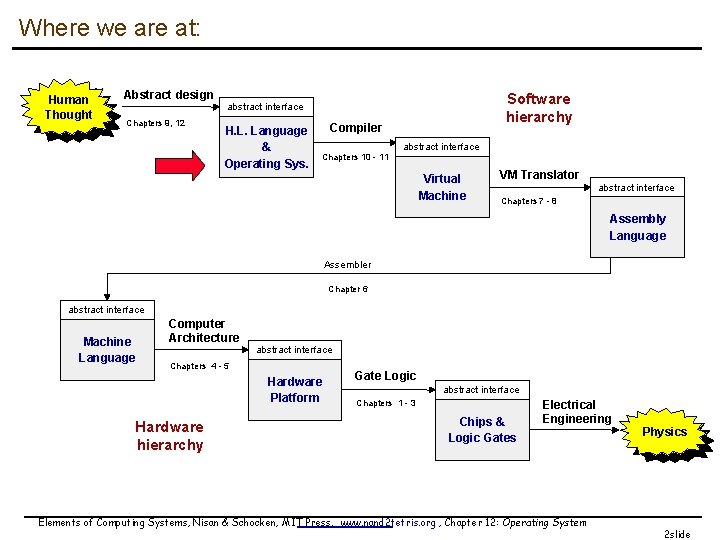
Where we are at: Human Thought Abstract design Chapters 9, 12 Software hierarchy abstract interface H. L. Language & Operating Sys. Compiler Chapters 10 - 11 abstract interface Virtual Machine VM Translator abstract interface Chapters 7 - 8 Assembly Language Assembler Chapter 6 abstract interface Machine Language Computer Architecture abstract interface Chapters 4 - 5 Hardware Platform Hardware hierarchy Gate Logic abstract interface Chapters 1 - 3 Chips & Logic Gates Electrical Engineering Elements of Computing Systems, Nisan & Schocken, MIT Press, www. nand 2 tetris. org , Chapter 12: Operating System Physics 2 slide
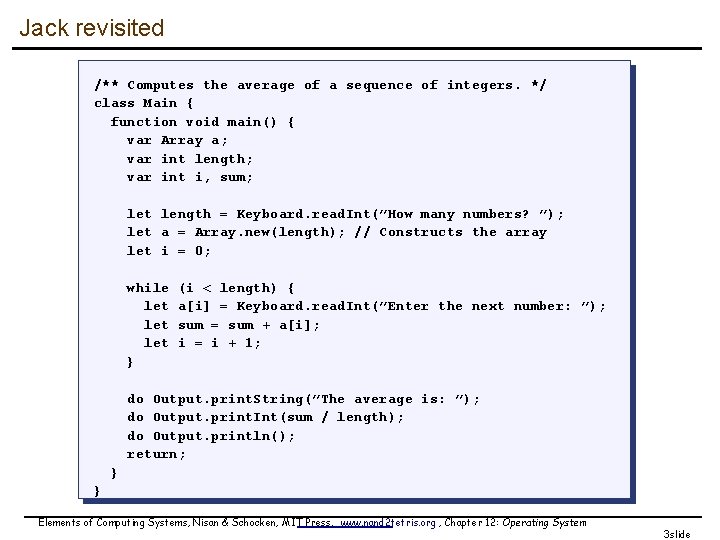
Jack revisited /** Computes the average of a sequence of integers. */ class Main { function void main() { var Array a; var int length; var int i, sum; let length = Keyboard. read. Int(”How many numbers? ”); let a = Array. new(length); // Constructs the array let i = 0; while (i < length) { let a[i] = Keyboard. read. Int(”Enter the next number: ”); let sum = sum + a[i]; let i = i + 1; } do Output. print. String(”The average is: ”); do Output. print. Int(sum / length); do Output. println(); return; } } Elements of Computing Systems, Nisan & Schocken, MIT Press, www. nand 2 tetris. org , Chapter 12: Operating System 3 slide
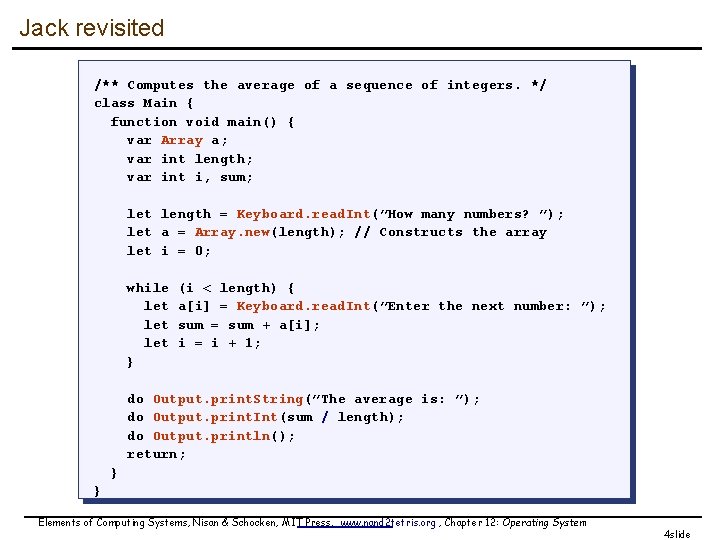
Jack revisited /** Computes the average of a sequence of integers. */ class Main { function void main() { var Array a; var int length; var int i, sum; let length = Keyboard. read. Int(”How many numbers? ”); let a = Array. new(length); // Constructs the array let i = 0; while (i < length) { let a[i] = Keyboard. read. Int(”Enter the next number: ”); let sum = sum + a[i]; let i = i + 1; } do Output. print. String(”The average is: ”); do Output. print. Int(sum / length); do Output. println(); return; } } Elements of Computing Systems, Nisan & Schocken, MIT Press, www. nand 2 tetris. org , Chapter 12: Operating System 4 slide
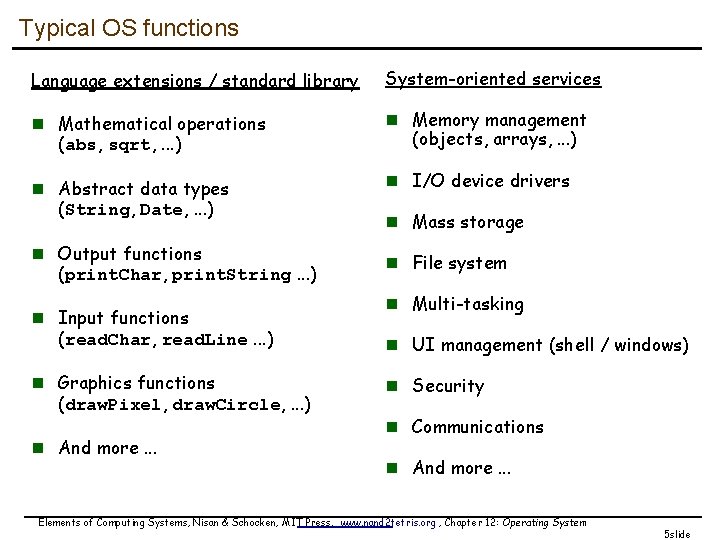
Typical OS functions Language extensions / standard library System-oriented services n Mathematical operations (abs, sqrt, . . . ) n Memory management (objects, arrays, . . . ) n Abstract data types (String, Date, . . . ) n I/O device drivers n Output functions (print. Char, print. String. . . ) n File system n Input functions (read. Char, read. Line. . . ) n Graphics functions (draw. Pixel, draw. Circle, . . . ) n And more. . . n Mass storage n Multi-tasking n UI management (shell / windows) n Security n Communications n And more. . . Elements of Computing Systems, Nisan & Schocken, MIT Press, www. nand 2 tetris. org , Chapter 12: Operating System 5 slide
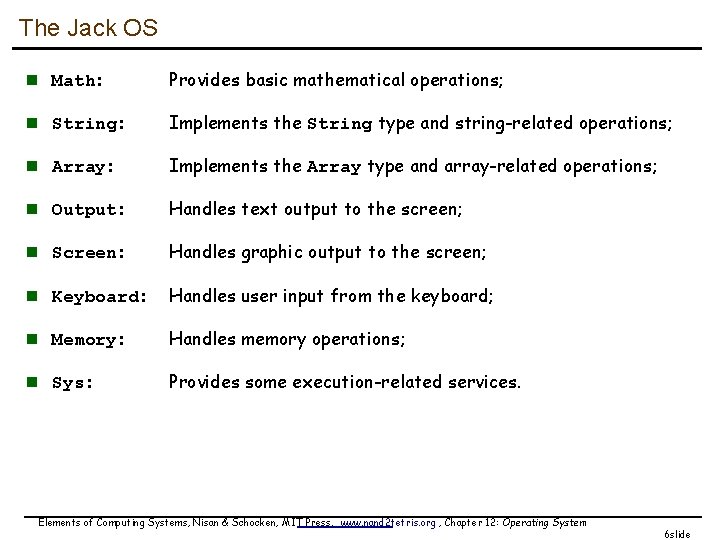
The Jack OS n Math: Provides basic mathematical operations; n String: Implements the String type and string-related operations; n Array: Implements the Array type and array-related operations; n Output: Handles text output to the screen; n Screen: Handles graphic output to the screen; n Keyboard: Handles user input from the keyboard; n Memory: Handles memory operations; n Sys: Provides some execution-related services. Elements of Computing Systems, Nisan & Schocken, MIT Press, www. nand 2 tetris. org , Chapter 12: Operating System 6 slide
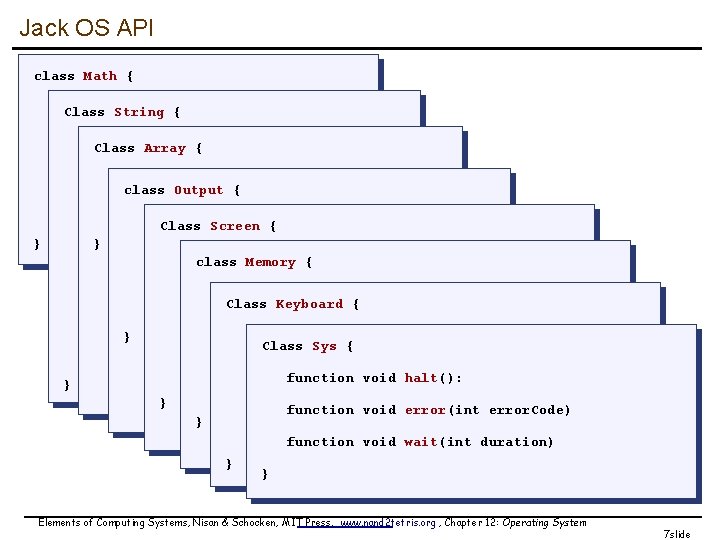
Jack OS API class Math { function void init() Class String { function int abs(int x) constructor String new(int max. Length) function int multiply(int x, int y) Class Array { method void dispose() function int divide(int x, int y) method int length() function Array new(int size) function int min(int x, int y) class Output { method char. At(int j) function int max(int x, int y) function void move. Cursor(int i, int j) method void dispose() method void set. Char. At(int j, char c) function int sqrt(int x) Class Screen { function void print. Char(char c) method String append. Char(char c) } } function void clear. Screen() function void print. String(String s) method void erase. Last. Char() class Memory { function void set. Color(boolean b) function void print. Int(int i) method int. Value() function void draw. Pixel(int x, int y) function int peek(int address) function void println() method void set. Int(int j) Class Keyboard { function void draw. Line(int x 1, int y 1, function void back. Space() function char back. Space() int x 2, int y 2) function void poke(int address, int value) function char key. Pressed() } function char double. Quote() Class Sys { function void draw. Rectangle(int x 1, int y 1, function Array alloc(int size) int x 2, int y 2) function char new. Line() function char read. Char() function void halt(): function void draw. Circle(int x, int y, int r) } function void de. Alloc(Array o) function String read. Line(String message) } function void error(int error. Code) } function int read. Int(String message) function void wait(int duration) } } Elements of Computing Systems, Nisan & Schocken, MIT Press, www. nand 2 tetris. org , Chapter 12: Operating System 7 slide
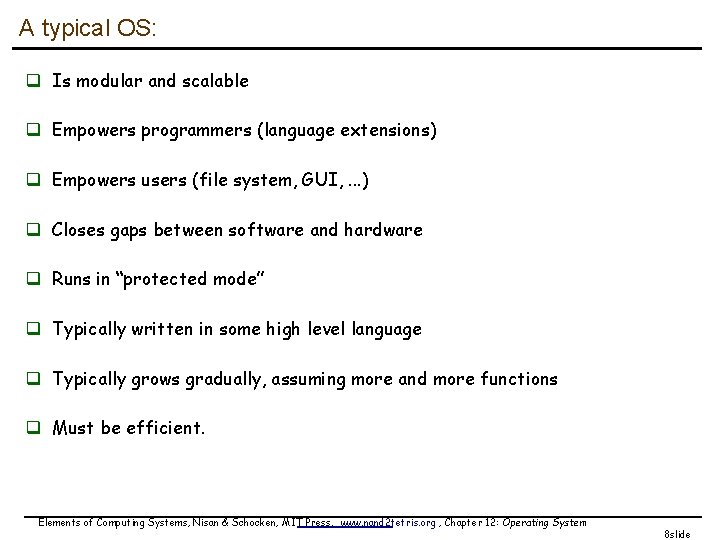
A typical OS: q Is modular and scalable q Empowers programmers (language extensions) q Empowers users (file system, GUI, . . . ) q Closes gaps between software and hardware q Runs in “protected mode” q Typically written in some high level language q Typically grows gradually, assuming more and more functions q Must be efficient. Elements of Computing Systems, Nisan & Schocken, MIT Press, www. nand 2 tetris. org , Chapter 12: Operating System 8 slide
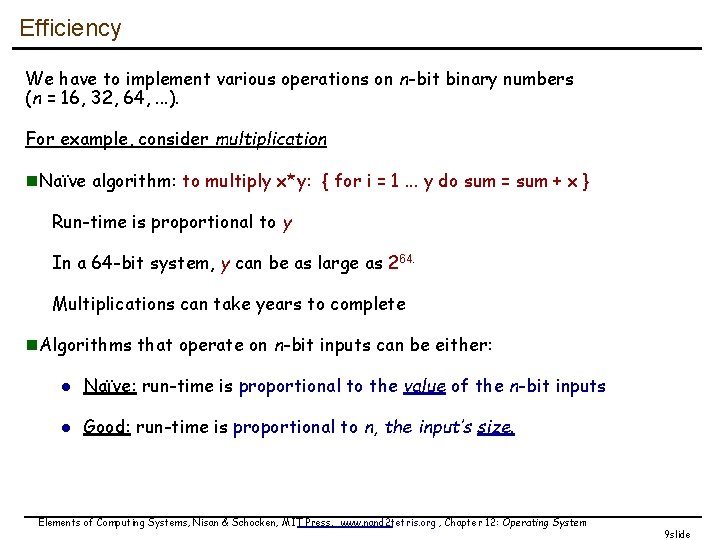
Efficiency We have to implement various operations on n-bit binary numbers (n = 16, 32, 64, . . . ). For example, consider multiplication n. Naïve algorithm: to multiply x*y: { for i = 1. . . y do sum = sum + x } Run-time is proportional to y In a 64 -bit system, y can be as large as 264. Multiplications can take years to complete n. Algorithms that operate on n-bit inputs can be either: l Naïve: run-time is proportional to the value of the n-bit inputs l Good: run-time is proportional to n, the input’s size. Elements of Computing Systems, Nisan & Schocken, MIT Press, www. nand 2 tetris. org , Chapter 12: Operating System 9 slide
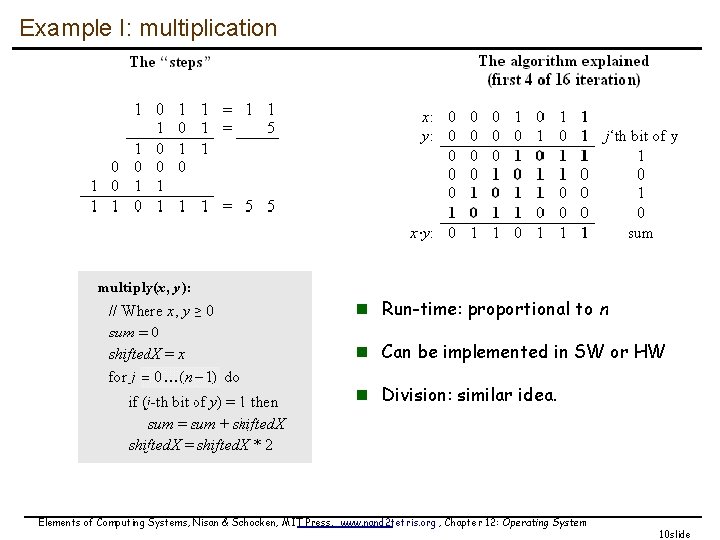
Example I: multiplication n Run-time: proportional to n n Can be implemented in SW or HW n Division: similar idea. Elements of Computing Systems, Nisan & Schocken, MIT Press, www. nand 2 tetris. org , Chapter 12: Operating System 10 slide
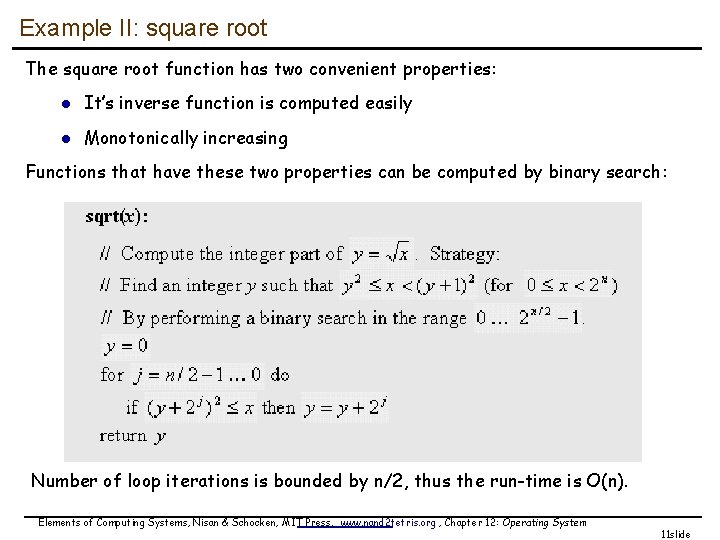
Example II: square root The square root function has two convenient properties: l It’s inverse function is computed easily l Monotonically increasing Functions that have these two properties can be computed by binary search: Number of loop iterations is bounded by n/2, thus the run-time is O(n). Elements of Computing Systems, Nisan & Schocken, MIT Press, www. nand 2 tetris. org , Chapter 12: Operating System 11 slide
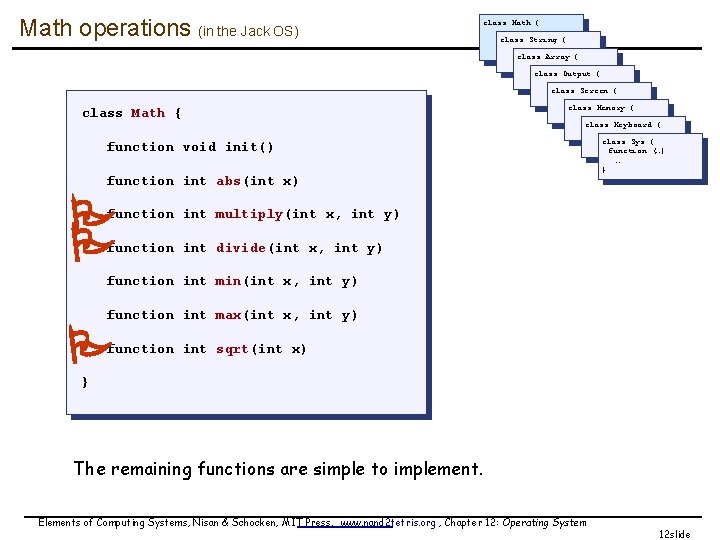
Math operations (in the Jack OS) class Math { class String { class Array { class Output { class Screen { class Math { class Memory { class Keyboard { function void init() function int abs(int x) class Sys { function (…) … } function int multiply(int x, int y) function int divide(int x, int y) function int min(int x, int y) function int max(int x, int y) function int sqrt(int x) } The remaining functions are simple to implement. Elements of Computing Systems, Nisan & Schocken, MIT Press, www. nand 2 tetris. org , Chapter 12: Operating System 12 slide
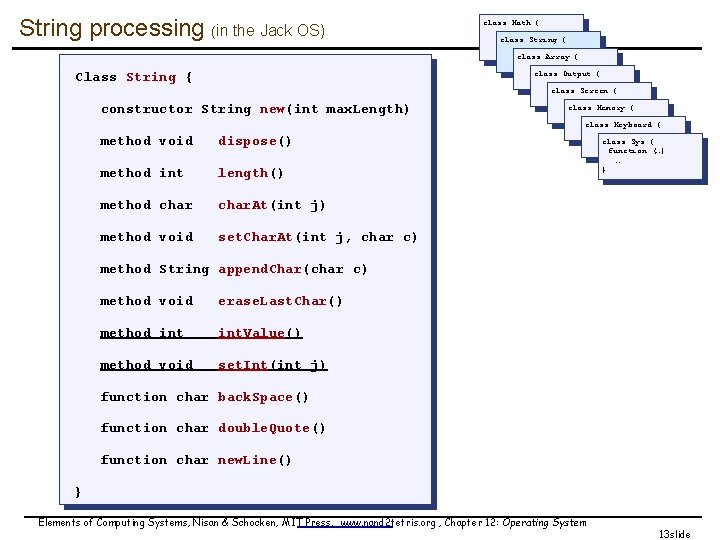
String processing (in the Jack OS) class Math { class String { class Array { Class String { class Output { class Screen { constructor String new(int max. Length) class Memory { class Keyboard { method void dispose() method int length() class Sys { function (…) … } method char. At(int j) method void set. Char. At(int j, char c) method String append. Char(char c) method void erase. Last. Char() method int. Value() method void set. Int(int j) function char back. Space() function char double. Quote() function char new. Line() } Elements of Computing Systems, Nisan & Schocken, MIT Press, www. nand 2 tetris. org , Chapter 12: Operating System 13 slide
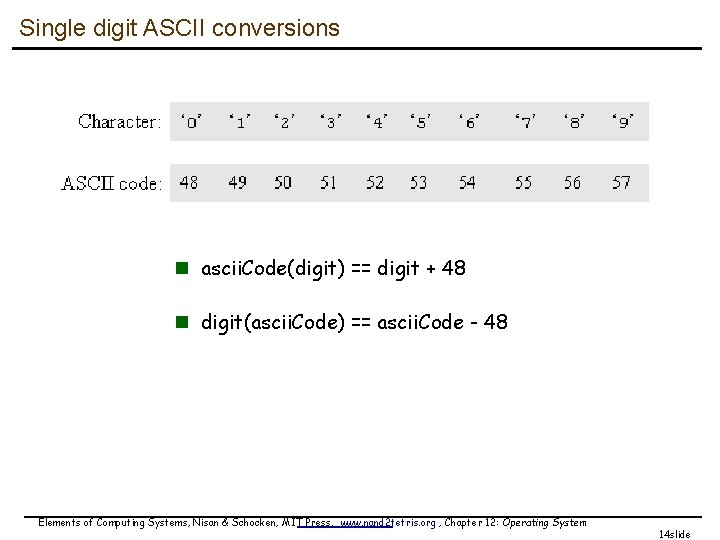
Single digit ASCII conversions n ascii. Code(digit) == digit + 48 n digit(ascii. Code) == ascii. Code - 48 Elements of Computing Systems, Nisan & Schocken, MIT Press, www. nand 2 tetris. org , Chapter 12: Operating System 14 slide
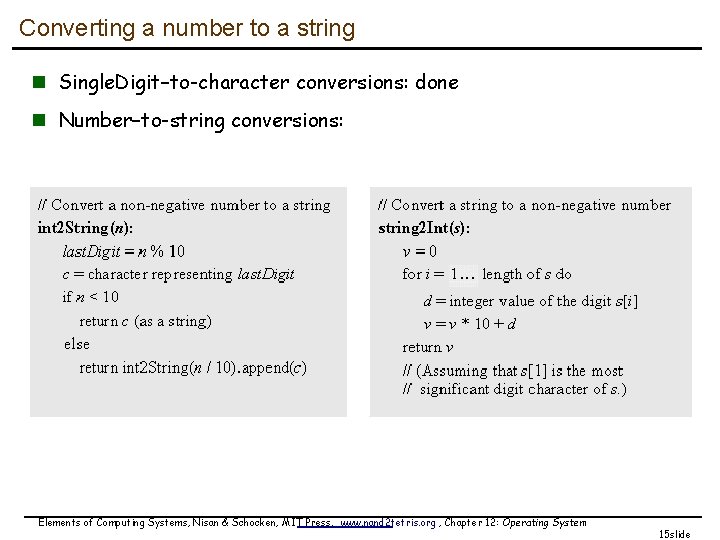
Converting a number to a string n Single. Digit–to-character conversions: done n Number–to-string conversions: Elements of Computing Systems, Nisan & Schocken, MIT Press, www. nand 2 tetris. org , Chapter 12: Operating System 15 slide
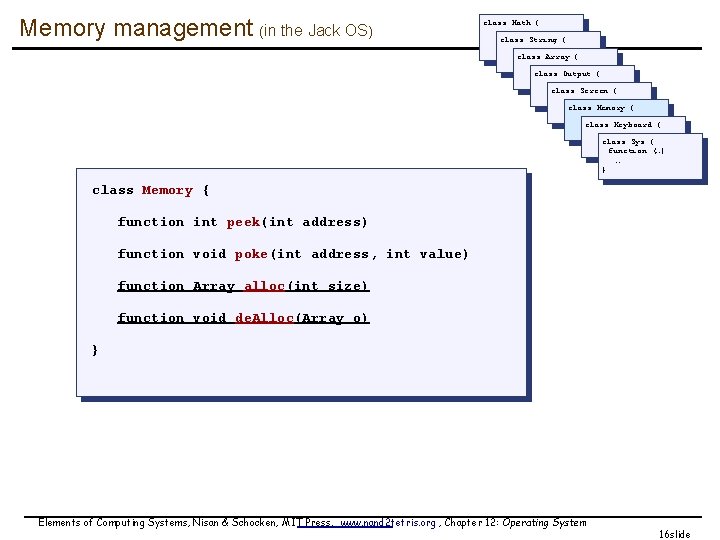
Memory management (in the Jack OS) class Math { class String { class Array { class Output { class Screen { class Memory { class Keyboard { class Sys { function (…) … } class Memory { function int peek(int address) function void poke(int address, int value) function Array alloc(int size) function void de. Alloc(Array o) } Elements of Computing Systems, Nisan & Schocken, MIT Press, www. nand 2 tetris. org , Chapter 12: Operating System 16 slide
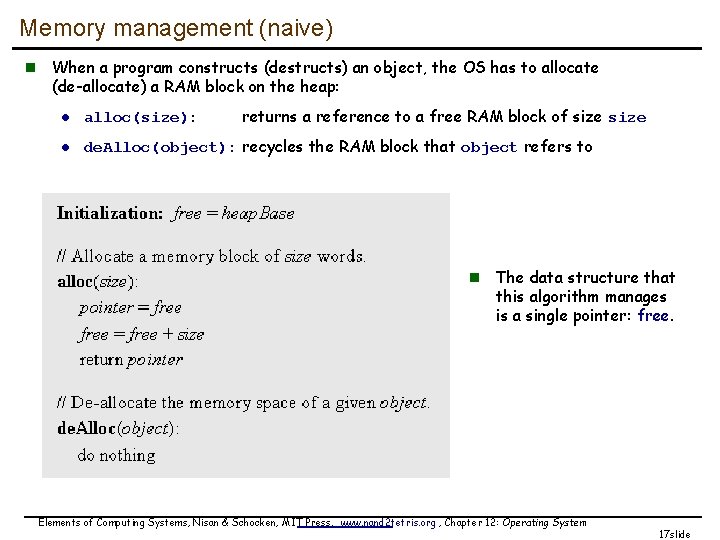
Memory management (naive) n When a program constructs (destructs) an object, the OS has to allocate (de-allocate) a RAM block on the heap: returns a reference to a free RAM block of size l alloc(size): l de. Alloc(object): recycles the RAM block that object refers to n The data structure that this algorithm manages is a single pointer: free. Elements of Computing Systems, Nisan & Schocken, MIT Press, www. nand 2 tetris. org , Chapter 12: Operating System 17 slide
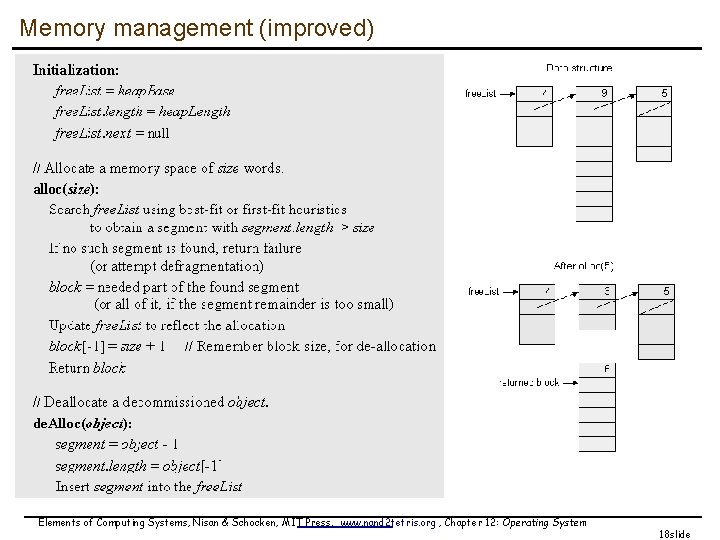
Memory management (improved) Elements of Computing Systems, Nisan & Schocken, MIT Press, www. nand 2 tetris. org , Chapter 12: Operating System 18 slide
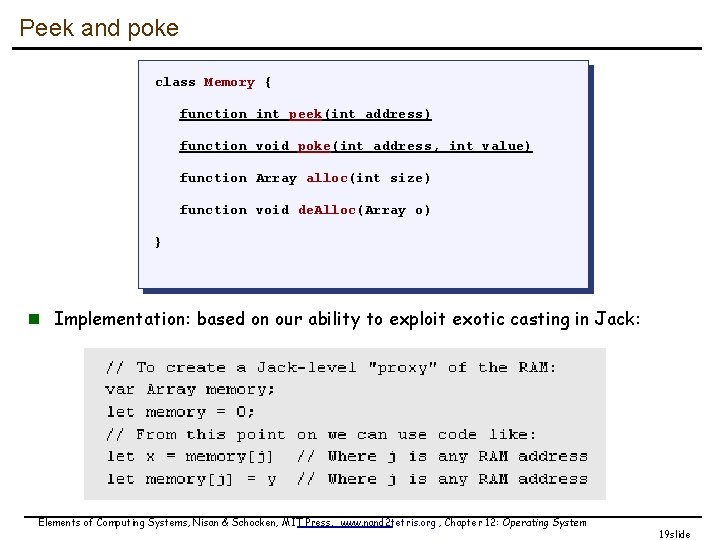
Peek and poke class Memory { function int peek(int address) function void poke(int address, int value) function Array alloc(int size) function void de. Alloc(Array o) } n Implementation: based on our ability to exploit exotic casting in Jack: Elements of Computing Systems, Nisan & Schocken, MIT Press, www. nand 2 tetris. org , Chapter 12: Operating System 19 slide
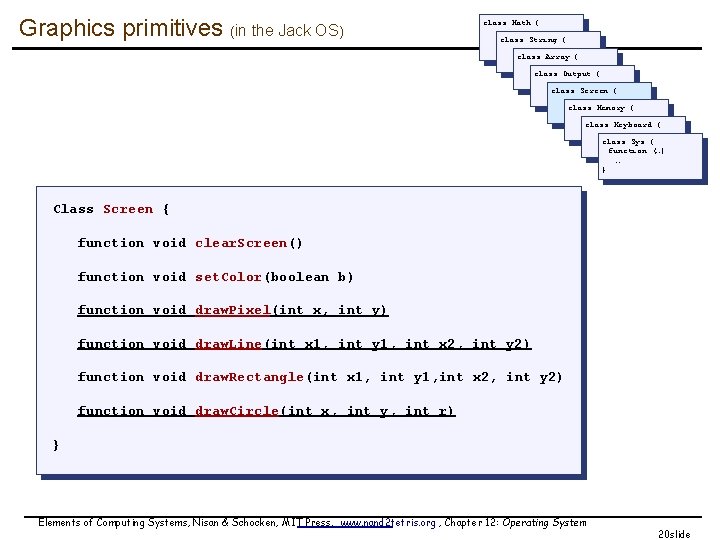
Graphics primitives (in the Jack OS) class Math { class String { class Array { class Output { class Screen { class Memory { class Keyboard { class Sys { function (…) … } Class Screen { function void clear. Screen() function void set. Color(boolean b) function void draw. Pixel(int x, int y) function void draw. Line(int x 1, int y 1, int x 2, int y 2) function void draw. Rectangle(int x 1, int y 1, int x 2, int y 2) function void draw. Circle(int x, int y, int r) } Elements of Computing Systems, Nisan & Schocken, MIT Press, www. nand 2 tetris. org , Chapter 12: Operating System 20 slide
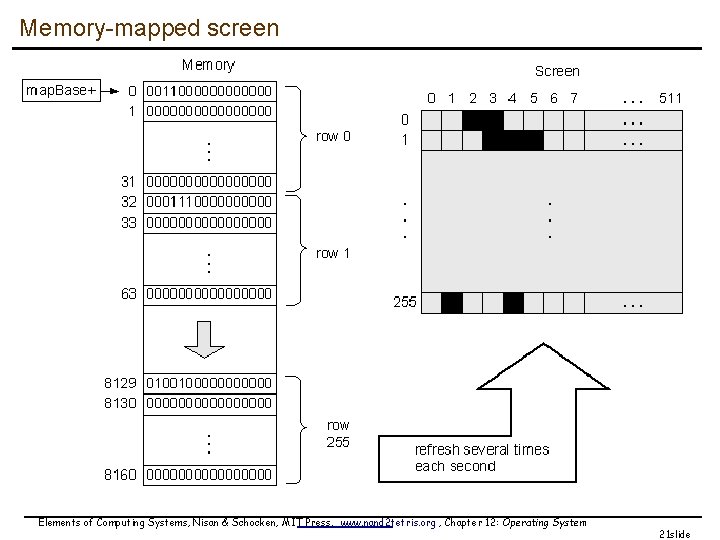
Memory-mapped screen Elements of Computing Systems, Nisan & Schocken, MIT Press, www. nand 2 tetris. org , Chapter 12: Operating System 21 slide
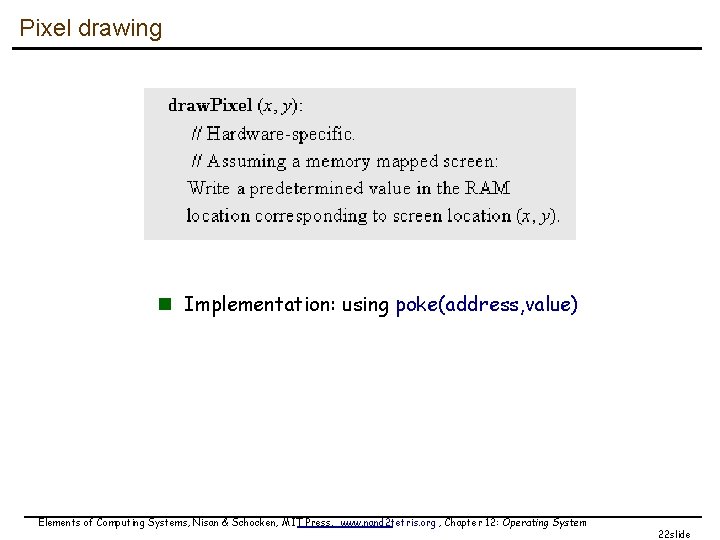
Pixel drawing n Implementation: using poke(address, value) Elements of Computing Systems, Nisan & Schocken, MIT Press, www. nand 2 tetris. org , Chapter 12: Operating System 22 slide
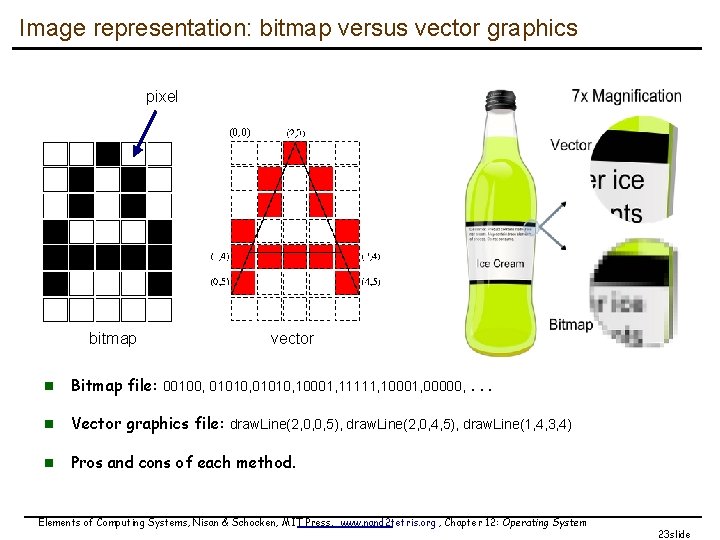
Image representation: bitmap versus vector graphics pixel (0, 0) bitmap vector n Bitmap file: 00100, 01010, 10001, 11111, 10001, 00000, . . . n Vector graphics file: draw. Line(2, 0, 0, 5), draw. Line(2, 0, 4, 5), draw. Line(1, 4, 3, 4) n Pros and cons of each method. Elements of Computing Systems, Nisan & Schocken, MIT Press, www. nand 2 tetris. org , Chapter 12: Operating System 23 slide
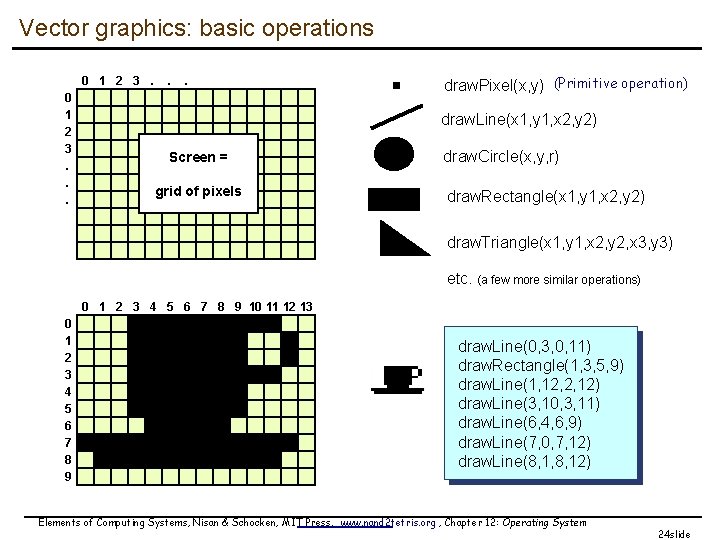
Vector graphics: basic operations 0 1 2 3. . . draw. Pixel(x, y) (Primitive operation) draw. Line(x 1, y 1, x 2, y 2) Screen = grid of pixels draw. Circle(x, y, r) draw. Rectangle(x 1, y 1, x 2, y 2) draw. Triangle(x 1, y 1, x 2, y 2, x 3, y 3) etc. (a few more similar operations) 0 1 2 3 4 5 6 7 8 9 10 11 12 13 0 1 2 3 4 5 6 7 8 9 draw. Line(0, 3, 0, 11) draw. Rectangle(1, 3, 5, 9) draw. Line(1, 12, 2, 12) draw. Line(3, 10, 3, 11) draw. Line(6, 4, 6, 9) draw. Line(7, 0, 7, 12) draw. Line(8, 1, 8, 12) Elements of Computing Systems, Nisan & Schocken, MIT Press, www. nand 2 tetris. org , Chapter 12: Operating System 24 slide
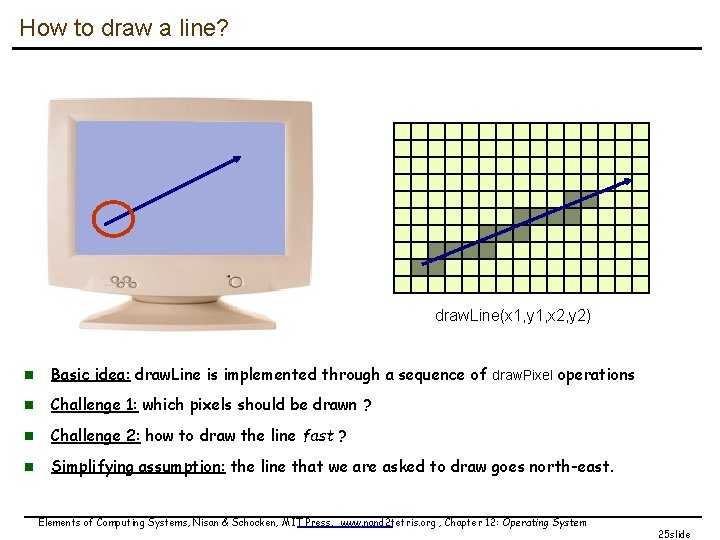
How to draw a line? draw. Line(x 1, y 1, x 2, y 2) n Basic idea: draw. Line is implemented through a sequence of draw. Pixel operations n Challenge 1: which pixels should be drawn ? n Challenge 2: how to draw the line fast ? n Simplifying assumption: the line that we are asked to draw goes north-east. Elements of Computing Systems, Nisan & Schocken, MIT Press, www. nand 2 tetris. org , Chapter 12: Operating System 25 slide
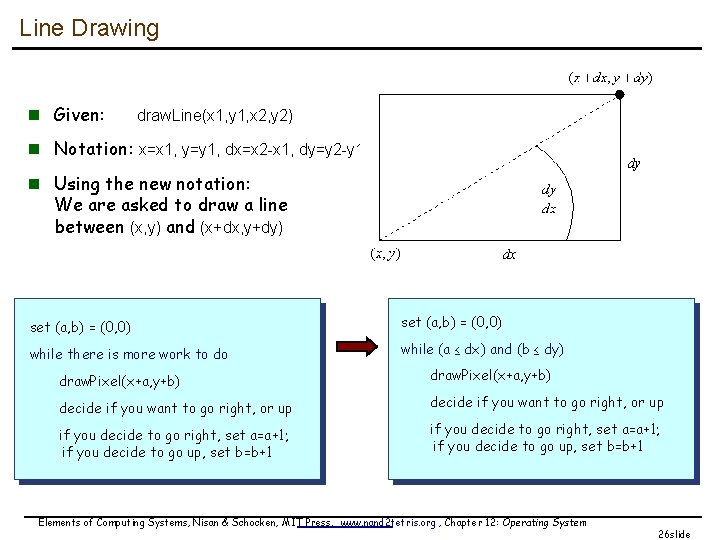
Line Drawing n Given: draw. Line(x 1, y 1, x 2, y 2) n Notation: x=x 1, y=y 1, dx=x 2 -x 1, dy=y 2 -y 1 dy n Using the new notation: We are asked to draw a line between (x, y) and (x+dx, y+dy) dx set (a, b) = (0, 0) while there is more work to do while (a ≤ dx) and (b ≤ dy) draw. Pixel(x+a, y+b) decide if you want to go right, or up if you decide to go right, set a=a+1; if you decide to go up, set b=b+1 Elements of Computing Systems, Nisan & Schocken, MIT Press, www. nand 2 tetris. org , Chapter 12: Operating System 26 slide
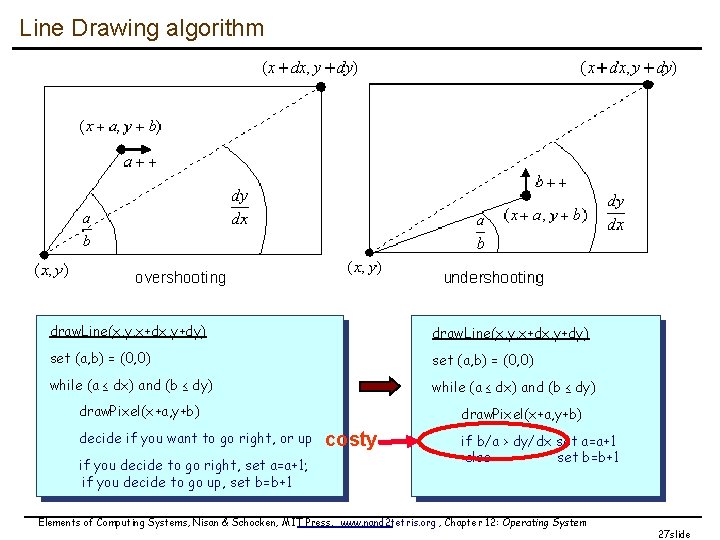
Line Drawing algorithm draw. Line(x, y, x+dx, y+dy) set (a, b) = (0, 0) while (a ≤ dx) and (b ≤ dy) draw. Pixel(x+a, y+b) decide if you want to go right, or up if you decide to go right, set a=a+1; if you decide to go up, set b=b+1 draw. Pixel(x+a, y+b) costy if b/a > dy/dx set a=a+1 else set b=b+1 Elements of Computing Systems, Nisan & Schocken, MIT Press, www. nand 2 tetris. org , Chapter 12: Operating System 27 slide
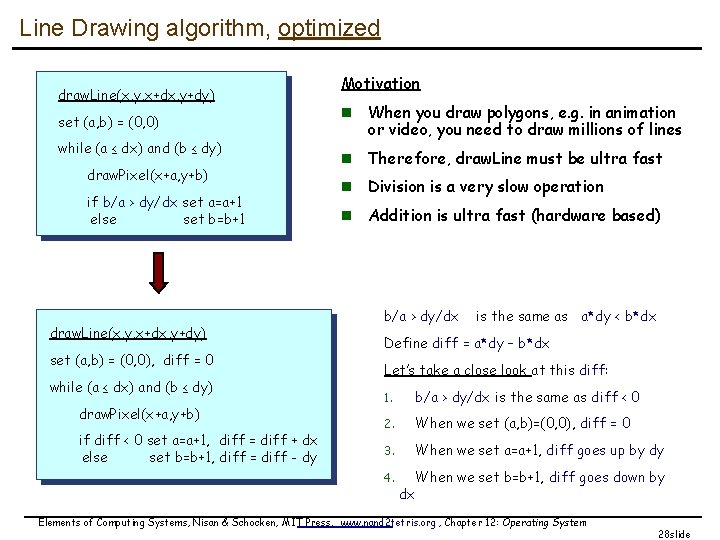
Line Drawing algorithm, optimized draw. Line(x, y, x+dx, y+dy) set (a, b) = (0, 0) while (a ≤ dx) and (b ≤ dy) draw. Pixel(x+a, y+b) if b/a > dy/dx set a=a+1 else set b=b+1 draw. Line(x, y, x+dx, y+dy) set (a, b) = (0, 0), diff = 0 while (a ≤ dx) and (b ≤ dy) draw. Pixel(x+a, y+b) if diff < 0 set a=a+1, diff = diff + dx else set b=b+1, diff = diff - dy Motivation n When you draw polygons, e. g. in animation or video, you need to draw millions of lines n Therefore, draw. Line must be ultra fast n Division is a very slow operation n Addition is ultra fast (hardware based) b/a > dy/dx is the same as a*dy < b*dx Define diff = a*dy – b*dx Let’s take a close look at this diff: 1. b/a > dy/dx is the same as diff < 0 2. When we set (a, b)=(0, 0), diff = 0 3. When we set a=a+1, diff goes up by dy 4. When we set b=b+1, diff goes down by dx Elements of Computing Systems, Nisan & Schocken, MIT Press, www. nand 2 tetris. org , Chapter 12: Operating System 28 slide
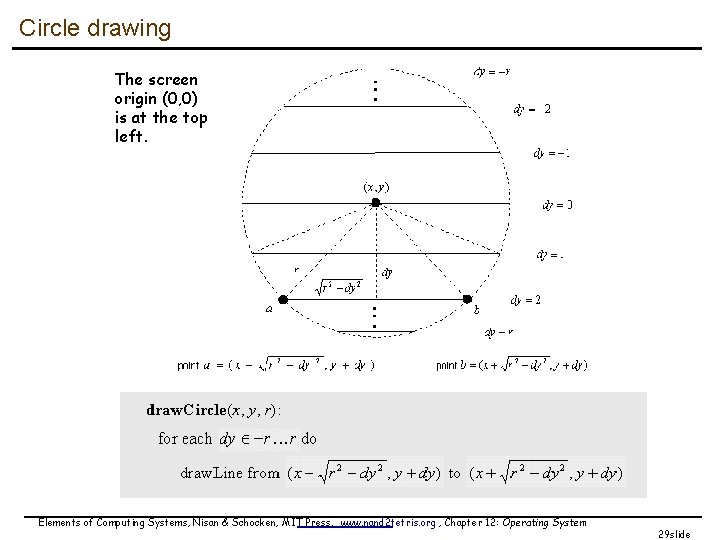
Circle drawing The screen origin (0, 0) is at the top left. Elements of Computing Systems, Nisan & Schocken, MIT Press, www. nand 2 tetris. org , Chapter 12: Operating System 29 slide
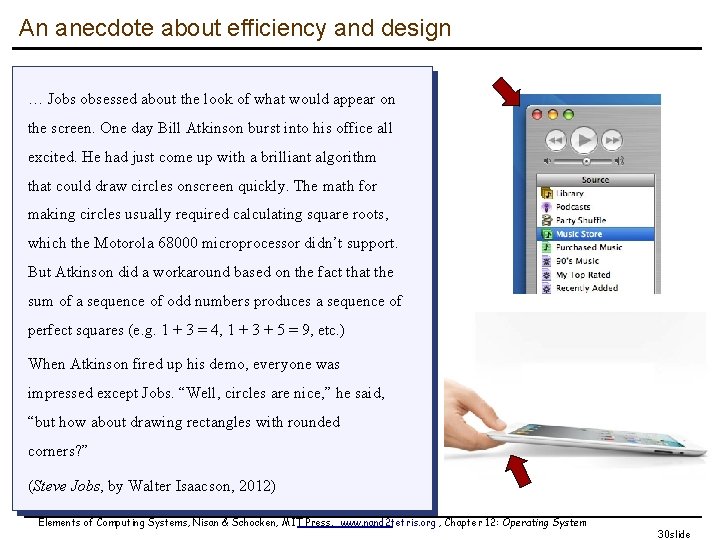
An anecdote about efficiency and design … Jobs obsessed about the look of what would appear on the screen. One day Bill Atkinson burst into his office all excited. He had just come up with a brilliant algorithm that could draw circles onscreen quickly. The math for making circles usually required calculating square roots, which the Motorola 68000 microprocessor didn’t support. But Atkinson did a workaround based on the fact that the sum of a sequence of odd numbers produces a sequence of perfect squares (e. g. 1 + 3 = 4, 1 + 3 + 5 = 9, etc. ) When Atkinson fired up his demo, everyone was impressed except Jobs. “Well, circles are nice, ” he said, “but how about drawing rectangles with rounded corners? ” (Steve Jobs, by Walter Isaacson, 2012) Elements of Computing Systems, Nisan & Schocken, MIT Press, www. nand 2 tetris. org , Chapter 12: Operating System 30 slide
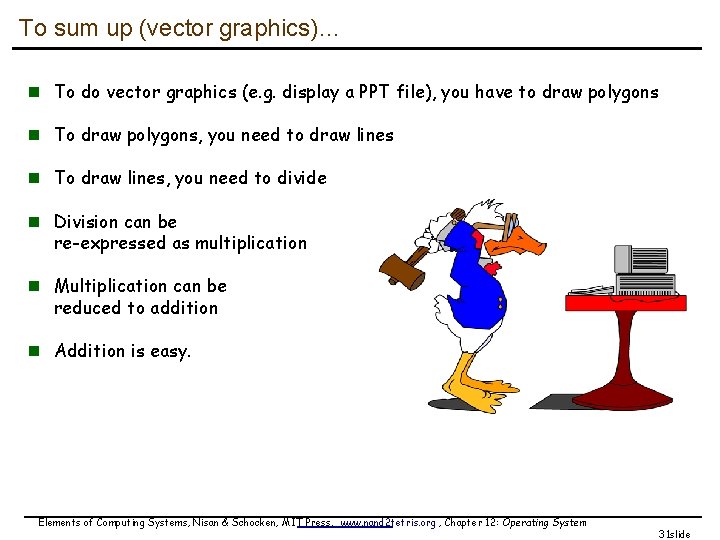
To sum up (vector graphics)… n To do vector graphics (e. g. display a PPT file), you have to draw polygons n To draw polygons, you need to draw lines n To draw lines, you need to divide n Division can be re-expressed as multiplication n Multiplication can be reduced to addition n Addition is easy. Elements of Computing Systems, Nisan & Schocken, MIT Press, www. nand 2 tetris. org , Chapter 12: Operating System 31 slide
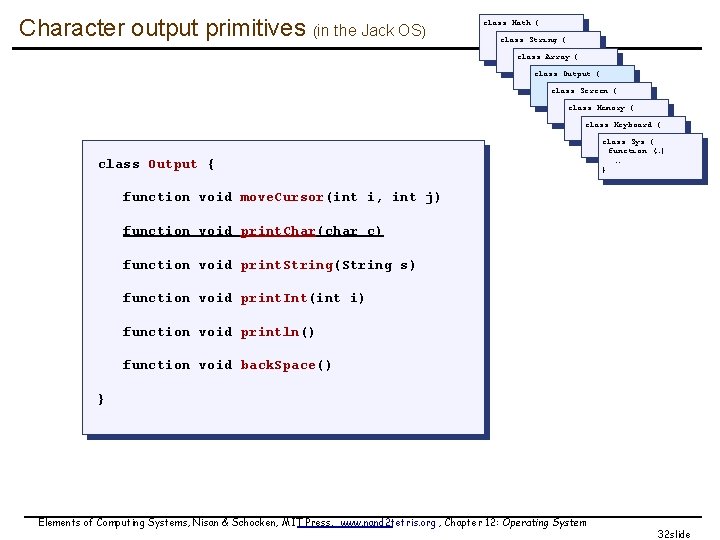
Character output primitives (in the Jack OS) class Math { class String { class Array { class Output { class Screen { class Memory { class Keyboard { class Output { class Sys { function (…) … } function void move. Cursor(int i, int j) function void print. Char(char c) function void print. String(String s) function void print. Int(int i) function void println() function void back. Space() } Elements of Computing Systems, Nisan & Schocken, MIT Press, www. nand 2 tetris. org , Chapter 12: Operating System 32 slide
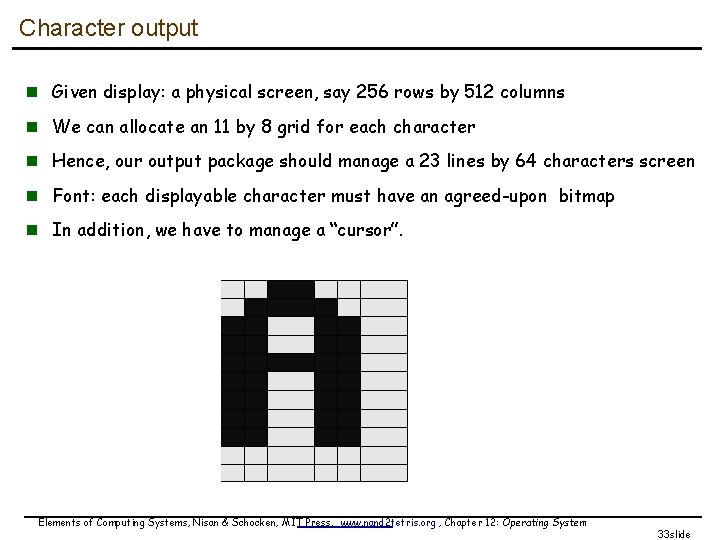
Character output n Given display: a physical screen, say 256 rows by 512 columns n We can allocate an 11 by 8 grid for each character n Hence, our output package should manage a 23 lines by 64 characters screen n Font: each displayable character must have an agreed-upon bitmap n In addition, we have to manage a “cursor”. Elements of Computing Systems, Nisan & Schocken, MIT Press, www. nand 2 tetris. org , Chapter 12: Operating System 33 slide
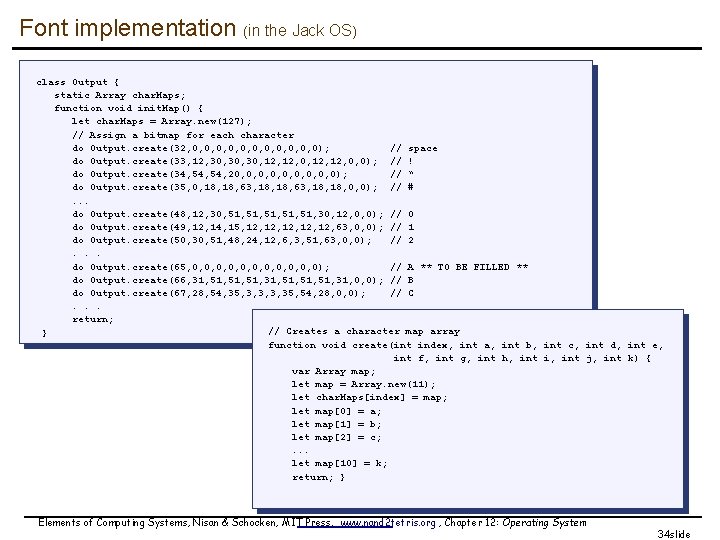
Font implementation (in the Jack OS) class Output { static Array char. Maps; function void init. Map() { let char. Maps = Array. new(127); // Assign a bitmap for each character do Output. create(32, 0, 0, 0, 0); // space do Output. create(33, 12, 30, 30, 12, 12, 0, 0); // ! do Output. create(34, 54, 20, 0, 0); // “ do Output. create(35, 0, 18, 18, 63, 18, 0, 0); // # . . . do Output. create(48, 12, 30, 51, 51, 51, 30, 12, 0, 0); // 0 do Output. create(49, 12, 14, 15, 12, 12, 12, 63, 0, 0); // 1 do Output. create(50, 30, 51, 48, 24, 12, 6, 3, 51, 63, 0, 0); // 2 . . . do Output. create(65, 0, 0, 0, 0); // A ** TO BE FILLED ** do Output. create(66, 31, 51, 51, 51, 31, 0, 0); // B do Output. create(67, 28, 54, 35, 3, 35, 54, 28, 0, 0); // C . . . return; // Creates a character map array } function void create(int index, int a, int b, int c, int d, int e, int f, int g, int h, int i, int j, int k) { var Array map; let map = Array. new(11); let char. Maps[index] = map; let map[0] = a; let map[1] = b; let map[2] = c; . . . let map[10] = k; return; } Elements of Computing Systems, Nisan & Schocken, MIT Press, www. nand 2 tetris. org , Chapter 12: Operating System 34 slide
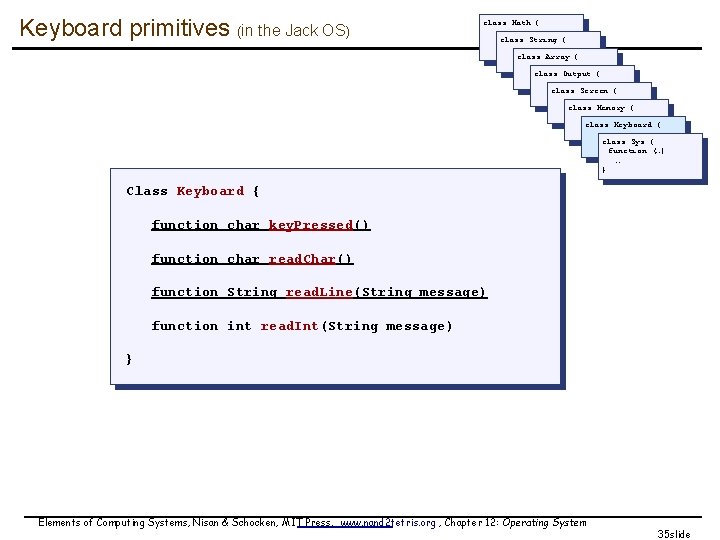
Keyboard primitives (in the Jack OS) class Math { class String { class Array { class Output { class Screen { class Memory { class Keyboard { class Sys { function (…) … } Class Keyboard { function char key. Pressed() function char read. Char() function String read. Line(String message) function int read. Int(String message) } Elements of Computing Systems, Nisan & Schocken, MIT Press, www. nand 2 tetris. org , Chapter 12: Operating System 35 slide
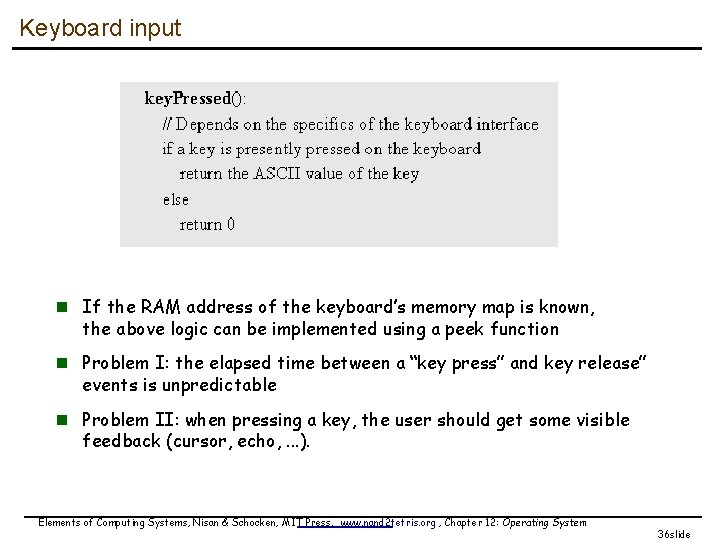
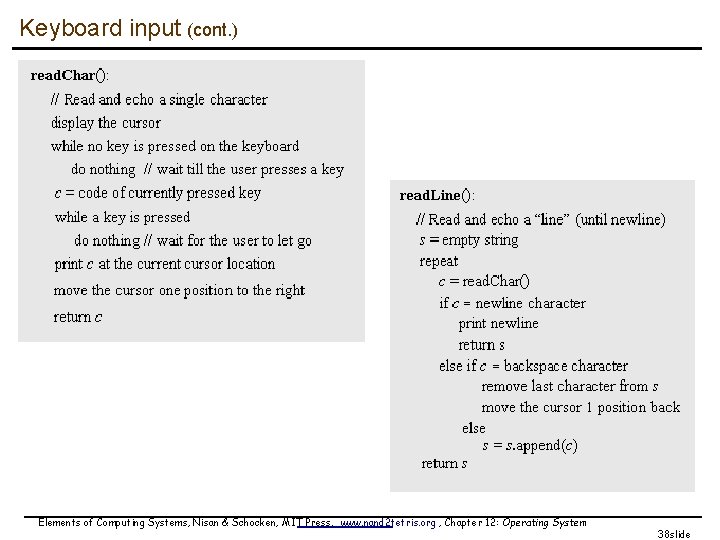
Keyboard input n If the RAM address of the keyboard’s memory map is known, the above logic can be implemented using a peek function n Problem I: the elapsed time between a “key press” and key release” events is unpredictable n Problem II: when pressing a key, the user should get some visible feedback (cursor, echo, . . . ). Elements of Computing Systems, Nisan & Schocken, MIT Press, www. nand 2 tetris. org , Chapter 12: Operating System 36 slide
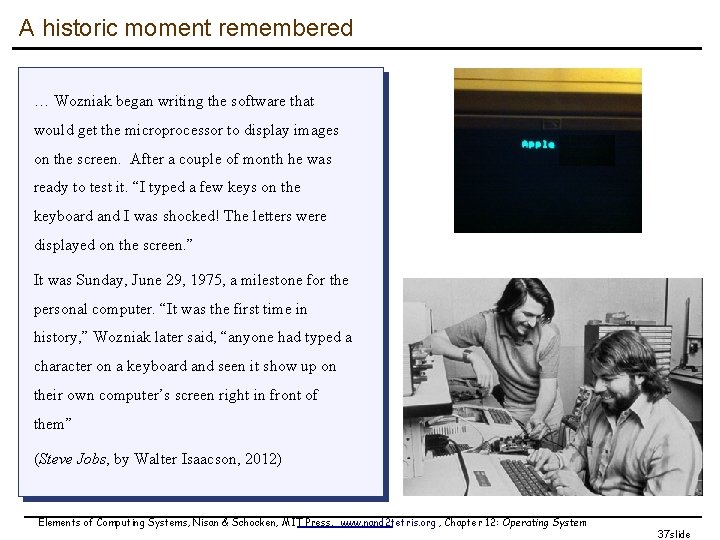
A historic moment remembered … Wozniak began writing the software that would get the microprocessor to display images on the screen. After a couple of month he was ready to test it. “I typed a few keys on the keyboard and I was shocked! The letters were displayed on the screen. ” It was Sunday, June 29, 1975, a milestone for the personal computer. “It was the first time in history, ” Wozniak later said, “anyone had typed a character on a keyboard and seen it show up on their own computer’s screen right in front of them” (Steve Jobs, by Walter Isaacson, 2012) Elements of Computing Systems, Nisan & Schocken, MIT Press, www. nand 2 tetris. org , Chapter 12: Operating System 37 slide
Keyboard input (cont. ) Elements of Computing Systems, Nisan & Schocken, MIT Press, www. nand 2 tetris. org , Chapter 12: Operating System 38 slide
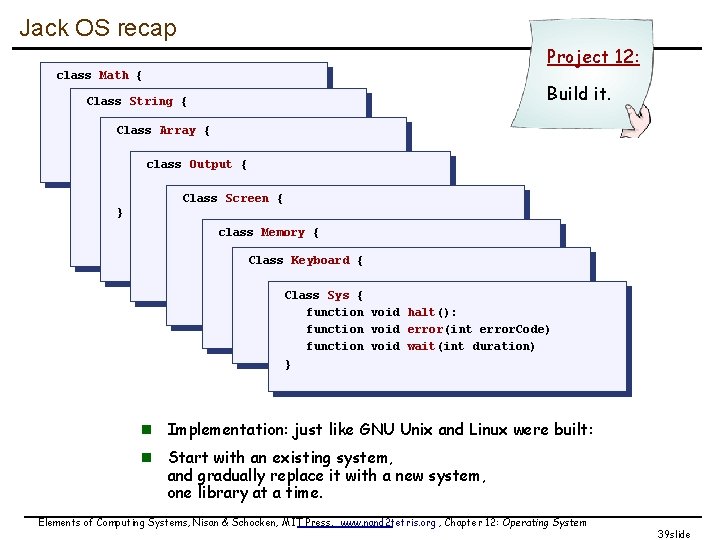
Jack OS recap Project 12: class Math { function void init() Class String { function int abs(int x) Class Array { Build it. function Array new(int size) class Output { method void dispose() Class Screen { } class Memory { function int peek(int address) Class Keyboard { Class Sys { function void halt(): function void error(int error. Code) function void wait(int duration) } n Implementation: just like GNU Unix and Linux were built: n Start with an existing system, and gradually replace it with a new system, one library at a time. Elements of Computing Systems, Nisan & Schocken, MIT Press, www. nand 2 tetris. org , Chapter 12: Operating System 39 slide
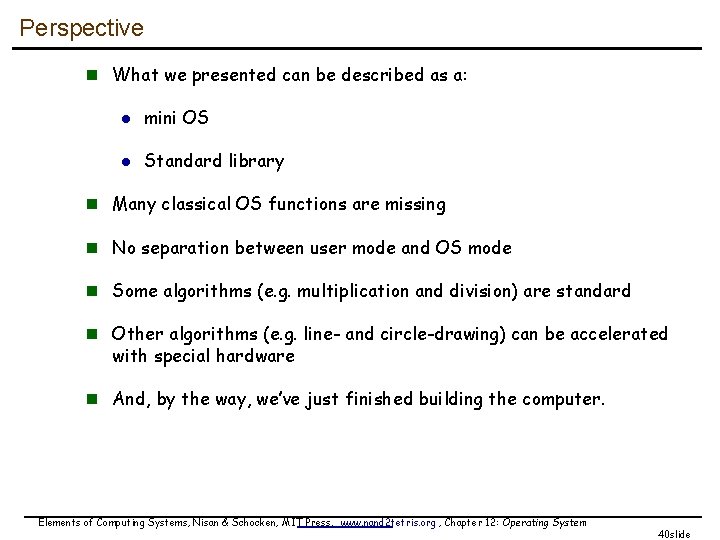
Perspective n What we presented can be described as a: l mini OS l Standard library n Many classical OS functions are missing n No separation between user mode and OS mode n Some algorithms (e. g. multiplication and division) are standard n Other algorithms (e. g. line- and circle-drawing) can be accelerated with special hardware n And, by the way, we’ve just finished building the computer. Elements of Computing Systems, Nisan & Schocken, MIT Press, www. nand 2 tetris. org , Chapter 12: Operating System 40 slide