
Elements of a Short Story Setting Time Place
- Slides: 17
Elements of a Short Story Setting èTime èPlace è Establishes the mood
Setting The Time “Once upon a time…. ” This can include the historical period, time of day, time of year, etc.
Setting The Place “…in a wee little shack…” What is the geographical location? What is the climate or weather? Where is the story taking place?
Setting Mood Ø What feeling or atmosphere is created at the beginning of the story? Ø How does the author create the mood?
Characters “…there lived 3 Bears” The people, animals, or imaginary creatures that act out the events of the story “. . One was a Mama bear, one was a Papa bear and one was a wee bear”
An author develops and reveals a character through describing…. • Appearance (What they look like) • Personality • Speech (How they talk – What they say) • Actions (what they do) • Thoughts & Feelings • Interactions with other characters
Characterization Direct characterization • When the author tells what the character is like. No inference needed. Indirect characterization • The writer shows what the character is like. The reader must often draw conclusions (infer) based on • What the character says & does • What the character looks like • What other characters say and how they respond
Plot ACTION The action or sequence of events in a story “ One day they went a-walkin’ and astalkin’ through the forest came a girl with long hair. ”
Plot There are 5 parts to a plot 1. 2. 3. 4. 5. Exposition Rising action Climax Falling action Resolution See the power point on Plot for more detail.
Theme The Big Idea…. . • This is the statement about life that the author wants you to know. • It is stated as a sentence, not a word or two. • It is true for all people, in any place and in any time. (universal)
Theme The Big Idea…. . ►Sometimes clearly stated ►Most of the time the reader must make inferences based on how the main character changes or resolves the conflict.
Point of View The vantage point from which the story is told The narrator speaks in: • 1 st Person = I, me, us, we, mine told by one of the characters • 2 nd Person = you, yours narrator is speaking directly to the reader (not often used in narratives) • 3 rd Person = he, they, she, them told by a narrator outside the story. (see ppt on point of view for more detail)
Author’s Point of View This is different From the narrator’s point of view. An author’s point of view is also stated as his or her VIEWPOINT or opinion What ever the type of writing, the author is sharing his or her opinions or ideas about a topic or theme.
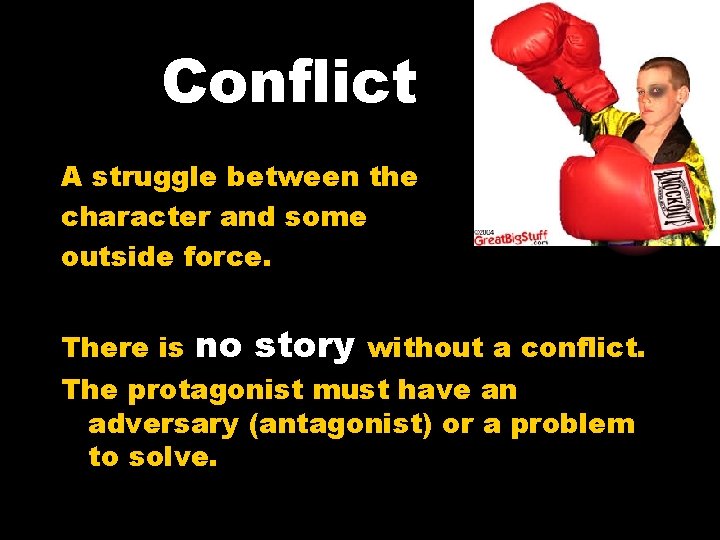
Conflict A struggle between the character and some outside force. There is no story without a conflict. The protagonist must have an adversary (antagonist) or a problem to solve.
There are 2 kinds of conflict • Internal conflict • External conflict
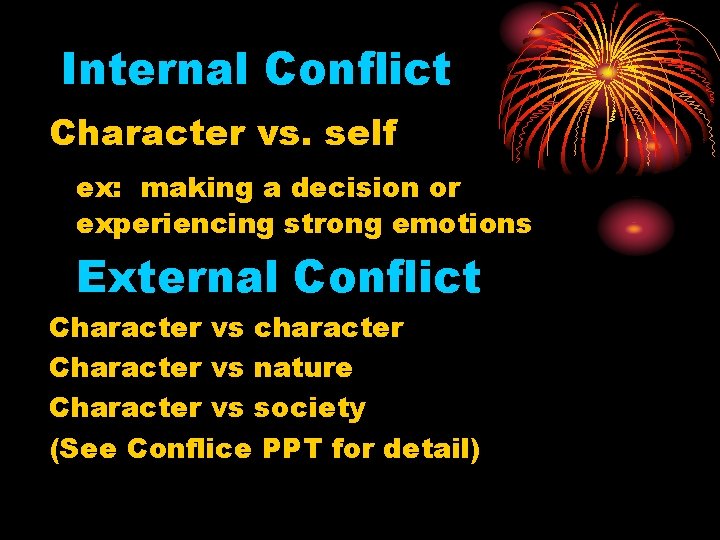
Internal Conflict Character vs. self ex: making a decision or experiencing strong emotions External Conflict Character vs character Character vs nature Character vs society (See Conflice PPT for detail)