
Elements of a Short Story Plot The Plan
- Slides: 19
Elements of a Short Story
Plot �The Plan of the short story. �The events that will happen.
Conflict �Physical – one individual vs. another. �Mental – individual struggles vs. conscience. �Physical and mental �Individual vs. environment or society.
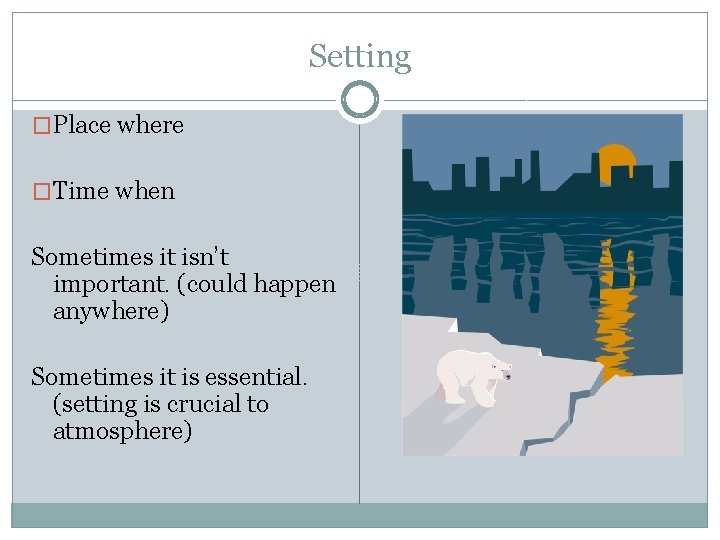
Setting �Place where �Time when Sometimes it isn’t important. (could happen anywhere) Sometimes it is essential. (setting is crucial to atmosphere)
Theme �What the writer has to say about his/her subject. �The basic idea that they wish to leave us with when the story is read)
What makes a Good Story #1 -Something must happen. #2 -It must happen within the context of human relationships. #3 – It must be something interesting about human relationships. #4 – Something must be learned. It should linger with us once the story is finished.
“Based” on a true story - assignment �Think of your favourite true story. �A story that you are good at telling and usually gets a good response. �Try to pick one that your friends may not have heard. �Fill out the Story Map – sheet. �Add one thing to the story that isn’t true. (it must be part of the plot not the setting or characters. �Try to trick your listeners/readers – see if they can identify the lie.
Plot Definite Inference �Who did what to whom �Comes from theme i. e. , and with what consequences? the aspect of human experience the writer wants his story to comment on. The “job” of the plot is to satisfy natural human curiosity About what happened.
Beginnings �The beginning has a key function for the plot: it helps the reader focus on who, what, and where. ex. What is this story going to be about? What is it not going to be about? What kind of problem or tension might develop? In what situation is this story placed?
Turning Point or Climax �This occurs where the presentation of the conflict ends and the solution begins, but, it is not the solution itself. Good Climax �The action should be fully developed by this point. �It should relate to the previous actions of the story. �It should give us a promise of a resolution.
Conclusions �It must satisfy the problem or conflict posed in the story. �Traditionally, consequences are usually fitting together of plot elements so that the plot strings are tied together neatly. �Sometimes the consequences are implied.
Theme �What is the story really about? �You must look at the psychological dilemma and find something to take away.
Literary Terms (Boring) BUT PAY ATTENTION!!!
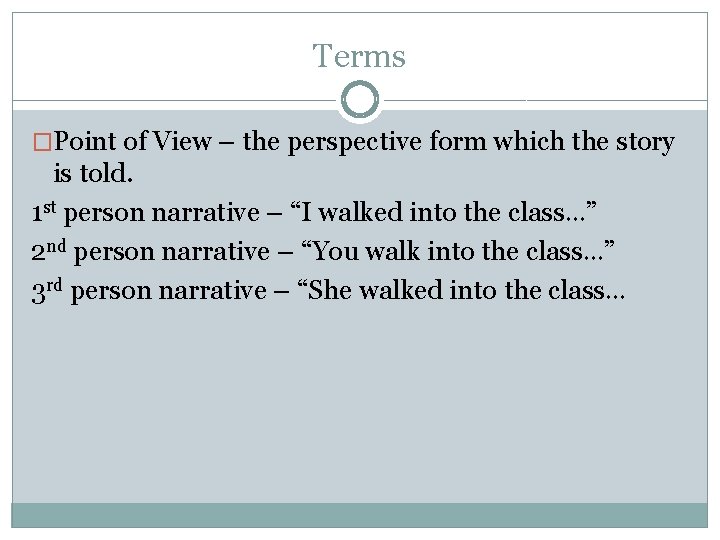
Terms �Point of View – the perspective form which the story is told. 1 st person narrative – “I walked into the class…” 2 nd person narrative – “You walk into the class…” 3 rd person narrative – “She walked into the class…
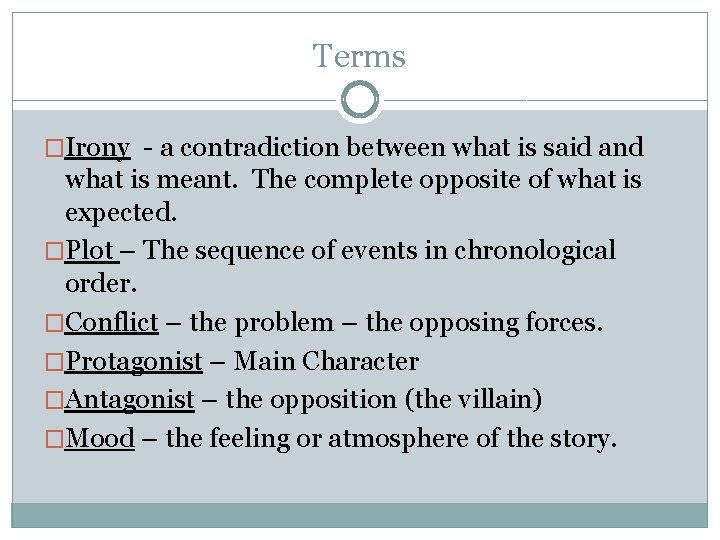
Terms �Irony - a contradiction between what is said and what is meant. The complete opposite of what is expected. �Plot – The sequence of events in chronological order. �Conflict – the problem – the opposing forces. �Protagonist – Main Character �Antagonist – the opposition (the villain) �Mood – the feeling or atmosphere of the story.
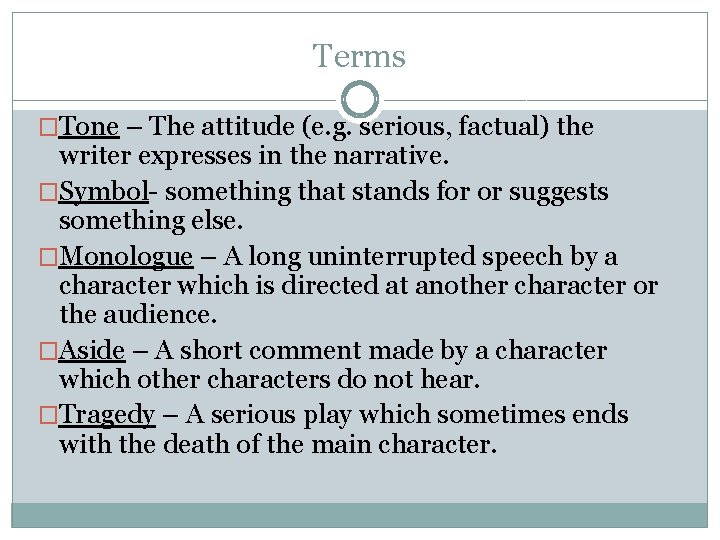
Terms �Tone – The attitude (e. g. serious, factual) the writer expresses in the narrative. �Symbol- something that stands for or suggests something else. �Monologue – A long uninterrupted speech by a character which is directed at another character or the audience. �Aside – A short comment made by a character which other characters do not hear. �Tragedy – A serious play which sometimes ends with the death of the main character.
Terms �Foreshadowing – hints of future events in the story. �Satire – A use of wit and sarcasm to attack human weakness or flaws. �Parody – A humorous imitation of serious stories or events. �Simile – A comparison using “like” or “as” �Metaphor – A comparison that does not use “like” or “as”
Terms �Imagery – A use of descriptive words or phrases used to create vivid mental pictures in the mind of the reader. �Suspense – a feeling of enjoyable tension that builds as the story progresses.
Inference �Making assumptions or deductions about something that is not in the story.