
Elements of a Novel setting theme plot dialog

- Slides: 14
Elements of a Novel setting, theme, plot, dialog, style
Plot • Structure • Exposition- sets up story & conflict • Rising action • Climax • Falling action • Denouement : final outcome or resolution
Plot • • What is the type of conflict ? Internal- man vs self External- man vs man Other: man vs society/culture/race/religion/technology/nature etc IDENTIFY TYPE OF CONFLICT
Plot structure • Chronological • Frame • non-chronological ( by paragraph/ chapter? ) • WHY? What’s the effect? The author did it for a reason!
Plot structure Each genre has their own unique plot structure. • Action adventure • crime • Romance- happily ever after ( G to X-rated ) • • Thriller-dead body in 1 st page Mystery/detective-a solvable crime (duh) Horror-gore Fantasy- unique fantastical world Sci-fi Western Inspirational • Fiction can be • Multi-genre • Elements of several • There are sub-groups within the genres • Ex: historical fiction, urban fantasy, chick-lit, cozy, YA, magical realism, speculative, comedic, erotic, Christian
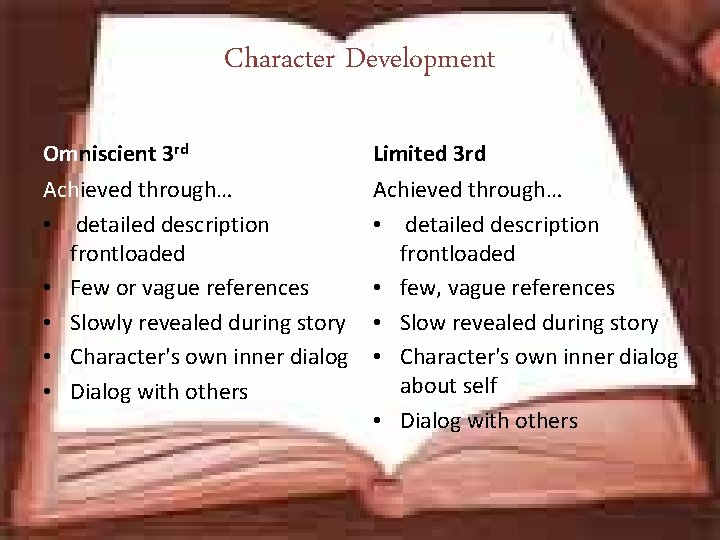
Character Development Omniscient 3 rd Limited 3 rd Achieved through… • detailed description frontloaded • Few or vague references • Slowly revealed during story • Character's own inner dialog • Dialog with others Achieved through… • detailed description frontloaded • few, vague references • Slow revealed during story • Character's own inner dialog about self • Dialog with others
Character Development • 1 st person ( how reliable is narrator? ) Achieved through • Dialog • Description, exposition
Writing Style • How does author achieve tone, mood, imagery? • Is it spare, concise, symbolic, heavy on the adjectives, metaphoric, complex, simple? • Word play: alliteration, rhyme, rhythm, assonance, repetition, anaphora
Writing style • • • Sentences: long, complex =general fiction) Short =thriller Poetic Lean (think Hemingway) graphic, specific =are you “there”) • Vague =reader must use their imagination
Writing Style • Which details are included and why? • What’s NOT written? Or left out? • Use of punctuation: caps, italics, parentheses, N/M-dash, ellipses
Over all Tone • • Dark Light Comedic Irreverent Witty Sarcastic Factual
Theme what point is the author trying to make? The _____of ______ Abstract idea, emotion abstract idea/emotion • • • • • Problems Consequences Beauty Pain Effects Joys Nature Hypocrisy Necessity Benefits Roles Benefits Values Nature Possibilities Violence Allure Injustice Ideals Struggles
Setting • Don’t think just geographical location, setting is also: • Historical • Rural/urban • topography=mountain/swamp/desert etc • season
Put it all together How do all the elements work as a whole? • • Confusing? Why? Traditional? Why? Chaotic? Why A writer of literature uses all these elements for a purpose!