
Elements Compounds and Mixtures Elements A substance that
Elements, Compounds and Mixtures
Elements • A substance that can not be broken down into a simpler substance by physical means. • Consist of atoms of only one type. • Elements get their names from: – Scientists who discovered them. – Greek and Latin words. – Location of origin. • Examples: Sodium (Na), Helium (He)…. .
Compounds • Substance made of atoms of two or more different elements • Atoms are held together by chemical bonds. • May have very different properties from the individual elements that make it up.
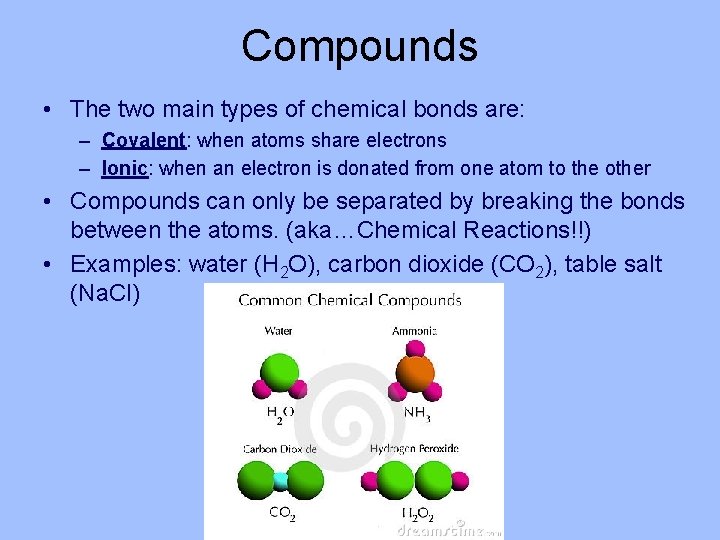
Compounds • The two main types of chemical bonds are: – Covalent: when atoms share electrons – Ionic: when an electron is donated from one atom to the other • Compounds can only be separated by breaking the bonds between the atoms. (aka…Chemical Reactions!!) • Examples: water (H 2 O), carbon dioxide (CO 2), table salt (Na. Cl)
Mixtures • Two or more substances that are combined together, but not chemically joined. • Can be separated by physical properties: – Size, Density and Solubility – Electrical Charge, Magnets, Filtration, Evaporation • Mixtures can be homogeneous or heterogeneous.
Homogeneous vs. Heterogeneous • Homogeneous- particles evenly spread throughout entire mixture (has uniform composition). – Ex: Sugar water, air, soft drinks • Heterogeneous- particles not evenly distributed throughout entire mixture (does not have uniform composition) – Examples: fruit salad, soil, trail mix
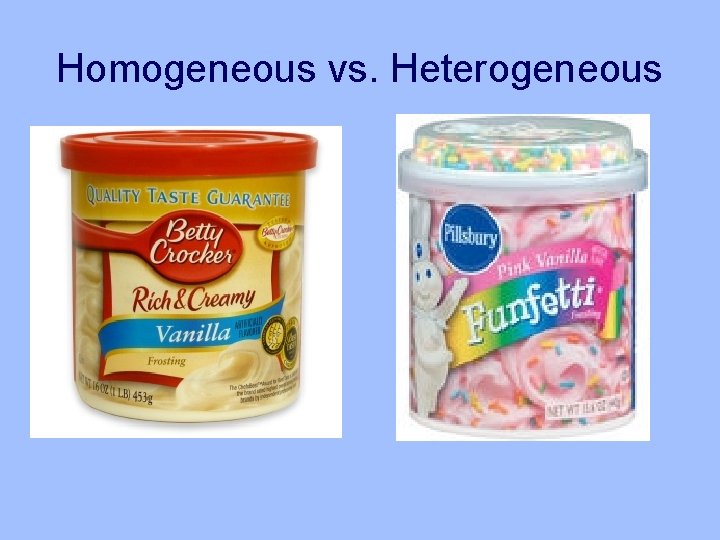
Homogeneous vs. Heterogeneous
- Slides: 7