
Elements and Principles of Design old and new
- Slides: 8
Elements and Principles of Design- old and new
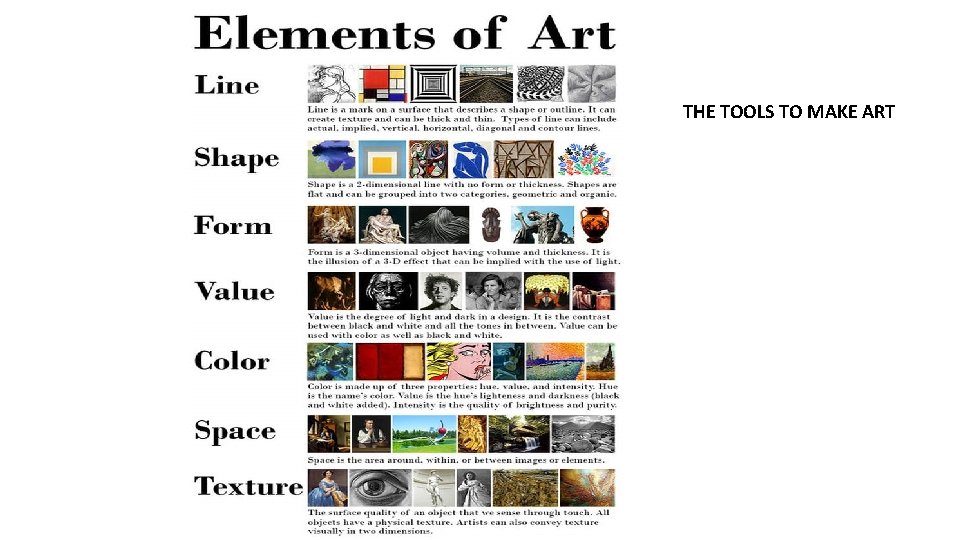
THE TOOLS TO MAKE ART
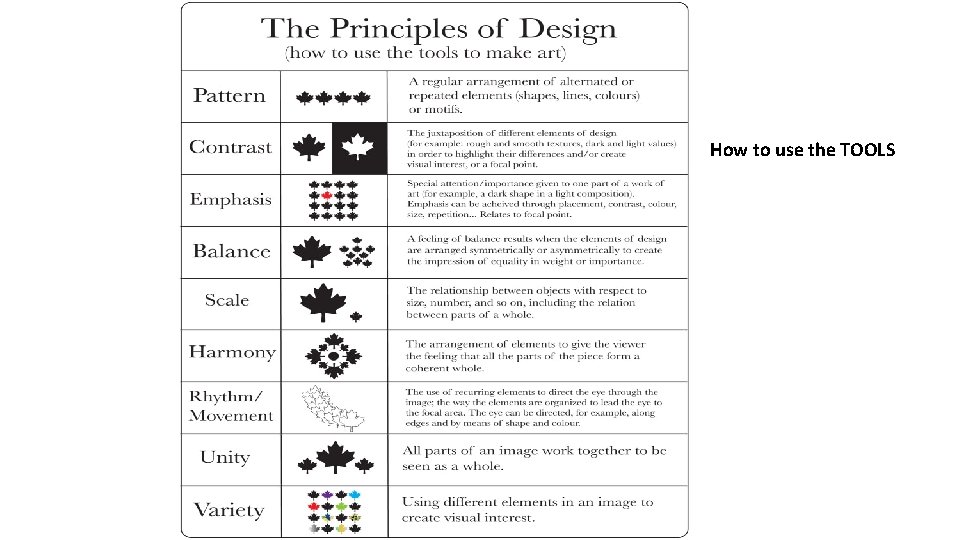
How to use the TOOLS
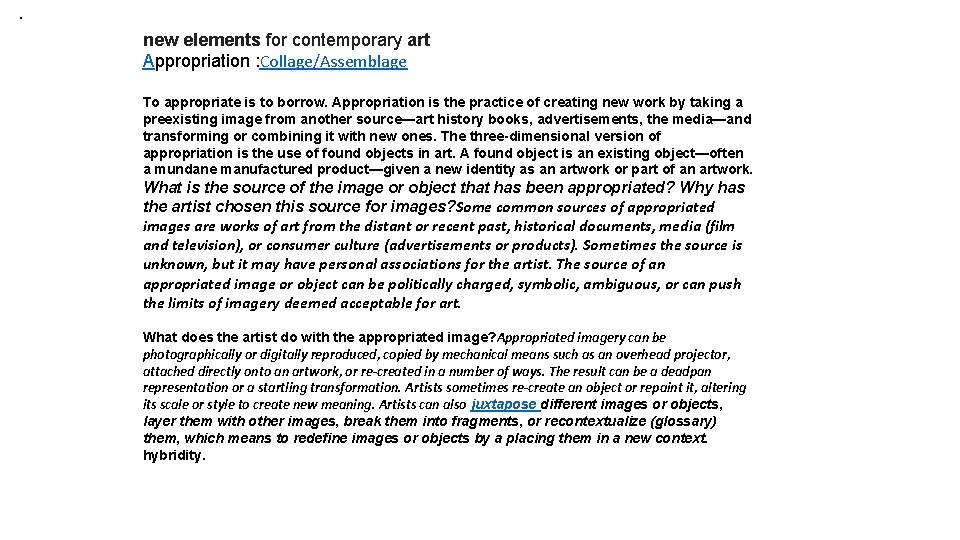
. new elements for contemporary art Appropriation : Collage/Assemblage To appropriate is to borrow. Appropriation is the practice of creating new work by taking a preexisting image from another source—art history books, advertisements, the media—and transforming or combining it with new ones. The three-dimensional version of appropriation is the use of found objects in art. A found object is an existing object—often a mundane manufactured product—given a new identity as an artwork or part of an artwork. What is the source of the image or object that has been appropriated? Why has the artist chosen this source for images? Some common sources of appropriated images are works of art from the distant or recent past, historical documents, media (film and television), or consumer culture (advertisements or products). Sometimes the source is unknown, but it may have personal associations for the artist. The source of an appropriated image or object can be politically charged, symbolic, ambiguous, or can push the limits of imagery deemed acceptable for art. What does the artist do with the appropriated image? Appropriated imagery can be photographically or digitally reproduced, copied by mechanical means such as an overhead projector, attached directly onto an artwork, or re-created in a number of ways. The result can be a deadpan representation or a startling transformation. Artists sometimes re-create an object or repaint it, altering its scale or style to create new meaning. Artists can also juxtapose different images or objects, layer them with other images, break them into fragments, or recontextualize (glossary) them, which means to redefine images or objects by a placing them in a new context. hybridity.
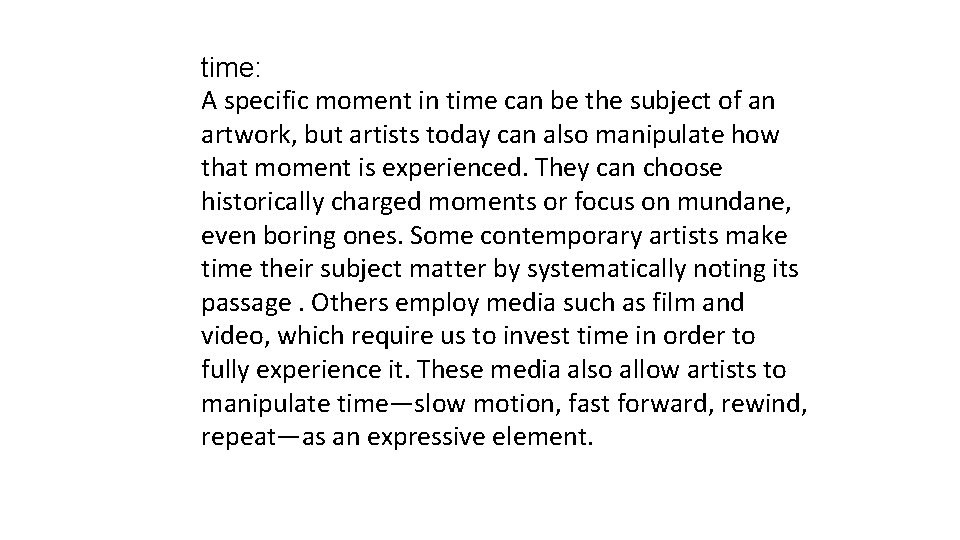
time: A specific moment in time can be the subject of an artwork, but artists today can also manipulate how that moment is experienced. They can choose historically charged moments or focus on mundane, even boring ones. Some contemporary artists make time their subject matter by systematically noting its passage. Others employ media such as film and video, which require us to invest time in order to fully experience it. These media also allow artists to manipulate time—slow motion, fast forward, rewind, repeat—as an expressive element.
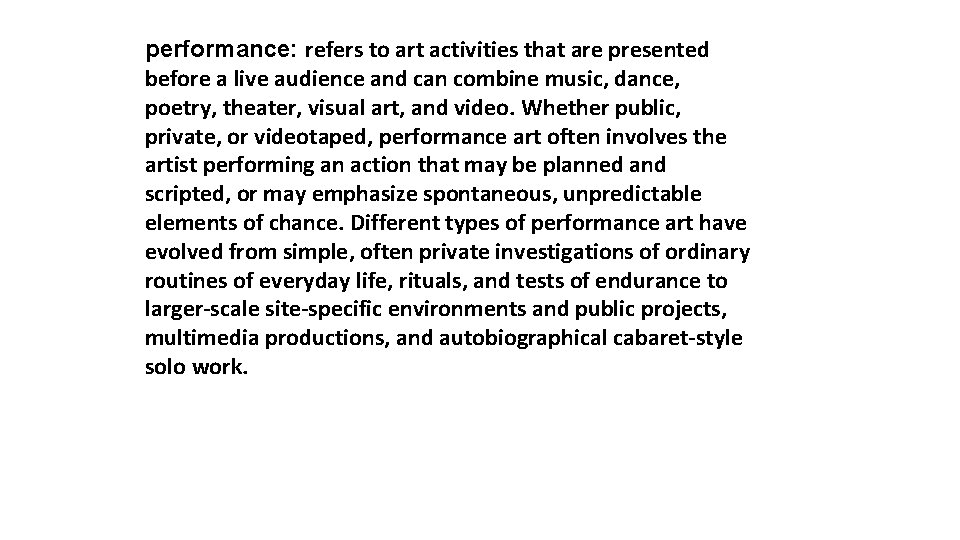
performance: refers to art activities that are presented before a live audience and can combine music, dance, poetry, theater, visual art, and video. Whether public, private, or videotaped, performance art often involves the artist performing an action that may be planned and scripted, or may emphasize spontaneous, unpredictable elements of chance. Different types of performance art have evolved from simple, often private investigations of ordinary routines of everyday life, rituals, and tests of endurance to larger-scale site-specific environments and public projects, multimedia productions, and autobiographical cabaret-style solo work.
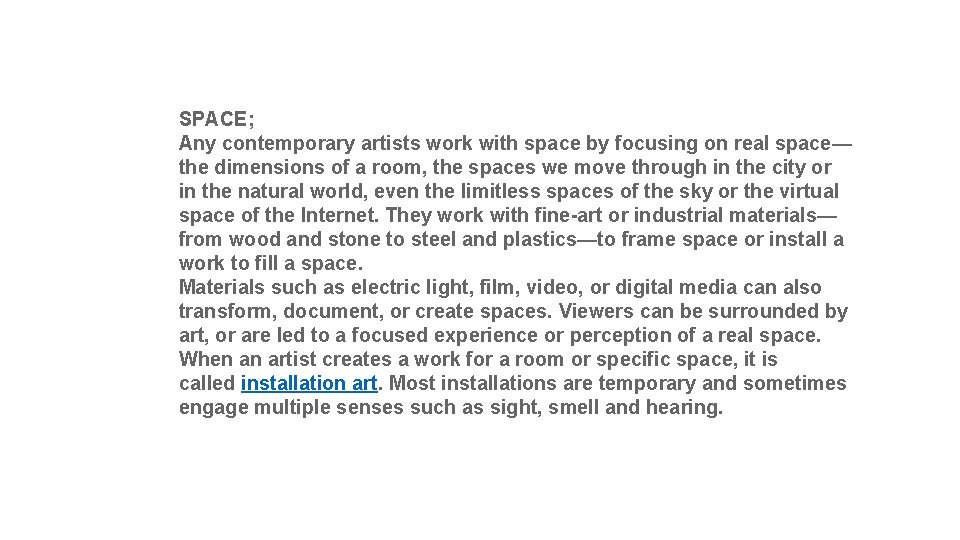
SPACE; Any contemporary artists work with space by focusing on real space— the dimensions of a room, the spaces we move through in the city or in the natural world, even the limitless spaces of the sky or the virtual space of the Internet. They work with fine-art or industrial materials— from wood and stone to steel and plastics—to frame space or install a work to fill a space. Materials such as electric light, film, video, or digital media can also transform, document, or create spaces. Viewers can be surrounded by art, or are led to a focused experience or perception of a real space. When an artist creates a work for a room or specific space, it is called installation art. Most installations are temporary and sometimes engage multiple senses such as sight, smell and hearing.
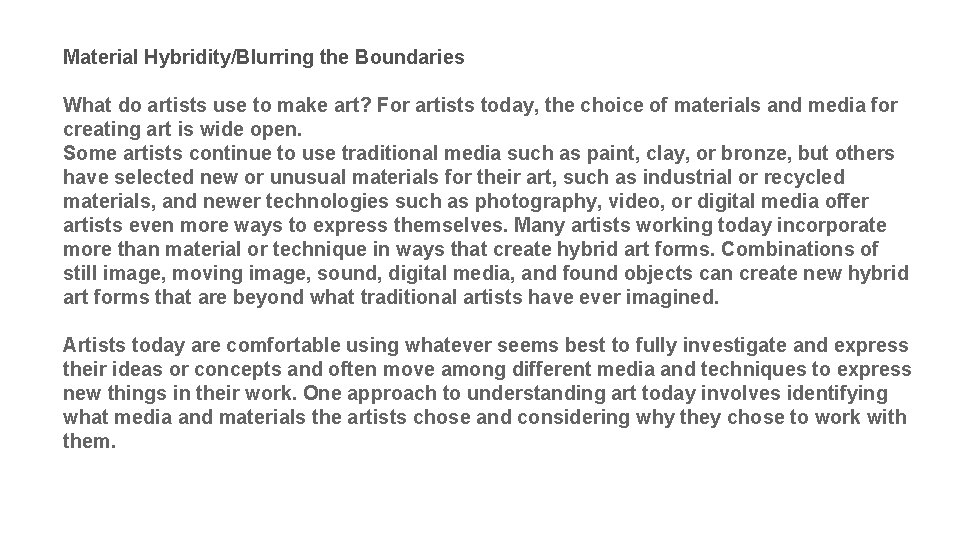
Material Hybridity/Blurring the Boundaries What do artists use to make art? For artists today, the choice of materials and media for creating art is wide open. Some artists continue to use traditional media such as paint, clay, or bronze, but others have selected new or unusual materials for their art, such as industrial or recycled materials, and newer technologies such as photography, video, or digital media offer artists even more ways to express themselves. Many artists working today incorporate more than material or technique in ways that create hybrid art forms. Combinations of still image, moving image, sound, digital media, and found objects can create new hybrid art forms that are beyond what traditional artists have ever imagined. Artists today are comfortable using whatever seems best to fully investigate and express their ideas or concepts and often move among different media and techniques to express new things in their work. One approach to understanding art today involves identifying what media and materials the artists chose and considering why they chose to work with them.