
Elements and Chemical Bonds Chapter 11 Material on
Elements and Chemical Bonds Chapter 11 Material on Midterm
Essential Questions � How is an electron’s energy related to its distance from the nucleus? � Why do atoms gain, lose, or share electrons? � How do elements differ from the compounds they form? � What are some common properties of a covalent compound? � Why is water a polar compound? � What is an ionic compound? � How do metallic bonds differ from covalent and ionic bonds?
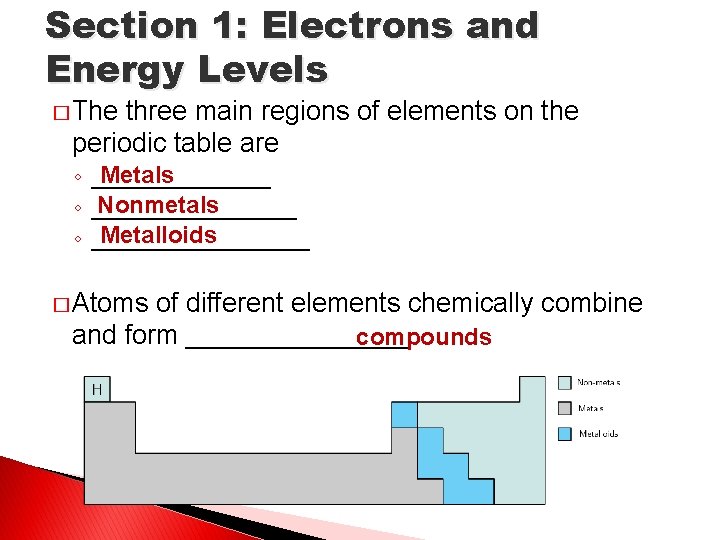
Section 1: Electrons and Energy Levels � The three main regions of elements on the periodic table are ◦ ◦ ◦ Metals _______ Nonmetals ________ Metalloids _________ � Atoms of different elements chemically combine and form ________ compounds
Section 1: Electrons and Energy Levels � Combining Atoms through Chemical Bonding ◦ Most atoms hate being alone…so they form Chemical bonds _________! combining �Term: Chemical bonding is the ________ of atoms to form molecules or ionic compounds different �Properties of new substance are ________ that the properties of the old substance
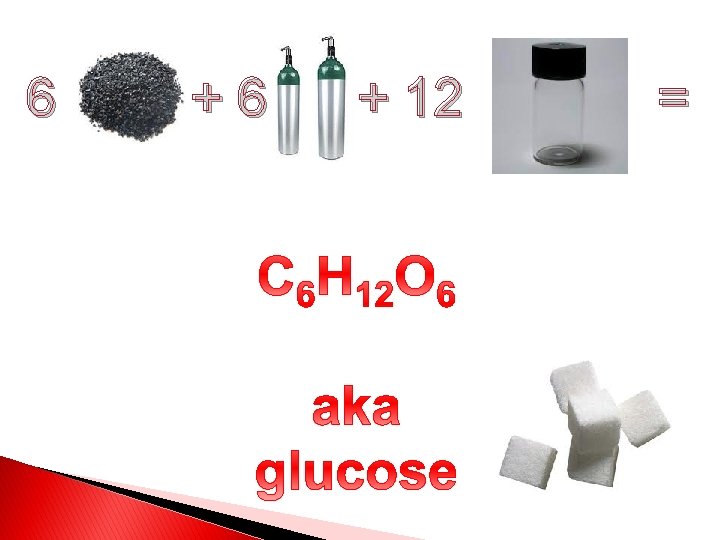
6 +6 + 12 =
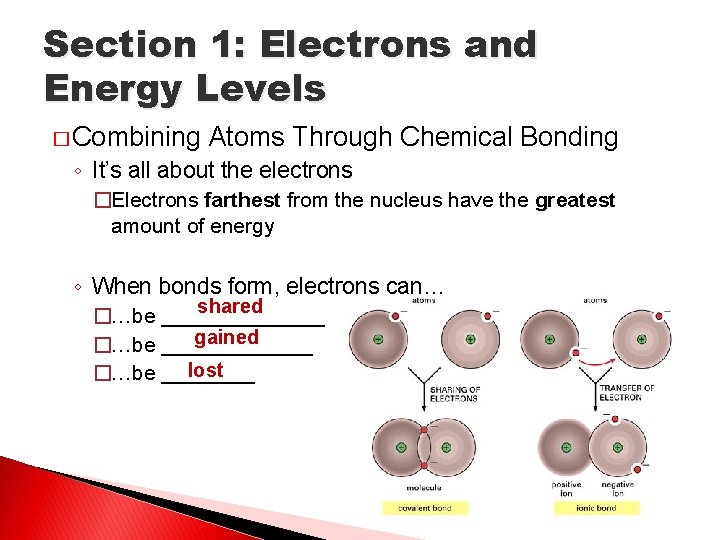
Section 1: Electrons and Energy Levels � Combining Atoms Through Chemical Bonding ◦ It’s all about the electrons �Electrons farthest from the nucleus have the greatest amount of energy ◦ When bonds form, electrons can… shared �…be _______ gained �…be _______ lost �…be ____
Section 1: Electrons and Energy Levels � Review: How do I know how many electrons a neutral atom has? atomic number ◦ Same as its ____________(proton #) ◦ Ex: chlorine
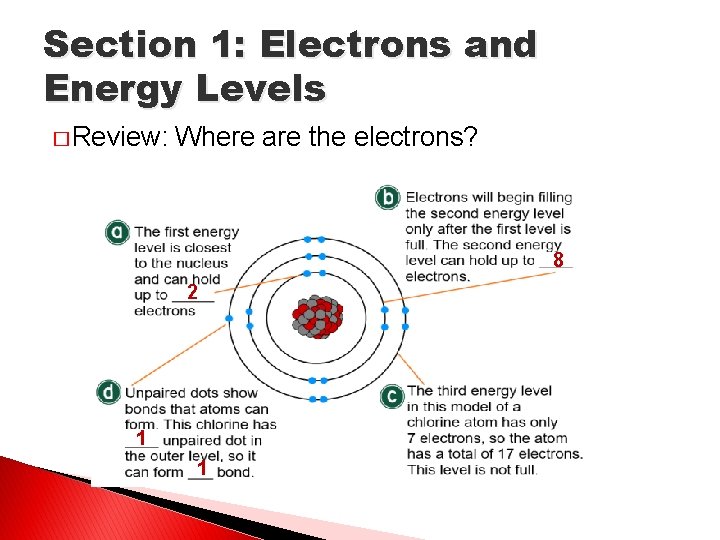
Section 1: Electrons and Energy Levels � Review: Where are the electrons? 8 2 1 1
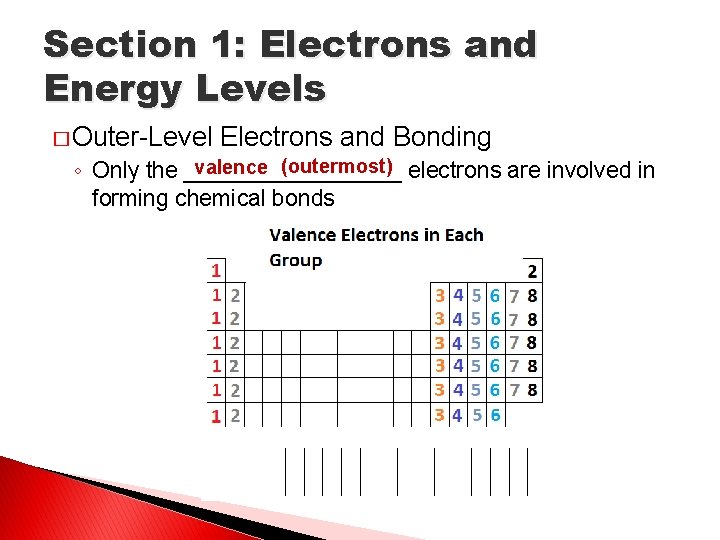
Section 1: Electrons and Energy Levels � Outer-Level Electrons and Bonding valence (outermost) electrons are involved in ◦ Only the _________ forming chemical bonds
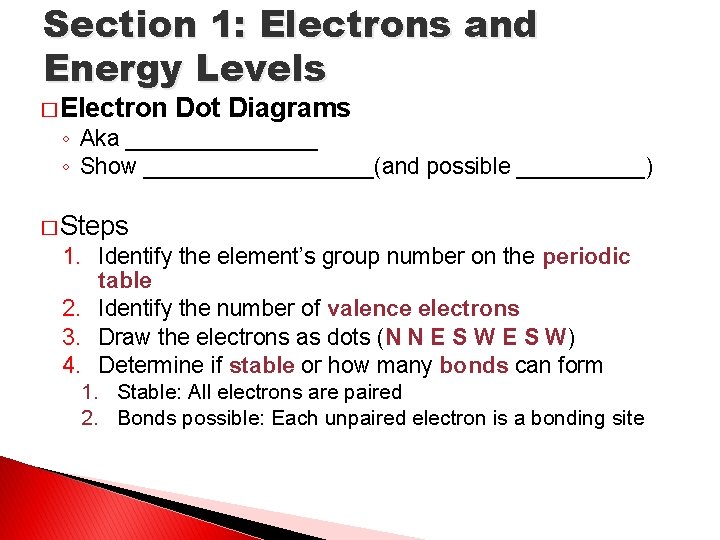
Section 1: Electrons and Energy Levels � Electron Dot Diagrams ◦ Aka ________ ◦ Show _________(and possible _____) � Steps 1. Identify the element’s group number on the periodic table 2. Identify the number of valence electrons 3. Draw the electrons as dots (N N E S W) 4. Determine if stable or how many bonds can form 1. Stable: All electrons are paired 2. Bonds possible: Each unpaired electron is a bonding site
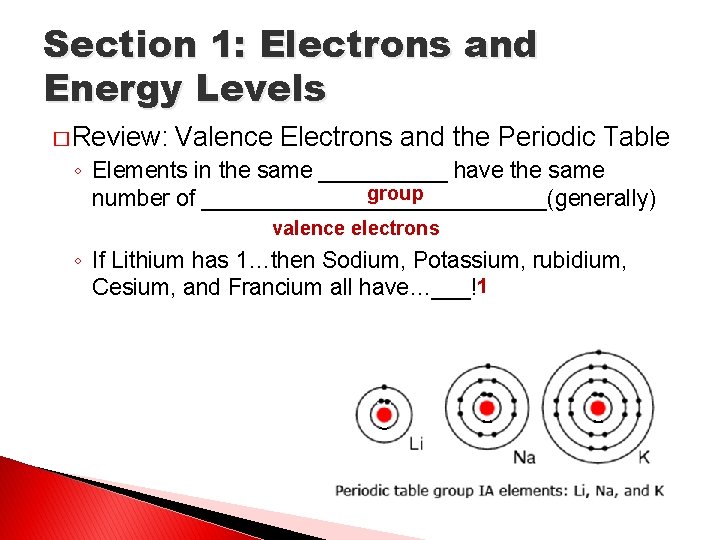
Section 1: Electrons and Energy Levels � Review: Valence Electrons and the Periodic Table ◦ Elements in the same _____ have the same group number of ______________(generally) valence electrons ◦ If Lithium has 1…then Sodium, Potassium, rubidium, Cesium, and Francium all have…___! 1
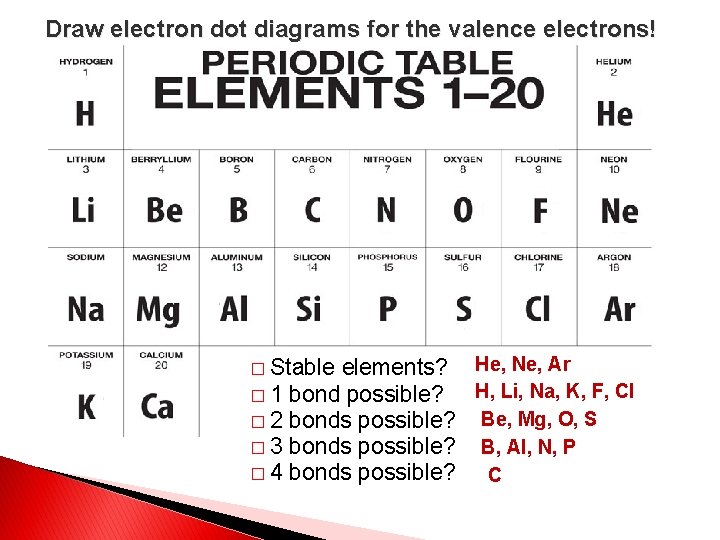
Draw electron dot diagrams for the valence electrons! elements? He, Ne, Ar H, Li, Na, K, F, Cl � 1 bond possible? Be, Mg, O, S � 2 bonds possible? � 3 bonds possible? B, Al, N, P � 4 bonds possible? C � Stable
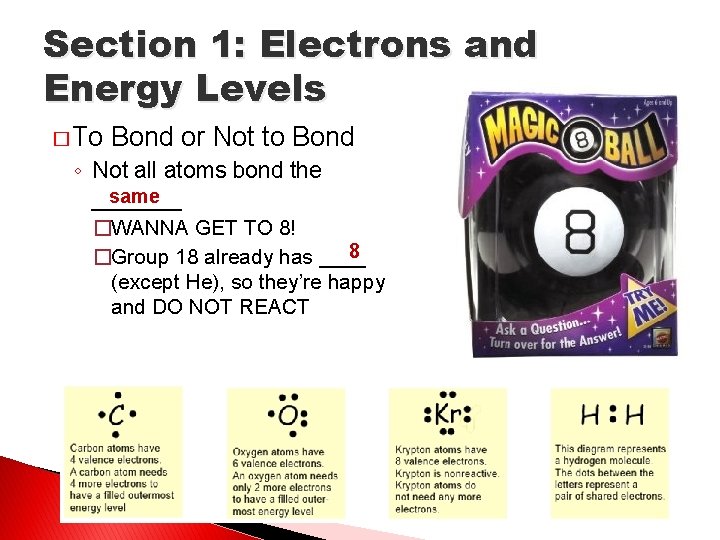
Section 1: Electrons and Energy Levels � To Bond or Not to Bond ◦ Not all atoms bond the same _______ �WANNA GET TO 8! 8 �Group 18 already has ____ (except He), so they’re happy and DO NOT REACT
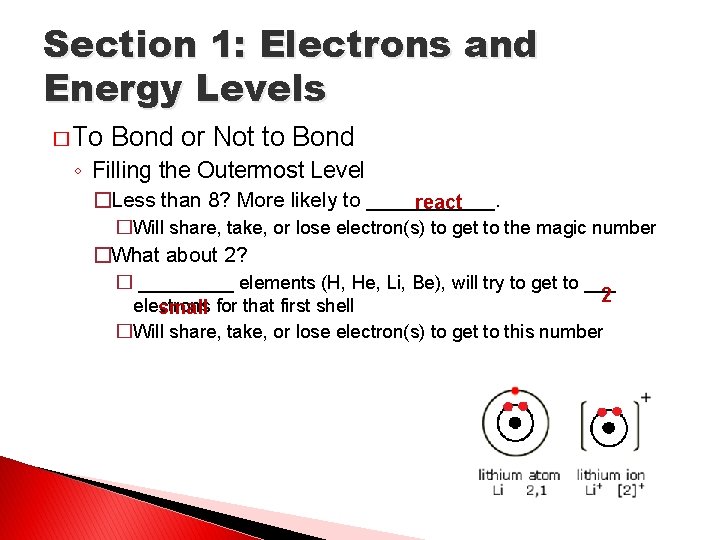
Section 1: Electrons and Energy Levels � To Bond or Not to Bond ◦ Filling the Outermost Level �Less than 8? More likely to ______. react �Will share, take, or lose electron(s) to get to the magic number �What about 2? � _____ elements (H, He, Li, Be), will try to get to ___ 2 electrons small for that first shell �Will share, take, or lose electron(s) to get to this number
Writing Prompt #1 (of 3) � Write 1. the answer on p 62. How do you determine the number of outer electrons for an atom? Explain how you know if an atom is likely to form bonds
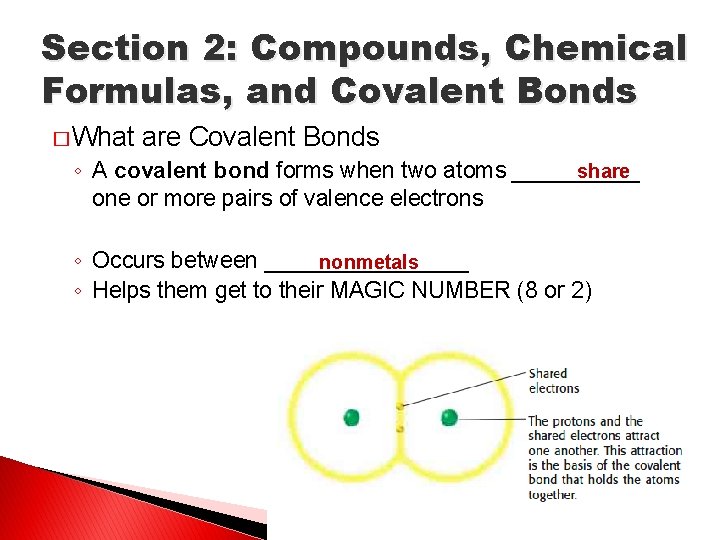
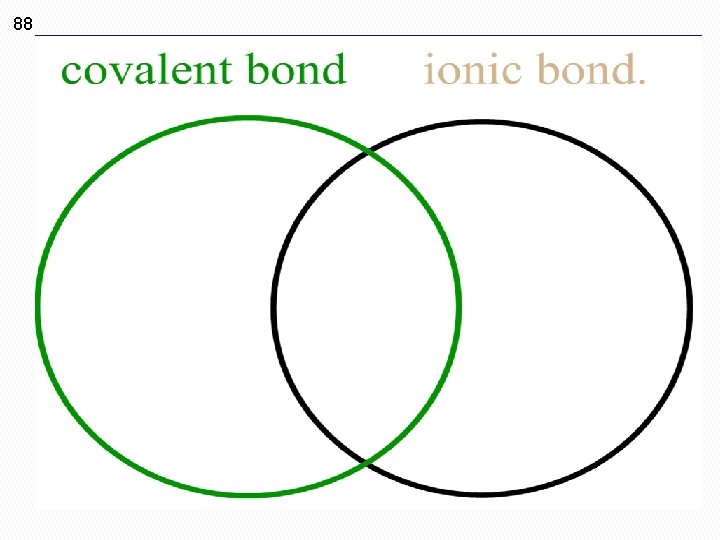
Section 2: Compounds, Chemical Formulas, and Covalent Bonds � What are Covalent Bonds share ◦ A covalent bond forms when two atoms _____ one or more pairs of valence electrons ◦ Occurs between ________ nonmetals ◦ Helps them get to their MAGIC NUMBER (8 or 2)
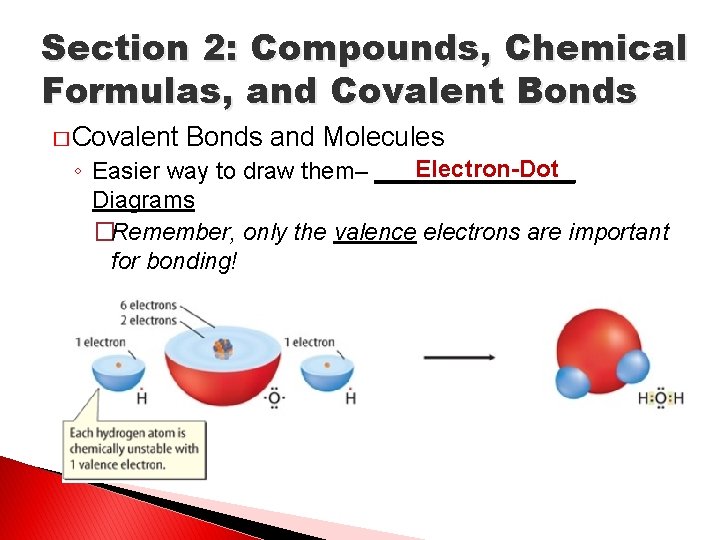
Section 2: Compounds, Chemical Formulas, and Covalent Bonds � Covalent Bonds and Molecules Electron-Dot ◦ Easier way to draw them– ________ Diagrams �Remember, only the valence electrons are important for bonding!
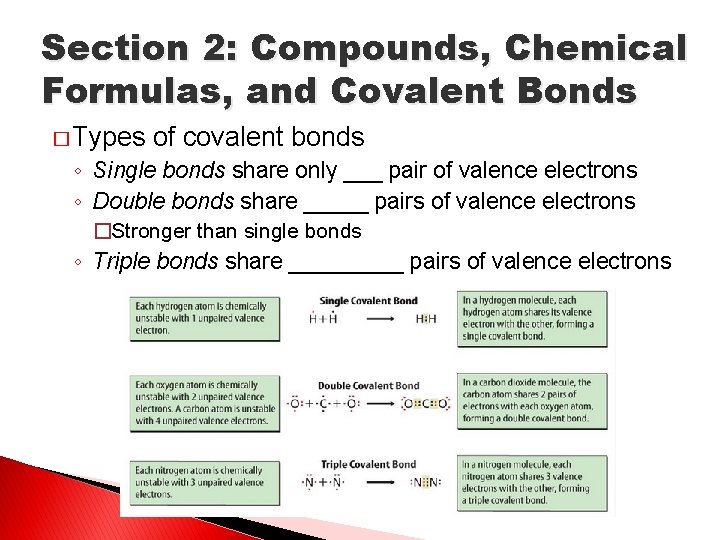
Section 2: Compounds, Chemical Formulas, and Covalent Bonds � Types of covalent bonds ◦ Single bonds share only ___ pair of valence electrons ◦ Double bonds share _____ pairs of valence electrons �Stronger than single bonds ◦ Triple bonds share _____ pairs of valence electrons
Section 2: Compounds, Chemical Formulas, and Covalent Bonds How to draw covalent molecules using electron dot diagrams � Combine the elements where they can share electrons so each have a full outer shell. (The shared electrons are the covalent bond) ◦ Examples: � Hydrogen + Chlorine � Fluorine + Fluorine � Water � Oxygen + Oxygen
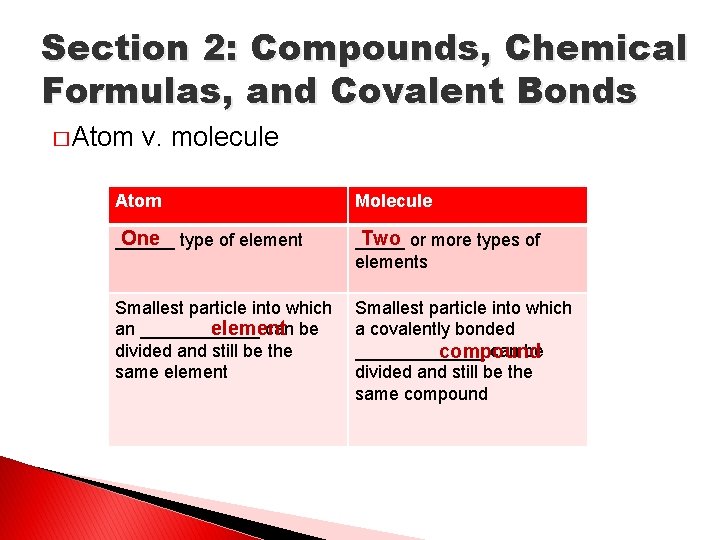
Section 2: Compounds, Chemical Formulas, and Covalent Bonds � Atom v. molecule Atom Molecule One type of element ______ Two or more types of _____ elements Smallest particle into which element an ______ can be divided and still be the same element Smallest particle into which a covalently bonded _______ can be compound divided and still be the same compound
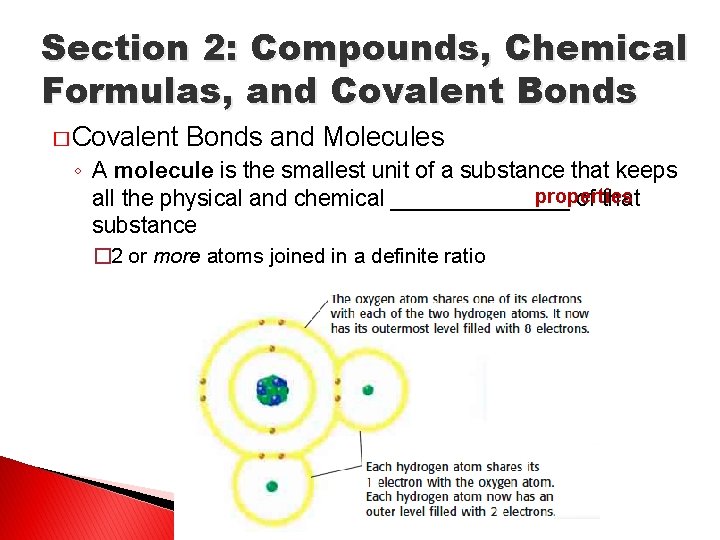
Section 2: Compounds, Chemical Formulas, and Covalent Bonds � Covalent Bonds and Molecules ◦ A molecule is the smallest unit of a substance that keeps properties all the physical and chemical _______ of that substance � 2 or more atoms joined in a definite ratio
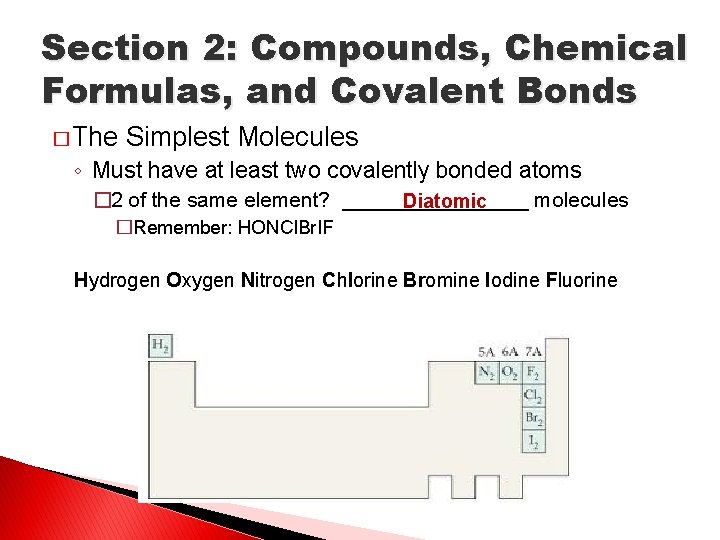
Section 2: Compounds, Chemical Formulas, and Covalent Bonds � The Simplest Molecules ◦ Must have at least two covalently bonded atoms � 2 of the same element? ________ molecules Diatomic �Remember: HONCl. Br. IF Hydrogen Oxygen Nitrogen Chlorine Bromine Iodine Fluorine
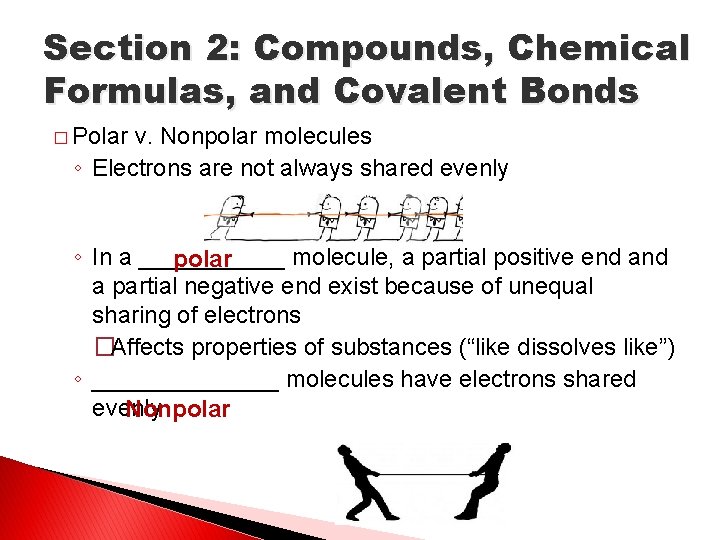
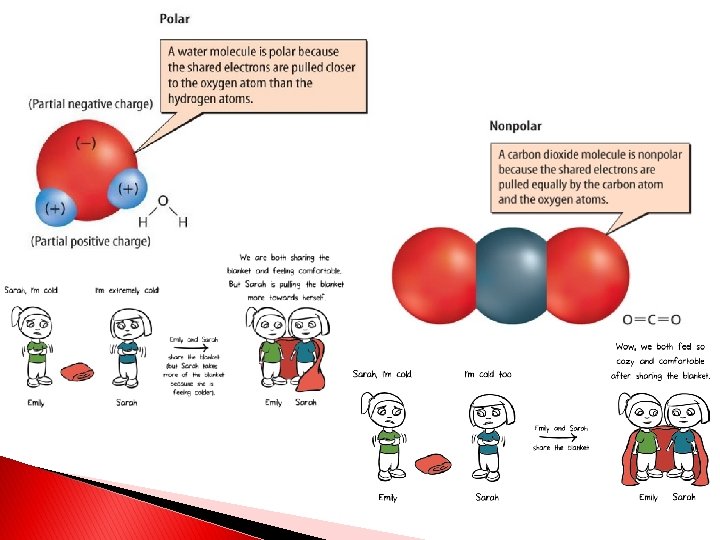
Section 2: Compounds, Chemical Formulas, and Covalent Bonds � Polar v. Nonpolar molecules ◦ Electrons are not always shared evenly ◦ In a ______ molecule, a partial positive end and polar a partial negative end exist because of unequal sharing of electrons �Affects properties of substances (“like dissolves like”) ◦ _______ molecules have electrons shared evenly Nonpolar
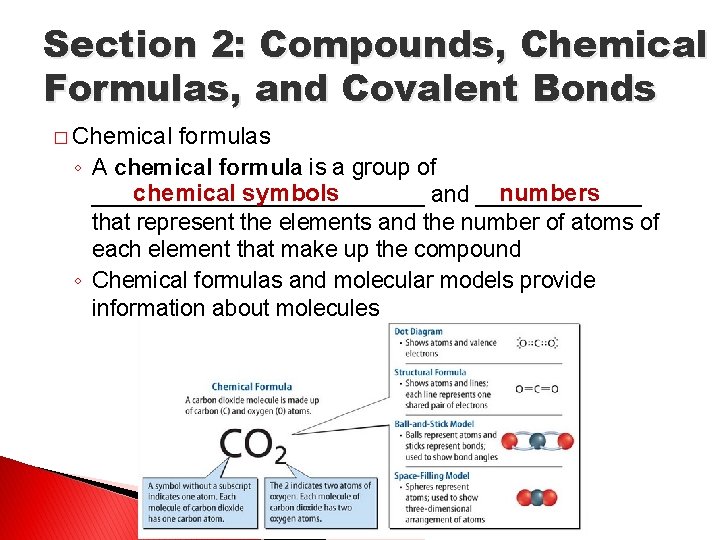
Section 2: Compounds, Chemical Formulas, and Covalent Bonds � Chemical formulas ◦ A chemical formula is a group of chemical symbols numbers _____________ and _______ that represent the elements and the number of atoms of each element that make up the compound ◦ Chemical formulas and molecular models provide information about molecules
Section 2: Compounds, Chemical Formulas, and Covalent Bonds ◦ You will use element symbols and subscripts �Symbol: which element �Coefficient: how many atoms of each compound �Must distribute to all elements �We multiply for distributing � Subscript : how many of each �Must distribute to element BEFORE it �We still multiply for distributing
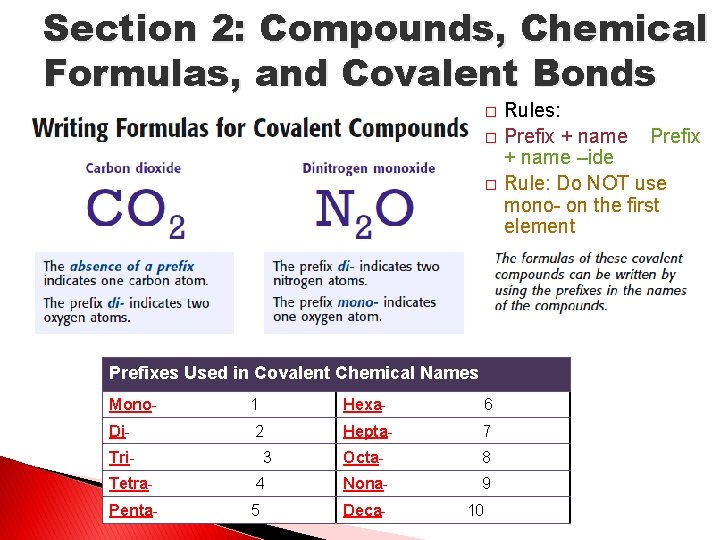
Section 2: Compounds, Chemical Formulas, and Covalent Bonds � � � Prefixes Used in Covalent Chemical Names Mono- 1 Hexa- 6 Di- 2 Hepta- 7 Octa- 8 9 Tri- 3 Tetra- 4 Nona- Penta- 5 Deca- 10 Rules: Prefix + name –ide Rule: Do NOT use mono- on the first element
Section 2: Compounds, Chemical Formulas, and Covalent Bonds � Examples: ◦ CO 2 ◦ C 2 H 4 ◦ P 2 O 5 � Examples: ◦ Dinitrogen monoxide ◦ Sulfur trifluoride ◦ Phosphorus pentachloride ◦ Nitrogen monoxide ◦ N 3 P 6 ◦ Tetranitrogen monoxide
Section 2: Compounds, Chemical Formulas, and Covalent Bonds � Draw and name! � 3 Hydrogen and 1 Nitrogen � Sulfur and 2 fluorine
Section 3: Ionic and Metallic Bonds All you need to know about ionic bonding is right here
Section 3: Ionic and Metallic Bonds � Forming Ionic Bonds ◦ An ionic bond is an attraction between positively and negatively charged ions in an ionic compound transferred �Electrons are_________ ◦ This creates ions, which are atoms that are no longer electrically neutral because they have gained or lost valence electrons �______ charged particles � As a result of an ionic bond, either _____ positiveor _______ ions can form negative
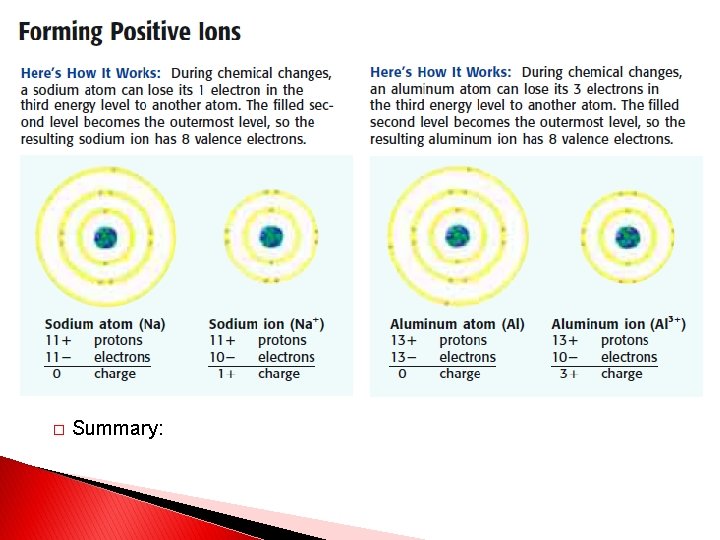
� � Summary:
Section 3: Ionic and Metallic Bonds � Forming Positive ions ◦ Positive ions (cations) form when ____ metal atoms lose _______ electrons ◦ Na loses one electron---Na+ Sodium cation ◦ Ca loses two electrons –Ca 2+ Calcium cation magic ◦ By losing electrons, metals can get to the ____ number _____! �Usually 8, could be 2
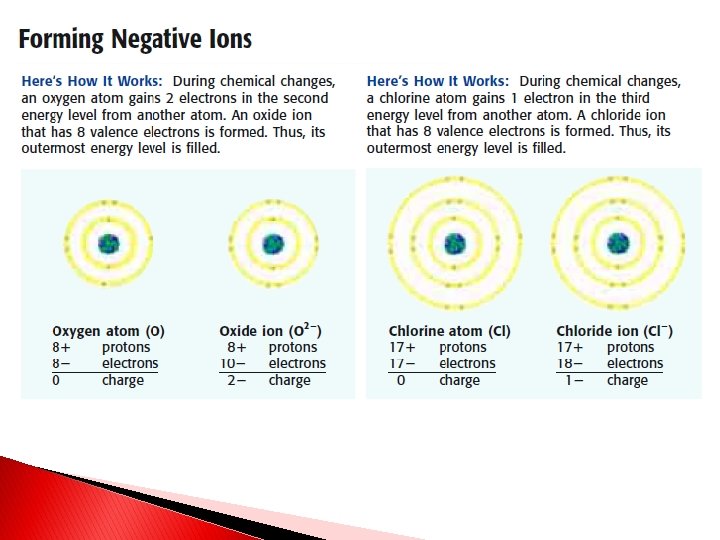
Section 3: Ionic and Metallic Bonds � Forming Negative Ions ◦ Negative ions (anions) form when ______ nonmetal atoms gain ______ electrons �Change ending to “ide” ◦ Cl gains one electron – Cl◦ O gains two electrons – O 2 - Chloride anion Oxide anion ◦ By gaining electrons, nonmetals can get to the magic number __________! �Usually 8, could be 2
Predicting Ionic bonds � An ionic bond would / wouldn’t form with aluminum and sodium because… � An ionic bond would / wouldn’t form with Aluminum and oxygen because…
Predicting Ionic bonds � An ionic bond would / wouldn’t form with sulfur and oxygen because… � An ionic bond would / wouldn’t form with sulfur and neon because… � An ionic bond would / wouldn’t form with sodium and neon because…
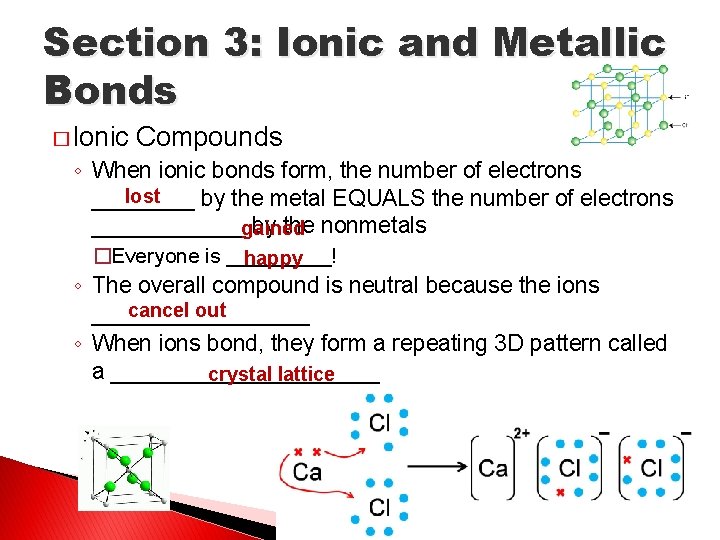
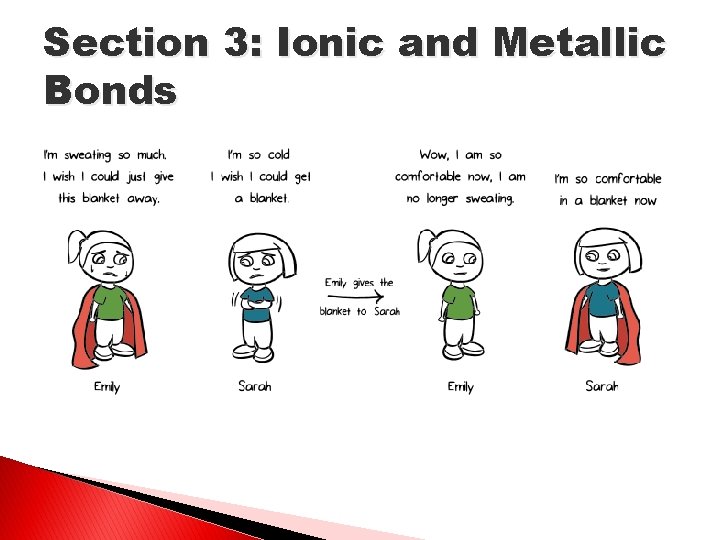
Section 3: Ionic and Metallic Bonds � Ionic Compounds ◦ When ionic bonds form, the number of electrons lost ____ by the metal EQUALS the number of electrons ______gained by the nonmetals �Everyone is _____! happy ◦ The overall compound is neutral because the ions cancel out _________ ◦ When ions bond, they form a repeating 3 D pattern called a ___________ crystal lattice
Section 3: Ionic and Metallic Bonds
88
Writing Prompt #2 (of 3) � Write 2. the answer on your green sheet. What is the difference between how metals and nonmetals form ions? Even though positive and negative ions are formed, why is an atom overall neutral? Full sentences for full credit!
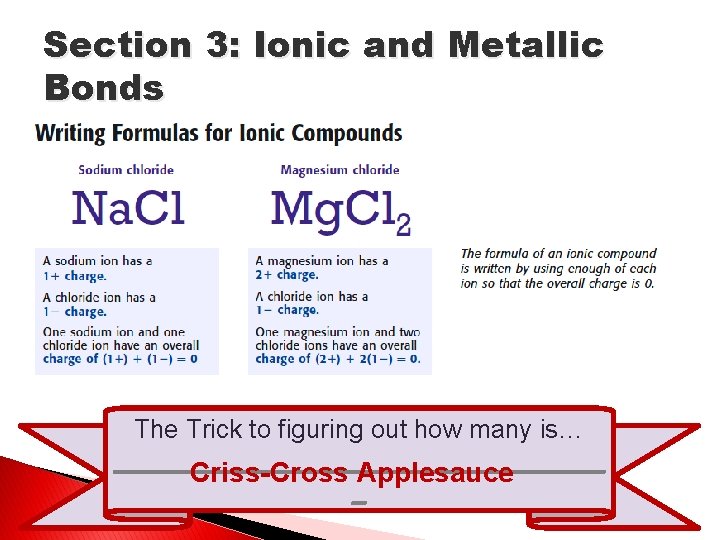
Section 3: Ionic and Metallic Bonds The Trick to figuring out how many is… _________________ Criss-Cross Applesauce _
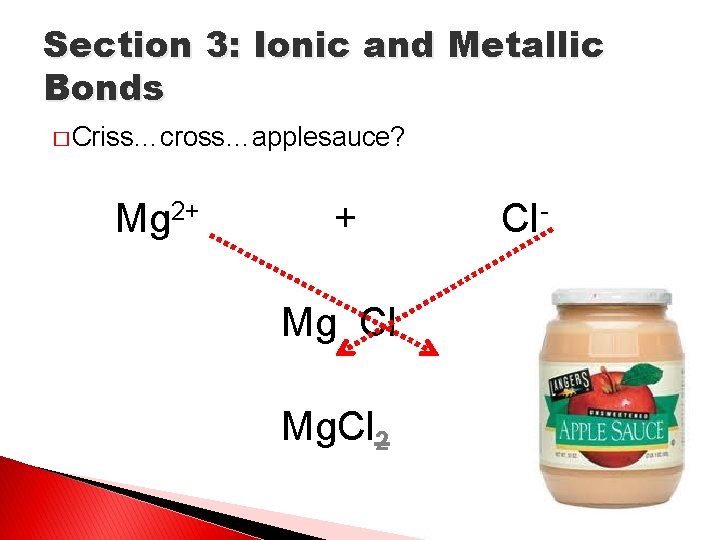
Section 3: Ionic and Metallic Bonds � Criss…cross…applesauce? Mg 2+ + Mg Cl Mg. Cl 2 Cl-
Writing Ionic Compounds 1. Write the metal with its charge 2. Write the nonmetal with its charge 3. Criss- Cross the charges �Only bring down the #, NOT the charge � Examples: ◦ Sodium and Chlorine ◦ Barium and Fluorine ◦ Potassium and Oxygen ◦ Lithium and Sulfur
Naming Ionic Compounds -ide of Metal + nonmetal w/ ending ______ � Examples: � Name ◦ Sodium and Chlorine ◦ Barium and Fluorine ◦ Potassium and Oxygen ◦ Lithium and Sulfur
Write and name me! ◦ Lithium and oxygen ◦ Aluminum and phosphorus ◦ Magnesium and fluorine ◦ Calcium and sulfur
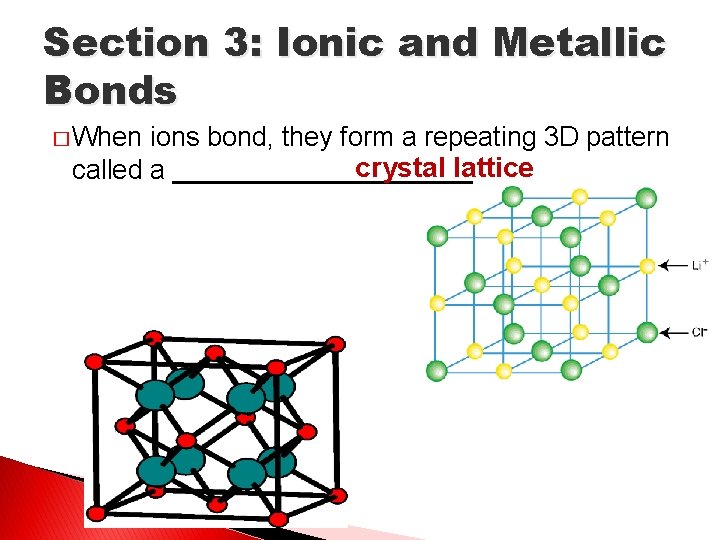
Section 3: Ionic and Metallic Bonds � When ions bond, they form a repeating 3 D pattern crystal lattice called a __________
Name and Draw! � Sodium and sulfur � Aluminum and Iodine
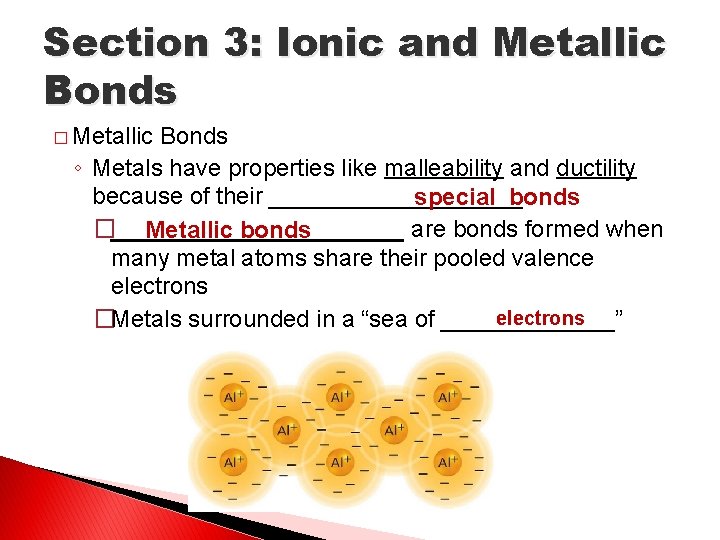
Section 3: Ionic and Metallic Bonds � Metallic Bonds ◦ Metals have properties like malleability and ductility because of their __________ special bonds �___________ are bonds formed when Metallic bonds many metal atoms share their pooled valence electrons �Metals surrounded in a “sea of _______”
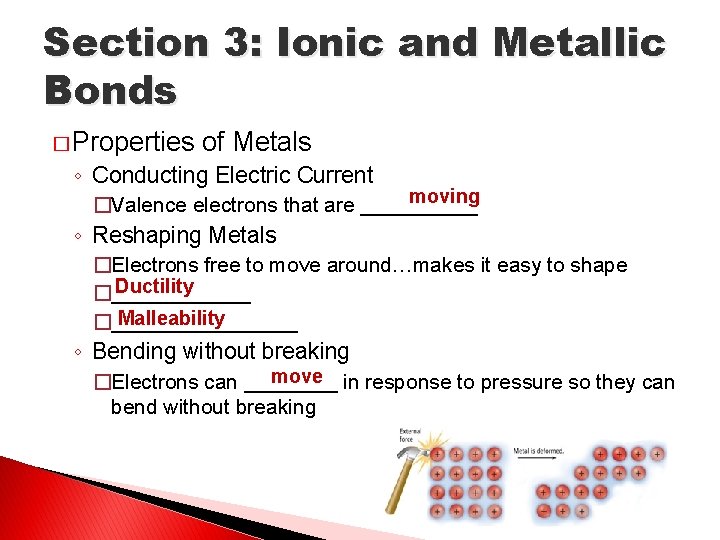
Section 3: Ionic and Metallic Bonds � Properties of Metals ◦ Conducting Electric Current moving �Valence electrons that are _____ ◦ Reshaping Metals �Electrons free to move around…makes it easy to shape Ductility �______ Malleability �________ ◦ Bending without breaking move in response to pressure so they can �Electrons can ____ bend without breaking
Writing Prompt #3 (of 3) � Write 3. the answer on your green sheet. How do metallic bonds explain ductility and malleability in metals? Full sentences for full credit!
- Slides: 52