
Elementary Text Analysis Topic Modeling Kristina Lerman University
- Slides: 47
Elementary Text Analysis & Topic Modeling Kristina Lerman University of Southern California CS 599: Social Media Analysis University of Southern California 1
Why topic modeling • Volume of collections of text document is growing exponentially, necessitating methods for automatically organizing, understanding, searching and summarizing them • Uncover hidden topical patterns in collections. • Annotate documents according to topics. • Using annotations to organize, summarize and search.
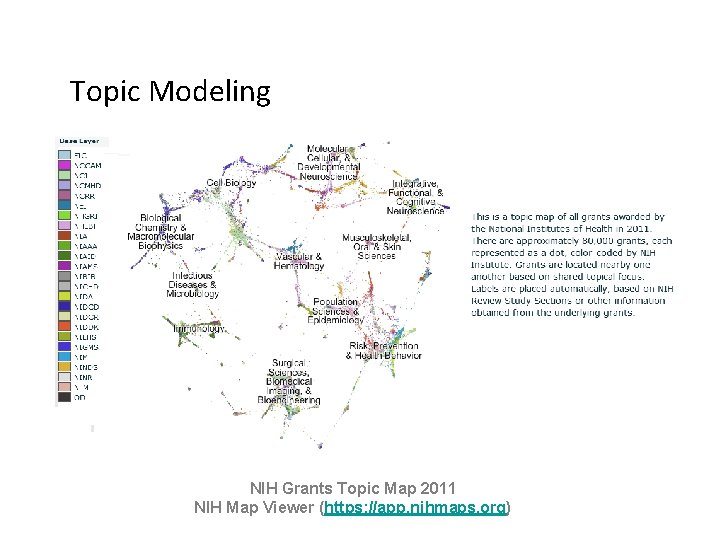
Topic Modeling NIH Grants Topic Map 2011 NIH Map Viewer (https: //app. nihmaps. org)
Brief history of text analysis • 1960 s – Electronic documents come online – Vector space models (Salton) – ‘bag of words’, tf-idf • 1990 s – Mathematical analysis tools become widely available – Latent semantic indexing (LSI) – Singular value decomposition (SVD, PCA) • 2000 s – Probabilistic topic modeling (LDA) – Probabilistic matrix factorization (PMF)
Readings • Blei, D. M. (2012). Probabilistic topic models. Communications of the ACM, 55(4): 77 -84. – Latent Dirichlet Allocation (LDA) • Yehuda Koren, Robert Bell and Chris Volinsky. Matrix Factorization Techniques For Recommender Systems. In Journal of Computer, 2009.
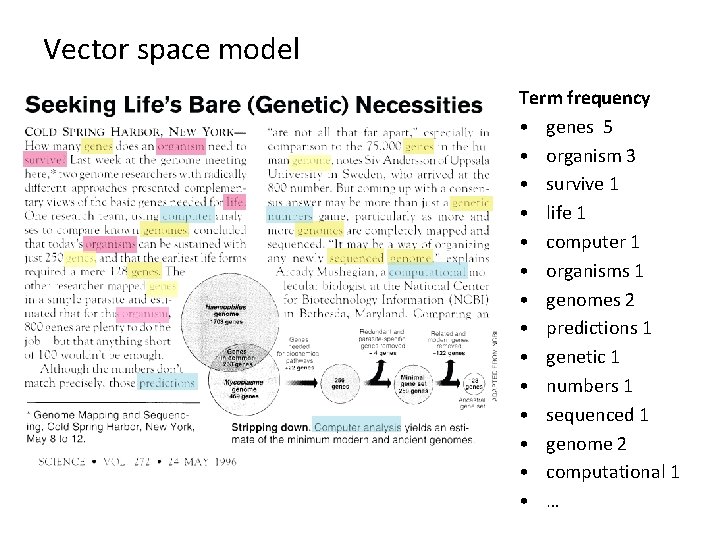
Vector space model Term frequency • genes 5 • organism 3 • survive 1 • life 1 • computer 1 • organisms 1 • genomes 2 • predictions 1 • genetic 1 • numbers 1 • sequenced 1 • genome 2 • computational 1 • …
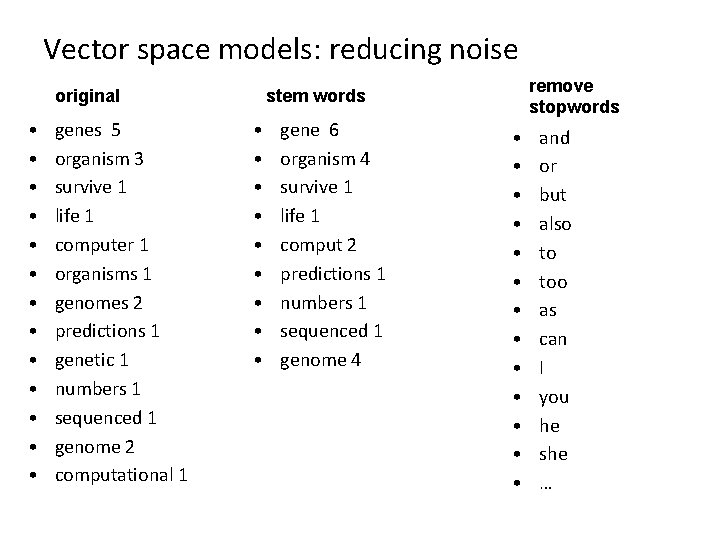
Vector space models: reducing noise • • • • genes 5 organism 3 survive 1 life 1 computer 1 organisms 1 genomes 2 predictions 1 genetic 1 numbers 1 sequenced 1 genome 2 computational 1 remove stopwords stem words original • • • gene 6 organism 4 survive 1 life 1 comput 2 predictions 1 numbers 1 sequenced 1 genome 4 • • • • and or but also to too as can I you he she …
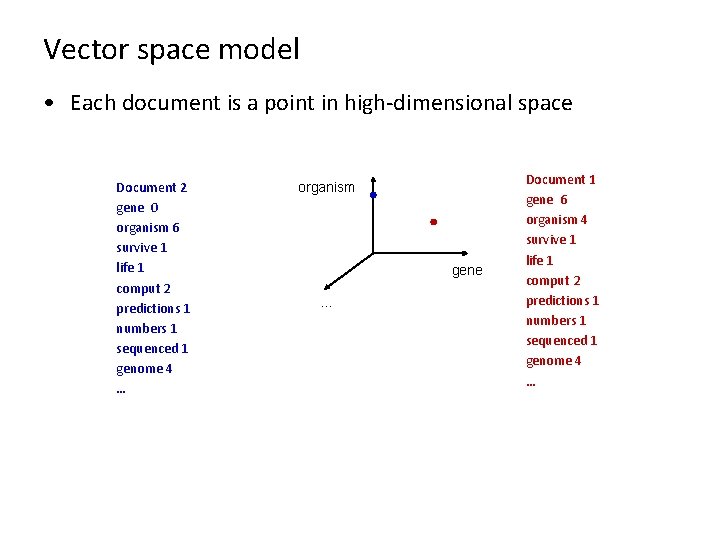
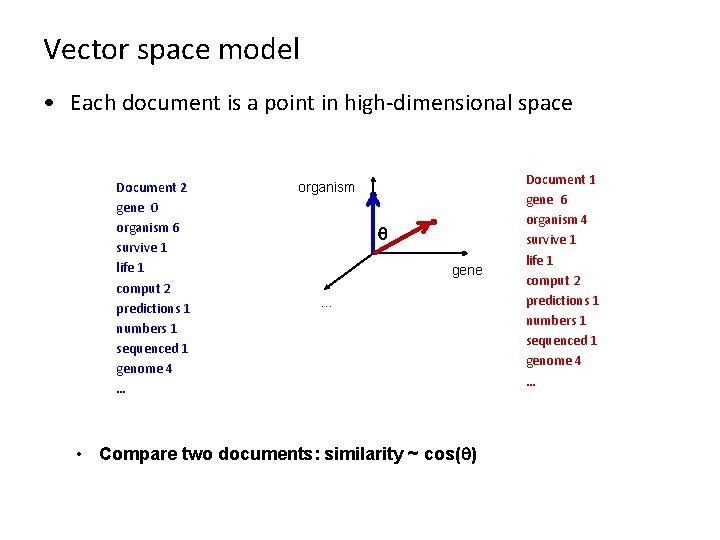
Vector space model • Each document is a point in high-dimensional space Document 2 gene 0 organism 6 survive 1 life 1 comput 2 predictions 1 numbers 1 sequenced 1 genome 4 … organism gene … Document 1 gene 6 organism 4 survive 1 life 1 comput 2 predictions 1 numbers 1 sequenced 1 genome 4 …
Vector space model • Each document is a point in high-dimensional space Document 2 gene 0 organism 6 survive 1 life 1 comput 2 predictions 1 numbers 1 sequenced 1 genome 4 … organism q gene … • Compare two documents: similarity ~ cos(q) Document 1 gene 6 organism 4 survive 1 life 1 comput 2 predictions 1 numbers 1 sequenced 1 genome 4 …
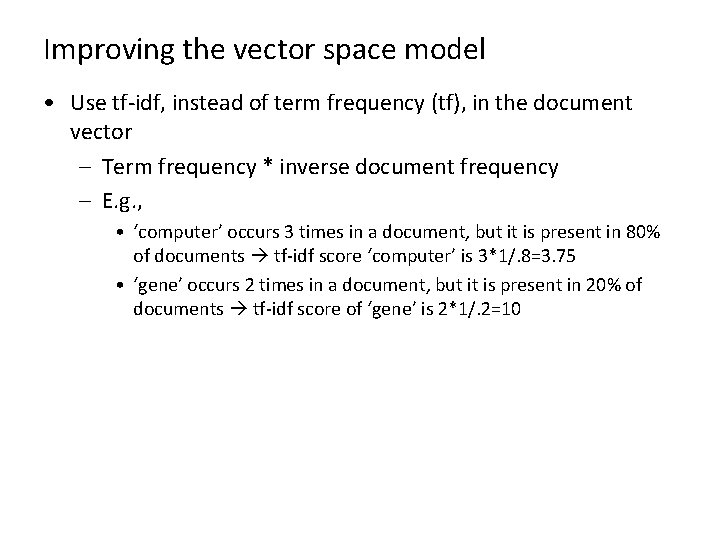
Improving the vector space model • Use tf-idf, instead of term frequency (tf), in the document vector – Term frequency * inverse document frequency – E. g. , • ‘computer’ occurs 3 times in a document, but it is present in 80% of documents tf-idf score ‘computer’ is 3*1/. 8=3. 75 • ‘gene’ occurs 2 times in a document, but it is present in 20% of documents tf-idf score of ‘gene’ is 2*1/. 2=10
Some problems with vector space model • Synonymy – Unique term corresponds to a dimension in term space – Synonyms (‘kid’ and ‘child’) are different dimensions • Polysemy – Different meanings of the same term improperly confused – E. g. , document about river ‘banks’ will be improperly judged to be similar to a document about financial ‘banks’
Latent Semantic Indexing • Identifies subspace of tf-idf that captures most of the variance in a corpus – Need a smaller subspace to represent document corpus – This subspace captures topics that exist in a corpus • Topic = set of related words • Handles polysemy and synonymy – Synonyms will belong to the same topic since they may co-occur with the same related words
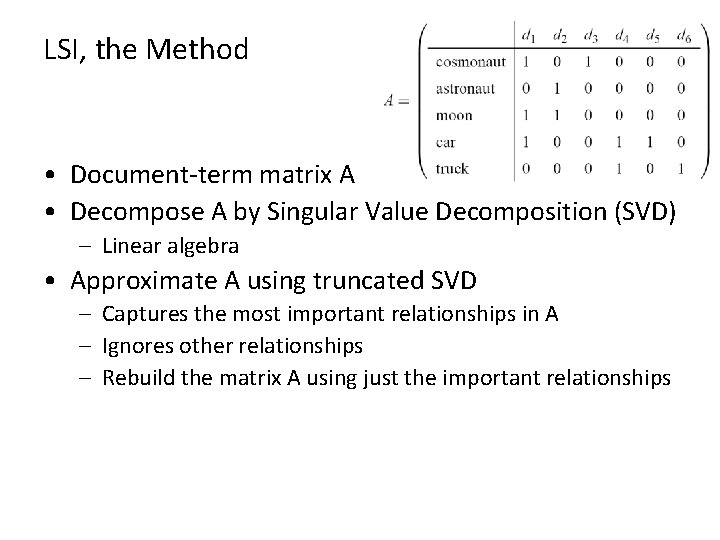
LSI, the Method • Document-term matrix A • Decompose A by Singular Value Decomposition (SVD) – Linear algebra • Approximate A using truncated SVD – Captures the most important relationships in A – Ignores other relationships – Rebuild the matrix A using just the important relationships
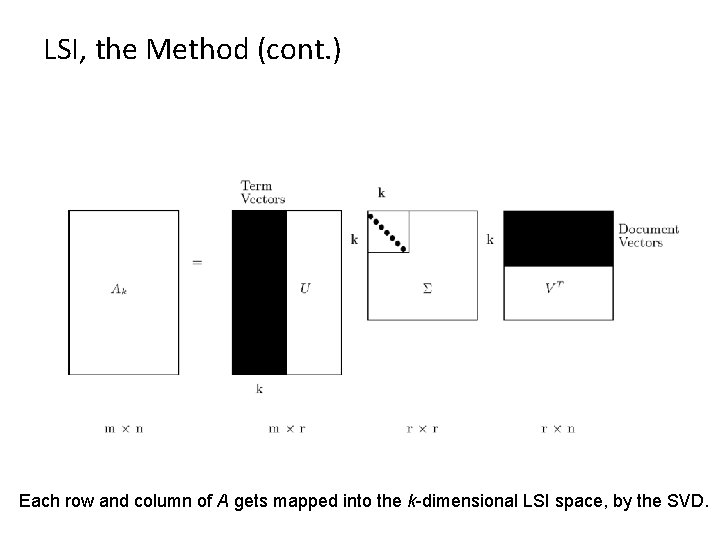
LSI, the Method (cont. ) Each row and column of A gets mapped into the k-dimensional LSI space, by the SVD.
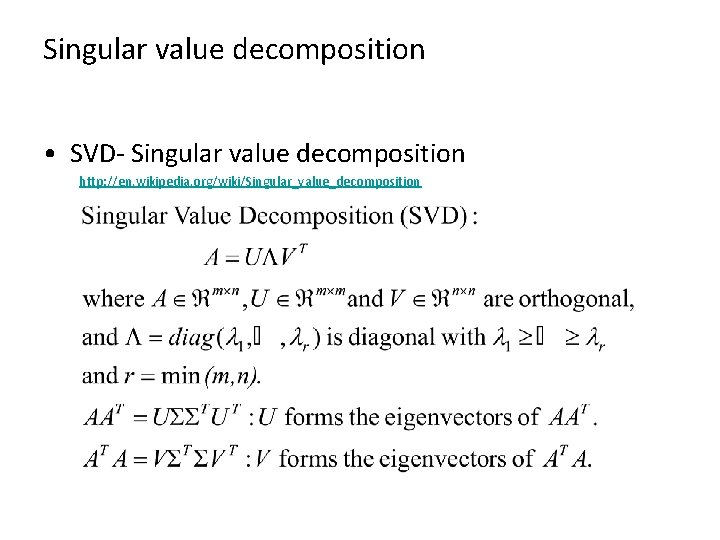
Singular value decomposition • SVD- Singular value decomposition http: //en. wikipedia. org/wiki/Singular_value_decomposition
Lower rank decomposition • Usually, rank of the matrix A is small: r<<min(m, n). – Only a few of the largest eigenvectors (those associated with the largest eigenvalues l) matter – These r eigenvectors define a lower dimensional subspace that captures most important characteristics of the document corpus – All operations (document comparison, similar) can be done in this reduced-dimension subspace
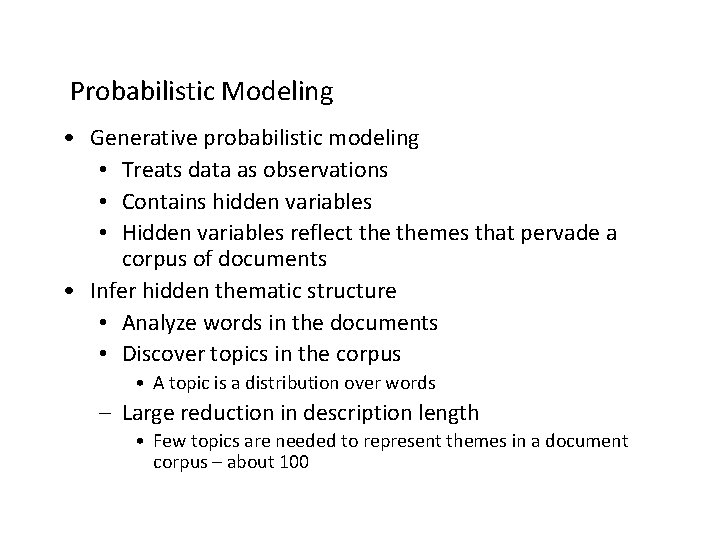
Probabilistic Modeling • Generative probabilistic modeling • Treats data as observations • Contains hidden variables • Hidden variables reflect themes that pervade a corpus of documents • Infer hidden thematic structure • Analyze words in the documents • Discover topics in the corpus • A topic is a distribution over words – Large reduction in description length • Few topics are needed to represent themes in a document corpus – about 100
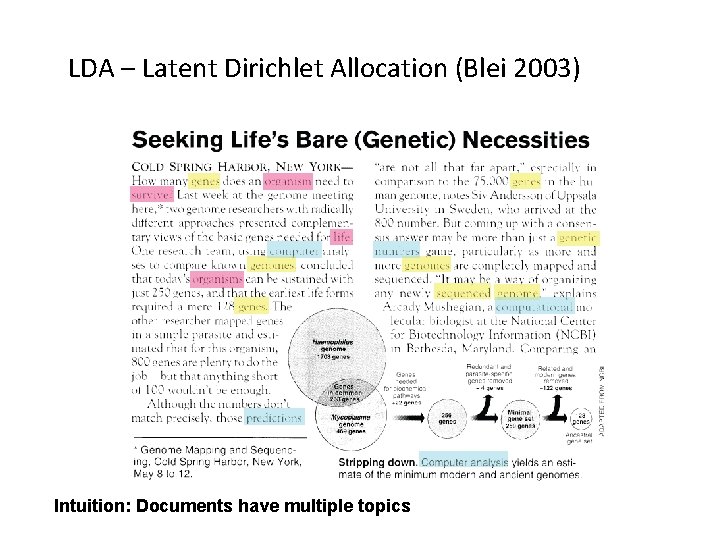
LDA – Latent Dirichlet Allocation (Blei 2003) Intuition: Documents have multiple topics
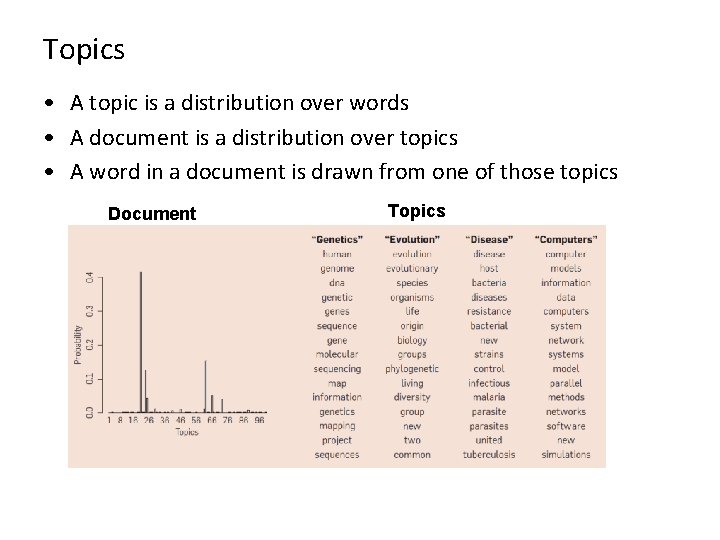
Topics • A topic is a distribution over words • A document is a distribution over topics • A word in a document is drawn from one of those topics Document Topics
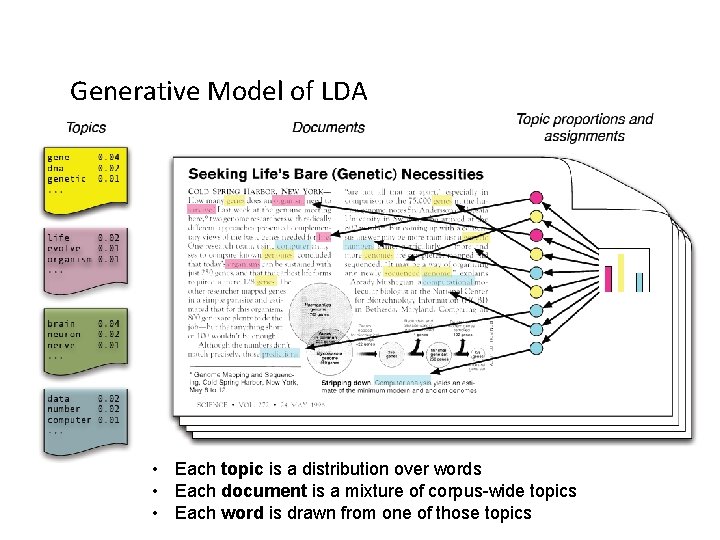
Generative Model of LDA • Each topic is a distribution over words • Each document is a mixture of corpus-wide topics • Each word is drawn from one of those topics
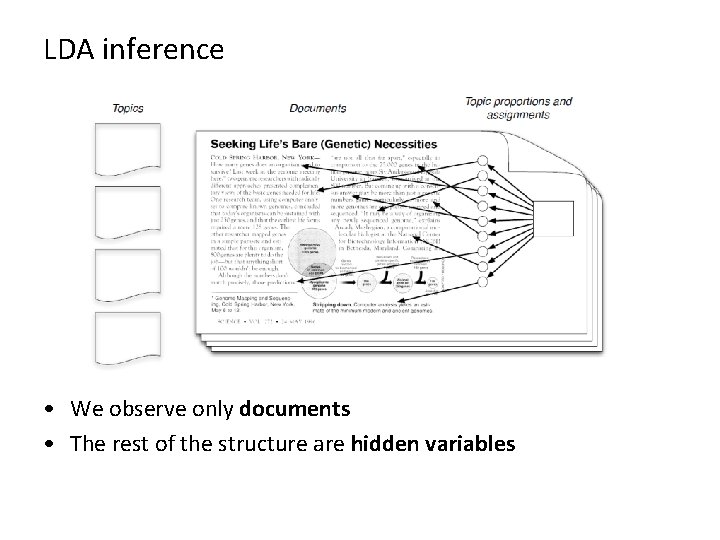
LDA inference • We observe only documents • The rest of the structure are hidden variables
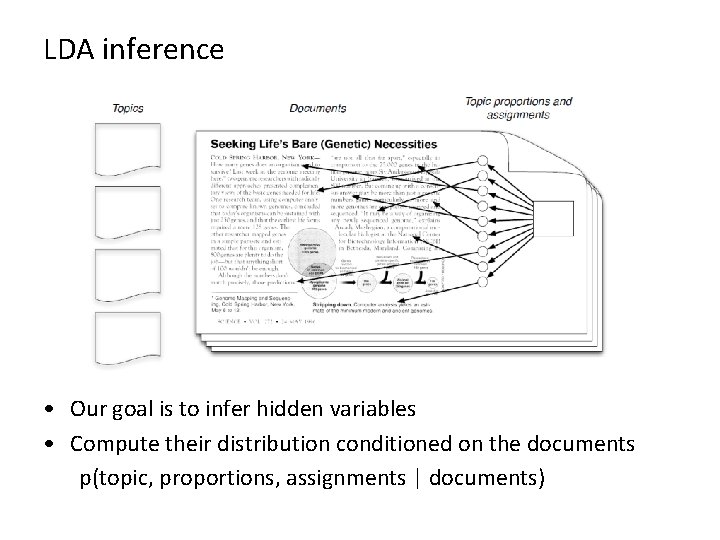
LDA inference • Our goal is to infer hidden variables • Compute their distribution conditioned on the documents p(topic, proportions, assignments | documents)
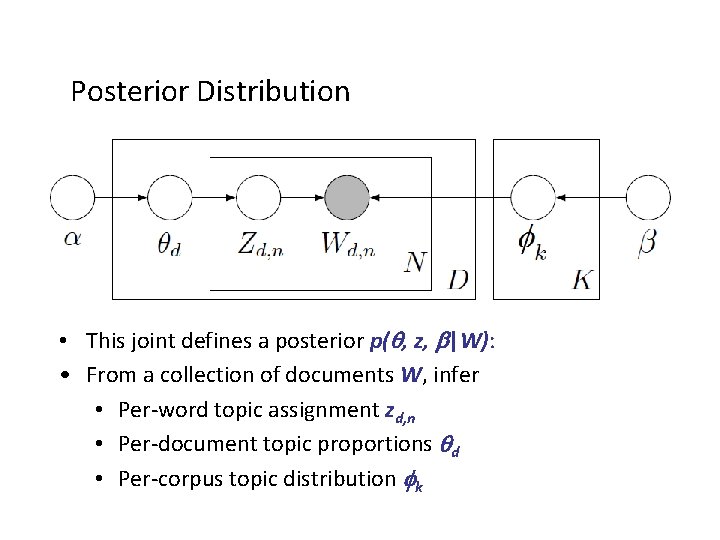
Posterior Distribution • Only documents are observable. • Infer underlying topic structure. • Topics that generated the documents. • For each document, distribution of topics. • For each word, which topic generated the word. • Algorithmic challenge: Finding the conditional distribution of all the latent variables, given the observation.
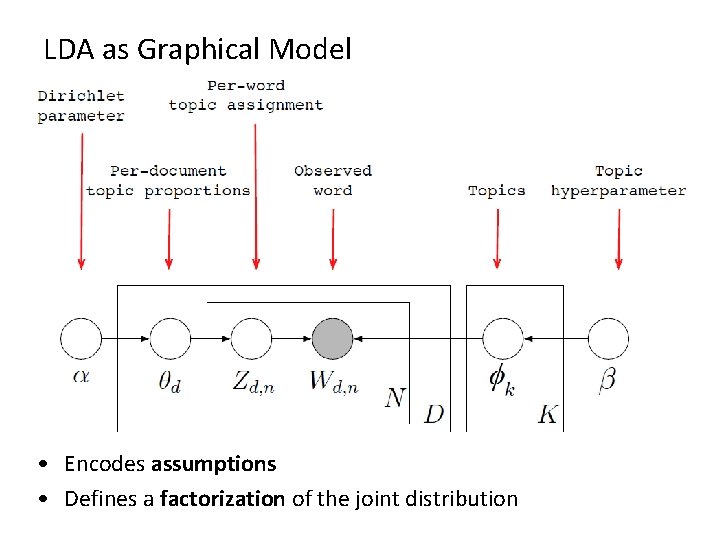
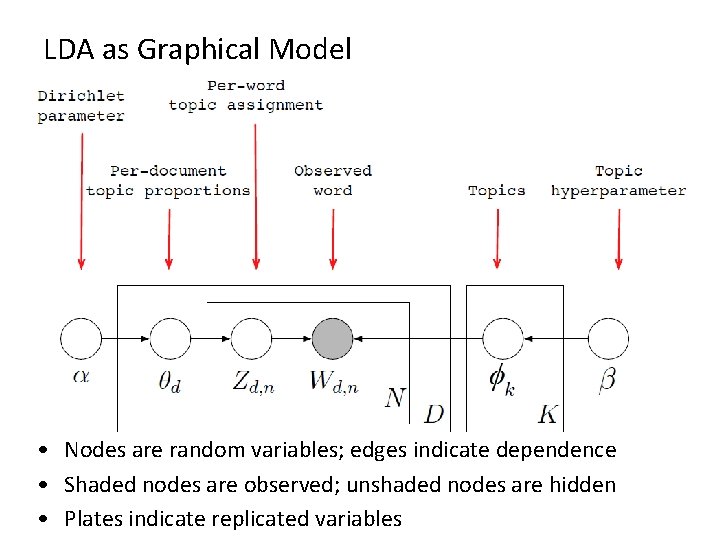
LDA as Graphical Model • Encodes assumptions • Defines a factorization of the joint distribution
LDA as Graphical Model • Nodes are random variables; edges indicate dependence • Shaded nodes are observed; unshaded nodes are hidden • Plates indicate replicated variables
Posterior Distribution • This joint defines a posterior p( , z, b|W): • From a collection of documents W, infer • Per-word topic assignment zd, n • Per-document topic proportions d • Per-corpus topic distribution k
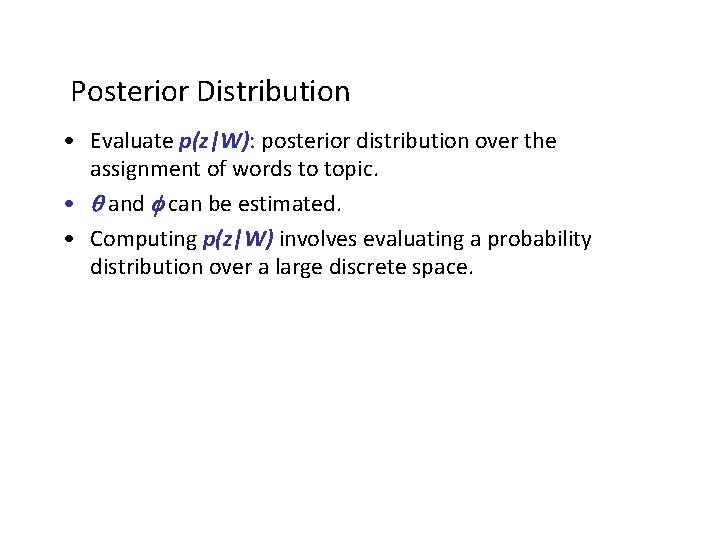
Posterior Distribution • Evaluate p(z|W): posterior distribution over the assignment of words to topic. • and can be estimated. • Computing p(z|W) involves evaluating a probability distribution over a large discrete space.
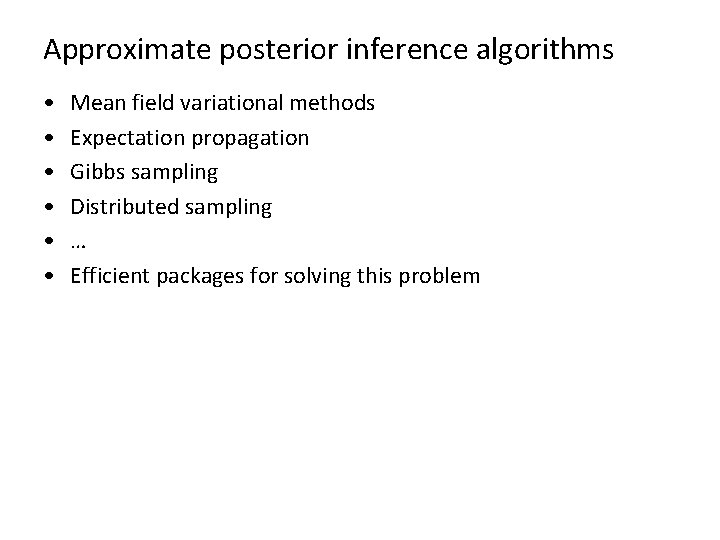
Approximate posterior inference algorithms • • • Mean field variational methods Expectation propagation Gibbs sampling Distributed sampling … Efficient packages for solving this problem
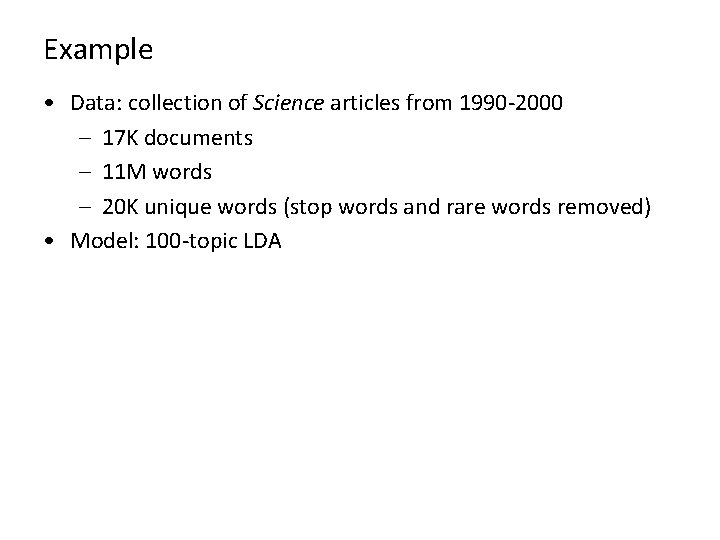
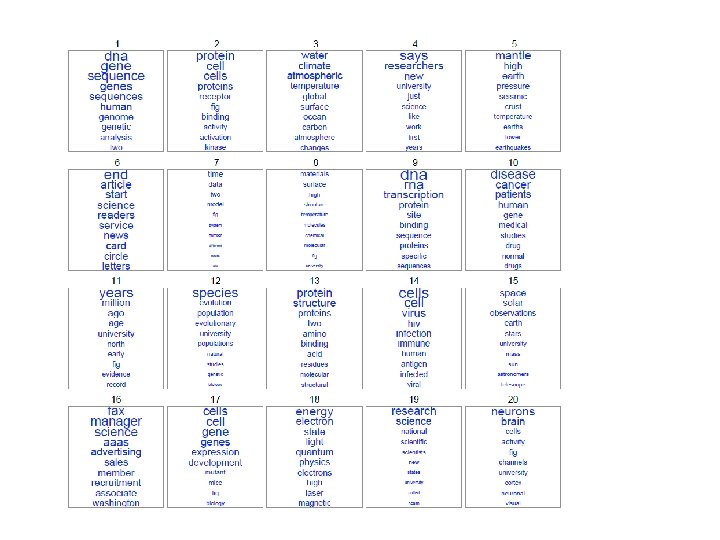
Example • Data: collection of Science articles from 1990 -2000 – 17 K documents – 11 M words – 20 K unique words (stop words and rare words removed) • Model: 100 -topic LDA
Extensions to LDA • Extension to LDA relax assumptions made by the model – “bag of words” assumption: order of words does not matter • in reality, the order of words in the document is not arbitrary – Order of documents does not matter • But in historical document collection, new topics arise – Number of topics is known and fixed • Hierarchical Baysian models infer the number of topics
How useful are learned topic models • Model evaluation – How well do learned topics describe unseen (test) documents – How well it can be used for personalization • Model checking – Given a new corpus of documents, what model should be used? How many topics? • Visualization and user interfaces • Topic models for exploratory data analysis
Recommender systems • Personalization tools allow filtering large collections of movies, music, tv shows, … to recommend only relevant items to people – Build a taste profile for a user – Build topic profile for an item – Recommend items that fit user’s taste profile • Probabilistic modeling techniques – Model people instead of documents to learn their profiles from observed actions • Commercially successful (Netflix competition)
The intuition
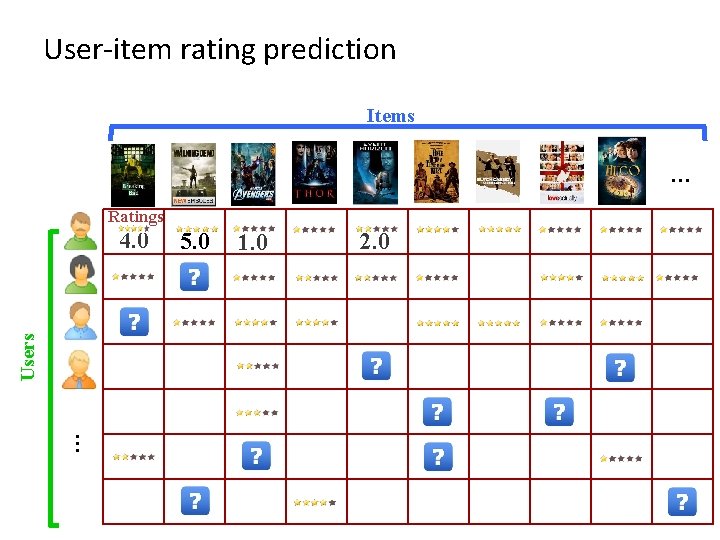
User-item rating prediction Items … Ratings Users 4. 0 5. 0 1. 0 2. 0 …
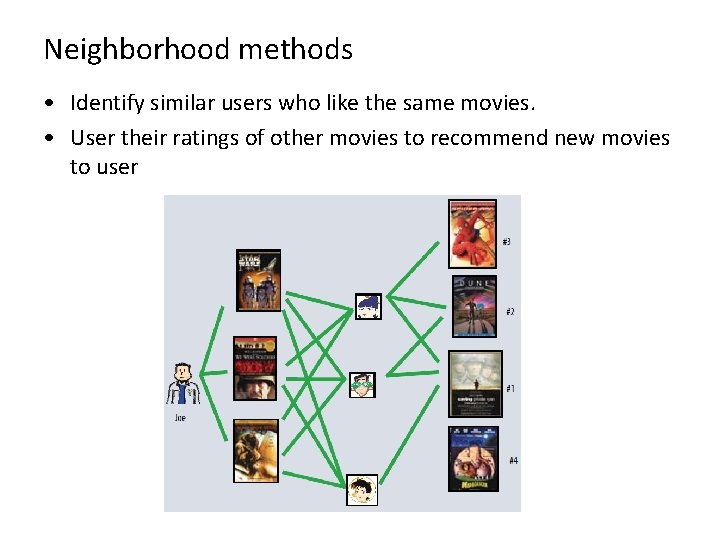
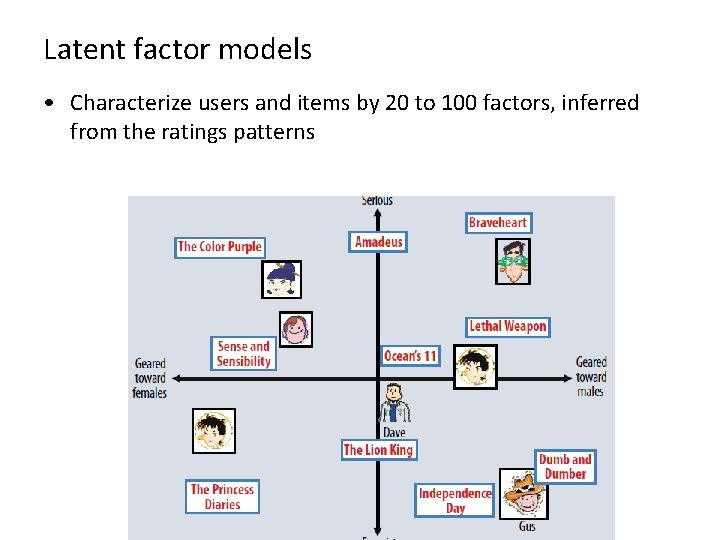
Collaborative filtering • Collaborative filtering analyzes users’ past behavior and relationships between users and items to identify new useritem associations – Recommend new items that “similar” users liked – But, “cold start” problem makes it hard to make recommendations to new users • Approaches – Neighborhood methods – Latent factor models
Neighborhood methods • Identify similar users who like the same movies. • User their ratings of other movies to recommend new movies to user
Latent factor models • Characterize users and items by 20 to 100 factors, inferred from the ratings patterns
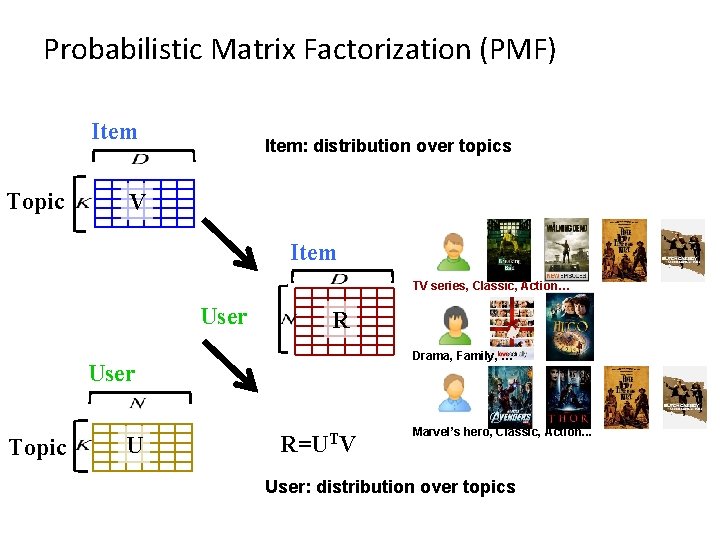
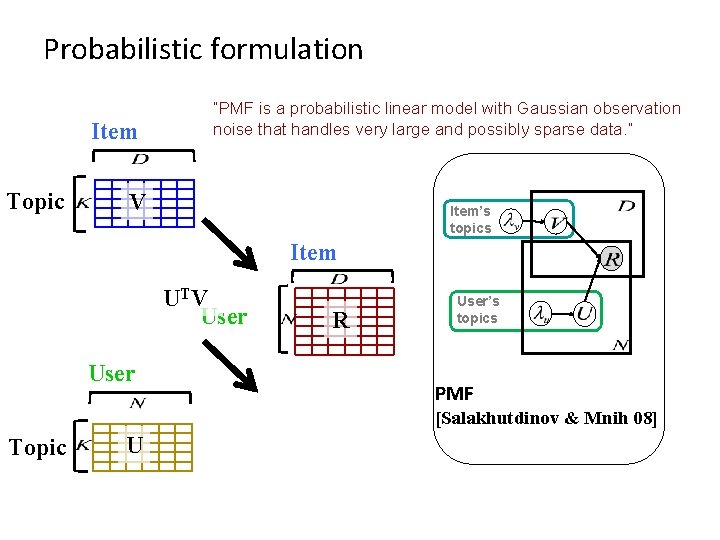
Probabilistic Matrix Factorization (PMF) Item Topic Item: distribution over topics V Item TV series, Classic, Action… User R Drama, Family, … User Topic U R=UTV Marvel’s hero, Classic, Action. . . User: distribution over topics
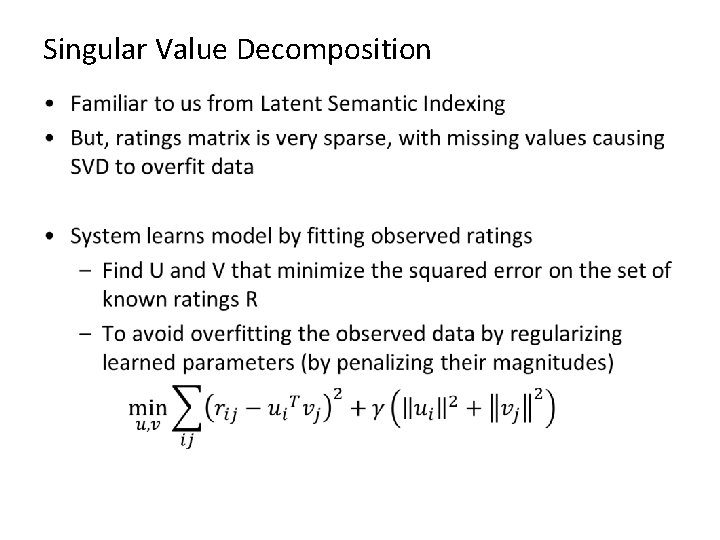
Singular Value Decomposition •
Probabilistic formulation Item Topic “PMF is a probabilistic linear model with Gaussian observation noise that handles very large and possibly sparse data. ” V Item’s topics Item UT V User R User’s topics PMF [Salakhutdinov & Mnih 08] Topic U
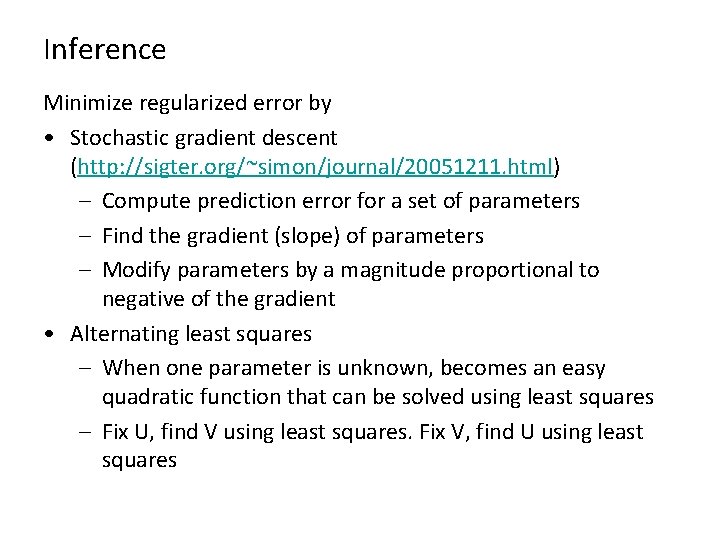
Inference Minimize regularized error by • Stochastic gradient descent (http: //sigter. org/~simon/journal/20051211. html) – Compute prediction error for a set of parameters – Find the gradient (slope) of parameters – Modify parameters by a magnitude proportional to negative of the gradient • Alternating least squares – When one parameter is unknown, becomes an easy quadratic function that can be solved using least squares – Fix U, find V using least squares. Fix V, find U using least squares
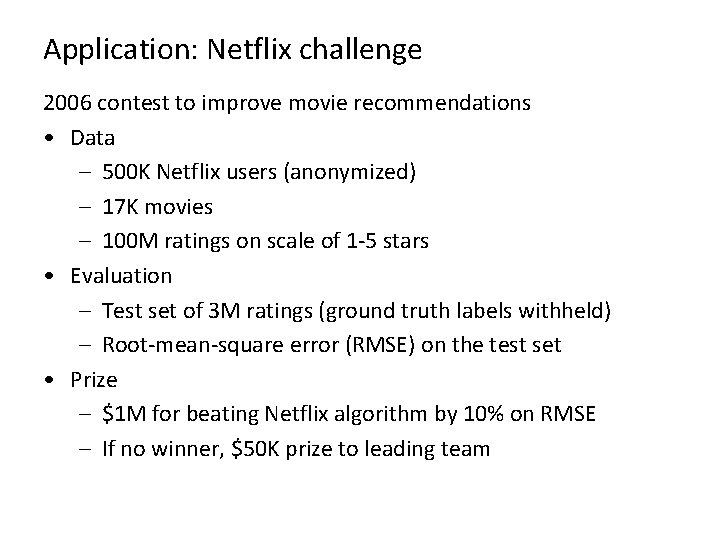
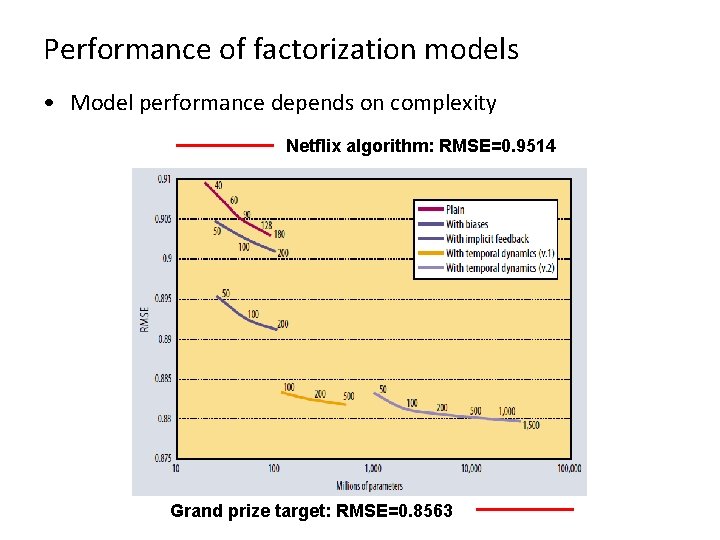
Application: Netflix challenge 2006 contest to improve movie recommendations • Data – 500 K Netflix users (anonymized) – 17 K movies – 100 M ratings on scale of 1 -5 stars • Evaluation – Test set of 3 M ratings (ground truth labels withheld) – Root-mean-square error (RMSE) on the test set • Prize – $1 M for beating Netflix algorithm by 10% on RMSE – If no winner, $50 K prize to leading team
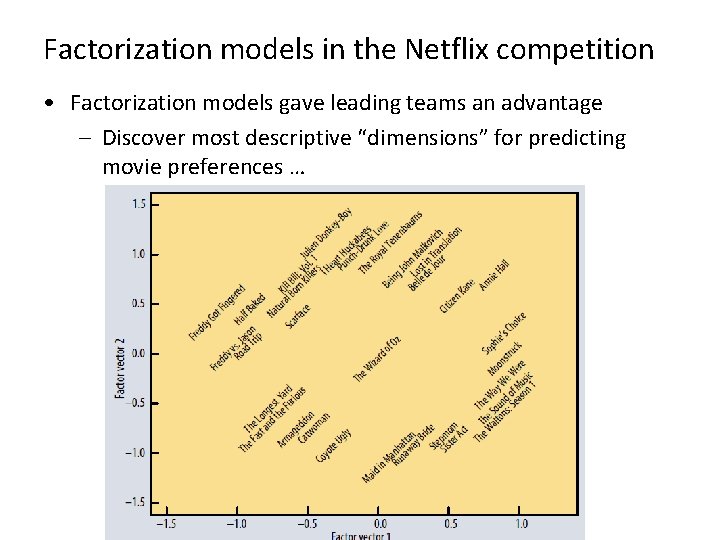
Factorization models in the Netflix competition • Factorization models gave leading teams an advantage – Discover most descriptive “dimensions” for predicting movie preferences …
Performance of factorization models • Model performance depends on complexity Netflix algorithm: RMSE=0. 9514 Grand prize target: RMSE=0. 8563
Summary • Hidden factors create relationships among observed data – Document topics give rise to correlations among words – User’s tastes give rise to correlations among her movie ratings • Methods for inferring hidden (latent) factors from observations – Latent semantic indexing (SVD) – Topic models (LDA, etc. ) – Matrix factorization (SVD, PMF, etc. ) • Trade off between model complexity, performance and computational efficience
Tools • Topic modeling 1. Blei's LDA w/ "variational method" (http: //cran. rproject. org/web/packages/lda/) or 2. "Gibbs sampling method" (https: //code. google. com/p/plda/ and http: //gibbslda. sourceforge. net/) • PMF 1. Matlab implementation (http: //www. cs. toronto. edu/~rsalakhu/BPMF. html) 2. Blei's CTR code (http: //www. cs. cmu. edu/~chongw/citeulike/).