
Elementary Science Focus Lesson SC 5 N 1
- Slides: 29
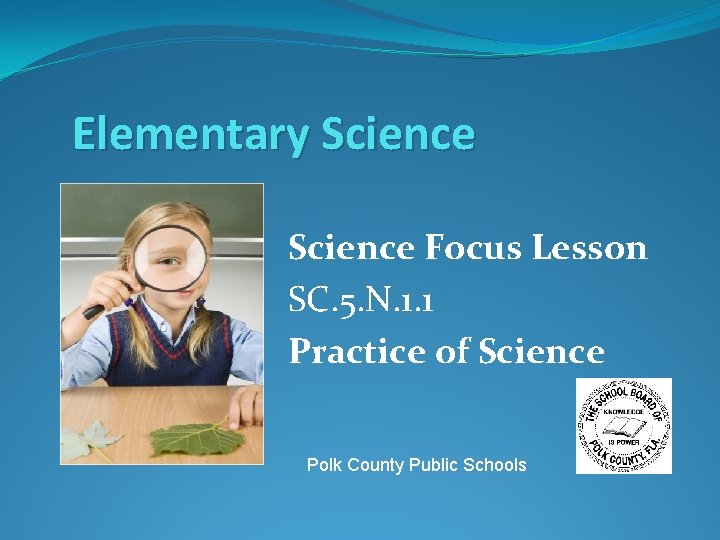
Elementary Science Focus Lesson SC. 5. N. 1. 1 Practice of Science Polk County Public Schools
SC. 5. N. 1. 1 Benchmark: Define a problem, use appropriate reference materials to support scientific understanding, plan and carry out scientific investigations of various types such as: systematic observations, experiments requiring the identification of variables, collecting and organizing data, interpreting data in charts, tables, and graphics, analyze information, make predictions, and defend conclusions. Essential Question: How do scientists answer questions about the natural world? Vocabulary: experiment observation inference predict data experiment control group investigation
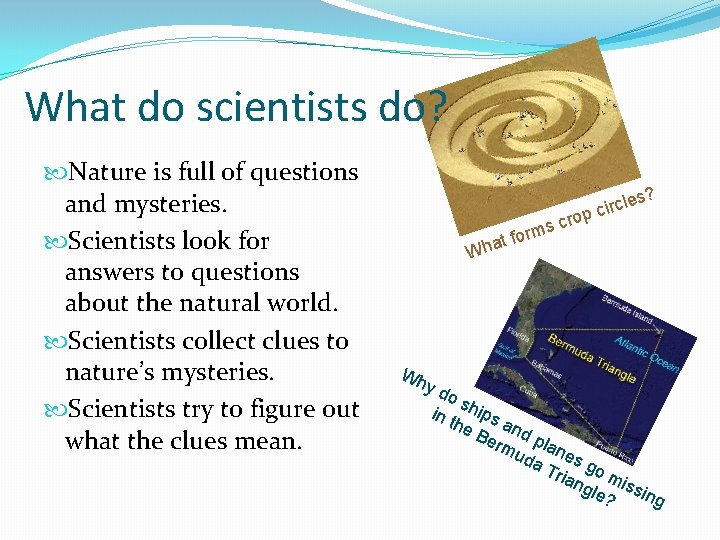
What do scientists do? Nature is full of questions and mysteries. Scientists look for answers to questions about the natural world. Scientists collect clues to nature’s mysteries. Scientists try to figure out what the clues mean. s? ms t for cle r i c p cro Wha Wh yd os in t hips he a Be nd p l rm uda anes Tri go m ang i le? ssing
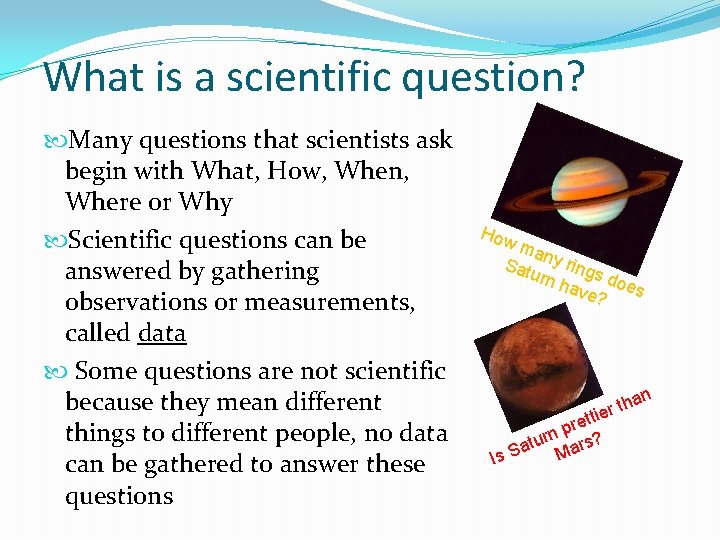
What is a scientific question? Many questions that scientists ask begin with What, How, When, Where or Why Scientific questions can be answered by gathering observations or measurements, called data Some questions are not scientific because they mean different things to different people, no data can be gathered to answer these questions How man Sat y ring urn s hav does e? th tier ret p urn ars? t a M Is S an
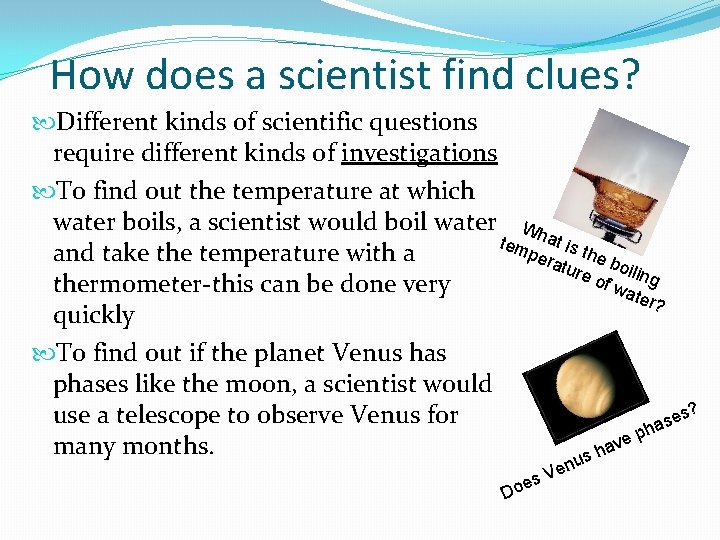
How does a scientist find clues? Different kinds of scientific questions require different kinds of investigations To find out the temperature at which water boils, a scientist would boil water Wh tem at is th per and take the temperature with a atu e boil re o ing f thermometer-this can be done very wat er? quickly To find out if the planet Venus has phases like the moon, a scientist would use a telescope to observe Venus for es? s a ph e av many months. sh es Do u n e V
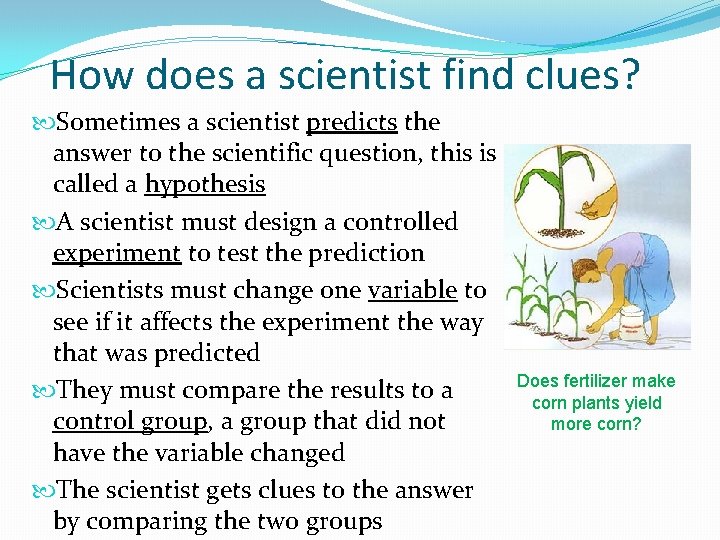
How does a scientist find clues? Sometimes a scientist predicts the answer to the scientific question, this is called a hypothesis A scientist must design a controlled experiment to test the prediction Scientists must change one variable to see if it affects the experiment the way that was predicted They must compare the results to a control group, a group that did not have the variable changed The scientist gets clues to the answer by comparing the two groups Does fertilizer make corn plants yield more corn?
Summarizing Question: what are some things that scientists do to find answers to questions about the natural world? Rally Table: One person in a cooperative group write a word or phrase to answer the question Pass the paper and pencil to the left and the next member write another response to answer the question Continue passing the paper/pencil around the table, each student adding to the team list Continue until the teacher calls time
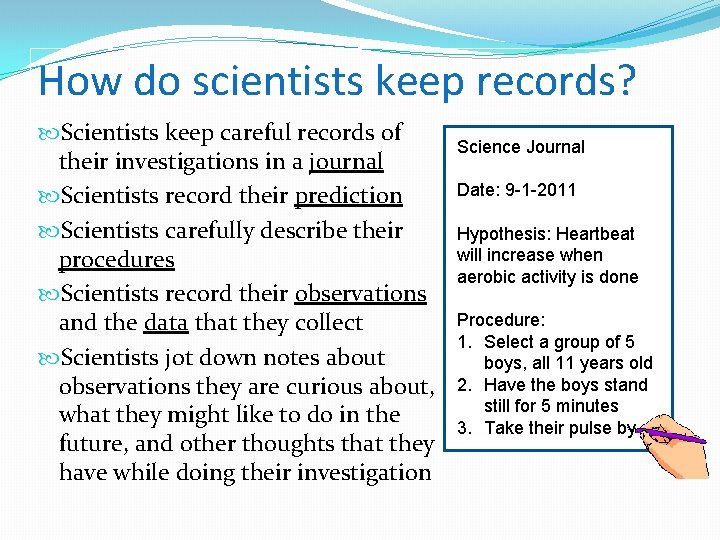
How do scientists keep records? Scientists keep careful records of their investigations in a journal Scientists record their prediction Scientists carefully describe their procedures Scientists record their observations and the data that they collect Scientists jot down notes about observations they are curious about, what they might like to do in the future, and other thoughts that they have while doing their investigation Science Journal Date: 9 -1 -2011 Hypothesis: Heartbeat will increase when aerobic activity is done Procedure: 1. Select a group of 5 boys, all 11 years old 2. Have the boys stand still for 5 minutes 3. Take their pulse by
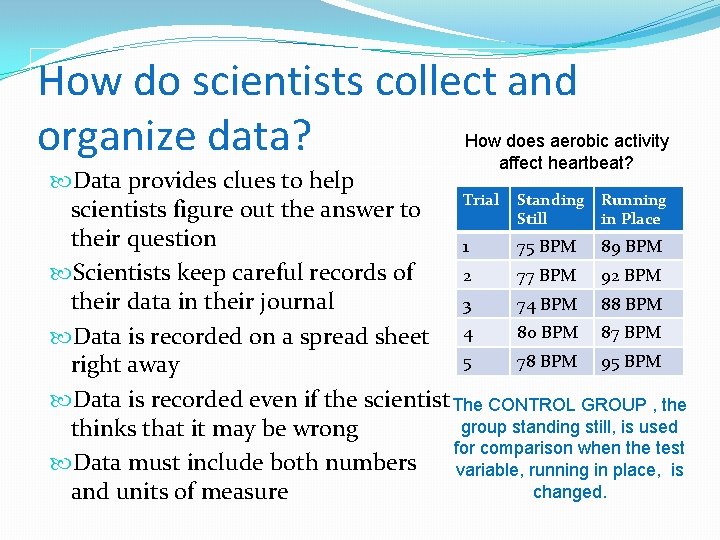
How do scientists collect and organize data? How does aerobic activity affect heartbeat? Data provides clues to help Trial Standing Running scientists figure out the answer to Still in Place their question 1 75 BPM 89 BPM Scientists keep careful records of 2 77 BPM 92 BPM their data in their journal 3 74 BPM 88 BPM 80 BPM 87 BPM Data is recorded on a spread sheet 4 5 78 BPM 95 BPM right away Data is recorded even if the scientist The CONTROL GROUP , the group standing still, is used thinks that it may be wrong for comparison when the test Data must include both numbers variable, running in place, is changed. and units of measure
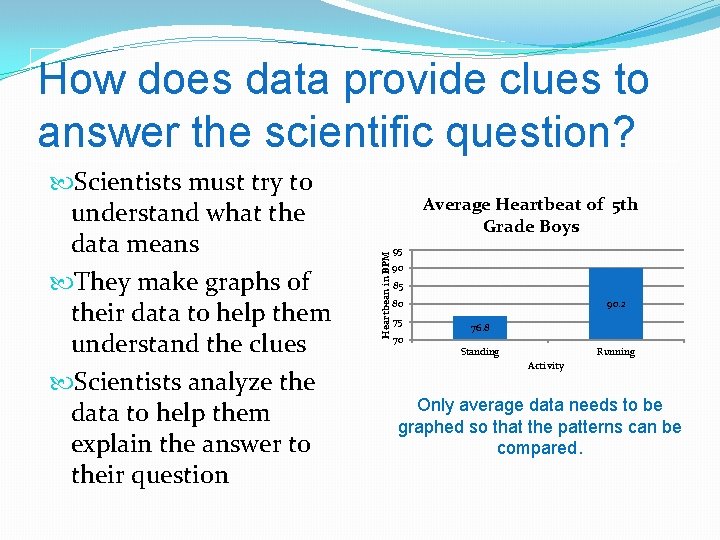
How does data provide clues to answer the scientific question? Average Heartbeat of 5 th Grade Boys Heartbean in BPM Scientists must try to understand what the data means They make graphs of their data to help them understand the clues Scientists analyze the data to help them explain the answer to their question 95 90 85 90. 2 80 75 70 76. 8 Standing Running Activity Only average data needs to be graphed so that the patterns can be compared.
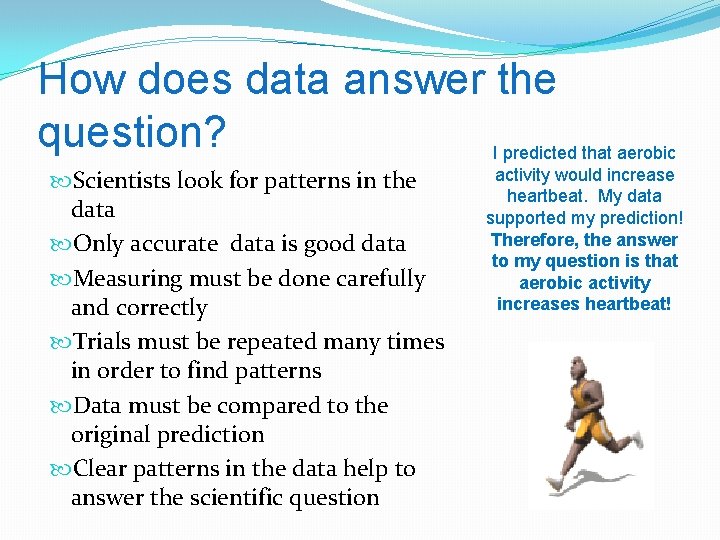
How does data answer the question? I predicted that aerobic Scientists look for patterns in the data Only accurate data is good data Measuring must be done carefully and correctly Trials must be repeated many times in order to find patterns Data must be compared to the original prediction Clear patterns in the data help to answer the scientific question activity would increase heartbeat. My data supported my prediction! Therefore, the answer to my question is that aerobic activity increases heartbeat!
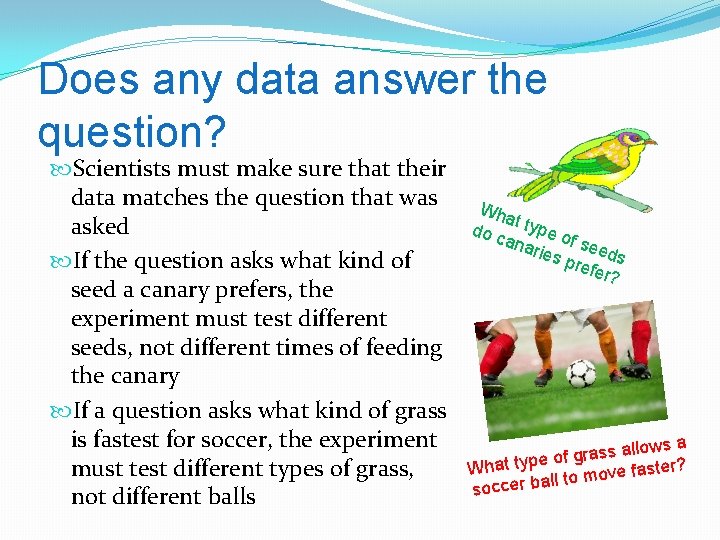
Does any data answer the question? Scientists must make sure that their data matches the question that was asked If the question asks what kind of seed a canary prefers, the experiment must test different seeds, not different times of feeding the canary If a question asks what kind of grass is fastest for soccer, the experiment must test different types of grass, not different balls I Wha do c t type o f ana ries seeds pref er? llows a a s s a r g f o What type ster? a f e v o m ll to soccer ba
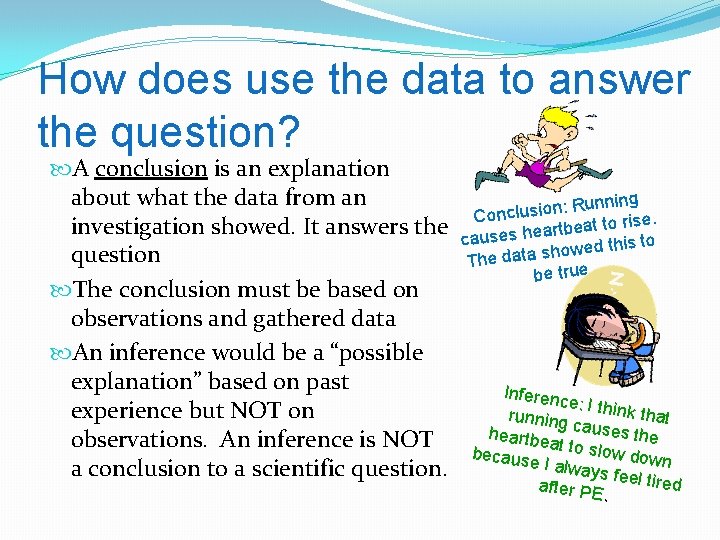
How does use the data to answer the question? A conclusion is an explanation about what the data from an investigation showed. It answers the question The conclusion must be based on observations and gathered data An inference would be a “possible explanation” based on past experience but NOT on observations. An inference is NOT a conclusion to a scientific question. unning R : n io s lu c Con t to rise. a e b t r a e h causes this to d e w o h s The data be true. Inferenc e: I thin k that running c auses t heartbe he at to slo becaus e I alwa w down ys fe after PE el tired.
Summarizing THE MOST IMPORTANT THING! Each person in a cooperative group tell the rest of the group THE MOST IMPORTANT THING that a scientist does when looking for answers about the natural world.
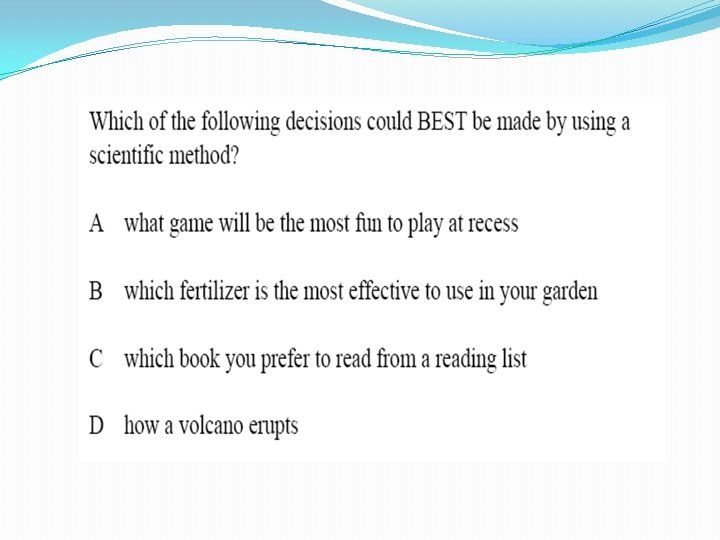
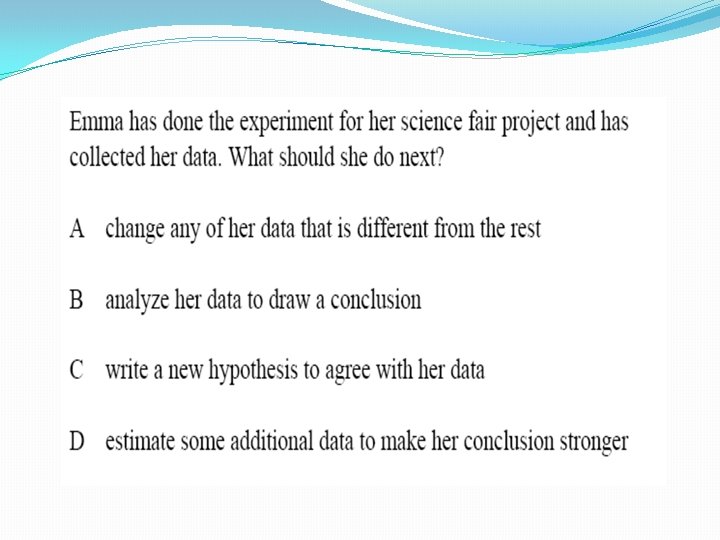
Guided Instruction: Talk to your shoulder partner about the answer to each question. Check your work.
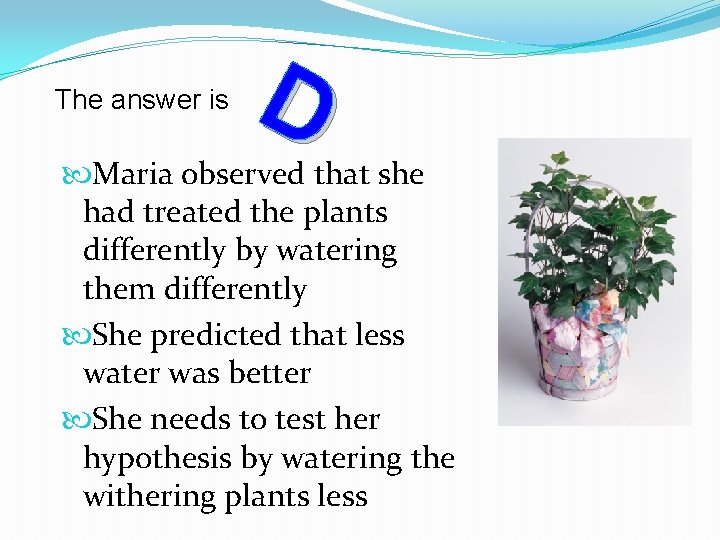
The answer is D Maria observed that she had treated the plants differently by watering them differently She predicted that less water was better She needs to test her hypothesis by watering the withering plants less
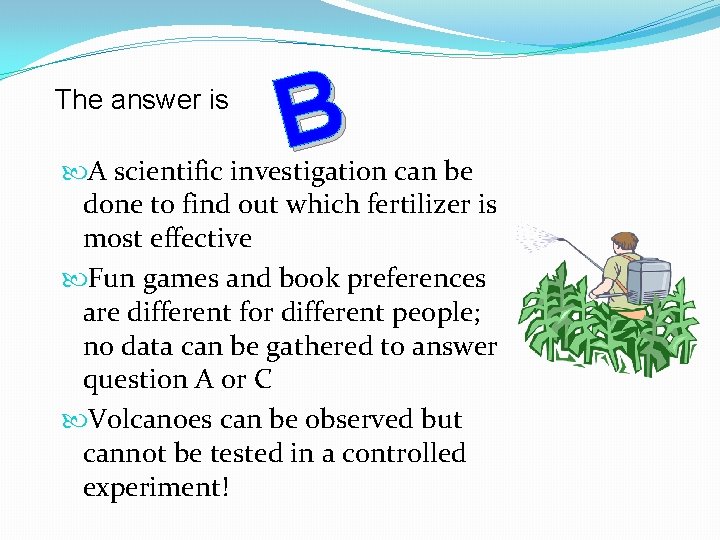
The answer is B A scientific investigation can be done to find out which fertilizer is most effective Fun games and book preferences are different for different people; no data can be gathered to answer question A or C Volcanoes can be observed but cannot be tested in a controlled experiment!
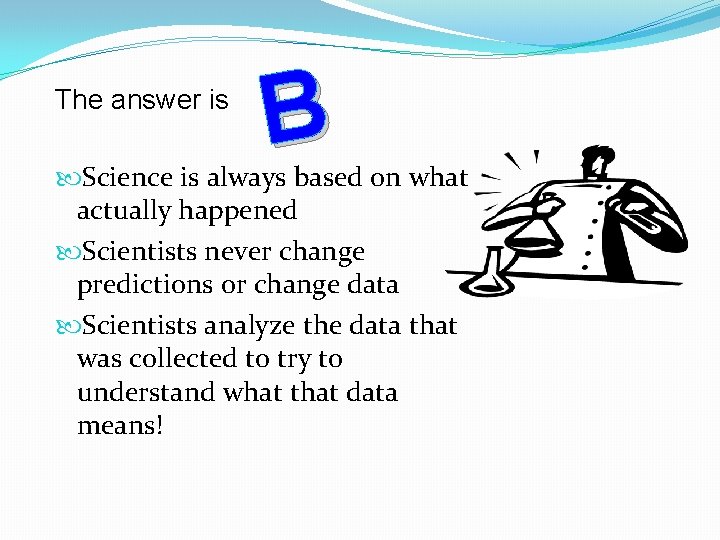
The answer is B Science is always based on what actually happened Scientists never change predictions or change data Scientists analyze the data that was collected to try to understand what that data means!
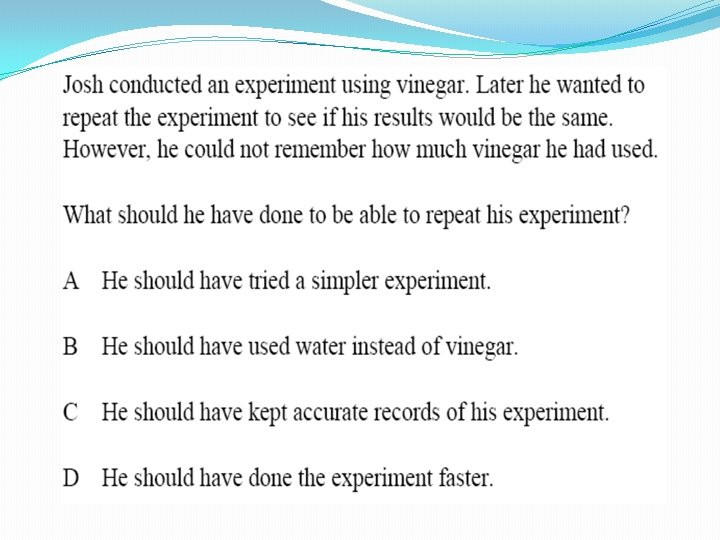
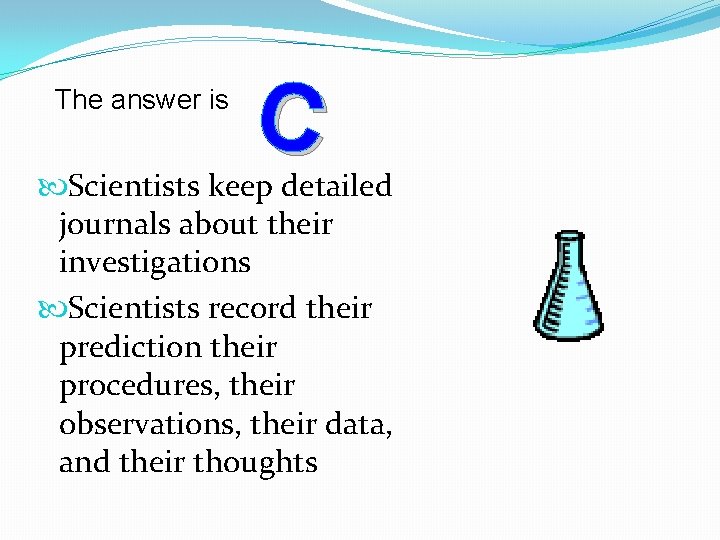
The answer is C Scientists keep detailed journals about their investigations Scientists record their prediction their procedures, their observations, their data, and their thoughts
Summarizing Pair Share Find a partner Taller partner talk for 30 seconds to shorter partner , talk about things that a scientist does to find answers to questions about the natural world Shorter partner talk for 30 seconds to taller partner, talk about more things that a scientist does to find answers to questions about the natural world
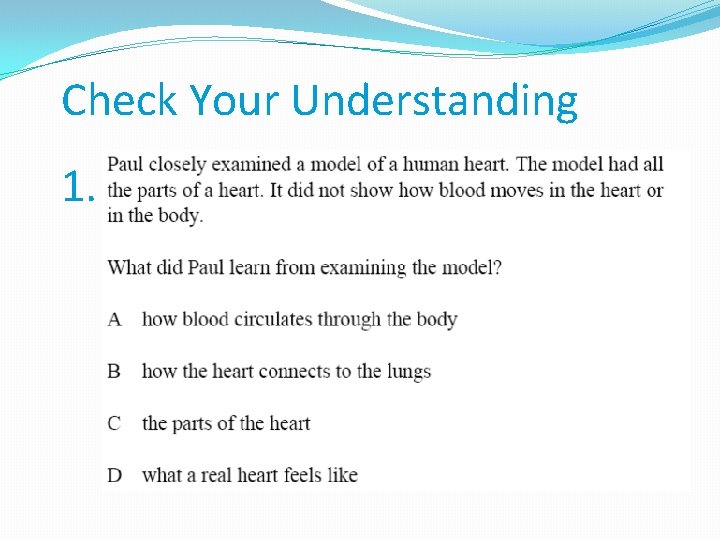
Check Your Understanding 1.
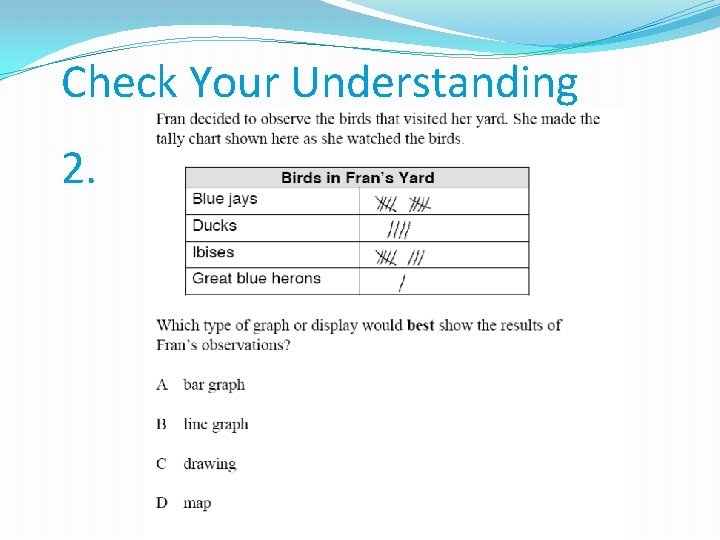
Check Your Understanding 2.
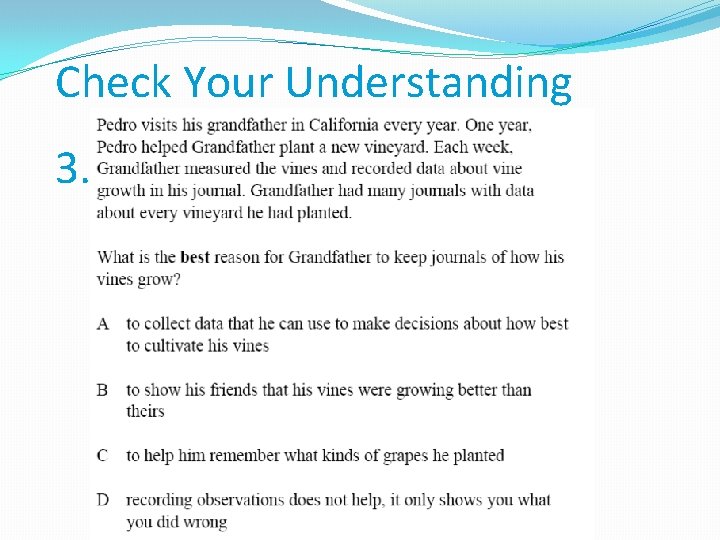
Check Your Understanding 3.
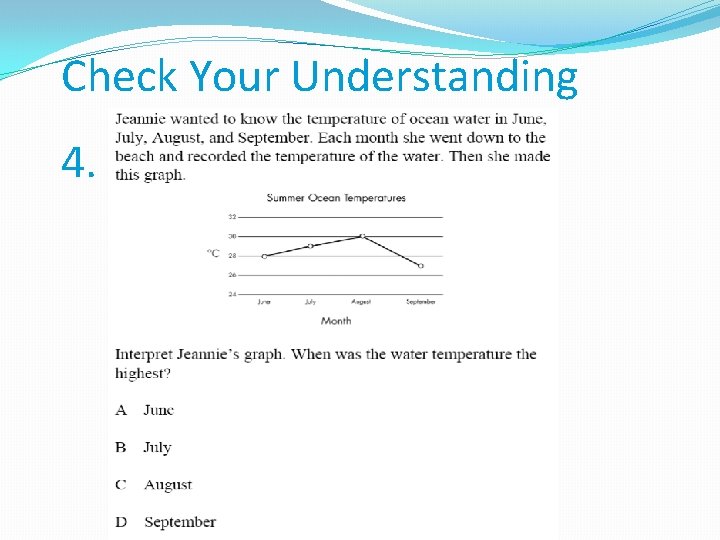
Check Your Understanding 4.
Check your Answers 1. C- this investigation used a model which could only provide limited information about a heart 2. A- a bar graph is the right graph for comparing different sets of data 3. A- Grandfather was able to re-read his journals so that he could replicate what he had done in the years that he produced good vineyards 4. C- The temperature increases as the line goes higher
Summarizing Write a summary paragraph to explain how scientists find answers to questions about the natural world. Include a topic sentence, at least 4 detail sentences, and a concluding sentence.