
ELEMENTARY PRINCIPLES OF CHEMICAL PROCESS THE CHEMICAL ENGINEER

- Slides: 10
ELEMENTARY PRINCIPLES OF CHEMICAL PROCESS THE CHEMICAL ENGINEER ROLE IN THE INDUSTRY
WHAT IS CHEMICAL ENGINEERING? “ A Chemical Engineer is concerned with the processes of change or transformation which convert raw materials into useful products. His special contribution is in the planning , design, control and management of inter-related processing systems to achieve safe, efficient and economic operations. This often involves integrating skills of other scientific disciplines. ”
WHAT CHEMICAL ENGINEERS SOMETIMES DO FOR A LIVING? • Example 1: Chemist • Example 2: Power Company
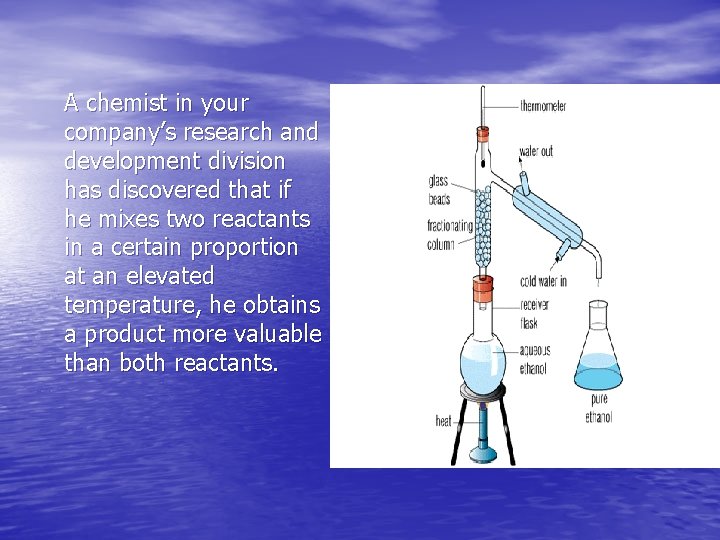
A chemist in your company’s research and development division has discovered that if he mixes two reactants in a certain proportion at an elevated temperature, he obtains a product more valuable than both reactants.
Engineering problems • What should the reaction be carry out in? • Where should the reactant be obtained? • What is the level of purity required? • How should the reactant and products be moved to and from the reactor? • What information provided by the laboratory test can be used to design? • What can be done if some go wrong?
Engineering Problems • Are there waste products that result from the process? • How much of the process should be automate? • How much does all of this cost? • Once the plant has been built, what procedure should be followed for “startup”?
Power Generation • Electricity is generated by burning a fuel in a boiler furnace, using the heat combustion to generate a high pressure, ejecting steam through an expansion nozzle, and impinging the resulting high velocity steam jet on the blades of a turbine rotor that drives an electrical generator. Your company is designing a process plant and plans to include an onsite power-generating facility.
Engineering Problems • How much do gas and oil will cost? • How much does coal cost now and how rapidly is its cost likely to increase? • The stack gas from a coal fired boiler furnace contains pollutants, What are the expected rates of these substances? • Which processes can be used to reduce emissions to acceptable levels?
Engineering Problems • Is it cost effect to recover the sulphur content in the stack to be marketable? • When is more adequate to remove the contaminant? • Are any alternative energy sources feasible, either in the short or the long run, such as solar collectors, wind turbines, municipal refuse, etc?
The End