
Elementary Mechanics of Fluids Lab 3 FLOW VISUALIZATION
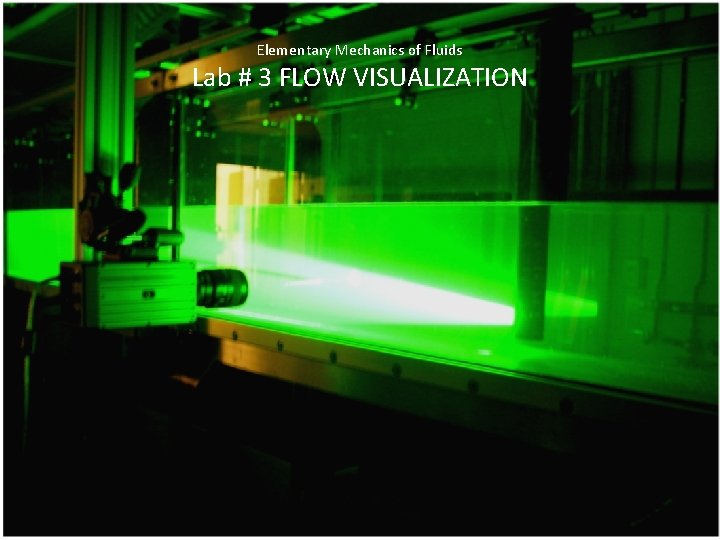
Elementary Mechanics of Fluids Lab # 3 FLOW VISUALIZATION
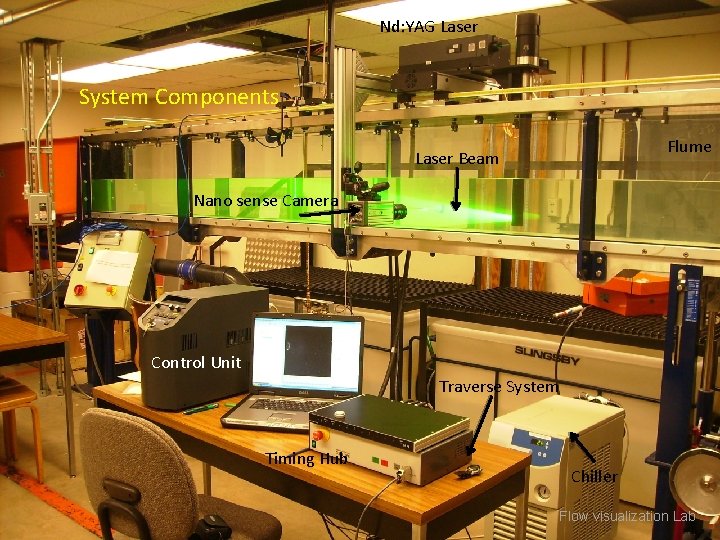
Nd: YAG Laser System Components Flume Laser Beam Nano sense Camera Control Unit Traverse System Timing Hub Chiller Flow visualization Lab
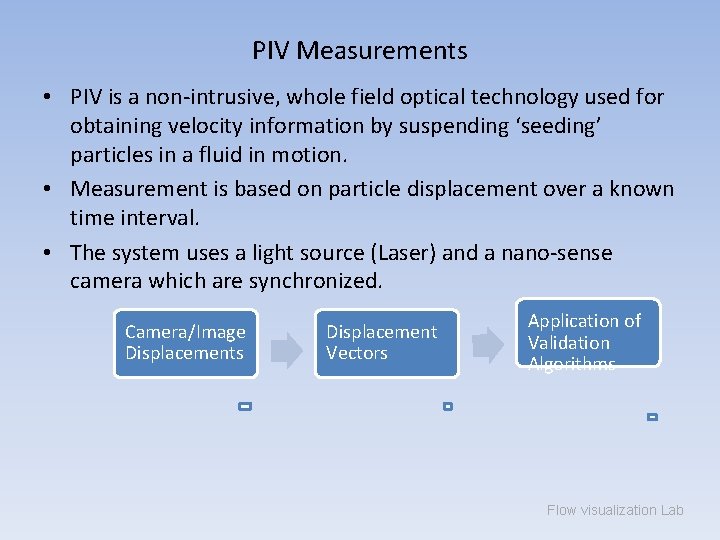
PIV Measurements • PIV is a non-intrusive, whole field optical technology used for obtaining velocity information by suspending ‘seeding’ particles in a fluid in motion. • Measurement is based on particle displacement over a known time interval. • The system uses a light source (Laser) and a nano-sense camera which are synchronized. Camera/Image Displacements Displacement Vectors Application of Validation Algorithms Flow visualization Lab
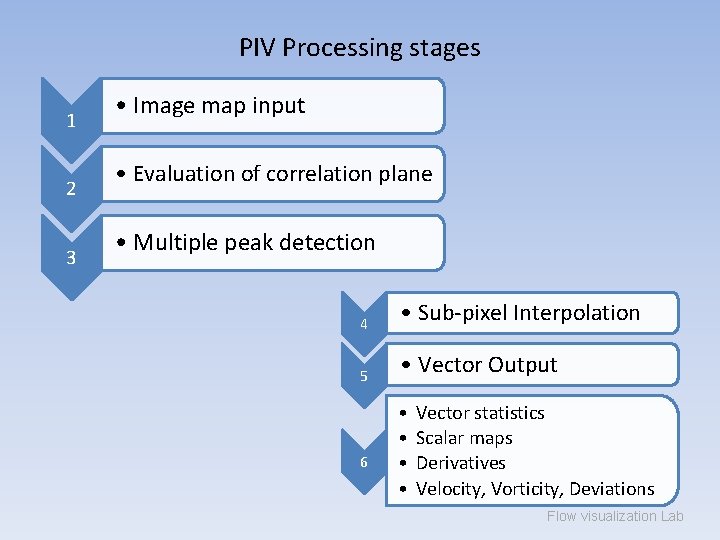
PIV Processing stages 1 2 3 • Image map input • Evaluation of correlation plane • Multiple peak detection 4 • Sub-pixel Interpolation 5 • Vector Output 6 • • Vector statistics Scalar maps Derivatives Velocity, Vorticity, Deviations Flow visualization Lab
Light source, sheet formation and Seeding particles Double Cavity Nd: YAG Laser: • Pulses of short duration (5 -10 ns) • Vast range of Output energy and repetition rates providing powerful light flash. • Optic components added for transformation of IR to Visible light and recombination along same optical path Seeding Particles: • Hollow glass spheres • Diameter comparable to light source wavelength (in accordance with Lorenz Mie theory) • Light scattering sideways is of interest Flow visualization Lab
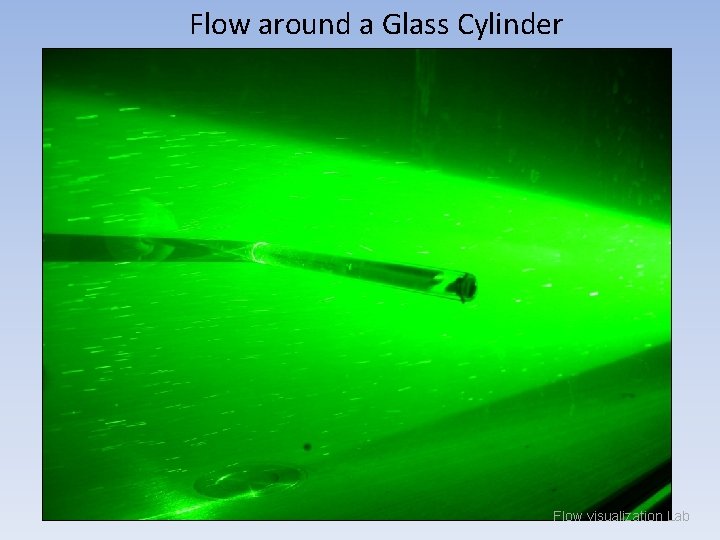
Flow around a Glass Cylinder Flow visualization Lab
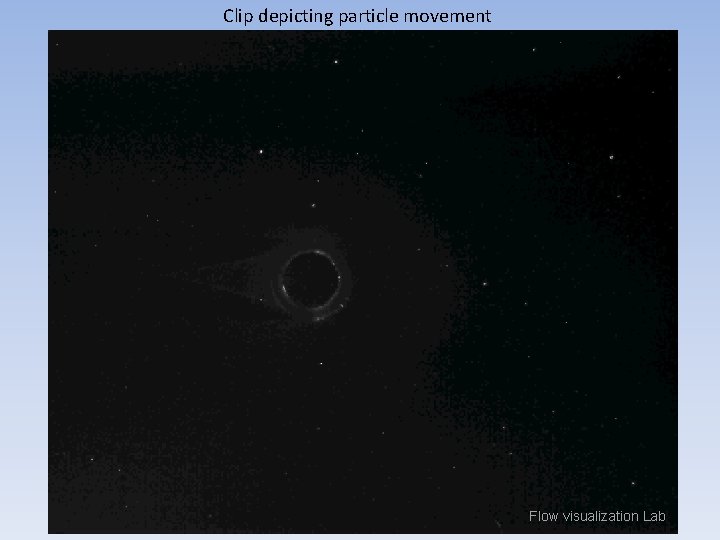
Clip depicting particle movement Flow visualization Lab
Correlations • Image is subdivided into Interrogation areas (IA), each IA has a correlation function • Different types such as Adaptive, Cross and Average correlations • Calculation of velocity vectors with initial IA, applying refinement steps and using intermediary results as input for the next IA • Application of Validation Methods and IA offset scheme • Averaging the correlation to increase the signal-to-noise-ratio significantly and generating clear correlation peaks • Cross-correlations for single frame images Flow visualization Lab

Filters • Average filter used to output vector maps by arithmetic averaging, individual vectors smoothed out • Substitution of vectors with uniformly weighted average over a user defined area • To enhance the results of measurement, a coherence filter applied to the raw velocity field to modify the inconsistent vectors • Application of filters improves the acquired parent data, various vector and scalar maps can be derived Flow visualization Lab
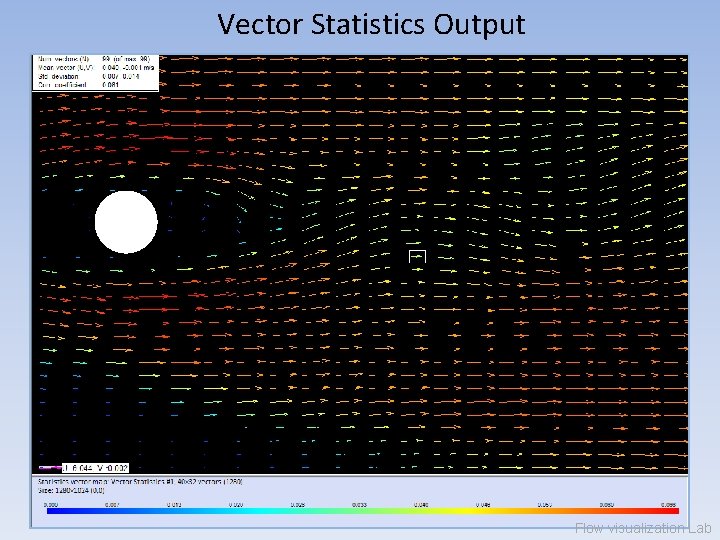
Vector Statistics Output Flow visualization Lab
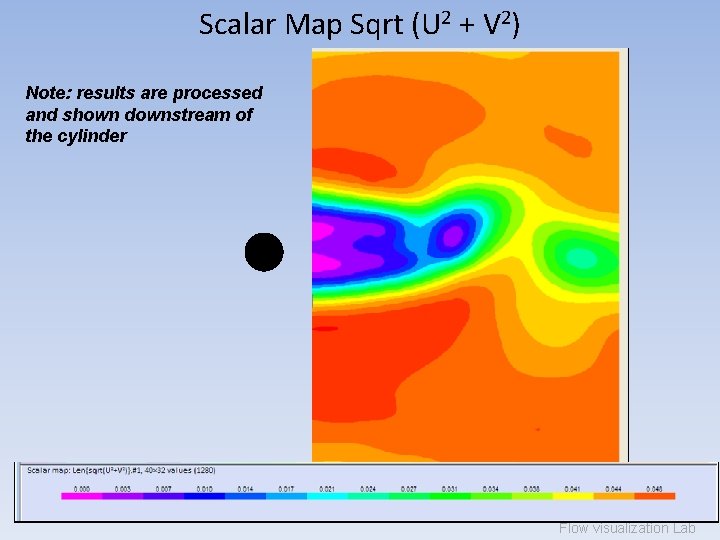
Scalar Map Sqrt (U 2 + V 2) Note: results are processed and shown downstream of the cylinder Flow visualization Lab
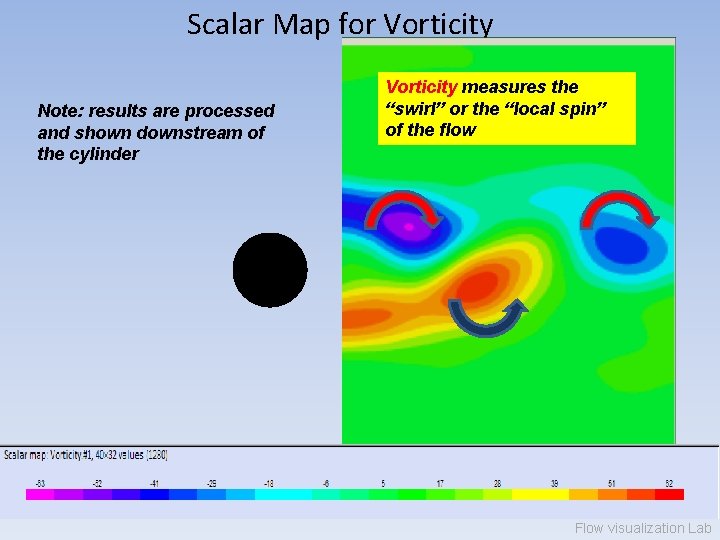
Scalar Map for Vorticity Note: results are processed and shown downstream of the cylinder Vorticity measures the “swirl” or the “local spin” of the flow Flow visualization Lab
Typical recommendations for PIV measurements around a cylinder: 1. At least 5 seeding particles per IA to minimize “loss of pairs” 2. Use cross-correlation than auto correlation methods 3. Use of Guassian window function to eliminate noise due to cyclic convolution 4. Use of filters to optimize the effectiveness of sub-pixel interpolation 5. Maximum permissible displacement of particles be 25% of the IA 6. Minimize effects of zero velocity biasing Flow visualization Lab
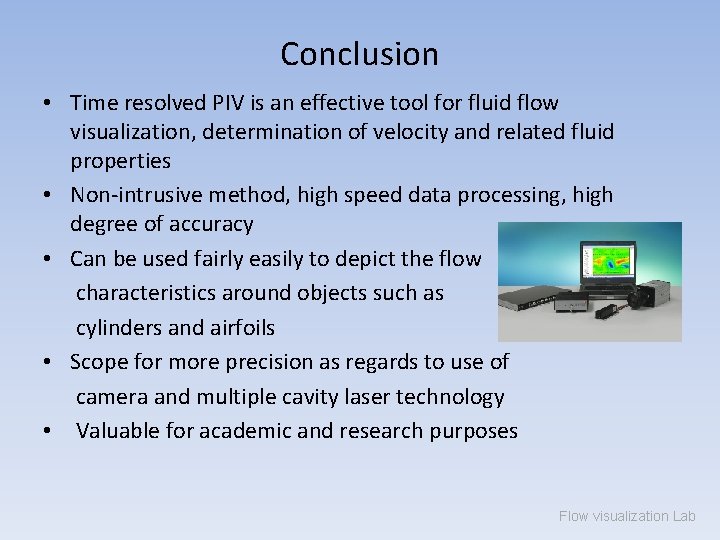
Conclusion • Time resolved PIV is an effective tool for fluid flow visualization, determination of velocity and related fluid properties • Non-intrusive method, high speed data processing, high degree of accuracy • Can be used fairly easily to depict the flow characteristics around objects such as cylinders and airfoils • Scope for more precision as regards to use of camera and multiple cavity laser technology • Valuable for academic and research purposes Flow visualization Lab
- Slides: 14