
ELEMENTARY MARIO F TRIOLA STATISTICS EIGHTH Chapter 1
- Slides: 19
ELEMENTARY MARIO F. TRIOLA STATISTICS EIGHTH Chapter 1. Section 1 -1 and 1 -2. Triola, Elementary Statistics, Eighth Edition. Copyright 2001. Addison Wesley Longman EDITION 1
Statistics Two Meanings v Specific numbers v Method of analysis Chapter 1. Section 1 -1 and 1 -2. Triola, Elementary Statistics, Eighth Edition. Copyright 2001. Addison Wesley Longman 2
Statistics v Specific number numerical measurement determined by a set of data Example: Twenty-three percent of people polled believed that there are too many polls. Chapter 1. Section 1 -1 and 1 -2. Triola, Elementary Statistics, Eighth Edition. Copyright 2001. Addison Wesley Longman 3
Statistics v Method of analysis a collection of methods for planning experiments, obtaining data, and then organizing, summarizing, presenting, analyzing, interpreting, and drawing conclusions based on the data Chapter 1. Section 1 -1 and 1 -2. Triola, Elementary Statistics, Eighth Edition. Copyright 2001. Addison Wesley Longman 4
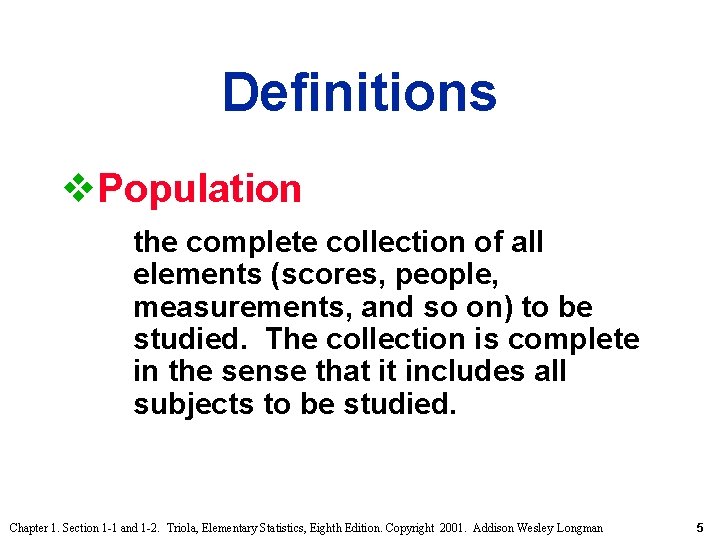
Definitions v. Population the complete collection of all elements (scores, people, measurements, and so on) to be studied. The collection is complete in the sense that it includes all subjects to be studied. Chapter 1. Section 1 -1 and 1 -2. Triola, Elementary Statistics, Eighth Edition. Copyright 2001. Addison Wesley Longman 5
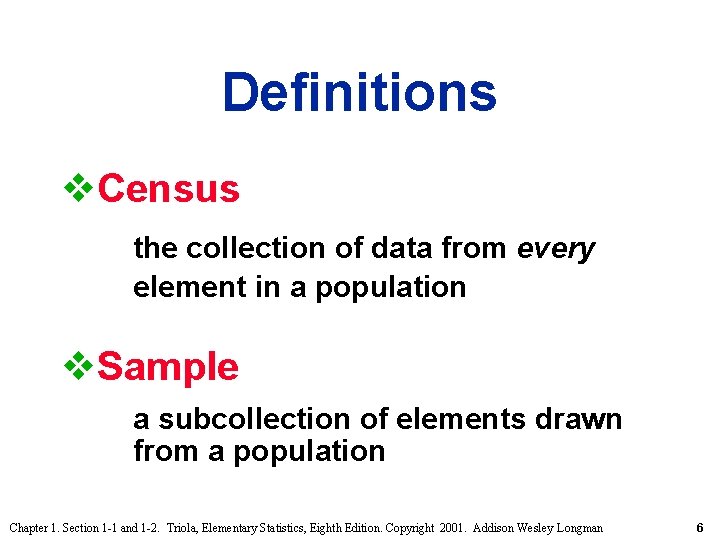
Definitions v. Census the collection of data from every element in a population v. Sample a subcollection of elements drawn from a population Chapter 1. Section 1 -1 and 1 -2. Triola, Elementary Statistics, Eighth Edition. Copyright 2001. Addison Wesley Longman 6
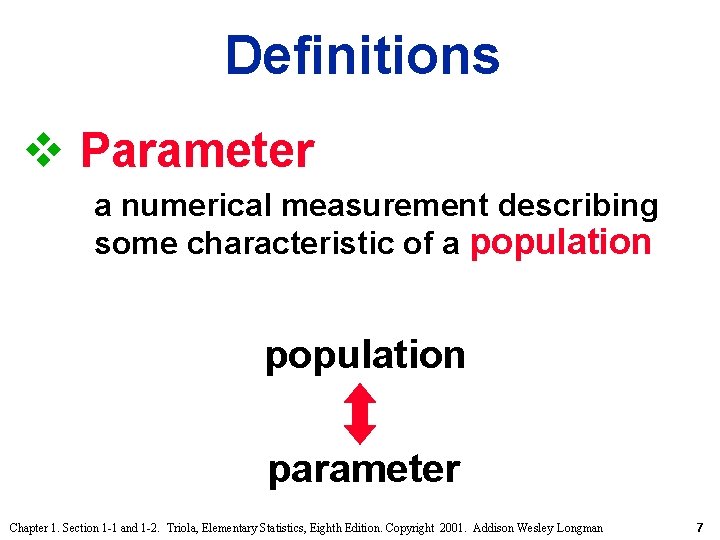
Definitions v Parameter a numerical measurement describing some characteristic of a population parameter Chapter 1. Section 1 -1 and 1 -2. Triola, Elementary Statistics, Eighth Edition. Copyright 2001. Addison Wesley Longman 7
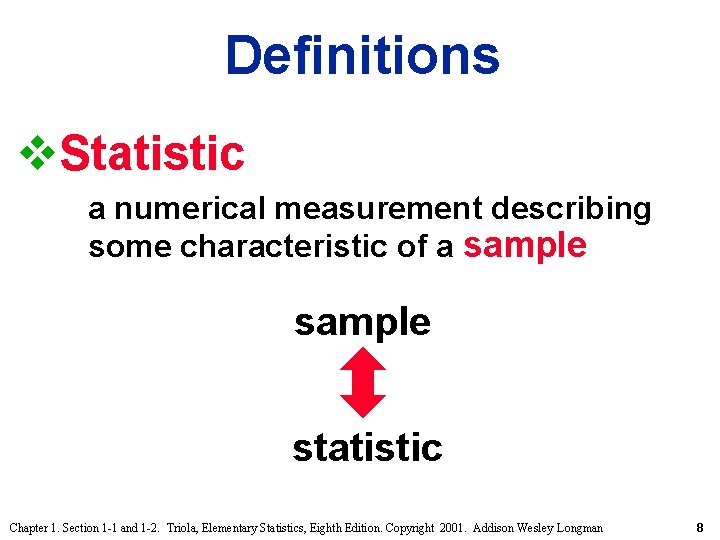
Definitions v. Statistic a numerical measurement describing some characteristic of a sample statistic Chapter 1. Section 1 -1 and 1 -2. Triola, Elementary Statistics, Eighth Edition. Copyright 2001. Addison Wesley Longman 8
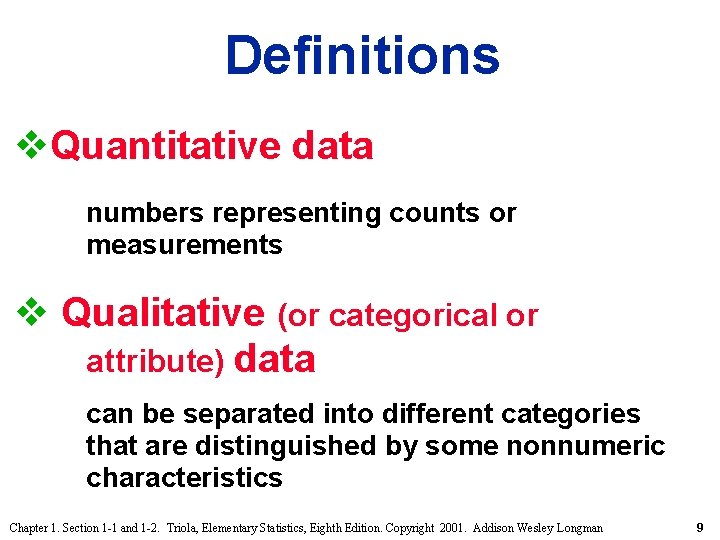
Definitions v. Quantitative data numbers representing counts or measurements v Qualitative (or categorical or attribute) data can be separated into different categories that are distinguished by some nonnumeric characteristics Chapter 1. Section 1 -1 and 1 -2. Triola, Elementary Statistics, Eighth Edition. Copyright 2001. Addison Wesley Longman 9
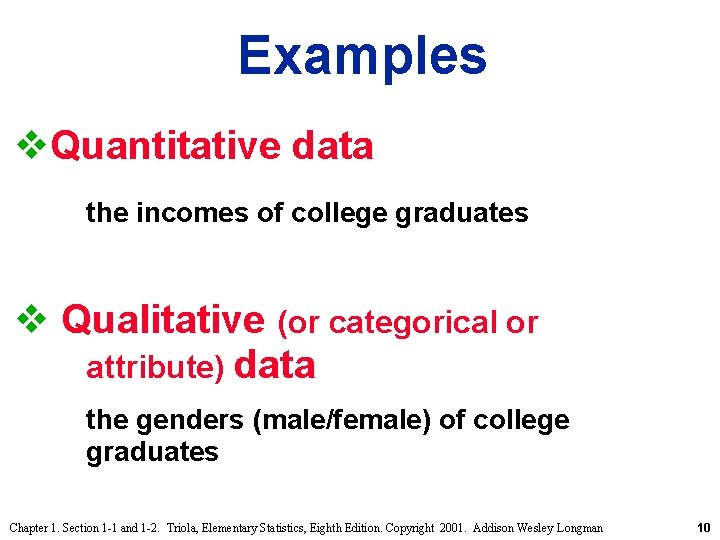
Examples v. Quantitative data the incomes of college graduates v Qualitative (or categorical or attribute) data the genders (male/female) of college graduates Chapter 1. Section 1 -1 and 1 -2. Triola, Elementary Statistics, Eighth Edition. Copyright 2001. Addison Wesley Longman 10
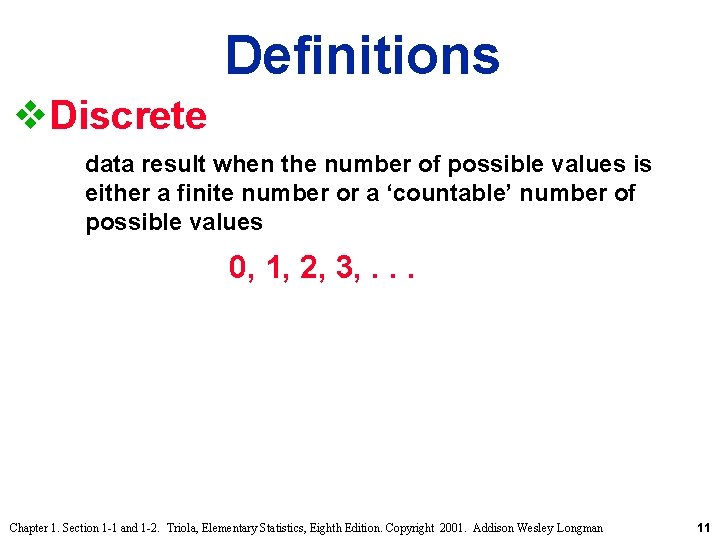
Definitions v. Discrete data result when the number of possible values is either a finite number or a ‘countable’ number of possible values 0, 1, 2, 3, . . . Chapter 1. Section 1 -1 and 1 -2. Triola, Elementary Statistics, Eighth Edition. Copyright 2001. Addison Wesley Longman 11
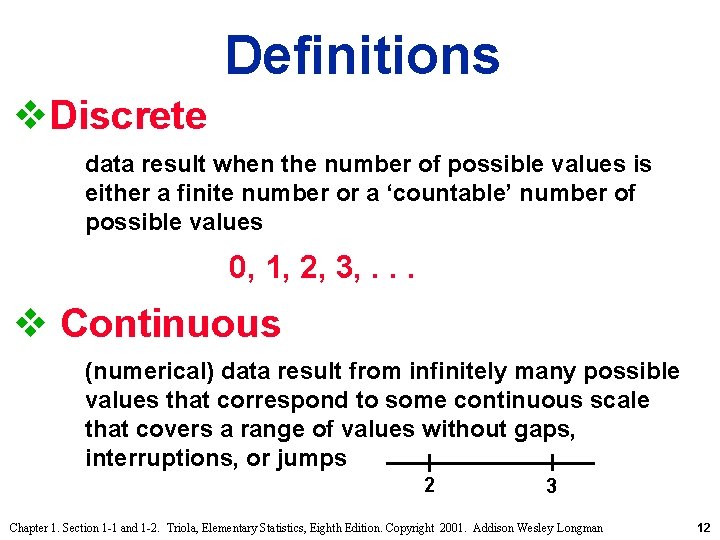
Definitions v. Discrete data result when the number of possible values is either a finite number or a ‘countable’ number of possible values 0, 1, 2, 3, . . . v Continuous (numerical) data result from infinitely many possible values that correspond to some continuous scale that covers a range of values without gaps, interruptions, or jumps 2 3 Chapter 1. Section 1 -1 and 1 -2. Triola, Elementary Statistics, Eighth Edition. Copyright 2001. Addison Wesley Longman 12
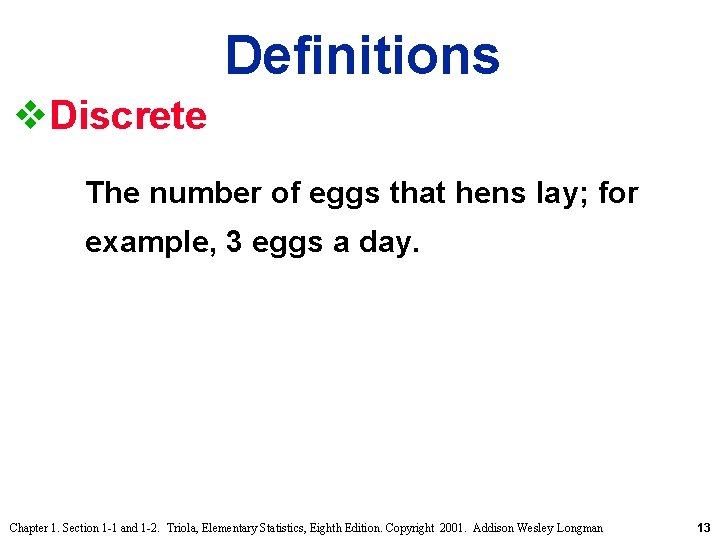
Definitions v. Discrete The number of eggs that hens lay; for example, 3 eggs a day. Chapter 1. Section 1 -1 and 1 -2. Triola, Elementary Statistics, Eighth Edition. Copyright 2001. Addison Wesley Longman 13
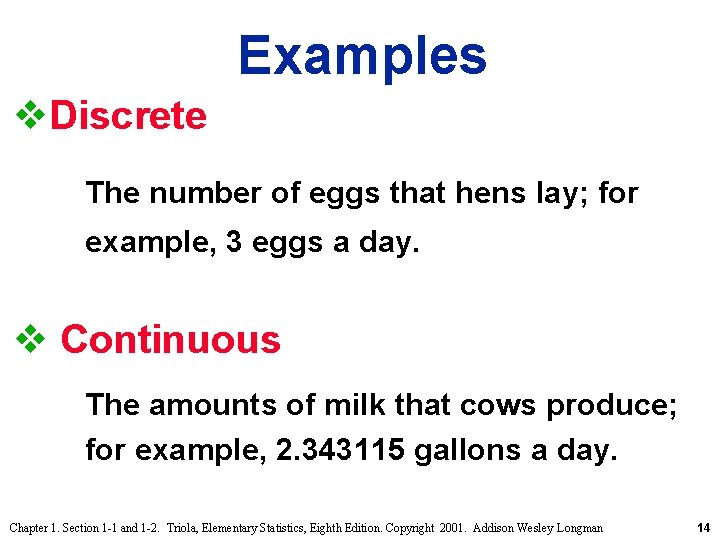
Examples v. Discrete The number of eggs that hens lay; for example, 3 eggs a day. v Continuous The amounts of milk that cows produce; for example, 2. 343115 gallons a day. Chapter 1. Section 1 -1 and 1 -2. Triola, Elementary Statistics, Eighth Edition. Copyright 2001. Addison Wesley Longman 14
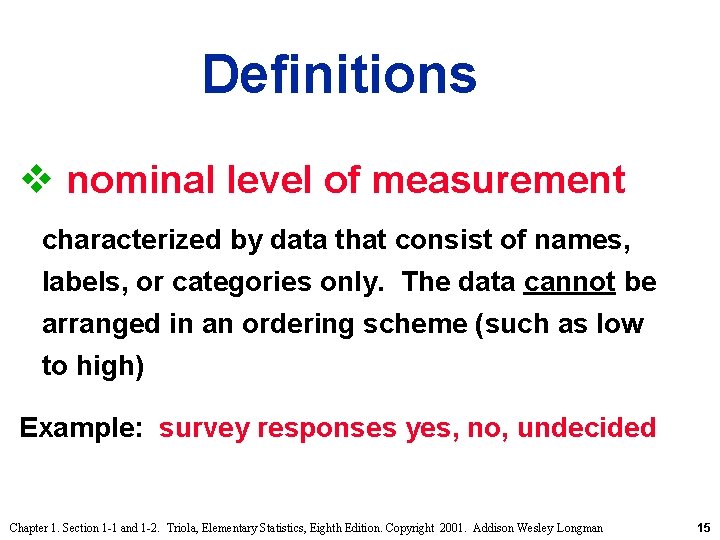
Definitions v nominal level of measurement characterized by data that consist of names, labels, or categories only. The data cannot be arranged in an ordering scheme (such as low to high) Example: survey responses yes, no, undecided Chapter 1. Section 1 -1 and 1 -2. Triola, Elementary Statistics, Eighth Edition. Copyright 2001. Addison Wesley Longman 15
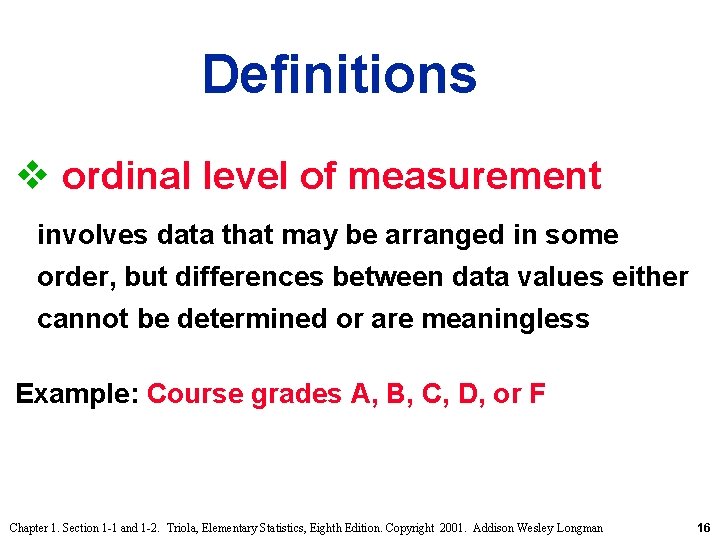
Definitions v ordinal level of measurement involves data that may be arranged in some order, but differences between data values either cannot be determined or are meaningless Example: Course grades A, B, C, D, or F Chapter 1. Section 1 -1 and 1 -2. Triola, Elementary Statistics, Eighth Edition. Copyright 2001. Addison Wesley Longman 16
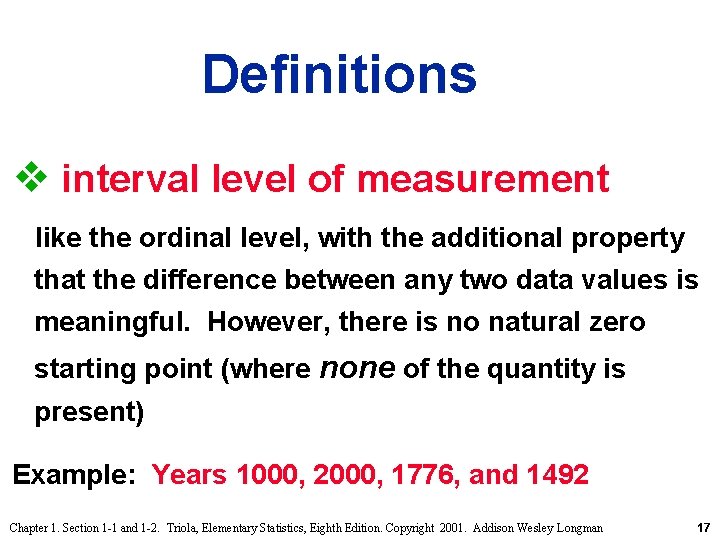
Definitions v interval level of measurement like the ordinal level, with the additional property that the difference between any two data values is meaningful. However, there is no natural zero starting point (where none of the quantity is present) Example: Years 1000, 2000, 1776, and 1492 Chapter 1. Section 1 -1 and 1 -2. Triola, Elementary Statistics, Eighth Edition. Copyright 2001. Addison Wesley Longman 17
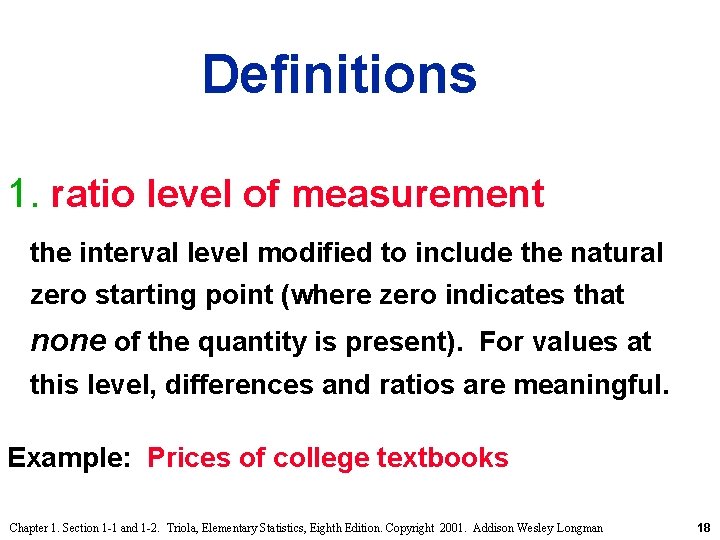
Definitions 1. ratio level of measurement the interval level modified to include the natural zero starting point (where zero indicates that none of the quantity is present). For values at this level, differences and ratios are meaningful. Example: Prices of college textbooks Chapter 1. Section 1 -1 and 1 -2. Triola, Elementary Statistics, Eighth Edition. Copyright 2001. Addison Wesley Longman 18
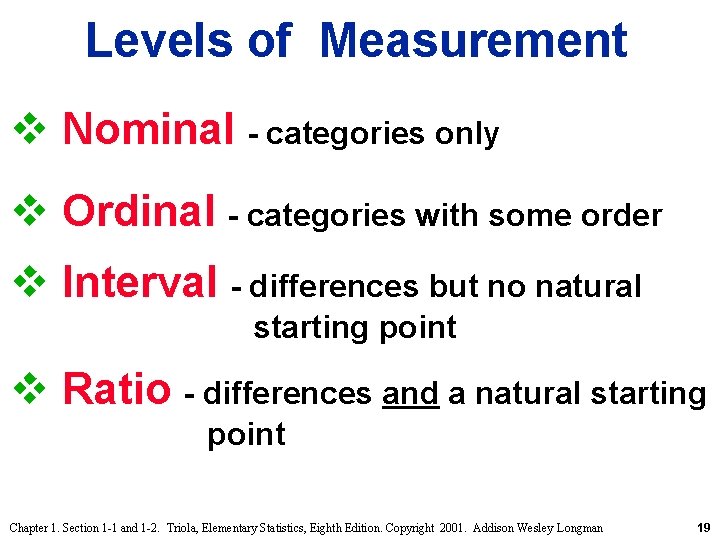
Levels of Measurement v Nominal - categories only v Ordinal - categories with some order v Interval - differences but no natural starting point v Ratio - differences and a natural starting point Chapter 1. Section 1 -1 and 1 -2. Triola, Elementary Statistics, Eighth Edition. Copyright 2001. Addison Wesley Longman 19