
Elementary Concept of DC circuit Department of Electrical
- Slides: 17
Elementary Concept of DC circuit Department of Electrical Engineering BY: - PARMAR VAISHALI B PATEL DARSHAP G PATEL DHVANI C RANA BRIJESH M TRIVEDI STAVAN S Guided by: PROF. (DR. ) A. R. CHUDASAMA NIDHI. J. GOHIL Neotech Institute of Technology 1
Electrical Circuits • We want to transfer electrical energy to perform a task • We want to supply energy to some load • Charged particles want to “move” when an emf applied • Apply emf and constrain the path of the charged particles • Force charged particles to supply energy to the load in order to do work (no path through load no useful work done!) Neotech Institute of Technology 2
Types of Circuit Elements • Circuit components are generally classified as control elements, passive elements, and active elements • Control Elements – direct and modify the current (e. g. switches) • Passive Elements – total energy delivered to the element by the rest of the circuit is nonnegative (e. g. resistors, capacitors, inductors) • Active Elements – can provide energy to the circuit (e. g. batteries, generators, current, voltage) Neotech Institute of Technology 3
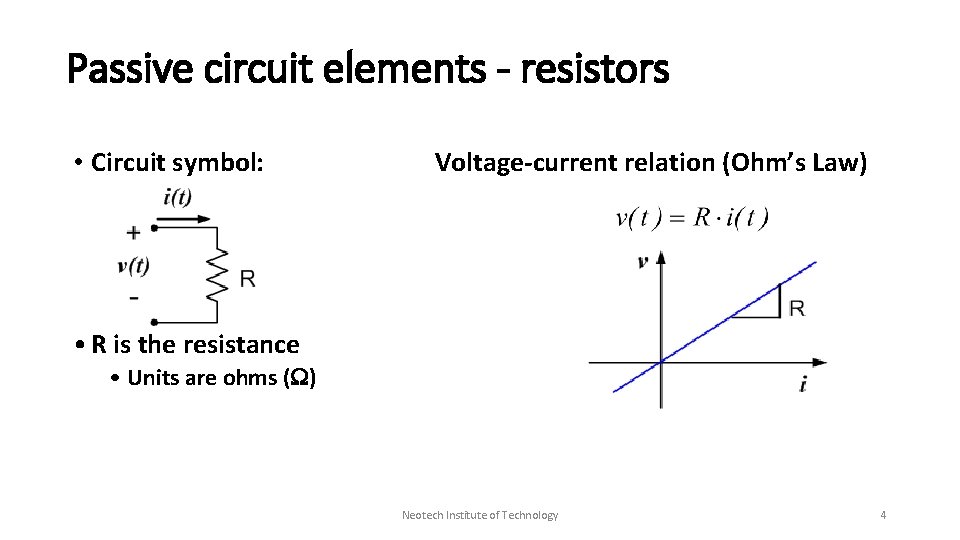
Passive circuit elements - resistors • Circuit symbol: Voltage-current relation (Ohm’s Law) • R is the resistance • Units are ohms ( ) Neotech Institute of Technology 4
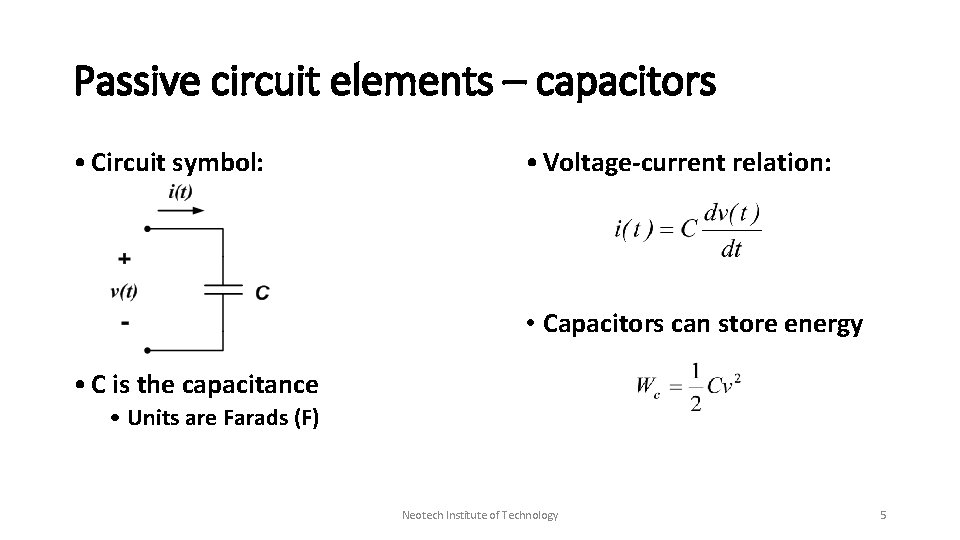
Passive circuit elements – capacitors • Circuit symbol: • Voltage-current relation: • Capacitors can store energy • C is the capacitance • Units are Farads (F) Neotech Institute of Technology 5
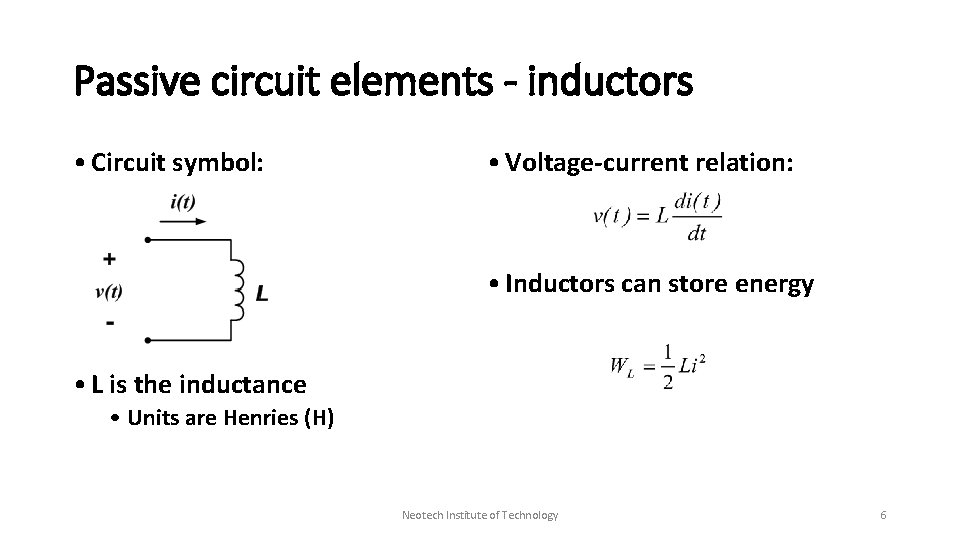
Passive circuit elements - inductors • Circuit symbol: • Voltage-current relation: • Inductors can store energy • L is the inductance • Units are Henries (H) Neotech Institute of Technology 6
Types of power supplies • Power supplies can be modeled in a number of ways: • Voltage, current sources • Independent, dependent sources • Ideal and non-ideal sources Neotech Institute of Technology 7
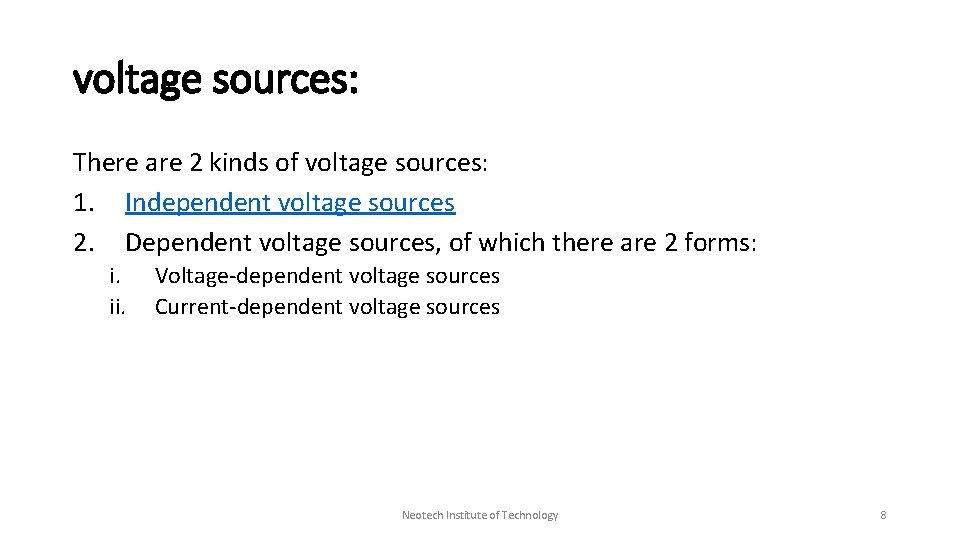
voltage sources: There are 2 kinds of voltage sources: 1. Independent voltage sources 2. Dependent voltage sources, of which there are 2 forms: i. ii. Voltage-dependent voltage sources Current-dependent voltage sources Neotech Institute of Technology 8
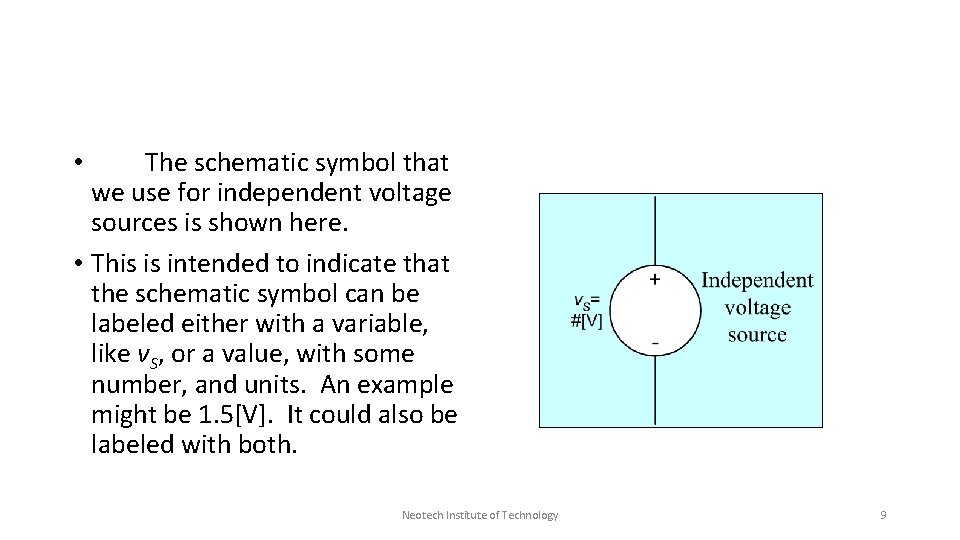
The schematic symbol that we use for independent voltage sources is shown here. • This is intended to indicate that the schematic symbol can be labeled either with a variable, like v. S, or a value, with some number, and units. An example might be 1. 5[V]. It could also be labeled with both. • Neotech Institute of Technology 9
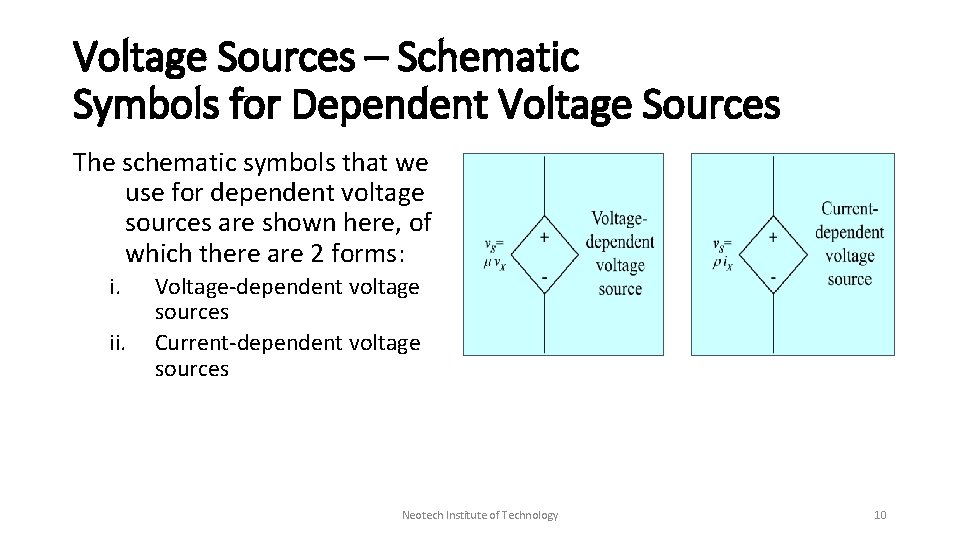
Voltage Sources – Schematic Symbols for Dependent Voltage Sources The schematic symbols that we use for dependent voltage sources are shown here, of which there are 2 forms: i. ii. Voltage-dependent voltage sources Current-dependent voltage sources Neotech Institute of Technology 10
current sources: There are 2 kinds of current sources: 1. Independent current sources 2. Dependent current sources, of which there are 2 forms: i. ii. Voltage-dependent current sources Current-dependent current. Neotech Institute of Technology 11
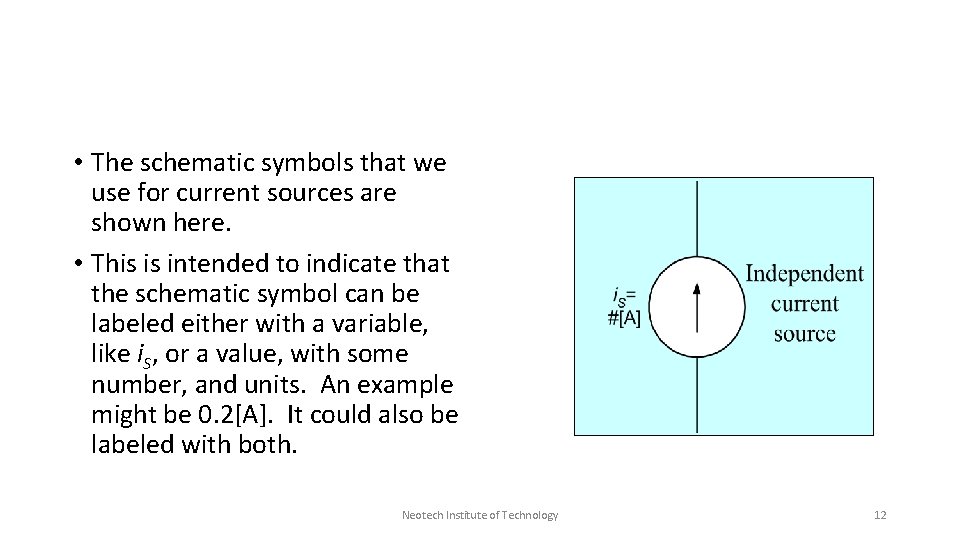
• The schematic symbols that we use for current sources are shown here. • This is intended to indicate that the schematic symbol can be labeled either with a variable, like i. S, or a value, with some number, and units. An example might be 0. 2[A]. It could also be labeled with both. Neotech Institute of Technology 12
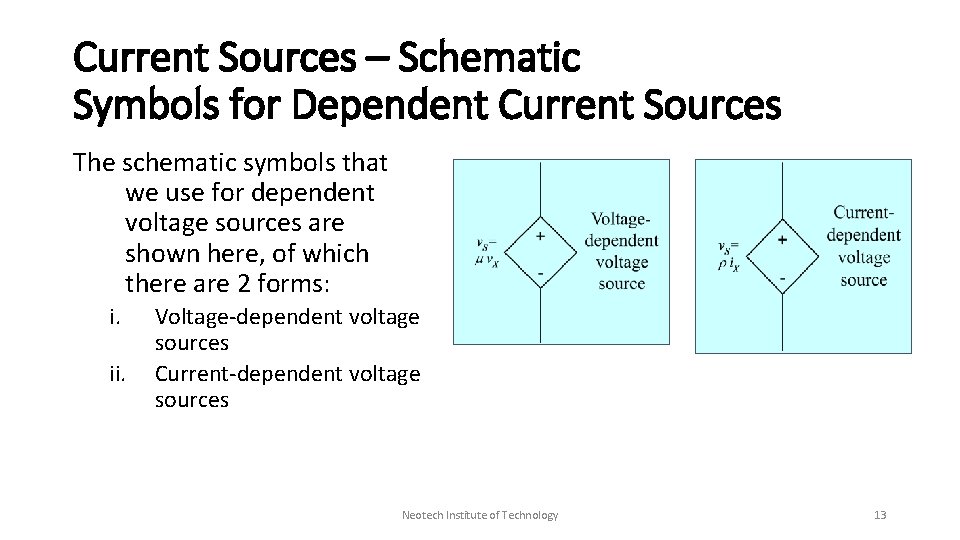
Current Sources – Schematic Symbols for Dependent Current Sources The schematic symbols that we use for dependent voltage sources are shown here, of which there are 2 forms: i. ii. Voltage-dependent voltage sources Current-dependent voltage sources Neotech Institute of Technology 13
Fundamental Laws of Electrical circuit • Ohm’s Law • Kirchhoff’s Law Neotech Institute of Technology 14
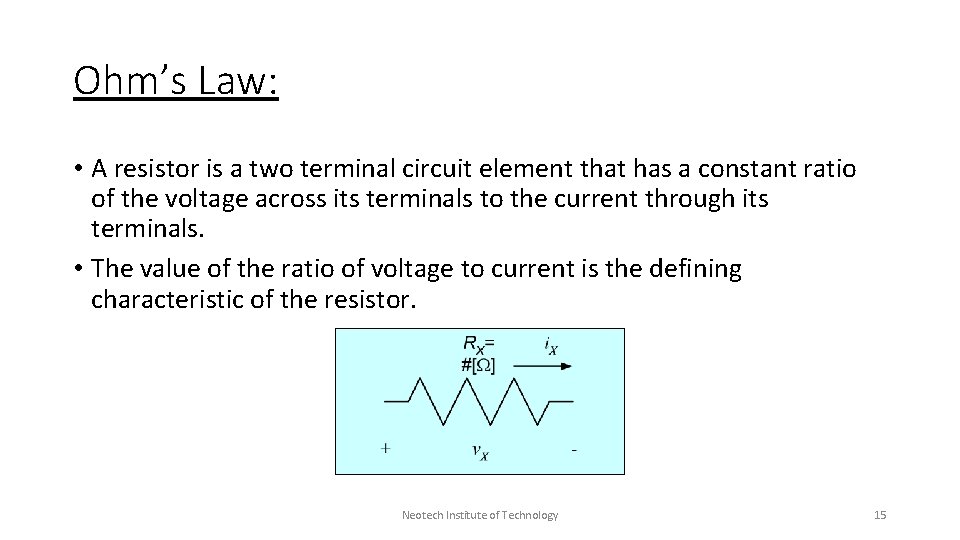
Ohm’s Law: • A resistor is a two terminal circuit element that has a constant ratio of the voltage across its terminals to the current through its terminals. • The value of the ratio of voltage to current is the defining characteristic of the resistor. Neotech Institute of Technology 15
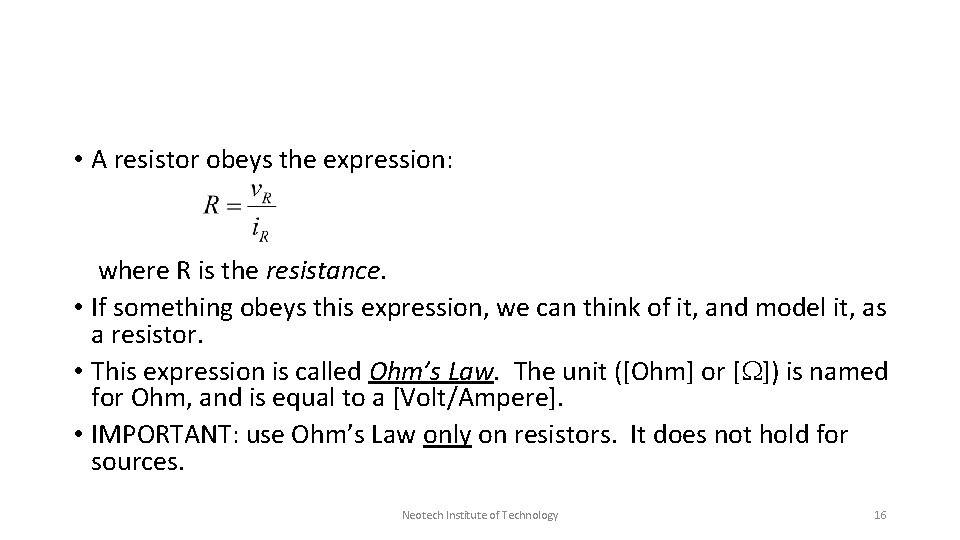
• A resistor obeys the expression: where R is the resistance. • If something obeys this expression, we can think of it, and model it, as a resistor. • This expression is called Ohm’s Law. The unit ([Ohm] or [W]) is named for Ohm, and is equal to a [Volt/Ampere]. • IMPORTANT: use Ohm’s Law only on resistors. It does not hold for sources. Neotech Institute of Technology 16
THANK YOU Neotech Institute of Technology 17