
Elementary and Middle School Mathematics Teaching Developmentally 10

- Slides: 17
Elementary and Middle School Mathematics Teaching Developmentally 10 th Edition Chapter 6 Teaching Mathematics Equitably to All Students Copyright © 2019, 2016, 2013 Pearson Education, Inc. All Rights Reserved
Learner Outcomes 6. 1 Differentiate between a modification and an accommodation. 6. 2 Describe the components of a multitiered system of support for struggling students and identify successful components of interventions for students with disabilities. 6. 3 Explain characteristics of culturally responsive instruction, including how to focus on developing academic vocabulary during mathematics instruction. 6. 4 Apply knowledge of working with students who are gifted and talented mathematically. 6. 5 Illustrate approaches that are used to develop students’ resilience and reduce resistance in learning mathematics. Copyright © 2019, 2016, 2013 Pearson Education, Inc. All Rights Reserved
NCTM Access and Equity in Mathematics Education Achievement gaps are actually instructional gaps of expectation gaps. Some teachers operate under the belief that some students cannot do mathematics. Have you heard these statements? My class can’t do group work they are too unruly. This class can’t solve word problems because they don’t have the reading skills. How do we design instruction in ADVANCE of finding weak student performance? Copyright © 2019, 2016, 2013 Pearson Education, Inc. All Rights Reserved
Mathematics for All Students Addressing the needs of All means: • Students who are identified as struggling or have a disability • Students from different backgrounds • Students who are English language learners (ELLs) • Students who are mathematically gifted • Students who are unmotivated or need to build resilience Copyright © 2019, 2016, 2013 Pearson Education, Inc. All Rights Reserved
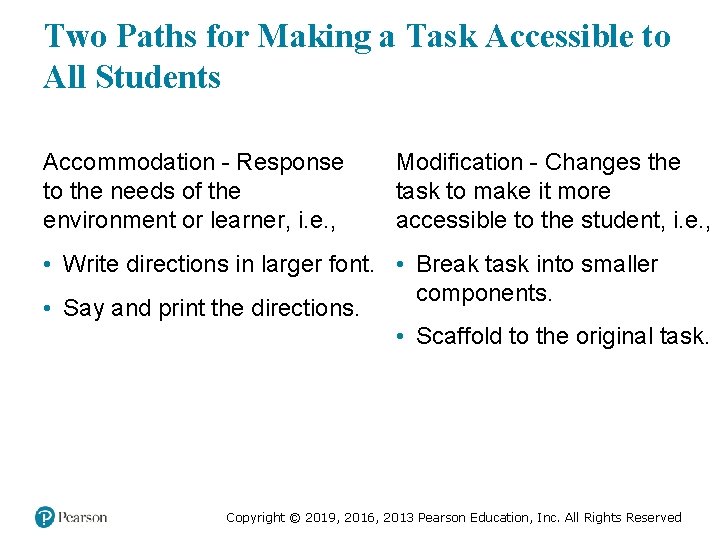
Two Paths for Making a Task Accessible to All Students Accommodation - Response to the needs of the environment or learner, i. e. , Modification - Changes the task to make it more accessible to the student, i. e. , • Write directions in larger font. • Break task into smaller components. • Say and print the directions. • Scaffold to the original task. Copyright © 2019, 2016, 2013 Pearson Education, Inc. All Rights Reserved
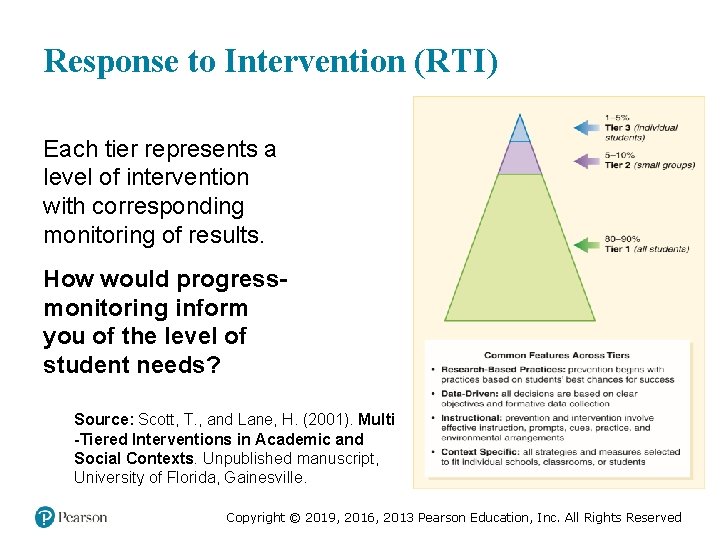
Response to Intervention (RTI) Each tier represents a level of intervention with corresponding monitoring of results. How would progressmonitoring inform you of the level of student needs? Source: Scott, T. , and Lane, H. (2001). Multi -Tiered Interventions in Academic and Social Contexts. Unpublished manuscript, University of Florida, Gainesville. Copyright © 2019, 2016, 2013 Pearson Education, Inc. All Rights Reserved
Research Proven Strategies for Tier 2 & 3 Students (1 of 2) Explicit strategy instruction • Assess student to know what to target • Model the strategy and self instructive prompts for student to use through the model • Teacher-led explanations highlight critical connection building and meaning making. Concrete, Semi-Concrete, Abstract (CSA) Sequence • Concrete representations - Working with manipulatives • Semi-concrete - Drawings or pictures • Abstract - Using numbers and symbols Copyright © 2019, 2016, 2013 Pearson Education, Inc. All Rights Reserved
Research Proven Strategies for Tier 2 & 3 Students (2 of 2) Peer-Assisted Learning • Students learn best when placed in the role of apprentice working with peer or “expert” (ZPD) • Uses “as-needed” versus explicit strategy model Think-Alouds • Teacher verbalizes the thinking process steps from student starting point • Teacher identifies the reasoning by asking questions as they move through the process Copyright © 2019, 2016, 2013 Pearson Education, Inc. All Rights Reserved
Teaching and Assessing Students with Learning Disabilities (1 of 3) Structure the environment • Centralize attention - Face student and remove competing stimuli • Avoid confusion - Word directions carefully and specifically • Create smooth transitions - Limit off-task time Identify and Remove Potential Barriers • Help students remember - Memory aids (Mnemonic devices, songs, etc. ) • Provide vocabulary and concept support • Vary task size Copyright © 2019, 2016, 2013 Pearson Education, Inc. All Rights Reserved
Teaching and Assessing Students with Learning Disabilities (2 of 3) Provide clarity • Repeat the timeframe - Repeat reminders of time left. • Ask students to share their thinking - Think-alouds or thinkpair-share. • Emphasize connections - Provide visual representations. • Adapt delivery mode - Use materials, images and examples. • Support organization of written work - Tools and templates • Provide examples and nonexamples. Copyright © 2019, 2016, 2013 Pearson Education, Inc. All Rights Reserved
Teaching and Assessing Students with Learning Disabilities (3 of 3) Consider alternative assessments • Propose alternative products - Verbal response scribed by someone else or electronically. • Encourage self-monitoring and self-assessment. • Consider feedback charts - Monitoring their growth. Emphasize practice and summary • Consolidate ideas - Study guides for review. • Provide extra practice - Carefully selected problems to use with manipulatives. Copyright © 2019, 2016, 2013 Pearson Education, Inc. All Rights Reserved
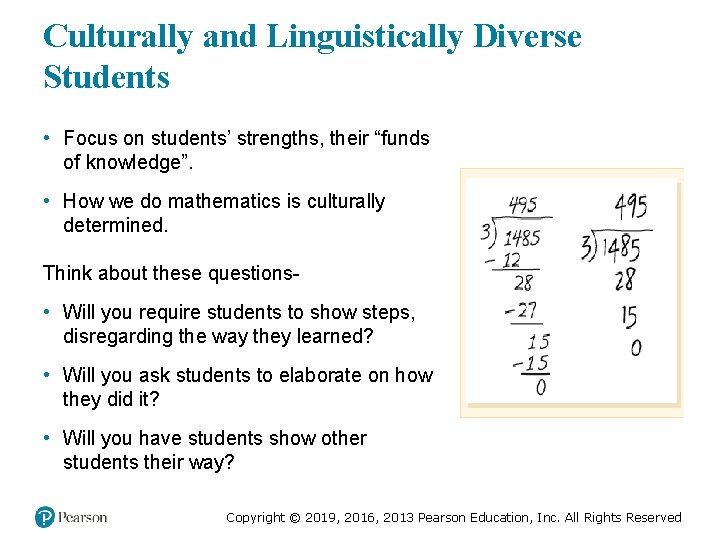
Culturally and Linguistically Diverse Students • Focus on students’ strengths, their “funds of knowledge”. • How we do mathematics is culturally determined. Think about these questions- • Will you require students to show steps, disregarding the way they learned? • Will you ask students to elaborate on how they did it? • Will you have students show other students their way? Copyright © 2019, 2016, 2013 Pearson Education, Inc. All Rights Reserved
Culturally Responsive Instruction • Stay focused on standardsbased mathematics. • Make content relevant. 1. Is mathematics presented meaningfully, and is it connected to other content? 2. Is mathematics presented so that it connects to authentic situations in their lives? • Attend to students’ mathematical identities by: 1. Assigning competence 2. Sharing personal stories puts a face on mathematical contributions 3. Ensure shared power and value students’ ideas and thinking Copyright © 2019, 2016, 2013 Pearson Education, Inc. All Rights Reserved
Teaching Strategies That Support Culturally and Linguistically Diverse Students (1 of 2) Focus on Academic Vocabulary • Encourage students to work together and discuss problems in their native language. • Utilize dual objectives in language and mathematics. • Intentional vocabulary instruction must be part of instruction. E LLs do not use mathematical vocabulary in their everyday lives. i. e. Personal math dictionaries – Link concepts, terms with drawings or clip art. Copyright © 2019, 2016, 2013 Pearson Education, Inc. All Rights Reserved
Teaching Strategies That Support Culturally and Linguistically Diverse Students (2 of 2) Focus on Student Participation during Instruction: • Building background knowledge involves considering native language and culture as well as content. • Comprehensible input means that the message the teacher is communicating is understandable. • Engage students in discourse that reflects language needs, i. e. , revoicing with gestures and visuals. • Plan cooperative/interdependent groups to support language development. Copyright © 2019, 2016, 2013 Pearson Education, Inc. All Rights Reserved
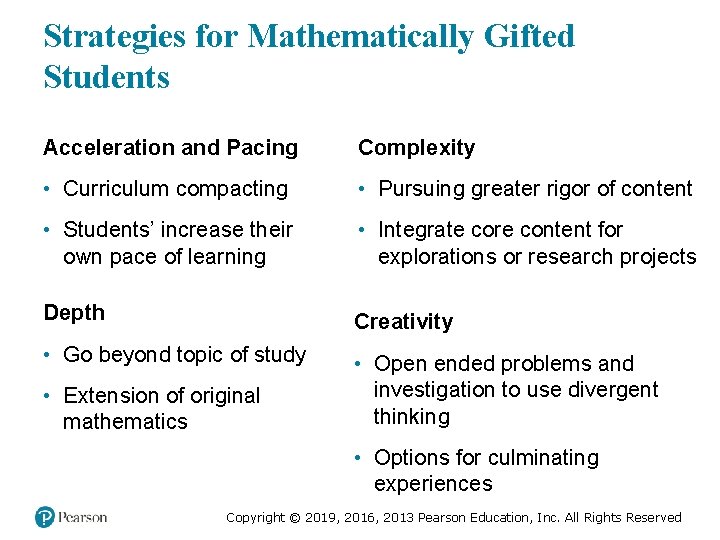
Strategies for Mathematically Gifted Students Acceleration and Pacing Complexity • Curriculum compacting • Pursuing greater rigor of content • Students’ increase their own pace of learning • Integrate core content for explorations or research projects Depth Creativity • Go beyond topic of study • Open ended problems and investigation to use divergent thinking • Extension of original mathematics • Options for culminating experiences Copyright © 2019, 2016, 2013 Pearson Education, Inc. All Rights Reserved
Reducing Resistance and Building Resilience 1. Give students choices that capitalize on their unique strengths. 2. Nurture traits of resilience. 3. Make mathematics irresistible. 4. Give students leadership in their own learning. Copyright © 2019, 2016, 2013 Pearson Education, Inc. All Rights Reserved