
Elemental Cycle The circular flow of elements from

- Slides: 36
Elemental Cycle • The circular flow of elements – from living organisms to nonliving matter • All elements making up living tissue – all have elemental cycles • Two important elemental cycles – carbon – nitrogen © 2009 Delmar, Cengage Learning
Carbon Cycle • Carbons atoms cycle between – living organisms • most abundant element in living organisms – the atmosphere – the oceans – the soil © 2009 Delmar, Cengage Learning
Carbon Cycle • Carbon enters living organisms through photosynthesis – takes carbon dioxide (CO 2) from atmosphere – using light, turns CO 2 into sugars – sugars used to form plant tissue • roots, stems, leaves © 2009 Delmar, Cengage Learning
Carbon Cycle • Carbon in plant material can enter animals – Animals consume plants • Respiration by plants and animals – returns CO 2 to atmosphere • Plants and animals die – decay and release CO 2 as gas – may form fossil fuels © 2009 Delmar, Cengage Learning
Carbon Cycle • Carbon dioxide returns to atmosphere – through respiration – through decay of plants and animals – by burning fossil fuels • Living organisms die and are converted to fossil fuels © 2009 Delmar, Cengage Learning
Carbon Cycle • Oceans absorb and release CO 2 – high atmospheric carbon content: • Oceans absorb CO 2 – low atmospheric carbon content: • Oceans release CO 2 to atmosphere • Oceans have maintained carbon content – Carbon in atmosphere remains fairly constant © 2009 Delmar, Cengage Learning
Carbon Cycle and Global Warming • Carbon content of atmosphere has been rising – Burning of fossil fuels has increased – Carbon content of atmosphere has increased • Studies indicate that increasing carbon content is associated with increasing global temperatures © 2009 Delmar, Cengage Learning
Cure for Global Warming? • Oceanic algae – addition of iron to seawater – stimulates algae growth – growth takes carbon dioxide from atmosphere • Scientists debate where CO 2 goes next – bottom of the ocean or back to atmosphere? © 2009 Delmar, Cengage Learning
Nitrogen Cycle • Nitrogen cycles – from nitrogen gas in atmosphere – to nitrates in soil – back to atmosphere as nitrogen gas © 2009 Delmar, Cengage Learning
Nitrogen Cycle • Nitrogen makes up 80 percent of air – most abundant element in atmosphere – must be combined with oxygen before it can be used by organisms © 2009 Delmar, Cengage Learning
Nitrogen Cycle • Nitrogen fixation – Nitrogen gas converted to nitrates • Nitrogen fixation can occur several ways – bacteria – industrial processes – lightning and decay © 2009 Delmar, Cengage Learning
Nitrogen Cycle • Nitrogen fixation – bacteria • capable of converting nitrogen to nitrates © 2009 Delmar, Cengage Learning
Nitrogen Cycle • Nitrogen-fixing bacteria found in – soil – roots of some plants • capable of making own nitrogen fertilizer © 2009 Delmar, Cengage Learning
Nitrogen Cycle • Nitrogen fixation – industrial processes • • converts nitrogen gas to nitrates nitrogen first converted to ammonia then converted to nitrates used to make fertilizers © 2009 Delmar, Cengage Learning
Nitrogen Cycle • Nitrogen fixation – lightning • electrical current passes through nitrogen • converts nitrogen gas to useable compounds – decay • nitrates released by decaying wastes • also released from decaying organisms © 2009 Delmar, Cengage Learning
Nitrogen Cycle • Denitrification – nitrates are broken down – returns nitrogen gas to atmosphere • Accomplished by – some bacteria • Nitrates in runoff enter surface water © 2009 Delmar, Cengage Learning
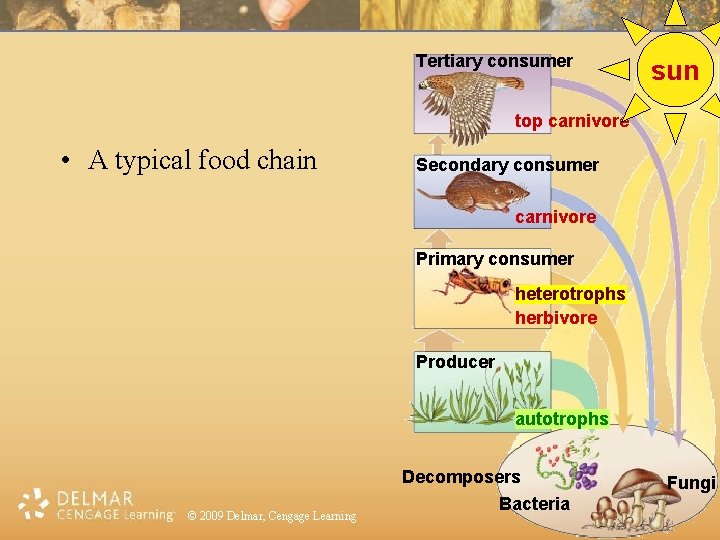
Energy Flow • Ecologists represent energy flow with food chain – Sequence of organisms that eat and are eaten – Starts with producers © 2009 Delmar, Cengage Learning
Energy Flow – Producers eaten by herbivores • also called primary consumers © 2009 Delmar, Cengage Learning
Energy Flow • Ecologists represent energy flow with food chain – Herbivores eaten by carnivores • meat-eating organisms • also called secondary consumers © 2009 Delmar, Cengage Learning
Energy Flow – Decomposers • final stop in the food chain • break down tissues of other organisms © 2009 Delmar, Cengage Learning
Tertiary consumer sun top carnivore • A typical food chain Secondary consumer carnivore Primary consumer heterotrophs herbivore Producer autotrophs © 2009 Delmar, Cengage Learning Decomposers Bacteria Fungi
Energy Flow • Food chain in ecosystems more complex – Usually many food chains are interwoven • Forms food webs – Many food chains linked together • Also forms a food pyramid – arranges organisms in a ranking order – rank related to dominance in food web © 2009 Delmar, Cengage Learning
Ecosystem Change • Human intervention may change food chains – Human activity may displace some organisms – Many times, top predators are removed © 2009 Delmar, Cengage Learning
Ecosystem Change • Some organisms cannot adapt to human presence – decline in number – replaced by organisms that tolerate humans © 2009 Delmar, Cengage Learning
Biological Succession • Always occurring – Environments are rarely stable • always changing • Two types – primary – secondary © 2009 Delmar, Cengage Learning
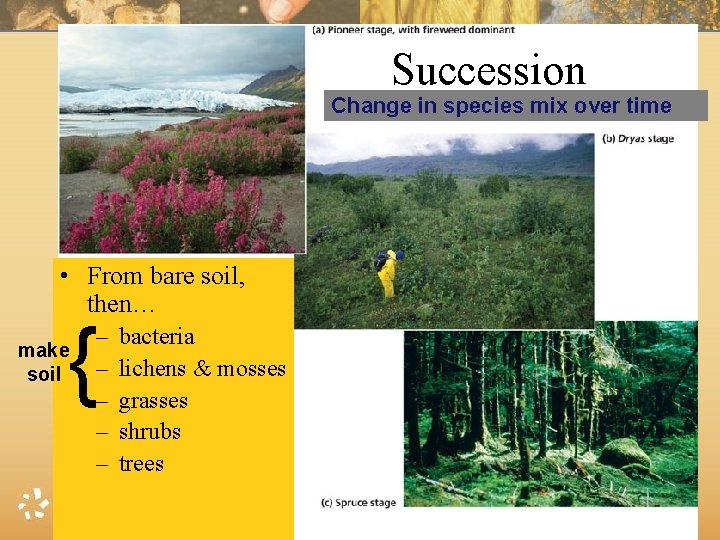
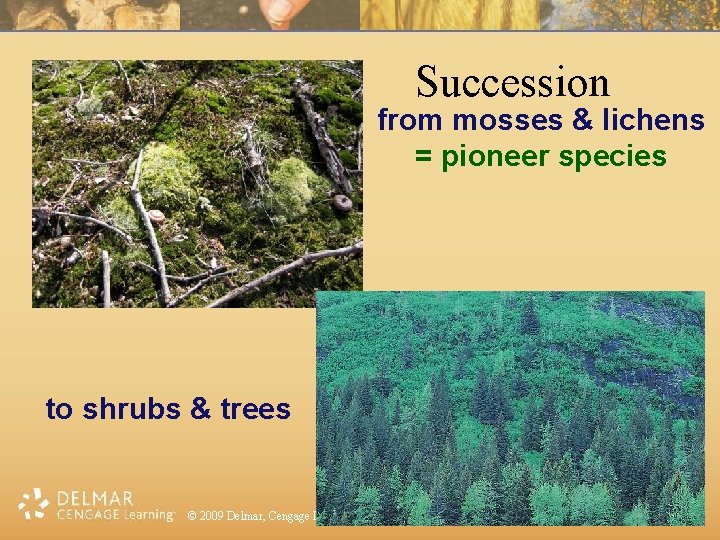
Biological Succession • Primary succession – occurs where no organisms existed before – cooled lava is an example • Over time, lichen and fungi appear • Pioneer species: first organisms growing in new environment • Soil begins to develop and plants appear © 2009 Delmar, Cengage Learning
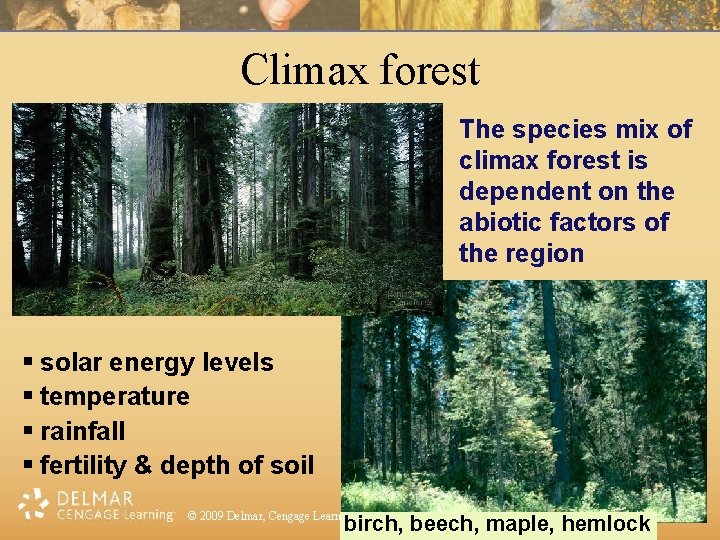
Biological Succession – Climax community • plants that occupy environment when succession complete © 2009 Delmar, Cengage Learning
Biological Succession • Secondary succession – occurs when ecosystem is damaged – forest fire is an example • ecosystem changed by fire • supports organisms from earlier stage in succession © 2009 Delmar, Cengage Learning
Biological Succession • Change that occurs in an environment – One kind of organism replaces another • Also called ecological succession – two forms • primary • secondary © 2009 Delmar, Cengage Learning
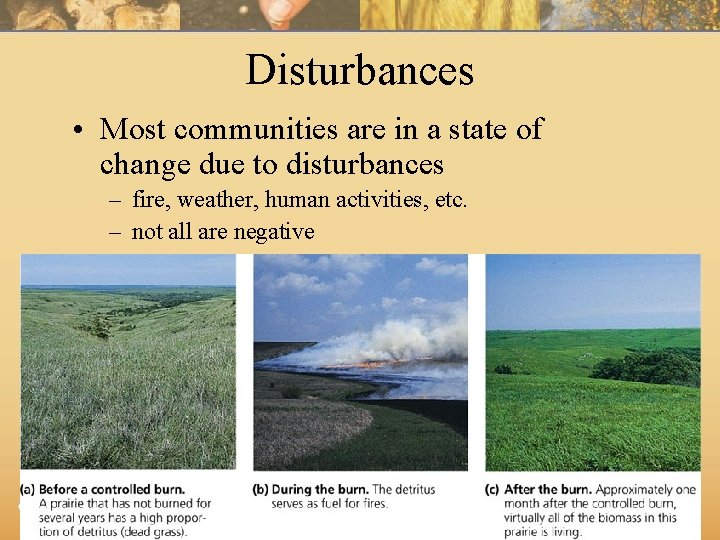
Disturbances • Most communities are in a state of change due to disturbances – fire, weather, human activities, etc. – not all are negative © 2009 Delmar, Cengage Learning
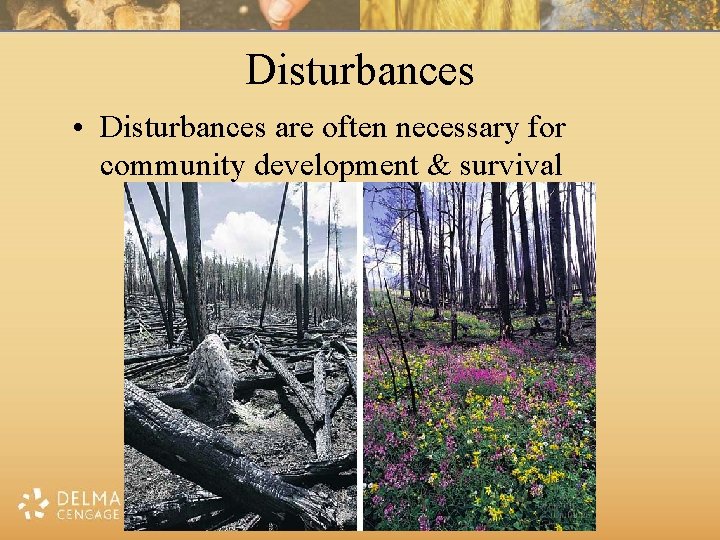
Disturbances • Disturbances are often necessary for community development & survival © 2009 Delmar, Cengage Learning
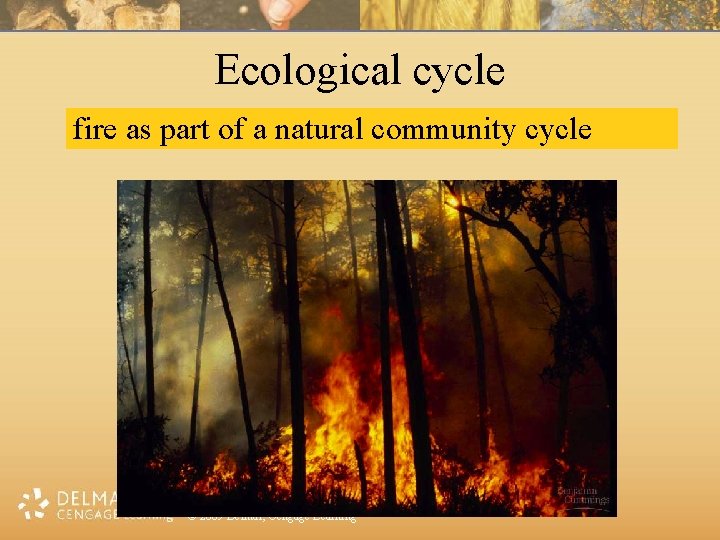
Ecological cycle fire as part of a natural community cycle © 2009 Delmar, Cengage Learning
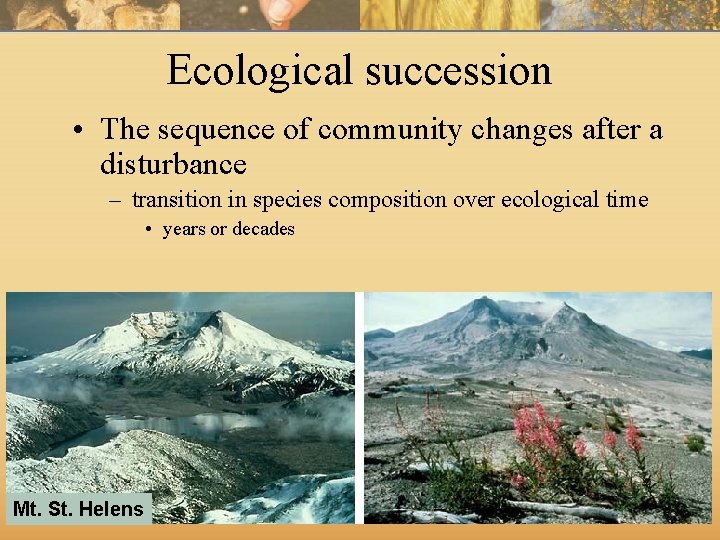
Ecological succession • The sequence of community changes after a disturbance – transition in species composition over ecological time • years or decades Mt. St. Helens © 2009 Delmar, Cengage Learning
Succession Change in species mix over time • From bare soil, then… { make soil – – – bacteria lichens & mosses grasses shrubs trees © 2009 Delmar, Cengage Learning
Succession from mosses & lichens = pioneer species to shrubs & trees © 2009 Delmar, Cengage Learning
Climax forest The species mix of climax forest is dependent on the abiotic factors of the region § solar energy levels § temperature § rainfall § fertility & depth of soil © 2009 Delmar, Cengage Learning birch, beech, maple, hemlock