
Electrotherapy Overview Farley Brown Product Manager Recovery SciencesChattanooga

Electrotherapy Overview Farley Brown Product Manager. Recovery Sciences/Chattanooga Line ©DJO Incorporated 1

Electrotherapy objectives § § § § Introduction (historical) Indications / Contraindications Physiological response to current Electrodes Waveforms Pain Management Muscle strengthening (NMES) Conclusion ©DJO Incorporated

Introduction • Cavemen rub amber fur and utilize charges. • 46 AD torpedo fish to treat Gout and Headaches. • Late 1700’s • Galvani stimulates frog muscle with electrical charge of metal. • Current practices? ©DJO Incorporated
Indications for Electrotherapy § Relatively short list of indications provides multiple dynamic treatment opportunities § –Pain control § –Enhance muscle recruitment § –Retard muscle atrophy § –Muscle strengthening § –Stimulate motor(re)learning § –Edema management § –Transdermal drug delivery ©DJO Incorporated
Contraindications for Electrotherapy ©DJO Incorporated § *Cardiac pacemaker § Cardioverter defibrillator § Over the carotid sinus/anterior transcervical area § Over heart transthoracic area § Over the abdominal, lowback and pelvic area during pregnancy § Areas of venous or arterial thrombosis § Thrombophlebitis § Neoplasm § Superficial metal (e. g. staples, pins, external fixators) § Patients prone to seizures § Transcerebral stimulation § Pain of unknown etiology
Concepts to understand § Electrical circuits involve 3 basic components : ü Voltage ü Current ü Resistance ©DJO Incorporated
Ohm’s law § Current flow (intensity/amplitude) changes with changing resistance § Ohm’s law (I=V/R) governs relationship between intensity and resistance § Clinical implications ©DJO Incorporated
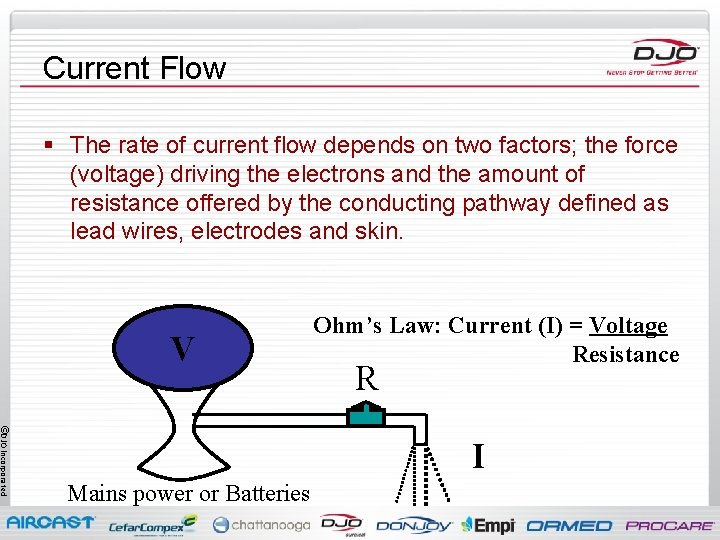
Current Flow § The rate of current flow depends on two factors; the force (voltage) driving the electrons and the amount of resistance offered by the conducting pathway defined as lead wires, electrodes and skin. V Ohm’s Law: Current (I) = Voltage Resistance R ©DJO Incorporated I Mains power or Batteries
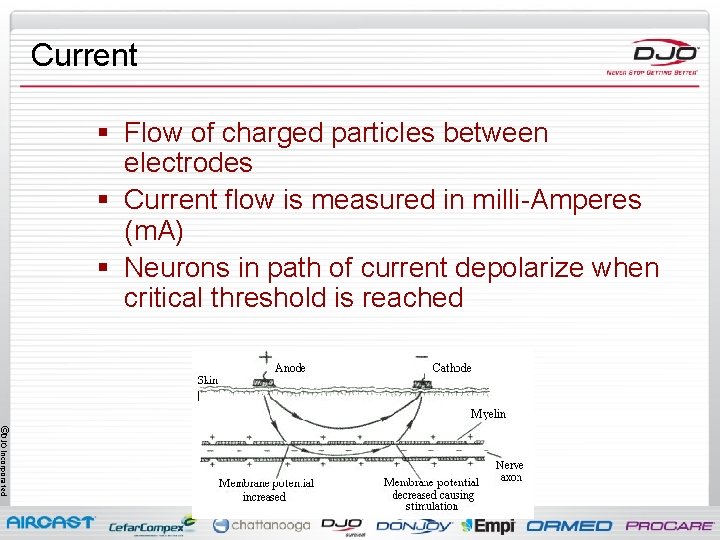
Current § Flow of charged particles between electrodes § Current flow is measured in milli-Amperes (m. A) § Neurons in path of current depolarize when critical threshold is reached ©DJO Incorporated
Current intensity ( increasing amplitude) § Increase the depth of penetration § Increase the number of neuroreceptors & depolarize both superficial and deep. § Amplitude should be adjusted to produce a desired physiologic response. § Physiologic response is the key, do not focus on the number of milliamps…………. § PATIENT TOLERANCE!! ©DJO Incorporated
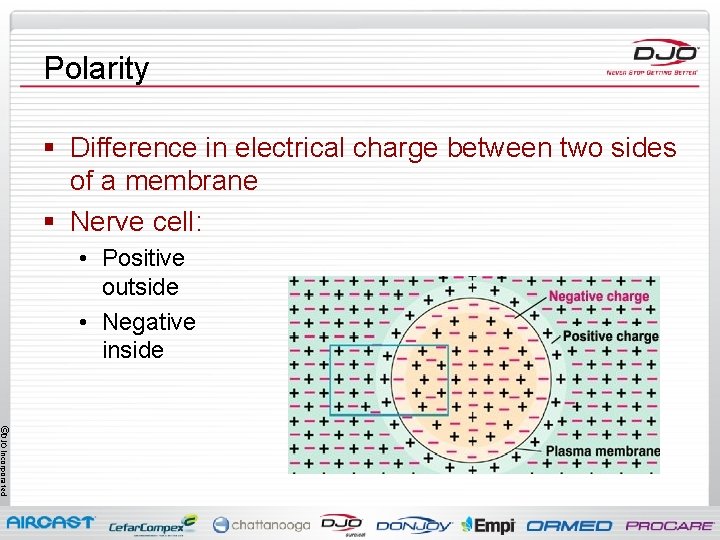
Polarity § Difference in electrical charge between two sides of a membrane § Nerve cell: • Positive outside • Negative inside ©DJO Incorporated
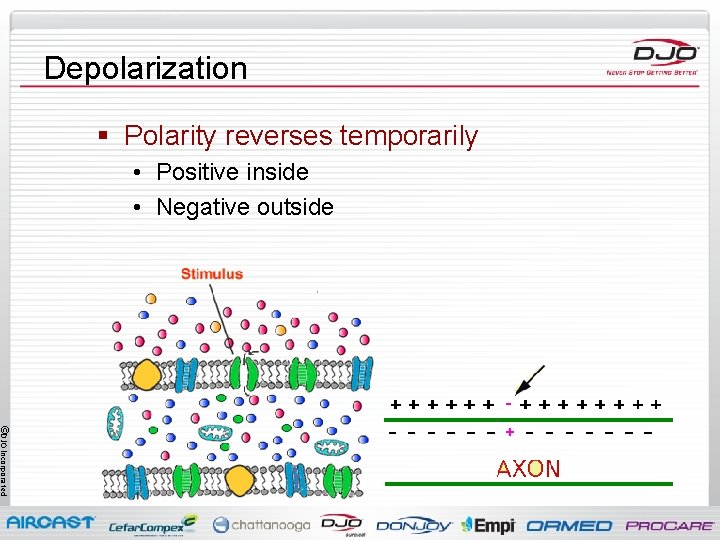
Depolarization § Polarity reverses temporarily • Positive inside • Negative outside ©DJO Incorporated
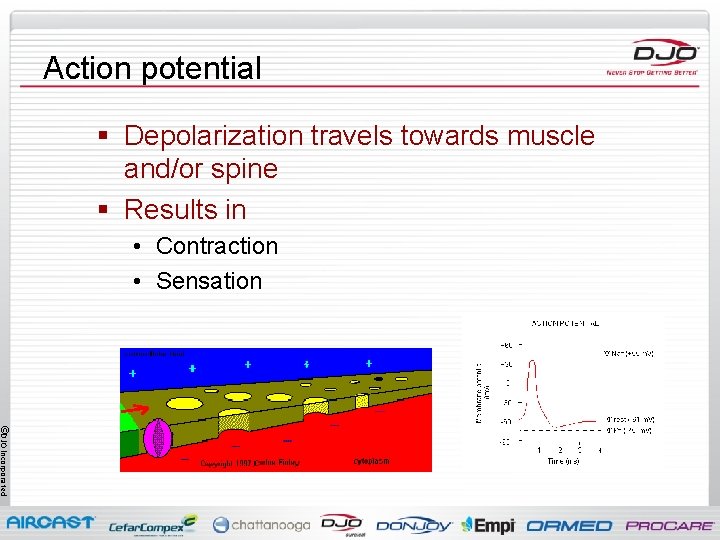
Action potential § Depolarization travels towards muscle and/or spine § Results in • Contraction • Sensation ©DJO Incorporated
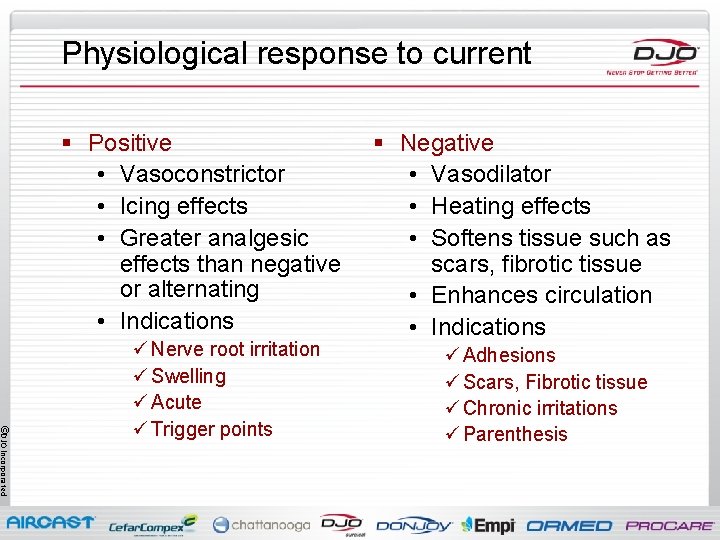
Physiological response to current § Positive • Vasoconstrictor • Icing effects • Greater analgesic effects than negative or alternating • Indications ©DJO Incorporated ü Nerve root irritation ü Swelling ü Acute ü Trigger points § Negative • Vasodilator • Heating effects • Softens tissue such as scars, fibrotic tissue • Enhances circulation • Indications ü Adhesions ü Scars, Fibrotic tissue ü Chronic irritations ü Parenthesis
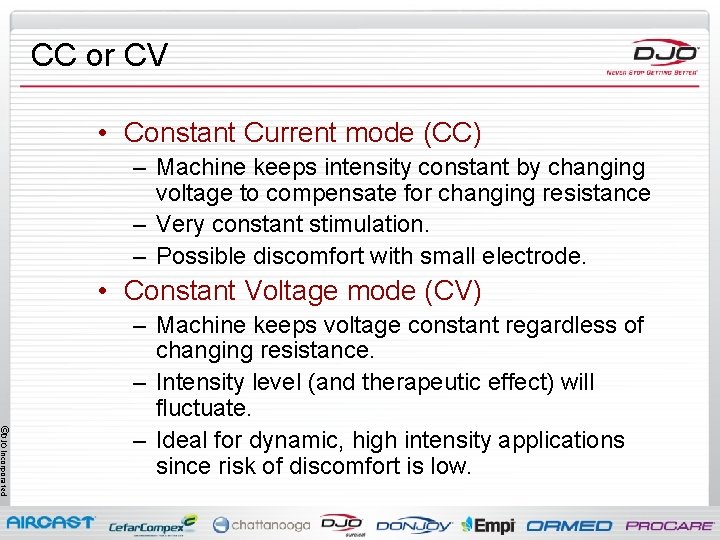
CC or CV • Constant Current mode (CC) – Machine keeps intensity constant by changing voltage to compensate for changing resistance – Very constant stimulation. – Possible discomfort with small electrode. • Constant Voltage mode (CV) ©DJO Incorporated – Machine keeps voltage constant regardless of changing resistance. – Intensity level (and therapeutic effect) will fluctuate. – Ideal for dynamic, high intensity applications since risk of discomfort is low.

Review of Electrotherapy Currents ©DJO Incorporated Pulsed Current Alternating Current (AC) Direct Current (DC)
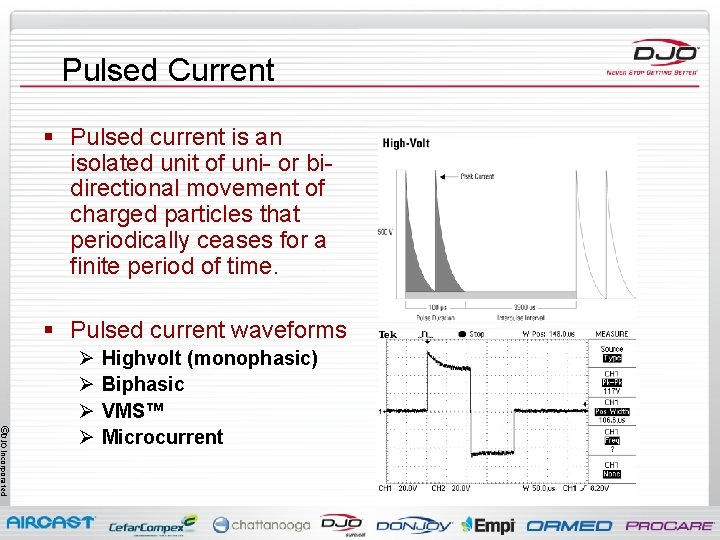
Pulsed Current § Pulsed current is an isolated unit of uni- or bidirectional movement of charged particles that periodically ceases for a finite period of time. § Pulsed current waveforms ©DJO Incorporated Ø Ø Highvolt (monophasic) Biphasic VMS™ Microcurrent
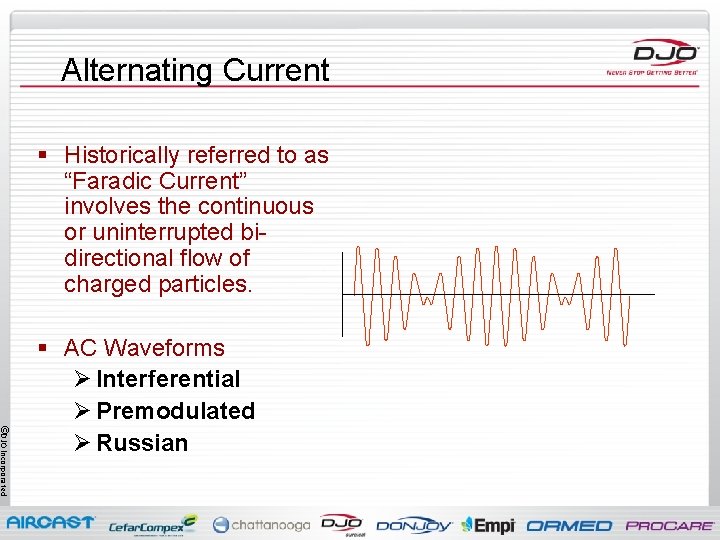
Alternating Current § Historically referred to as “Faradic Current” involves the continuous or uninterrupted bidirectional flow of charged particles. ©DJO Incorporated § AC Waveforms Ø Interferential Ø Premodulated Ø Russian
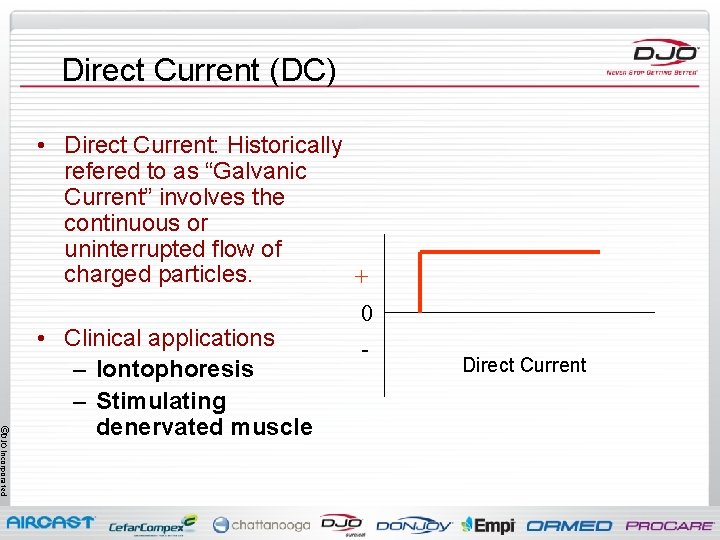
Direct Current (DC) ©DJO Incorporated • Direct Current: Historically refered to as “Galvanic Current” involves the continuous or uninterrupted flow of charged particles. + 0 • Clinical applications – Iontophoresis – Stimulating denervated muscle Direct Current
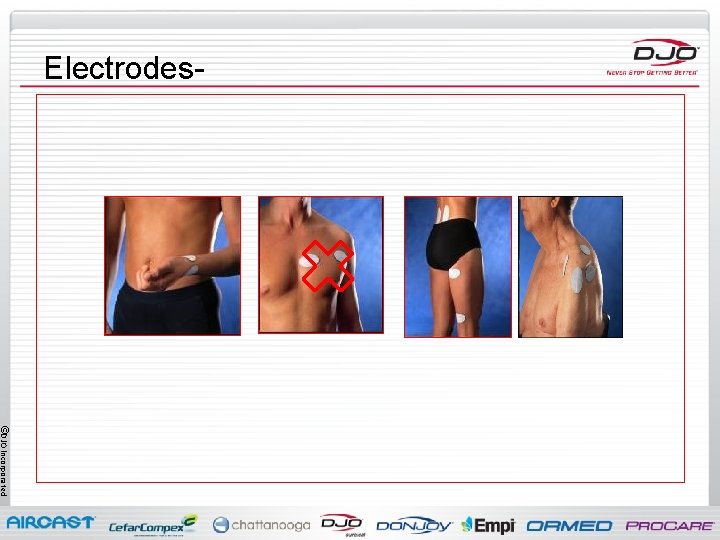
Electrodes- ©DJO Incorporated
Electrode issues § Common reason that clinicians & patients get a negative impression of electrotherapy. § Considerations: § The correct size electrode for the job! § Identifying when the electrode is spent! § Firm fixation. § Keeping a complete inventory. ©DJO Incorporated
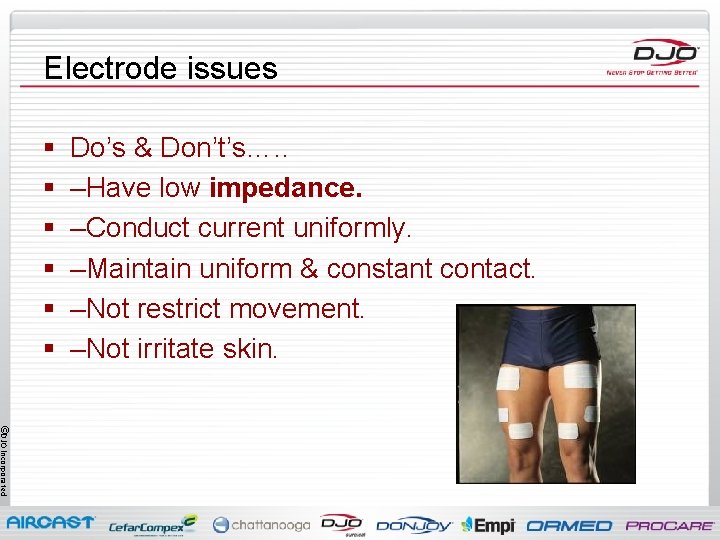
Electrode issues § § § Do’s & Don’t’s…. . –Have low impedance. –Conduct current uniformly. –Maintain uniform & constant contact. –Not restrict movement. –Not irritate skin. ©DJO Incorporated
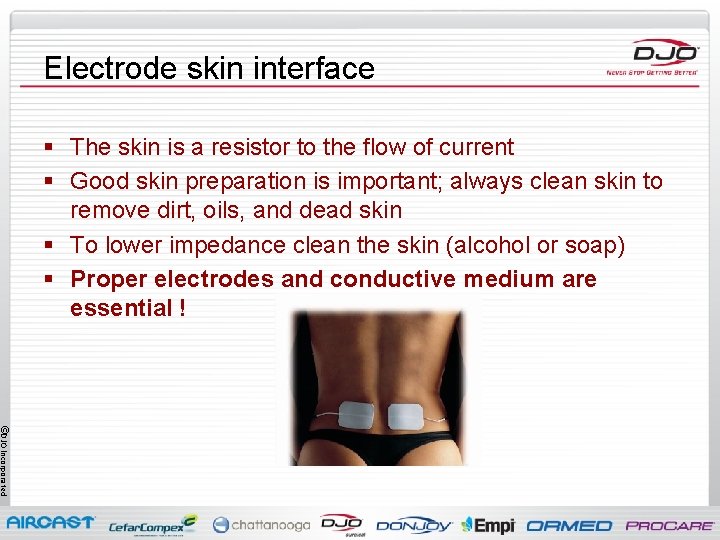
Electrode skin interface § The skin is a resistor to the flow of current § Good skin preparation is important; always clean skin to remove dirt, oils, and dead skin § To lower impedance clean the skin (alcohol or soap) § Proper electrodes and conductive medium are essential ! ©DJO Incorporated
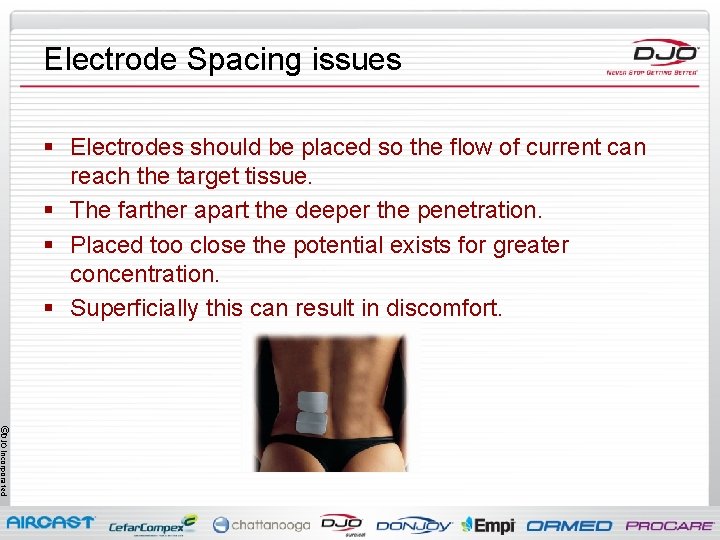
Electrode Spacing issues § Electrodes should be placed so the flow of current can reach the target tissue. § The farther apart the deeper the penetration. § Placed too close the potential exists for greater concentration. § Superficially this can result in discomfort. ©DJO Incorporated
Choosing the appropriate electrodes Small electrode Large electrode § § § Large electrode (ex: 4 x 5 inches) § Decreases current density. § Recruits more motor units § More comfortable. § Better for targeting larger areas. (ex: 2 x 2 inches) Increases current density Recruits fewer motor units. More “uncomfortable” Better for targeting small areas. ©DJO Incorporated
Waveforms ©DJO Incorporated § § § § Interferential Premodulated Russian Biphasic “VMS” High Volt Pulsed current Microcurrent Direct current
Which waveform do I choose? § Concept: “the waveform is not the treatment” § We use waveforms to deliver a specific electrotherapy intervention (e. g. sensory level electro-analgesia) § Always choose treatment first then choose suitable waveform. ©DJO Incorporated
Interferential Current § Marketing made IFC very popular in Europe since 50’ies, in USA since 80’s. § High carrier frequency allows deeper and more comfortable penetration. § Low modulation frequency produces low frequency effect in targeted tissue. ©DJO Incorporated
Interferential Quad-Polar § Alternating Current § Amplitude modulated medium-frequency current (2, 000 -5, 000 Hz) § Uses two channels of differing carrier frequencies to create a “beat” frequency within the tissues. § Scan -amplitude modulation § Sweep -frequency modulation ©DJO Incorporated
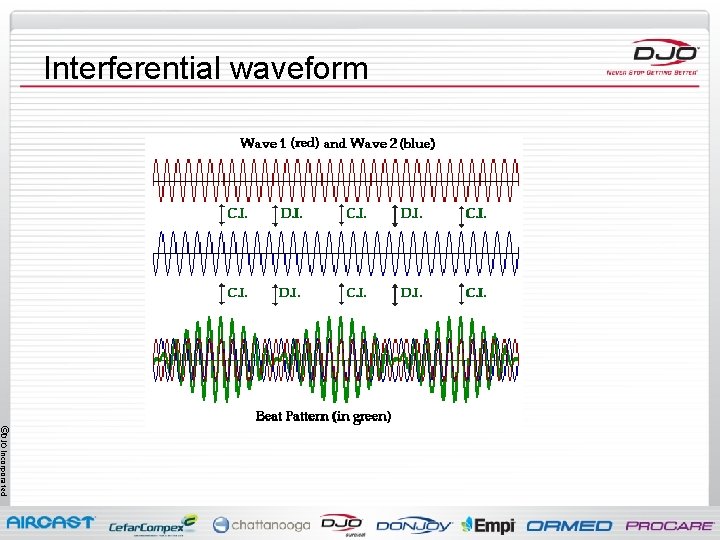
Interferential waveform ©DJO Incorporated
Interferencial clinical benefits § • Comfortable § • Targeting hard to reach tissues (e. g. subscapularis) § • Indication: Pain modulation § –Acute pain § –Chronic pain § Acute or chronic pain ©DJO Incorporated
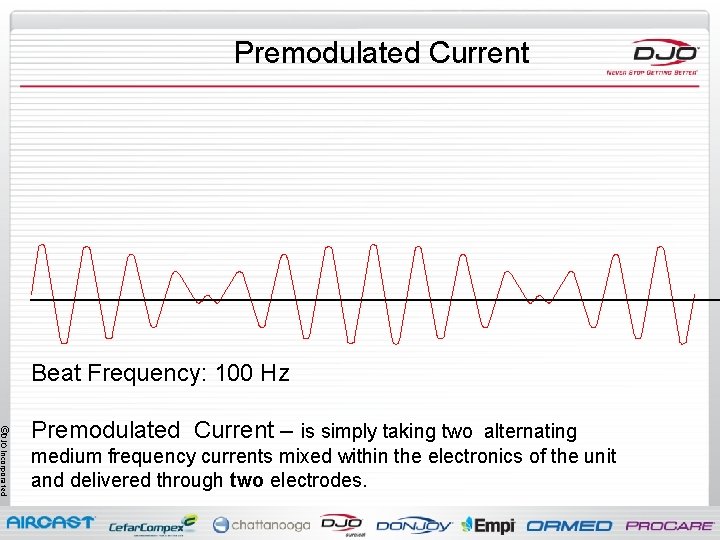
Premodulated Current Beat Frequency: 100 Hz ©DJO Incorporated Premodulated Current – is simply taking two alternating medium frequency currents mixed within the electronics of the unit and delivered through two electrodes.
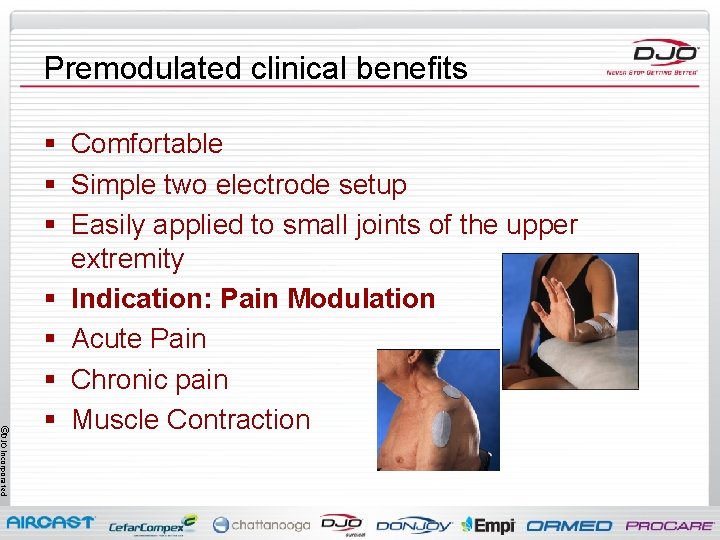
Premodulated clinical benefits ©DJO Incorporated § Comfortable § Simple two electrode setup § Easily applied to small joints of the upper extremity § Indication: Pain Modulation § Acute Pain § Chronic pain § Muscle Contraction
Russian Stimulation § Compared to other waveforms. § Tissue reacts to each burst as if it were a single pulse. § Muscle strengthening effects not better than pulsed current. § Stimulation not more comfortable, actually less comfortable at high intensities. § Literature support. § Muscle strengthening: Yes § Pain inhibition: good case report literature. ©DJO Incorporated
Biphasic. § Most frequently used waveform § When used for pain inhibition: TENS (Transcutaneous Electrical Nerve Stimulation) § When used for muscle strengthening: NMES (Neuromuscular Electrical Nerve Stimulation) § Versatility depends on pulse characteristics. ©DJO Incorporated
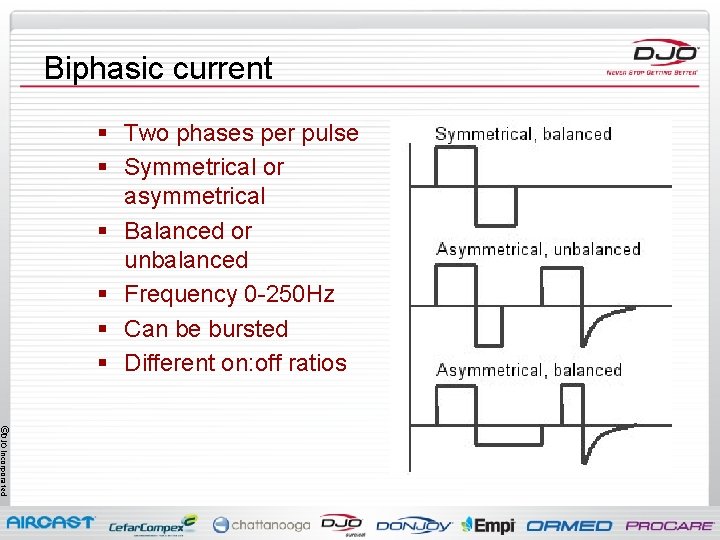
Biphasic current § Two phases per pulse § Symmetrical or asymmetrical § Balanced or unbalanced § Frequency 0 -250 Hz § Can be bursted § Different on: off ratios ©DJO Incorporated
Biphasic current-most versatile § Suitable for high intensity and/or long term applications § Abundance of equipment available § Literature support § Edema management: Yes § Stimulation of circulation: Yes § Muscle strengthening: Yes § Pain control: Yes ©DJO Incorporated
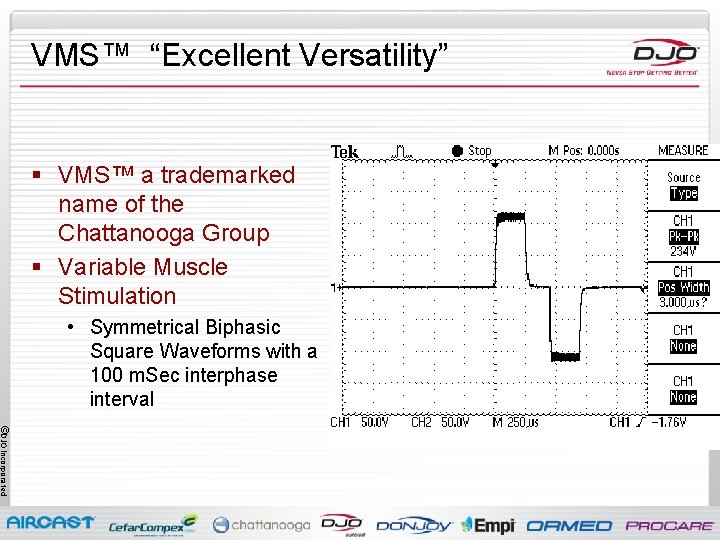
VMS™ “Excellent Versatility” § VMS™ a trademarked name of the Chattanooga Group § Variable Muscle Stimulation • Symmetrical Biphasic Square Waveforms with a 100 m. Sec interphase interval ©DJO Incorporated
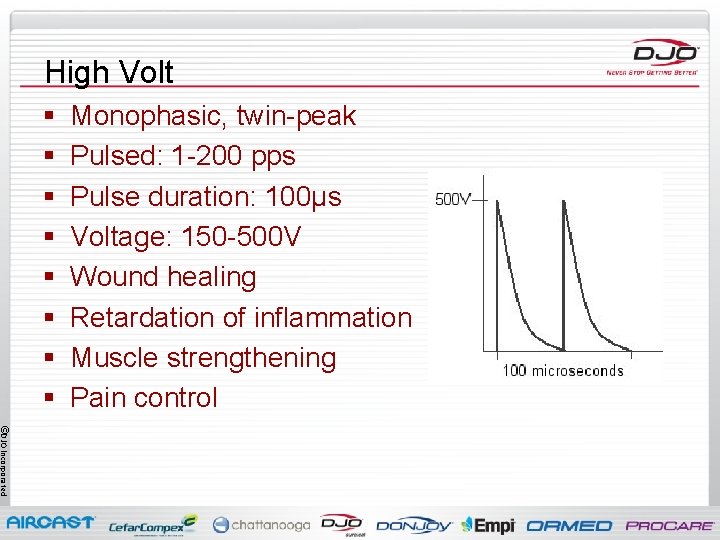
High Volt § § § § Monophasic, twin-peak Pulsed: 1 -200 pps Pulse duration: 100μs Voltage: 150 -500 V Wound healing Retardation of inflammation Muscle strengthening Pain control ©DJO Incorporated
Low Voltage § So, What is a Low Voltage Waveform? ? § Short answer = any Waveform that is not high volt § “Low Volt” uses longer pulse durations, hence require less peak voltage (↓ 150 V)1 § Example: Biphasic current ©DJO Incorporated
Direct Current § First accounts of medical use of electrical currents go back hundreds of years. § Unidirectional nature provides electromotive force that can move electrically charged particles. § Primary use is iontophoresis. § Has polarizing effect on tissue…. Skin damage may result if not dosed properly. ©DJO Incorporated
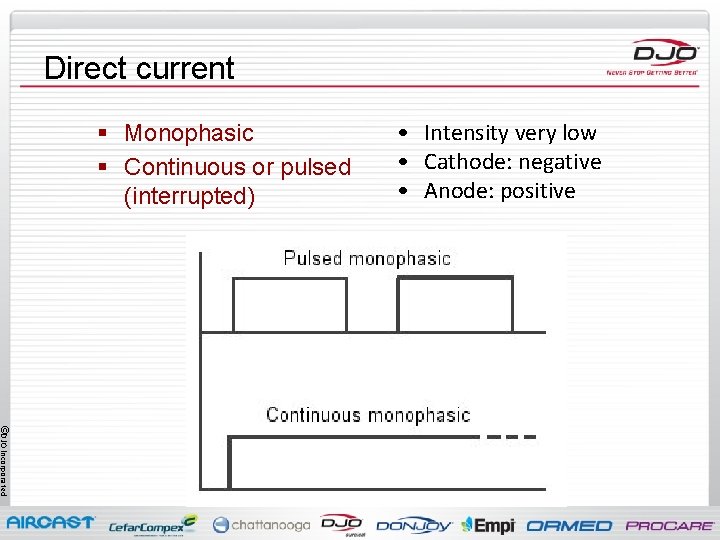
Direct current § Monophasic § Continuous or pulsed (interrupted) • Intensity very low • Cathode: negative • Anode: positive ©DJO Incorporated
Direct current § § § Iontophoresis: Active electrode of same polarity as medications. Dispersive electrode proximal to it and larger. EMS (deinnervated muscle): Equal size electrodes on either side of muscle belly. Polarizing effect under electrodes. ©DJO Incorporated
Pain and types of : § Nociceptive – dull ache or pressure caused by injury or disease outside the nervous system (cancer or arthritis) § Neuropathic – burning or stabbing damage to nerve tissue (pinched nerve). § “Pain is the last thing to show but the first thing to go”! ©DJO Incorporated
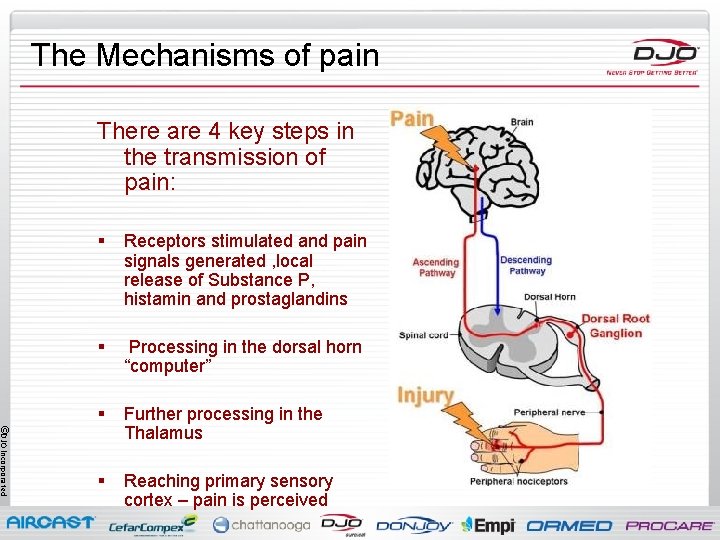
The Mechanisms of pain There are 4 key steps in the transmission of pain: ©DJO Incorporated § Receptors stimulated and pain signals generated , local release of Substance P, histamin and prostaglandins § Processing in the dorsal horn “computer” § Further processing in the Thalamus § Reaching primary sensory cortex – pain is perceived
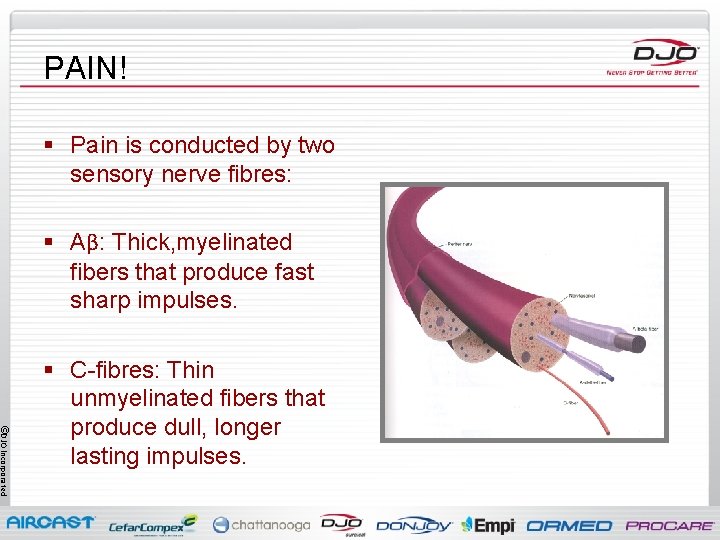
PAIN! § Pain is conducted by two sensory nerve fibres: § Aβ: Thick, myelinated fibers that produce fast sharp impulses. ©DJO Incorporated § C-fibres: Thin unmyelinated fibers that produce dull, longer lasting impulses.
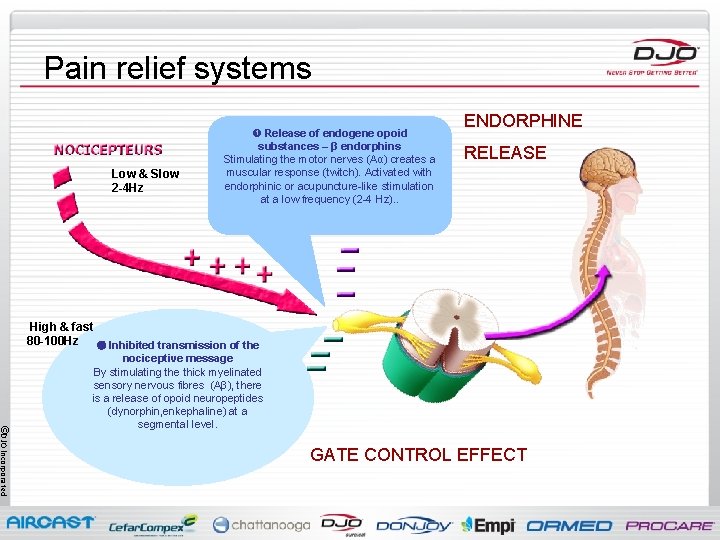
Pain relief systems Low & Slow 2 -4 Hz Release of endogene opoid substances – β endorphins Stimulating the motor nerves (Aα) creates a muscular response (twitch). Activated with endorphinic or acupuncture-like stimulation at a low frequency (2 -4 Hz). . ENDORPHINE RELEASE High & fast 80 -100 Hz Inhibited transmission of the ©DJO Incorporated nociceptive message By stimulating the thick myelinated sensory nervous fibres (Aβ), there is a release of opoid neuropeptides (dynorphin, enkephaline) at a segmental level. GATE CONTROL EFFECT
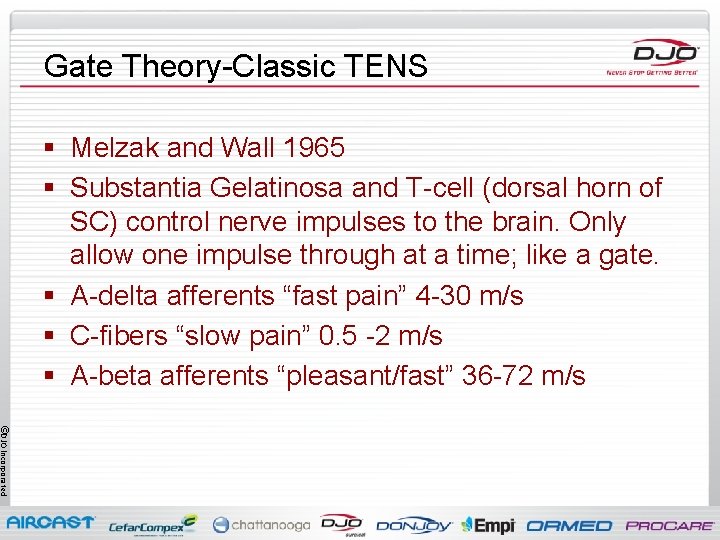
Gate Theory-Classic TENS § Melzak and Wall 1965 § Substantia Gelatinosa and T-cell (dorsal horn of SC) control nerve impulses to the brain. Only allow one impulse through at a time; like a gate. § A-delta afferents “fast pain” 4 -30 m/s § C-fibers “slow pain” 0. 5 -2 m/s § A-beta afferents “pleasant/fast” 36 -72 m/s ©DJO Incorporated
Muscle Strengthening (NMES) ©DJO Incorporated § § § § § Two broad approaches using electrotherapy Strengthening of static, postural strength Slow twitch fibers Enhance endurance Improve joint stability Strengthening of explosive strength Fast twitch fibers Increase speed of contraction Increase bulk strength
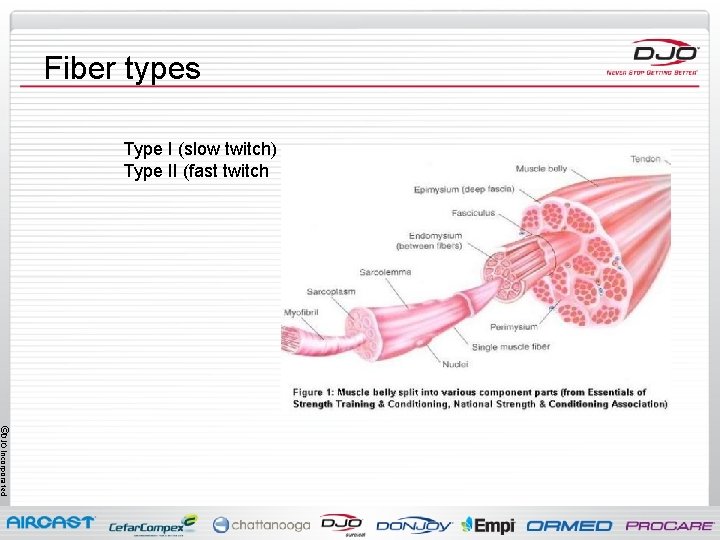
Fiber types Type I (slow twitch) Type II (fast twitch ©DJO Incorporated
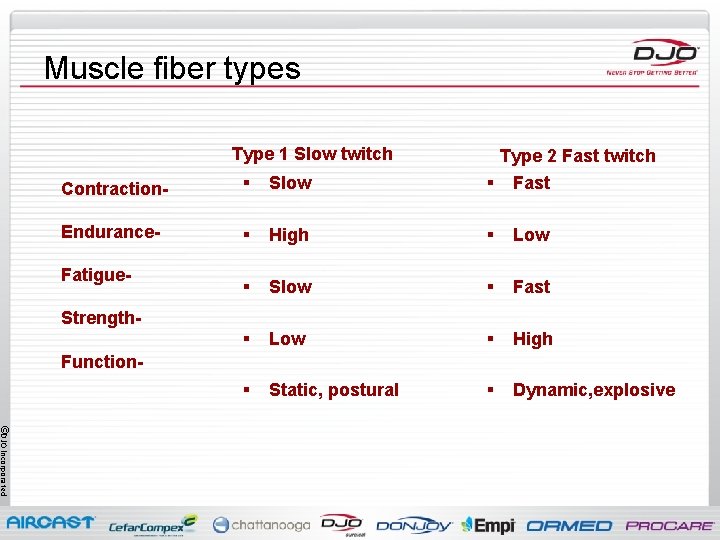
Muscle fiber types Type 1 Slow twitch Contraction- § Slow Type 2 Fast twitch § Fast Endurance- § High § Low § Slow § Fast § Low § High § Static, postural § Dynamic, explosive Fatigue. Strength. Function- ©DJO Incorporated
Muscle fiber recruitment order § During a normal muscle contraction muscle fibers are recruited according to the ‘size principle’. § Small type I muscle fibers recruited first. § Large Type II fibers recruited later when the effort increases. ©DJO Incorporated
Treatment guidelines § Voluntary exercise should occur simultaneously to electrical stimulation. § Contraction should be in functional patterns. § Maximal evoked contractions to facilitate explosive strength. § Sub-maximal evoked contractions to facilitate postural strength. ©DJO Incorporated
Slow twitch protocol ©DJO Incorporated § § § § § Target neurons: Thin: slow-twitch motor Waveform: Symmetrical Biphasic Frequency: 35 Hz Frequency mod. : No Duty cycle: 1: 1 (10 sec on, 10 sec off) Time: ½-1 hour (or even more!) Intensity: Sub-maximal motor Pulse duration: 300μs Current mode: CC • Electrode location: Over belly of target muscle

Conclusion & questions § Farley Brown Product Director Recovery Sciences / Chattanooga Line Farley. Brown@DJOGlobal. com 949 -338 -7959 ©DJO Incorporated
- Slides: 55