
Electrotechnology N 3 Chapter 1 Direct current machines
- Slides: 63
Electrotechnology N 3
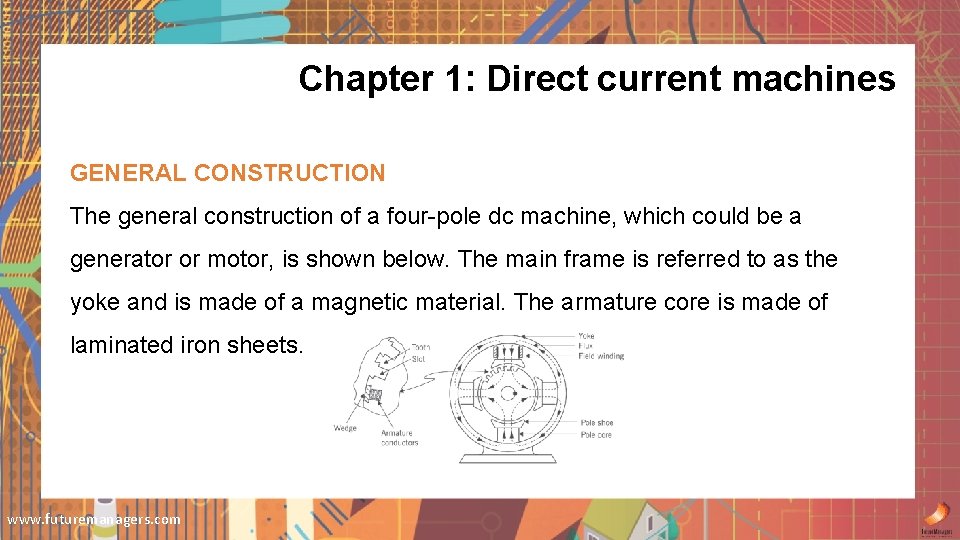
Chapter 1: Direct current machines GENERAL CONSTRUCTION The general construction of a four-pole dc machine, which could be a generator or motor, is shown below. The main frame is referred to as the yoke and is made of a magnetic material. The armature core is made of laminated iron sheets. www. futuremanagers. com
Chapter 1: Direct current machines (continued) ARMATURE WINDINGS In general, armature windings can be divided into two groups, depending on the manner in which the windings (coils) are connected to the commutator. The two groups are: • Lap windings; and • Wave windings. www. futuremanagers. com
Chapter 1: Direct current machines (continued) ARMATURE REACTION Armature reaction is the distortion of the main flux entering and leaving the armature, caused by the flux set up by armature conductors when they carry current. www. futuremanagers. com
Chapter 1: Direct current machines (continued) COMMUTATION Commutation is the reversal of the emf and current in the short-circuited coil during its transfer from one commutator segment to the next. www. futuremanagers. com
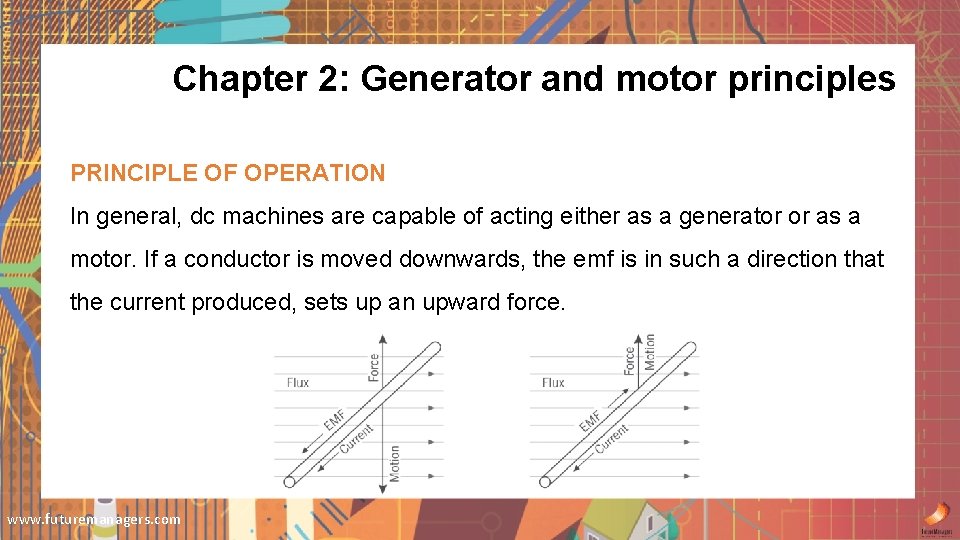
Chapter 2: Generator and motor principles PRINCIPLE OF OPERATION In general, dc machines are capable of acting either as a generator or as a motor. If a conductor is moved downwards, the emf is in such a direction that the current produced, sets up an upward force. www. futuremanagers. com
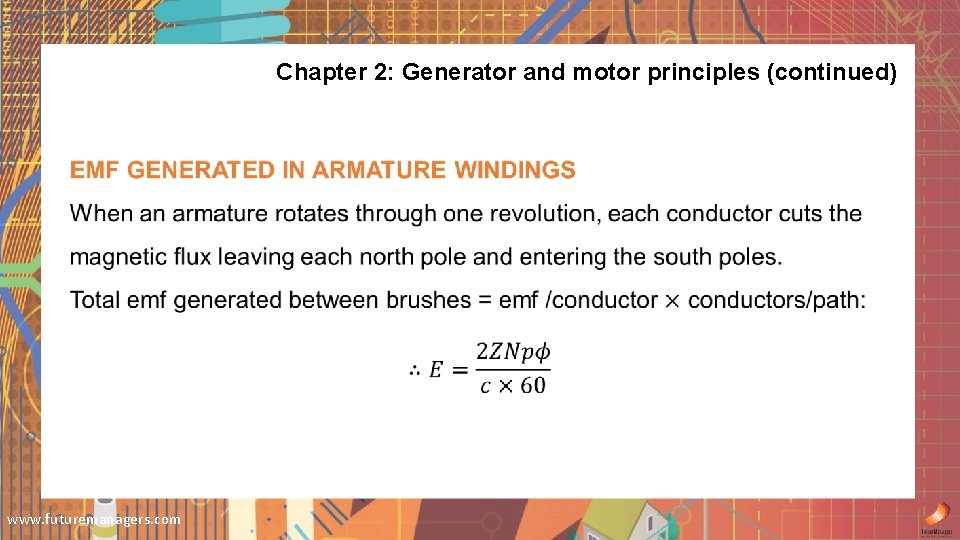
Chapter 2: Generator and motor principles (continued) www. futuremanagers. com
Chapter 3: Direct current generators SEPERATELY EXCITED GENERATOR Large dc generators are sometimes separately excited, as this allows easy control of the field current and hence of the voltage generated. The field excitation is supplied from an independent dc source such as a battery or separate dc generator. www. futuremanagers. com
Chapter 3: Direct current generators (continued) SHUNT GENERATOR The shunt generator may be used for supplying excitation to ac generators or in other applications where the distance from the generator to its load, is short. It is also used for charging batteries. www. futuremanagers. com
Chapter 3: Direct current generators (continued) www. futuremanagers. com
Chapter 3: Direct current generators (continued) COMPOUND GENERATOR A generator which has both a series and a shunt field winding, is called a compound generator. Compound generators are used more extensively than other types of generators because they may be designed to have a wide variety of characteristics. Over-compounded generators are commonly used in generating stations that are some distance from the loads that they supply. www. futuremanagers. com
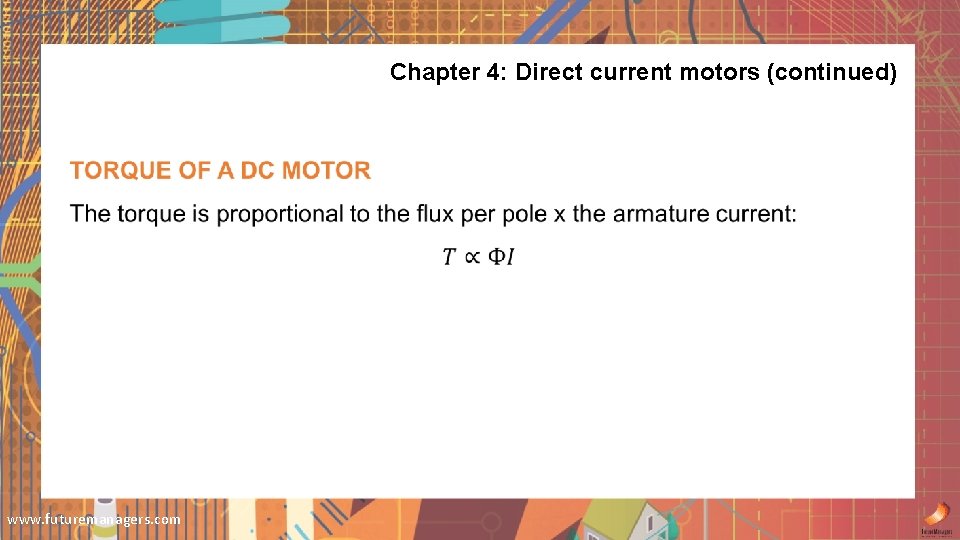
Chapter 4: Direct current motors THE DC MACHINE AS A MOTOR If a dc machine is supplied with electrical energy from an external source, the forces set up owing to the current in the armature conductors, cause the armature to rotate and the machine acts as a motor. www. futuremanagers. com
Chapter 4: Direct current motors (continued) www. futuremanagers. com
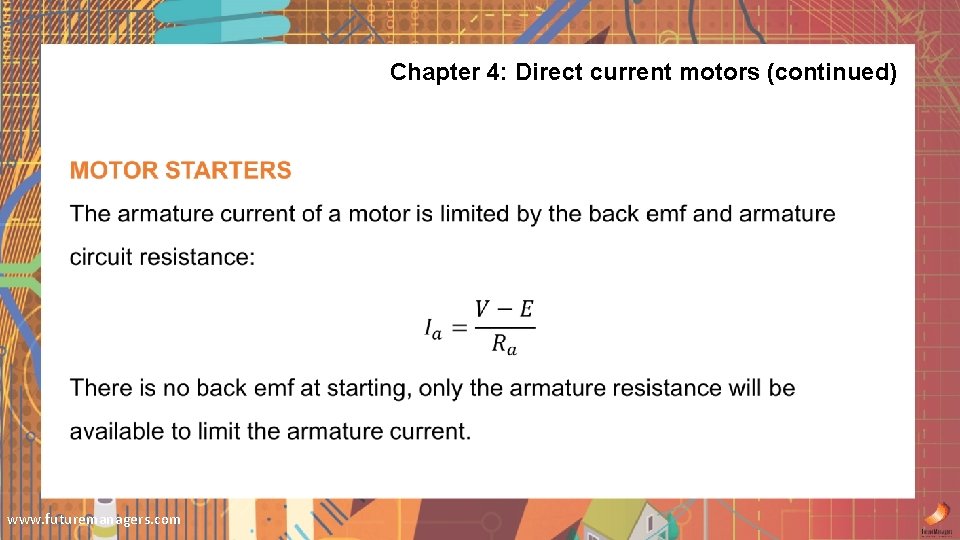
Chapter 4: Direct current motors (continued) EFFECT OF A LOAD A motor is loaded when it overcomes a torque opposing its motion. Assume that the supply pd is constant and, for simplicity, that the flux per pole is independent of the load. When a load is applied, the armature slows down, but as soon as it does, the back emf decreases and allows a larger armature current to flow. www. futuremanagers. com
Chapter 4: Direct current motors (continued) TYPES OF MOTORS There are: • Separately and shunt excited motors; • Series motor; and • Compound wound motors. www. futuremanagers. com
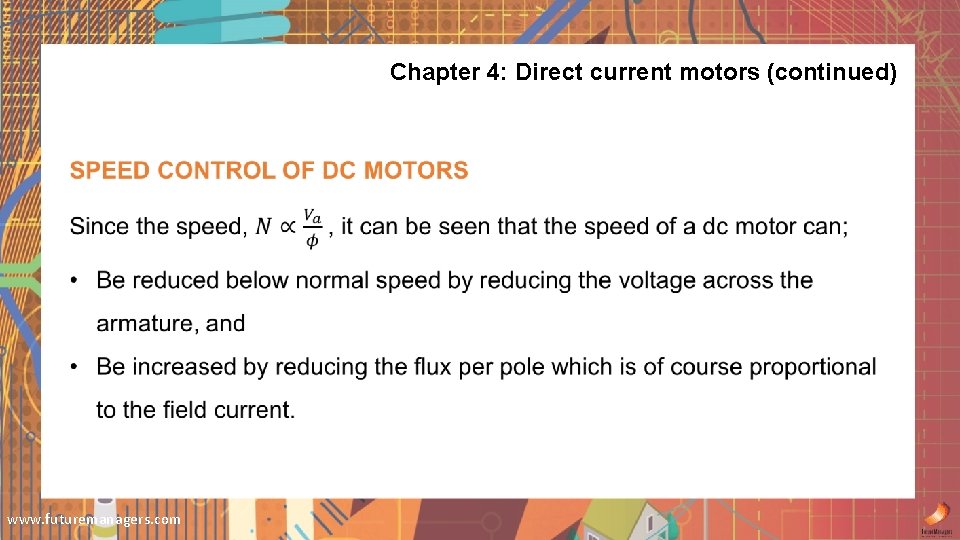
Chapter 4: Direct current motors (continued) www. futuremanagers. com
Chapter 4: Direct current motors (continued) REVERSING THE DIRECTION OF ROTATION The direction of rotation of dc motors may be changed by reversing the direction of the current through the field windings or the armature windings, but not both. If the currents through both field windings are reversed, the direction will remain the same. www. futuremanagers. com
Chapter 4: Direct current motors (continued) www. futuremanagers. com
Chapter 4: Direct current motors (continued) COMPARING DC MOTORS TO AC MOTORS - ADVANTAGES Direct current motors have the following advantages over ac motors: • Speed control over a wide range is easier and cheaper to obtain. • They can be operated directly from storage batteries as with motor vehicle starter motors, underground locomotives and battery driven vehicles. www. futuremanagers. com
Chapter 4: Direct current motors (continued) COMPARING DC MOTORS TO AC MOTORS - DISADVANTAGES Direct current motors have the following disadvantages over ac motors: • They require more care and maintenance owing to the commutator. • Their initial cost is high. • They are not as robust. www. futuremanagers. com
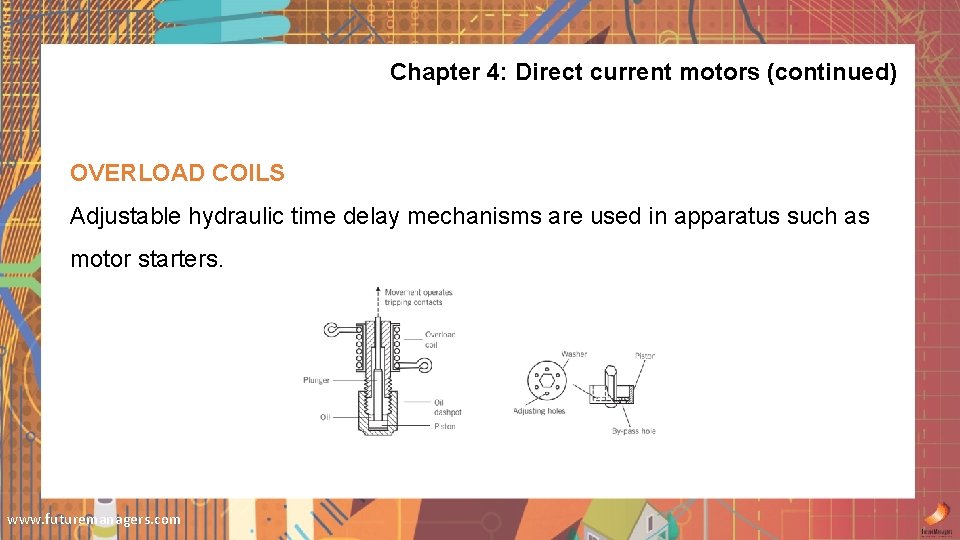
Chapter 4: Direct current motors (continued) OVERLOAD COILS Adjustable hydraulic time delay mechanisms are used in apparatus such as motor starters. www. futuremanagers. com
Chapter 5: Efficiency of DC machines LOSSES The energy losses in dc machines may, for convenience, be divided into three classes: • Electrical losses; • Iron losses; and • Mechanical losses. www. futuremanagers. com
Chapter 5: Efficiency of DC machines (continued) www. futuremanagers. com
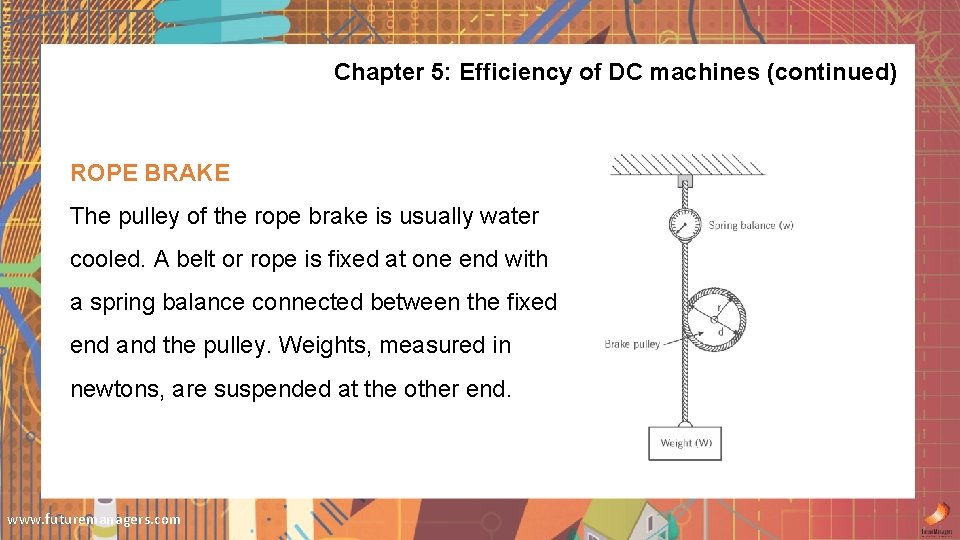
Chapter 5: Efficiency of DC machines (continued) ROPE BRAKE The pulley of the rope brake is usually water cooled. A belt or rope is fixed at one end with a spring balance connected between the fixed end and the pulley. Weights, measured in newtons, are suspended at the other end. www. futuremanagers. com
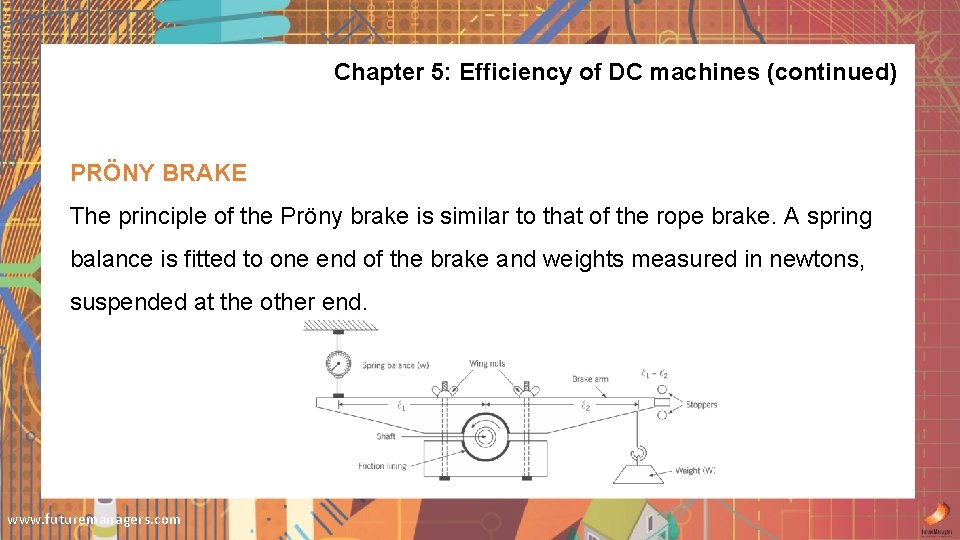
Chapter 5: Efficiency of DC machines (continued) PRÖNY BRAKE The principle of the Pröny brake is similar to that of the rope brake. A spring balance is fitted to one end of the brake and weights measured in newtons, suspended at the other end. www. futuremanagers. com
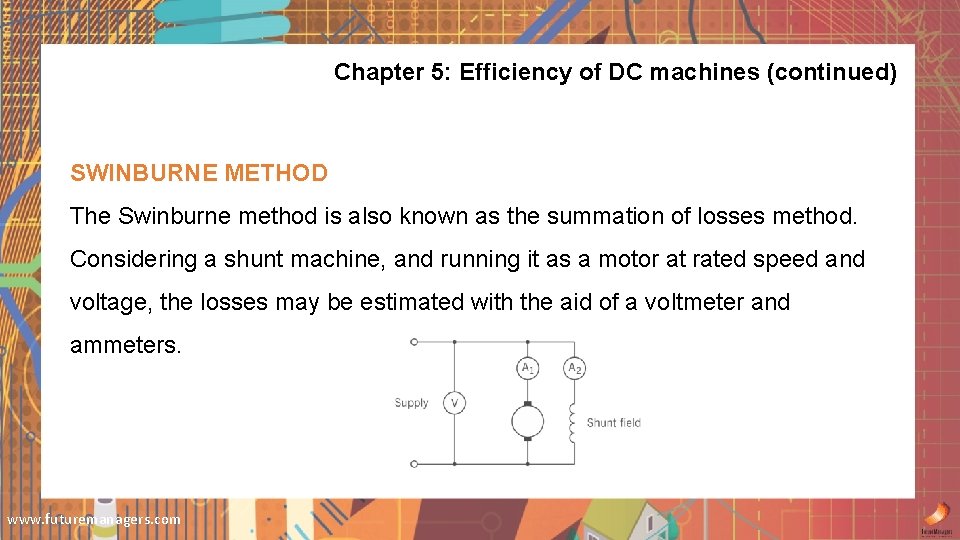
Chapter 5: Efficiency of DC machines (continued) SWINBURNE METHOD The Swinburne method is also known as the summation of losses method. Considering a shunt machine, and running it as a motor at rated speed and voltage, the losses may be estimated with the aid of a voltmeter and ammeters. www. futuremanagers. com
Chapter 5: Efficiency of DC machines (continued) HOPKINSON OR BACK-TO-BACK TEST Some form of Hopkinson test is generally used when it is necessary to test a large machine on full load. This requires a second machine of the same or approximately similar size. The two machines are coupled to each other and one is run as a motor driving the other as a shunt excited generator. www. futuremanagers. com
Chapter 6: Alternating current theory DIRECT CURRENT When a current flows in one direction only, it is known as direct current (dc). This occurs when the polarity of the power supply terminals remain the same. Primary and secondary cells and batteries as well as dc generators are common power sources for direct current. www. futuremanagers. com
Chapter 6: Alternating current theory (continued) ALTERNATING CURRENT In the case of alternating current, the current reverses its direction at a constant rate. This occurs as a result of the constant reversal of polarity at the output terminals of the power supply. www. futuremanagers. com
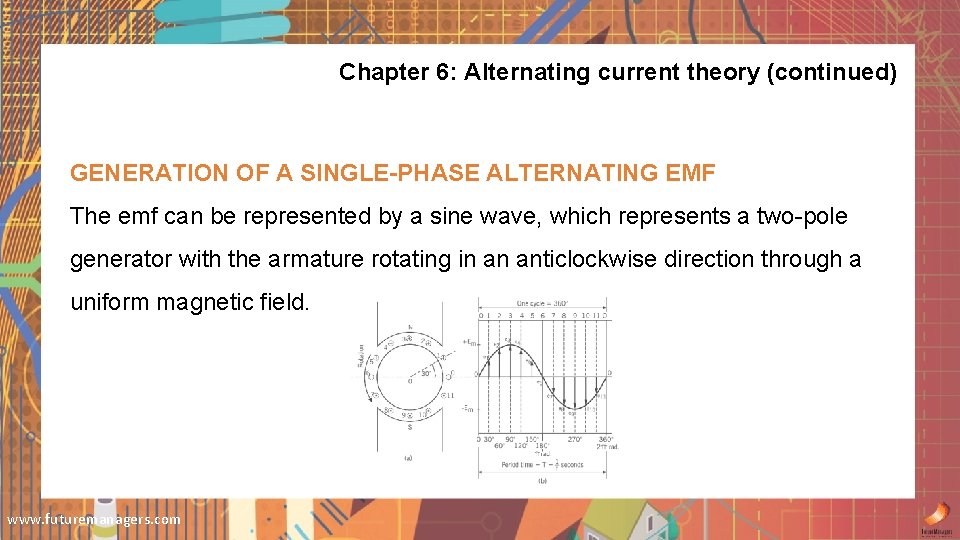
Chapter 6: Alternating current theory (continued) GENERATION OF A SINGLE-PHASE ALTERNATING EMF The emf can be represented by a sine wave, which represents a two-pole generator with the armature rotating in an anticlockwise direction through a uniform magnetic field. www. futuremanagers. com
Chapter 6: Alternating current theory (continued) AVERAGE AND EFFECTIVE VALUE OF AN ALTERNATING QUANTITY The effective (or rms) value of an alternating current. The effective value of an alternating current is that value of alternating current, which produces the same amount of heat energy, at the same rate as a direct current would, if passed through an identical resistance. www. futuremanagers. com
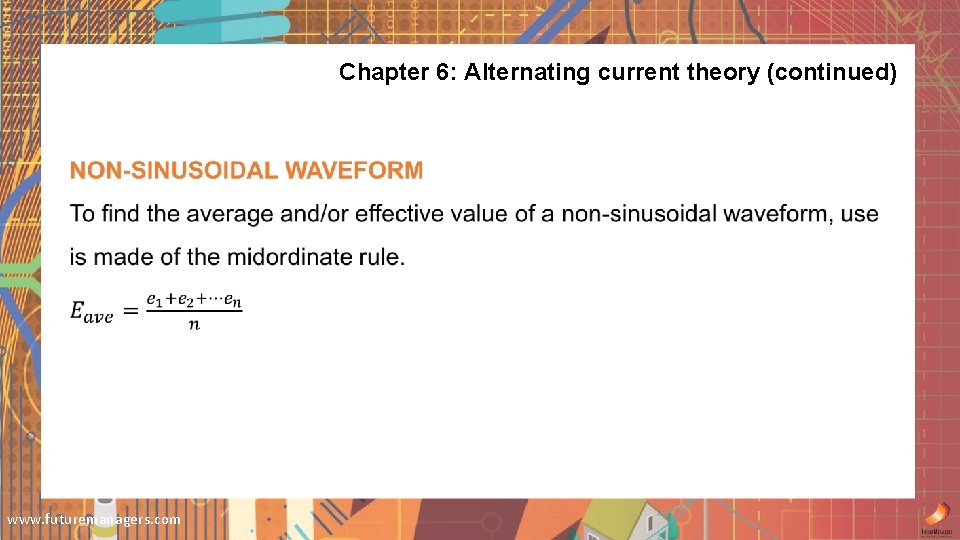
Chapter 6: Alternating current theory (continued) www. futuremanagers. com
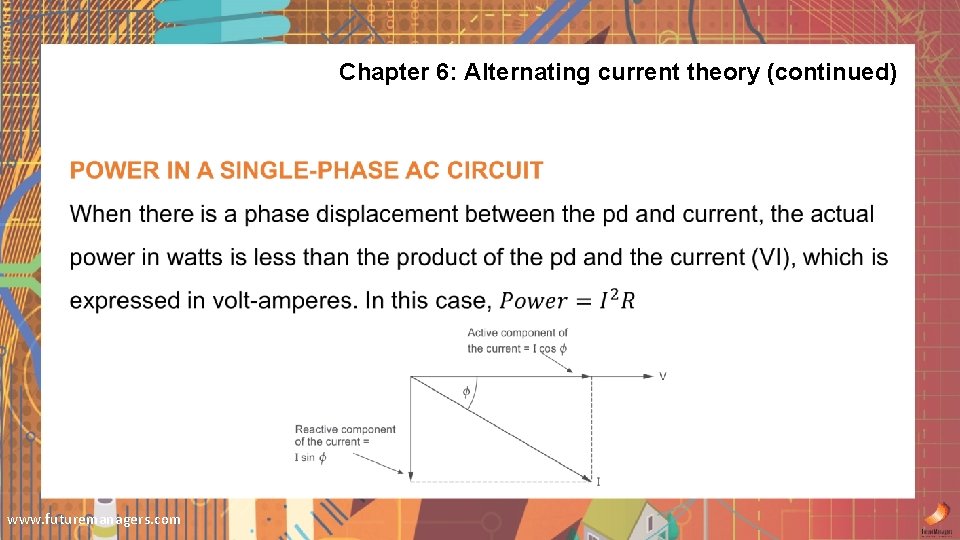
Chapter 6: Alternating current theory (continued) RESISTANCE IN AC CIRCUITS The current flowing through a pure resistor is governed by Ohm’s law for every instant of time, for every point on the cycle. This means that the current waveform for a purely resistive circuit is exactly the same shape as the waveform of the applied pd and is in phase with it. www. futuremanagers. com
Chapter 6: Alternating current theory (continued) INDUCTANCE IN AC CIRCUITS A self-induced emf is produced in an inductor, whenever the current through it changes. When an alternating current flows through a pure inductor, the value of the current is continually changing and so produces a self-induced emf at every instant. www. futuremanagers. com
Chapter 6: Alternating current theory (continued) CAPACITANCE IN AC CIRCUITS A capacitor is a device for storing electric charge. The charge on the plates is always proportional to the pd between them, thus, as this pd varies, current must flow either into or out of the capacitor in order to maintain the correct charge. The greater the rate of change of the pd, the greater the rate of change of current will be. www. futuremanagers. com
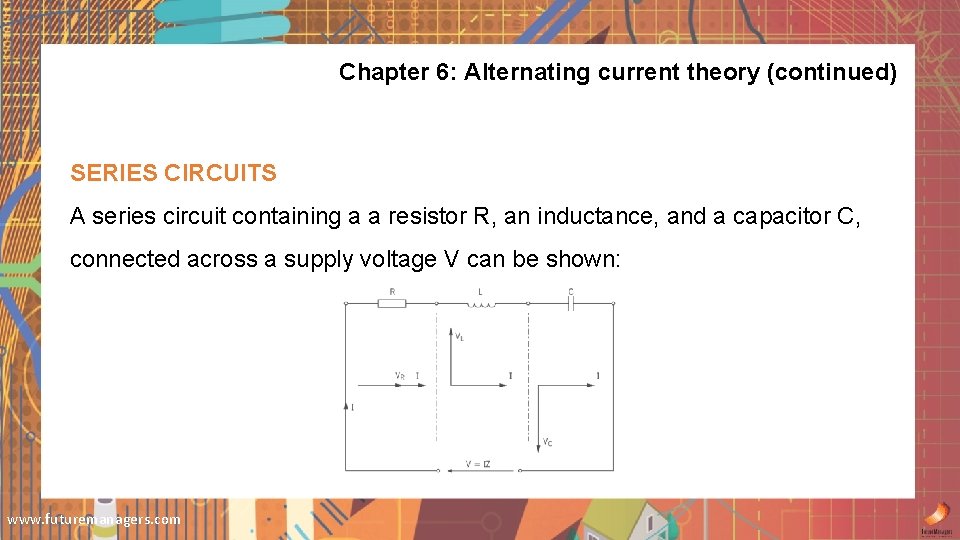
Chapter 6: Alternating current theory (continued) SERIES CIRCUITS A series circuit containing a a resistor R, an inductance, and a capacitor C, connected across a supply voltage V can be shown: www. futuremanagers. com
Chapter 6: Alternating current theory (continued) www. futuremanagers. com
Chapter 6: Alternating current theory (continued) PARALLEL CIRCUITS In a parallel circuit, the supply voltage V, will be common to all the components but the resulting current I, will be divided among the components, combine after flowing through them, and return to the supply again. www. futuremanagers. com
Chapter 6: Alternating current theory (continued) THREE-PHASE AC SYSTEMS Consider a three-phase circuit as merely a combination of three single-phase circuits. With this approach, current, voltage and power relations of balanced three-phase circuits may be studied by the application of single-phase rules to the component parts of the three-phase circuit. www. futuremanagers. com
Chapter 7: Transformers TRANSFORMERS IN GENERAL The principal elements of a transformer are; • The magnetic circuit, • The windings, • The cooling system and in larger transformers, • The oil tanks, and • Protection devices. www. futuremanagers. com
Chapter 7: Transformers (continued) LOSSES IN TRANSFORMERS The energy losses in transformers occur in the windings and the iron core. These losses appear in the form of heat and are lost in the atmosphere. www. futuremanagers. com
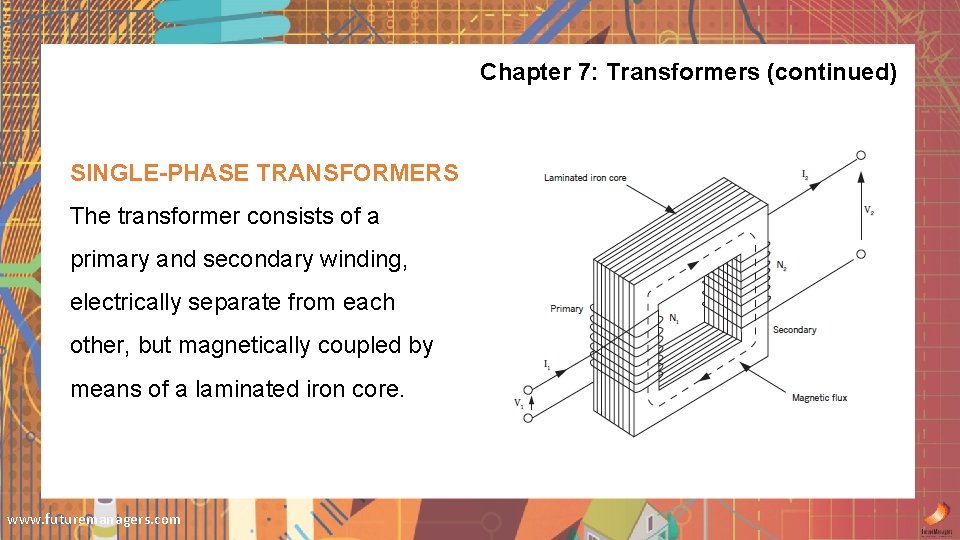
Chapter 7: Transformers (continued) SINGLE-PHASE TRANSFORMERS The transformer consists of a primary and secondary winding, electrically separate from each other, but magnetically coupled by means of a laminated iron core. www. futuremanagers. com
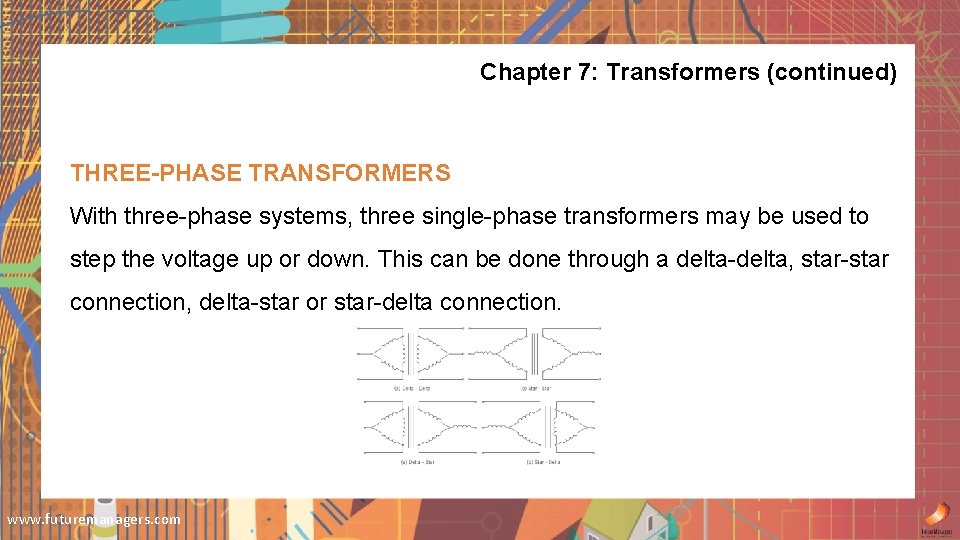
Chapter 7: Transformers (continued) THREE-PHASE TRANSFORMERS With three-phase systems, three single-phase transformers may be used to step the voltage up or down. This can be done through a delta-delta, star-star connection, delta-star or star-delta connection. www. futuremanagers. com
Chapter 7: Transformers (continued) AUTO-TRANSFORMERS An auto-transformer is a transformer which has the primary and secondary windings connected electrically, as well as magnetically. It can be used as a step-down transformer, the entire winding forms the primary winding and only a section forms the secondary winding. www. futuremanagers. com
Chapter 7: Transformers (continued) INSTRUMENT TRANSFORMERS Instrument transformers are often used with ac circuits to reduce the currents and voltages to safe practical values. By making use of instrument transformers, instruments can be standardised. www. futuremanagers. com
Chapter 8: Measuring instruments CONSTRUCTION Essentially a measuring instrument comprises; • A fixed field system, • A controlling system, • A damping system, and • A pointer attached to a moving system and pivoted in jewelled bearings. www. futuremanagers. com
Chapter 8: Measuring instruments (continued) AMMETERS AND VOLTMETERS There is no essential difference between an ammeter and a voltmeter. In both, the deflection is caused by the magnetic effect of a current, which in the case of the ammeter, is the current to be measured, and in the case of a voltmeter, a current proportional to the pd to be measured. The construction is therefore similar, except for details depending on the difference of the size of the currents. www. futuremanagers. com
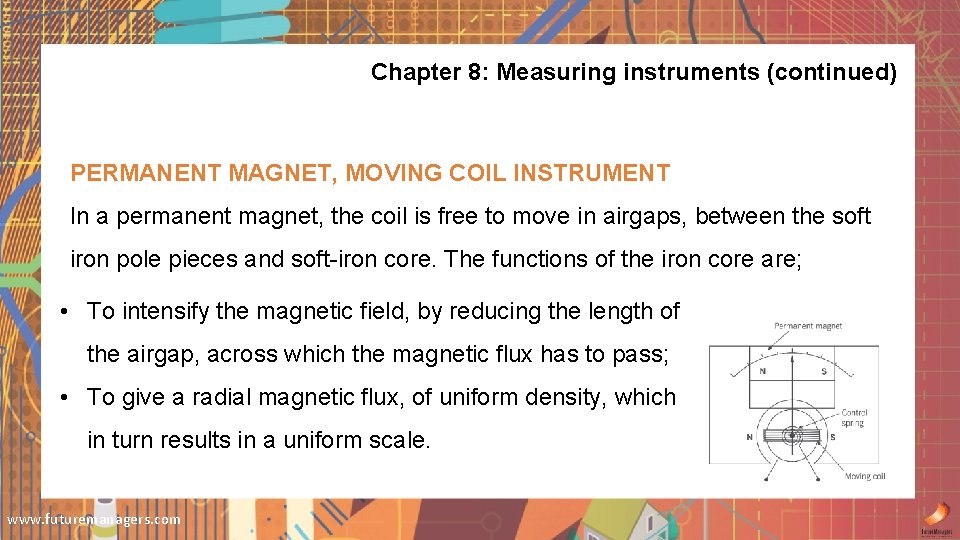
Chapter 8: Measuring instruments (continued) PERMANENT MAGNET, MOVING COIL INSTRUMENT In a permanent magnet, the coil is free to move in airgaps, between the soft iron pole pieces and soft-iron core. The functions of the iron core are; • To intensify the magnetic field, by reducing the length of the airgap, across which the magnetic flux has to pass; • To give a radial magnetic flux, of uniform density, which in turn results in a uniform scale. www. futuremanagers. com
Chapter 8: Measuring instruments (continued) MOVING IRON INSTRUMENT As the coil through which the current flows, is fixed, it can be used to measure relatively large currents directly, when used as an ammeter. There are two types of moving iron instruments, namely the attraction type and the repulsion type. www. futuremanagers. com
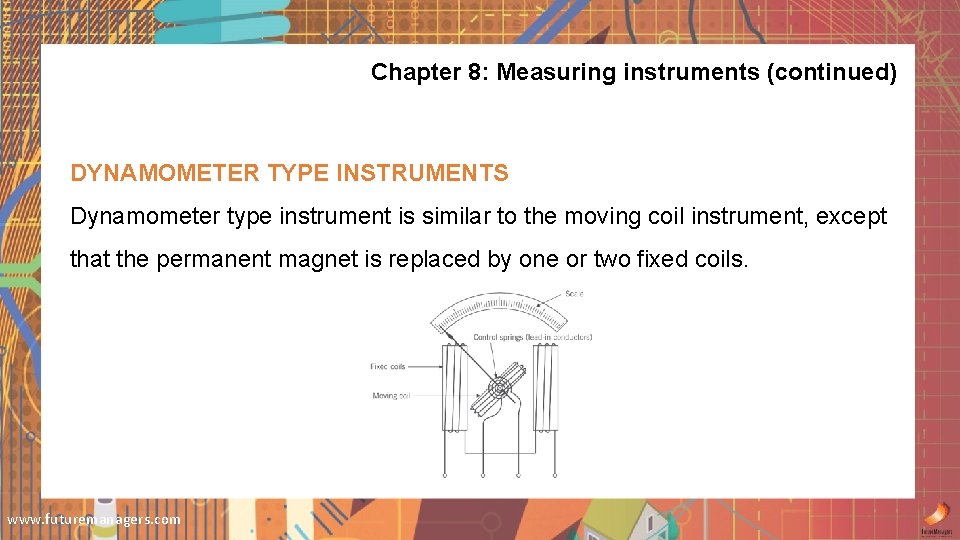
Chapter 8: Measuring instruments (continued) DYNAMOMETER TYPE INSTRUMENTS Dynamometer type instrument is similar to the moving coil instrument, except that the permanent magnet is replaced by one or two fixed coils. www. futuremanagers. com
Chapter 8: Measuring instruments (continued) CONNECTION OF INSTRUMENTS The different types of connections are: • Direct connection; • Two wattmeter method for three-phase supplies; and • Indirect connection. www. futuremanagers. com
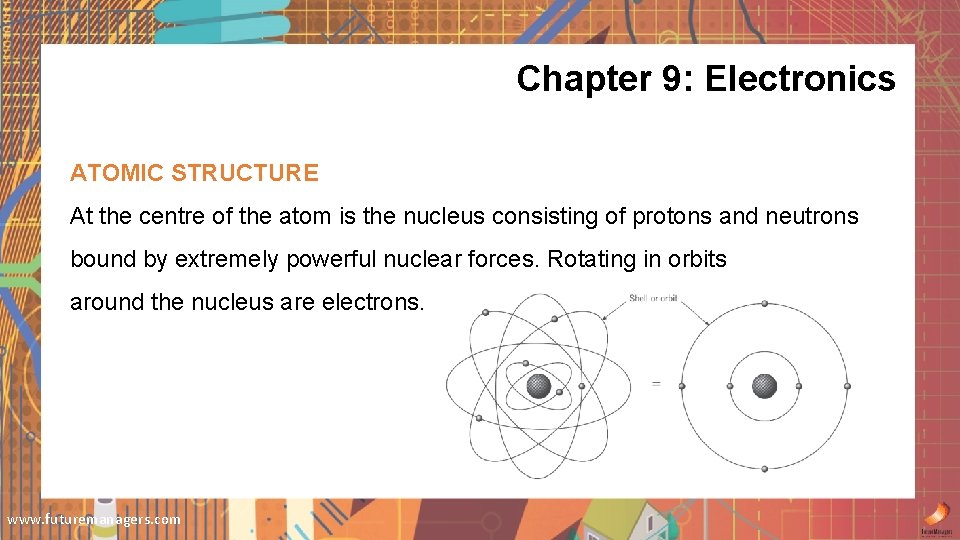
Chapter 9: Electronics ATOMIC STRUCTURE At the centre of the atom is the nucleus consisting of protons and neutrons bound by extremely powerful nuclear forces. Rotating in orbits around the nucleus are electrons. www. futuremanagers. com
Electronics (continued) CONDUCTORS In some elements, the orbiting electrons in the outer shell are loosely bonded. This means that the attraction that the positive nucleus has on those electrons, is relatively small. These loosely bonded electrons are known as free electrons. Elements which have free electrons are classed as good conductors. www. futuremanagers. com
Electronics (continued) INSULATORS Many elements and substances offer great resistance to ionising. This means that they have no free or loosely bound electrons in their structure. No random movement of electrons take place. When a potential difference exists between two points, separated by such a material, there will be no current flow. These materials are known as insulators. www. futuremanagers. com
Electronics (continued) SEMICONDUCTORS A semiconductor may act either as a conductor, allowing an easy flow of electric current, or as an insulator, blocking the flow of current, depending upon various physical influences. This is due to the atomic structure which causes the valence electrons to be held in inter-atomic bonds known as covalent bonds. www. futuremanagers. com
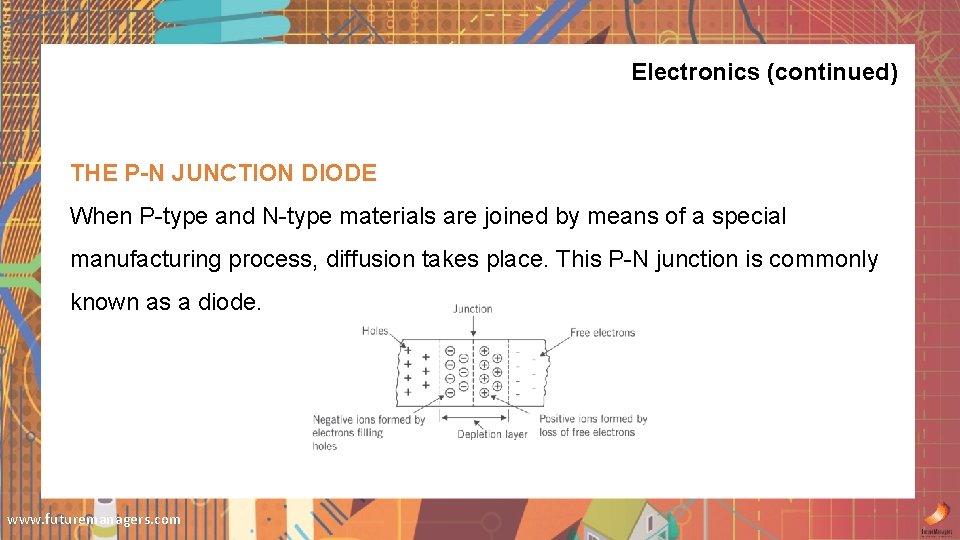
Electronics (continued) THE P-N JUNCTION DIODE When P-type and N-type materials are joined by means of a special manufacturing process, diffusion takes place. This P-N junction is commonly known as a diode. www. futuremanagers. com
Electronics (continued) DIODES AS RECTIFIERS As single-phase circuits, diodes can be used as half wave and full wave rectifiers. The bridge circuit is the most commonly used circuit for obtaining full wave. www. futuremanagers. com
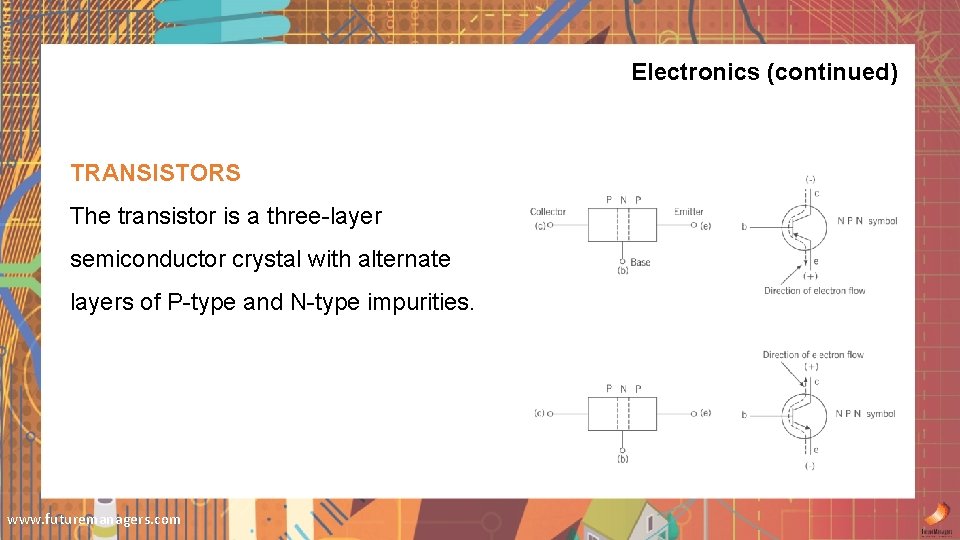
Electronics (continued) TRANSISTORS The transistor is a three-layer semiconductor crystal with alternate layers of P-type and N-type impurities. www. futuremanagers. com
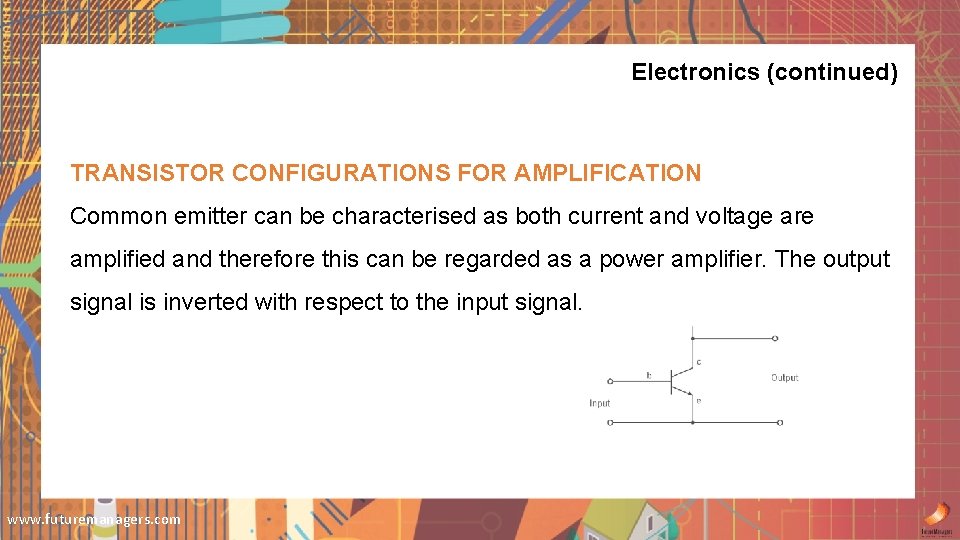
Electronics (continued) TRANSISTOR CONFIGURATIONS FOR AMPLIFICATION Common emitter can be characterised as both current and voltage are amplified and therefore this can be regarded as a power amplifier. The output signal is inverted with respect to the input signal. www. futuremanagers. com
Electronics (continued) SILICON CONTROLLED RECTIFIER (SCR) The SCR is a four-layer PNPN semiconductor device with three terminals namely an anode, cathode and gate. The SCR will only conduct in one direction as is the case with the rectifying diode, but a triggering pulse must be applied to the gate to start the conduction. www. futuremanagers. com
Electronics (continued) CATHODE RAY TUBE The cathode ray tube is used in the cathode ray oscilloscope and is used for studying wave shapes of alternating currents and voltages as well as for measuring quantities such as voltage, current, power and frequency. www. futuremanagers. com
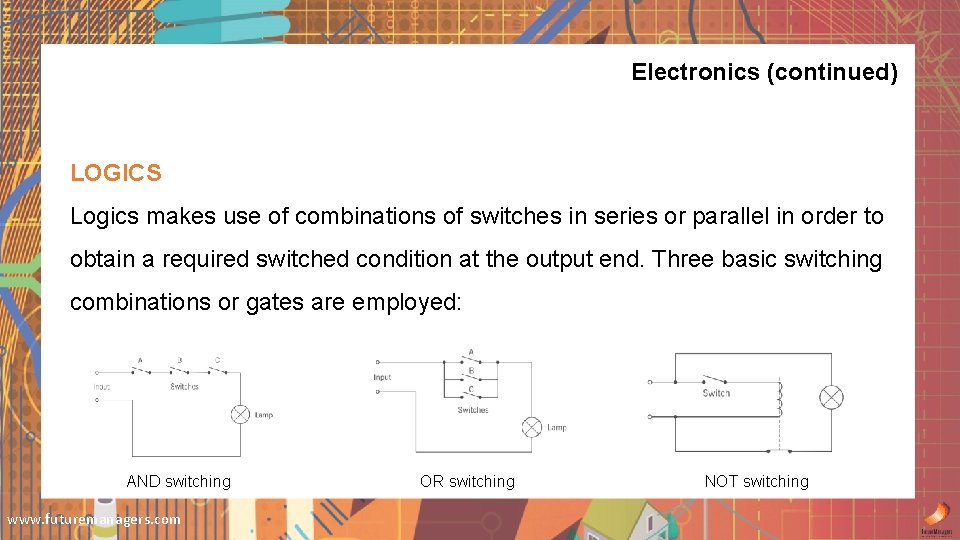
Electronics (continued) LOGICS Logics makes use of combinations of switches in series or parallel in order to obtain a required switched condition at the output end. Three basic switching combinations or gates are employed: AND switching www. futuremanagers. com OR switching NOT switching
Electronics (continued) NUMBER SYSTEMS All counting systems use a given number of digits depending on the system used. For example, the decimal system uses 10 digits ranging from 0 to 9. Logic circuits, which are the basis of digital systems, can only handle two digits, namely 0 and 1. It is necessary to be able to convert the standard quantities to binary in order to use such circuits. www. futuremanagers. com