
Electrotechnics N 5 Module 1 DC machines CONSTRUCTION
- Slides: 54
Electrotechnics N 5
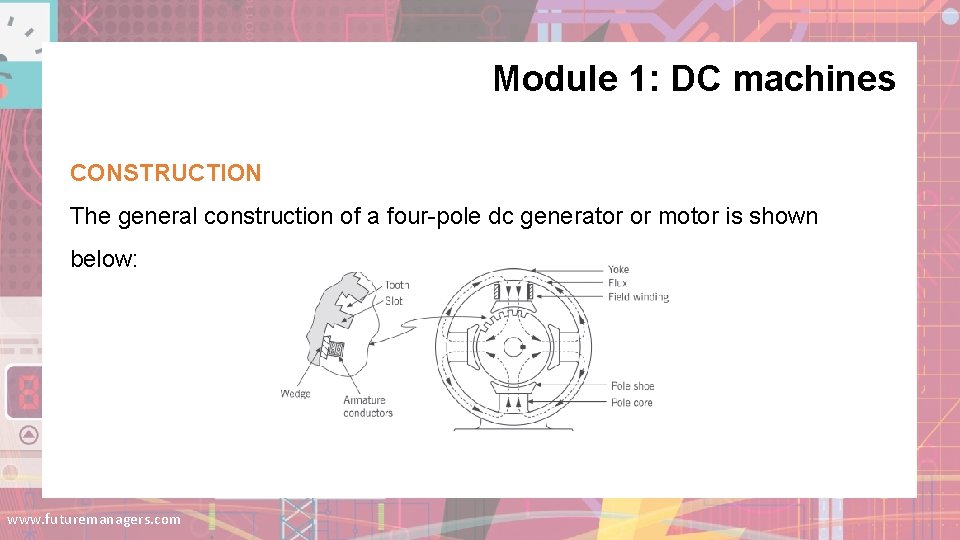
Module 1: DC machines CONSTRUCTION The general construction of a four-pole dc generator or motor is shown below: www. futuremanagers. com
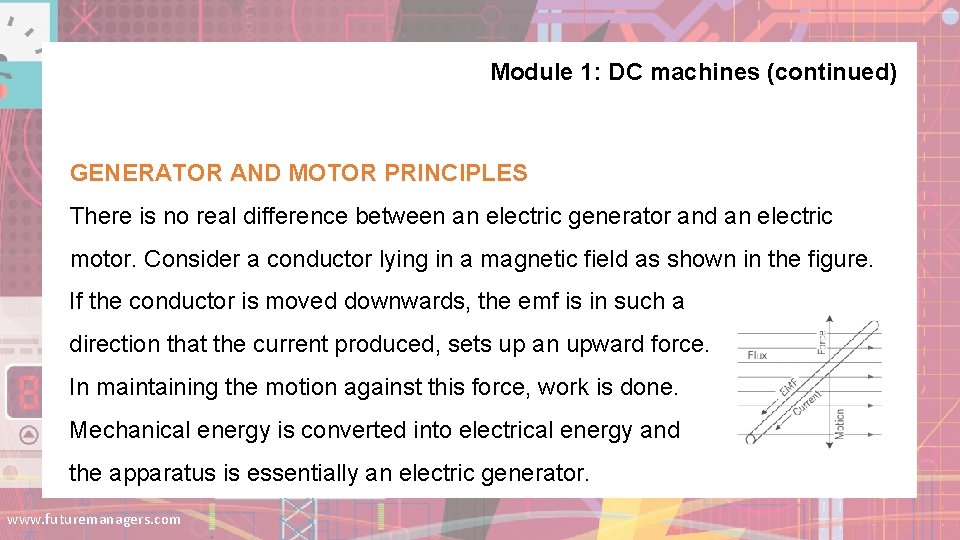
Module 1: DC machines (continued) GENERATOR AND MOTOR PRINCIPLES There is no real difference between an electric generator and an electric motor. Consider a conductor lying in a magnetic field as shown in the figure. If the conductor is moved downwards, the emf is in such a direction that the current produced, sets up an upward force. In maintaining the motion against this force, work is done. Mechanical energy is converted into electrical energy and the apparatus is essentially an electric generator. www. futuremanagers. com
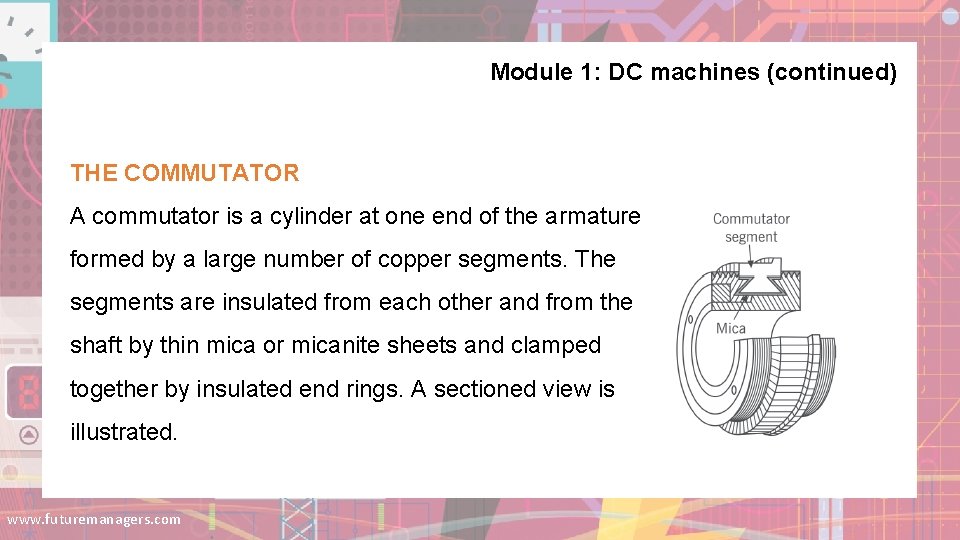
Module 1: DC machines (continued) THE COMMUTATOR A commutator is a cylinder at one end of the armature formed by a large number of copper segments. The segments are insulated from each other and from the shaft by thin mica or micanite sheets and clamped together by insulated end rings. A sectioned view is illustrated. www. futuremanagers. com
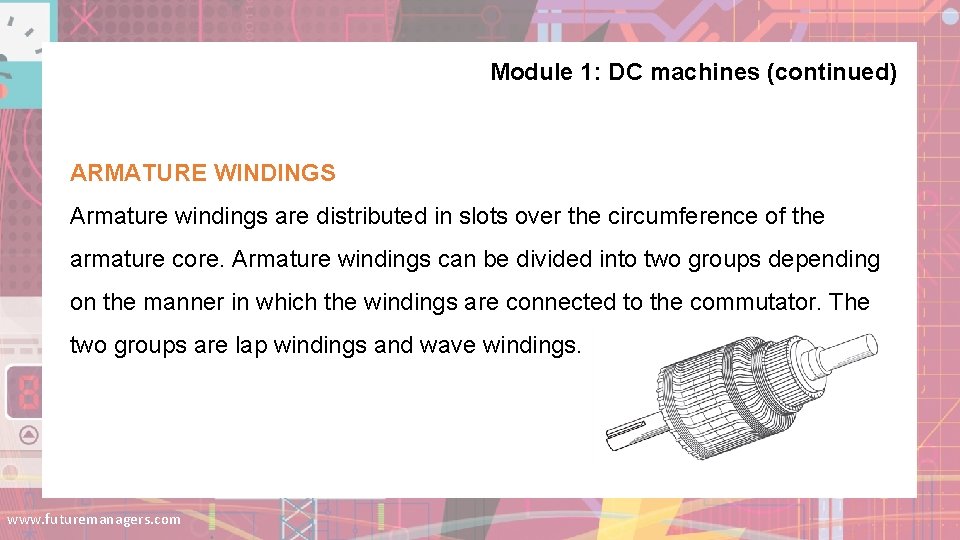
Module 1: DC machines (continued) ARMATURE WINDINGS Armature windings are distributed in slots over the circumference of the armature core. Armature windings can be divided into two groups depending on the manner in which the windings are connected to the commutator. The two groups are lap windings and wave windings. www. futuremanagers. com
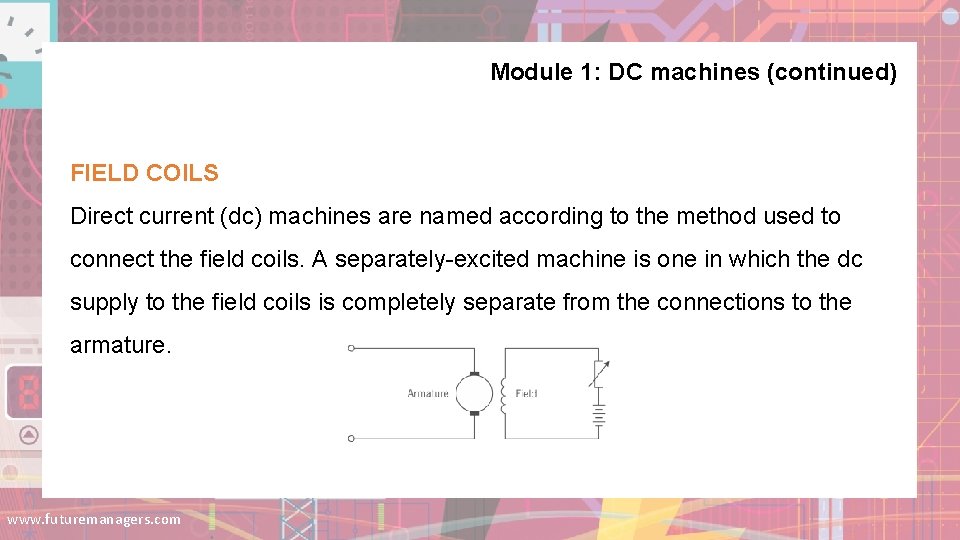
Module 1: DC machines (continued) FIELD COILS Direct current (dc) machines are named according to the method used to connect the field coils. A separately-excited machine is one in which the dc supply to the field coils is completely separate from the connections to the armature. www. futuremanagers. com
Module 1: DC machines (continued) ARMATURE REACTION Armature reaction is the distortion of the main flux entering and leaving the armature, caused by the flux set up by armature conductors when they carry current. www. futuremanagers. com
Module 1: DC machines (continued) www. futuremanagers. com
Module 1: DC machines (continued) ARMATURE REACTION IN A DC MOTOR The direction of the armature current in a dc motor is opposite to that of the generated emf. It follows that in a dc motor, the flux is distorted backwards, and the brushes have to be shifted backwards if they are to be on the magnetic neutral axis when the machine is loaded. www. futuremanagers. com
Module 1: DC machines (continued) www. futuremanagers. com
Module 1: DC machines (continued) COMMUTATION Commutation is the reversal of the emf and current in the short-circuited coil during its transfer from one commutator segment to the next. Up to the instant of short-circuit, the coil has been carrying full-circuit current in one direction. The moment it leaves short-circuit, it must carry full-circuit current in the opposite direction. If the current has just reached its fully reversed value at the end of the short-circuit period, commutation is ideal. www. futuremanagers. com
Module 1: DC machines (continued) TORQUE OF AN ELECTRIC MOTOR In a practical motor, the commutator and brushes ensure that the current through the armature conductor windings are always in such a direction, relative to the field set up by the field coils, that continuous, unidirectional forces are exerted on the armature conductors. The resulting unidirectional forces cause the armature to rotate. The magnitude of the resulting rotational force is referred to as the torque of the motor. www. futuremanagers. com
Module 1: DC machines (continued) STARTING TORQUE AND ACCELERATION The value of the starting torque required, will depend largely on its duty. At the instant of starting there is no back emf as the rotor is at standstill and only the armature circuit resistance is there to limit the armature current. The current drawn at the instant of starting would be excessive. In order to limit the starting current, a reduced voltage must be supplied to the armature. www. futuremanagers. com
Module 1: DC machines (continued) www. futuremanagers. com
Module 1: DC machines (continued) www. futuremanagers. com
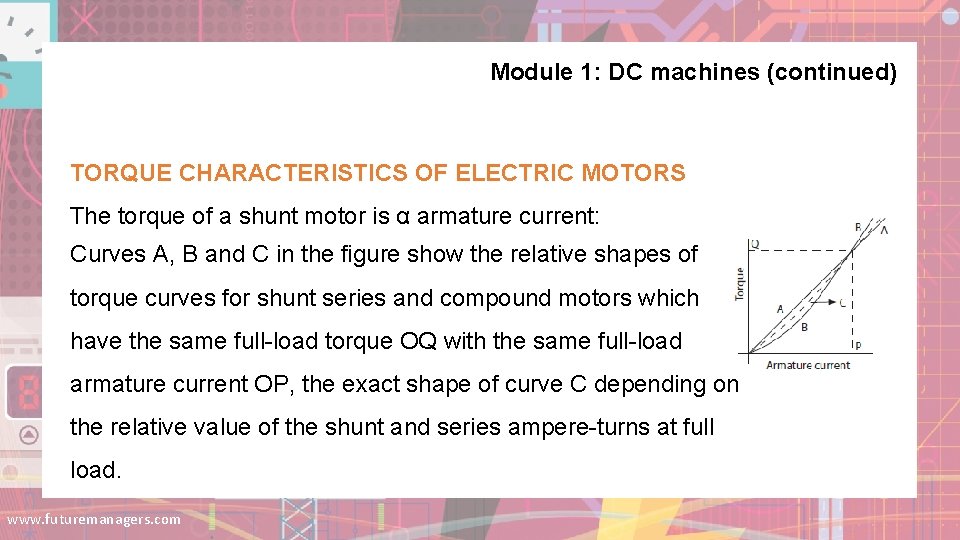
Module 1: DC machines (continued) TORQUE CHARACTERISTICS OF ELECTRIC MOTORS The torque of a shunt motor is α armature current: Curves A, B and C in the figure show the relative shapes of torque curves for shunt series and compound motors which have the same full-load torque OQ with the same full-load armature current OP, the exact shape of curve C depending on the relative value of the shunt and series ampere-turns at full load. www. futuremanagers. com
Module 1: DC machines (continued) SPEED CONTROL The speed of series motors may be controlled by varying the exciting current, but in this, the regulating resistance must be connected in parallel with the field winding. By these means, a varying amount of the total current can be diverted and the field winding can carry any desired fraction of the main current. www. futuremanagers. com
Module 2: AC circuit theory ALTERNATING CURRENT In the case of alternating current the current reverses its direction at a constant rate. This occurs as a result of the constant reversal of polarity at the output terminals of the power supply. www. futuremanagers. com
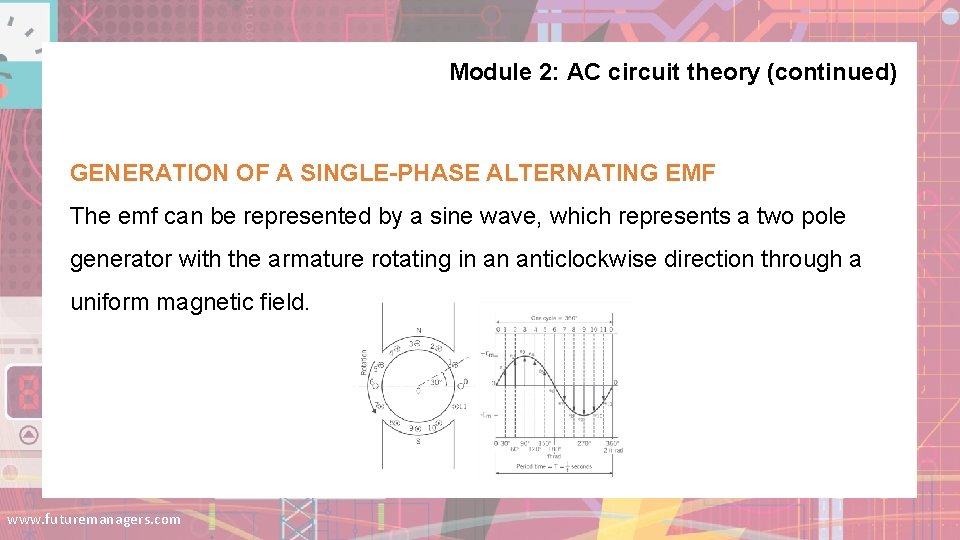
Module 2: AC circuit theory (continued) GENERATION OF A SINGLE-PHASE ALTERNATING EMF The emf can be represented by a sine wave, which represents a two pole generator with the armature rotating in an anticlockwise direction through a uniform magnetic field. www. futuremanagers. com
Module 2: AC circuit theory (continued) AVERAGE AND EFFECTIVE OR RMS VALUE OF AN ALTERNATING QUANTITY The effective value of an alternating current is that value of alternating current, which produces the same amount of heat energy, at the same rate, as a direct current would, if passed through an identical resistance. www. futuremanagers. com
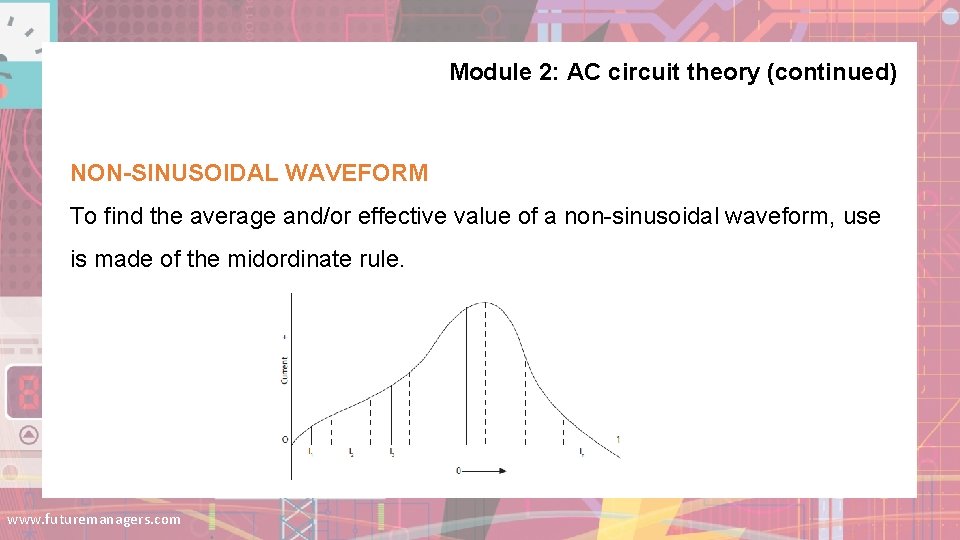
Module 2: AC circuit theory (continued) NON-SINUSOIDAL WAVEFORM To find the average and/or effective value of a non-sinusoidal waveform, use is made of the midordinate rule. www. futuremanagers. com
Module 2: AC circuit theory (continued) RESISTANCE IN AC CIRCUITS The current flowing through a pure resistor is governed by Ohm’s law for every instant of time, i. e. 1 = e/R for every point on the cycle. This means that the current waveform for a purely resistive circuit is exactly the same shape as the waveform of the applied pd and is in phase with it. www. futuremanagers. com
Module 2: AC circuit theory (continued) INDUCTANCE IN AC CIRCUITS A self-induced emf is produced in an inductor whenever the current through it changes. When an alternating current flows through a pure inductor, the value of the current is continually changing and so produces a self-induced emf at every instant. www. futuremanagers. com
Module 2: AC circuit theory (continued) CAPACITANCE IN AC CIRCUITS A capacitor is a device for storing electric charge. The charge on the plates is always proportional to the pd between them, thus, as this pd varies, current must flow either into or out of the capacitor in order to maintain the correct charge. The greater the rate of change of the pd, the greater will be the rate of change of current. www. futuremanagers. com
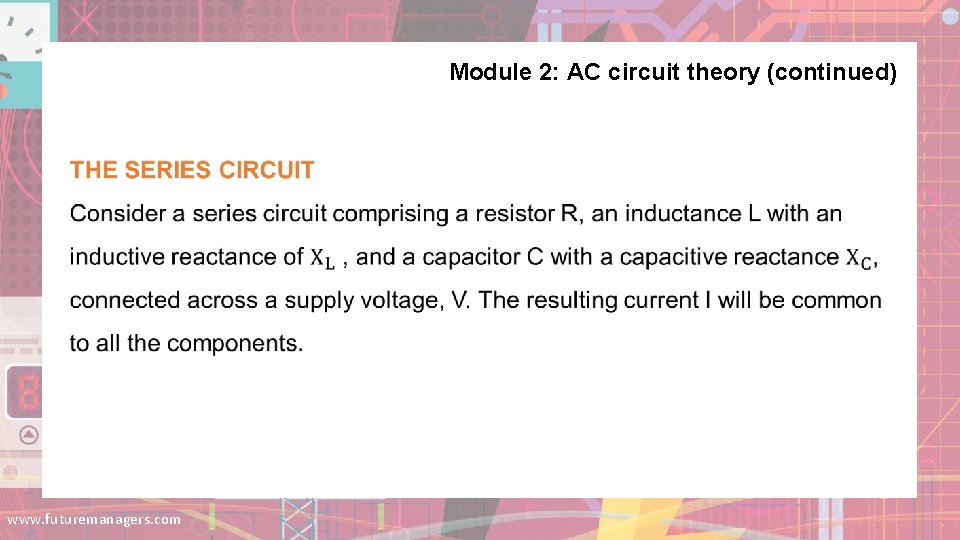
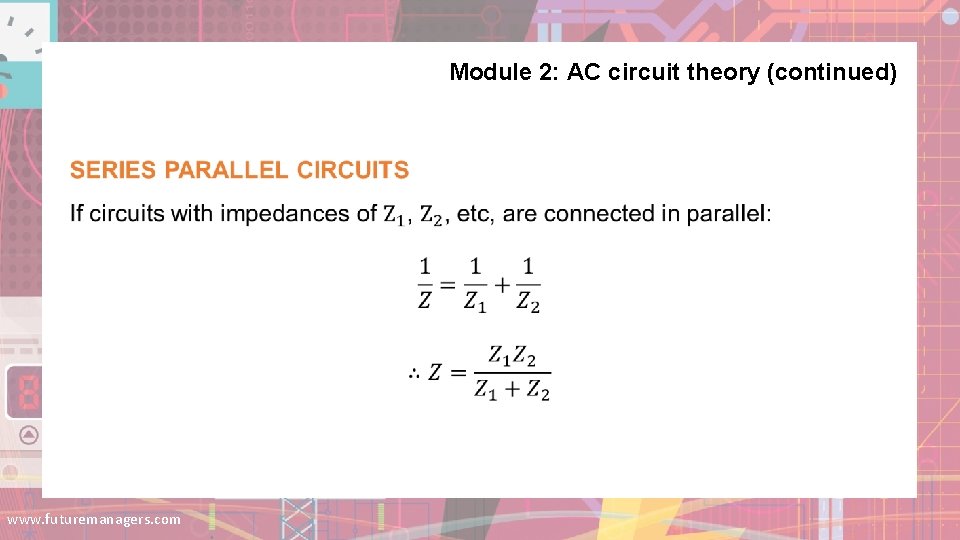
Module 2: AC circuit theory (continued) www. futuremanagers. com
Module 2: AC circuit theory (continued) www. futuremanagers. com
Module 2: AC circuit theory (continued) THREE-PHASE AC SYSTEMS When compared to single-phase systems, three-phase distribution has the following advantages: • Two voltage are available, and • For the same power rating, three-phase motors are smaller, cheaper, more efficient, operate at a better power factor, and are self-starting. • Only 87% of the amount of copper is required for the same output. www. futuremanagers. com
Module 3: Transformers PRINCIPLES OF OPERATION OF A TRANSFORMER Transformers are used for raising or lowering the voltage in an ac circuit with a corresponding decrease or increase in the current. Essentially, a transformer is made up of a primary and secondary winding, electrically separate from each other, but magnetically coupled by means of an iron core. www. futuremanagers. com
Module 3: Transformers (continued) CONSTRUCTION The construction of transformers is the simplest of all ac machines. The principal elements of a transformer are; • The magnetic circuit, • The windings, • the cooling system, and in larger transformers, • The oil tanks, and • Protection devices. www. futuremanagers. com
Module 3: Transformers (continued) TRANSFORMER ON OPEN-CIRCUIT When connected to an ac supply with the secondary winding open-circuited, it acts simply as a highly inductive coil, and the current drawn is just sufficient to set up a flux which makes the emf of self inductance (neglecting the small resistance drop) equal and opposite to the supply pd. www. futuremanagers. com
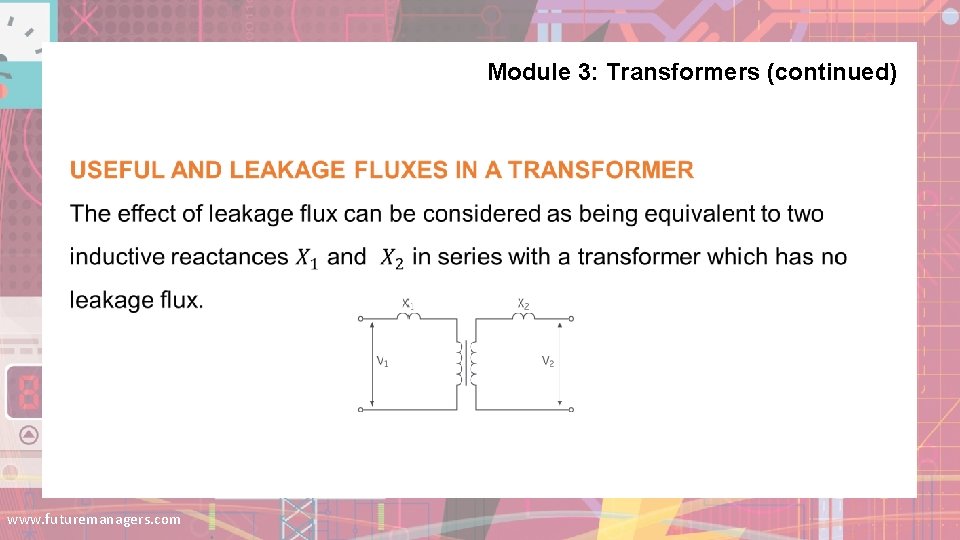
Module 3: Transformers (continued) www. futuremanagers. com
Module 3: Transformers (continued) EQUIVALENT CIRCUIT OF A TRANSFORMER The behaviour of a transformer may be considered by assuming it to be equivalent to a transformer which has no losses and no magnetic leakage and an iron core, thus requiring no magnetising current, and then allowing for the imperfections of the transformer by means of additional impedances. www. futuremanagers. com
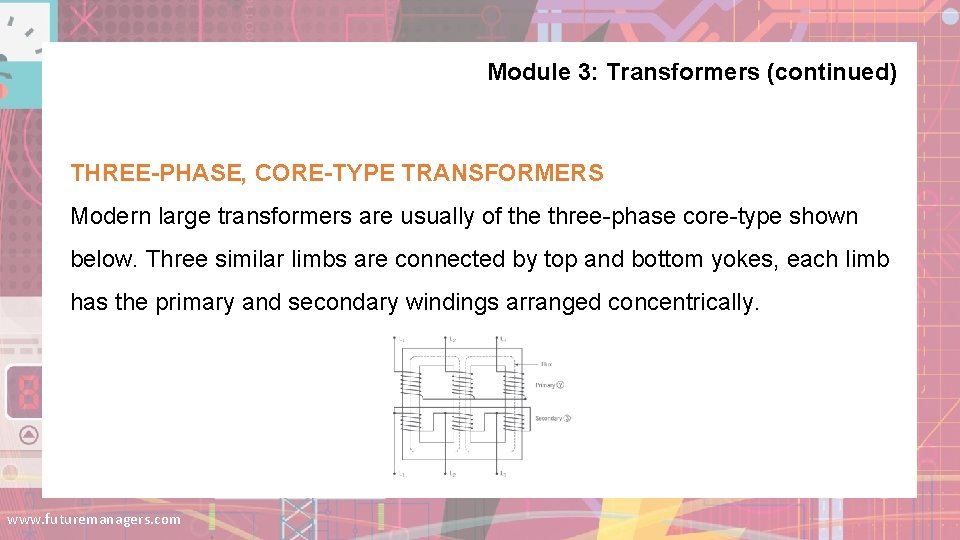
Module 3: Transformers (continued) THREE-PHASE, CORE-TYPE TRANSFORMERS Modern large transformers are usually of the three-phase core-type shown below. Three similar limbs are connected by top and bottom yokes, each limb has the primary and secondary windings arranged concentrically. www. futuremanagers. com
Module 3: Transformers (continued) PARALLEL OPERATION When operating two or more transformers in parallel, their satisfactory performance requires that they have: • The same voltage-ratio, • The same per-unit impedance, • The same polarity, and • The same phase-sequence and zero relative phase-displacement. www. futuremanagers. com
Module 4: Measuring instruments CONSTRUCTION Essentially, most measuring instruments comprise: • A fixed field system, • A controlling system, • A damping system, and • A pointer attached to a moving system and pivoted in jewelled bearings. www. futuremanagers. com
Module 4: Measuring instruments (continued) TYPES OF MEASURING INSTRUMENTS Ammeters and voltmeters are the most common and well-known of all measuring instruments. Power is measured by means of a wattmeter. A frequency meter is used to measure the frequency of ac cycles per second in an alternating current circuit. Power factor meters are used to measure the power factor of an alternating current circuit. www. futuremanagers. com
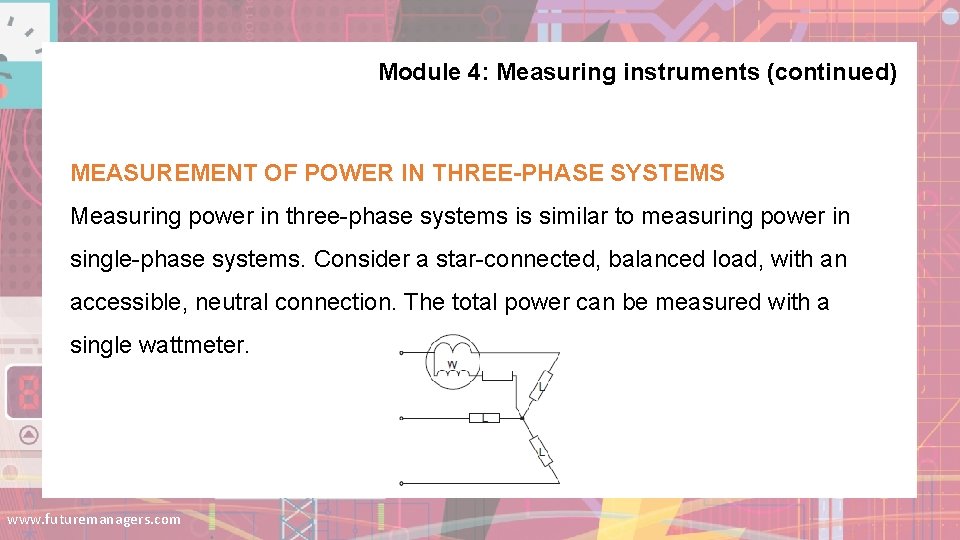
Module 4: Measuring instruments (continued) MEASUREMENT OF POWER IN THREE-PHASE SYSTEMS Measuring power in three-phase systems is similar to measuring power in single-phase systems. Consider a star-connected, balanced load, with an accessible, neutral connection. The total power can be measured with a single wattmeter. www. futuremanagers. com
Module 4: Measuring instruments (continued) RANGE EXTENSION Measuring instruments are mostly required to be connected to measure currents or voltages of values higher than their construction is able to allow them. In ac circuits, instrument transformers are invaluable in fulfilling this function. www. futuremanagers. com
Module 5: AC machines INDUCTION MOTOR In an induction motor, there are no electrical connections between the stator and the rotor. The energy is transferred entirely magnetically, as in the case of a transformer, by means of the emf induced in the rotor conductors, by the rotating field set up by the stator windings. This principle of operation enables the motor to be manufactured as a simple, robust and efficient machine. www. futuremanagers. com
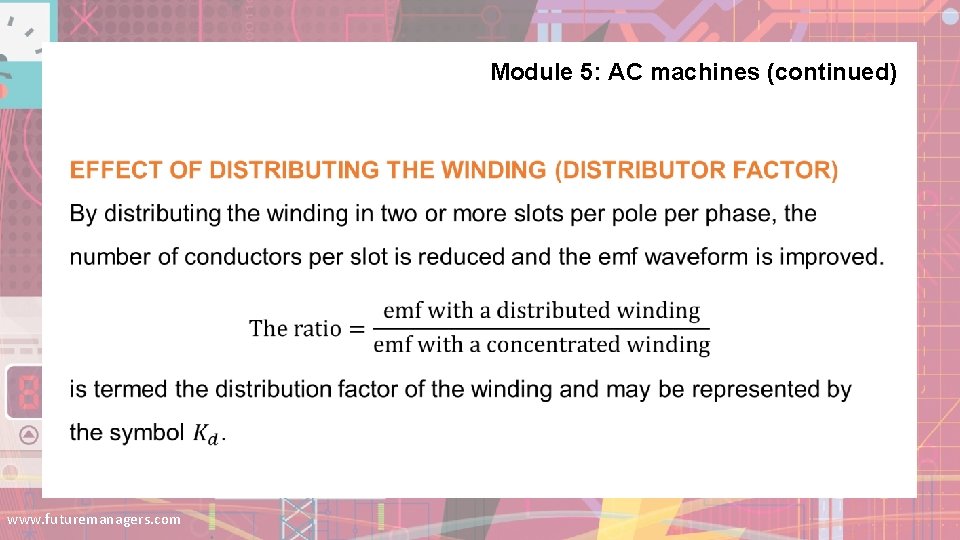
Module 5: AC machines (continued) www. futuremanagers. com
Module 5: AC machines (continued) www. futuremanagers. com
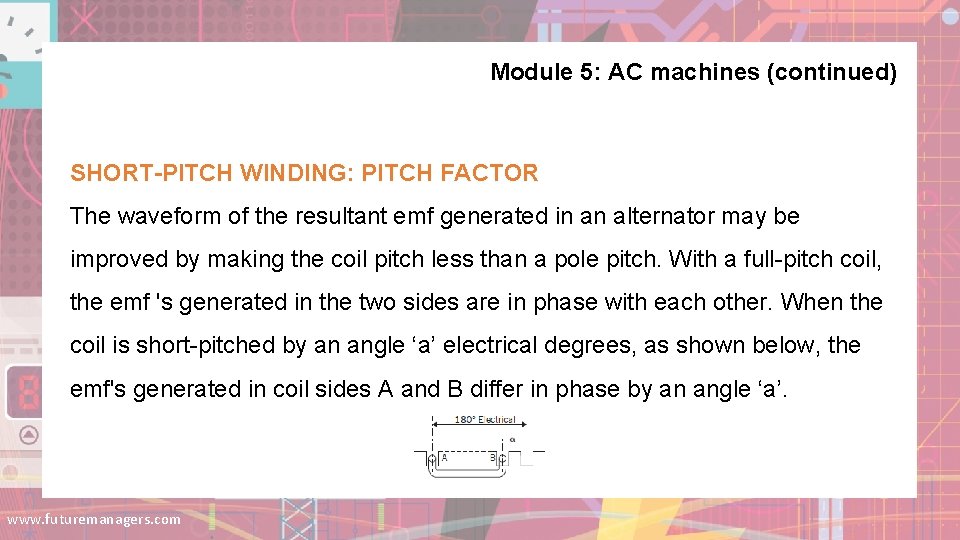
Module 5: AC machines (continued) SHORT-PITCH WINDING: PITCH FACTOR The waveform of the resultant emf generated in an alternator may be improved by making the coil pitch less than a pole pitch. With a full-pitch coil, the emf 's generated in the two sides are in phase with each other. When the coil is short-pitched by an angle ‘a’ electrical degrees, as shown below, the emf's generated in coil sides A and B differ in phase by an angle ‘a’. www. futuremanagers. com
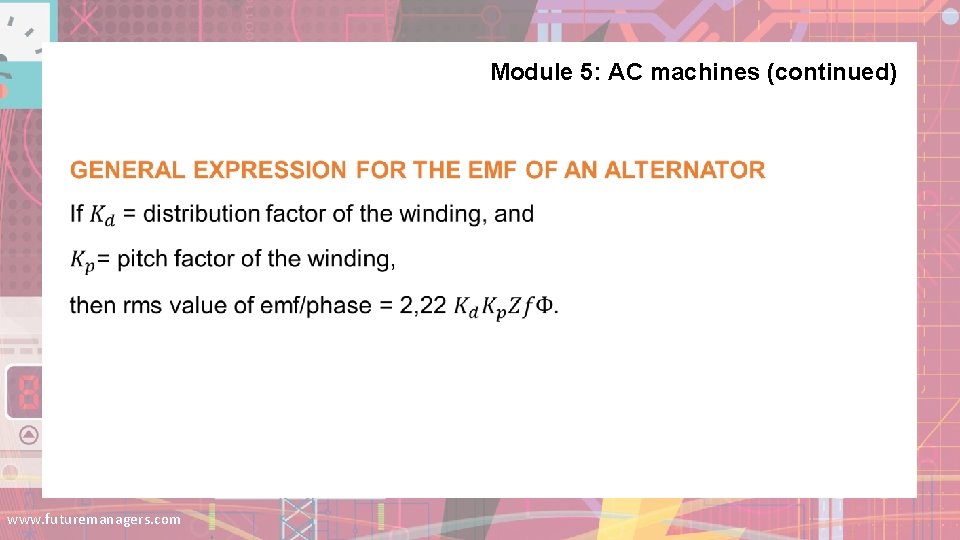
Module 5: AC machines (continued) www. futuremanagers. com
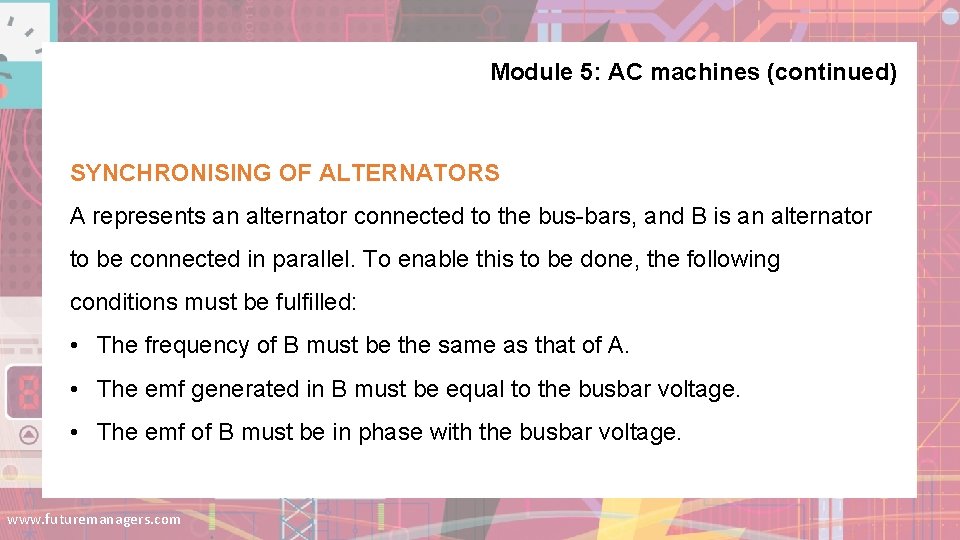
Module 5: AC machines (continued) SYNCHRONISING OF ALTERNATORS A represents an alternator connected to the bus-bars, and B is an alternator to be connected in parallel. To enable this to be done, the following conditions must be fulfilled: • The frequency of B must be the same as that of A. • The emf generated in B must be equal to the busbar voltage. • The emf of B must be in phase with the busbar voltage. www. futuremanagers. com
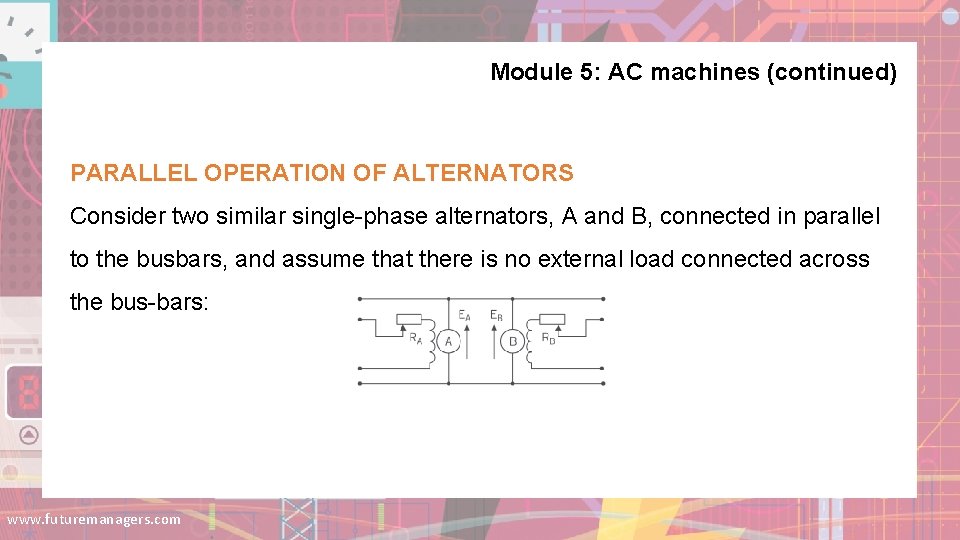
Module 5: AC machines (continued) PARALLEL OPERATION OF ALTERNATORS Consider two similar single-phase alternators, A and B, connected in parallel to the busbars, and assume that there is no external load connected across the bus-bars: www. futuremanagers. com
Module 5: AC machines (continued) THREE-PHASE MOTORS The operation of an induction motor is dependent on a rotating magnetic field which is established in the air gap of the motor by the stator currents. The manner in which the rotating magnetic field is established by a three-phase stator winding of a three-phase induction motor, may be illustrated by considering the direction of current flow through the three phases, at several successive instants. www. futuremanagers. com
Module 5: AC machines (continued) PRINCIPLE OF OPERATION OF A THREE-PHASE INDUCTION MOTOR When the stator winding is energised from a three-phase supply, a rotating magnetic field is established, which rotates at synchronous speed. As the field sweeps across the rotor conductors, an emf is induced in them. Since the rotor circuit is completed, either through end rings, or slip-rings and external resistors, the induced emf causes a current to flow in the rotor conductors. The rotor conductors carrying current in the stator field thus have a force exerted upon them. www. futuremanagers. com
Module 5: AC machines (continued) SPEED CONTROL BY POLE-CHANGING Two economical speeds can be obtained, one double the other, by arranging the stator windings so that the number of poles can be changed at will in some simple ratio, such as eight to four. www. futuremanagers. com
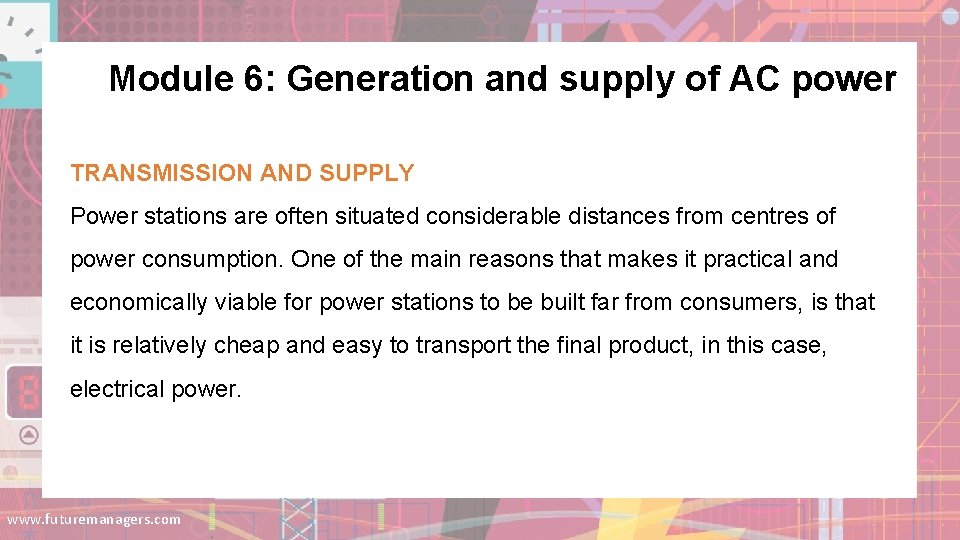
Module 6: Generation and supply of AC power TRANSMISSION AND SUPPLY Power stations are often situated considerable distances from centres of power consumption. One of the main reasons that makes it practical and economically viable for power stations to be built far from consumers, is that it is relatively cheap and easy to transport the final product, in this case, electrical power. www. futuremanagers. com
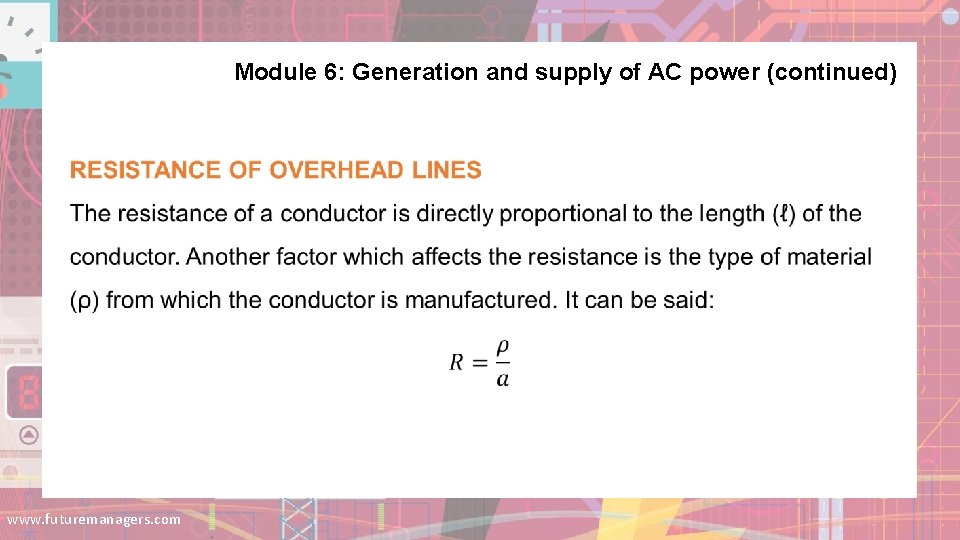
Module 6: Generation and supply of AC power (continued) www. futuremanagers. com
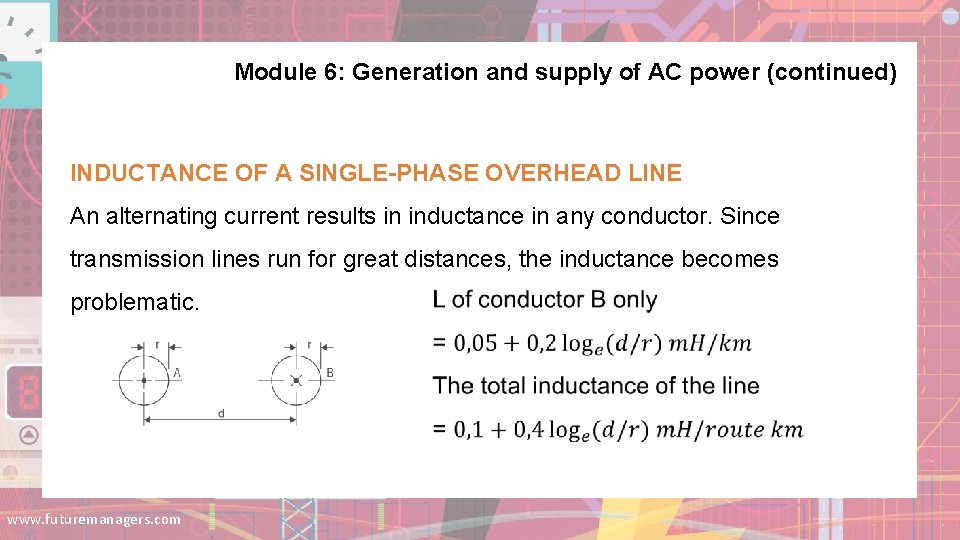
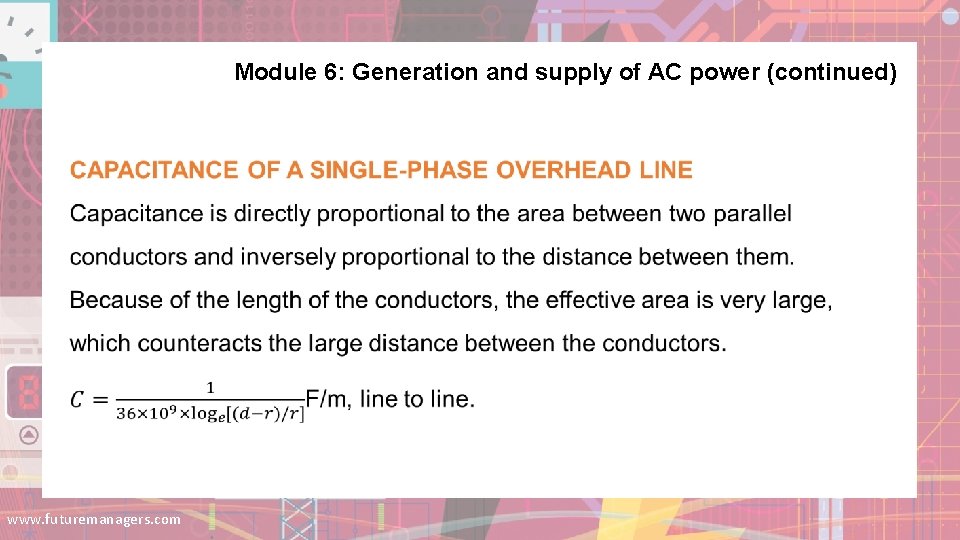
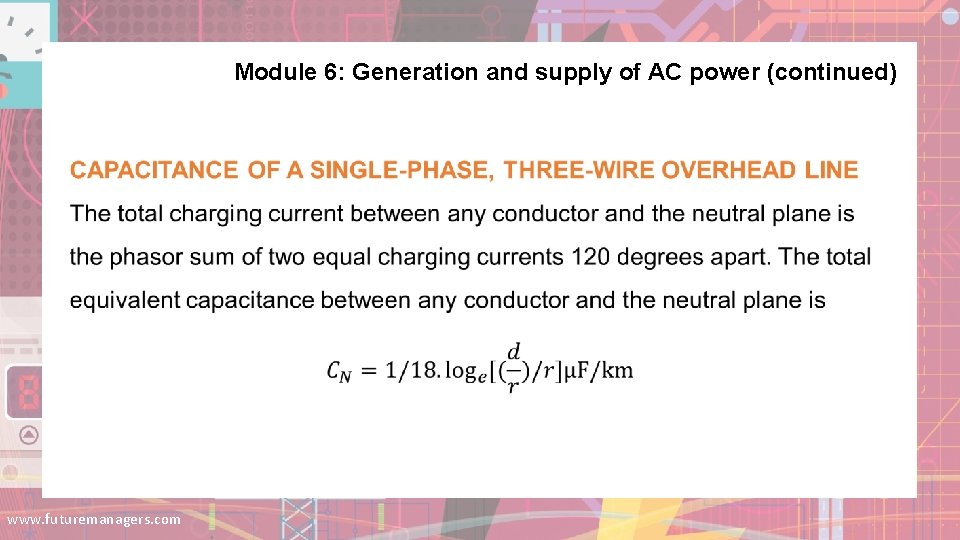
Module 6: Generation and supply of AC power (continued) INDUCTANCE OF A SINGLE-PHASE OVERHEAD LINE An alternating current results in inductance in any conductor. Since transmission lines run for great distances, the inductance becomes problematic. www. futuremanagers. com
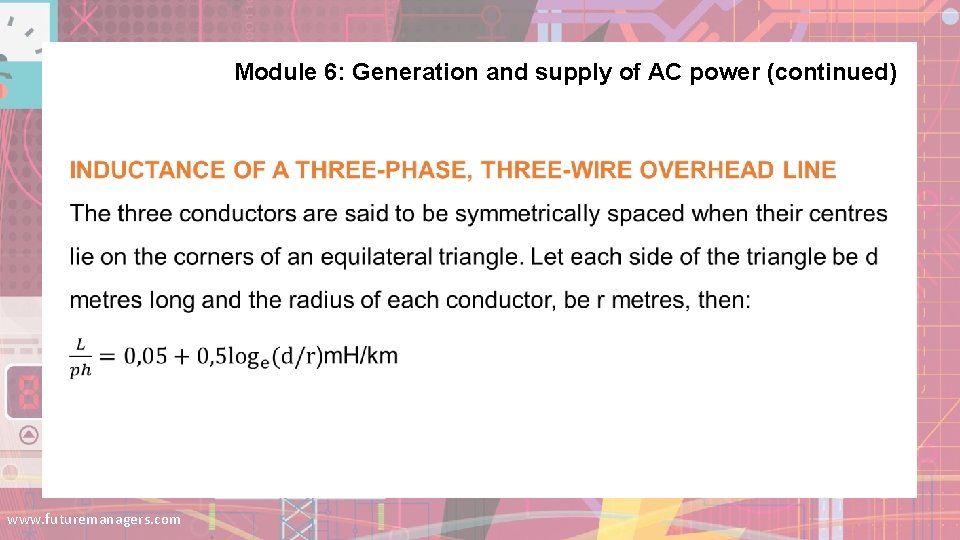
Module 6: Generation and supply of AC power (continued) www. futuremanagers. com
Module 6: Generation and supply of AC power (continued) www. futuremanagers. com
Module 6: Generation and supply of AC power (continued) www. futuremanagers. com