
Electrostatics Coulombs Law AttractionRepulsion Repulsion Attraction Nothing or
Electrostatics Coulomb’s Law
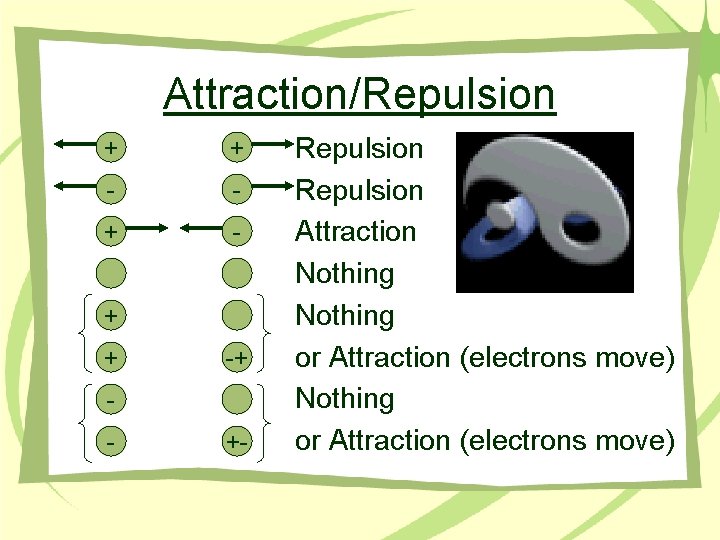
Attraction/Repulsion + + - - + + -+ - +- Repulsion Attraction Nothing or Attraction (electrons move)
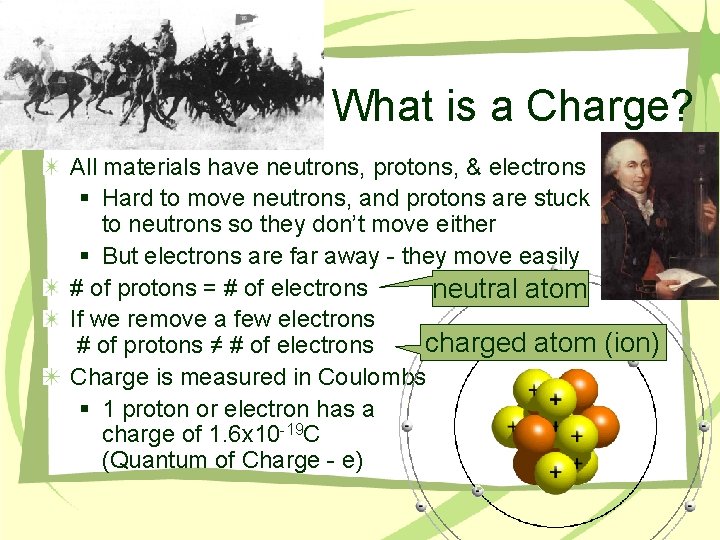
What is a Charge? All materials have neutrons, protons, & electrons § Hard to move neutrons, and protons are stuck to neutrons so they don’t move either § But electrons are far away - they move easily # of protons = # of electrons neutral atom If we remove a few electrons charged atom (ion) # of protons ≠ # of electrons Charge is measured in Coulombs § 1 proton or electron has a charge of 1. 6 x 10 -19 C (Quantum of Charge - e)
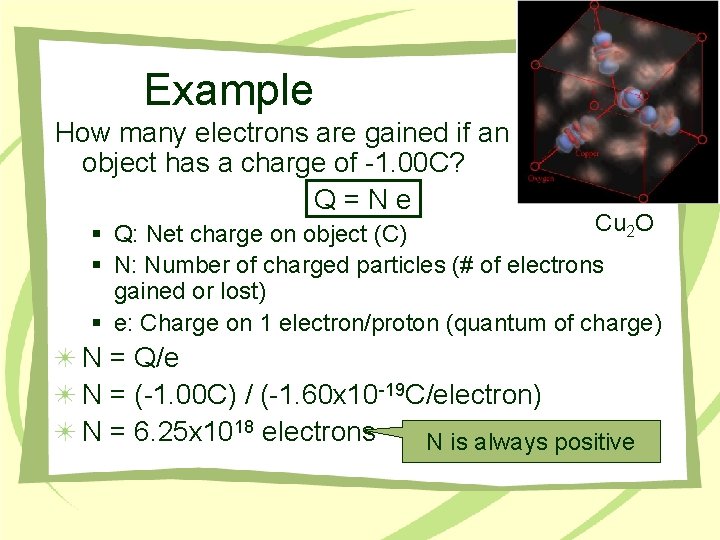
Example How many electrons are gained if an object has a charge of -1. 00 C? Q=Ne Cu 2 O § Q: Net charge on object (C) § N: Number of charged particles (# of electrons gained or lost) § e: Charge on 1 electron/proton (quantum of charge) N = Q/e N = (-1. 00 C) / (-1. 60 x 10 -19 C/electron) N = 6. 25 x 1018 electrons N is always positive
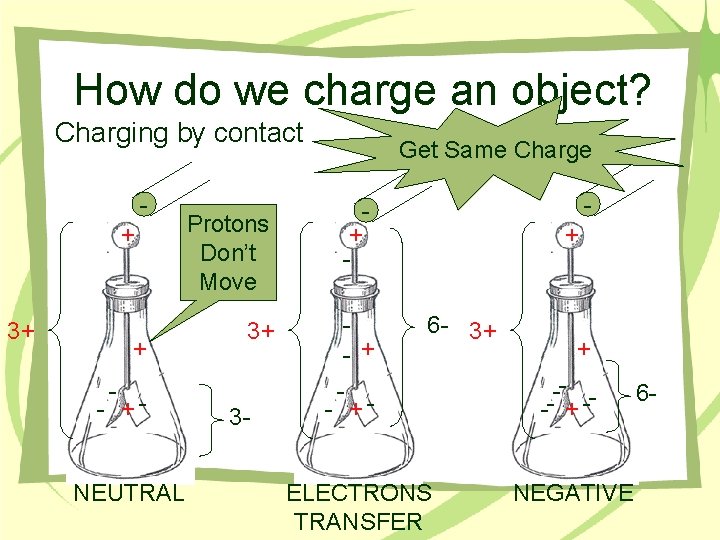
How do we charge an object? Charging by contact + 3+ + - - + NEUTRAL Protons Don’t Move 3+ 3 - Get Same Charge - + - - + + 6 - 3+ ELECTRONS TRANSFER + - -- + NEGATIVE 6 -
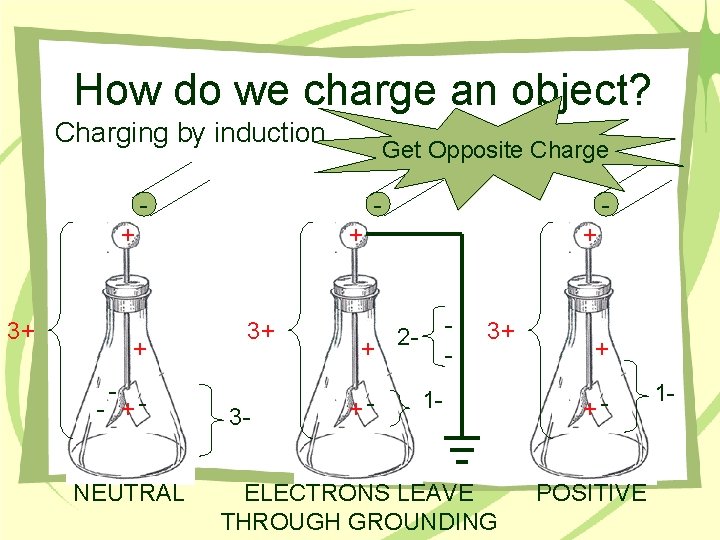
How do we charge an object? Charging by induction Get Opposite Charge - - + 3+ + - - + NEUTRAL - + 3+ 3 - + +- + - 2 - 3+ 1 - ELECTRONS LEAVE THROUGH GROUNDING + +POSITIVE 1 -
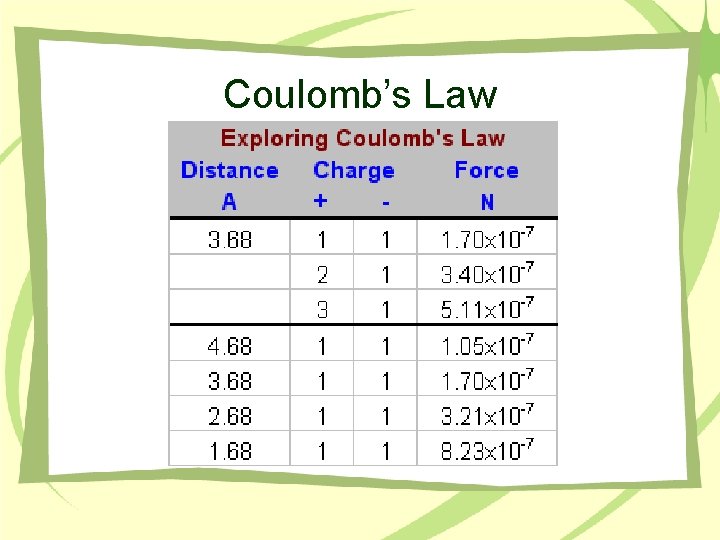
Coulomb’s Law
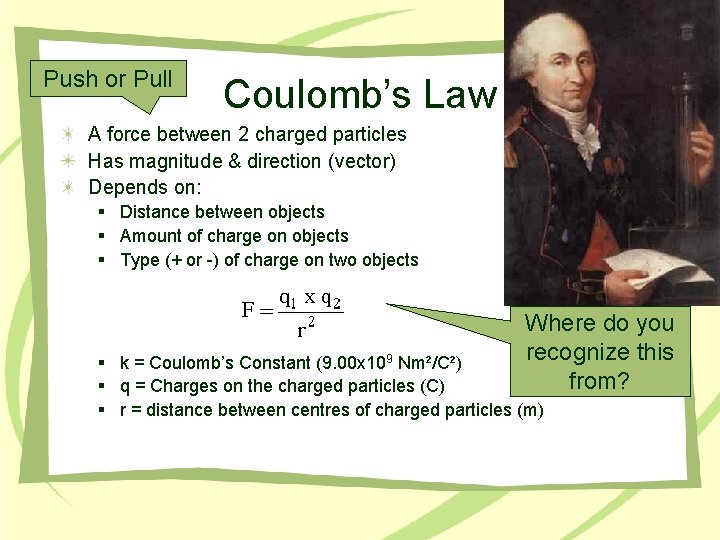
Push or Pull Coulomb’s Law A force between 2 charged particles Has magnitude & direction (vector) Depends on: § Distance between objects § Amount of charge on objects § Type (+ or -) of charge on two objects Where do you recognize this from? § k = Coulomb’s Constant (9. 00 x 109 Nm²/C²) § q = Charges on the charged particles (C) § r = distance between centres of charged particles (m)

Coulomb’s Law Example 3 charged particles lie on a table, what is net force on “B”? FAon. B = Kq. Aq. B / r. AB² § FAon. B = (9 E 9)(0. 005)(-0. 003) / (0. 4 m)² § FAon. B = -843, 750 N Attraction FCon. B = Kq. Bq. C / r. BC² § FCon. B = (9 E 9)(-0. 003)(-0. 008) / (0. 5 m)² § FCon. B = 864, 000 N Repulsion FBnet = FAon. B + FCon. B § FBnet = (843, 750 N [Left]) + (864, 000 N [Left]) § FBnet = 1. 7 x 10⁶ N [Left] Look at diagram for direction 5 m. C -3 m. C -8 m. C A B C 0. 4 m 0. 5 m

Coulomb’s Law Example 2 3 particles lie at 90°, what is net force on the 6 C particle? F-3 on 6 = Kq-3 q 6 / r-3, 6² § F-3 on 6 = (9 E 9)(-3)(6) / (0. 4 m)² § F-3 on 6 = -1. 0 E 12 N Attraction F 1. 5 on 6 = Kq 1. 5 q 6 / r 1. 5, 6² § F 1. 5 on 6 = (9 E 9)(1. 5)(6) / (0. 3 m)² § F 1. 5 on 6 = 9. 0 E 11 N Repulsion F 6 net = √[F-3 on 6² + F 1. 5 on 6²] § F 6 net = √[(-1. 0 E 12 N)² + (9. 0 E 11 N)²] = 1. 35 E 12 N 1. 5 θ = tan-1[F-3 on 6 / F 1. 5 on 6] § θ = tan-1[(-1. 0 E 12 N) / (9. 0 E 11 N)] = 48° 0. 3 m F 6 net = 1. 35 E 12 N @ 48°Wof. S -3 6 0. 4 m
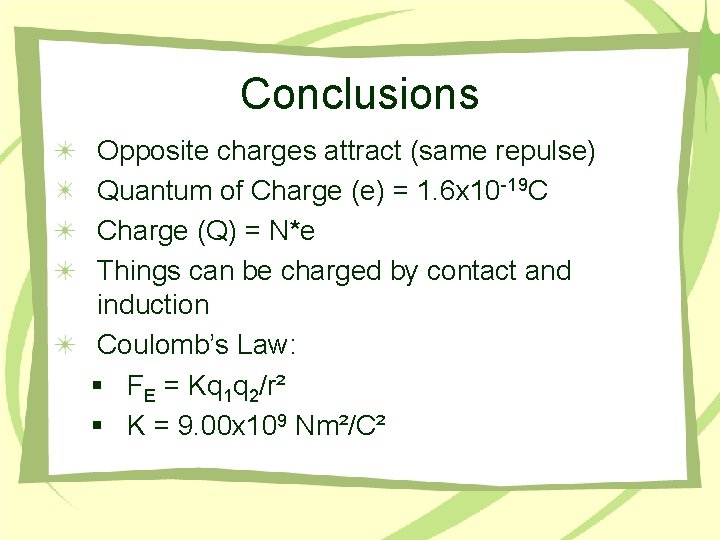
Conclusions Opposite charges attract (same repulse) Quantum of Charge (e) = 1. 6 x 10 -19 C Charge (Q) = N*e Things can be charged by contact and induction Coulomb’s Law: § FE = Kq 1 q 2/r² § K = 9. 00 x 109 Nm²/C²
- Slides: 11