
Electrostatics AP Physics End Slide Parts of The
- Slides: 29
Electrostatics AP Physics
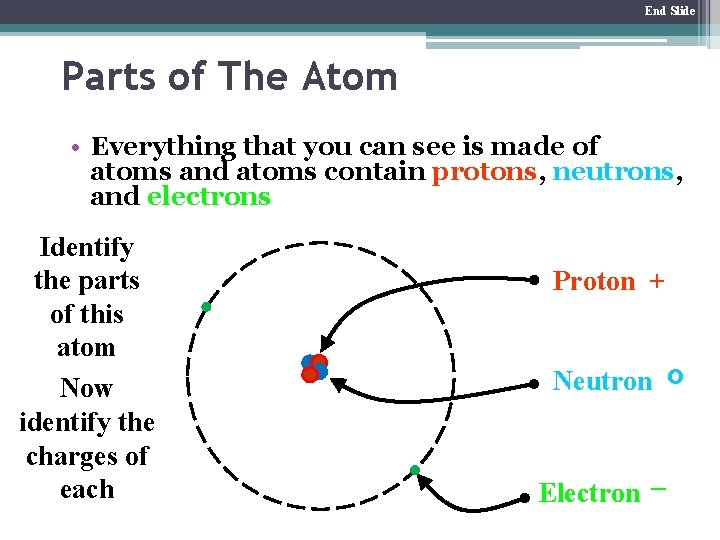
End Slide Parts of The Atom • Everything that you can see is made of atoms and atoms contain protons, neutrons, and electrons Identify the parts of this atom Now identify the charges of each Proton + Neutron o Electron –
End Slide The Atom • Protons and Neutrons are in the center of the atom and are EXTREMELY hard to move • Electrons, however, are on the outer part of the atom and can be removed easily • So, to change the charge of an atom, you have to…? ? ? …add or remove electrons
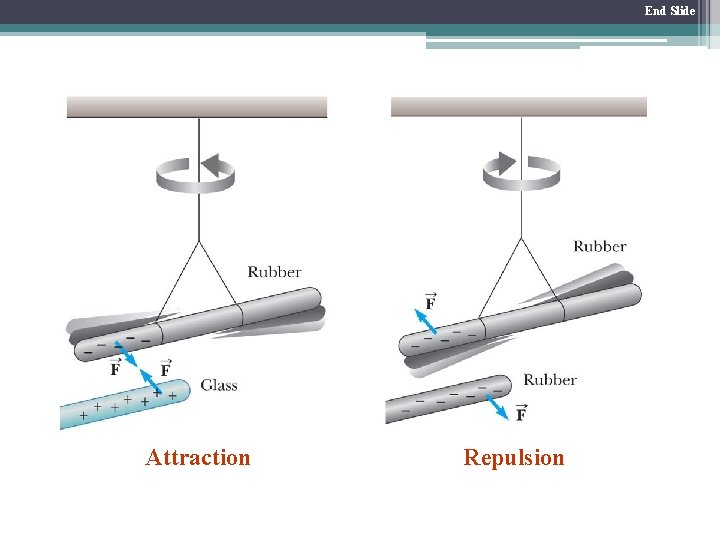
End Slide Attraction Repulsion
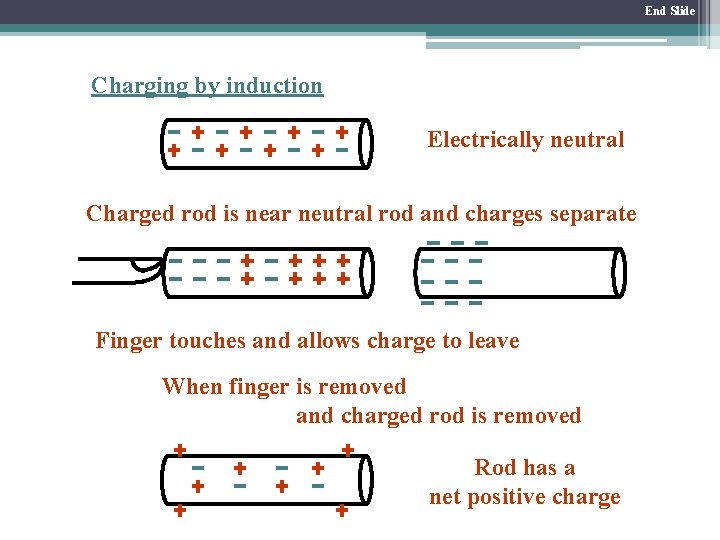
End Slide Charging by induction Electrically neutral Charged rod is near neutral rod and charges separate Finger touches and allows charge to leave When finger is removed and charged rod is removed Rod has a net positive charge
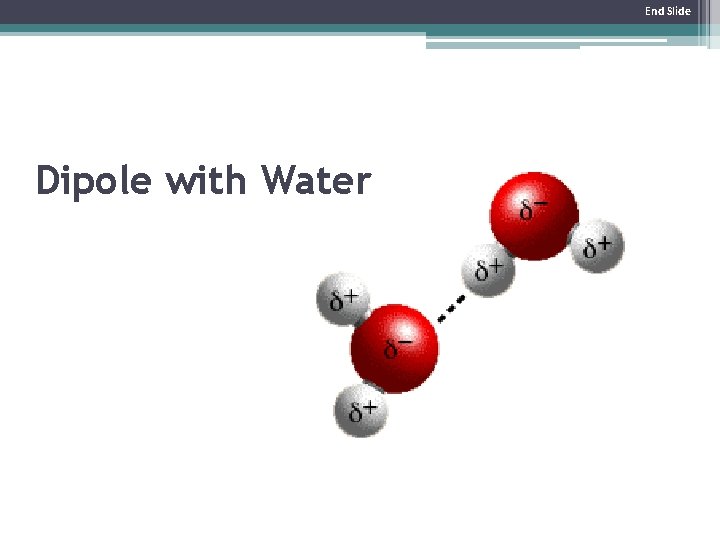
End Slide Dipole with Water
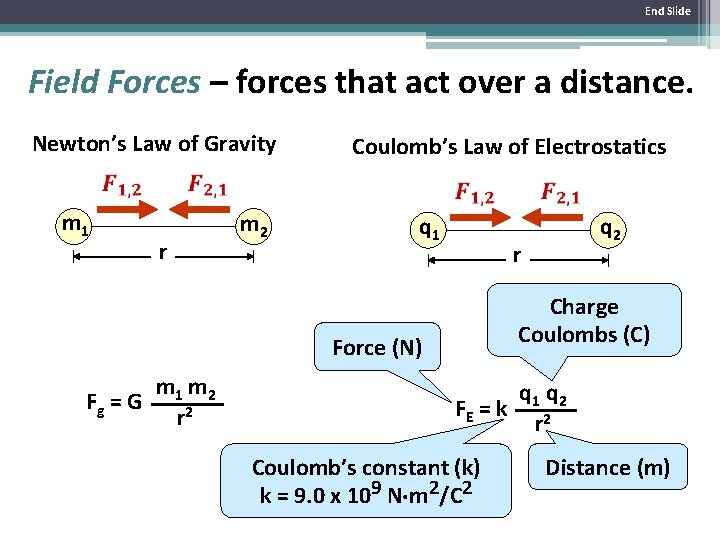
End Slide Field Forces – forces that act over a distance. Newton’s Law of Gravity m 1 r m 2 Coulomb’s Law of Electrostatics q 1 r Charge Coulombs (C) Force (N) m 1 m 2 Fg = G r 2 q 2 FE = k Coulomb’s constant (k) k = 9. 0 x 109 N m 2/C 2 q 1 q 2 r 2 Distance (m)
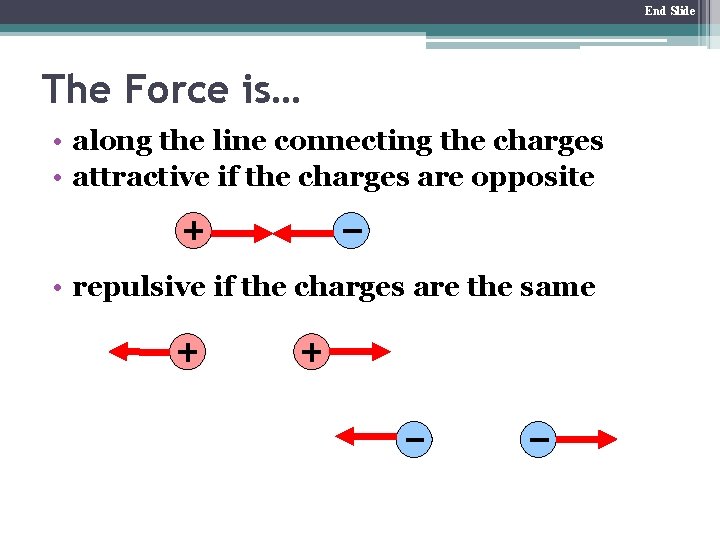
End Slide The Force is… • along the line connecting the charges • attractive if the charges are opposite • repulsive if the charges are the same
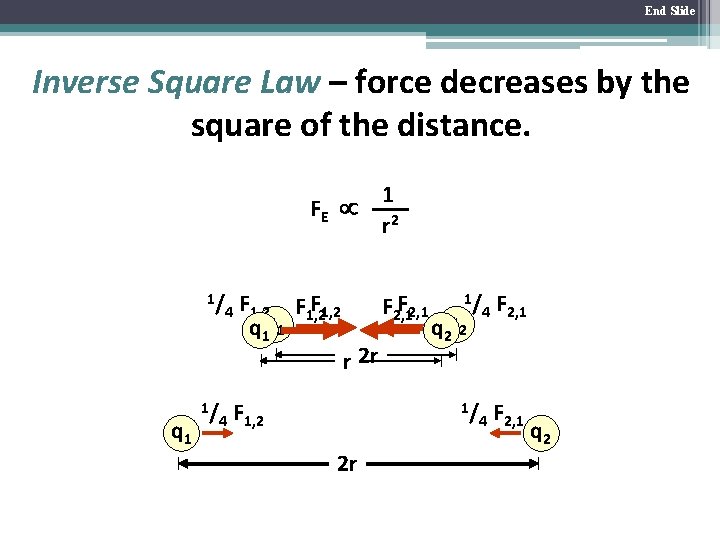
End Slide Inverse Square Law – force decreases by the square of the distance. 1 FE µ 2 r 1/ q 1 1/ F 1, 2 4 F 1, 2 q 1 q 1 4 F 2, 1 r r 2 r F 1, 2 1/ q 2 q 2 1/ 2 r 4 F 2, 1 q 2
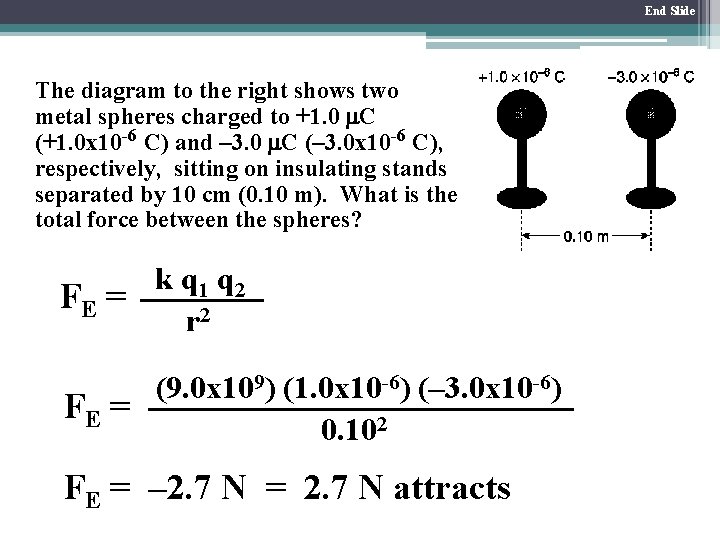
End Slide The diagram to the right shows two metal spheres charged to +1. 0 m. C (+1. 0 x 10 -6 C) and – 3. 0 m. C (– 3. 0 x 10 -6 C), respectively, sitting on insulating stands separated by 10 cm (0. 10 m). What is the total force between the spheres? k q 1 q 2 FE = r 2 (9. 0 x 109) (1. 0 x 10 -6) (– 3. 0 x 10 -6) FE = 0. 102 FE = – 2. 7 N = 2. 7 N attracts
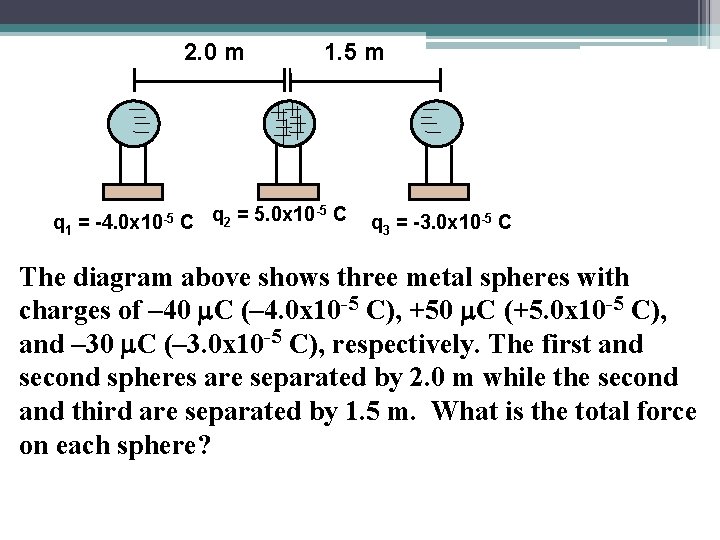
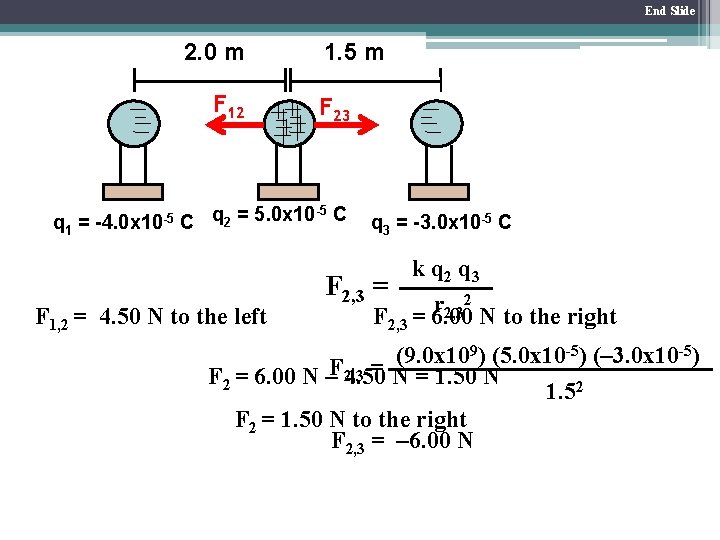
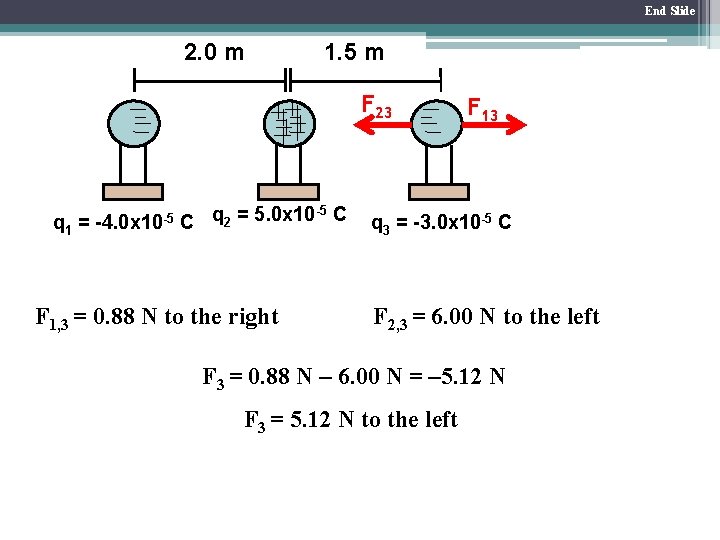
2. 0 m q 1 = -4. 0 x 10 -5 1. 5 m -5 C q = 5. 0 x 10 2 C q 3 = -3. 0 x 10 -5 C The diagram above shows three metal spheres with charges of – 40 m. C (– 4. 0 x 10 -5 C), +50 m. C (+5. 0 x 10 -5 C), and – 30 m. C (– 3. 0 x 10 -5 C), respectively. The first and second spheres are separated by 2. 0 m while the second and third are separated by 1. 5 m. What is the total force on each sphere?
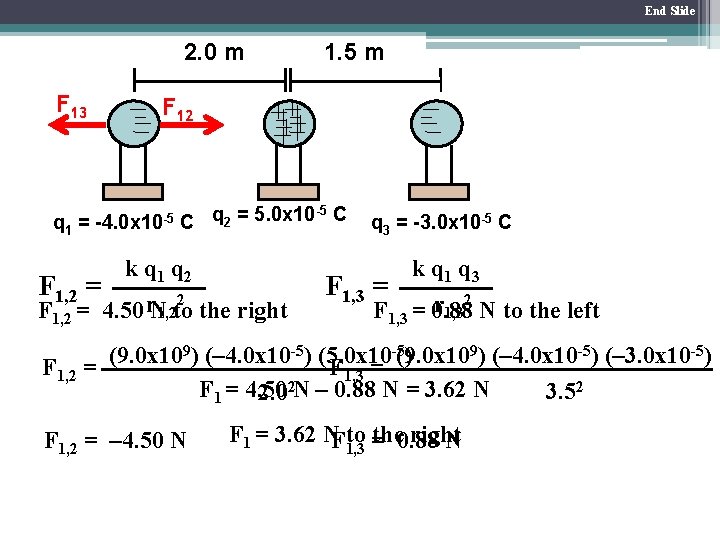
End Slide 2. 0 m F 13 q 1 = 1. 5 m F 12 -4. 0 x 10 -5 F 1, 2 = -5 C q = 5. 0 x 10 2 C k q 1 q 2 F 1, 2 = 4. 50 r. N 1, 2 to the right 2 q 3 = -3. 0 x 10 -5 C F 1, 3 = k q 1 q 3 r 1, 32 N to the left F 1, 3 = 0. 88 9) (– 4. 0 x 10 -5) (– 3. 0 x 10 -5) -5 (9. 0 x 109) (– 4. 0 x 10 -5) (5. 0 x 10 ) F 1, 3 = F 1, 2 = F 1 = 4. 50 3. 52 2. 02 N – 0. 88 N = 3. 62 N F 1, 2 = – 4. 50 N F 1 = 3. 62 NF 1, 3 to = the 0. 88 right N
End Slide 2. 0 m F 12 q 1 = -4. 0 x 10 -5 1. 5 m F 23 -5 C q = 5. 0 x 10 2 C F 1, 2 = 4. 50 N to the left q 3 = -3. 0 x 10 -5 C F 2, 3 = k q 2 q 3 r 2, 32 F 2, 3 = 6. 00 N to the right (9. 0 x 109) (5. 0 x 10 -5) (– 3. 0 x 10 -5) 2, 3 = N = 1. 50 N F 2 = 6. 00 N –F 4. 50 1. 52 F 2 = 1. 50 N to the right F 2, 3 = – 6. 00 N
End Slide 2. 0 m 1. 5 m F 23 q 1 = -4. 0 x 10 -5 -5 C q = 5. 0 x 10 2 C F 1, 3 = 0. 88 N to the right F 13 q 3 = -3. 0 x 10 -5 C F 2, 3 = 6. 00 N to the left F 3 = 0. 88 N – 6. 00 N = – 5. 12 N F 3 = 5. 12 N to the left
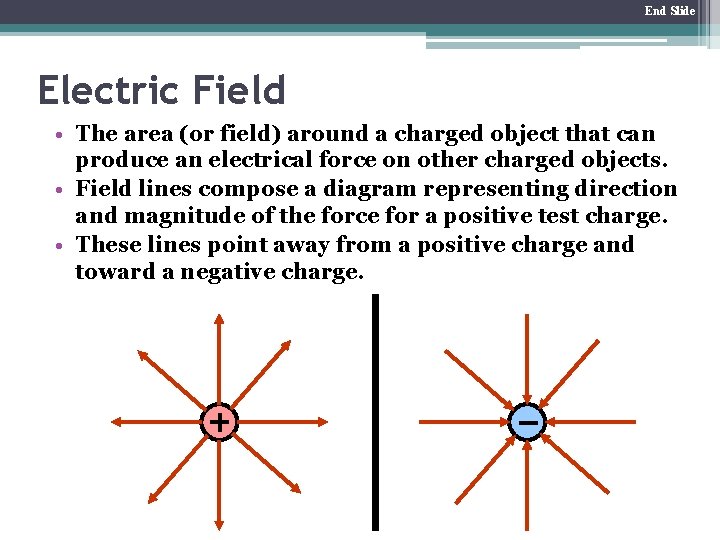
End Slide Electric Field • The area (or field) around a charged object that can produce an electrical force on other charged objects. • Field lines compose a diagram representing direction and magnitude of the force for a positive test charge. • These lines point away from a positive charge and toward a negative charge.
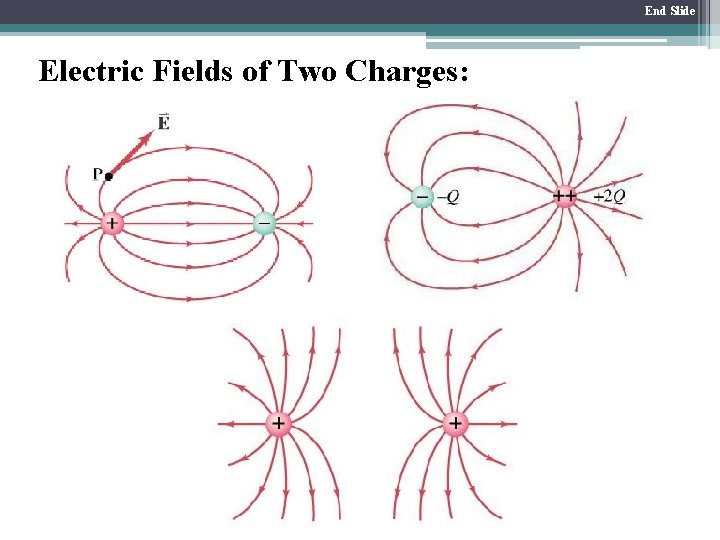
End Slide Electric Fields of Two Charges:
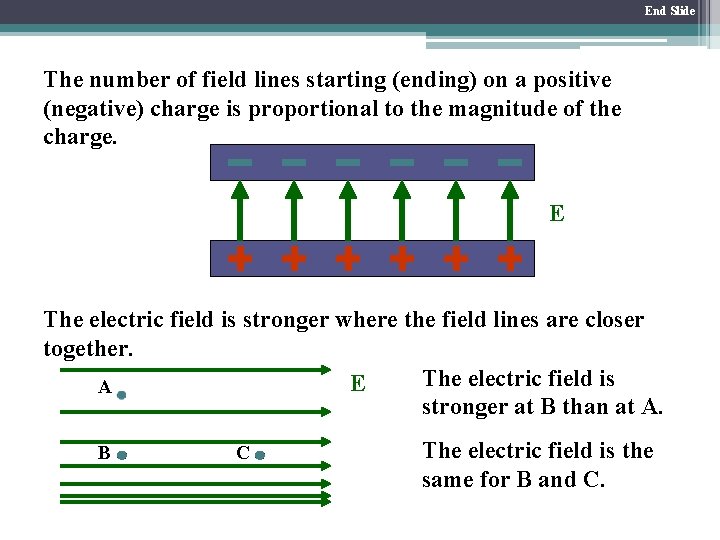
End Slide The number of field lines starting (ending) on a positive (negative) charge is proportional to the magnitude of the charge. E The electric field is stronger where the field lines are closer together. The electric field is E A stronger at B than at A. B C The electric field is the same for B and C.
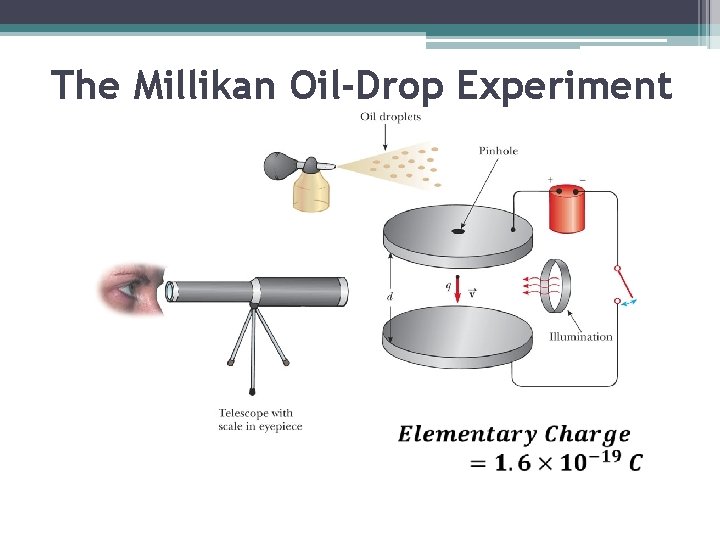
The Millikan Oil-Drop Experiment
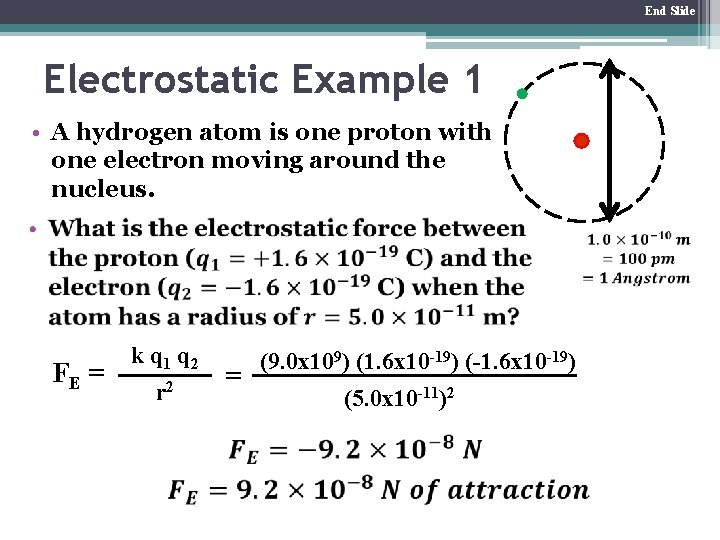
End Slide Electrostatic Example 1 • A hydrogen atom is one proton with one electron moving around the nucleus. FE = k q 1 q 2 r 2 = (9. 0 x 109) (1. 6 x 10 -19) (-1. 6 x 10 -19) (5. 0 x 10 -11)2
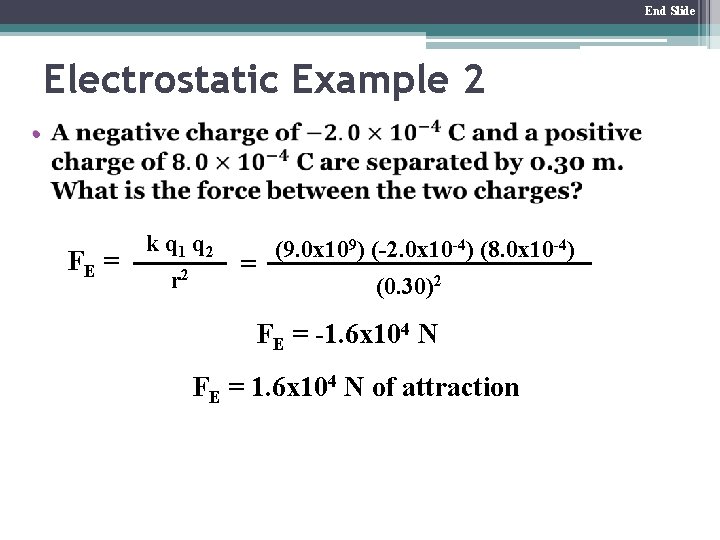
End Slide Electrostatic Example 2 • FE = k q 1 q 2 r 2 = (9. 0 x 109) (-2. 0 x 10 -4) (8. 0 x 10 -4) (0. 30)2 FE = -1. 6 x 10⁴ N FE = 1. 6 x 10⁴ N of attraction
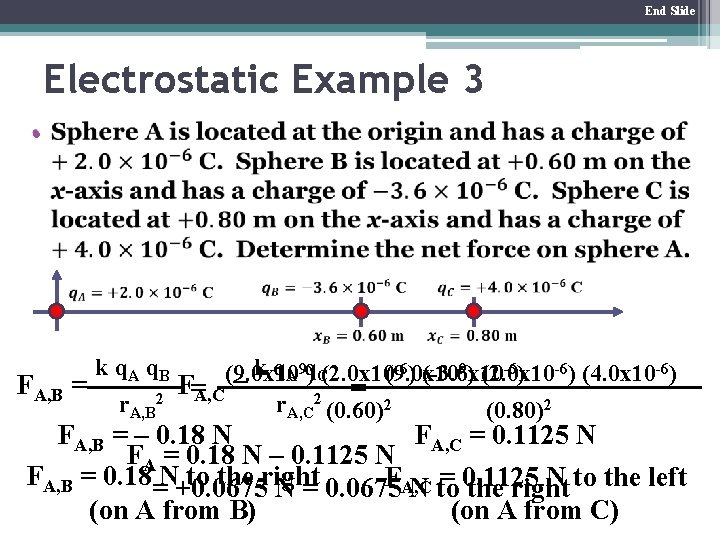
End Slide Electrostatic Example 3 • FA, B = k q A q. B r. A, B 2 -6) (-3. 6 x 10 9) (2. 0 x 10 -6) (4. 0 x 10 -6) k q. A 9 q) C(2. 0 x 10(9. 0 x 10 F=A, C = = r. A, C 2 (0. 60)2 (0. 80)2 FA, B = – 0. 18 N FA, C = 0. 1125 N FA = 0. 18 N – 0. 1125 N FA, B = 0. 18=N+0. 0675 to the right FA, C = 0. 1125 N to the left N = 0. 0675 N to the right (on A from B) (on A from C)
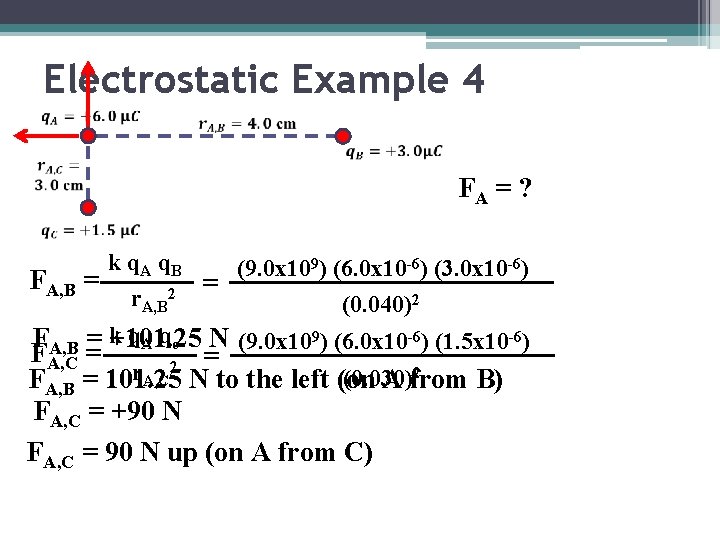
Electrostatic Example 4 FA = ? FA, B = k q A q. B r. A, B 2 = (9. 0 x 109) (6. 0 x 10 -6) (3. 0 x 10 -6) (0. 040)2 q. A qc N (9. 0 x 109) (6. 0 x 10 -6) (1. 5 x 10 -6) FA, B = k+101. 25 FA, C = = 2 2 r A, C N to the left (on (0. 030) FA, B = 101. 25 A from B) FA, C = +90 N FA, C = 90 N up (on A from C)
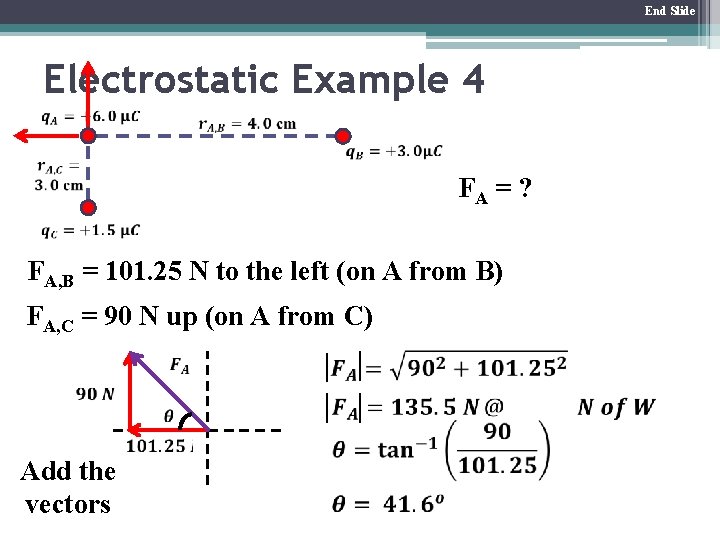
End Slide Electrostatic Example 4 FA = ? FA, B = 101. 25 N to the left (on A from B) FA, C = 90 N up (on A from C) Add the vectors
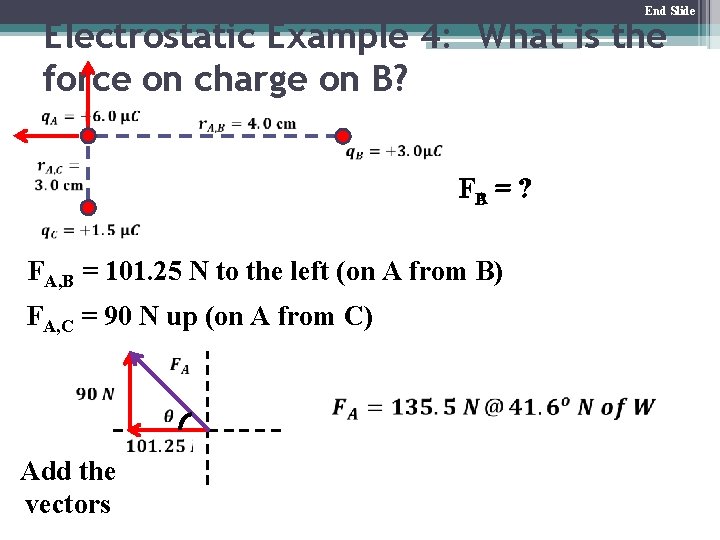
End Slide Electrostatic Example 4: What is the force on charge on B? FBA = ? FA, B = 101. 25 N to the left (on A from B) FA, C = 90 N up (on A from C) Add the vectors
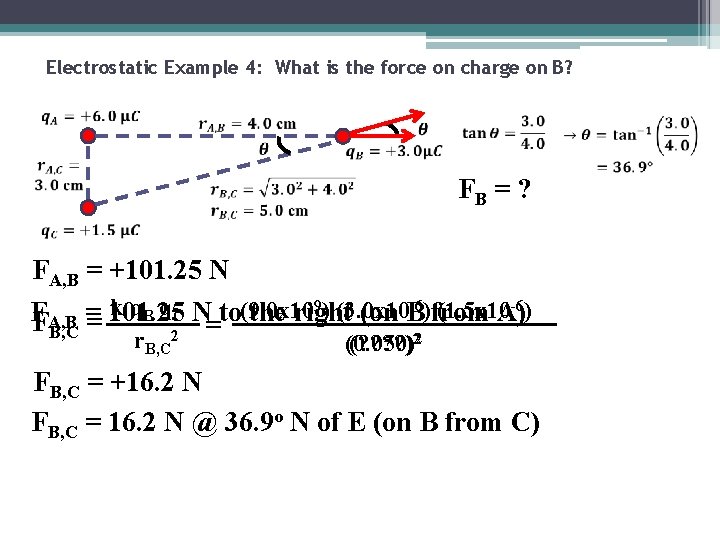
Electrostatic Example 4: What is the force on charge on B? FB = ? FA, B = +101. 25 N 9) (3. 0 x 10 -6) (1. 5 x 10 -6) k q. B q. C N to(9. 0 x 10 F = 101. 25 the right (on B from A) FA, B = = B, C r. B, C 2 (0. 050) (? ? )22 FB, C = +16. 2 N FB, C = 16. 2 N @ 36. 9 o N of E (on B from C)
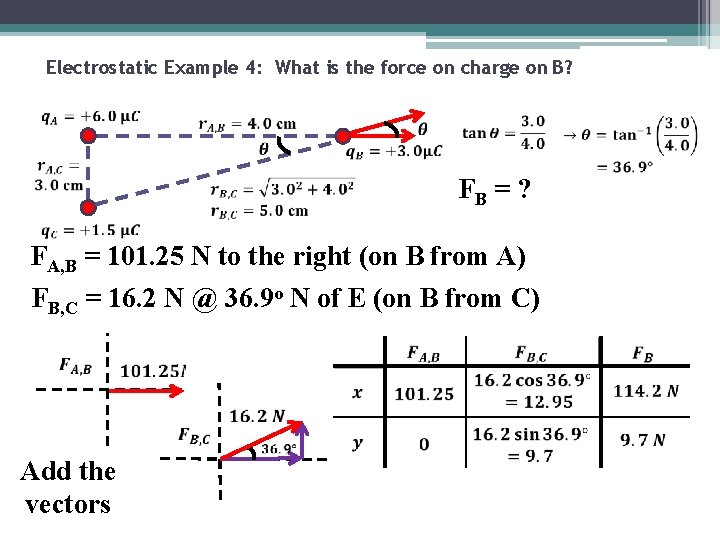
Electrostatic Example 4: What is the force on charge on B? FB = ? FA, B = 101. 25 N to the right (on B from A) FB, C = 16. 2 N @ 36. 9 o N of E (on B from C) Add the vectors
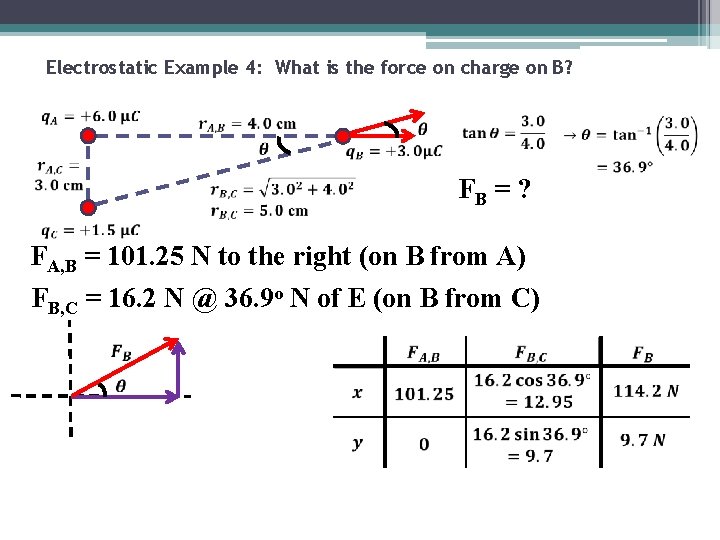
Electrostatic Example 4: What is the force on charge on B? FB = ? FA, B = 101. 25 N to the right (on B from A) FB, C = 16. 2 N @ 36. 9 o N of E (on B from C)
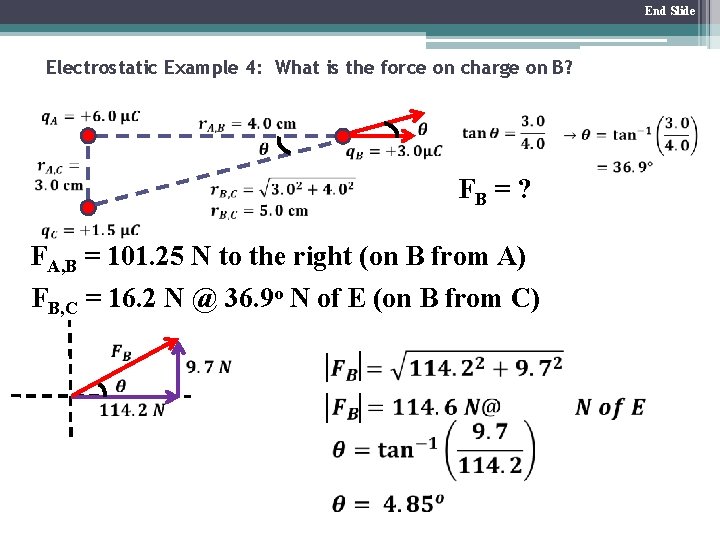
End Slide Electrostatic Example 4: What is the force on charge on B? FB = ? FA, B = 101. 25 N to the right (on B from A) FB, C = 16. 2 N @ 36. 9 o N of E (on B from C)
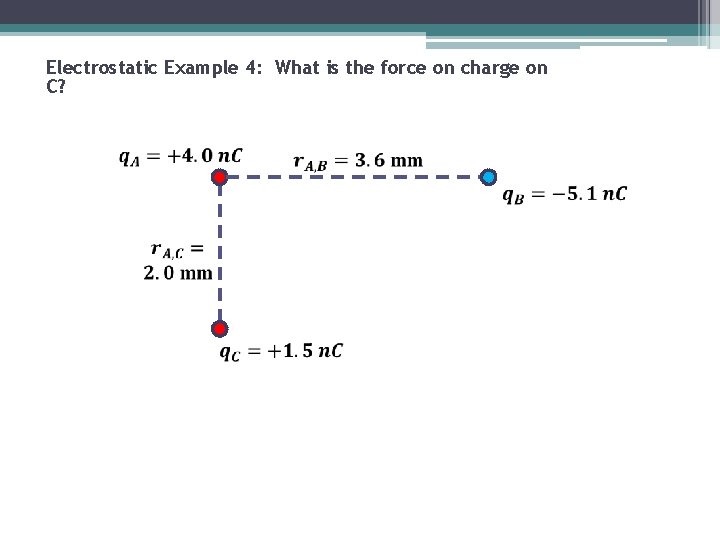
Electrostatic Example 4: What is the force on charge on C?