
Electrostatic septa design and development at CERN J
![1. CERN electrostatic septa inventory Unom [k. V] Upeak [k. V] Enom [MV/m] Gap](https://slidetodoc.com/presentation_image_h2/59d9321a7f3bee787576db6b772f4738/image-5.jpg "1. CERN electrostatic septa inventory Unom [k. V] Upeak [k. V] Enom [MV/m] Gap")
![Maximum field tests Septum Cathode Max. Voltage [k. V] Gap [mm] Max. Field [MV/m]](https://slidetodoc.com/presentation_image_h2/59d9321a7f3bee787576db6b772f4738/image-14.jpg "Maximum field tests Septum Cathode Max. Voltage [k. V] Gap [mm] Max. Field [MV/m]")
![Increase of vacuum pumping For LIU-SPS project, ZS are being upgraded [6]. Present 2](https://slidetodoc.com/presentation_image_h2/59d9321a7f3bee787576db6b772f4738/image-23.jpg "Increase of vacuum pumping For LIU-SPS project, ZS are being upgraded [6]. Present 2")
- Slides: 40
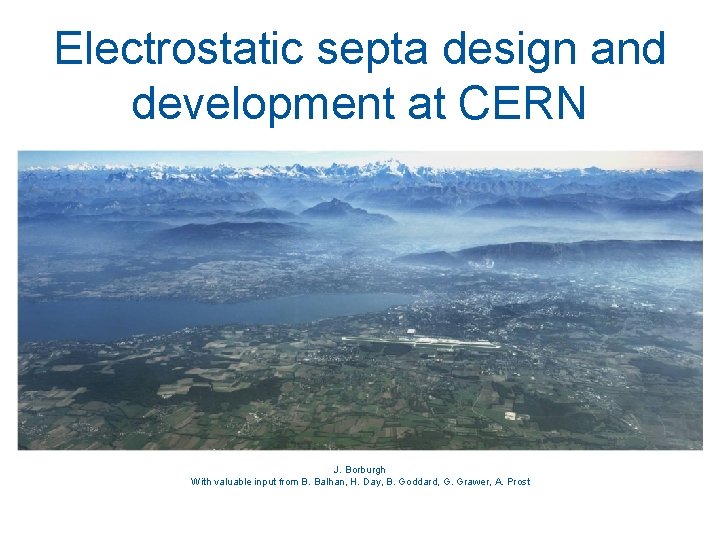
Electrostatic septa design and development at CERN J. Borburgh With valuable input from B. Balhan, H. Day, B. Goddard, G. Grawer, A. Prost
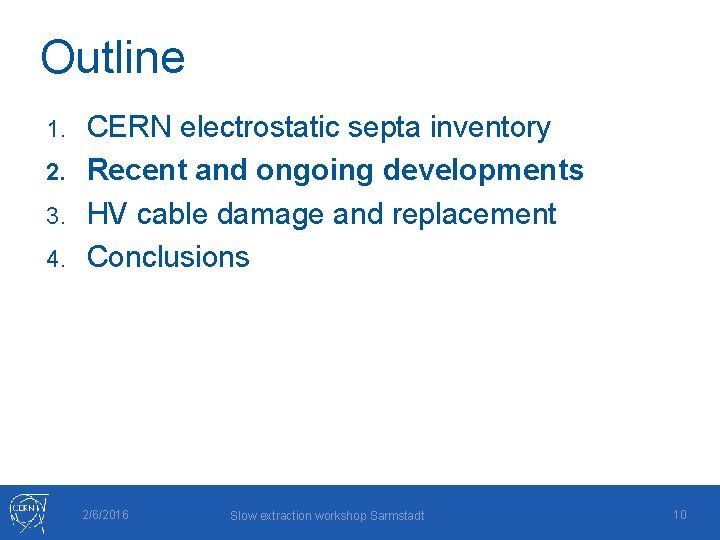
Outline CERN electrostatic septa inventory 2. Recent and ongoing developments 3. HV cable damage and replacement 4. Conclusions 1. 2/6/2016 Slow extraction workshop Sarmstadt 3
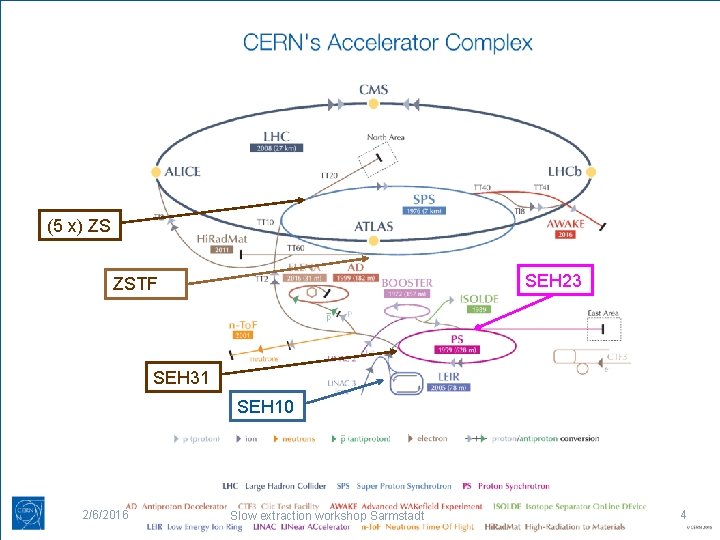
(5 x) ZS SEH 23 ZSTF SEH 31 SEH 10 2/6/2016 Slow extraction workshop Sarmstadt 4
1. CERN electrostatic septa inventory Unom [k. V] Upeak [k. V] Enom [MV/m] Gap nom. [mm] Cathode length [mm] Vacuum Bake [mbar] out [°C] Cathode Septum LEIR, 70 SEH 10 120 1. 8 40 720 10 -12 300 Ti Mo foil 100 µm PS, 170 SEH 23 250 10 17 778 10 -9 90 Al (s. a)* Mo foil 100 µm PS, 180 SEH 31 250 9 20 1850 10 -9 - Al (c. a)** Mo foil 100 µm SPS, ZS 220 280 11 20 3000 10 -9 90 Al (c. a)** WRe wire 60 µm 100 µm SPS, ZSTF 220 280 11 20 3000 10 -9 90 Al (c. a)** WRe wire 60 µm *c. a: chromic acid anodisation, **s. a: sulphuric acid anodisation Upeak used for conditioning prior to operation 2/6/2016 Slow extraction workshop Sarmstadt 5
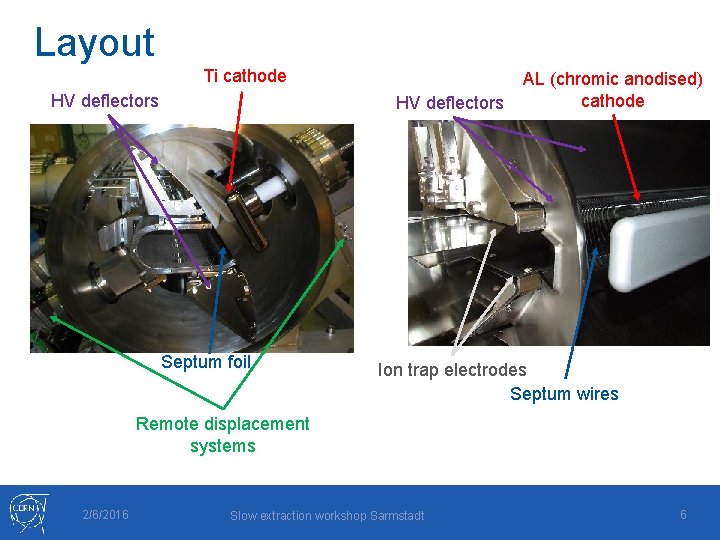
Layout Ti cathode HV deflectors Septum foil AL (chromic anodised) cathode Ion trap electrodes Septum wires Remote displacement systems 2/6/2016 Slow extraction workshop Sarmstadt 6
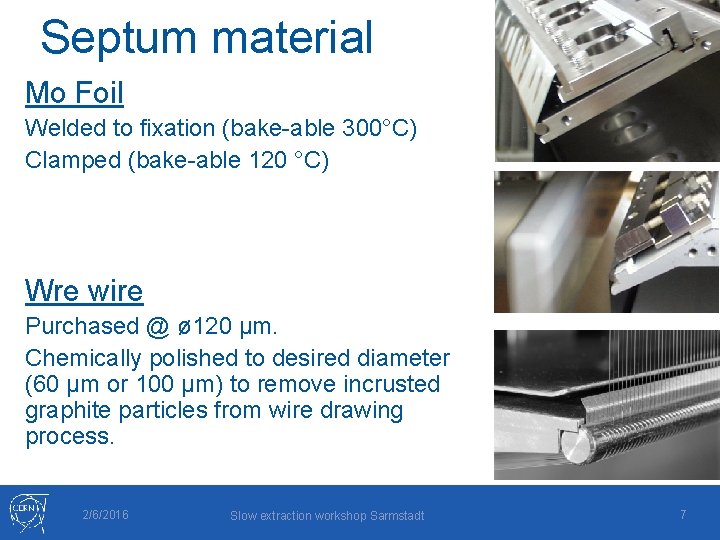
Septum material Mo Foil Welded to fixation (bake-able 300°C) Clamped (bake-able 120 °C) Wre wire Purchased @ ø 120 µm. Chemically polished to desired diameter (60 µm or 100 µm) to remove incrusted graphite particles from wire drawing process. 2/6/2016 Slow extraction workshop Sarmstadt 7
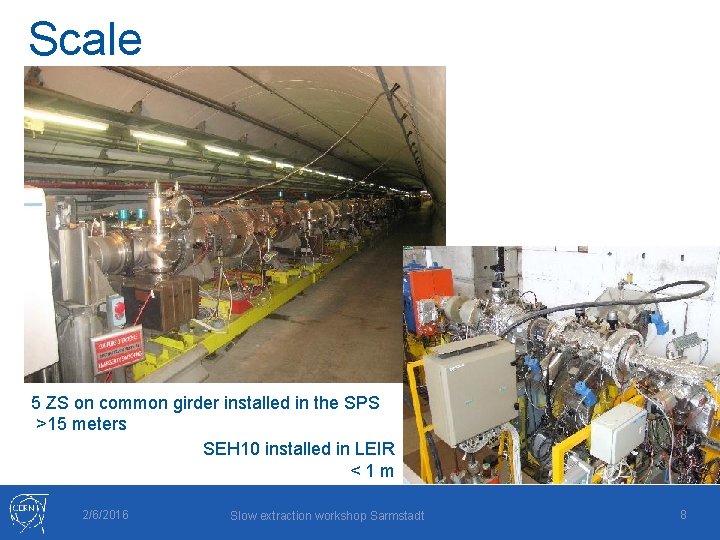
Scale 5 ZS on common girder installed in the SPS >15 meters SEH 10 installed in LEIR <1 m 2/6/2016 Slow extraction workshop Sarmstadt 8
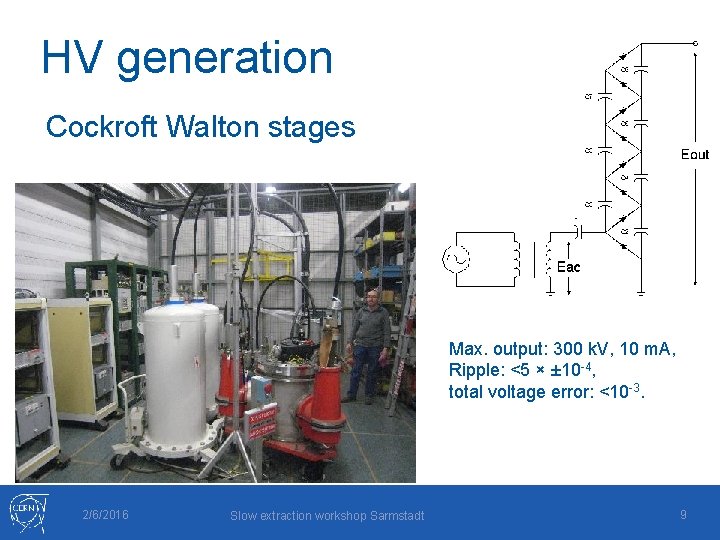
HV generation Cockroft Walton stages Max. output: 300 k. V, 10 m. A, Ripple: <5 × ± 10 -4, total voltage error: <10 -3. 2/6/2016 Slow extraction workshop Sarmstadt 9
Outline CERN electrostatic septa inventory 2. Recent and ongoing developments 3. HV cable damage and replacement 4. Conclusions 1. 2/6/2016 Slow extraction workshop Sarmstadt 10
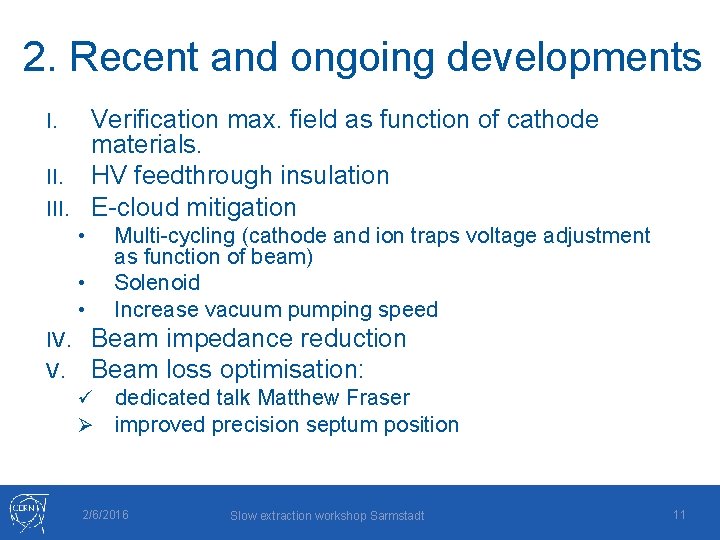
2. Recent and ongoing developments Verification max. field as function of cathode materials. II. HV feedthrough insulation III. E-cloud mitigation I. Multi-cycling (cathode and ion traps voltage adjustment as function of beam) Solenoid Increase vacuum pumping speed • • • IV. V. Beam impedance reduction Beam loss optimisation: ü Ø dedicated talk Matthew Fraser improved precision septum position 2/6/2016 Slow extraction workshop Sarmstadt 11
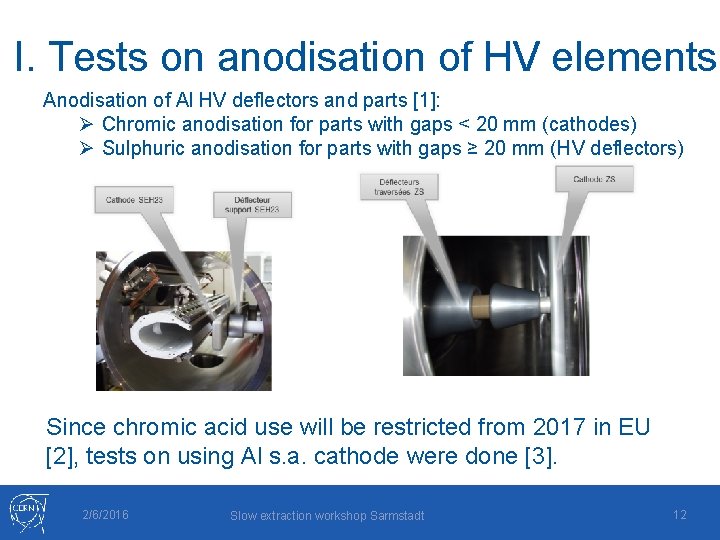
I. Tests on anodisation of HV elements Anodisation of Al HV deflectors and parts [1]: Ø Chromic anodisation for parts with gaps < 20 mm (cathodes) Ø Sulphuric anodisation for parts with gaps ≥ 20 mm (HV deflectors) Since chromic acid use will be restricted from 2017 in EU [2], tests on using Al s. a. cathode were done [3]. 2/6/2016 Slow extraction workshop Sarmstadt 12
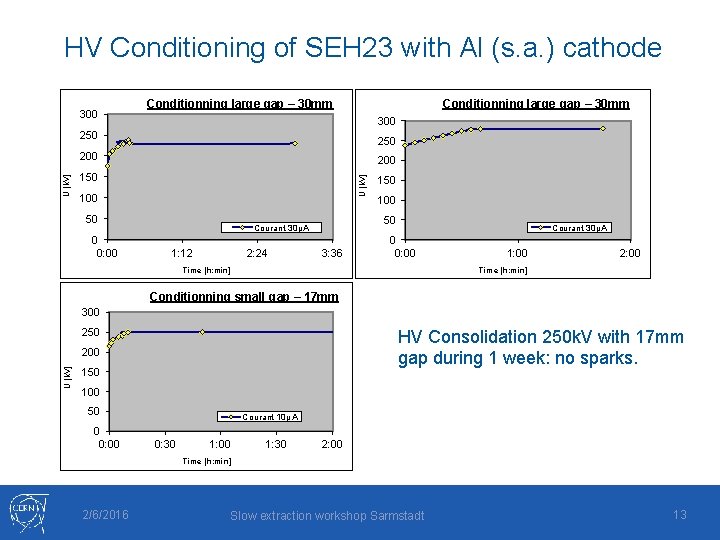
HV Conditioning of SEH 23 with Al (s. a. ) cathode 300 Conditionning large gap – 30 mm 300 250 200 150 U [k. V] 200 100 50 0 0: 00 2: 24 100 50 Courant 30µA 1: 12 150 3: 36 Courant 30µA 0 0: 00 Time [h: min] 1: 00 2: 00 Time [h: min] Conditionning small gap – 17 mm 300 HV Consolidation 250 k. V with 17 mm gap during 1 week: no sparks. 250 U [k. V] 200 150 100 50 0 0: 00 Courant 10µA 0: 30 1: 00 1: 30 2: 00 Time [h: min] 2/6/2016 Slow extraction workshop Sarmstadt 13
Maximum field tests Septum Cathode Max. Voltage [k. V] Gap [mm] Max. Field [MV/m] ZS Al c. a. 260 20 13 SEH 23/31 Al c. a. 250 17 14. 7 SEH 10 Ti 160 30 5. 5 / 6 SEH 23 test Al s. a. 250 17 14. 7 Ti results indicated without/with residual DC current, all other test results indicated where residual DC current <1µA. Tests were done without beam. 2/6/2016 Slow extraction workshop Sarmstadt 14
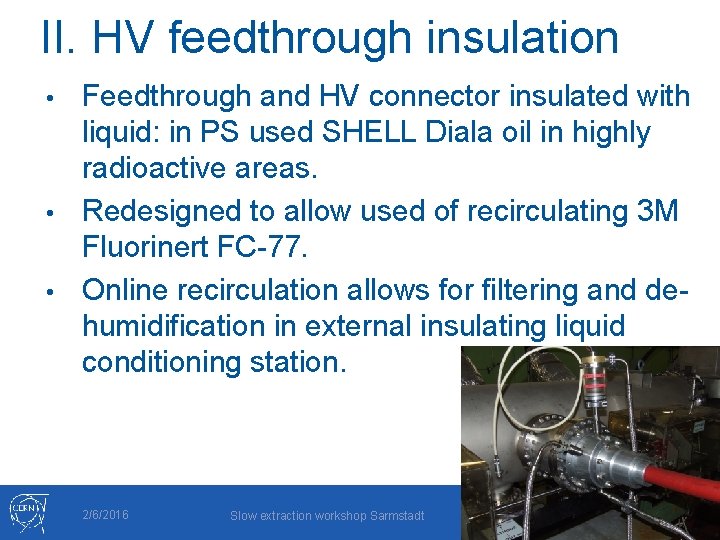
II. HV feedthrough insulation Feedthrough and HV connector insulated with liquid: in PS used SHELL Diala oil in highly radioactive areas. • Redesigned to allow used of recirculating 3 M Fluorinert FC-77. • Online recirculation allows for filtering and dehumidification in external insulating liquid conditioning station. • 2/6/2016 Slow extraction workshop Sarmstadt 15
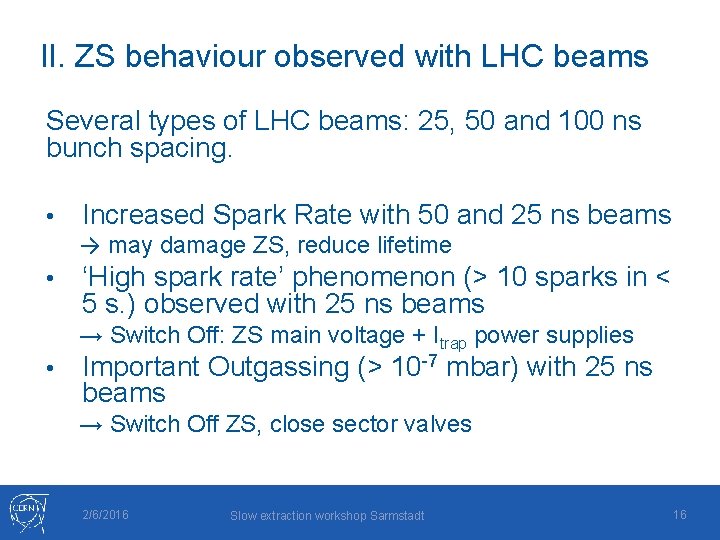
II. ZS behaviour observed with LHC beams Several types of LHC beams: 25, 50 and 100 ns bunch spacing. • Increased Spark Rate with 50 and 25 ns beams → may damage ZS, reduce lifetime • ‘High spark rate’ phenomenon (> 10 sparks in < 5 s. ) observed with 25 ns beams → Switch Off: ZS main voltage + Itrap power supplies • Important Outgassing (> 10 -7 mbar) with 25 ns beams → Switch Off ZS, close sector valves 2/6/2016 Slow extraction workshop Sarmstadt 16
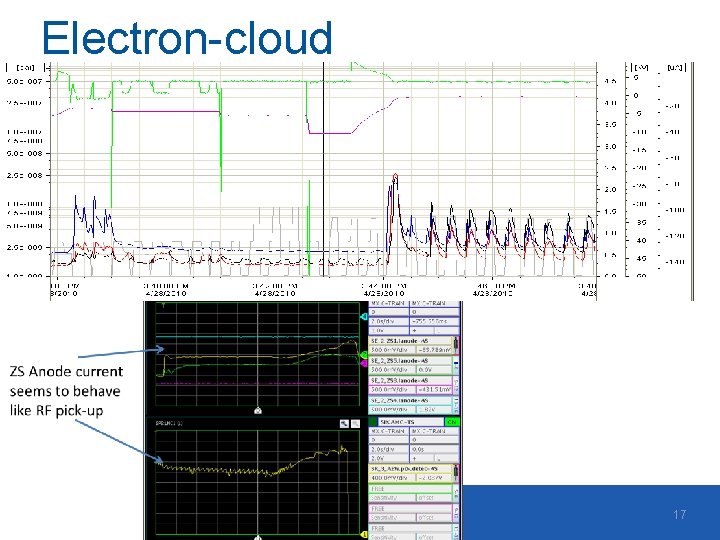
Electron-cloud Since 2002 incident, where ZS was damaged by scrubbing, ZS were used in ‘retracted’ position and with Ion trap Voltage on and main cathode HV generator on at 0 k. V. Anode seems to behave as RF pick-up, as observed in measured anode current. Depending on beam, a lot of vacuum activity is observed in ZS tanks. By applying ≥ ~10 k. V main field (!) the vacuum activity can be reduced. 2/6/2016 Slow extraction workshop Sarmstadt 17
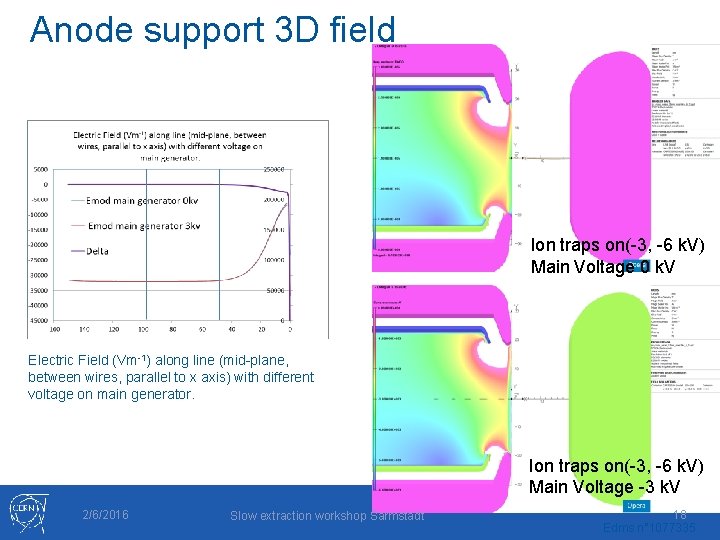
Anode support 3 D field Ion traps on(-3, -6 k. V) Main Voltage 0 k. V Electric Field (Vm-1) along line (mid-plane, between wires, parallel to x axis) with different voltage on main generator. Ion traps on(-3, -6 k. V) Main Voltage -3 k. V 2/6/2016 Slow extraction workshop Sarmstadt 18 Edms n° 1077335
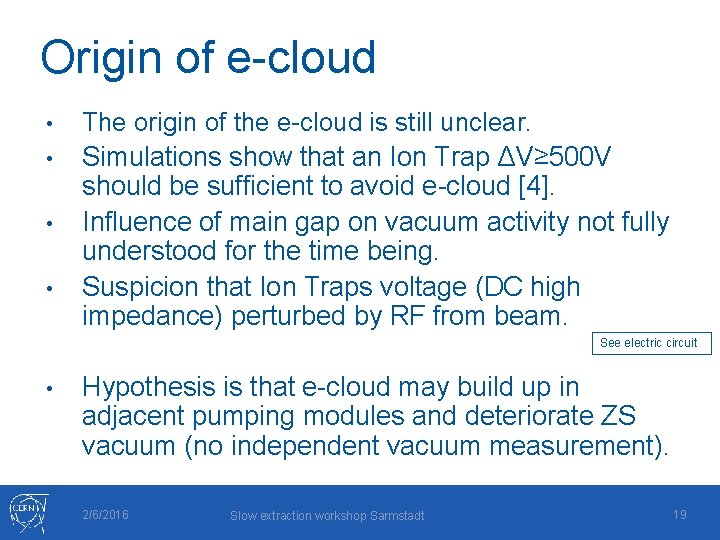
Origin of e-cloud • • The origin of the e-cloud is still unclear. Simulations show that an Ion Trap ΔV≥ 500 V should be sufficient to avoid e-cloud [4]. Influence of main gap on vacuum activity not fully understood for the time being. Suspicion that Ion Traps voltage (DC high impedance) perturbed by RF from beam. See electric circuit • Hypothesis is that e-cloud may build up in adjacent pumping modules and deteriorate ZS vacuum (no independent vacuum measurement). 2/6/2016 Slow extraction workshop Sarmstadt 19
Multi-cycling To reduce vacuum activity as well as spark rate: ü a dynamic cycling for ion trap and main field voltages was developed and deployed, ü dynamically adapt trip levels and interlock settings, as a function of the beam (type) in the machine. 2/6/2016 Slow extraction workshop Sarmstadt 20
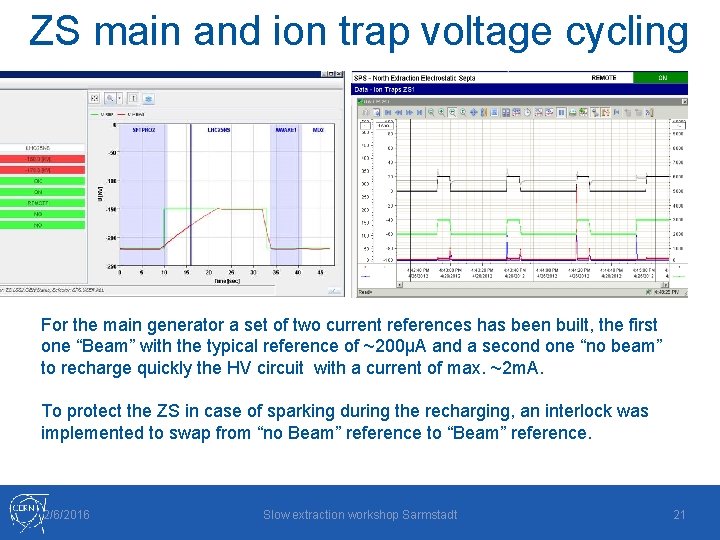
ZS main and ion trap voltage cycling For the main generator a set of two current references has been built, the first one “Beam” with the typical reference of ~200µA and a second one “no beam” to recharge quickly the HV circuit with a current of max. ~2 m. A. To protect the ZS in case of sparking during the recharging, an interlock was implemented to swap from “no Beam” reference to “Beam” reference. 2/6/2016 Slow extraction workshop Sarmstadt 21
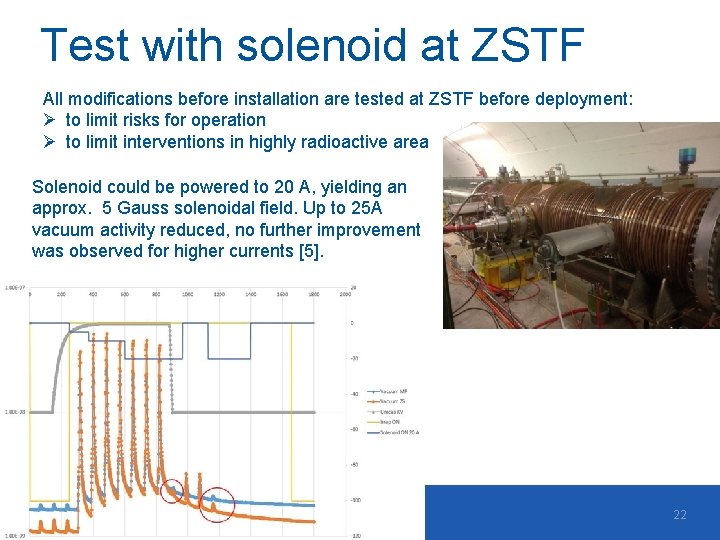
Test with solenoid at ZSTF All modifications before installation are tested at ZSTF before deployment: Ø to limit risks for operation Ø to limit interventions in highly radioactive area Solenoid could be powered to 20 A, yielding an approx. 5 Gauss solenoidal field. Up to 25 A vacuum activity reduced, no further improvement was observed for higher currents [5]. 2/6/2016 Slow extraction workshop Sarmstadt 22
Increase of vacuum pumping For LIU-SPS project, ZS are being upgraded [6]. Present 2 x 400 l/s ion pumps, installed on neighbouring Pumping Modules. Upgrade (2019/2020) 2 x 500 l/s ion pump, 2 NEG cartridges (1000 l/s), installed directly on the ZS tanks. 2/6/2016 Slow extraction workshop Sarmstadt 23
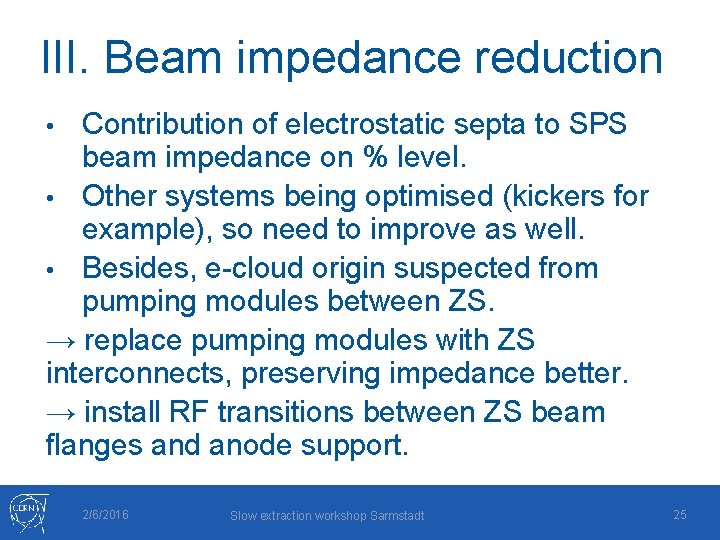
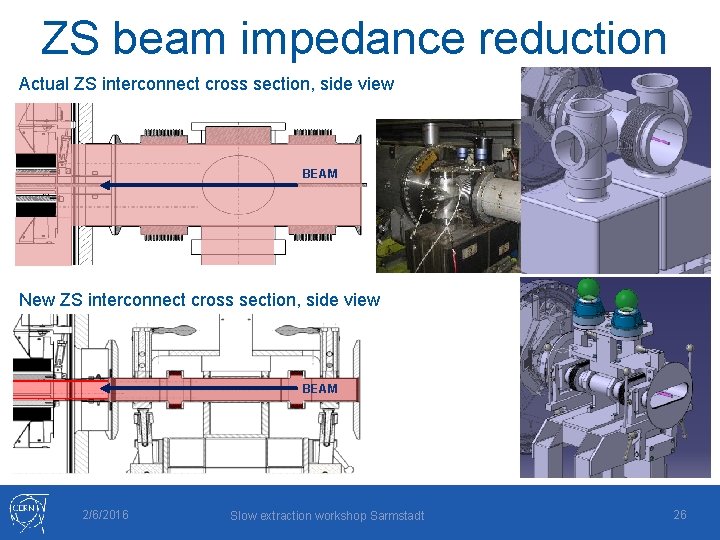
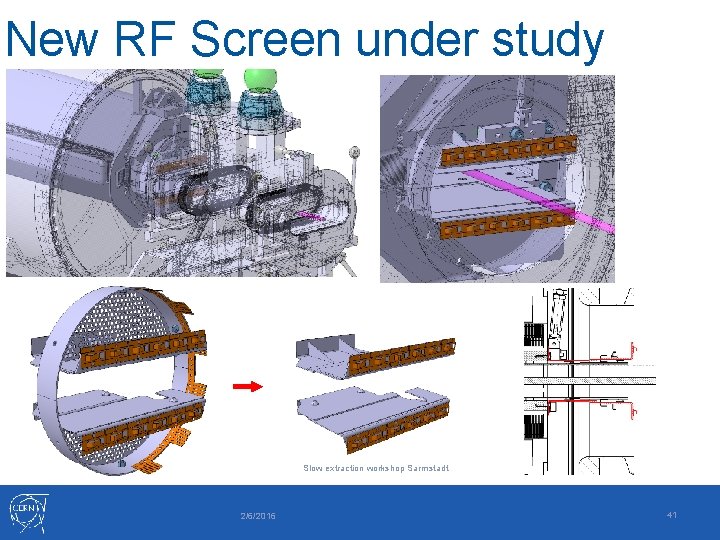
III. Beam impedance reduction Contribution of electrostatic septa to SPS beam impedance on % level. • Other systems being optimised (kickers for example), so need to improve as well. • Besides, e-cloud origin suspected from pumping modules between ZS. → replace pumping modules with ZS interconnects, preserving impedance better. → install RF transitions between ZS beam flanges and anode support. • 2/6/2016 Slow extraction workshop Sarmstadt 25
ZS beam impedance reduction Actual ZS interconnect cross section, side view BEAM New ZS interconnect cross section, side view BEAM 2/6/2016 Slow extraction workshop Sarmstadt 26
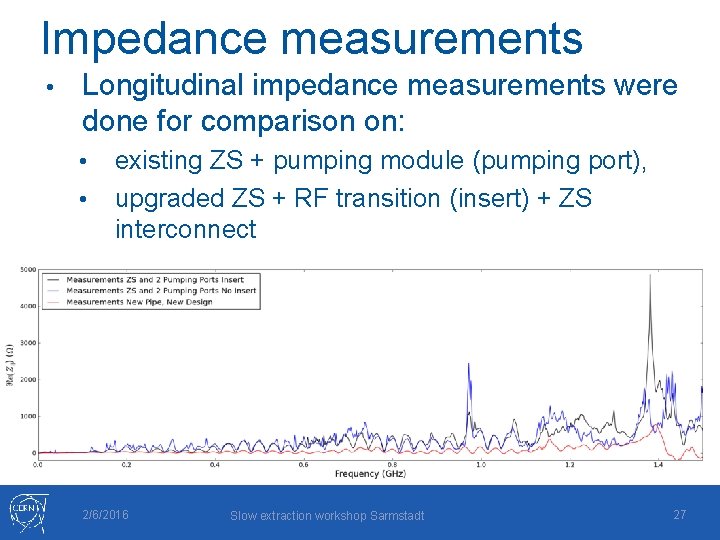
Impedance measurements • Longitudinal impedance measurements were done for comparison on: • • existing ZS + pumping module (pumping port), upgraded ZS + RF transition (insert) + ZS interconnect 2/6/2016 Slow extraction workshop Sarmstadt 27
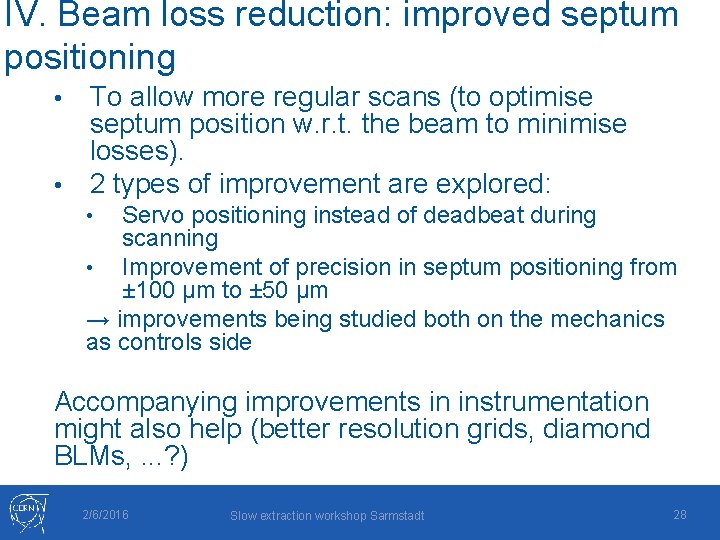
IV. Beam loss reduction: improved septum positioning To allow more regular scans (to optimise septum position w. r. t. the beam to minimise losses). • 2 types of improvement are explored: • Servo positioning instead of deadbeat during scanning • Improvement of precision in septum positioning from ± 100 µm to ± 50 µm → improvements being studied both on the mechanics as controls side • Accompanying improvements in instrumentation might also help (better resolution grids, diamond BLMs, . . . ? ) 2/6/2016 Slow extraction workshop Sarmstadt 28
Outline CERN electrostatic septa inventory 2. Recent and ongoing developments 3. HV cable damage and replacement 4. Conclusions 1. 2/6/2016 Slow extraction workshop Sarmstadt 29
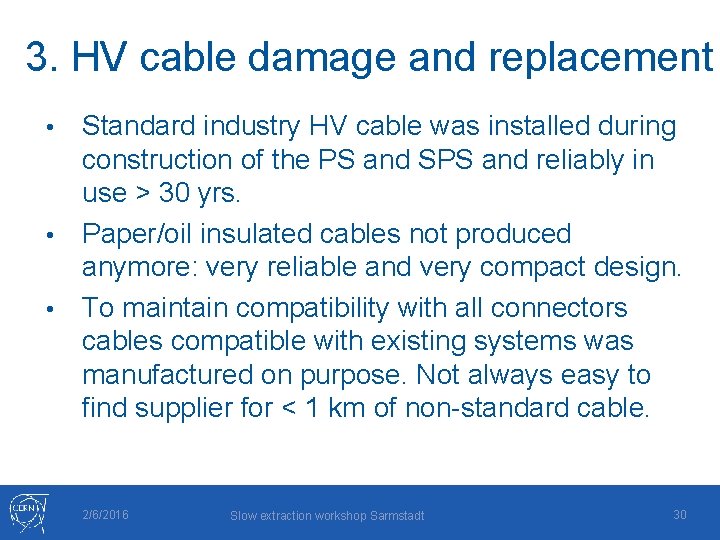
3. HV cable damage and replacement Standard industry HV cable was installed during construction of the PS and SPS and reliably in use > 30 yrs. • Paper/oil insulated cables not produced anymore: very reliable and very compact design. • To maintain compatibility with all connectors cables compatible with existing systems was manufactured on purpose. Not always easy to find supplier for < 1 km of non-standard cable. • 2/6/2016 Slow extraction workshop Sarmstadt 30
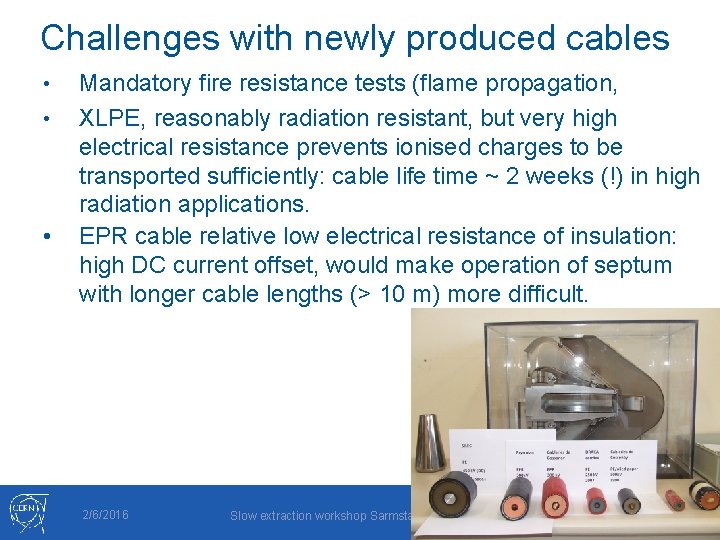
Challenges with newly produced cables • • • Mandatory fire resistance tests (flame propagation, XLPE, reasonably radiation resistant, but very high electrical resistance prevents ionised charges to be transported sufficiently: cable life time ~ 2 weeks (!) in high radiation applications. EPR cable relative low electrical resistance of insulation: high DC current offset, would make operation of septum with longer cable lengths (> 10 m) more difficult. 2/6/2016 Slow extraction workshop Sarmstadt 31
Cable specifications In past dedicated CERN specifications used. • More recently, specifications based on IEC norm ( for ex. 60840) for AC cables. • Since 2012, CIGRE recommendation 496 published for DC cables up to 500 k. V, and more suppliers are getting familiar and equipped for tests • → added pre-qualification: 1 yr → partial discharge and impulse test not included 2/6/2016 Slow extraction workshop Sarmstadt 32
CERN HV cable consolidation PS now using recent and modern technology cable. MTBF getting longer again (from <1 yr to several years). • SPS tunnel cables are to be renewed. Link between surface and tunnel (> 40 yrs old) planned to be replaced at end of this decade. • 2/6/2016 Slow extraction workshop Sarmstadt 33
Outline CERN electrostatic septa inventory 2. Recent and ongoing developments 3. HV cable damage and replacement 4. Conclusions 1. 2/6/2016 Slow extraction workshop Sarmstadt 34
4. Conclusions • • • Efforts on electrostatic septa diluted over time, also due to available time/resources. In last 10 years efforts mainly focussed on HV cables to increase MTBF. Efforts now directed to improve spark rate and reduce vacuum activity on SPS wire septa with LHC beams. Beam impedance being reduced for SPS septa. Results of consolidation and upgrade efforts should be available to operation after LS 2. 2/6/2016 Slow extraction workshop Sarmstadt 35
References 1. 2. 3. 4. 5. 6. C. Germain et al. , “Technical developments of the CERN electrostatic program”, 2 nd Int. Symp. On Insulation of High Voltages in Vacuum, p. 279 -291, Boston (1966). ECHA Annex XIV of REACH (authorisation list) of 11/1/2016: Sunset date Chromic acid, EC number 231801 -5: 21/9/2017 A. Prost, TE-ABT-SE Section meeting 4/5/2016, Indico. cern. ch/event/505577 G. Rumolo, “E-cloud build up simulations for ZS”, SPSU study group meeting, 22 April 2010 B. Balhan, J. Borburgh, “Observations and measurements on the ZS during the SPS MD”, SUSG meeting 20 May 2010, CERN edms 1079513 B. Balhan, TE-ABT-SE Section meeting 4/5/2016, Indico. cern. ch/event/505577 2/6/2016 Slow extraction workshop Sarmstadt 36
Back up slides 2/6/2016 Slow extraction workshop Sarmstadt 37
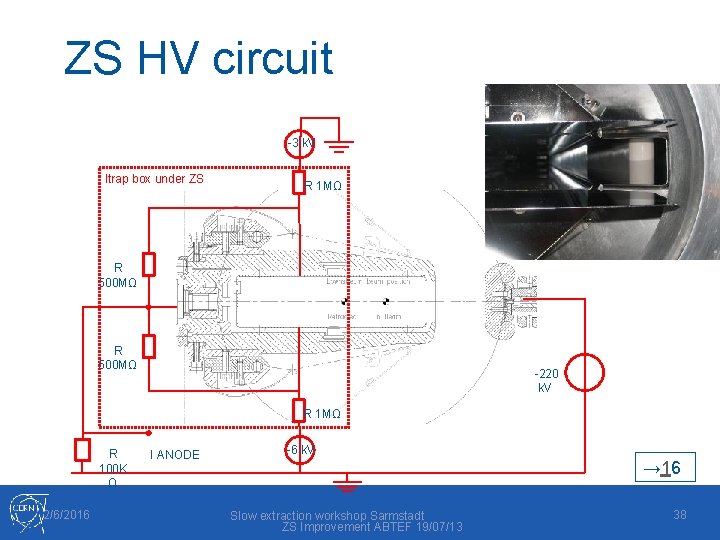
ZS HV circuit -3 k. V Itrap box under ZS R 1 MΩ R 500 MΩ -220 k. V R 1 MΩ R 100 K Ω 2/6/2016 I ANODE -6 k. V → 16 Slow extraction workshop Sarmstadt ZS Improvement ABTEF 19/07/13 38
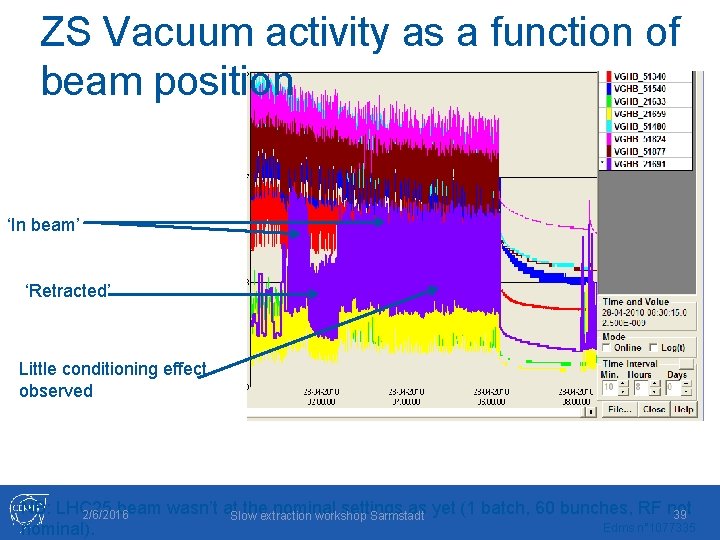
ZS Vacuum activity as a function of beam position ‘In beam’ ‘Retracted’ Little conditioning effect observed NB: LHC 25 beam wasn’t at. Slow theextraction nominal settings as yet (1 batch, 60 bunches, RF not 2/6/2016 39 workshop Sarmstadt Edms n° 1077335 nominal).
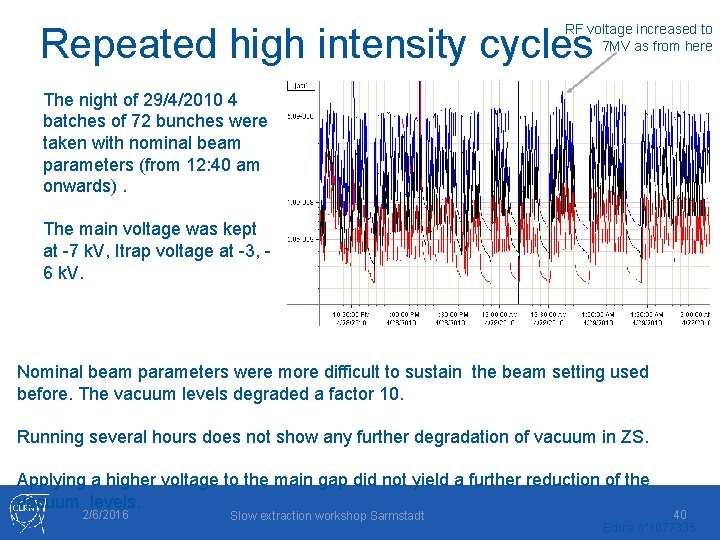
Repeated high intensity cycles RF voltage increased to 7 MV as from here The night of 29/4/2010 4 batches of 72 bunches were taken with nominal beam parameters (from 12: 40 am onwards). The main voltage was kept at -7 k. V, Itrap voltage at -3, 6 k. V. Nominal beam parameters were more difficult to sustain the beam setting used before. The vacuum levels degraded a factor 10. Running several hours does not show any further degradation of vacuum in ZS. Applying a higher voltage to the main gap did not yield a further reduction of the vacuum levels. 2/6/2016 Slow extraction workshop Sarmstadt 40 Edms n° 1077335
New RF Screen under study Slow extraction workshop Sarmstadt 2/6/2016 41