
Electrostatic Forces and Electric Fields Your Guide to

- Slides: 34
Electrostatic Forces and Electric Fields Your Guide to the Universe
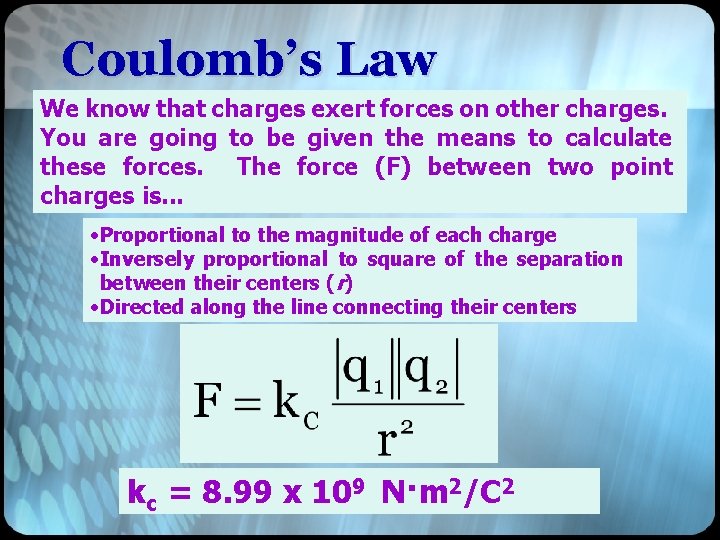
Coulomb’s Law We know that charges exert forces on other charges. You are going to be given the means to calculate these forces. The force (F) between two point charges is. . . • Proportional to the magnitude of each charge • Inversely proportional to square of the separation between their centers (r) • Directed along the line connecting their centers kc = 8. 99 x 109 N·m 2/C 2
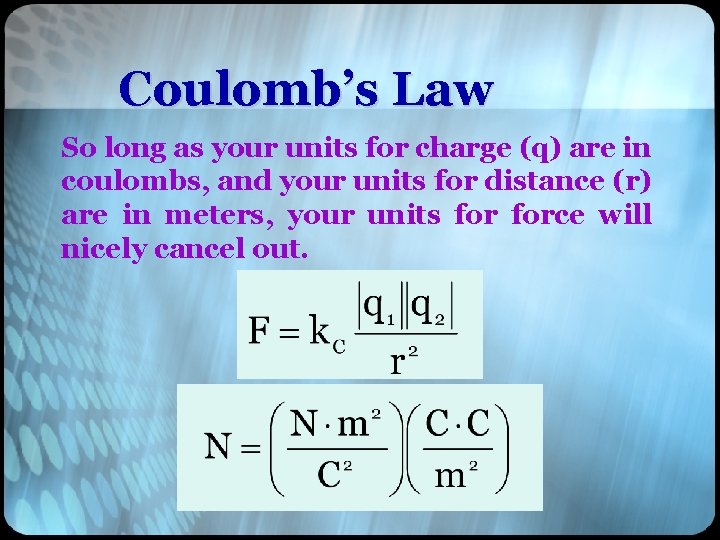
Coulomb’s Law So long as your units for charge (q) are in coulombs, and your units for distance (r) are in meters, your units force will nicely cancel out.
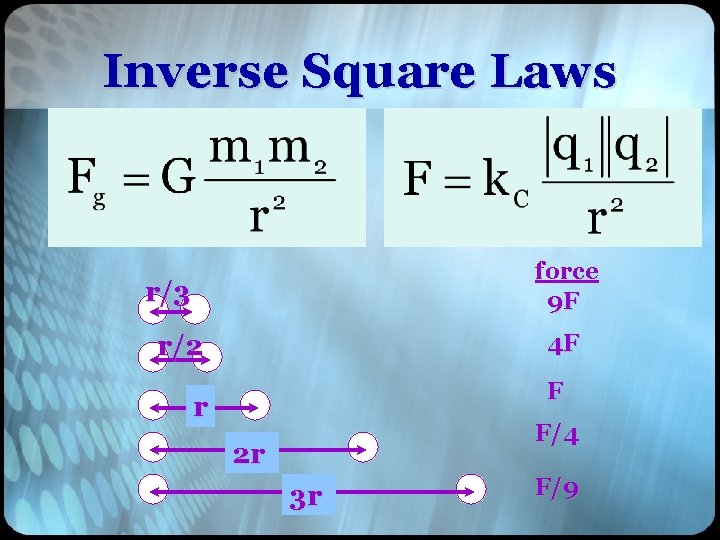
Inverse Square Laws force 9 F r/3 4 F r/2 F r F/4 2 r 3 r F/9
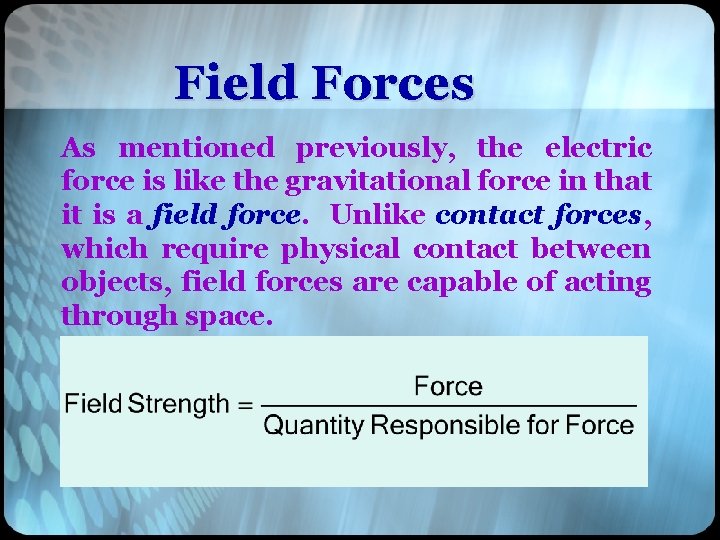
Field Forces As mentioned previously, the electric force is like the gravitational force in that it is a field force. Unlike contact forces, which require physical contact between objects, field forces are capable of acting through space.
Gravitational Fields The space surrounding any mass M may be considered to be a gravitational force field, meaning that any other mass located within this space will experience a force of attraction due to the mass M.
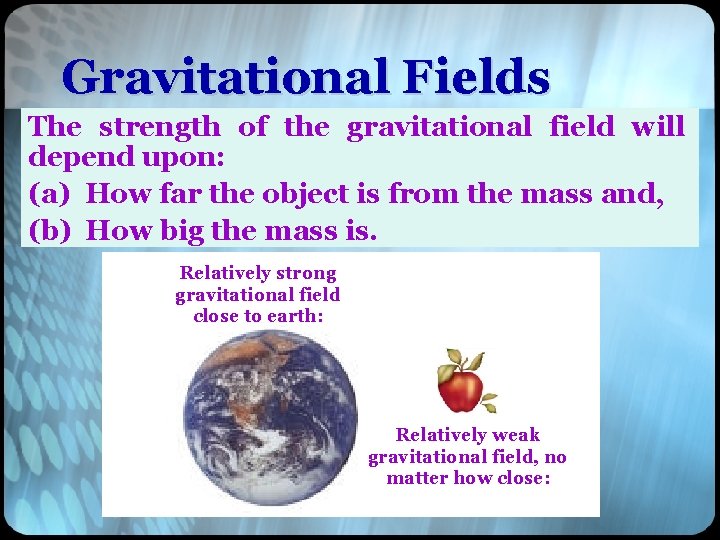
Gravitational Fields The strength of the gravitational field will depend upon: (a) How far the object is from the mass and, (b) How big the mass is. Relatively strong gravitational field close to earth: Relatively weak gravitational field, no matter how close:
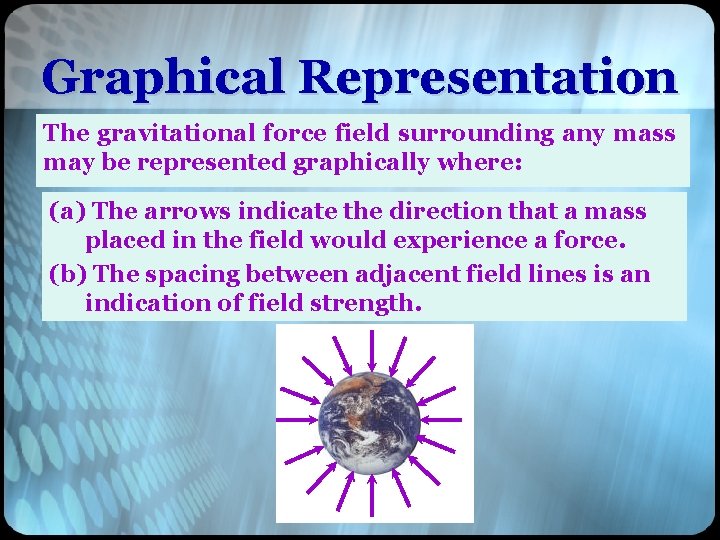
Graphical Representation The gravitational force field surrounding any mass may be represented graphically where: (a) The arrows indicate the direction that a mass placed in the field would experience a force. (b) The spacing between adjacent field lines is an indication of field strength.
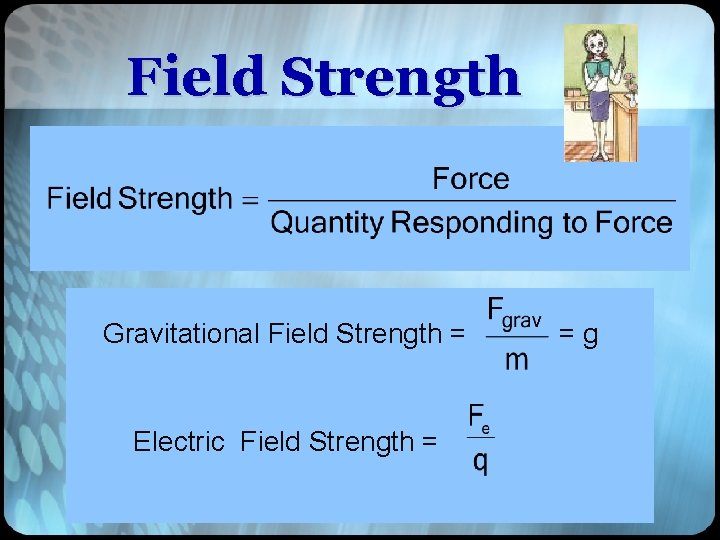
Field Strength Gravitational Field Strength = Electric Field Strength = =g
The Electric Field The space surrounding charged particles is an electric field, and can be represented graphically, similar to that of the gravitation field. A field can be read as a map indicating the direction and relative strength of a force on a positive charge placed in the field.
Graphical Representation For the electric field: (a) Arrows are drawn to indicate the direction of the force that would be experienced by a positive test charge placed in the field. (b) The spacing between adjacent arrows are an indication of the field strength. A greater line density means a stronger field strength.
Positive Test Charge A positive test charge is a tool used to help analyze an electric field. By placing a positive test charge in different locations, and asking, “What forces act on the test charge here? ”, you can start to map out the electric field. WHAT IF I moved over here? +
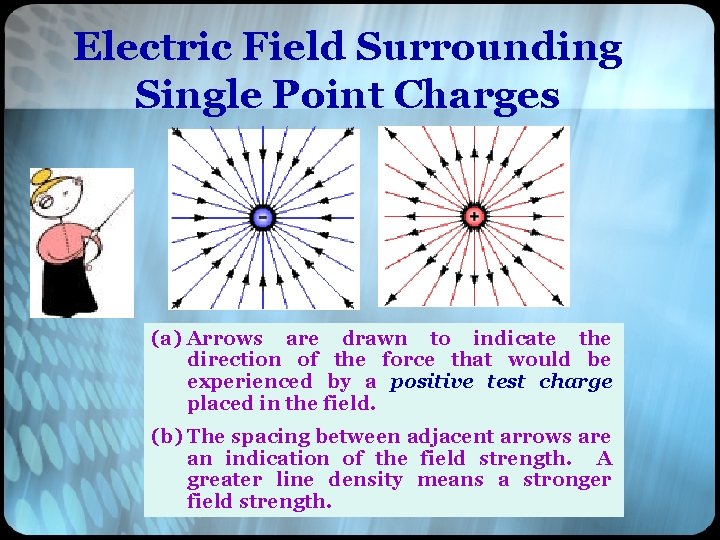
Electric Field Surrounding Single Point Charges (a) Arrows are drawn to indicate the direction of the force that would be experienced by a positive test charge placed in the field. (b) The spacing between adjacent arrows are an indication of the field strength. A greater line density means a stronger field strength.
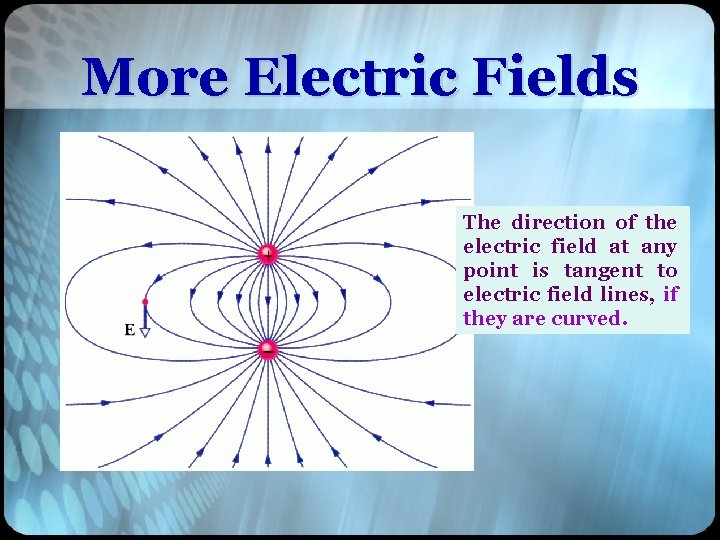
More Electric Fields The direction of the electric field at any point is tangent to electric field lines, if they are curved.
More Electric Fields
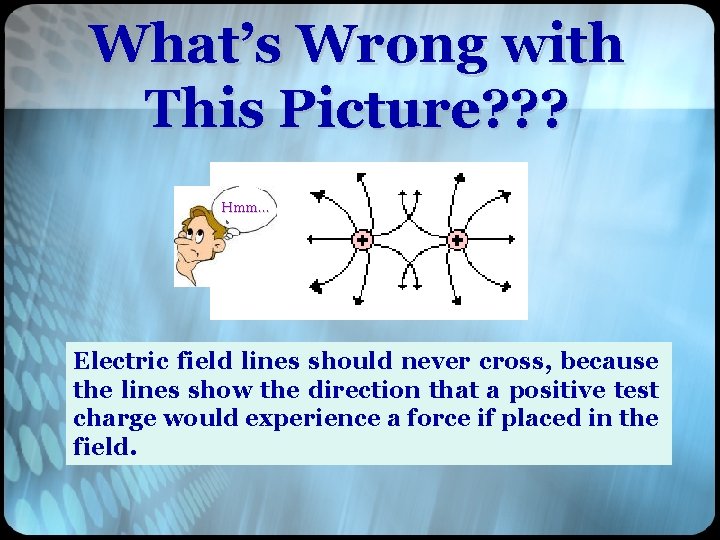
Rules for Drawing Electric Field Lines Hmm… 1. Lines must begin on positive charges or at infinity, and must terminate on negative charges or at infinity. 2. The number of lines drawn leaving a positive charge or terminating on a negative charge must be proportional to the size of the charge. 3. No two field lines from the same field can cross each other.
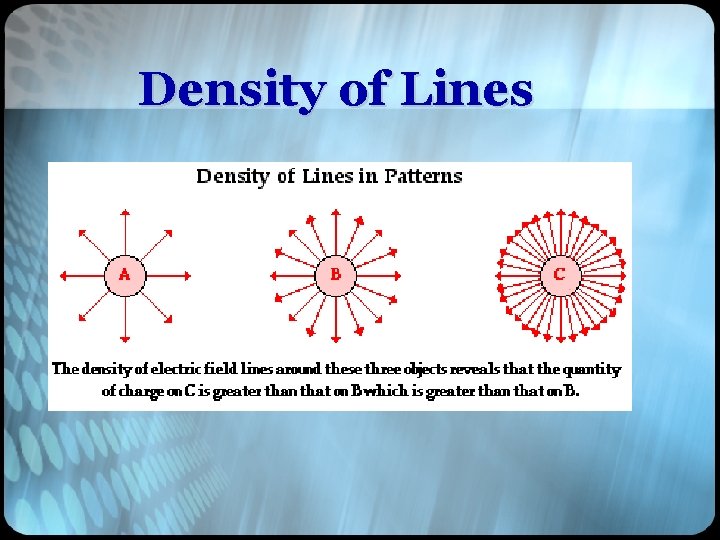
Density of Lines
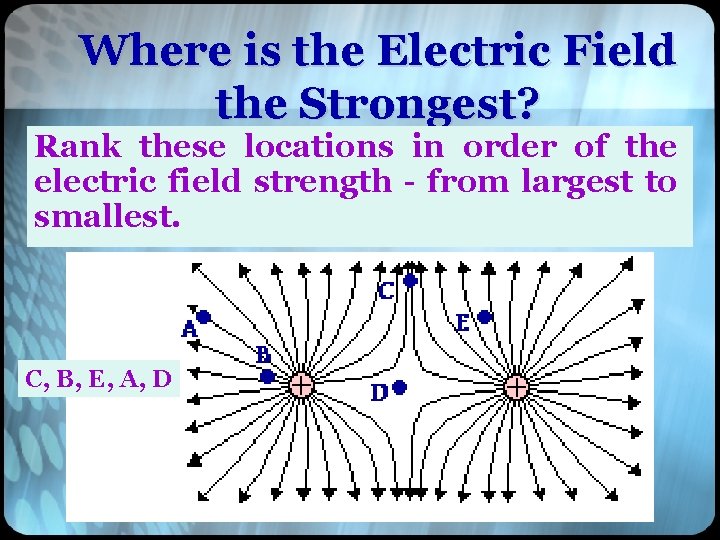
Where is the Electric Field the Strongest? Rank these locations in order of the electric field strength - from largest to smallest. C, B, E, A, D
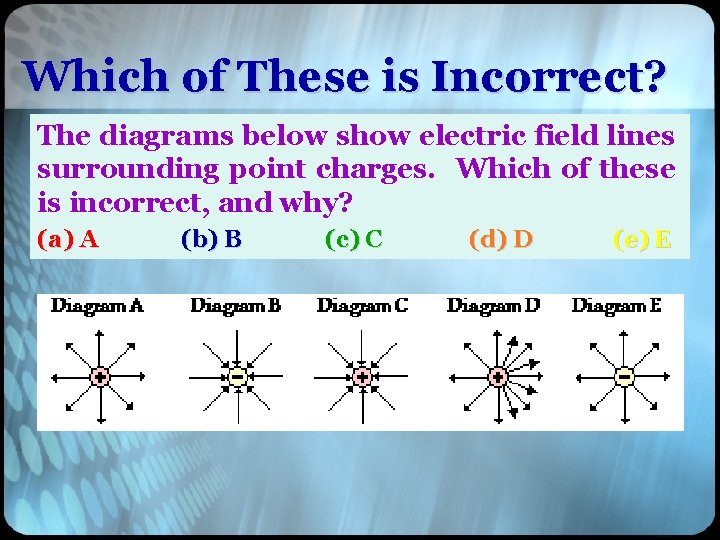
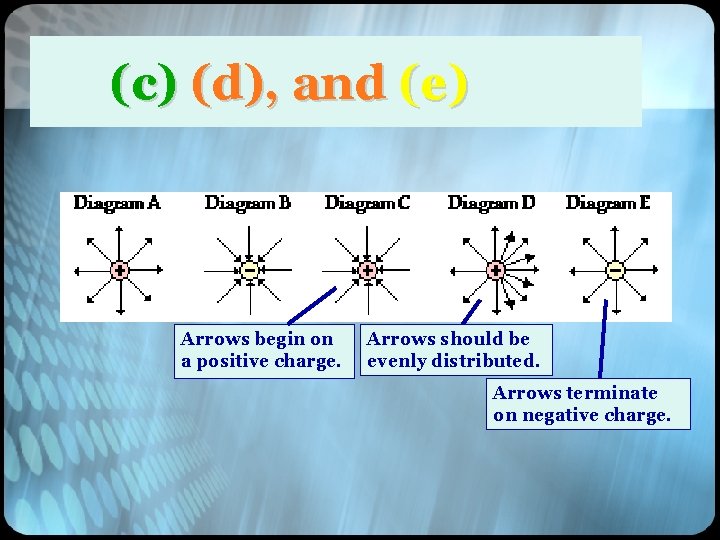
Which of These is Incorrect? The diagrams below show electric field lines surrounding point charges. Which of these is incorrect, and why? (a) A (b) B (c) C (d) D (e) E
(c) (d), and (e) Arrows begin on a positive charge. Arrows should be evenly distributed. Arrows terminate on negative charge.
What’s Wrong with This Picture? ? ? Hmm… Electric field lines should never cross, because the lines show the direction that a positive test charge would experience a force if placed in the field.
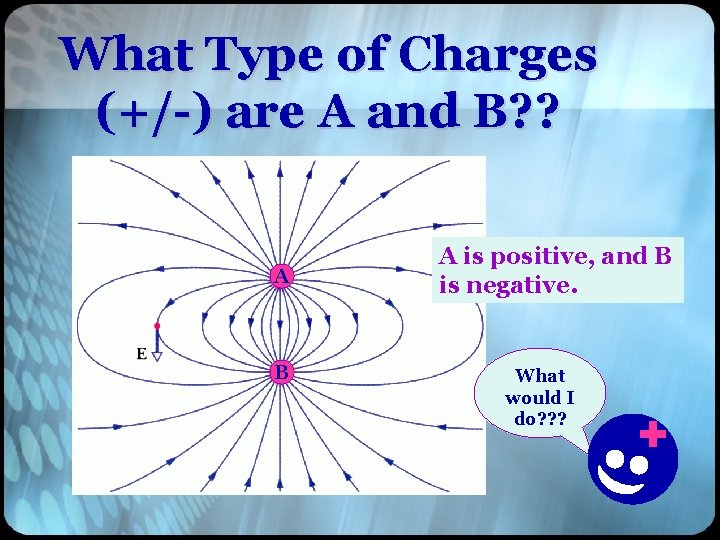
What Type of Charges (+/-) are A and B? ? A B A is positive, and B is negative. What would I do? ? ? +
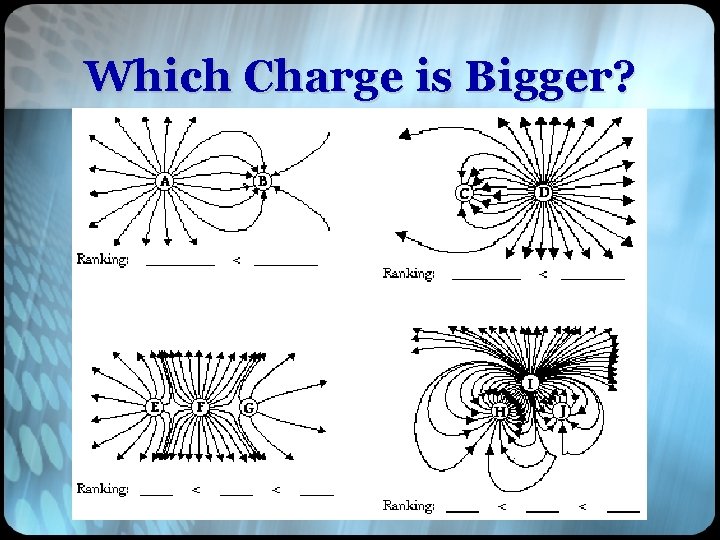
Which Charge is Bigger?
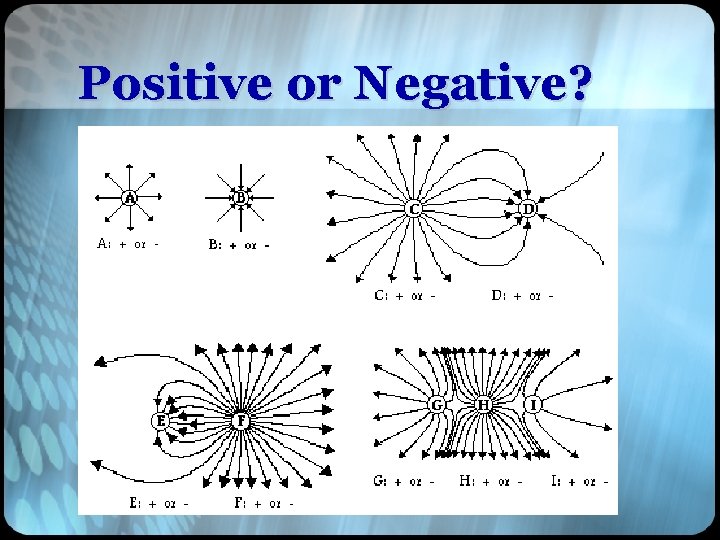
Positive or Negative?
The Graphical Representations are Only Qualitative… You can tell, relatively speaking, how strong the field is by reading electric field lines. However, you can also quantify the field strength.
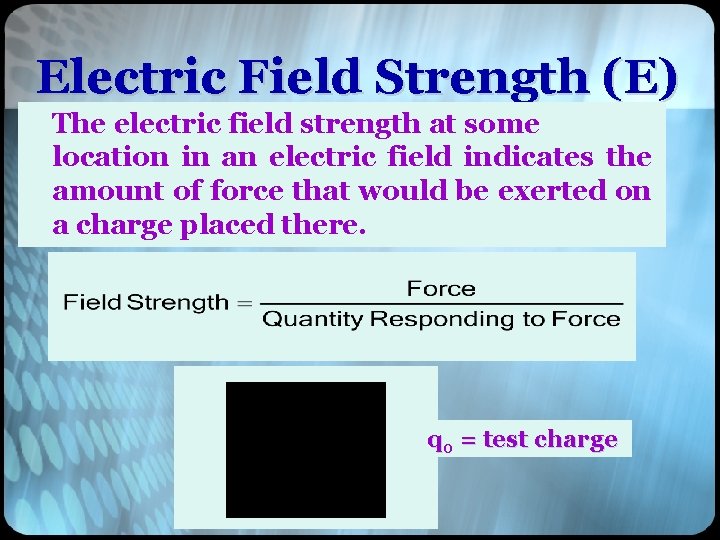
Electric Field Strength (E) The electric field strength at some location in an electric field indicates the amount of force that would be exerted on a charge placed there. q 0 = test charge
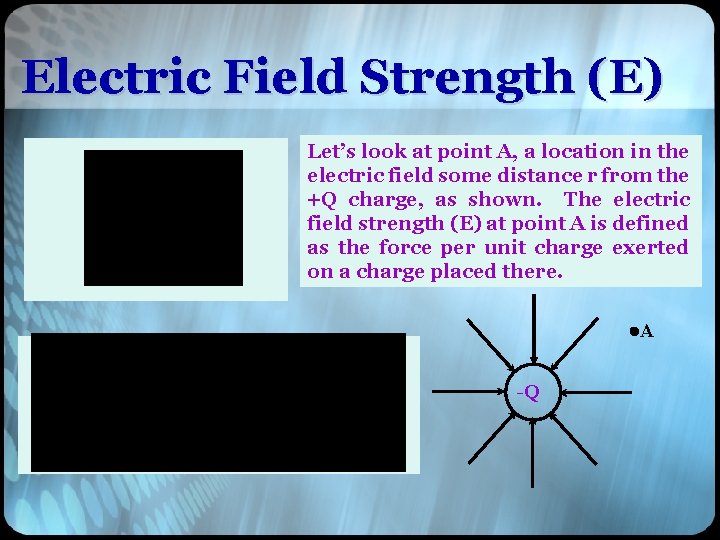
Electric Field Strength (E) Let’s look at point A, a location in the electric field some distance r from the +Q charge, as shown. The electric field strength (E) at point A is defined as the force per unit charge exerted on a charge placed there. A -Q
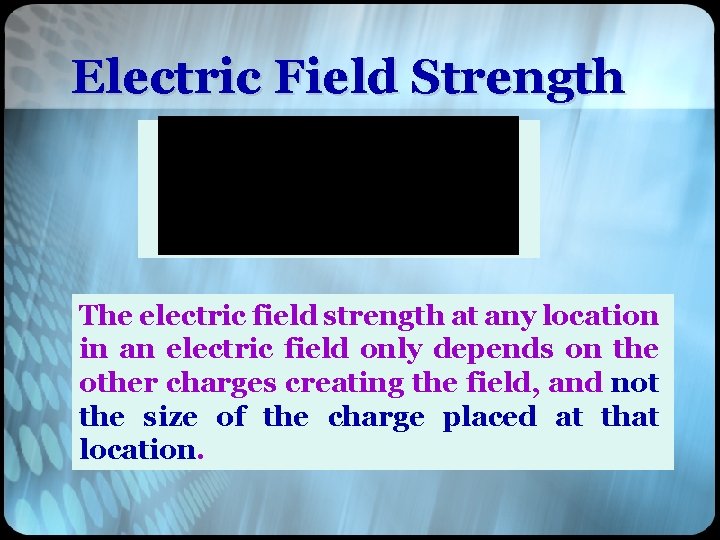
Electric Field Strength The electric field strength at any location in an electric field only depends on the other charges creating the field, and not the size of the charge placed at that location.
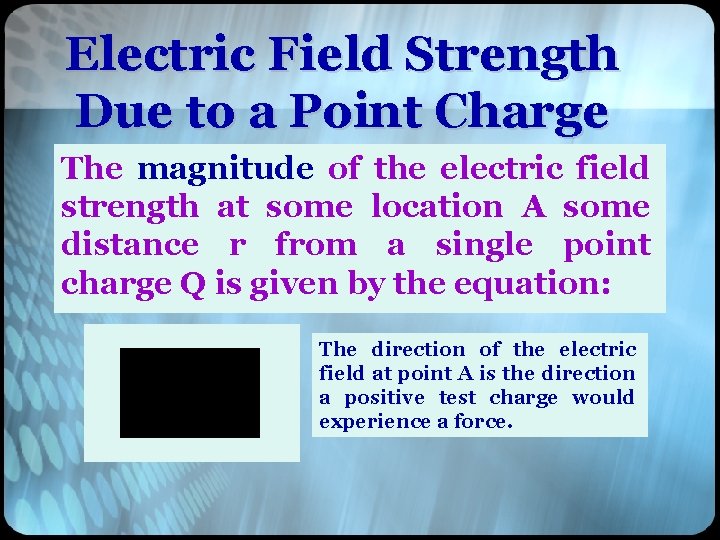
Electric Field Strength Due to a Point Charge The magnitude of the electric field strength at some location A some distance r from a single point charge Q is given by the equation: The direction of the electric field at point A is the direction a positive test charge would experience a force.
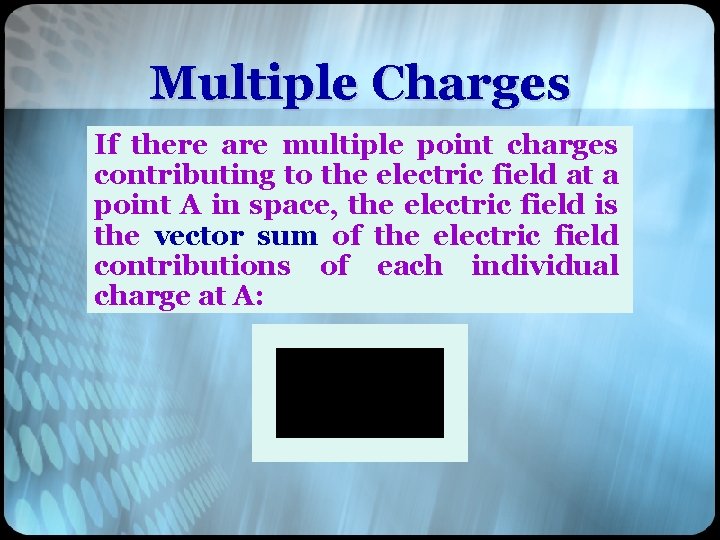
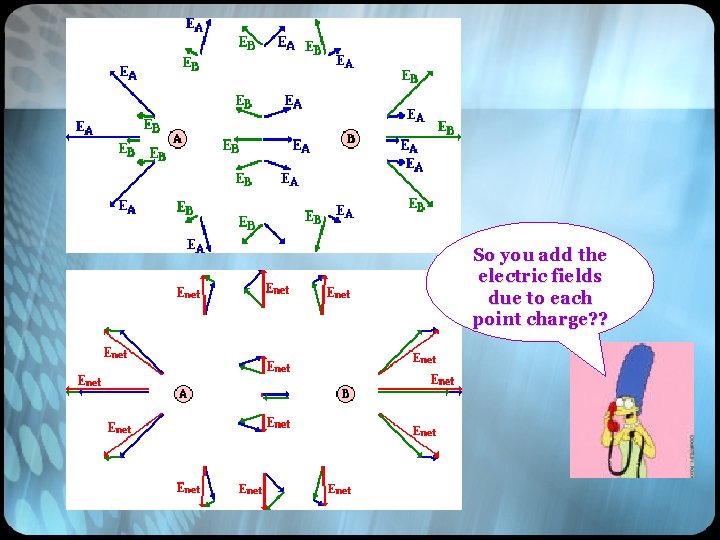
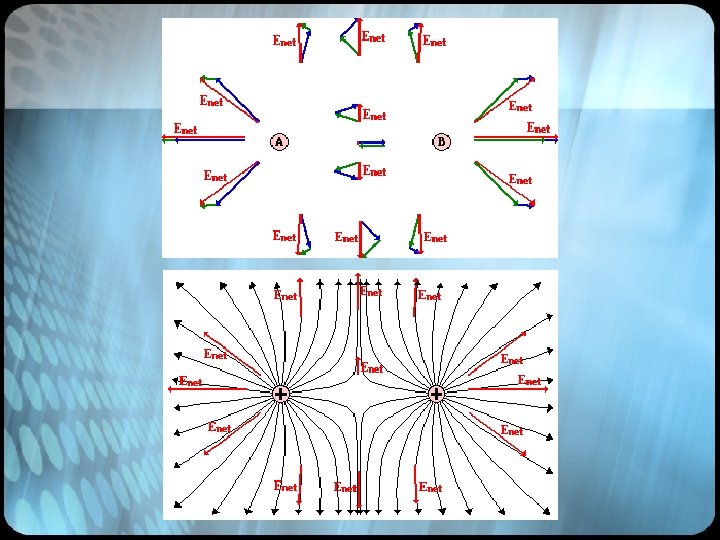
Multiple Charges If there are multiple point charges contributing to the electric field at a point A in space, the electric field is the vector sum of the electric field contributions of each individual charge at A:
So you add the electric fields due to each point charge? ?
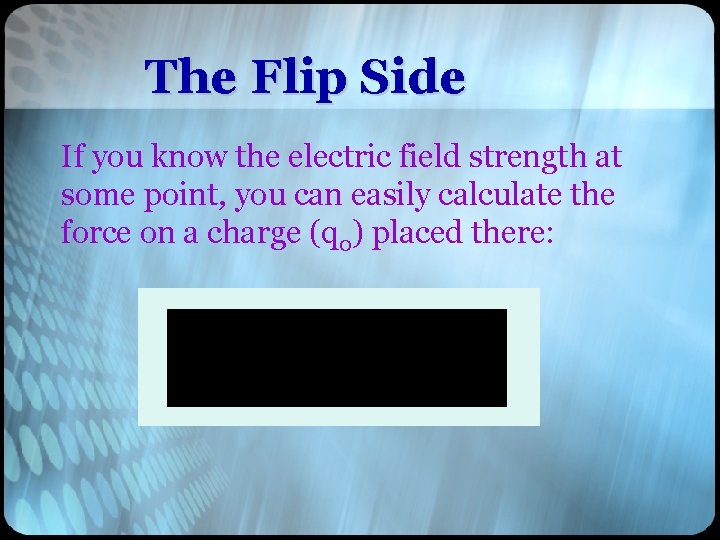
The Flip Side If you know the electric field strength at some point, you can easily calculate the force on a charge (q 0) placed there:
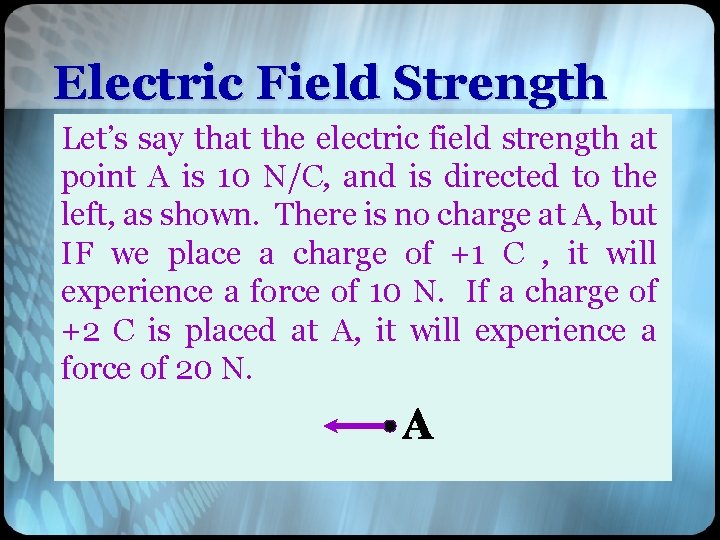
Electric Field Strength Let’s say that the electric field strength at point A is 10 N/C, and is directed to the left, as shown. There is no charge at A, but IF we place a charge of +1 C , it will experience a force of 10 N. If a charge of +2 C is placed at A, it will experience a force of 20 N.