
Electrostatic Electrostatics is the study of forces between
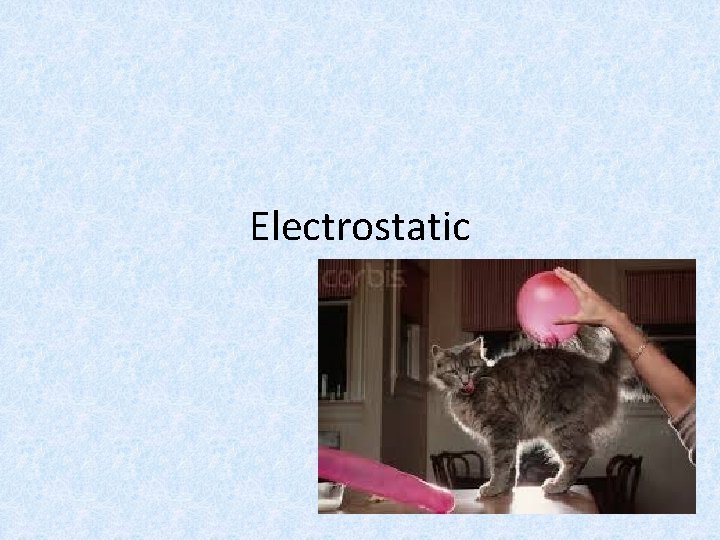
Electrostatic
Electrostatics is the study of forces between charges. Electric Charge - the property of an object that determines its electrical behavior: the electric force it can exert, and the electric force it can experience. The unit of charge is coulomb (C)
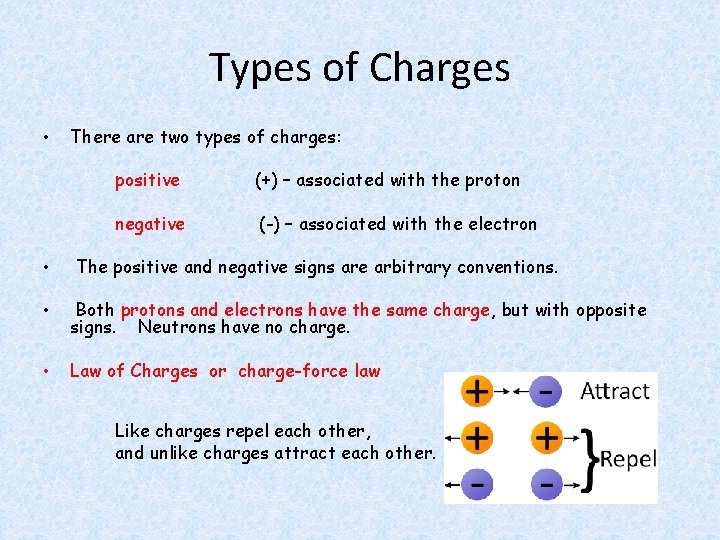
Types of Charges • There are two types of charges: positive (+) – associated with the proton negative (-) – associated with the electron • The positive and negative signs are arbitrary conventions. • Both protons and electrons have the same charge, but with opposite signs. Neutrons have no charge. • Law of Charges or charge-force law Like charges repel each other, and unlike charges attract each other.
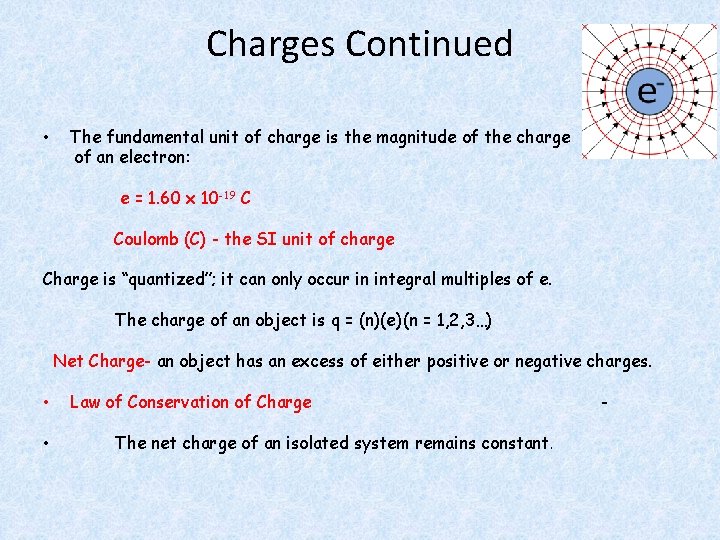
Charges Continued • The fundamental unit of charge is the magnitude of the charge of an electron: e = 1. 60 x 10 -19 C Coulomb (C) - the SI unit of charge Charge is “quantized”; it can only occur in integral multiples of e. The charge of an object is q = (n)(e)(n = 1, 2, 3…) Net Charge- an object has an excess of either positive or negative charges. • • Law of Conservation of Charge The net charge of an isolated system remains constant. -
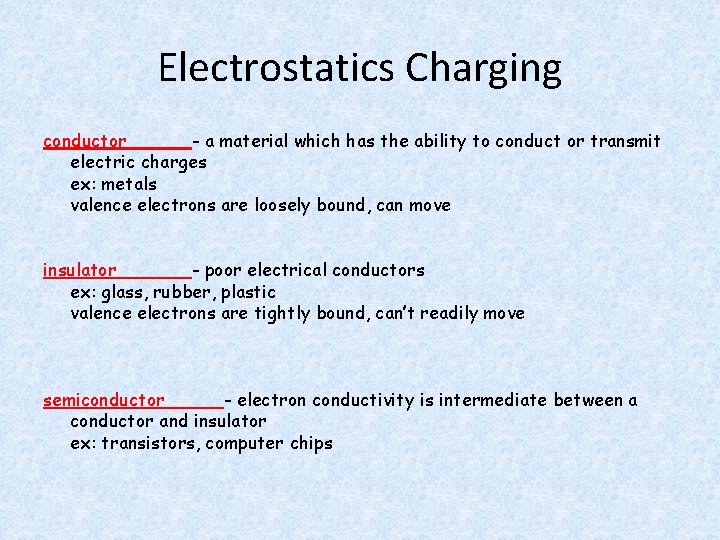
Electrostatics Charging conductor - a material which has the ability to conduct or transmit electric charges ex: metals valence electrons are loosely bound, can move insulator - poor electrical conductors ex: glass, rubber, plastic valence electrons are tightly bound, can’t readily move semiconductor - electron conductivity is intermediate between a conductor and insulator ex: transistors, computer chips

Charging by Contact
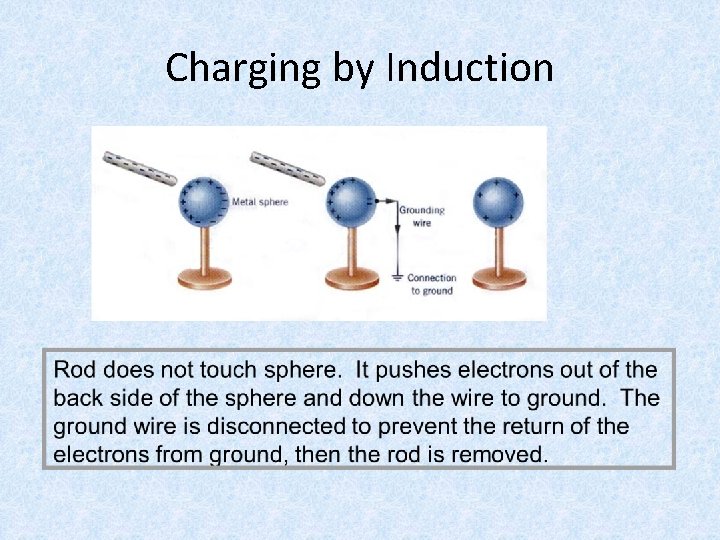
Charging by Induction
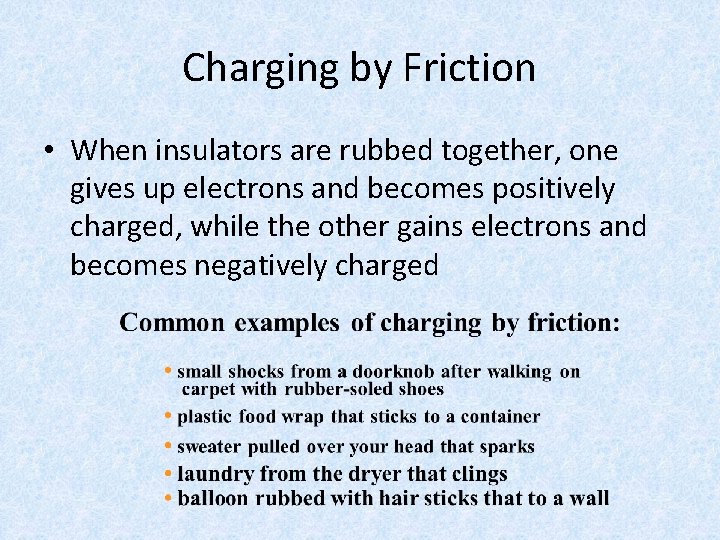
Charging by Friction • When insulators are rubbed together, one gives up electrons and becomes positively charged, while the other gains electrons and becomes negatively charged
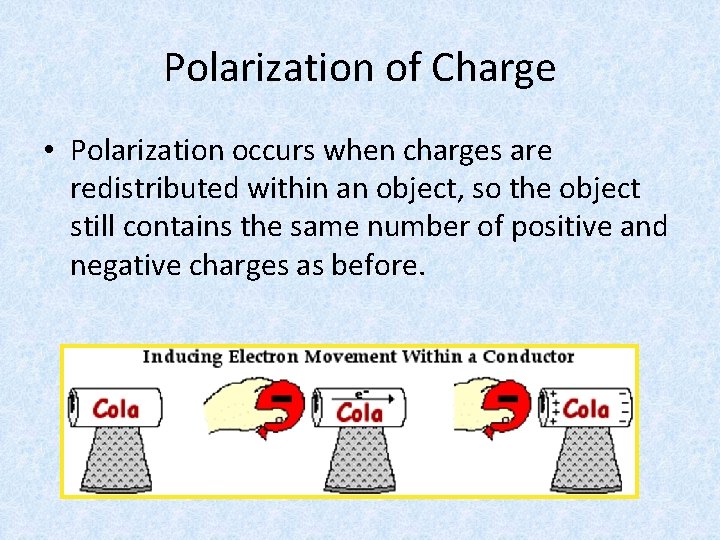
Polarization of Charge • Polarization occurs when charges are redistributed within an object, so the object still contains the same number of positive and negative charges as before.
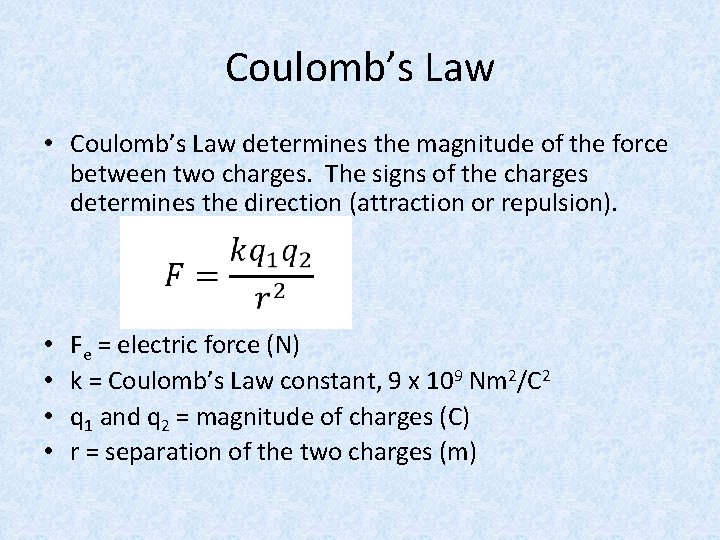
Coulomb’s Law • Coulomb’s Law determines the magnitude of the force between two charges. The signs of the charges determines the direction (attraction or repulsion). • • Fe = electric force (N) k = Coulomb’s Law constant, 9 x 10⁹ Nm 2/C 2 q 1 and q 2 = magnitude of charges (C) r = separation of the two charges (m)
Coulomb’s Law and Inverse Square Law • Just like with Newton’s Law of Gravitational Motion, Coulomb’s Law also follows the inverse square law. • Both equations show that the force is proportional to the product of the quantity that causes the force - charge in the case of electrical force and mass in the case of gravitational force. • The force depends inversely on the square of distance between charges.
Example 1 • Suppose that two point charges, each with a charge of +1. 00 Coulomb are separated by a distance of 3. 00 meters. Determine the magnitude of the electrical force of repulsion between them
Example 2 • The force between two identical charges separated by 1 cm is equal to 90 N. What is the magnitude of the two charges?
- Slides: 13