
Electroscopes and Charges Charge Distribution One of these
Electroscopes and Charges
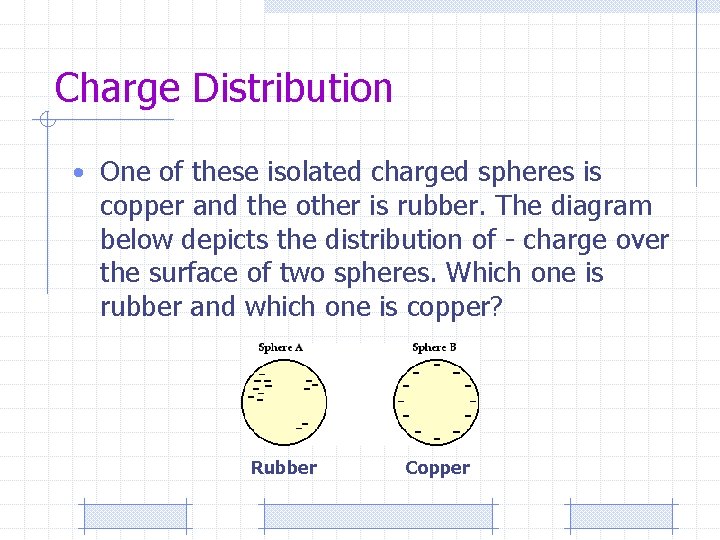
Charge Distribution • One of these isolated charged spheres is copper and the other is rubber. The diagram below depicts the distribution of - charge over the surface of two spheres. Which one is rubber and which one is copper? Rubber Copper
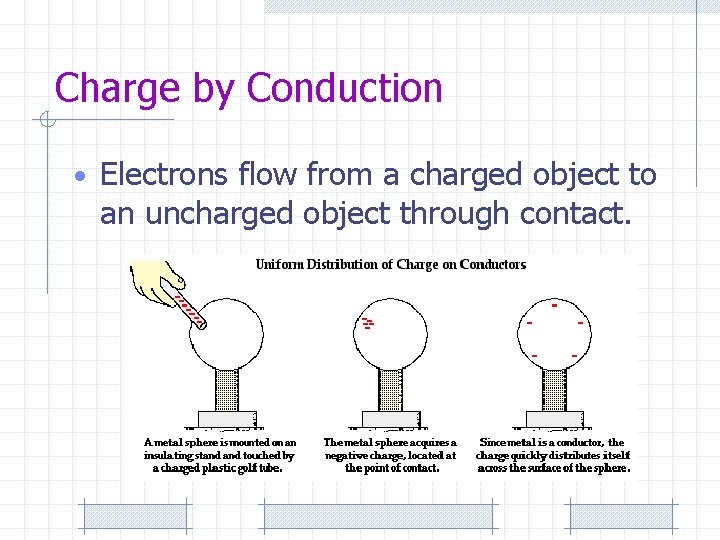
Charge by Conduction • Electrons flow from a charged object to an uncharged object through contact.

Charging an electroscope by contact - What will happen as a positively charged rod is brought near?

Grounding a positively charged electroscope - Which way will the electrons flow?

Charge by Induction of an Electroscope
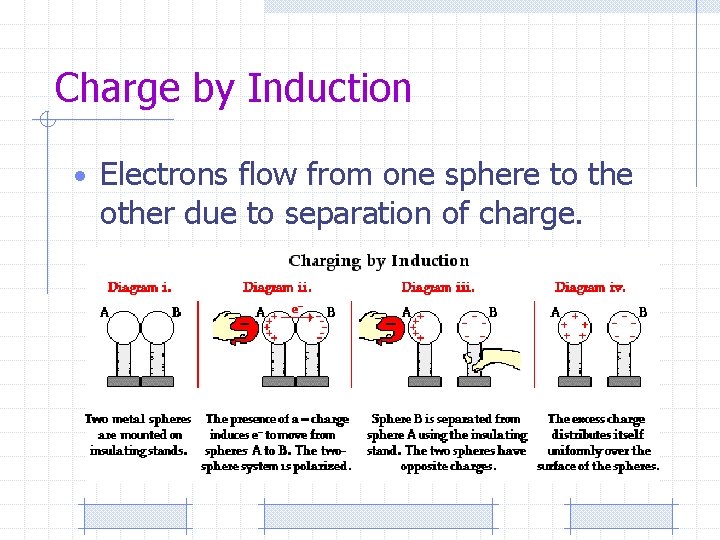
Charge by Induction • Electrons flow from one sphere to the other due to separation of charge.
Key Ideas • Objects become charged by losing or gaining electrons. – Negatively charged objects have an excess of electrons. – Positively charged objects have a deficiency of electrons. • • • Like charges repel. Unlike charges attract. Conductors allow electrons to flow freely. Insulators do not allow electrons to flow easily. Separation of charge occurs when objects become charged or when a charged object is brought in local proximity to an uncharged (neutral) object.
Key Ideas • Charge by conduction results when charge is transferred through contact. • Charge by induction occurs when a charged object is place in local proximity to a neutral object causing a separation of charge.
- Slides: 9