
Electrophoresis Part 2 Chelsea Aitken Peter Aspinall Zonal

- Slides: 19
Electrophoresis Part 2 Chelsea Aitken Peter Aspinall
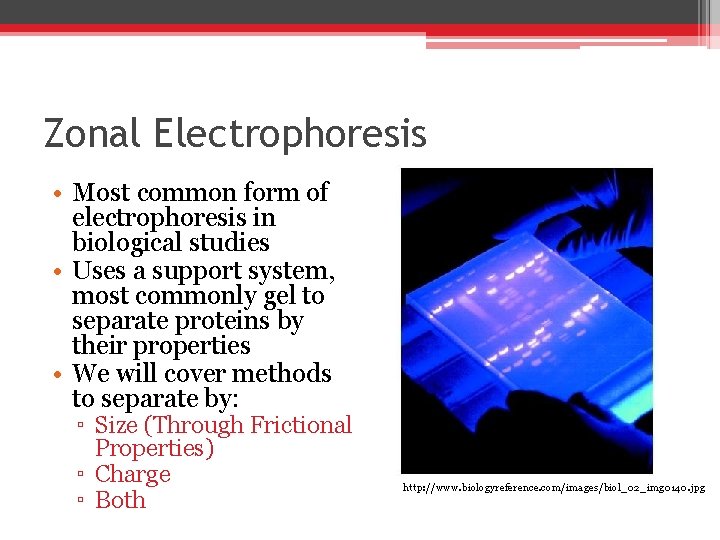
Zonal Electrophoresis • Most common form of electrophoresis in biological studies • Uses a support system, most commonly gel to separate proteins by their properties • We will cover methods to separate by: ▫ Size (Through Frictional Properties) ▫ Charge ▫ Both http: //www. biologyreference. com/images/biol_02_img 0140. jpg
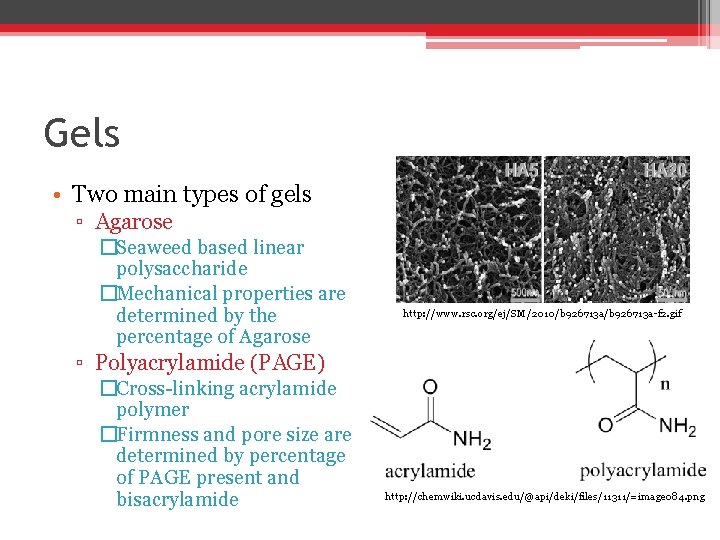
Gels • Two main types of gels ▫ Agarose �Seaweed based linear polysaccharide �Mechanical properties are determined by the percentage of Agarose http: //www. rsc. org/ej/SM/2010/b 926713 a-f 2. gif ▫ Polyacrylamide (PAGE) �Cross-linking acrylamide polymer �Firmness and pore size are determined by percentage of PAGE present and bisacrylamide http: //chemwiki. ucdavis. edu/@api/deki/files/11311/=image 084. png
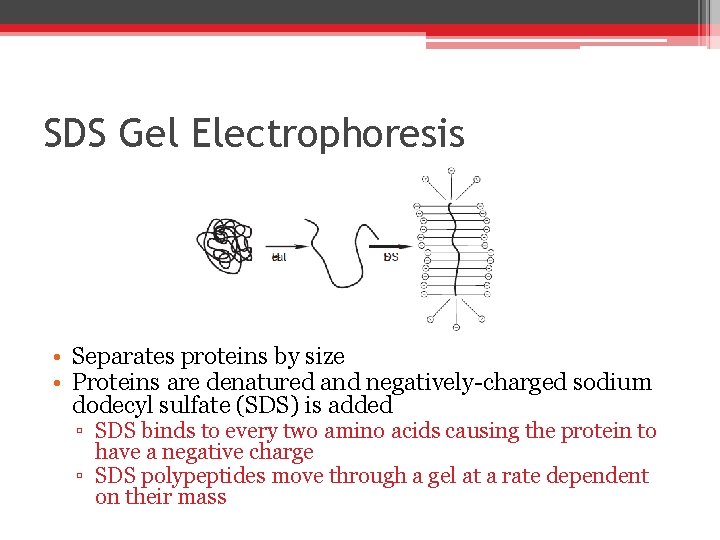
SDS Gel Electrophoresis • Separates proteins by size • Proteins are denatured and negatively-charged sodium dodecyl sulfate (SDS) is added ▫ SDS binds to every two amino acids causing the protein to have a negative charge ▫ SDS polypeptides move through a gel at a rate dependent on their mass
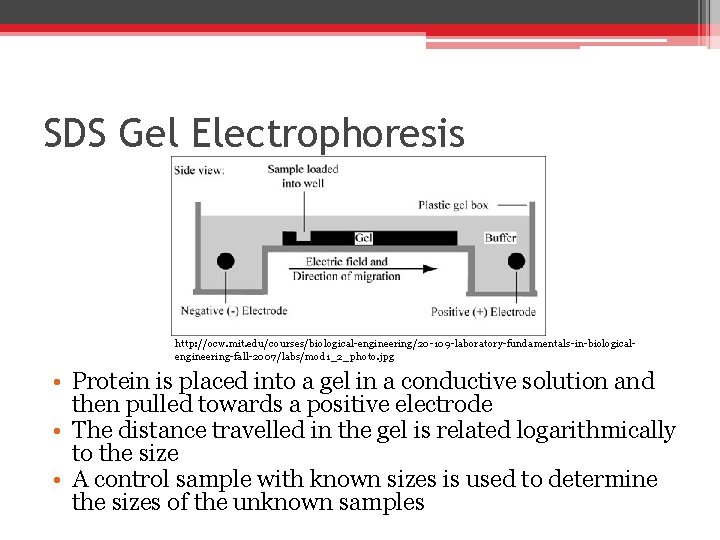
SDS Gel Electrophoresis http: //ocw. mit. edu/courses/biological-engineering/20 -109 -laboratory-fundamentals-in-biologicalengineering-fall-2007/labs/mod 1_2_photo. jpg • Protein is placed into a gel in a conductive solution and then pulled towards a positive electrode • The distance travelled in the gel is related logarithmically to the size • A control sample with known sizes is used to determine the sizes of the unknown samples
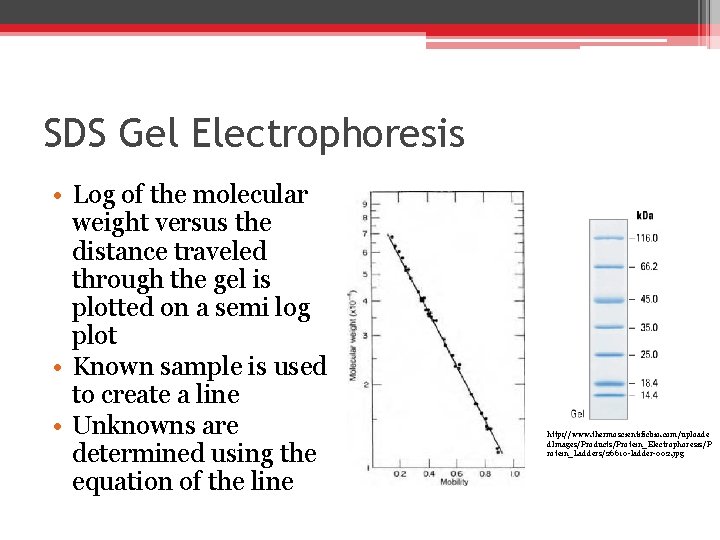
SDS Gel Electrophoresis • Log of the molecular weight versus the distance traveled through the gel is plotted on a semi log plot • Known sample is used to create a line • Unknowns are determined using the equation of the line http: //www. thermoscientificbio. com/uploade d. Images/Products/Protein_Electrophoresis/P rotein_Ladders/26610 -ladder-002. jpg
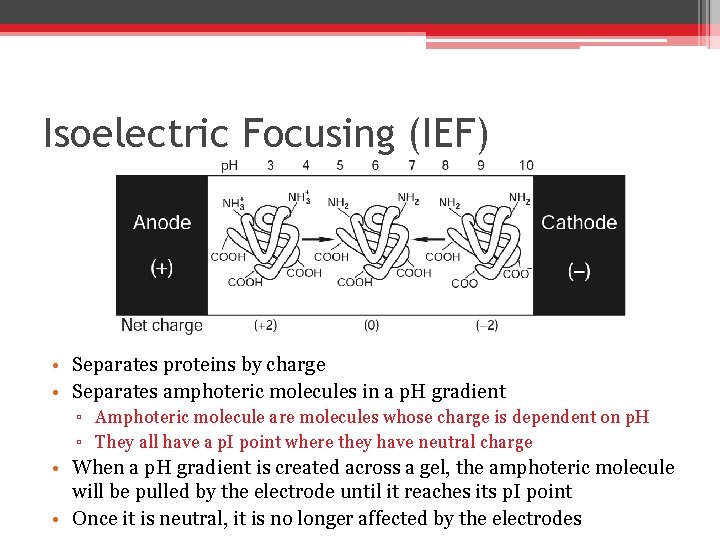
Isoelectric Focusing (IEF) • Separates proteins by charge • Separates amphoteric molecules in a p. H gradient ▫ Amphoteric molecule are molecules whose charge is dependent on p. H ▫ They all have a p. I point where they have neutral charge • When a p. H gradient is created across a gel, the amphoteric molecule will be pulled by the electrode until it reaches its p. I point • Once it is neutral, it is no longer affected by the electrodes
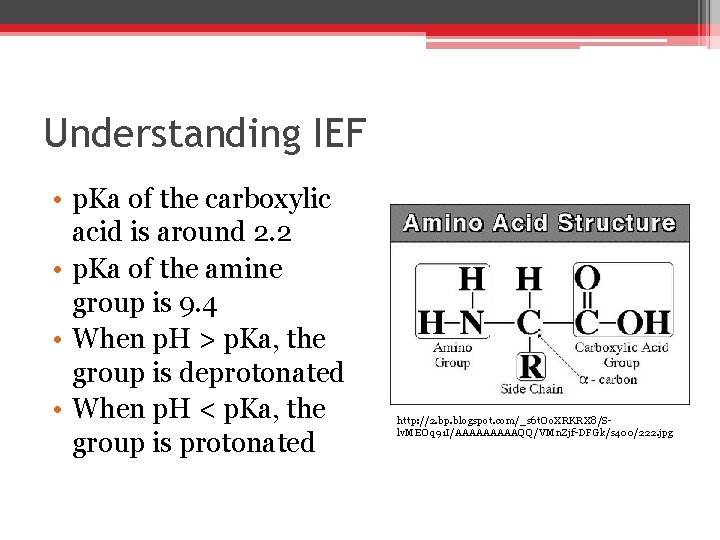
Understanding IEF • p. Ka of the carboxylic acid is around 2. 2 • p. Ka of the amine group is 9. 4 • When p. H > p. Ka, the group is deprotonated • When p. H < p. Ka, the group is protonated http: //2. bp. blogspot. com/_s 6 t. Oo. XRKRX 8/Slv. MEOq 91 I/AAAAAQQ/VMn. Zjf-DFGk/s 400/222. jpg
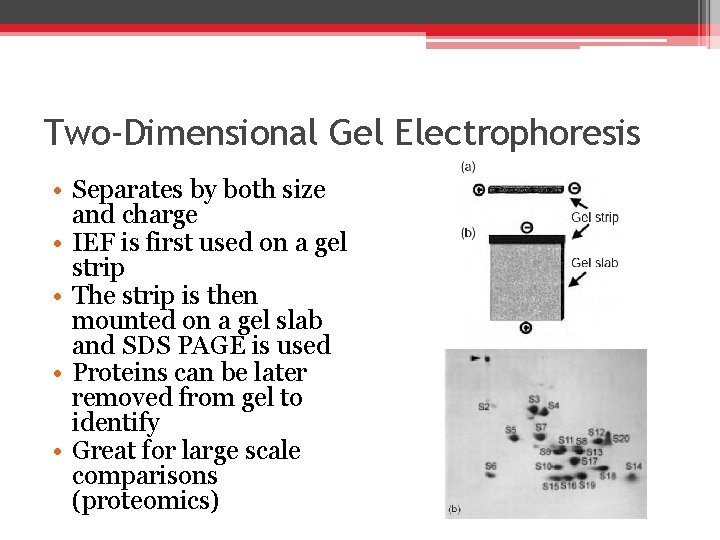
Two-Dimensional Gel Electrophoresis • Separates by both size and charge • IEF is first used on a gel strip • The strip is then mounted on a gel slab and SDS PAGE is used • Proteins can be later removed from gel to identify • Great for large scale comparisons (proteomics)
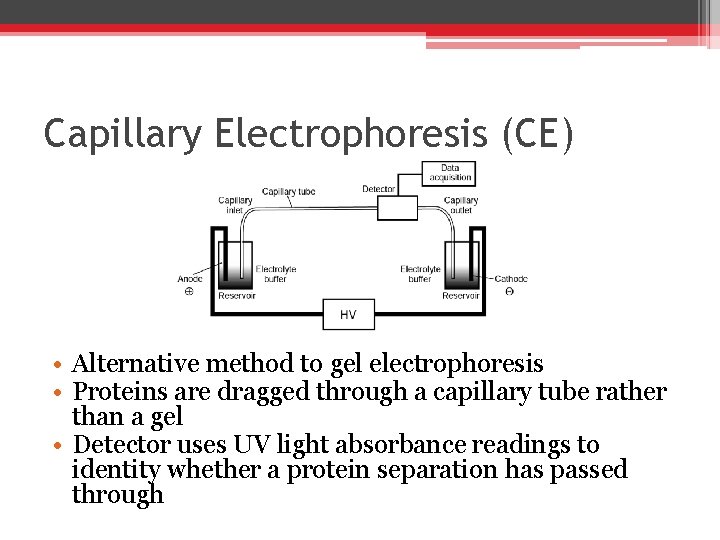
Capillary Electrophoresis (CE) • Alternative method to gel electrophoresis • Proteins are dragged through a capillary tube rather than a gel • Detector uses UV light absorbance readings to identity whether a protein separation has passed through
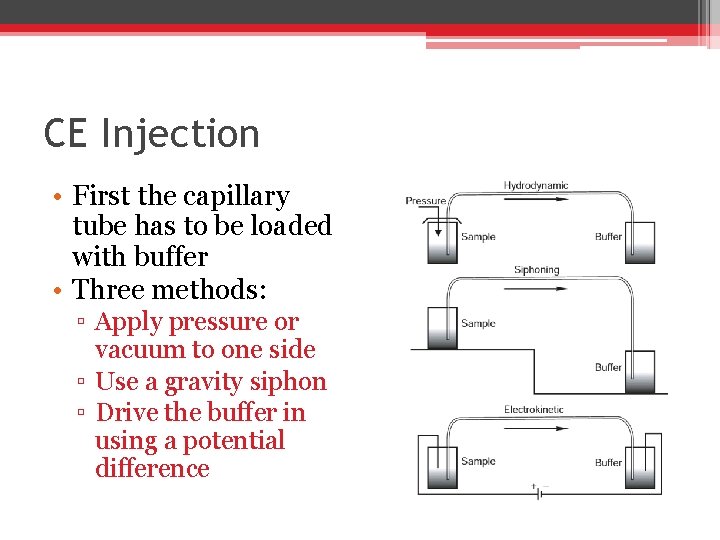
CE Injection • First the capillary tube has to be loaded with buffer • Three methods: ▫ Apply pressure or vacuum to one side ▫ Use a gravity siphon ▫ Drive the buffer in using a potential difference
CE Formulas •
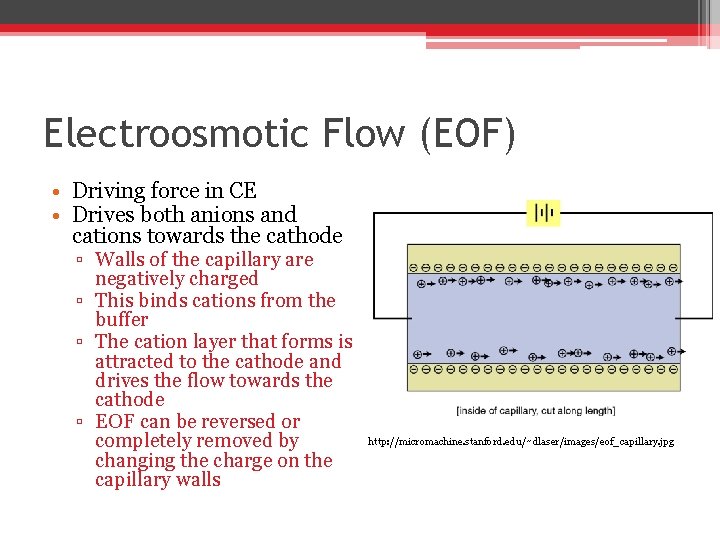
Electroosmotic Flow (EOF) • Driving force in CE • Drives both anions and cations towards the cathode ▫ Walls of the capillary are negatively charged ▫ This binds cations from the buffer ▫ The cation layer that forms is attracted to the cathode and drives the flow towards the cathode ▫ EOF can be reversed or completely removed by changing the charge on the capillary walls http: //micromachine. stanford. edu/~dlaser/images/eof_capillary. jpg
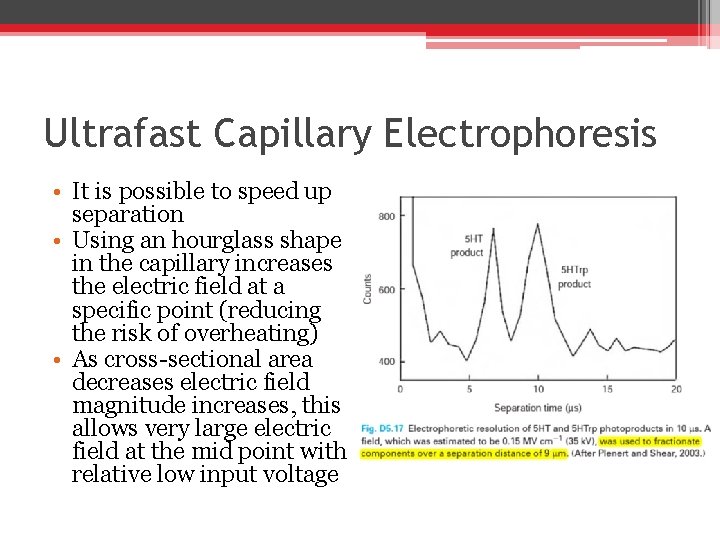
Ultrafast Capillary Electrophoresis • It is possible to speed up separation • Using an hourglass shape in the capillary increases the electric field at a specific point (reducing the risk of overheating) • As cross-sectional area decreases electric field magnitude increases, this allows very large electric field at the mid point with relative low input voltage
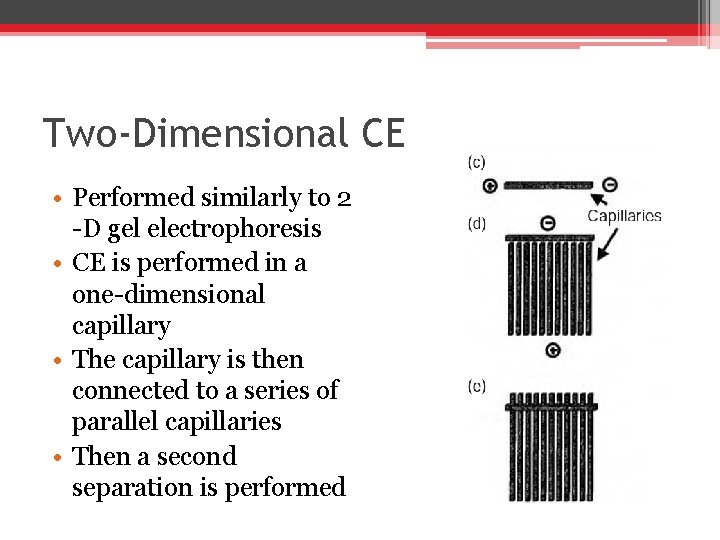
Two-Dimensional CE • Performed similarly to 2 -D gel electrophoresis • CE is performed in a one-dimensional capillary • The capillary is then connected to a series of parallel capillaries • Then a second separation is performed
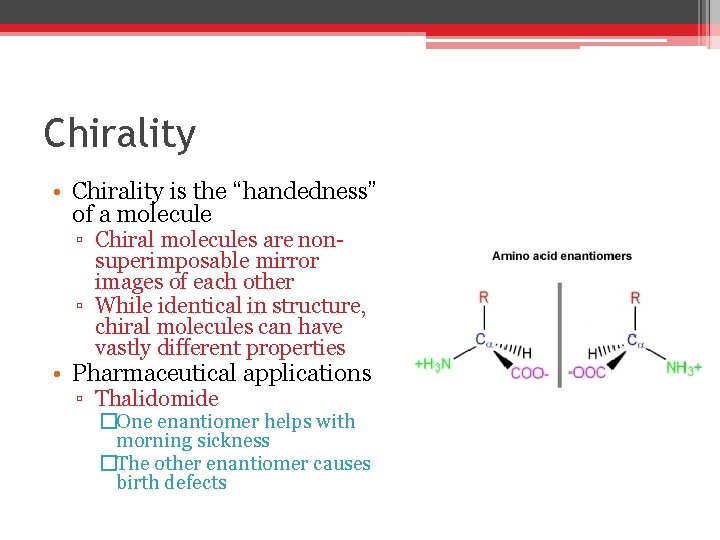
Chirality • Chirality is the “handedness” of a molecule ▫ Chiral molecules are nonsuperimposable mirror images of each other ▫ While identical in structure, chiral molecules can have vastly different properties • Pharmaceutical applications ▫ Thalidomide �One enantiomer helps with morning sickness �The other enantiomer causes birth defects
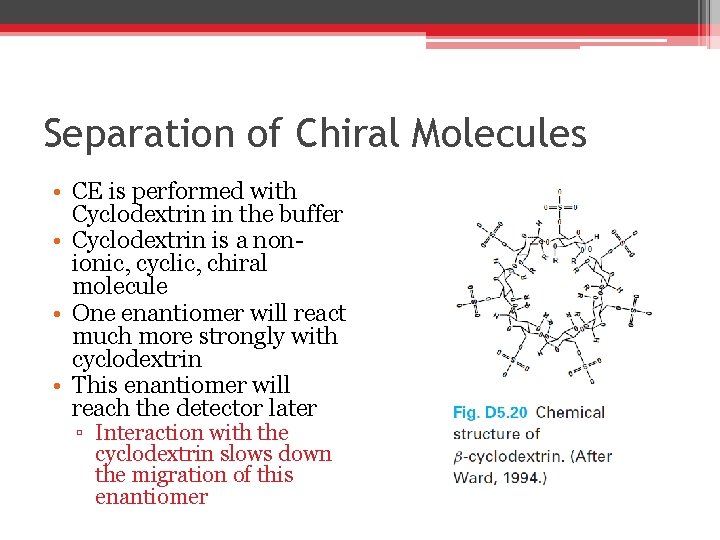
Separation of Chiral Molecules • CE is performed with Cyclodextrin in the buffer • Cyclodextrin is a nonionic, cyclic, chiral molecule • One enantiomer will react much more strongly with cyclodextrin • This enantiomer will reach the detector later ▫ Interaction with the cyclodextrin slows down the migration of this enantiomer
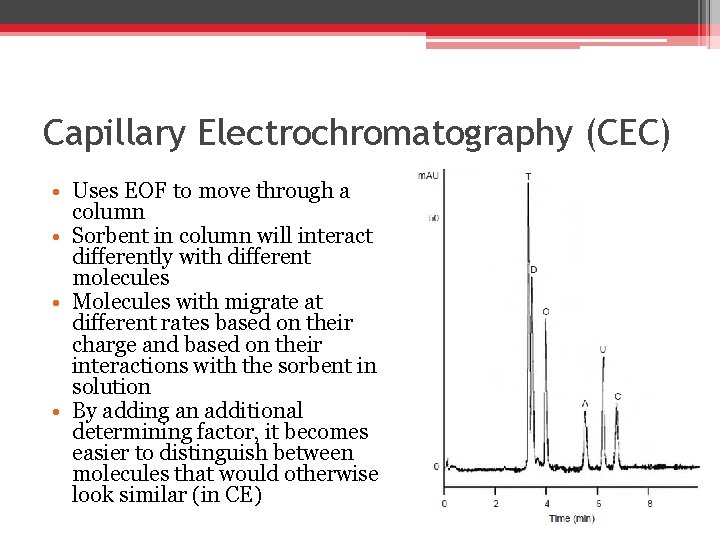
Capillary Electrochromatography (CEC) • Uses EOF to move through a column • Sorbent in column will interact differently with different molecules • Molecules with migrate at different rates based on their charge and based on their interactions with the sorbent in solution • By adding an additional determining factor, it becomes easier to distinguish between molecules that would otherwise look similar (in CE)
Sources 1. 2. 3. 4. Serdyuk, Igor N. , Nathan R. Zaccai, and Joseph Zaccai. Methods in Molecular Biophysics: Structure, Dynamics, Function. New York: Cambridge University Press, 2007. Print. Voet, Donald, Judith G. Voet, and Charlotte W. Pratt. Fundamentals of Biochemistry: Life at the Molecular Level. 4 th ed. John Wiley & Sons, Inc. , 2013. Print. "Capillary Electrophoresis. " Sam Houston State University. N. p. . Web. 6 Oct 2013. <http: //www. shsu. edu/chm_tgc/sounds/flashfiles/CE. swf>. Clark, Jim. " HIGH PERFORMANCE LIQUID CHROMATOGRAPHY - HPLC. "Chem. Guide. co. uk. N. p. , n. d. Web. 6 Oct 2013. <http: //www. chemguide. co. uk/analysis/chromatography/hplc. ht ml>.