
Electrons in Materials Density Functional Theory Richard M
- Slides: 16
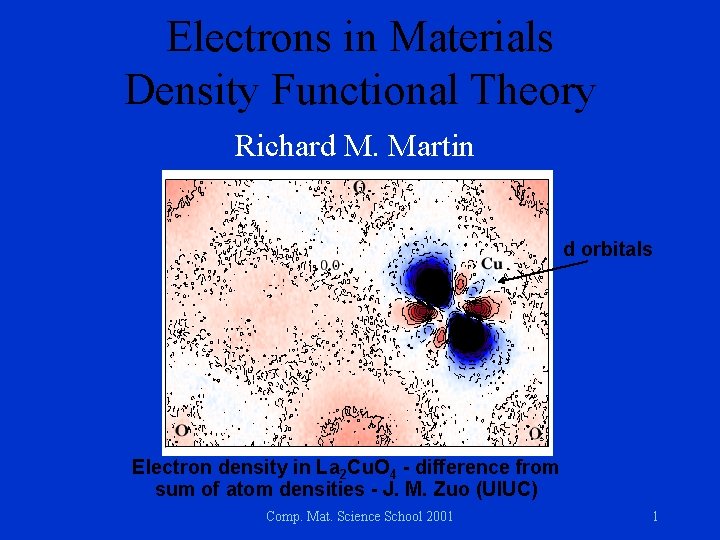
Electrons in Materials Density Functional Theory Richard M. Martin d orbitals Electron density in La 2 Cu. O 4 - difference from sum of atom densities - J. M. Zuo (UIUC) Comp. Mat. Science School 2001 1
Outline • Many Body Problem! • Density Functional Theory Kohn-Sham Equations allow in principle exact solution for ground state of many-body system using independent particle methods Approximate LDA, GGA functionals • Examples of Results from practical calculations • Pseudopotentials - needed for plane wave calculations • Next Time - Bloch Theorem, Bands in crystals, Plane wave calculations, Iterative methods Comp. Mat. Science School 2001 2
Ab Initio Simulations of Matter • • Why is this a hard problem? Many-Body Problem - Electrons/ Nuclei Must be Accurate --- Computation Emphasize here: Density Functional Theory – Numerical Algorithms – Some recent results Comp. Mat. Science School 2001 3
Eigenstates of electrons • For optical absortion, etc. , one needs the spectrum of excited states • For thermodynamics and chemistry the lowest states are most important • In many problems the temperature is low compared to characteristic electronic energies and we need only the ground state – Phase transitions – Phonons, etc. Comp. Mat. Science School 2001 4
The Ground State • General idea: Can use minmization methods to get the lowest energy state • Why is this difficult ? • It is a Many-Body Problem • Yi ( r 1, r 2, r 3, r 4, r 5, . . . ) • How to minimize in such a large space Comp. Mat. Science School 2001 5
The Ground State • How to minimize in such a large space – Methods of Quantum Chemistry- expand in extremely large bases - Billions - grows exponentially with size of system • Limited to small molecules – Quantum Monte Carlo - statistical sampling of high-dimensional spaces • Exact for Bosons (Helium 4) • Fermion sign problem for Electrons Comp. Mat. Science School 2001 6
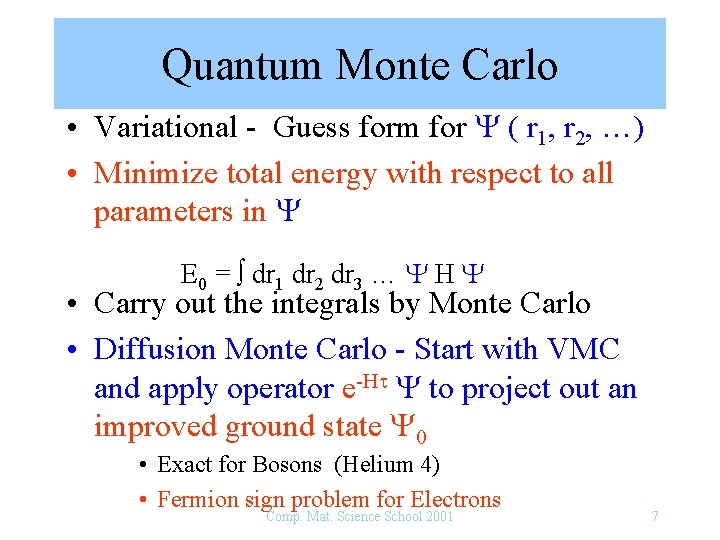
Quantum Monte Carlo • Variational - Guess form for Y ( r 1, r 2, …) • Minimize total energy with respect to all parameters in Y E 0 = dr 1 dr 2 dr 3 … Y H Y • Carry out the integrals by Monte Carlo • Diffusion Monte Carlo - Start with VMC and apply operator e-Ht Y to project out an improved ground state Y 0 • Exact for Bosons (Helium 4) • Fermion sign problem for Electrons Comp. Mat. Science School 2001 7
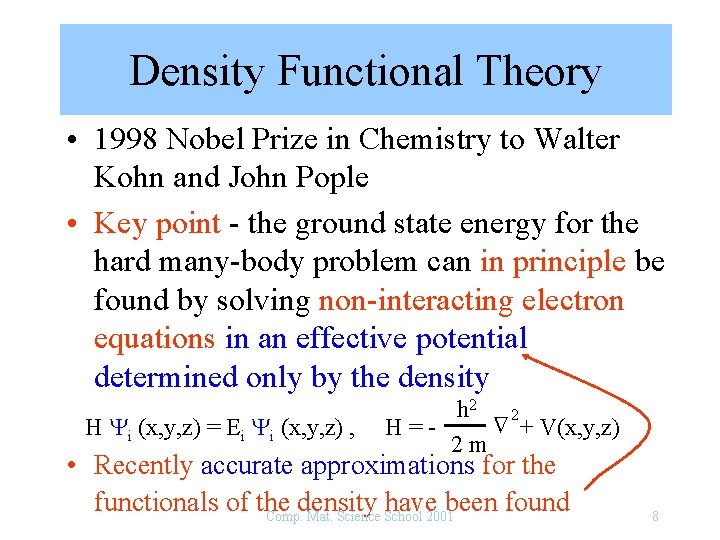
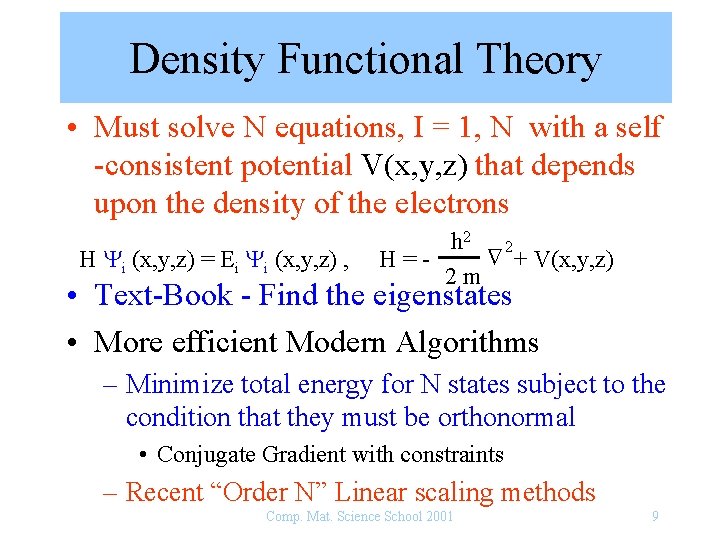
Density Functional Theory • 1998 Nobel Prize in Chemistry to Walter Kohn and John Pople • Key point - the ground state energy for the hard many-body problem can in principle be found by solving non-interacting electron equations in an effective potential determined only by the density D H Yi (x, y, z) = Ei Yi (x, y, z) , h 2 H=2 m 2 + V(x, y, z) • Recently accurate approximations for the functionals of the density have been found Comp. Mat. Science School 2001 8
Density Functional Theory • Must solve N equations, I = 1, N with a self -consistent potential V(x, y, z) that depends upon the density of the electrons D H Yi (x, y, z) = Ei Yi (x, y, z) , h 2 H=2 m 2 + V(x, y, z) • Text-Book - Find the eigenstates • More efficient Modern Algorithms – Minimize total energy for N states subject to the condition that they must be orthonormal • Conjugate Gradient with constraints – Recent “Order N” Linear scaling methods Comp. Mat. Science School 2001 9
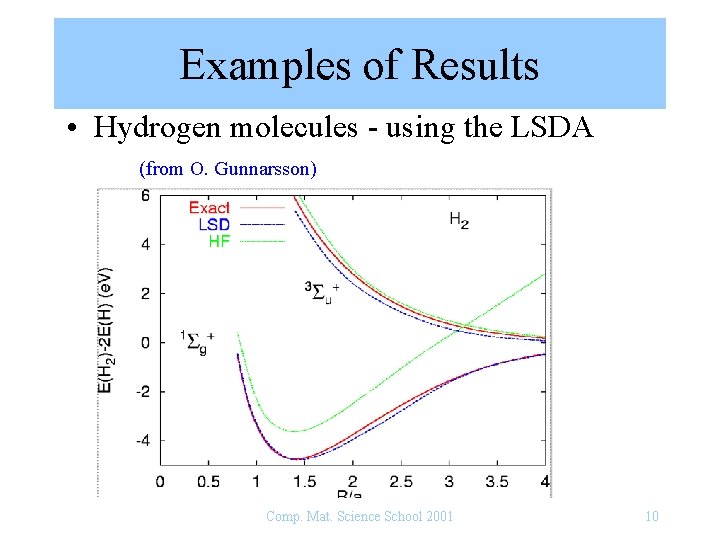
Examples of Results • Hydrogen molecules - using the LSDA (from O. Gunnarsson) Comp. Mat. Science School 2001 10
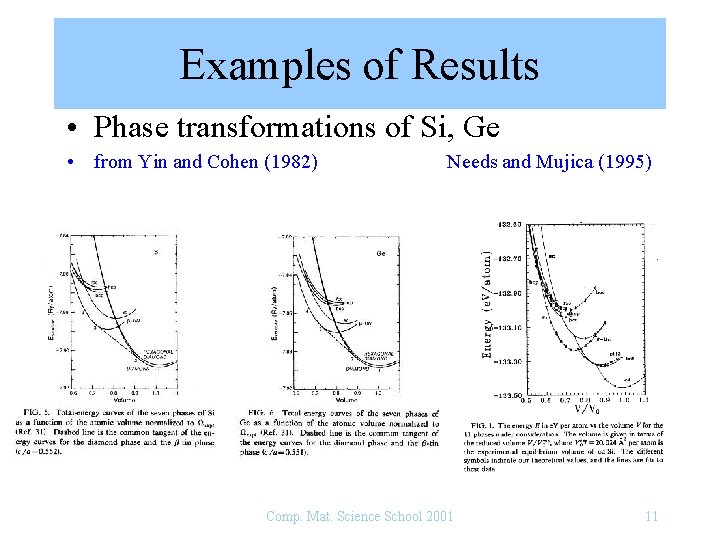
Examples of Results • Phase transformations of Si, Ge • from Yin and Cohen (1982) Needs and Mujica (1995) Comp. Mat. Science School 2001 11
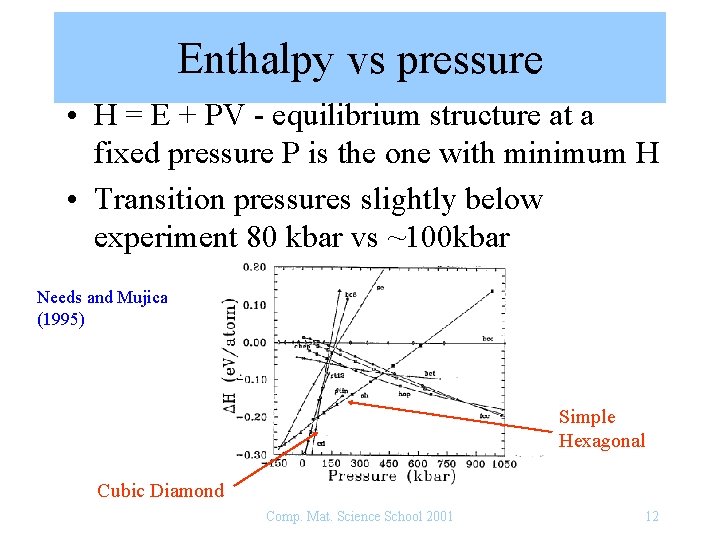
Enthalpy vs pressure • H = E + PV - equilibrium structure at a fixed pressure P is the one with minimum H • Transition pressures slightly below experiment 80 kbar vs ~100 kbar Needs and Mujica (1995) Simple Hexagonal Cubic Diamond Comp. Mat. Science School 2001 12
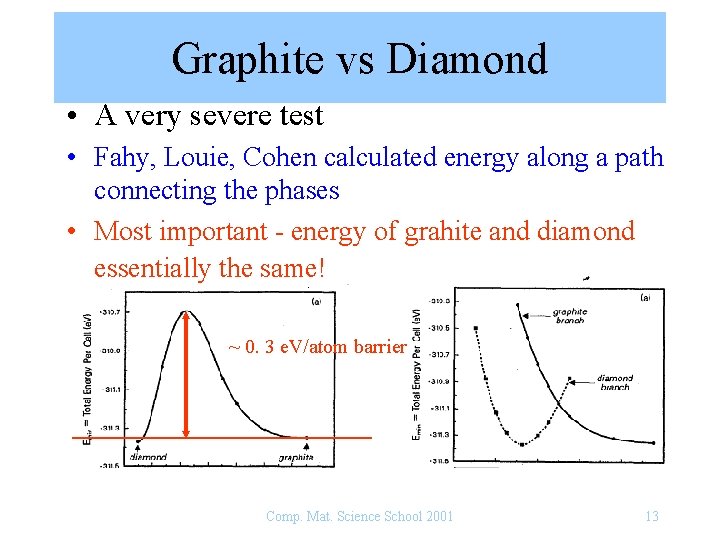
Graphite vs Diamond • A very severe test • Fahy, Louie, Cohen calculated energy along a path connecting the phases • Most important - energy of grahite and diamond essentially the same! ~ 0. 3 e. V/atom barrier Comp. Mat. Science School 2001 13
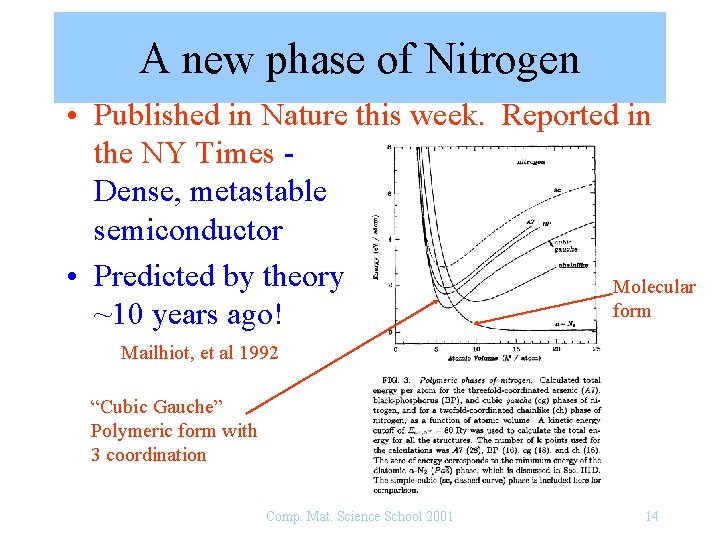
A new phase of Nitrogen • Published in Nature this week. Reported in the NY Times Dense, metastable semiconductor • Predicted by theory Molecular form ~10 years ago! Mailhiot, et al 1992 “Cubic Gauche” Polymeric form with 3 coordination Comp. Mat. Science School 2001 14
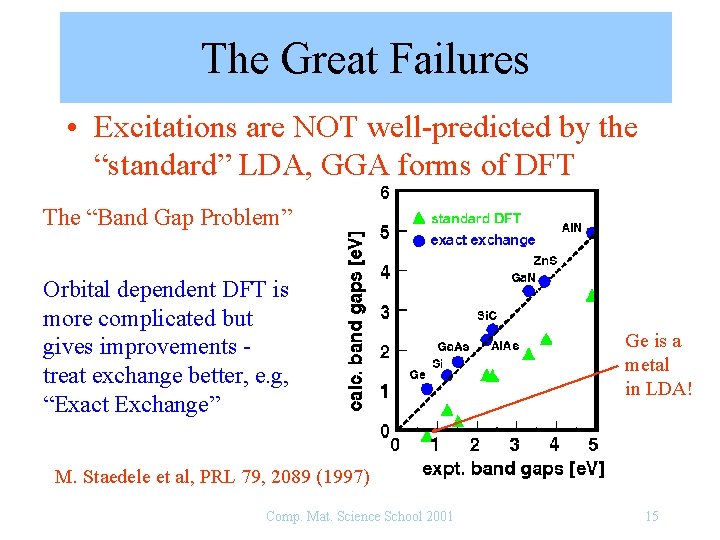
The Great Failures • Excitations are NOT well-predicted by the “standard” LDA, GGA forms of DFT The “Band Gap Problem” Orbital dependent DFT is more complicated but gives improvements treat exchange better, e. g, “Exact Exchange” Ge is a metal in LDA! M. Staedele et al, PRL 79, 2089 (1997) Comp. Mat. Science School 2001 15
Conclusions • The ground state properties are predicted with remarkable success by the simple LDA and GGAs. Structures, phonons (~5%), …. • Excitations are NOT well-predicted by the usual LDA, GGA forms of DFT The “Band Gap Problem” Orbital dependant functionals increase the gaps - agree well with experiment now a research topic Comp. Mat. Science School 2001 16