
Electrons capture in the air The subject Medical
Electrons capture in the air The subject: Medical Ionization Chambers are air filled ICs In the air, electrons are captured by O 2 forming O 2 - (this is just the beginning of the story…) When increasing dose rate, we increase recombination rate X+ + Y - X + Y Recombination depends on the time ions spend mixing it is useful to know how many electrons (fast) are captured to form O 2 - (slow). How to perform this measurement a direct way? instrumentation examples 1
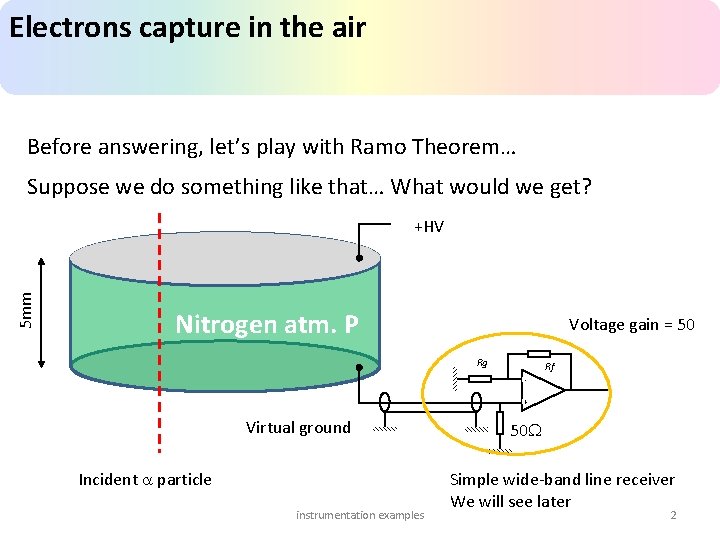
Electrons capture in the air Before answering, let’s play with Ramo Theorem… Suppose we do something like that… What would we get? 5 mm +HV Nitrogen atm. P Voltage gain = 50 Rg Rf + Virtual ground Incident a particle instrumentation examples 50 W Simple wide-band line receiver We will see later 2
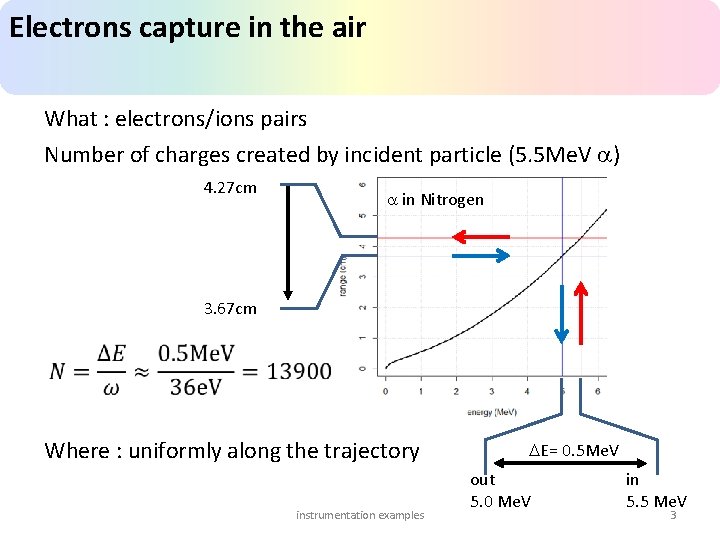
Electrons capture in the air What : electrons/ions pairs Number of charges created by incident particle (5. 5 Me. V a) 4. 27 cm a in Nitrogen 3. 67 cm Where : uniformly along the trajectory instrumentation examples DE= 0. 5 Me. V out 5. 0 Me. V in 5. 5 Me. V 3
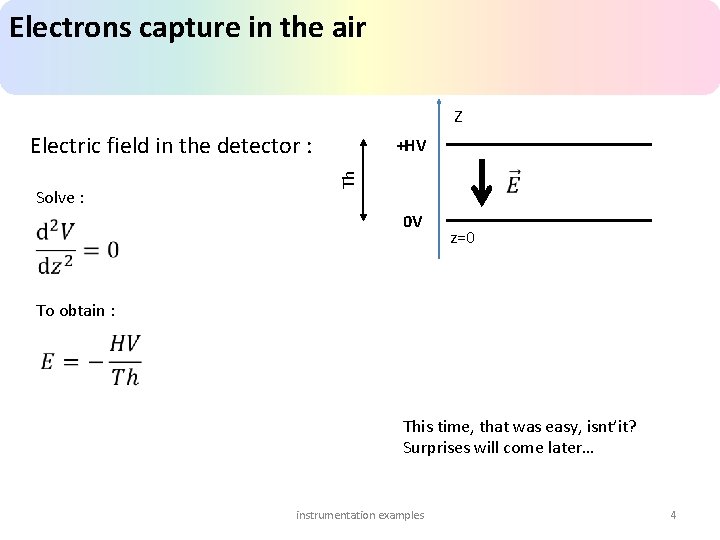
Electrons capture in the air Z Electric field in the detector : Th Solve : +HV 0 V z=0 To obtain : This time, that was easy, isnt’it? Surprises will come later… instrumentation examples 4
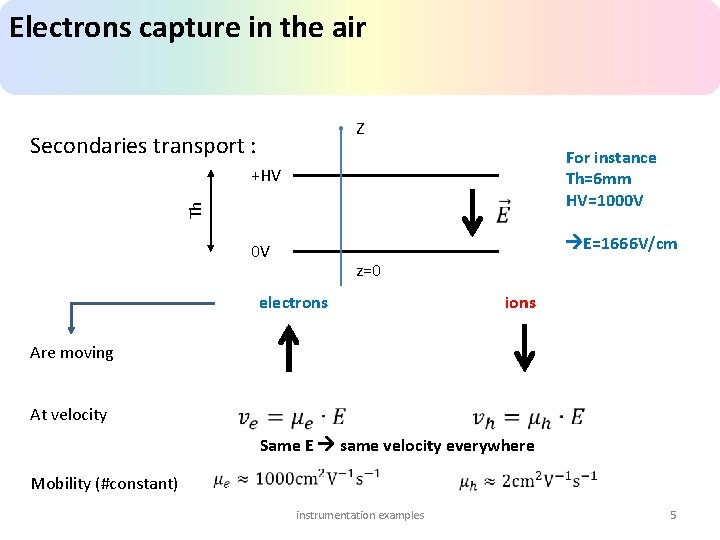
Electrons capture in the air Z Secondaries transport : 0 V E=1666 V/cm Th +HV For instance Th=6 mm HV=1000 V z=0 electrons ions Are moving At velocity Same E same velocity everywhere Mobility (#constant) instrumentation examples 5
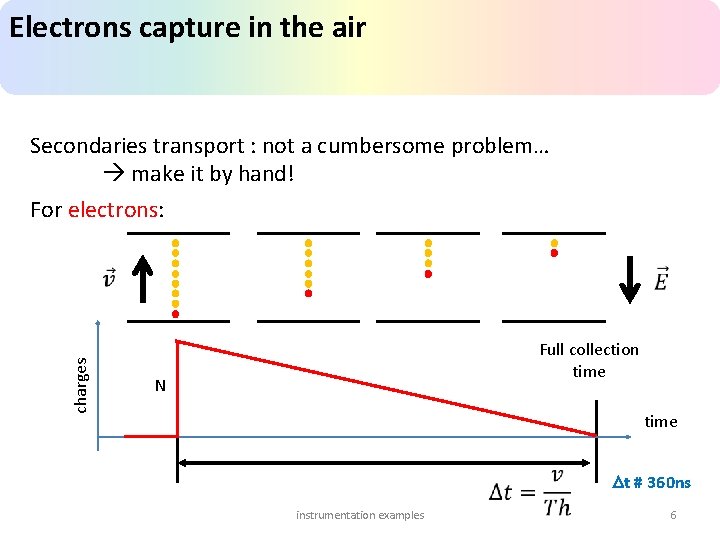
Electrons capture in the air charges Secondaries transport : not a cumbersome problem… make it by hand! For electrons: Full collection time N time Dt # 360 ns instrumentation examples 6
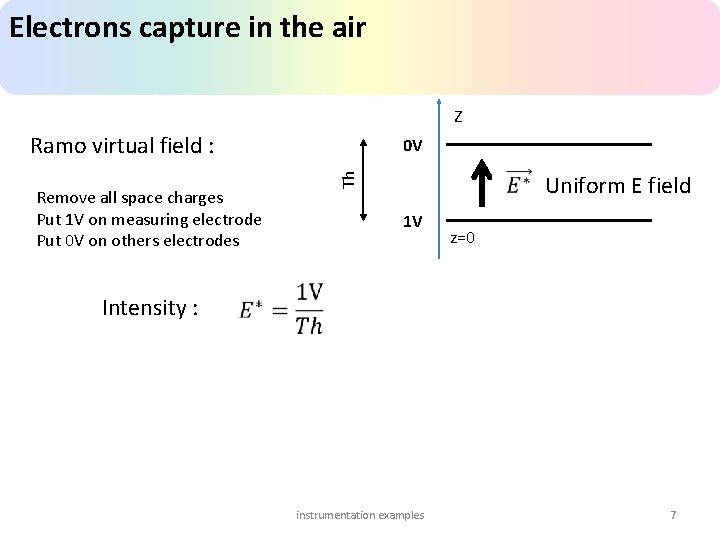
Electrons capture in the air Z Ramo virtual field : Uniform E field Th Remove all space charges Put 1 V on measuring electrode Put 0 V on others electrodes 0 V 1 V z=0 Intensity : instrumentation examples 7
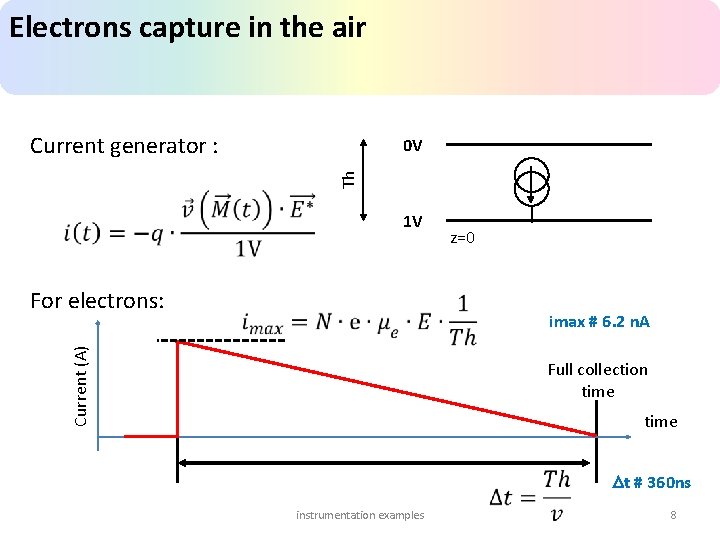
Electrons capture in the air Current generator : Th 0 V 1 V For electrons: z=0 Current (A) imax # 6. 2 n. A Full collection time Dt # 360 ns instrumentation examples 8
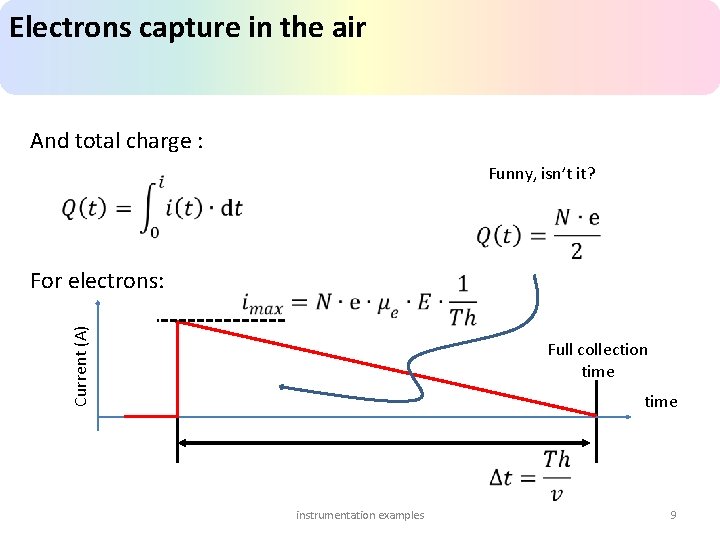
Electrons capture in the air And total charge : Funny, isn’t it? Current (A) For electrons: Full collection time instrumentation examples 9
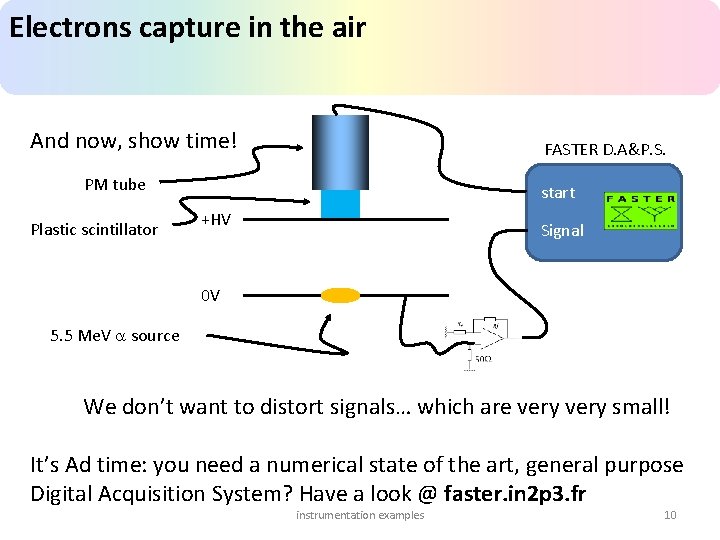
Electrons capture in the air And now, show time! FASTER D. A&P. S. PM tube Plastic scintillator start +HV Signal 0 V 5. 5 Me. V a source We don’t want to distort signals… which are very small! It’s Ad time: you need a numerical state of the art, general purpose Digital Acquisition System? Have a look @ faster. in 2 p 3. fr instrumentation examples 10
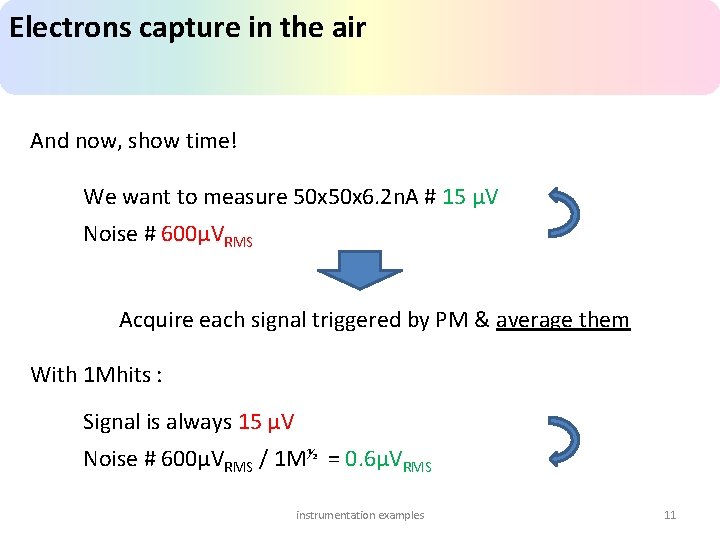
Electrons capture in the air And now, show time! We want to measure 50 x 6. 2 n. A # 15 µV Noise # 600µVRMS Acquire each signal triggered by PM & average them With 1 Mhits : Signal is always 15 µV Noise # 600µVRMS / 1 M½ = 0. 6µVRMS instrumentation examples 11
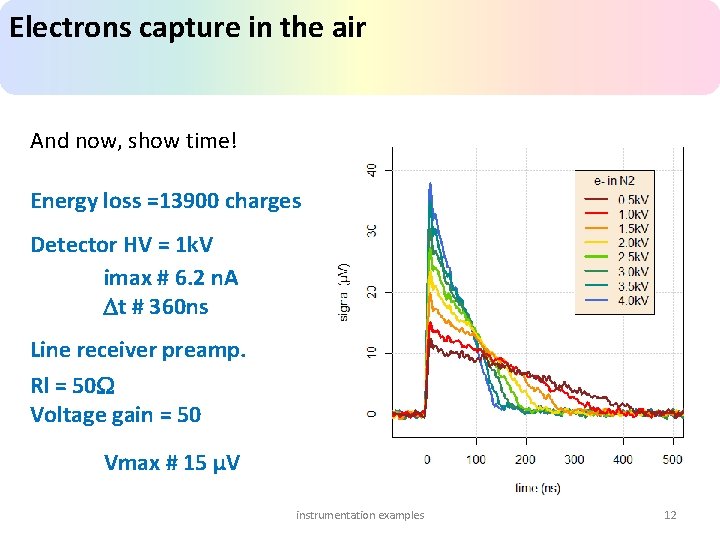
Electrons capture in the air And now, show time! Energy loss =13900 charges Detector HV = 1 k. V imax # 6. 2 n. A Dt # 360 ns Line receiver preamp. Rl = 50 W Voltage gain = 50 Vmax # 15 µV instrumentation examples 12
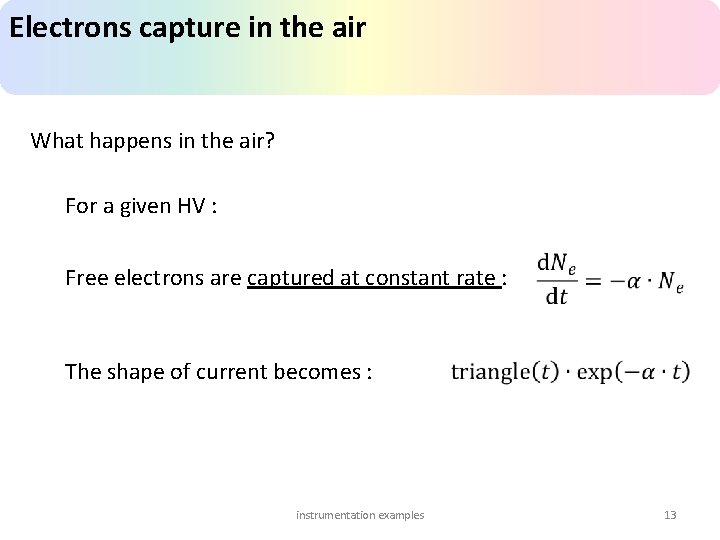
Electrons capture in the air What happens in the air? For a given HV : Free electrons are captured at constant rate : The shape of current becomes : instrumentation examples 13
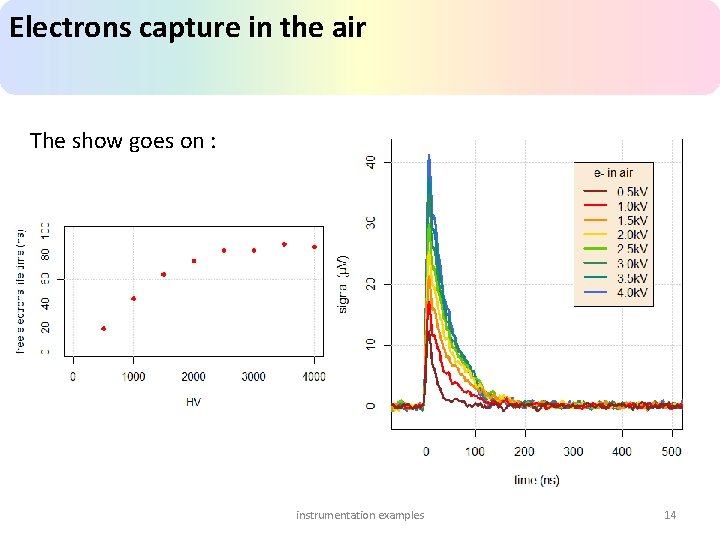
Electrons capture in the air The show goes on : instrumentation examples 14
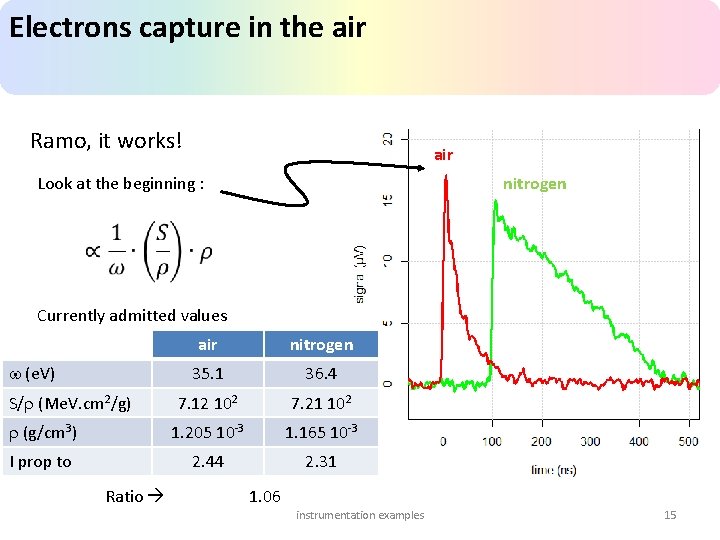
Electrons capture in the air Ramo, it works! air Look at the beginning : nitrogen Currently admitted values air nitrogen 35. 1 36. 4 7. 12 102 7. 21 102 r (g/cm 3) 1. 205 10 -3 1. 165 10 -3 I prop to 2. 44 2. 31 w (e. V) S/r (Me. V. cm 2/g) Ratio 1. 06 instrumentation examples 15
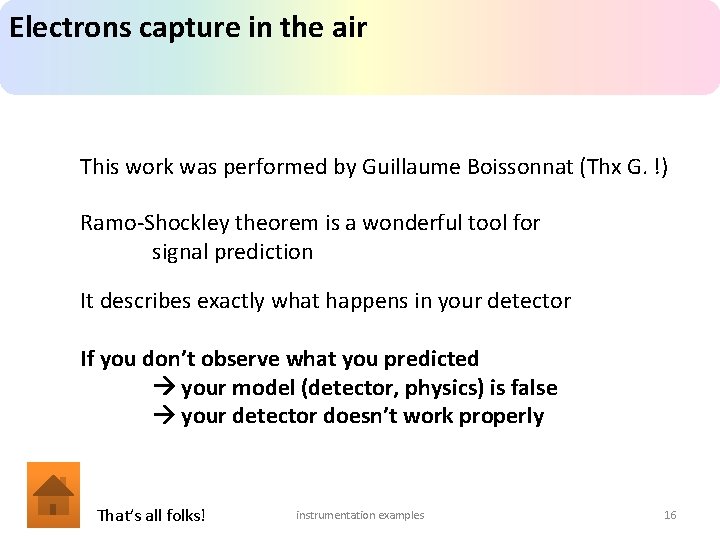
Electrons capture in the air This work was performed by Guillaume Boissonnat (Thx G. !) Ramo-Shockley theorem is a wonderful tool for signal prediction It describes exactly what happens in your detector If you don’t observe what you predicted your model (detector, physics) is false your detector doesn’t work properly That’s all folks! instrumentation examples 16
- Slides: 16