
ElectronPhoton identification in ATLAS and CMS Claude Charlot


- Slides: 24
Electron/Photon identification in ATLAS and CMS Claude Charlot LLR-École Polytechnique, Palaiseau, IN 2 P 3/CNRS for CMS and ATLAS collaborations C. Charlot, HCP 2006, Electron and photon ID at ATLAS and CMS
Outline o o o o Physics motivation ATLAS and CMS detectors @LHC In situ calibration procedures Energy estimation Electron tracking Material budget effects e/jet and / 0 separation Soft electrons C. Charlot, HCP 2006, Electron and photon ID at ATLAS and CMS
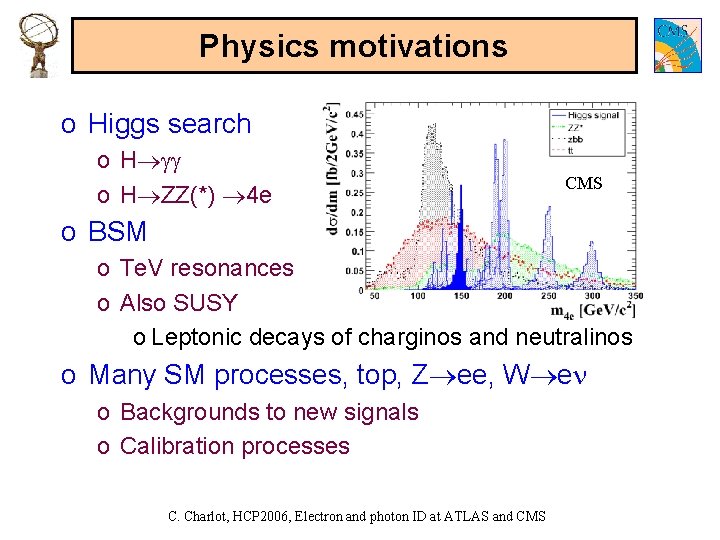
Physics motivations o Higgs search o H ZZ(*) 4 e CMS o BSM o Te. V resonances o Also SUSY o Leptonic decays of charginos and neutralinos o Many SM processes, top, Z ee, W e o Backgrounds to new signals o Calibration processes C. Charlot, HCP 2006, Electron and photon ID at ATLAS and CMS
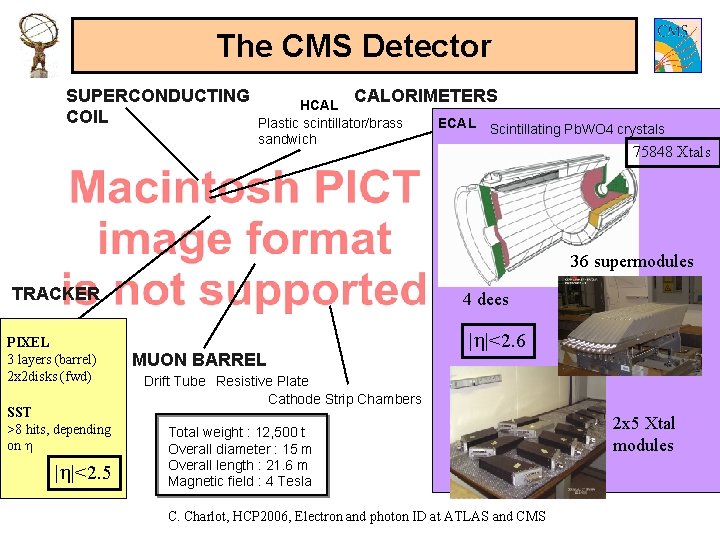
The CMS Detector SUPERCONDUCTING COIL CALORIMETERS HCAL Plastic scintillator/brass sandwich ECAL Scintillating Pb. WO 4 crystals 75848 Xtals 36 supermodules TRACKER PIXEL 3 layers (barrel) 2 x 2 disks (fwd) SST >8 hits, depending on | |<2. 5 4 dees | |<2. 6 MUON BARREL Drift Tube Resistive Plate Cathode Strip Chambers Total weight : 12, 500 t Overall diameter : 15 m Overall length : 21. 6 m Magnetic field : 4 Tesla 2 x 5 Xtal modules C. Charlot, HCP 2006, Electron and photon ID at ATLAS and CMS
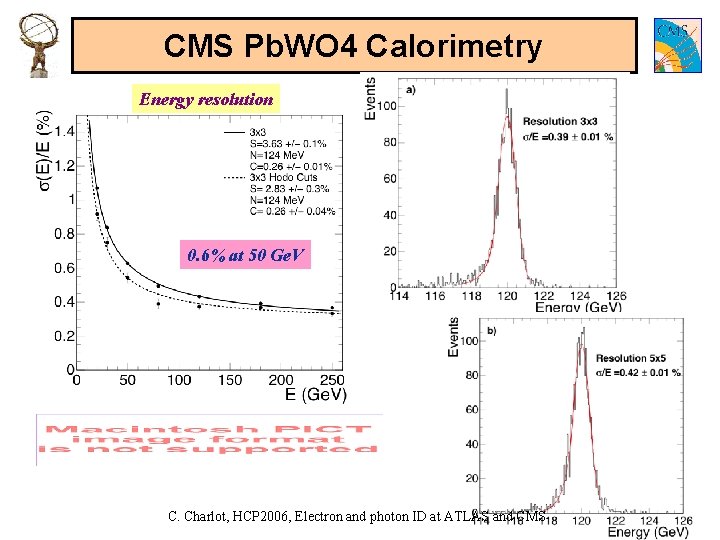
CMS Pb. WO 4 Calorimetry Resolution(%) Energy resolution CMS 0. 6% at 50 Ge. V C. Charlot, HCP 2006, Electron and photon ID at ATLAS and CMS
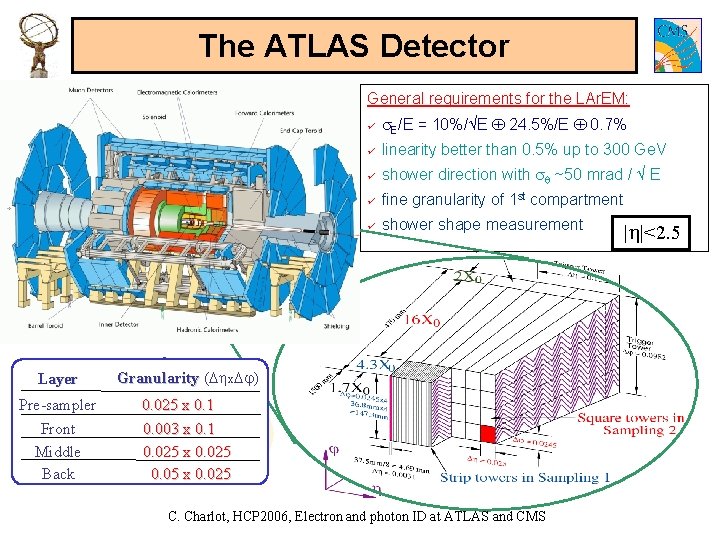
The ATLAS Detector General requirements for the ID: General requirements for the LAr. EM: E/E = 10%/ E 24. 5%/E 0. 7% robust pattern recognition linearity better than 0. 5% up to 300 Ge. V fast level-2 trigger shower direction with q ~50 mrad / E accurate momentum fine granularity of 1 st compartment measurements shower shape measurement | |<2. 5 accurate vertexing measurement TRT Layer Pre-sampler ap c d En. Front Middle Back ap c d Granularity ( x ) En 0. 025 x 0. 1 Radiator 0. 003 x 0. 1 0. 025 x 0. 025 Straws 0. 05 x 0. 025 C. Charlot, HCP 2006, Electron and photon ID at ATLAS and CMS
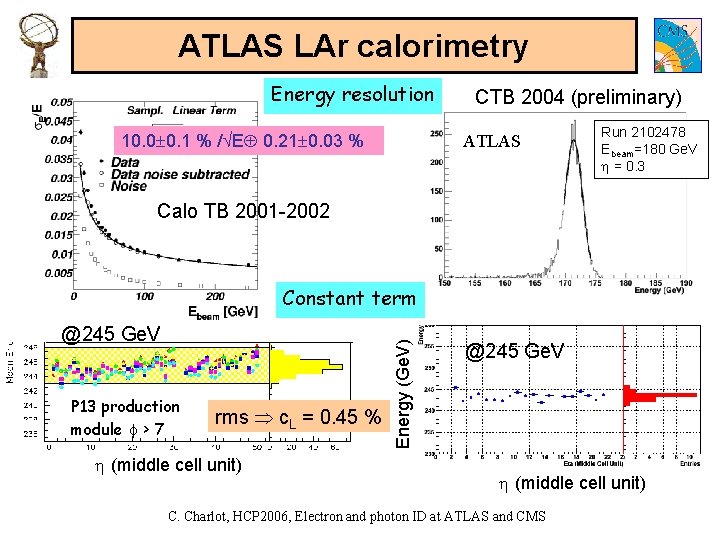
ATLAS LAr calorimetry Energy resolution 10. 0 0. 1 % / E 0. 21 0. 03 % CTB 2004 (preliminary) ATLAS Run 2102478 Ebeam=180 Ge. V = 0. 3 Calo TB 2001 -2002 @245 Ge. V P 13 production module > 7 4. 5‰ rms c. L = 0. 45 % (middle cell unit) Energy (Ge. V) Constant term @245 Ge. V (middle cell unit) C. Charlot, HCP 2006, Electron and photon ID at ATLAS and CMS
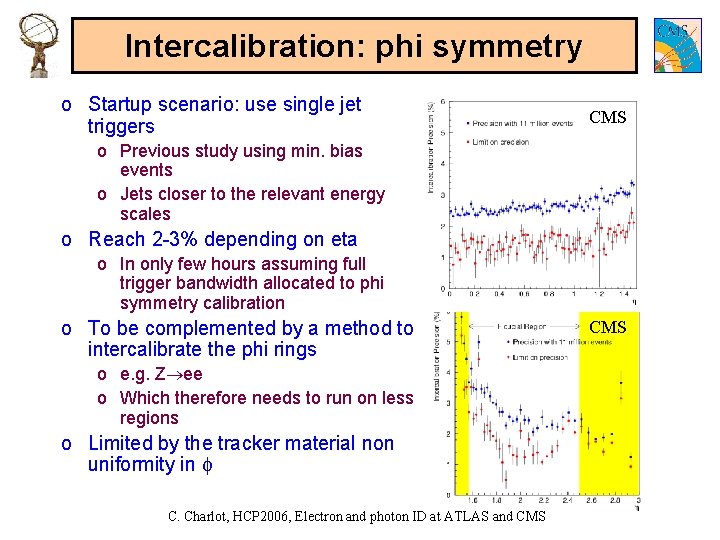
Intercalibration: phi symmetry o Startup scenario: use single jet triggers CMS o Previous study using min. bias events o Jets closer to the relevant energy scales o Reach 2 -3% depending on eta o In only few hours assuming full trigger bandwidth allocated to phi symmetry calibration o To be complemented by a method to intercalibrate the phi rings o e. g. Z ee o Which therefore needs to run on less regions o Limited by the tracker material non uniformity in C. Charlot, HCP 2006, Electron and photon ID at ATLAS and CMS
Intercalibration: Z ee o Intercalibration of regions at start up using kinematical constraint o Select low radiating electron pairs ATLAS =1. 9% o Main difficulty o Efficiency of 5. 6% for golden-golden Z’s o 0. 6% after 2 fb-1 (CMS) o Starting from a mis-calibration between rings of 2% and within rings of 4% o As result of lab measurements and phi symmetry CMS C. Charlot, HCP 2006, Electron and photon ID at ATLAS and CMS 2 fb-1
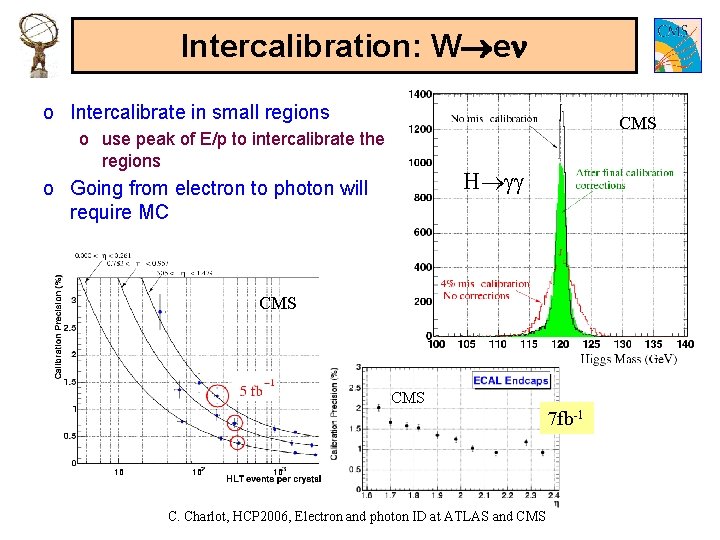
Intercalibration: W e o Intercalibrate in small regions CMS o use peak of E/p to intercalibrate the regions H o Going from electron to photon will require MC CMS 7 fb-1 C. Charlot, HCP 2006, Electron and photon ID at ATLAS and CMS
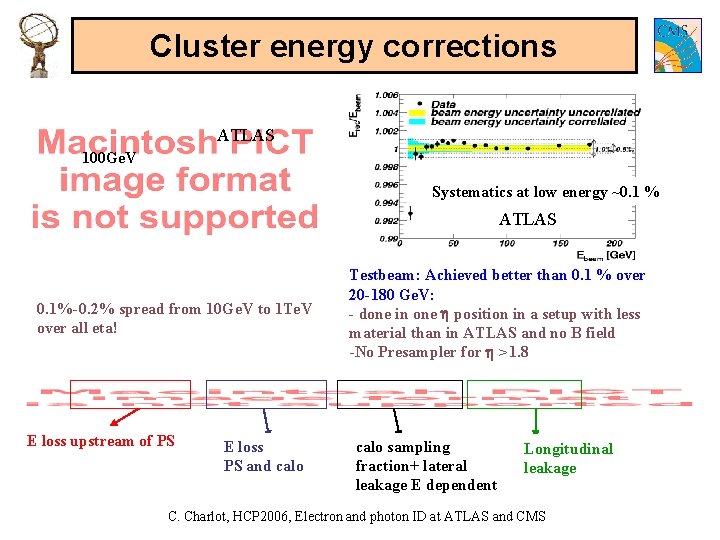
Cluster energy corrections ATLAS 100 Ge. V Systematics at low energy ~0. 1 % ATLAS 0. 1%-0. 2% spread from 10 Ge. V to 1 Te. V over all eta! E loss upstream of PS E loss PS and calo Testbeam: Achieved better than 0. 1 % over 20 -180 Ge. V: - done in one position in a setup with less material than in ATLAS and no B field -No Presampler for >1. 8 calo sampling fraction+ lateral leakage E dependent Longitudinal leakage C. Charlot, HCP 2006, Electron and photon ID at ATLAS and CMS
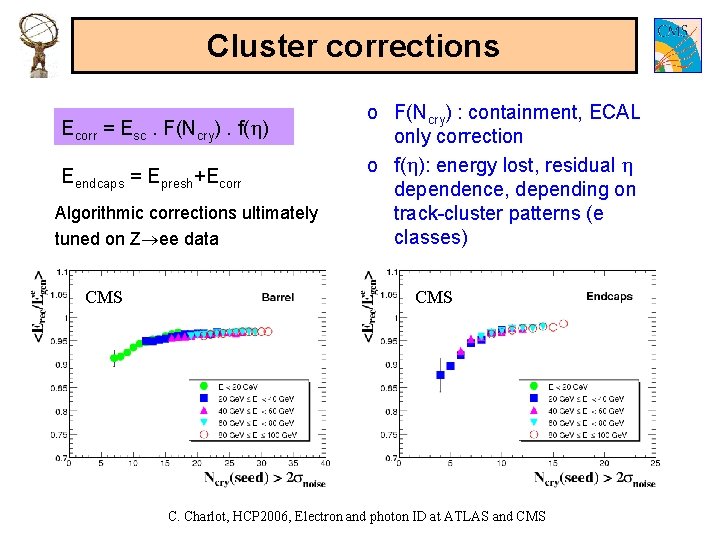
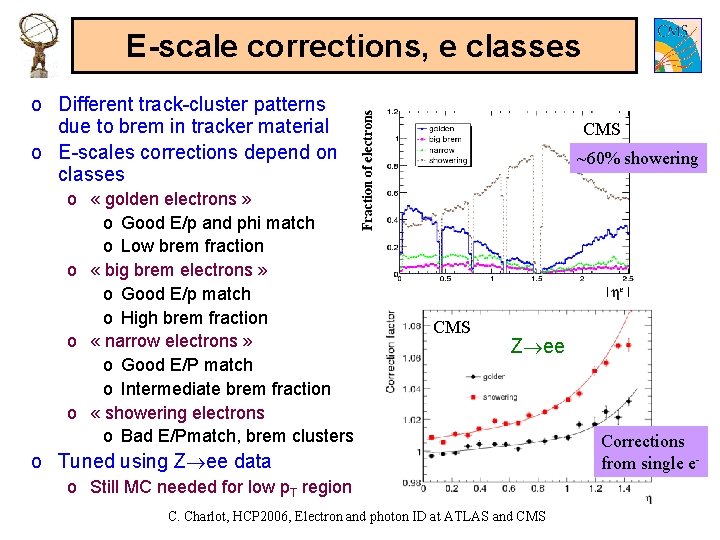
Cluster corrections Ecorr = Esc. F(Ncry). f( ) Eendcaps = Epresh+Ecorr Algorithmic corrections ultimately tuned on Z ee data CMS o F(Ncry) : containment, ECAL only correction o f( ): energy lost, residual dependence, depending on track-cluster patterns (e classes) CMS C. Charlot, HCP 2006, Electron and photon ID at ATLAS and CMS
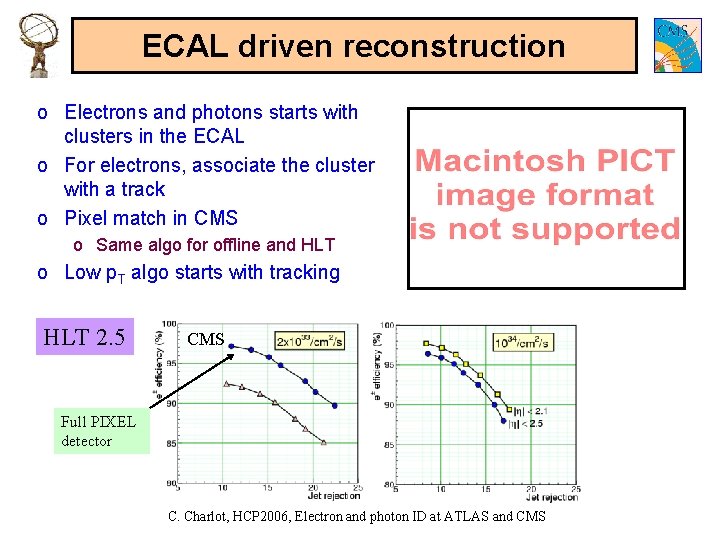
ECAL driven reconstruction o Electrons and photons starts with clusters in the ECAL o For electrons, associate the cluster with a track o Pixel match in CMS o Same algo for offline and HLT o Low p. T algo starts with tracking HLT 2. 5 CMS Full PIXEL detector C. Charlot, HCP 2006, Electron and photon ID at ATLAS and CMS
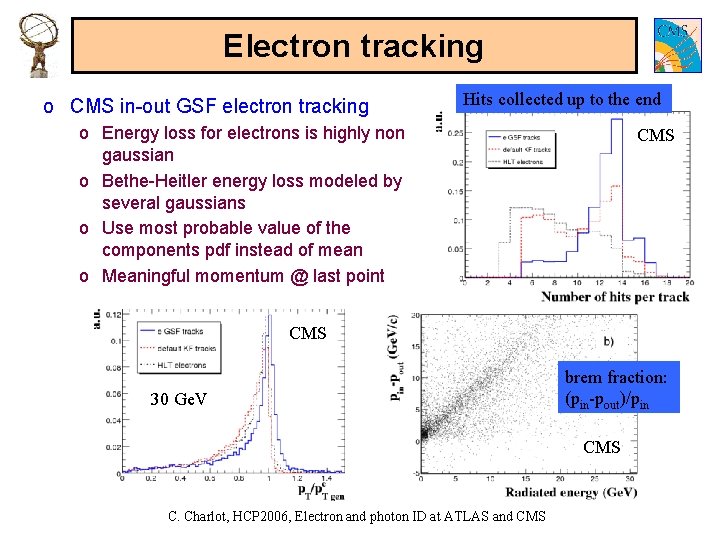
Electron tracking o CMS in-out GSF electron tracking Hits collected up to the end o Energy loss for electrons is highly non gaussian o Bethe-Heitler energy loss modeled by several gaussians o Use most probable value of the components pdf instead of mean o Meaningful momentum @ last point CMS 30 Ge. V brem fraction: (pin-pout)/pin CMS C. Charlot, HCP 2006, Electron and photon ID at ATLAS and CMS
E-scale corrections, e classes o Different track-cluster patterns due to brem in tracker material o E-scales corrections depend on classes o « golden electrons » o Good E/p and phi match o Low brem fraction o « big brem electrons » o Good E/p match o High brem fraction o « narrow electrons » o Good E/P match o Intermediate brem fraction o « showering electrons o Bad E/Pmatch, brem clusters CMS ~60% showering CMS Z ee o Tuned using Z ee data o Still MC needed for low p. T region C. Charlot, HCP 2006, Electron and photon ID at ATLAS and CMS Corrections from single e-
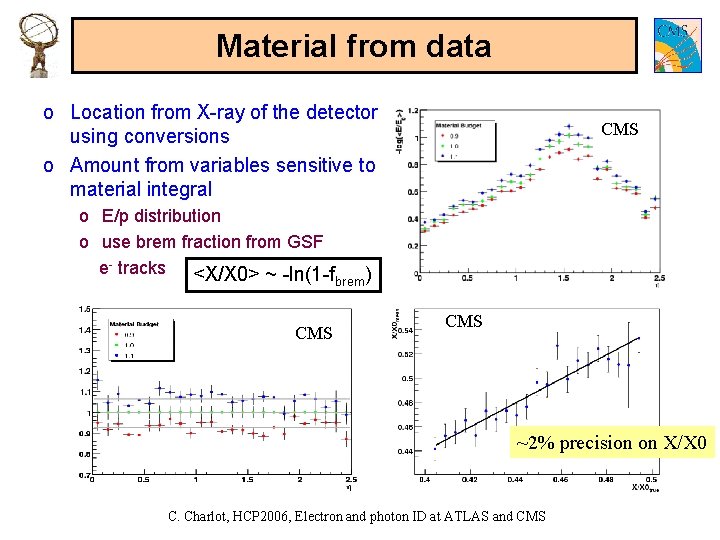
Material from data o Location from X-ray of the detector using conversions o Amount from variables sensitive to material integral o E/p distribution o use brem fraction from GSF e- tracks <X/X 0> ~ -ln(1 -f CMS brem) CMS ~2% precision on X/X 0 C. Charlot, HCP 2006, Electron and photon ID at ATLAS and CMS
Photon conversions o ECAL driven inward seed/track finding CMS o Followed by outward seed/track finding o Pairs of opposite-charge tracks fitted to common vertex o Parameters refitted with vertex constraint 2 tracks 1 track o Photon momentum from the tracks o Determines the primary interaction vertex 15<r<58 cm r<15 cm r>58 cm C. Charlot, HCP 2006, Electron and photon ID at ATLAS and CMS (barrel)
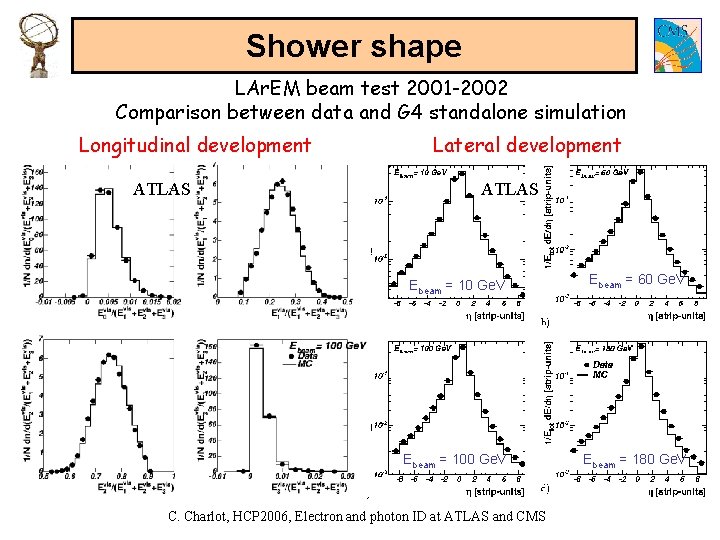
Shower shape LAr. EM beam test 2001 -2002 Comparison between data and G 4 standalone simulation Longitudinal development ATLAS Lateral development ATLAS Ebeam = 10 Ge. V Ebeam = 60 Ge. V Ebeam = 100 Ge. V Ebeam = 180 Ge. V C. Charlot, HCP 2006, Electron and photon ID at ATLAS and CMS
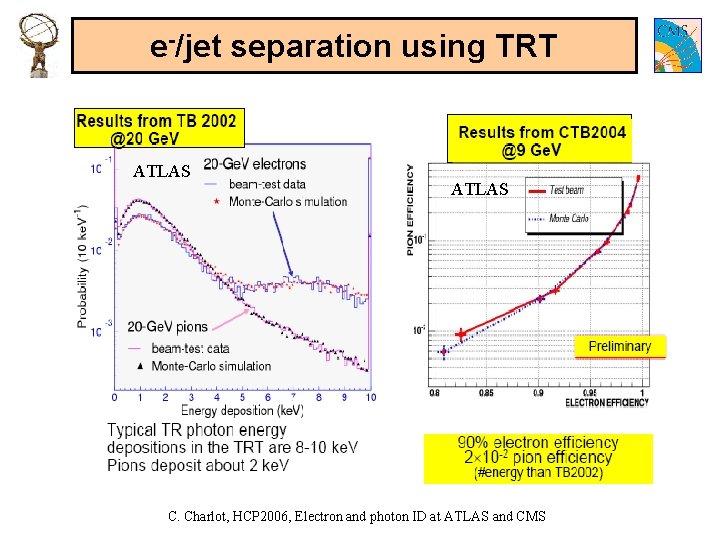
e-/jet separation using TRT ATLAS C. Charlot, HCP 2006, Electron and photon ID at ATLAS and CMS
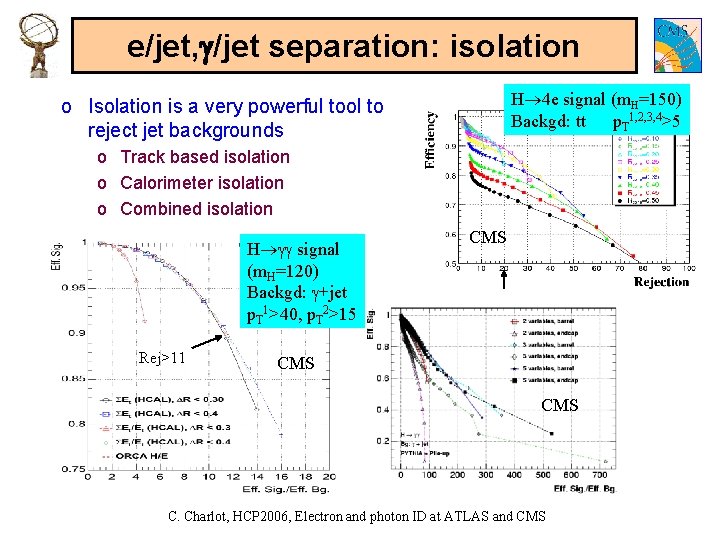
e/jet, /jet separation: isolation H 4 e signal (m. H=150) Backgd: tt p. T 1, 2, 3, 4>5 o Isolation is a very powerful tool to reject jet backgrounds o Track based isolation o Calorimeter isolation o Combined isolation H signal (m. H=120) Backgd: +jet p. T 1>40, p. T 2>15 Rej>11 CMS CMS C. Charlot, HCP 2006, Electron and photon ID at ATLAS and CMS
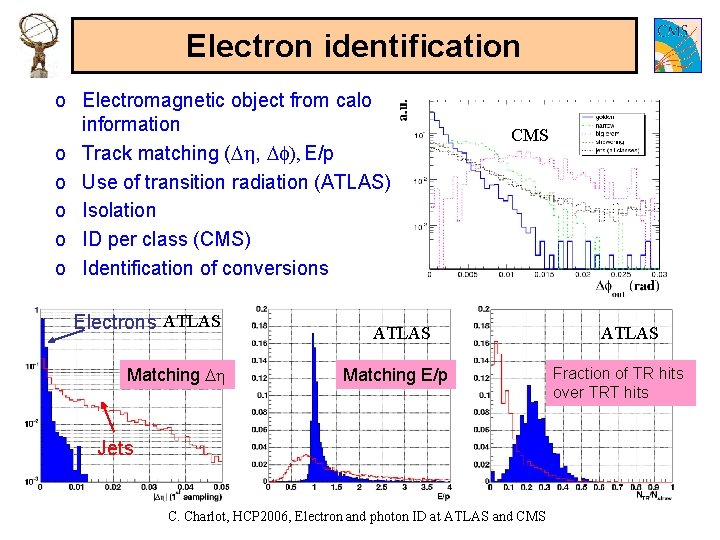
Electron identification o Electromagnetic object from calo information o Track matching ( , ), E/p o Use of transition radiation (ATLAS) o Isolation o ID per class (CMS) o Identification of conversions Electrons ATLAS Matching CMS ATLAS Matching E/p Jets C. Charlot, HCP 2006, Electron and photon ID at ATLAS and CMS ATLAS Fraction of TR hits over TRT hits
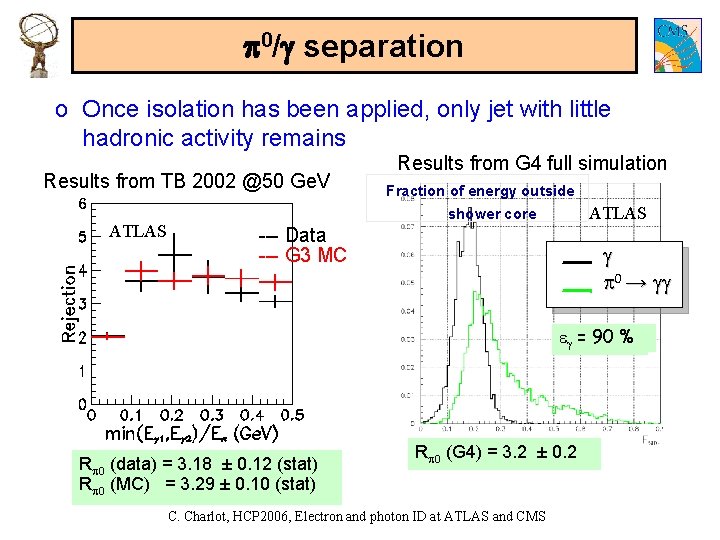
0/ separation o Once isolation has been applied, only jet with little hadronic activity remains Results from TB 2002 @50 Ge. V ATLAS Results from G 4 full simulation Fraction of energy outside ATLAS shower core --- Data --- G 3 MC 0 → ATLAS R 0 (data) = 3. 18 ± 0. 12 (stat) R 0 (MC) = 3. 29 ± 0. 10 (stat) = 90 % R 0 (G 4) = 3. 2 ± 0. 2 C. Charlot, HCP 2006, Electron and photon ID at ATLAS and CMS
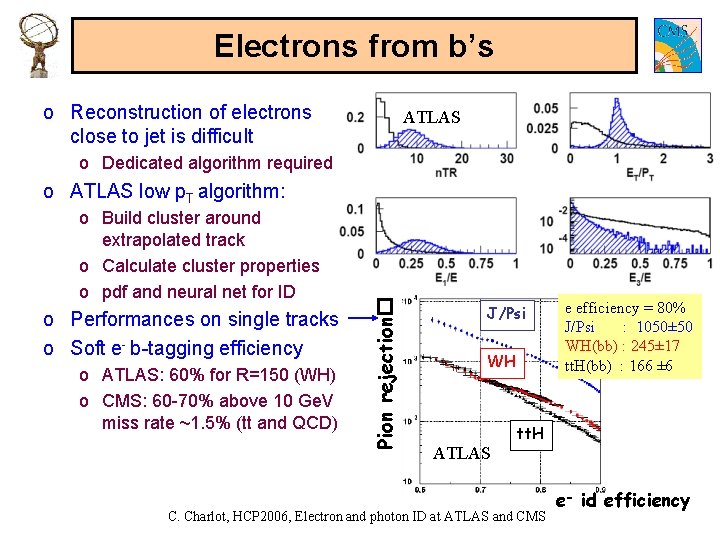
Electrons from b’s o Reconstruction of electrons close to jet is difficult ATLAS o Dedicated algorithm required o Build cluster around extrapolated track o Calculate cluster properties o pdf and neural net for ID o Performances on single tracks o Soft e- b-tagging efficiency o ATLAS: 60% for R=150 (WH) o CMS: 60 -70% above 10 Ge. V miss rate ~1. 5% (tt and QCD) Pion rejection� o ATLAS low p. T algorithm: J/Psi WH ATLAS e efficiency = 80% J/Psi : 1050± 50 WH(bb) : 245± 17 tt. H(bb) : 166 ± 6 tt. H C. Charlot, HCP 2006, Electron and photon ID at ATLAS and CMS e- id efficiency
Summary o Electron and photon ID are essential ingredients for new physics at LHC o In situ calibration procedures are established o Material budget is a key issue o Impact the reconstruction efficiency o Degrades performances o Isolation is a very powerful tool o Final ID using shape and match variables o Dedicated algorithms needed for e- from b’s C. Charlot, HCP 2006, Electron and photon ID at ATLAS and CMS