
ElectronIon Collider Overview Machine Detector Interface Considerations EIC
- Slides: 28
Electron-Ion Collider Overview & Machine -Detector Interface Considerations EIC Calorimeter Workshop March 15 2021 F. Willeke, BNL EIC Technical Director EIC Deputy Director
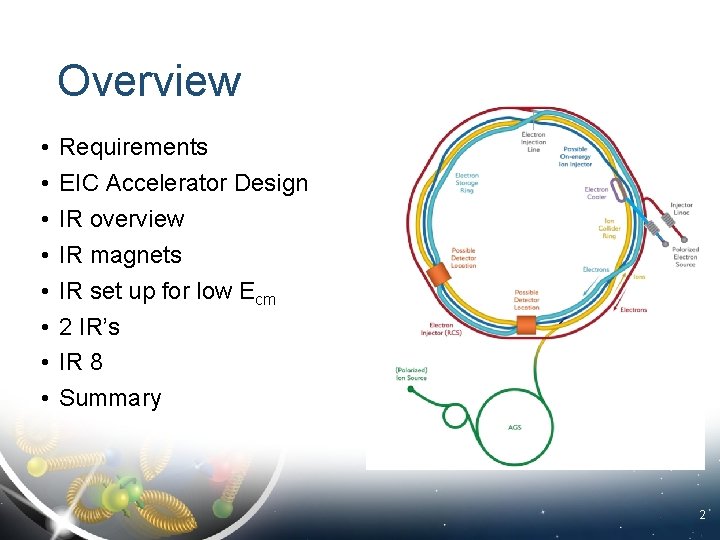
Overview • • Requirements EIC Accelerator Design IR overview IR magnets IR set up for low Ecm 2 IR’s IR 8 Summary 2
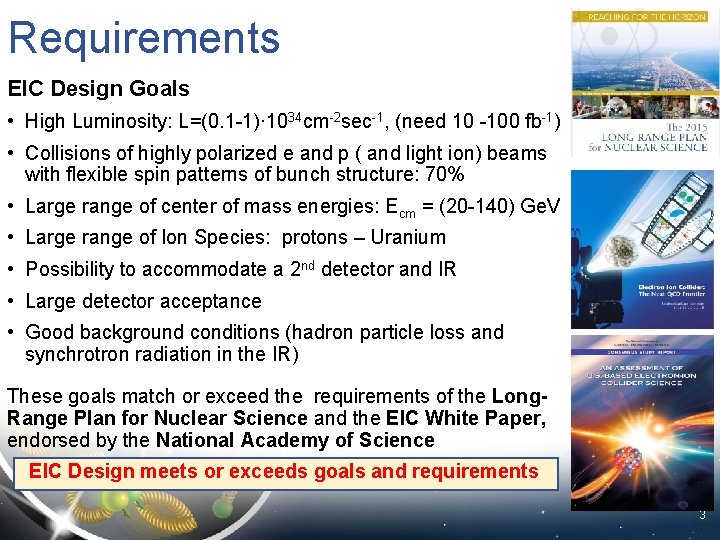
Requirements EIC Design Goals • High Luminosity: L=(0. 1 -1)∙ 1034 cm-2 sec-1, (need 10 -100 fb-1) • Collisions of highly polarized e and p ( and light ion) beams with flexible spin patterns of bunch structure: 70% • Large range of center of mass energies: Ecm = (20 -140) Ge. V • Large range of Ion Species: protons – Uranium • Possibility to accommodate a 2 nd detector and IR • Large detector acceptance • Good background conditions (hadron particle loss and synchrotron radiation in the IR) These goals match or exceed the requirements of the Long. Range Plan for Nuclear Science and the EIC White Paper, endorsed by the National Academy of Science EIC Design meets or exceeds goals and requirements 3
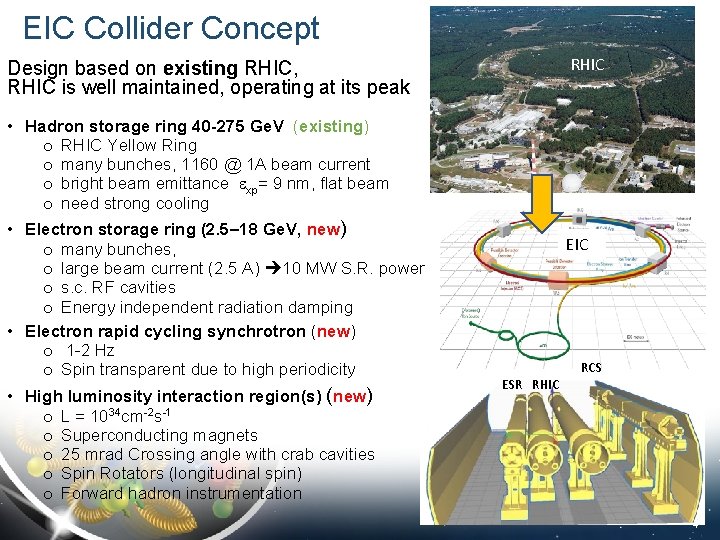
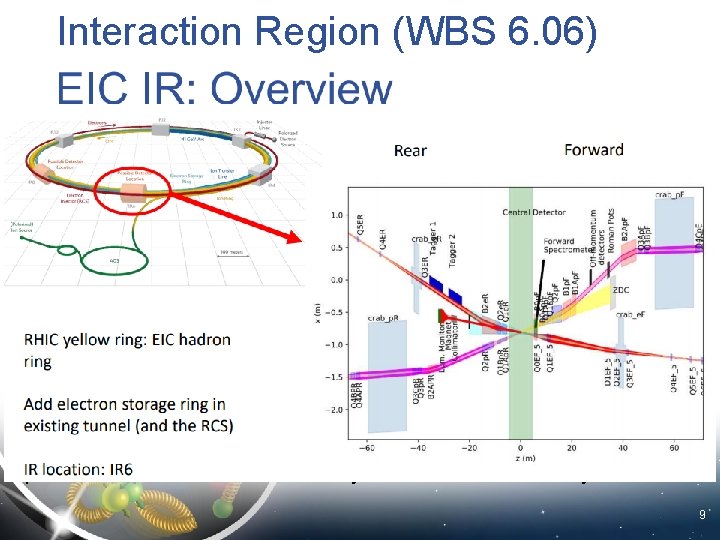
EIC Collider Concept RHIC Design based on existing RHIC, RHIC is well maintained, operating at its peak • Hadron storage ring 40 -275 Ge. V (existing) o RHIC Yellow Ring o many bunches, 1160 @ 1 A beam current o bright beam emittance exp= 9 nm, flat beam o need strong cooling • Electron storage ring (2. 5– 18 Ge. V, new) o many bunches, o large beam current (2. 5 A) 10 MW S. R. power o s. c. RF cavities o Energy independent radiation damping • Electron rapid cycling synchrotron (new) o 1 -2 Hz o Spin transparent due to high periodicity • High luminosity interaction region(s) (new) o L = 1034 cm-2 s-1 o Superconducting magnets o 25 mrad Crossing angle with crab cavities o Spin Rotators (longitudinal spin) o Forward hadron instrumentation EIC ESR RHIC RCS 4
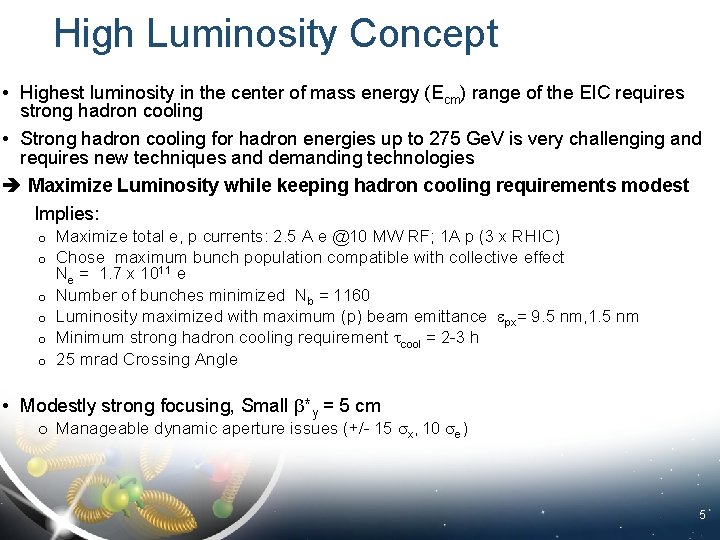
High Luminosity Concept • Highest luminosity in the center of mass energy (Ecm) range of the EIC requires strong hadron cooling • Strong hadron cooling for hadron energies up to 275 Ge. V is very challenging and requires new techniques and demanding technologies Maximize Luminosity while keeping hadron cooling requirements modest Implies: o o o Maximize total e, p currents: 2. 5 A e @10 MW RF; 1 A p (3 x RHIC) Chose maximum bunch population compatible with collective effect Ne = 1. 7 x 10¹¹ e Number of bunches minimized Nb = 1160 Luminosity maximized with maximum (p) beam emittance epx= 9. 5 nm, 1. 5 nm Minimum strong hadron cooling requirement tcool = 2 -3 h 25 mrad Crossing Angle • Modestly strong focusing, Small b*y = 5 cm o Manageable dynamic aperture issues (+/- 15 sx, 10 se) 5
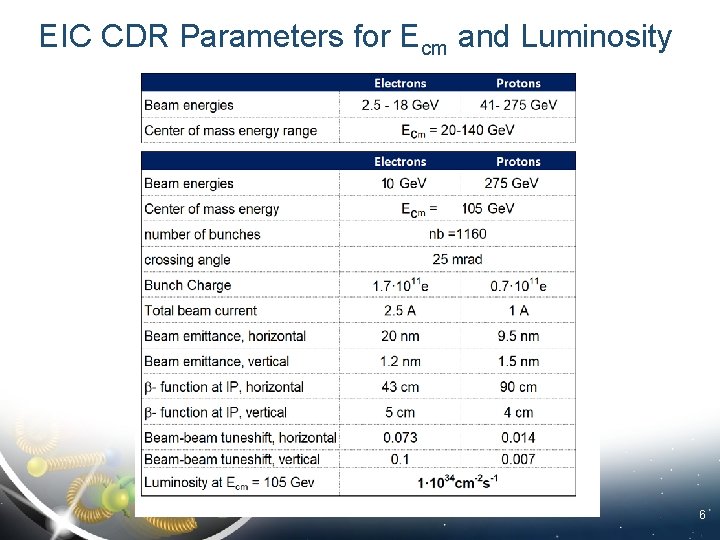
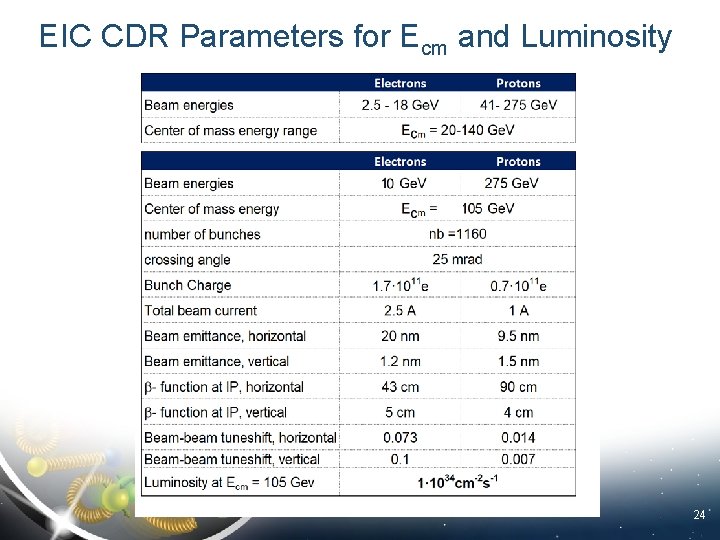
EIC CDR Parameters for Ecm and Luminosity 6
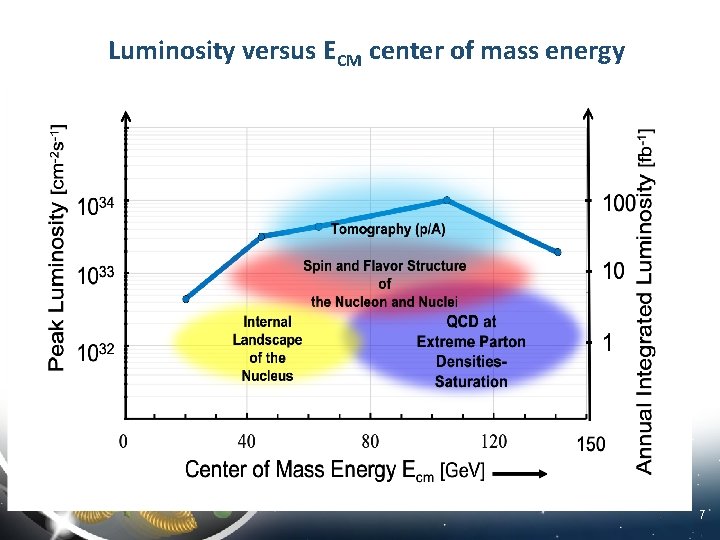
Luminosity versus ECM center of mass energy 7
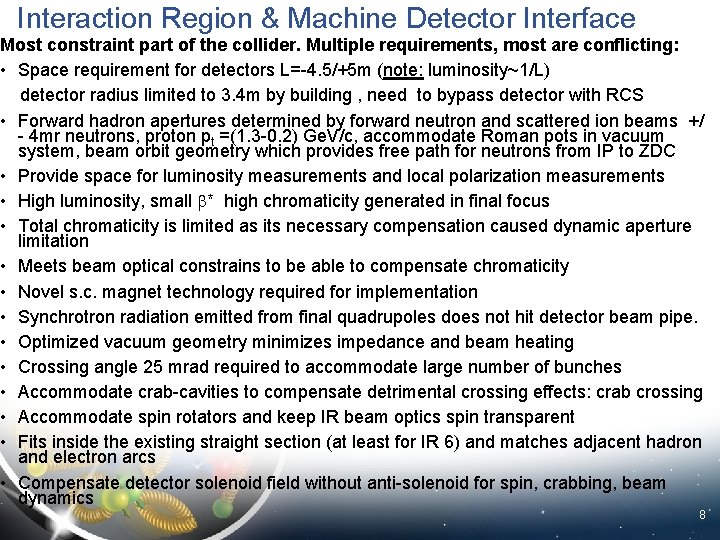
Interaction Region & Machine Detector Interface Most constraint part of the collider. Multiple requirements, most are conflicting: • Space requirement for detectors L=-4. 5/+5 m (note: luminosity~1/L) detector radius limited to 3. 4 m by building , need to bypass detector with RCS • Forward hadron apertures determined by forward neutron and scattered ion beams +/ - 4 mr neutrons, proton pt =(1. 3 -0. 2) Ge. V/c, accommodate Roman pots in vacuum system, beam orbit geometry which provides free path for neutrons from IP to ZDC • Provide space for luminosity measurements and local polarization measurements • High luminosity, small b* high chromaticity generated in final focus • Total chromaticity is limited as its necessary compensation caused dynamic aperture limitation • Meets beam optical constrains to be able to compensate chromaticity • Novel s. c. magnet technology required for implementation • Synchrotron radiation emitted from final quadrupoles does not hit detector beam pipe. • Optimized vacuum geometry minimizes impedance and beam heating • Crossing angle 25 mrad required to accommodate large number of bunches • Accommodate crab-cavities to compensate detrimental crossing effects: crab crossing • Accommodate spin rotators and keep IR beam optics spin transparent • Fits inside the existing straight section (at least for IR 6) and matches adjacent hadron and electron arcs • Compensate detector solenoid field without anti-solenoid for spin, crabbing, beam dynamics 8
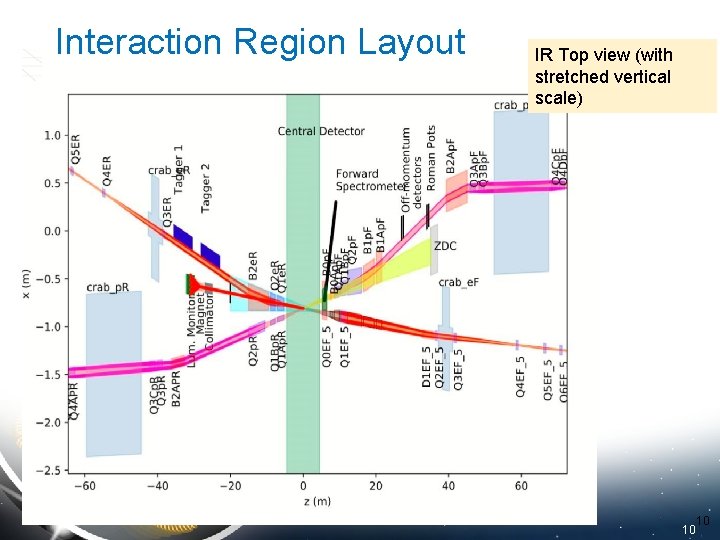
Interaction Region (WBS 6. 06) • Beams collide at the collision point in the center of the Interaction Region • IR Design is constraint by numerous requirements: o provides sufficient space for detector and detection of forward scattered particles o defines the collision orbits with a crossing angle of 25 mrad, o establishes focusing of the beam at the IP but avoiding extensive local chromaticity generation, o employs complex superconducting magnets with novel but-prototyped magnet technology o contains a low impedance vacuum system o generates manageable synchrotron radiation o accommodates crab cavities for hadrons and electrons with correct beam optics o accommodates spin rotators o fits inside the existing straight sections o accomplishes matching beam orbits and optics to the adjacent arc minimizing special dipole and quadrupole magnets o provides a spin matched electron and proton transport o provides optimum betatron phase advances to allow for compensation of 2 nd order chromaticity o provides favorable condition for luminosity measurements and auxiliary detectors 9
Interaction Region Layout IR Top view (with stretched vertical scale) 10 10
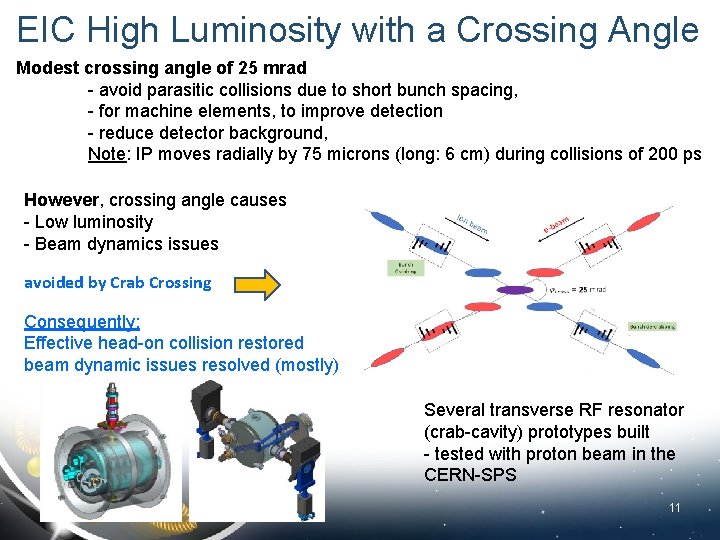
EIC High Luminosity with a Crossing Angle Modest crossing angle of 25 mrad - avoid parasitic collisions due to short bunch spacing, - for machine elements, to improve detection - reduce detector background, Note: IP moves radially by 75 microns (long: 6 cm) during collisions of 200 ps However, crossing angle causes - Low luminosity - Beam dynamics issues avoided by Crab Crossing Consequently: Effective head-on collision restored beam dynamic issues resolved (mostly) Several transverse RF resonator (crab-cavity) prototypes built - tested with proton beam in the CERN-SPS 11
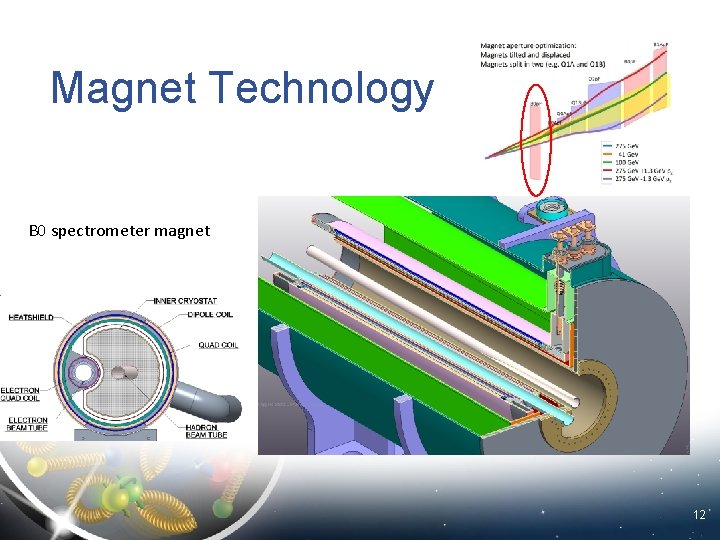
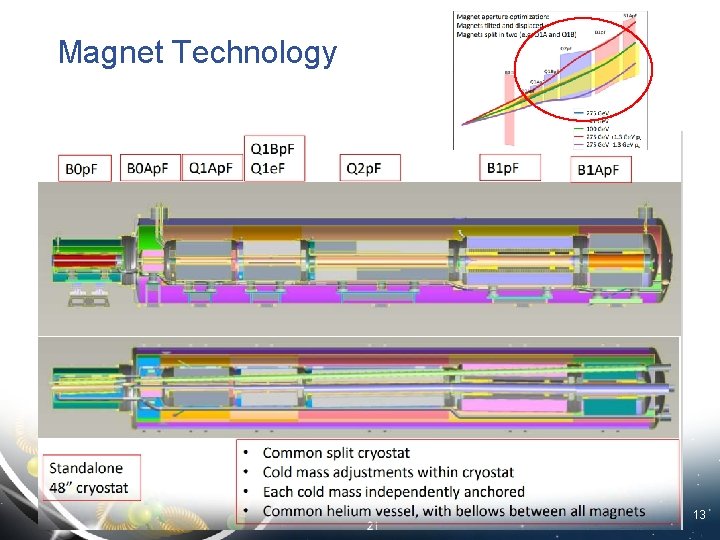
Magnet Technology B 0 spectrometer magnet 12
Magnet Technology 13
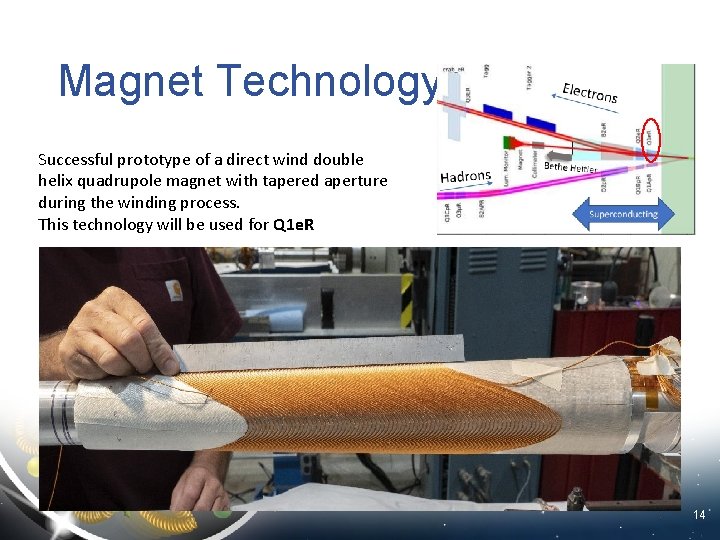
Magnet Technology Successful prototype of a direct wind double helix quadrupole magnet with tapered aperture during the winding process. This technology will be used for Q 1 e. R 14
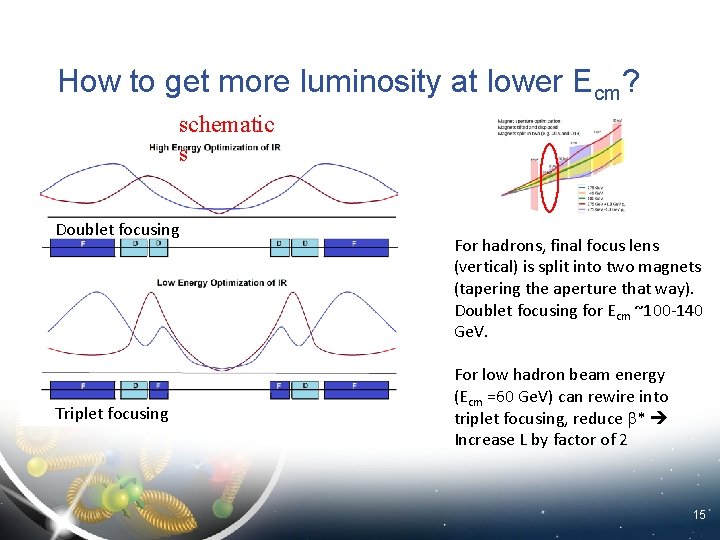
How to get more luminosity at lower Ecm? schematic s Doublet focusing Triplet focusing For hadrons, final focus lens (vertical) is split into two magnets (tapering the aperture that way). Doublet focusing for Ecm ~100 -140 Ge. V. For low hadron beam energy (Ecm =60 Ge. V) can rewire into triplet focusing, reduce b* Increase L by factor of 2 15
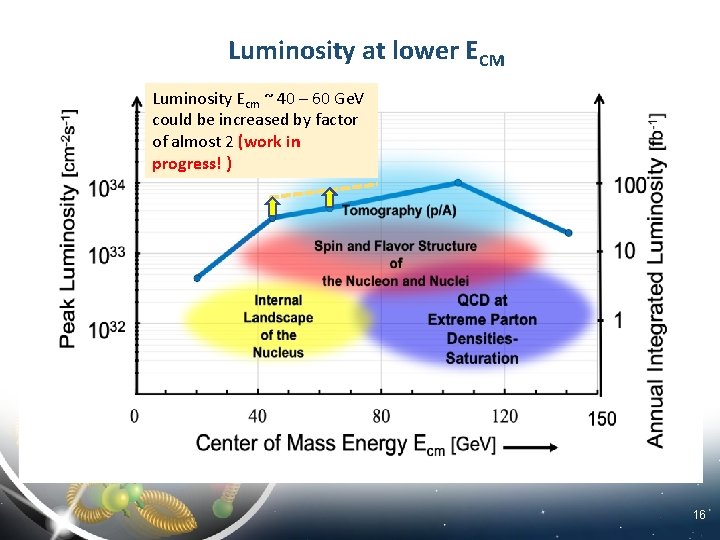
Luminosity at lower ECM Luminosity Ecm ~ 40 – 60 Ge. V could be increased by factor of almost 2 (work in progress! ) 16
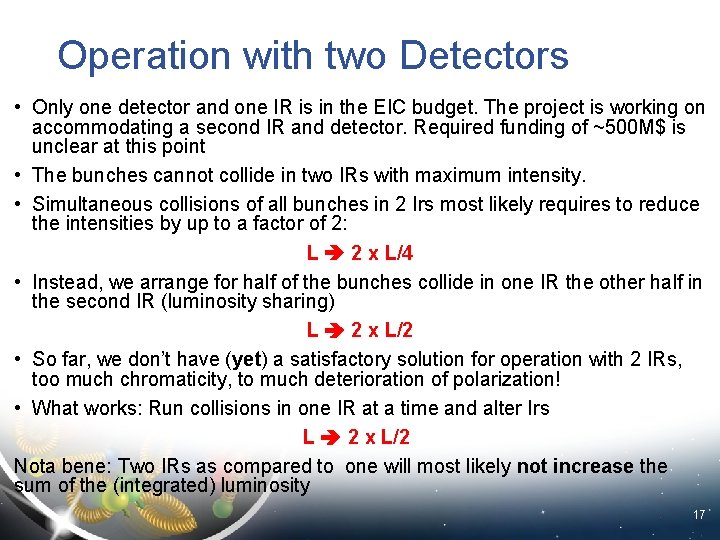
Operation with two Detectors • Only one detector and one IR is in the EIC budget. The project is working on accommodating a second IR and detector. Required funding of ~500 M$ is unclear at this point • The bunches cannot collide in two IRs with maximum intensity. • Simultaneous collisions of all bunches in 2 Irs most likely requires to reduce the intensities by up to a factor of 2: L 2 x L/4 • Instead, we arrange for half of the bunches collide in one IR the other half in the second IR (luminosity sharing) L 2 x L/2 • So far, we don’t have (yet) a satisfactory solution for operation with 2 IRs, too much chromaticity, to much deterioration of polarization! • What works: Run collisions in one IR at a time and alter Irs L 2 x L/2 Nota bene: Two IRs as compared to one will most likely not increase the sum of the (integrated) luminosity 17
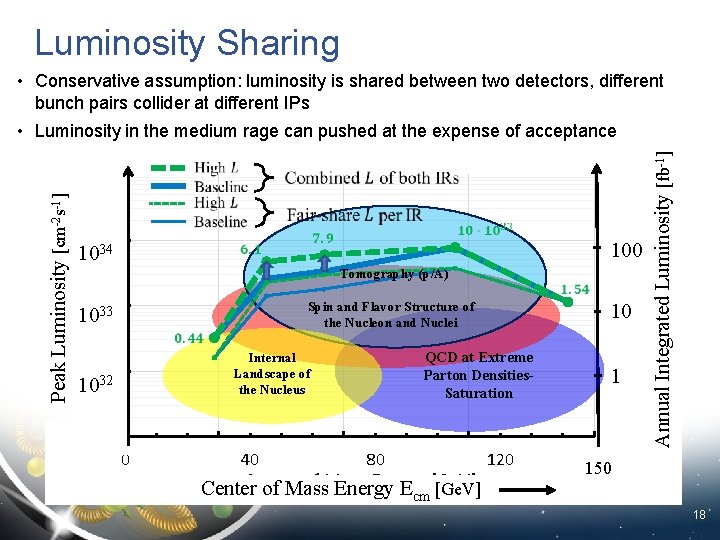
Luminosity Sharing 10 34 100 10 Tomography (p/A) 1 Spin and Flavor Structure of the Nucleon and Nuclei 1033 0, 1 0, 01 QCD at Extreme Parton Densities. Saturation Internal Landscape of the Nucleus 1032 0 40 10 80 Center of Mass Energy E [Ge. V] 120 1 Annual Integrated Luminosity [fb-1] Peak Luminosity [cm-2 s-1] • Conservative assumption: luminosity is shared between two detectors, different bunch pairs collider at different IPs • Luminosity in the medium rage can pushed at the expense of acceptance 150 cm 18
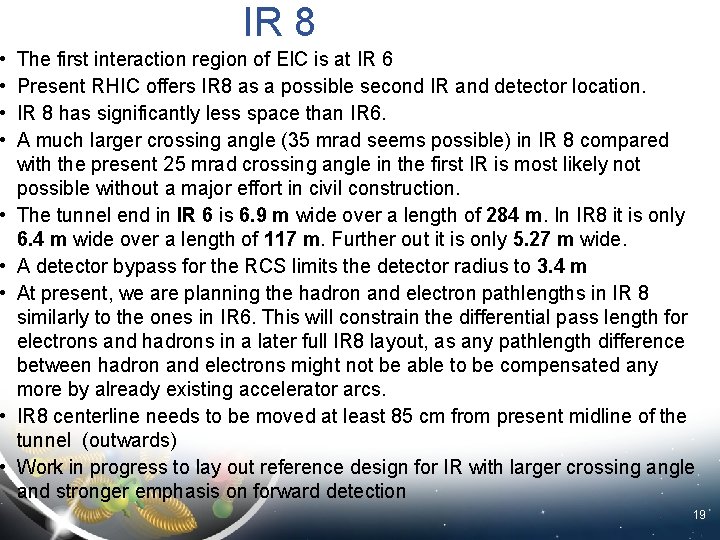
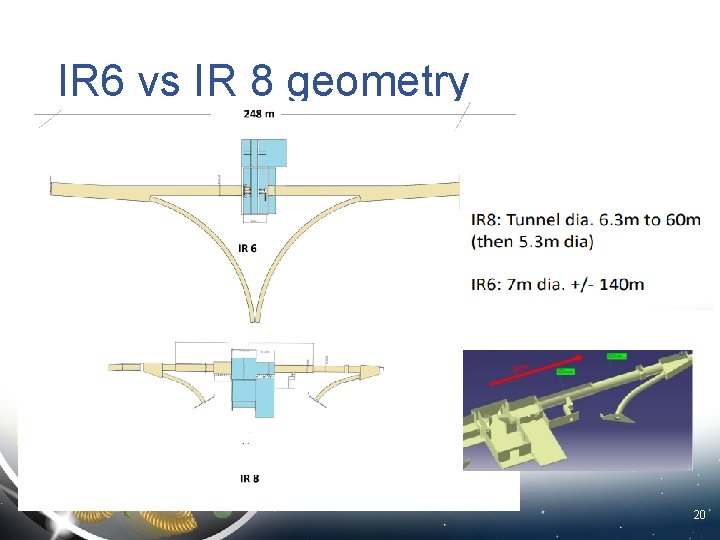
• • • IR 8 The first interaction region of EIC is at IR 6 Present RHIC offers IR 8 as a possible second IR and detector location. IR 8 has significantly less space than IR 6. A much larger crossing angle (35 mrad seems possible) in IR 8 compared with the present 25 mrad crossing angle in the first IR is most likely not possible without a major effort in civil construction. The tunnel end in IR 6 is 6. 9 m wide over a length of 284 m. In IR 8 it is only 6. 4 m wide over a length of 117 m. Further out it is only 5. 27 m wide. A detector bypass for the RCS limits the detector radius to 3. 4 m At present, we are planning the hadron and electron pathlengths in IR 8 similarly to the ones in IR 6. This will constrain the differential pass length for electrons and hadrons in a later full IR 8 layout, as any pathlength difference between hadron and electrons might not be able to be compensated any more by already existing accelerator arcs. IR 8 centerline needs to be moved at least 85 cm from present midline of the tunnel (outwards) Work in progress to lay out reference design for IR with larger crossing angle and stronger emphasis on forward detection 19
IR 6 vs IR 8 geometry 20
Summary • The EIC has challenging performance goals • The EIC conceptual design supports these goals • The design effort is well organized, and challenges are under control • The EIC conceptual design has achieved CD 1 maturity • The interaction region has progressed well • SC Magnet design has matured as well as vacuum systems and other important hardware systems • A possibility of increasing the luminosity for lower center of mass energies <100 Ge. V is being pursued and looks possible • Operation with 2 IRs being worked out and challenges are being addressed 21
Backup 22
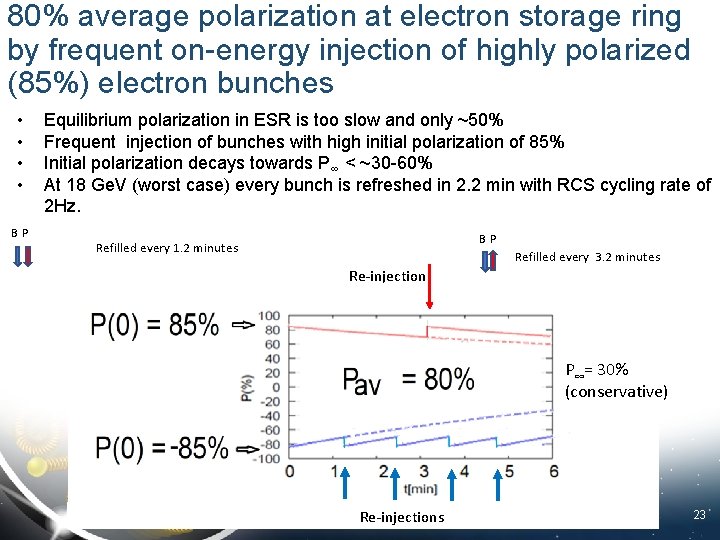
80% average polarization at electron storage ring by frequent on-energy injection of highly polarized (85%) electron bunches • • BP Equilibrium polarization in ESR is too slow and only ~50% Frequent injection of bunches with high initial polarization of 85% Initial polarization decays towards P∞ < ~30 -60% At 18 Ge. V (worst case) every bunch is refreshed in 2. 2 min with RCS cycling rate of 2 Hz. BP Refilled every 1. 2 minutes Refilled every 3. 2 minutes Re-injection Pav=80% P∞= 30% (conservative) Pav=80% Re-injections 23
EIC CDR Parameters for Ecm and Luminosity 24
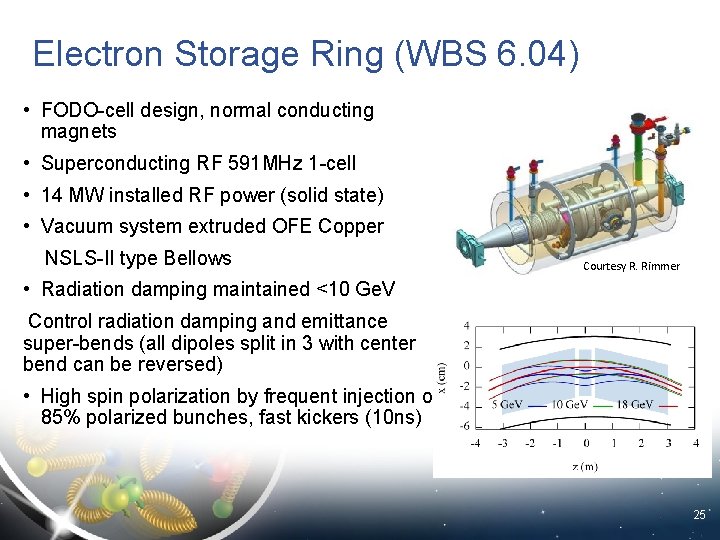
Electron Storage Ring (WBS 6. 04) • FODO-cell design, normal conducting magnets • Superconducting RF 591 MHz 1 -cell • 14 MW installed RF power (solid state) • Vacuum system extruded OFE Copper NSLS-II type Bellows Courtesy R. Rimmer • Radiation damping maintained <10 Ge. V Control radiation damping and emittance super-bends (all dipoles split in 3 with center bend can be reversed) • High spin polarization by frequent injection of 85% polarized bunches, fast kickers (10 ns) 25
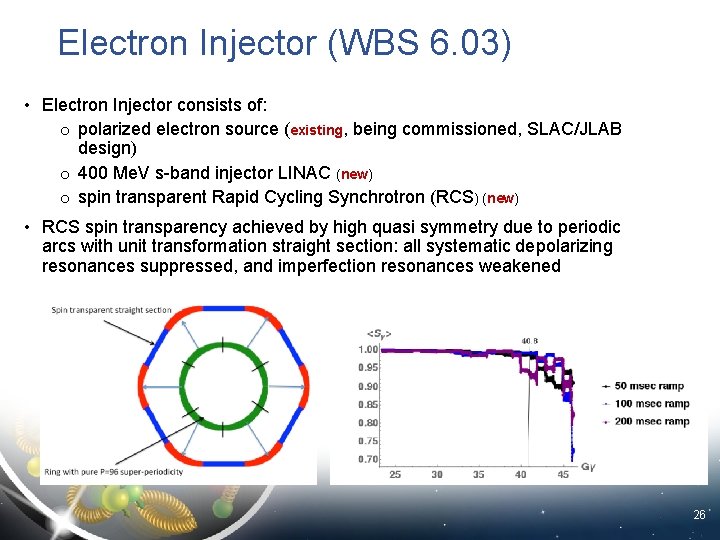
Electron Injector (WBS 6. 03) • Electron Injector consists of: o polarized electron source (existing, being commissioned, SLAC/JLAB design) o 400 Me. V s-band injector LINAC (new) o spin transparent Rapid Cycling Synchrotron (RCS) (new) • RCS spin transparency achieved by high quasi symmetry due to periodic arcs with unit transformation straight section: all systematic depolarizing resonances suppressed, and imperfection resonances weakened 26
Hadron Storage Ring (WBS 6. 05) • RHIC Yellow Ring is the Hadron Storage Ring of the EIC • Existing hadron injectors incl. polarized p and ion sources support EIC beam parameters • Large energy range 41 Ge. V -275 Ge. V • Use Blue Ring sector IR 2 to IR 12 as a bypass for low energy running (41 Ge. V), sector IR 6 -IR 4 as injection channel • Increase beam current by factor of 3 to 1 A (1160 bunches) • Insert a Cu- and a. C-coated liner into cold beam pipe to limit thermal loads and suppress e-cloud • Insert 4 more Siberian snakes (2 6) to improve polarization performance for protons and He-3 • To obtain/maintain flat beam emittance, short bunches(6 cm), introduce strong hadron cooling in longitudinal and horizontal plane by coherent electron cooling with plasma enhanced microbunching amplification 27
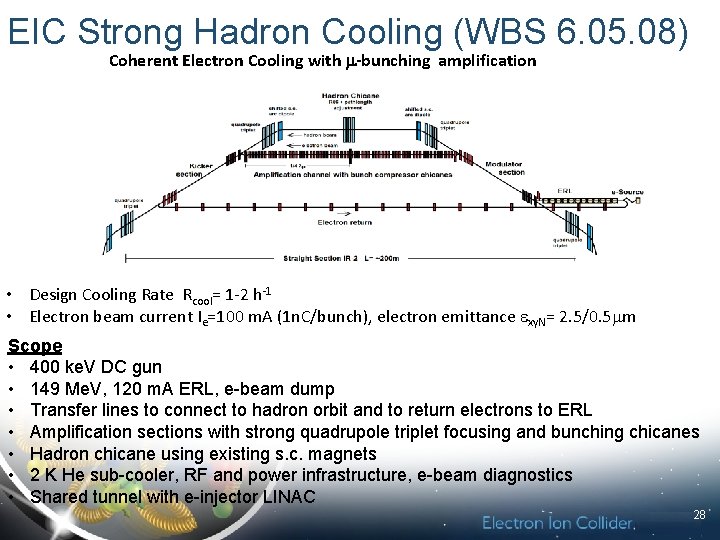
EIC Strong Hadron Cooling (WBS 6. 05. 08) Coherent Electron Cooling with m-bunching amplification • Design Cooling Rate Rcool= 1 -2 h-1 • Electron beam current Ie=100 m. A (1 n. C/bunch), electron emittance exy. N= 2. 5/0. 5 mm Scope • 400 ke. V DC gun • 149 Me. V, 120 m. A ERL, e-beam dump • Transfer lines to connect to hadron orbit and to return electrons to ERL • Amplification sections with strong quadrupole triplet focusing and bunching chicanes • Hadron chicane using existing s. c. magnets • 2 K He sub-cooler, RF and power infrastructure, e-beam diagnostics • Shared tunnel with e-injector LINAC 28