
ELECTRONICS LECTURE 05 WEEK 3 ENGR BILAL AHMAD
ELECTRONICS LECTURE #05 (WEEK #3) ENGR. BILAL AHMAD KUNDY B. TECH (ELECTRICAL)
LIGHT EMITTING DIODE (LED) • This one is the most popular diodes used in our daily life. • Light emitting diodes emit either visible light or invisible infrared light when forward biased. • The LEDs which emit invisible infrared light are used for remote controls. • A light Emitting Diode (LED) is an optical semiconductor device that emits light when voltage is applied. • In other words, LED is an optical semiconductor device that converts electrical energy into light energy.
LIGHT EMITTING DIODE (LED) • Unlike the light bulb in which electrical energy first converts into heat energy, the electrical energy can also be directly converted into light energy. • In Light Emitting Diodes (LEDs), electrical energy flowing through it is directly converted into light energy. • Light is a type of energy that can be released by an atom. Atoms are made up of small particles such as electrons, protons and neutrons. • Light is made up of many small particles called photons. Photons have energy and momentum but no mass. • Electrons are negatively charged, protons are positively charged, and neutrons have no charge. •
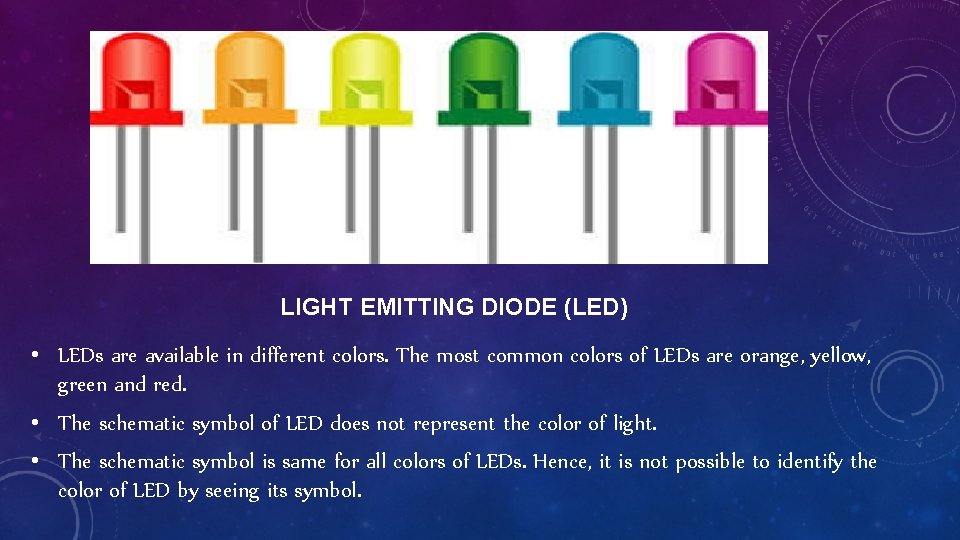
LIGHT EMITTING DIODE (LED) • LEDs are available in different colors. The most common colors of LEDs are orange, yellow, green and red. • The schematic symbol of LED does not represent the color of light. • The schematic symbol is same for all colors of LEDs. Hence, it is not possible to identify the color of LED by seeing its symbol.
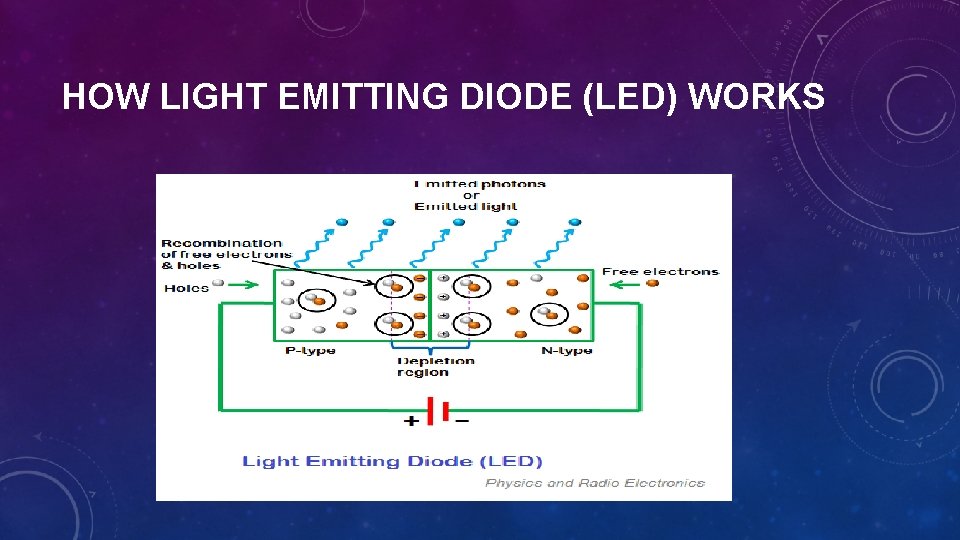
HOW LIGHT EMITTING DIODE (LED) WORKS • Light Emitting Diode (LED) works only in forward bias condition. • When Light Emitting Diode (LED) is forward biased, the free electrons from n-side and the holes from p-side are pushed towards the junction. • When free electrons reach the junction or depletion region, some of the free electrons recombine with the holes in the positive ions. • We know that positive ions have less number of electrons than protons. • Therefore, they are ready to accept electrons. Thus, free electrons recombine with holes in the depletion region.
HOW LIGHT EMITTING DIODE (LED) WORKS • When Light Emitting Diode (LED) is forward biased, free electrons in the conduction band recombines with the holes in the valence band releases energy in the form of light. • Like the normal p-n junction diodes, LEDs also operates only in forward bias condition.
HOW LIGHT EMITTING DIODE (LED) WORKS

LED SYMBOL
CONSTRUCTION OF LED • The construction of LED is similar to the normal p-n junction diode except that gallium, phosphorus and arsenic materials are used for construction instead of silicon or germanium materials. • However, silicon or germanium diodes do not emit energy in the form of light. • Instead, they emit energy in the form of heat. • Thus, silicon or germanium is not used for constructing LEDs.
APPLICATIONS OF LED The various applications of LEDs are as follows: • • • Burglar alarms systems Calculators Picture phones Traffic signals Digital computers • • • Multi-meters Microprocessors Digital watches Automotive heat lamps Camera flashes.

THANK S
- Slides: 11