
Electronics Digital Processes Learning Outcomes Transistor as a


- Slides: 28
Electronics Digital Processes
Learning Outcomes Transistor as a Switch 1) (G) State that a transistor can be used as a switch. 2) (G) State that a transistor may be conducting or nonconducting, ie on or off. Simple Switching Systems 3) (G) Draw and identify the circuit symbol for an NPN transistor. 4) (G) Identify from a circuit diagram the purpose of a simple transistor switching circuit. 15) (C) Explain the operation of a simple transistor switching circuit. Digital Logic Gates 5) (G) Draw and identify the symbols for two-input AND, OR and NOT gates. 6) (G) State that logic gates may have one or more inputs and that a truth table shows the output for all possible input combinations. 7) (G) State that high voltage = logic 1, low voltage = logic 0. 8) (G) Draw the truth tables for AND OR and NOT gates. 16) (C) Identify the following gates from truth tables: AND, OR, NOT. Combinational Logic Circuits 9) (G) Explain how to use combinations of digital logic gates for control in simple situations. 17) (C) Complete a truth table for a simple combinational logic circuit. Clock Signals 10) (G) State that a digital circuit can produce a series of clock pulses. 18) (C) Explain how a simple oscillator built from a Resistor, Capacitor and Inverter operates. 19) (C) Describe how to change the frequency of a clock. Counters 11) (G) Give an example of a device containing a counter circuit. 12) (G) State that there are circuits which can count digital pulses. 13) (G) State that the output of the counter circuit is in binary. 14) (G) State that the output of a binary counter can be converted to decimal.
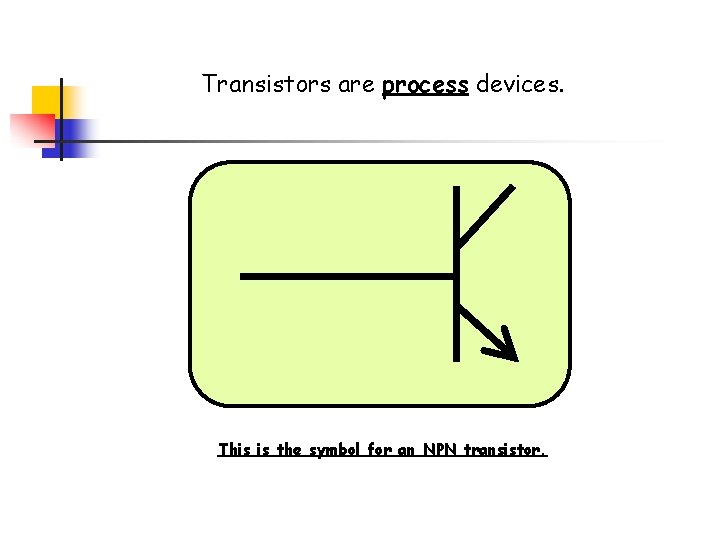
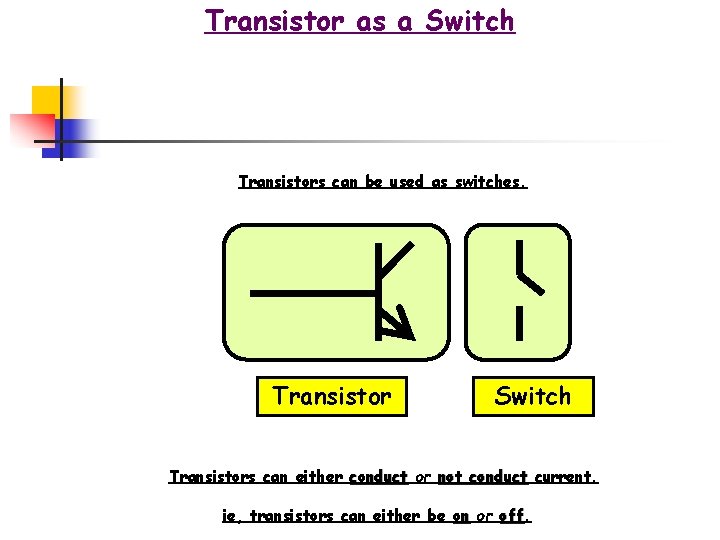
Transistors are process devices. This is the symbol for an NPN transistor.
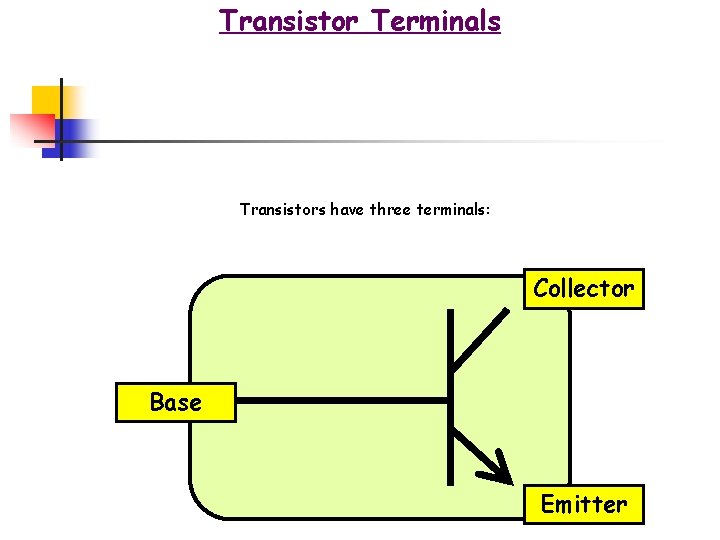
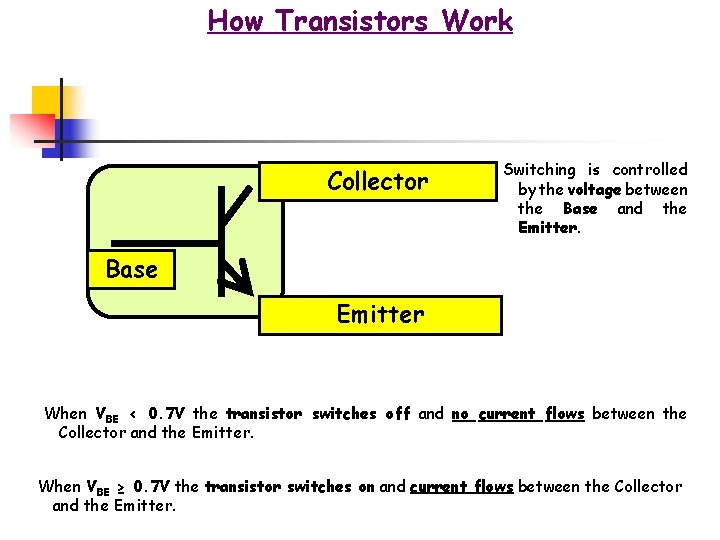
Transistor Terminals Transistors have three terminals: Collector Base Emitter
Transistor as a Switch Transistors can be used as switches. Transistor Switch Transistors can either conduct or not conduct current. ie, transistors can either be on or off
How Transistors Work Collector Switching is controlled by the voltage between the Base and the Emitter. Base Emitter When VBE < 0. 7 V the transistor switches off and no current flows between the Collector and the Emitter. When VBE ≥ 0. 7 V the transistor switches on and current flows between the Collector and the Emitter.
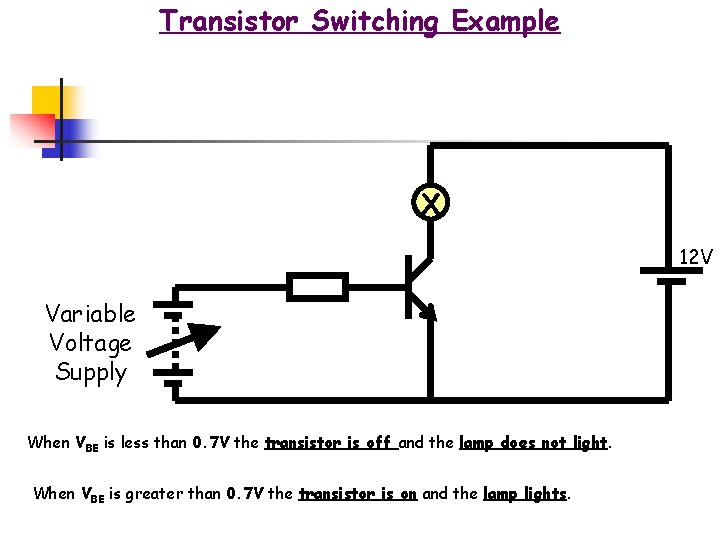
Transistor Switching Example X 12 V Variable Voltage Supply When VBE is less than 0. 7 V the transistor is off and the lamp does not light. When VBE is greater than 0. 7 V the transistor is on and the lamp lights.
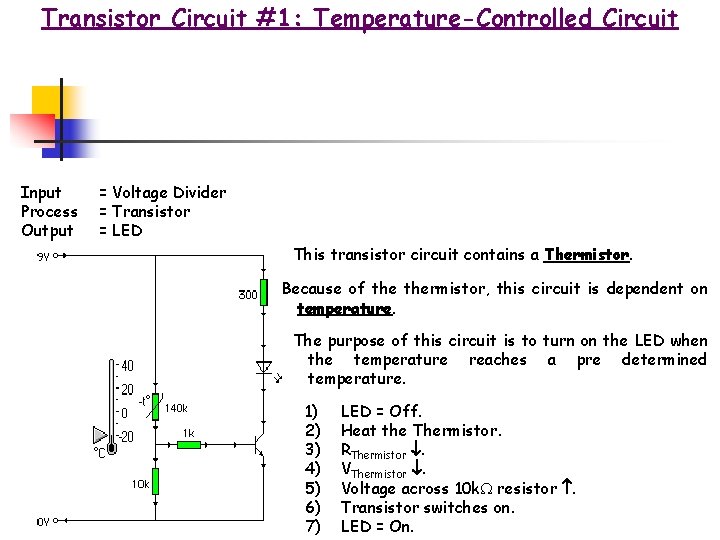
Transistor Circuit #1: Temperature-Controlled Circuit Input Process Output = Voltage Divider = Transistor = LED This transistor circuit contains a Thermistor. Because of thermistor, this circuit is dependent on temperature. The purpose of this circuit is to turn on the LED when the temperature reaches a pre determined temperature. 1) 2) 3) 4) 5) 6) 7) LED = Off. Heat the Thermistor. RThermistor . Voltage across 10 k resistor . Transistor switches on. LED = On.
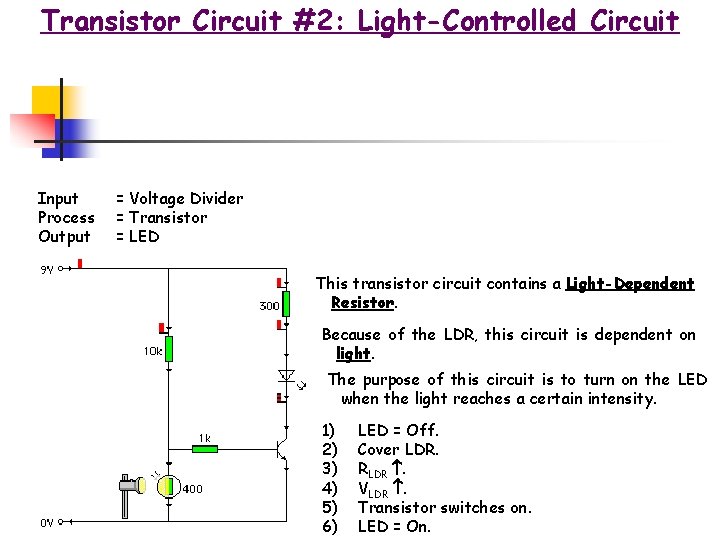
Transistor Circuit #2: Light-Controlled Circuit Input Process Output = Voltage Divider = Transistor = LED This transistor circuit contains a Light-Dependent Resistor. Because of the LDR, this circuit is dependent on light. The purpose of this circuit is to turn on the LED when the light reaches a certain intensity. 1) 2) 3) 4) 5) 6) LED = Off. Cover LDR. RLDR . VLDR . Transistor switches on. LED = On.
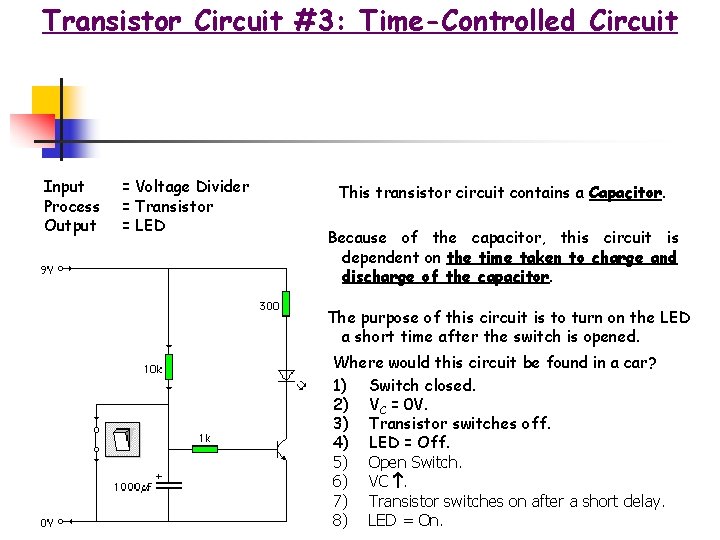
Transistor Circuit #3: Time-Controlled Circuit Input Process Output = Voltage Divider = Transistor = LED This transistor circuit contains a Capacitor. Because of the capacitor, this circuit is dependent on the time taken to charge and discharge of the capacitor. The purpose of this circuit is to turn on the LED a short time after the switch is opened. Where would this circuit be found in a car? 1) Switch closed. 2) VC = 0 V. 3) Transistor switches off. 4) LED = Off. 5) Open Switch. 6) VC . 7) Transistor switches on after a short delay. 8) LED = On.
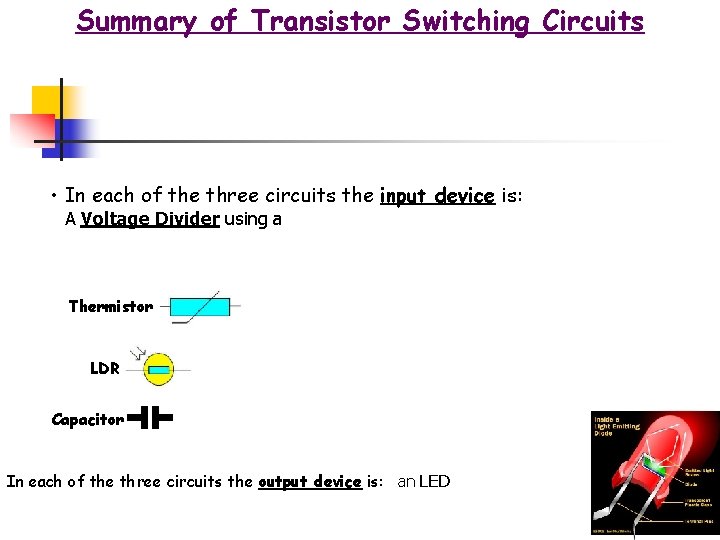
Summary of Transistor Switching Circuits • In each of the three circuits the input device is: A Voltage Divider using a Thermistor LDR Capacitor In each of the three circuits the output device is: an LED
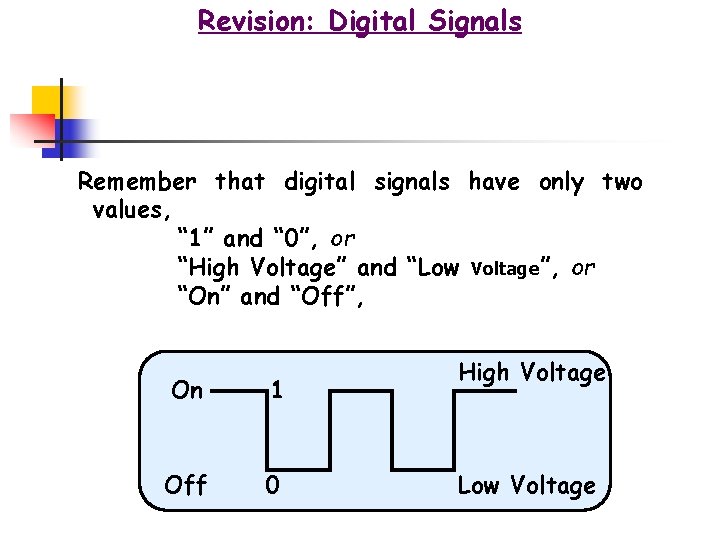
Revision: Digital Signals Remember that digital signals have only two values, “ 1” and “ 0”, or “High Voltage” and “Low Voltage”, or “On” and “Off”, On 1 Off 0 High Voltage Low Voltage
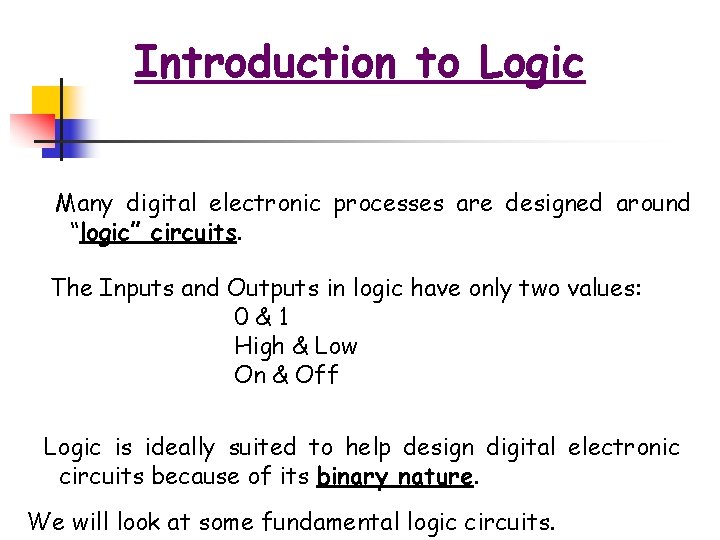
Introduction to Logic Many digital electronic processes are designed around “logic” circuits. The Inputs and Outputs in logic have only two values: 0&1 High & Low On & Off Logic is ideally suited to help design digital electronic circuits because of its binary nature. We will look at some fundamental logic circuits.
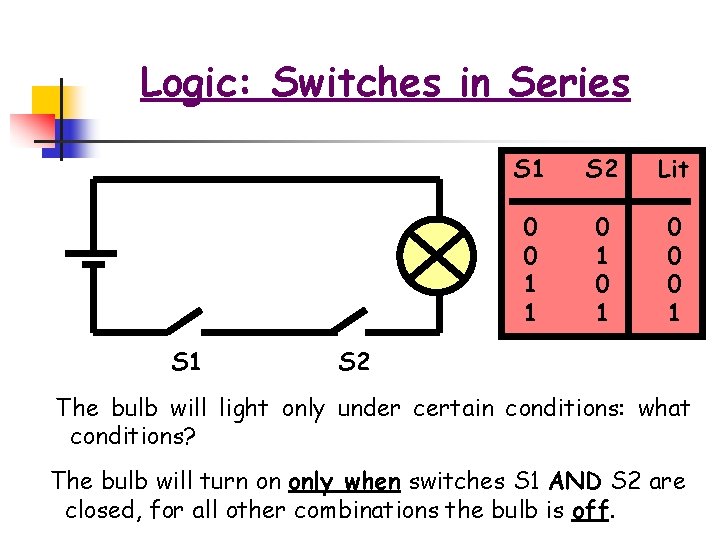
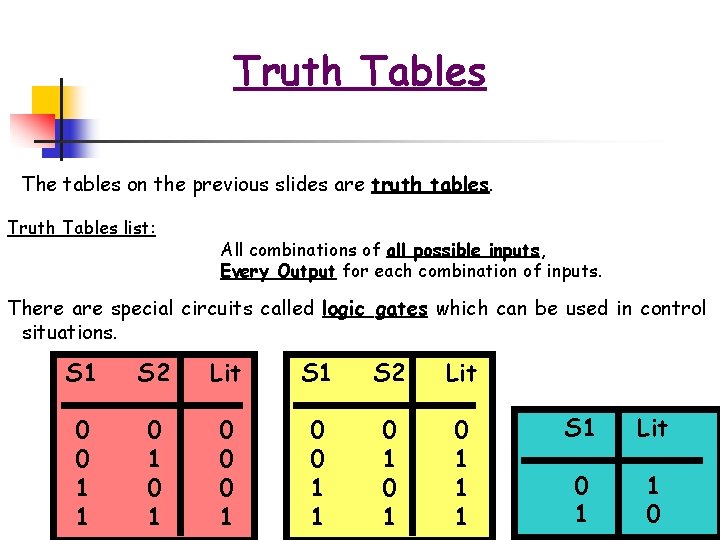
Logic: Switches in Series S 1 S 2 Lit 0 0 1 1 0 1 0 0 0 1 S 2 The bulb will light only under certain conditions: what conditions? The bulb will turn on only when switches S 1 AND S 2 are closed, for all other combinations the bulb is off.
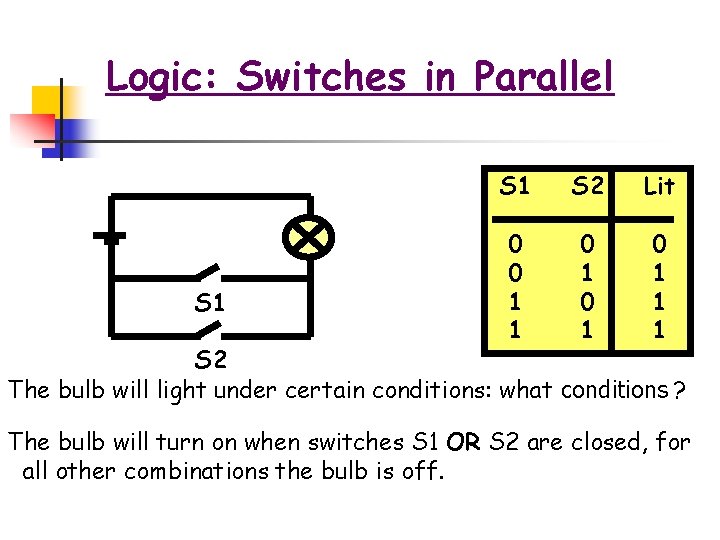
Logic: Switches in Parallel S 1 S 2 Lit 0 0 1 1 0 1 0 1 1 1 S 2 The bulb will light under certain conditions: what conditions ? The bulb will turn on when switches S 1 OR S 2 are closed, for all other combinations the bulb is off.
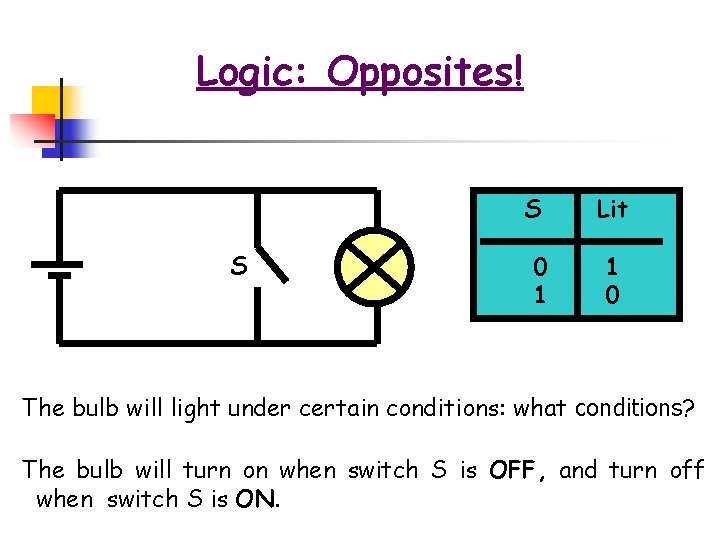
Logic: Opposites! S S 0 1 Lit 1 0 The bulb will light under certain conditions: what conditions? The bulb will turn on when switch S is OFF, and turn off when switch S is ON.
Truth Tables The tables on the previous slides are truth tables. Truth Tables list: All combinations of all possible inputs, Every Output for each combination of inputs. There are special circuits called logic gates which can be used in control situations. S 1 S 2 Lit 0 0 1 1 0 1 0 1 1 1 S 1 Lit 0 1 1 0
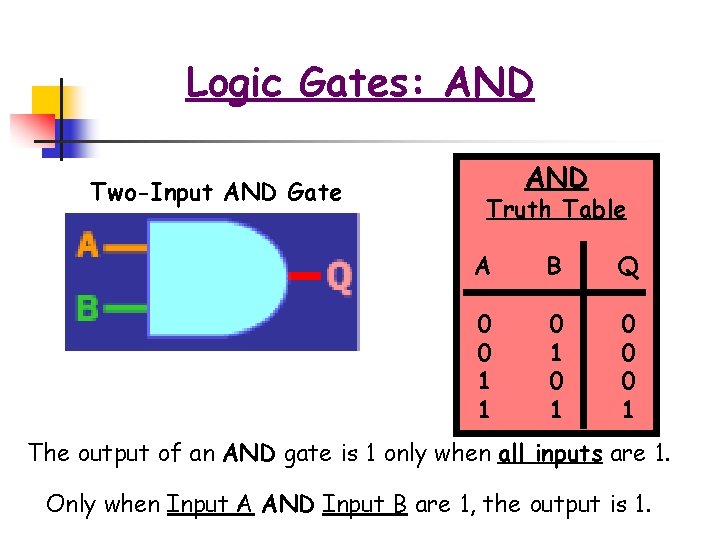
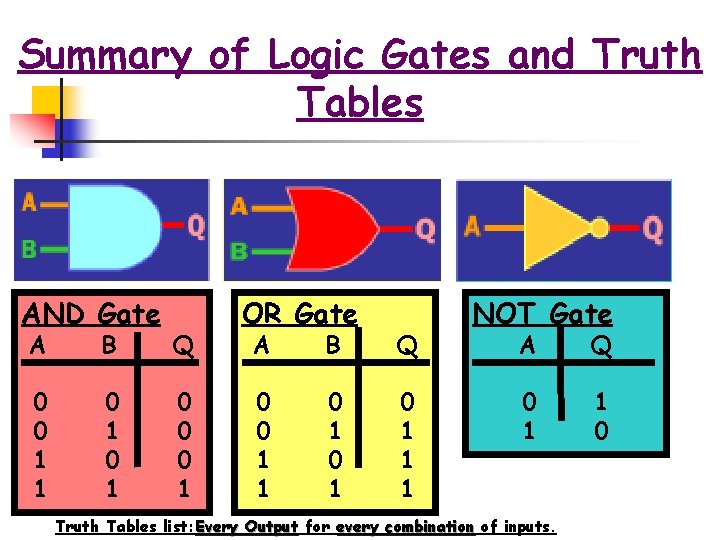
Logic Gates: AND Two-Input AND Gate AND Truth Table A B Q 0 0 1 1 0 1 0 0 0 1 The output of an AND gate is 1 only when all inputs are 1. Only when Input A AND Input B are 1, the output is 1.
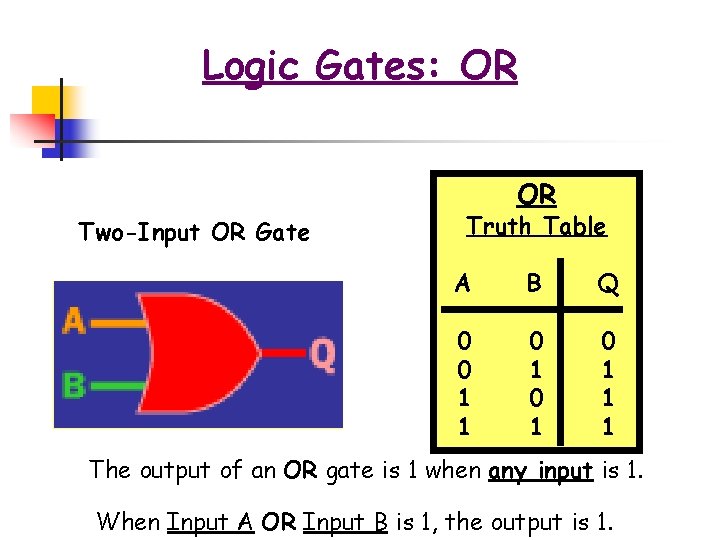
Logic Gates: OR OR Two-Input OR Gate Truth Table A B Q 0 0 1 1 0 1 0 1 1 1 The output of an OR gate is 1 when any input is 1. When Input A OR Input B is 1, the output is 1.
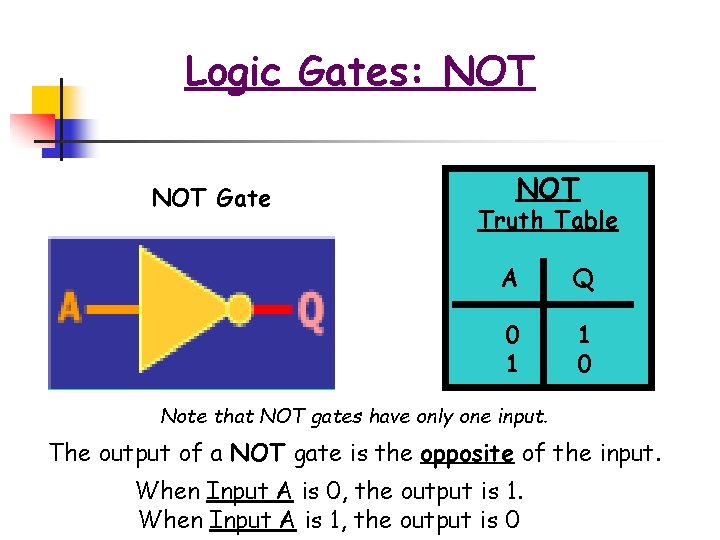
Logic Gates: NOT Gate NOT Truth Table A Q 0 1 1 0 Note that NOT gates have only one input. The output of a NOT gate is the opposite of the input. When Input A is 0, the output is 1. When Input A is 1, the output is 0
Summary of Logic Gates and Truth Tables AND Gate A B Q 0 0 1 1 0 1 0 0 0 1 OR Gate A B Q 0 0 1 1 0 1 0 1 1 1 NOT Gate A Q 0 1 1 0 Truth Tables list: Every Output for every combination of inputs.
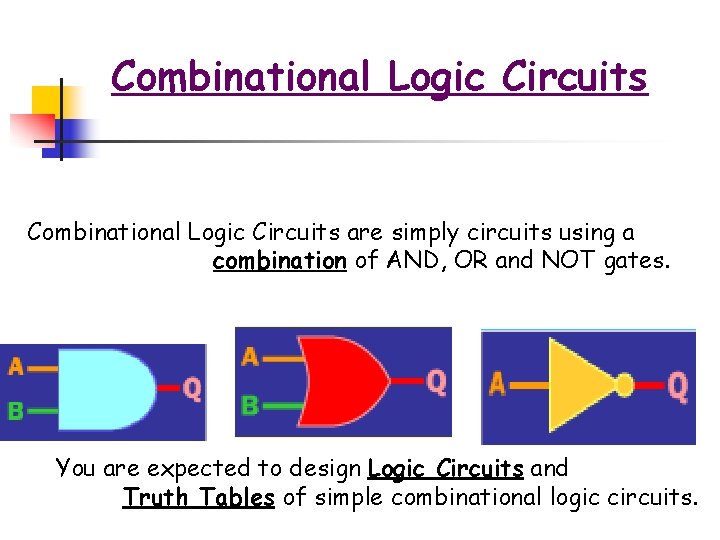
Combinational Logic Circuits are simply circuits using a combination of AND, OR and NOT gates. You are expected to design Logic Circuits and Truth Tables of simple combinational logic circuits.
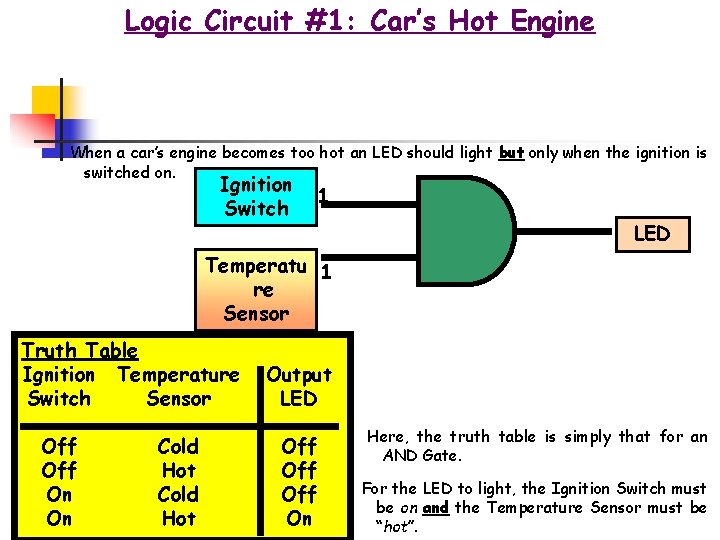
Logic Circuit #1: Car’s Hot Engine When a car’s engine becomes too hot an LED should light but only when the ignition is switched on. Ignition Switch 1 LED Temperatu 1 re Sensor Truth Table Ignition Temperature Switch Sensor Off On On Cold Hot Output LED Off Off On Here, the truth table is simply that for an AND Gate. For the LED to light, the Ignition Switch must be on and the Temperature Sensor must be “hot”.
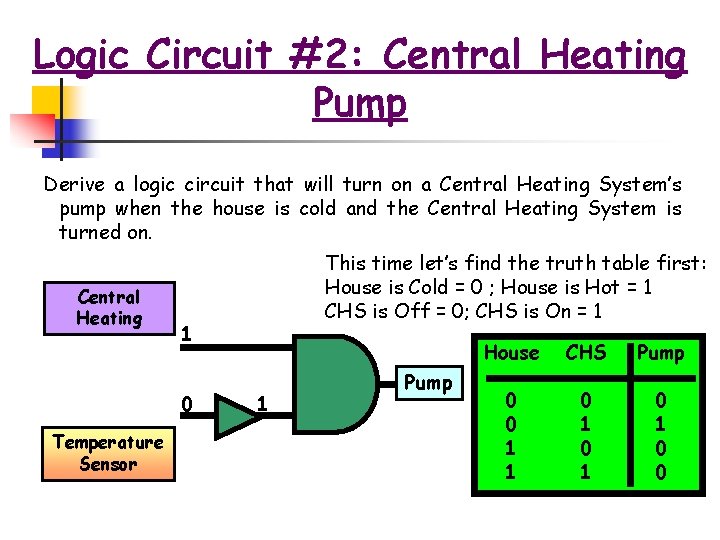
Logic Circuit #2: Central Heating Pump Derive a logic circuit that will turn on a Central Heating System’s pump when the house is cold and the Central Heating System is turned on. Central Heating 1 0 Temperature Sensor This time let’s find the truth table first: House is Cold = 0 ; House is Hot = 1 CHS is Off = 0; CHS is On = 1 1 Pump House CHS Pump 0 0 1 1 0 1 0 0
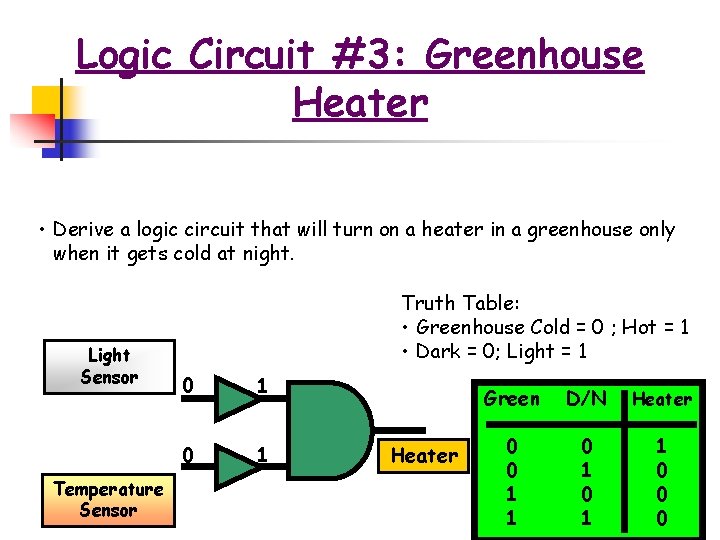
Logic Circuit #3: Greenhouse Heater • Derive a logic circuit that will turn on a heater in a greenhouse only when it gets cold at night. Light Sensor Temperature Sensor Truth Table: • Greenhouse Cold = 0 ; Hot = 1 • Dark = 0; Light = 1 0 1 Heater Green D/N Heater 0 0 1 1 0 0 0
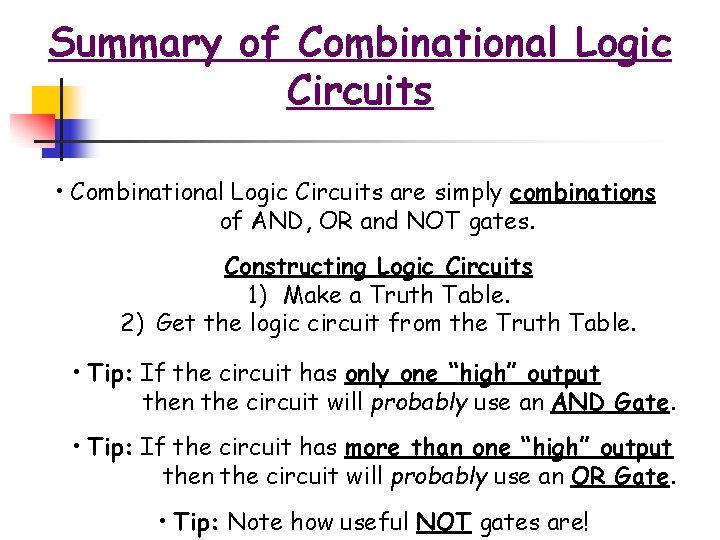
Summary of Combinational Logic Circuits • Combinational Logic Circuits are simply combinations of AND, OR and NOT gates. Constructing Logic Circuits 1) Make a Truth Table. 2) Get the logic circuit from the Truth Table. • Tip: If the circuit has only one “high” output then the circuit will probably use an AND Gate. • Tip: If the circuit has more than one “high” output then the circuit will probably use an OR Gate. • Tip: Note how useful NOT gates are!