
Electronic Systems Design HighLevel Synthesis for Online Testability
Electronic Systems Design High-Level Synthesis for On-line Testability P. Oikonomakos and M. Zwolinski Department of Electronics and Computer Science, University of Southampton Hampshire SO 17 1 BJ UK Department of Electronics and Computer Science University of Southampton, UK
Electronic Systems Design On-line testing Ø targets physical system failures Ø detects them while system is operating Ø increases reliability in several safety-critical applications, especially in hostile environments, e. g. • flight/space electronics • industrial/automotive electronics • medical electronics • deep submicron technologies Department of Electronics and Computer Science University of Southampton, UK
Electronic Systems Design High-level synthesis Ø the designer provides an abstract specification of the behaviour of his conceptual design along with his constraints and requirements Ø the synthesis tool is responsible for producing an equivalent structural description Ø high-level synthesis offers : • fast time-to-market • fast and efficient design space exploration • efficient design optimisation at the highest level of abstraction Department of Electronics and Computer Science University of Southampton, UK
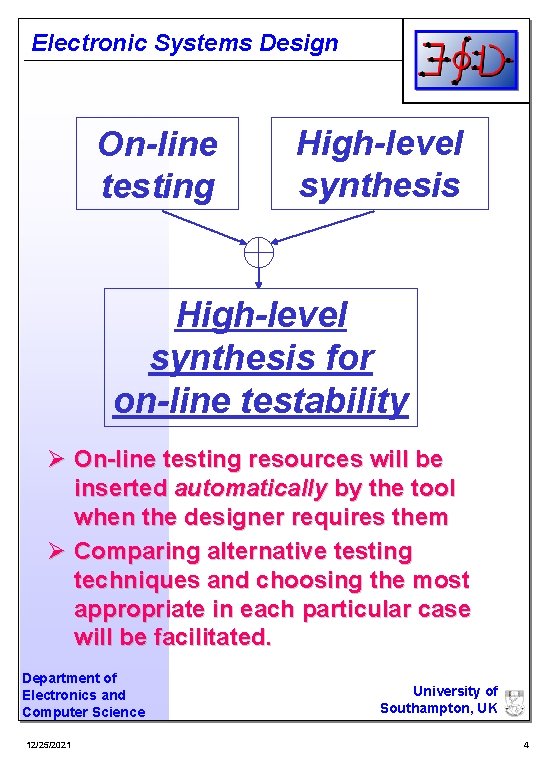
Electronic Systems Design On-line testing High-level synthesis for on-line testability Ø On-line testing resources will be inserted automatically by the tool when the designer requires them Ø Comparing alternative testing techniques and choosing the most appropriate in each particular case will be facilitated. Department of Electronics and Computer Science 12/25/2021 University of Southampton, UK 4
Electronic Systems Design On-line testing techniques Ø self-checking design Ø on-line built-in self-test (BIST) Ø monitoring analogue characteristics ü In this work, we focus on selfchecking design. Department of Electronics and Computer Science University of Southampton, UK
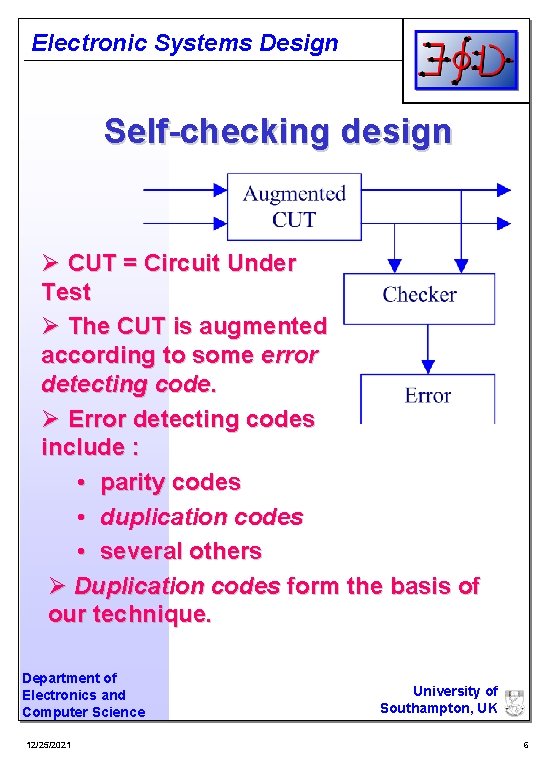
Electronic Systems Design Self-checking design Ø CUT = Circuit Under Test Ø The CUT is augmented according to some error detecting code. Ø Error detecting codes include : • parity codes • duplication codes • several others Ø Duplication codes form the basis of our technique. Department of Electronics and Computer Science 12/25/2021 University of Southampton, UK 6
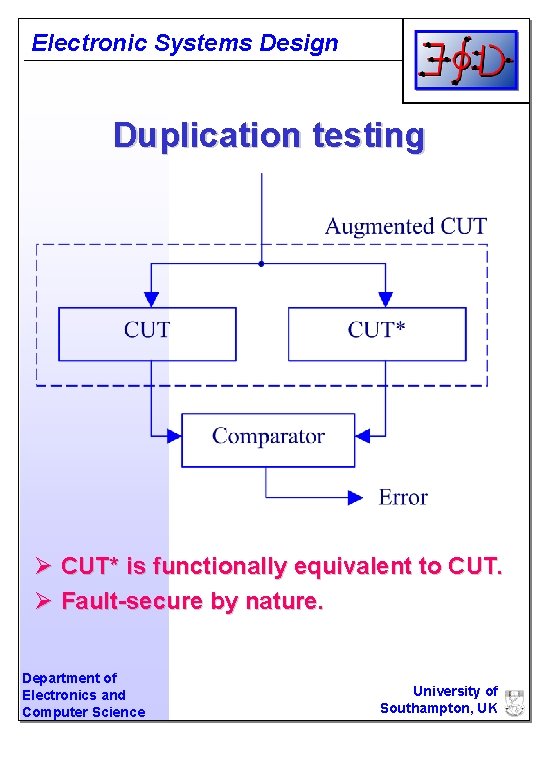
Electronic Systems Design Duplication testing Ø CUT* is functionally equivalent to CUT. Ø Fault-secure by nature. Department of Electronics and Computer Science University of Southampton, UK
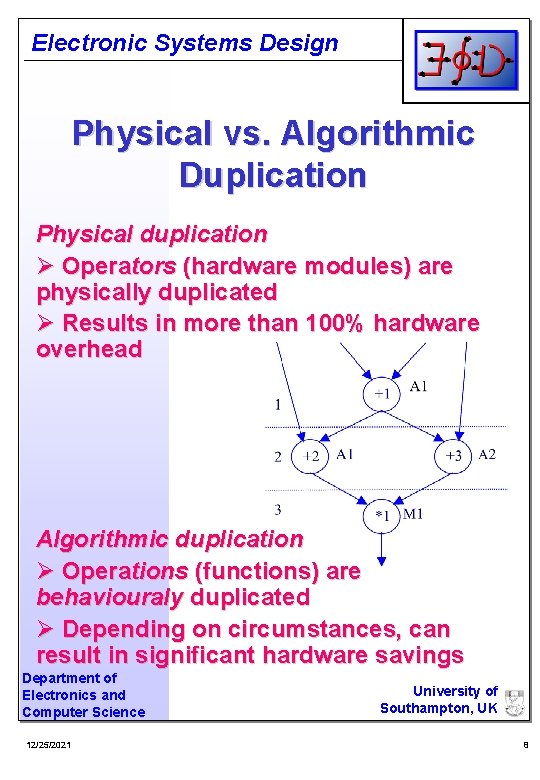
Electronic Systems Design Physical vs. Algorithmic Duplication Physical duplication Ø Operators (hardware modules) are physically duplicated Ø Results in more than 100% hardware overhead Algorithmic duplication Ø Operations (functions) are behaviouraly duplicated Ø Depending on circumstances, can result in significant hardware savings Department of Electronics and Computer Science 12/25/2021 University of Southampton, UK 8
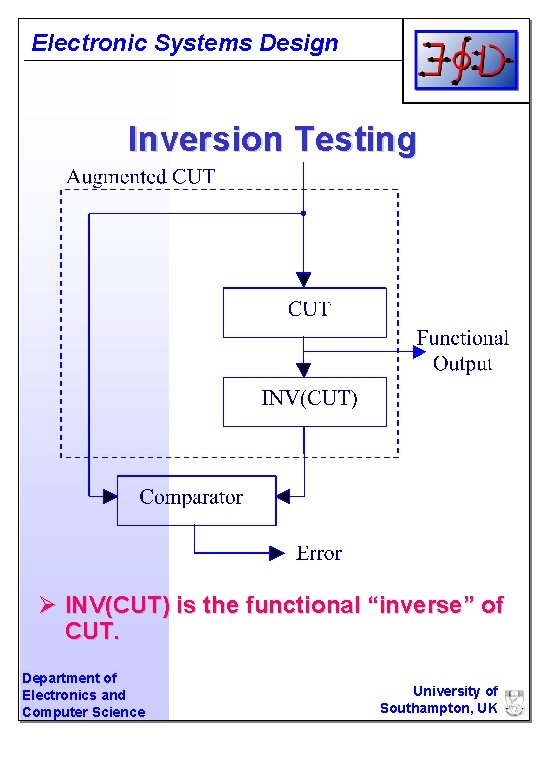
Electronic Systems Design Inversion Testing Ø INV(CUT) is the functional “inverse” of CUT. Department of Electronics and Computer Science University of Southampton, UK
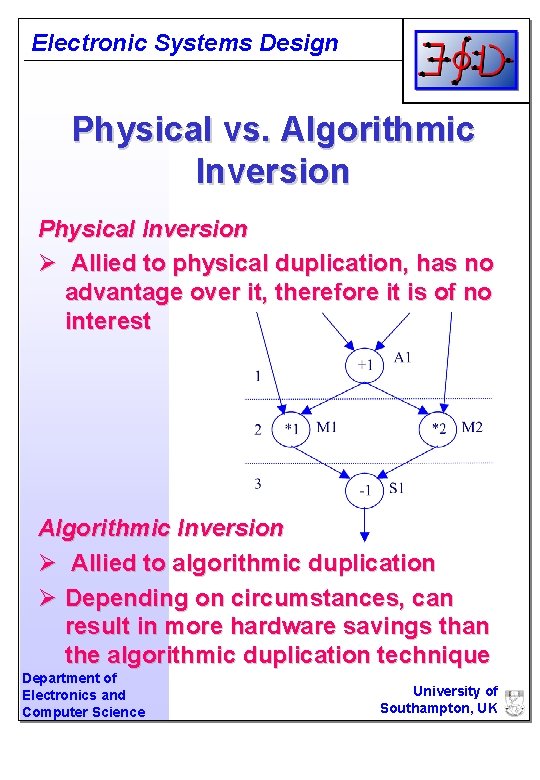
Electronic Systems Design Physical vs. Algorithmic Inversion Physical Inversion Ø Allied to physical duplication, has no advantage over it, therefore it is of no interest Algorithmic Inversion Ø Allied to algorithmic duplication Ø Depending on circumstances, can result in more hardware savings than the algorithmic duplication technique Department of Electronics and Computer Science University of Southampton, UK
Electronic Systems Design Conclusions and future work Ø Our first experiments (using the MOODS High-Level Synthesis Suite) have been encouraging. Ø We are working towards automating the on-line test resource insertion process, so that no modification of VHDL code will be required!!! Ø Our system should be versatile enough to recognise and apply the most beneficial (duplication or inversion) technique for each module in a given design. Ø Future steps include fault simulation and investigating methods to test the control path of our designs. Ø Questions…? Department of Electronics and Computer Science University of Southampton, UK
- Slides: 11