
Electronic Structure Theory TSTC Session 8 1 BornOppenheimer
Electronic Structure Theory TSTC Session 8 1. Born-Oppenheimer approx. - energy surfaces 2. Mean-field (Hartree-Fock) theory- orbitals 3. Pros and cons of HF- RHF, UHF 4. Beyond HF- why? 5. First, one usually does HF-how? 6. Basis sets and notations 7. MPn, MCSCF, CI, CC, DFT 8. Gradients and Hessians 9. Special topics: accuracy, metastable states Jack Simons, Henry Eyring Scientist and Professor Chemistry Department University of Utah 0
The use of analytical derivatives of the energy with respect to atomic positions has made evaluation of vibrational frequencies and the mapping out of reaction paths much easier. The first derivative with respect to a Cartesian coordinate (XK) of an atom is called the gradient g. K= E/ XK. These numbers form the gradient vector. 2 E/ XK XL form the Hessian matrix HK, L In the old days, g. K and HK, L were evaluated by “finite difference” (evaluating The second derivatives the energy at slightly displaced XK). Today, we have analytical expressions for g. K and HK, L. 1
Two issues: How does one compute g. K and HK, Land what do you do with them? Assume you have g. K available at some starting geometry X 0 = {X 1, Xz, … X 3 N}. One can attempt to move downhill toward a local-minimum by taking small displacements XK proportional to, but in opposition to, the gradient g. K along that direction XK = - a g. K. The energy E is then expected to change by E = - a ∑K(g. K)2. This is the most simple algorithm for “stepping” downhill toward a minimum. The parameter a can be used to keep the length of the step small. A series of such “steps” from X 0 to X 0 + X can often lead to a minimum (at which all 3 N g. K values vanish). 2
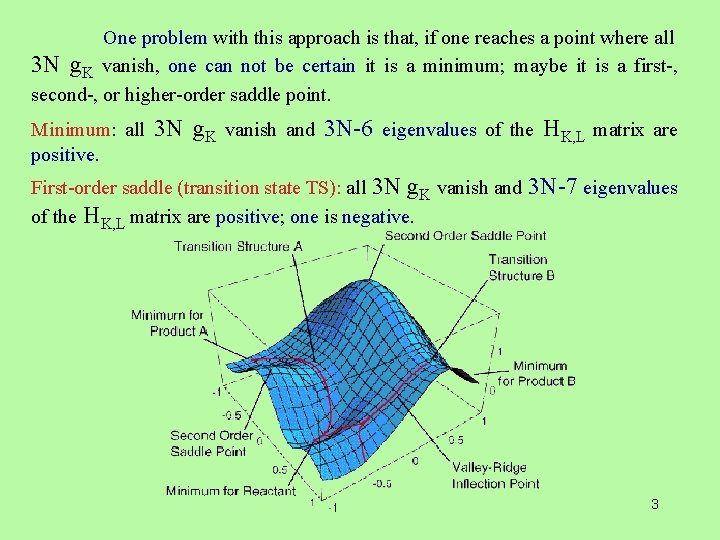
One problem with this approach is that, if one reaches a point where all 3 N g. K vanish, one can not be certain it is a minimum; maybe it is a first-, second-, or higher-order saddle point. Minimum: all positive. 3 N g. K vanish and 3 N-6 eigenvalues of the HK, L matrix are First-order saddle (transition state TS): all 3 N g. K vanish and 3 N-7 eigenvalues of the HK, L matrix are positive; one is negative. 3
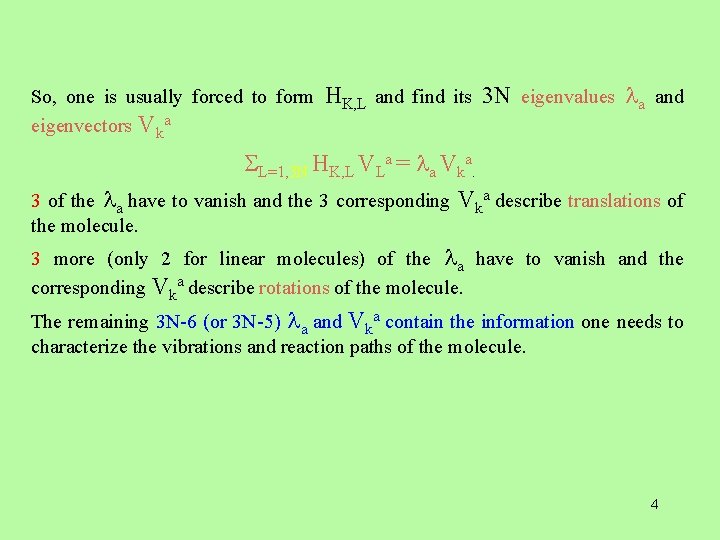
So, one is usually forced to form eigenvectors Vka HK, L and find its 3 N eigenvalues a and L=1, 3 N HK, L VLa = a Vka. 3 of the a have to vanish and the 3 corresponding Vka describe translations of the molecule. 3 more (only 2 for linear molecules) of the a have to vanish and the corresponding Vka describe rotations of the molecule. The remaining 3 N-6 (or 3 N-5) a and Vka contain the information one needs to characterize the vibrations and reaction paths of the molecule. 4
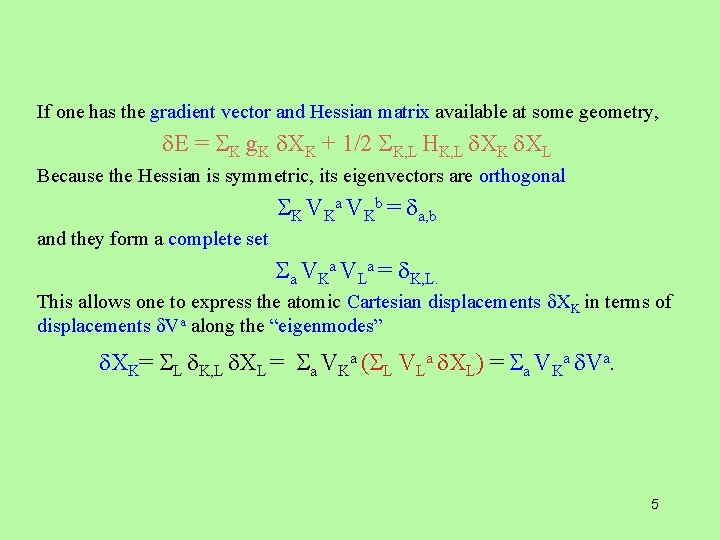
If one has the gradient vector and Hessian matrix available at some geometry, E = K g. K XK + 1/2 K, L HK, L XK XL Because the Hessian is symmetric, its eigenvectors are orthogonal K VKa VKb = a, b and they form a complete set a VKa VLa = K, L. This allows one to express the atomic Cartesian displacements XK in terms of displacements Va along the “eigenmodes” XK= L K, L XL = a VKa ( L VLa XL) = a VKa Va. 5
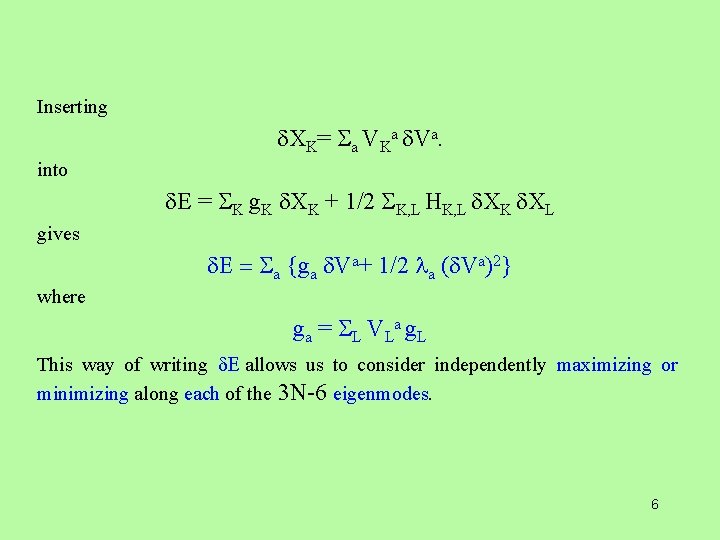
Inserting XK= a VKa Va. into E = K g. K XK + 1/2 K, L HK, L XK XL gives a {ga Va+ 1/2 a ( Va)2} where ga = L VLa g. L This way of writing allows us to consider independently maximizing or minimizing along each of the 3 N-6 eigenmodes. 6
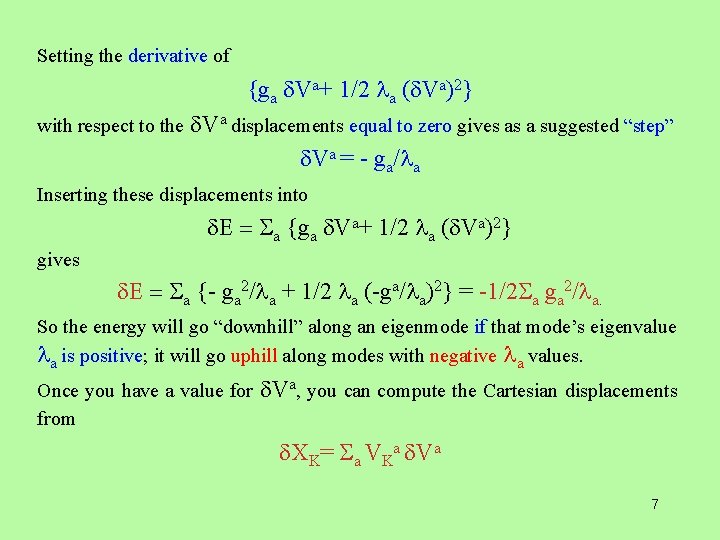
Setting the derivative of {ga Va+ 1/2 a ( Va)2} with respect to the Va displacements equal to zero gives as a suggested “step” Va = - ga/ a Inserting these displacements into a {ga Va+ 1/2 a ( Va)2} gives a {- ga 2/ a + 1/2 a (-ga/ a)2} = -1/2 a ga 2/ a. So the energy will go “downhill” along an eigenmode if that mode’s eigenvalue a is positive; it will go uphill along modes with negative a values. Once you have a value for from Va, you can compute the Cartesian displacements XK= a VKa Va 7
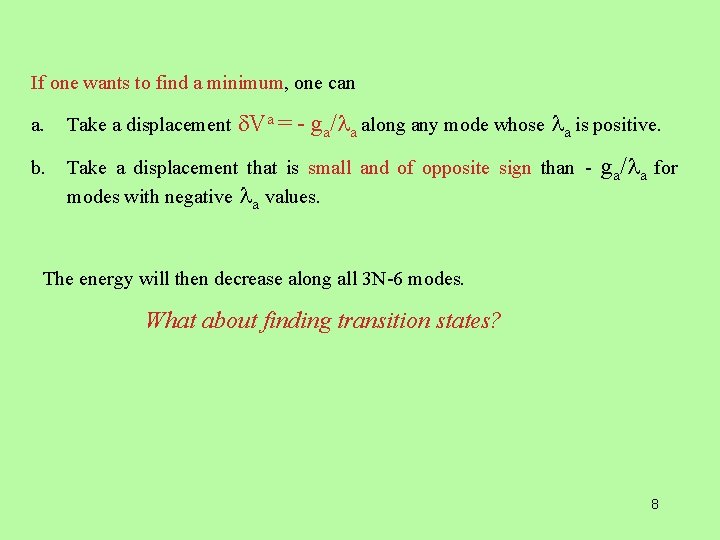
If one wants to find a minimum, one can Va = - ga/ a along any mode whose a is positive. a. Take a displacement b. Take a displacement that is small and of opposite sign than modes with negative a values. ga/ a for The energy will then decrease along all 3 N-6 modes. What about finding transition states? 8
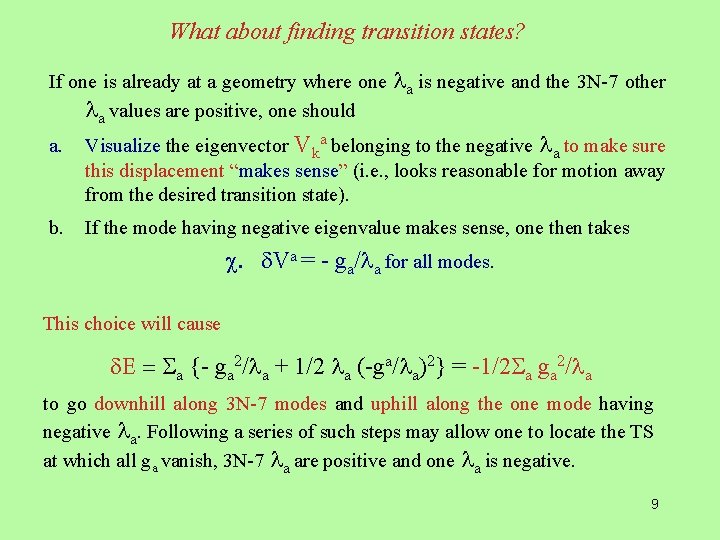
What about finding transition states? If one is already at a geometry where one a values are positive, one should a is negative and the 3 N-7 other a. Visualize the eigenvector Vka belonging to the negative a to make sure this displacement “makes sense” (i. e. , looks reasonable for motion away from the desired transition state). b. If the mode having negative eigenvalue makes sense, one then takes Va = - ga/ a for all modes. This choice will cause a {- ga 2/ a + 1/2 a (-ga/ a)2} = -1/2 a ga 2/ a to go downhill along 3 N-7 modes and uphill along the one mode having negative a. Following a series of such steps may allow one to locate the TS at which all ga vanish, 3 N-7 a are positive and one a is negative. 9
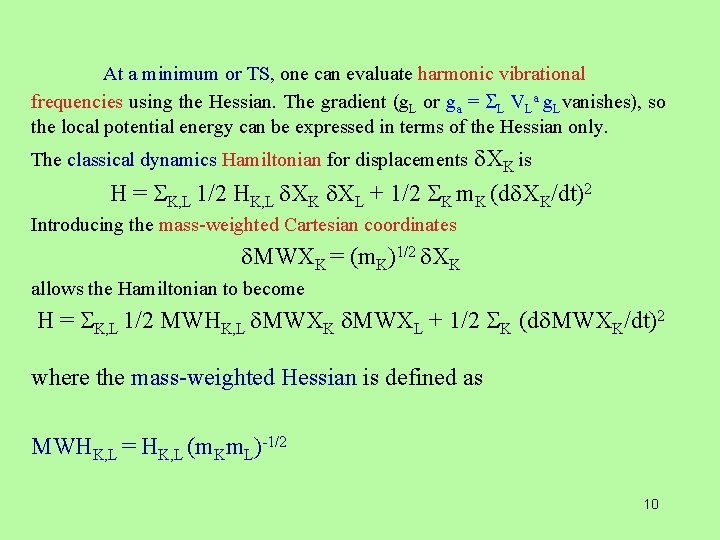
At a minimum or TS, one can evaluate harmonic vibrational frequencies using the Hessian. The gradient (g. L or ga = L VLa g. Lvanishes), so the local potential energy can be expressed in terms of the Hessian only. XK is H = K, L 1/2 HK, L XK XL + 1/2 K m. K (d XK/dt)2 The classical dynamics Hamiltonian for displacements Introducing the mass-weighted Cartesian coordinates MWXK = (m. K)1/2 XK allows the Hamiltonian to become H = K, L 1/2 MWHK, L MWXK MWXL + 1/2 K (d MWXK/dt)2 where the mass-weighted Hessian is defined as MWHK, L = HK, L (m. Km. L)-1/2 10
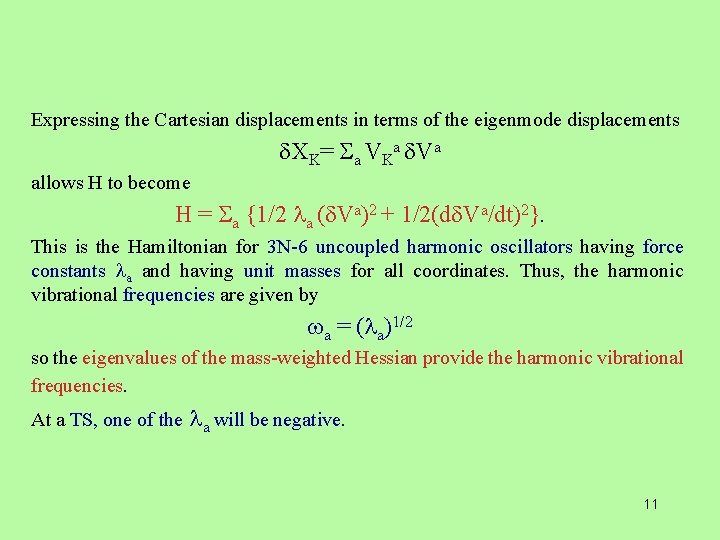
Expressing the Cartesian displacements in terms of the eigenmode displacements XK= a VKa Va allows H to become H = a {1/2 a ( Va)2 + 1/2(d Va/dt)2}. This is the Hamiltonian for 3 N-6 uncoupled harmonic oscillators having force constants a and having unit masses for all coordinates. Thus, the harmonic vibrational frequencies are given by a = ( a)1/2 so the eigenvalues of the mass-weighted Hessian provide the harmonic vibrational frequencies. At a TS, one of the a will be negative. 11
It is worth pointing out that one can use mass-weighted coordinates to locate minima and transition states, but the same minima and transition states will be found whether one uses Cartesian or mass-weighted Cartesian coordinates because whenever the Cartesian gradient vanishes g. L = 0 the mass-weighted gradient will also vanish ga = L VLa g. L = 0 12
To trace out a reaction path starting at a transition state, one first finds the Hessian eigenvector {VK 1} belonging to the negative eigenvalue. One takes a very small step along this direction. Next, one re-computes the Hessian and gradient (n. b. , the gradient vanishes at the transition state, but not once begins to move along the reaction path) at the new geometry XK + XK where one finds the eigenvalues and eigenvectors of the mass-weighted Hessian and uses the local quadratic approximation a {ga Va+ 1/2 a ( Va)2} to guide one downhill. Along the eigenmode corresponding to the negative eigenvalue 1, the gradient g 1 will be non-zero while the components of the gradient along the other eigenmodes will be small (if one has taken a small initial step). One is attempting to move down a streambed whose direction of flow initially lies along VK 1 and perpendicular to which there are harmonic sidewalls 1/2 a ( Va)2. 13
One performs a series of displacements by a) moving (in small steps) downhill along the eigenmode that begins at VK 1 and that has a significant gradient component ga, b) while minimizing the energy (to remain in the streambed’s bottom) along the 3 N-7 other eigenmodes (by taking steps Va = - ga/ a that minimize each {ga Va+ 1/2 a ( Va)2}. As one evolves along this reaction path, one reaches a point where 1 changes sign from negative to positive. This signals that one is approaching a minimum. Continuing onward, one reaches a point where the gradient’s component along the step displacement vanishes and along all other directions vanishes. This is the local minimum that connects to the transition state at which the reaction path started. a) One needs to also begin at the transition state and follow the other branch of the reaction path to be able to connect reactants, transition state, and products. 14
When tracing out reaction paths, one uses the mass-weighted coordinates because dynamical theories (e. g. the reaction-path Hamiltonian theory) are formulated in terms of motions in mass-weighted coordinates. The minima and transition states one finds using mass-weighted coordinates will be the same as one finds using conventional Cartesian coordinates. However, the paths one traces out will differ depending on whether mass-weighting is or is not employed. 15
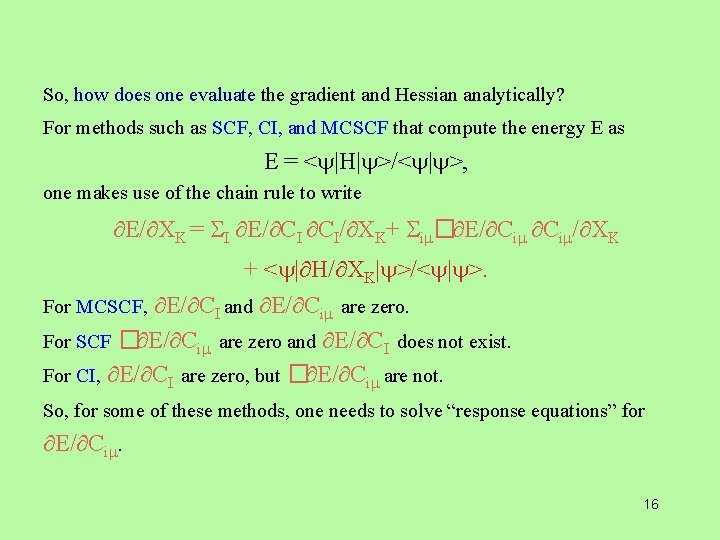
So, how does one evaluate the gradient and Hessian analytically? For methods such as SCF, CI, and MCSCF that compute the energy E as E = <y|H|y>/<y|y>, one makes use of the chain rule to write E/ XK = I E/ CI CI/ XK+ i � E/ Ci / XK + <y| H/ XK|y>/<y|y>. For MCSCF, E/ CI and E/ Ci are zero. For SCF � E/ Ci are zero and E/ CI does not exist. For CI, E/ CI are zero, but � E/ Ci are not. So, for some of these methods, one needs to solve “response equations” for E/ Ci 16
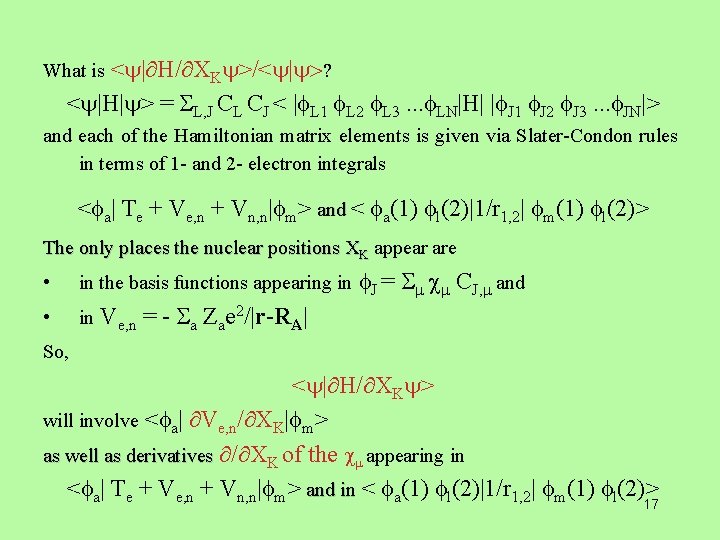
<y| H/ XKy>/<y|y>? <y|H|y> = L, J CL CJ < | L 1 L 2 L . . . LN|H| | J 1 J 2 J . . . JN|> What is and each of the Hamiltonian matrix elements is given via Slater-Condon rules in terms of 1 - and 2 - electron integrals < a| Te + Ve, n + Vn, n| m> and < a(1) l(2)|1/r 1, 2| m(1) l(2)> The only places the nuclear positions XK appear are • in the basis functions appearing in • in J = CJ, and Ve, n = - a Zae 2/|r-RA| So, <y| H/ XKy> will involve < a| Ve, n/ XK| m> as well as derivatives / XK of the appearing in < a| Te + Ve, n + Vn, n| m> and in < a(1) l(2)|1/r 1, 2| m(1) l(2)> 17
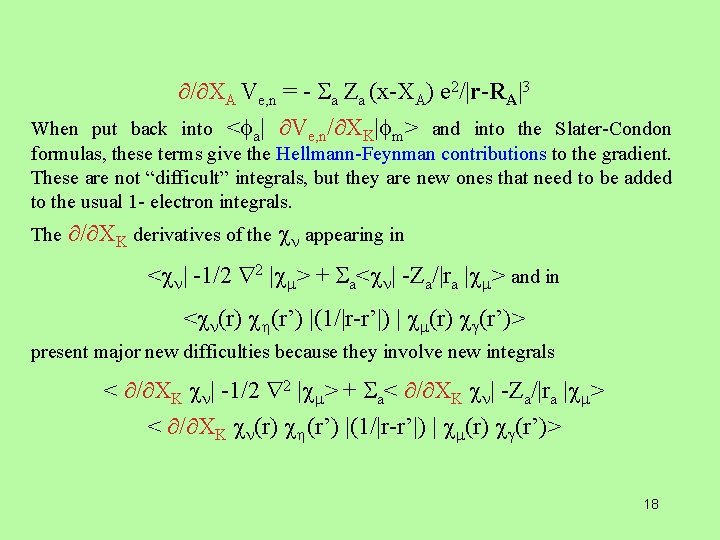
/ XA Ve, n = - a Za (x-XA) e 2/|r-RA|3 When put back into < a| Ve, n/ XK| m> and into the Slater-Condon formulas, these terms give the Hellmann-Feynman contributions to the gradient. These are not “difficult” integrals, but they are new ones that need to be added to the usual 1 - electron integrals. The / XK derivatives of the appearing in < | -1/2 2 | > + a< | -Za/|ra | > and in < (r) (r’) |(1/|r-r’|) | (r) (r’)> present major new difficulties because they involve new integrals < / XK | -1/2 2 | > + a< / XK | -Za/|ra | > < / XK (r) (r’) |(1/|r-r’|) | (r) (r’)> 18
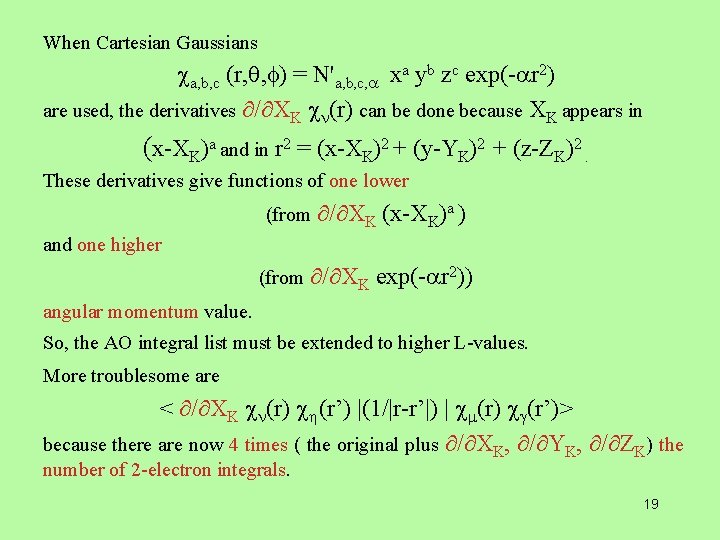
When Cartesian Gaussians a, b, c (r, , ) = N'a, b, c, xa yb zc exp(- r 2) are used, the derivatives / XK (r) can be done because XK appears in (x-XK)a and in r 2 = (x-XK)2 + (y-YK)2 + (z-ZK)2. These derivatives give functions of one lower (from / XK (x-XK)a ) and one higher (from / XK exp(- r 2)) angular momentum value. So, the AO integral list must be extended to higher L-values. More troublesome are < / XK (r) (r’) |(1/|r-r’|) | (r) (r’)> because there are now 4 times ( the original plus / XK, / YK, / ZK) the number of 2 -electron integrals. 19
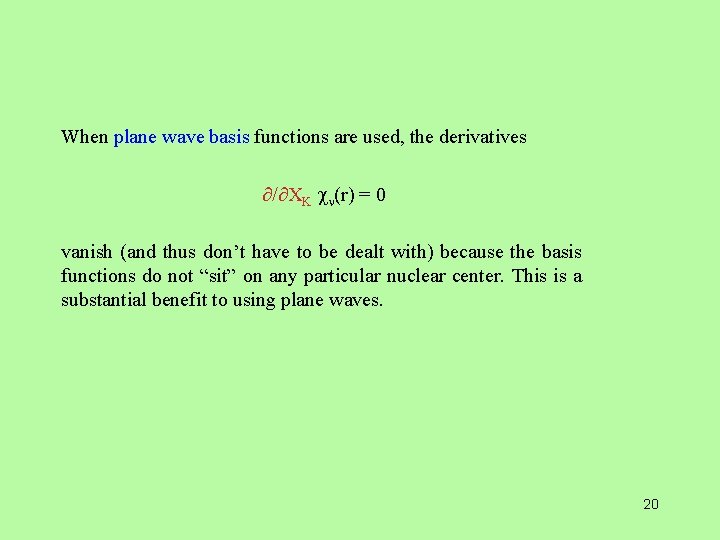
When plane wave basis functions are used, the derivatives / XK (r) = 0 vanish (and thus don’t have to be dealt with) because the basis functions do not “sit” on any particular nuclear center. This is a substantial benefit to using plane waves. 20
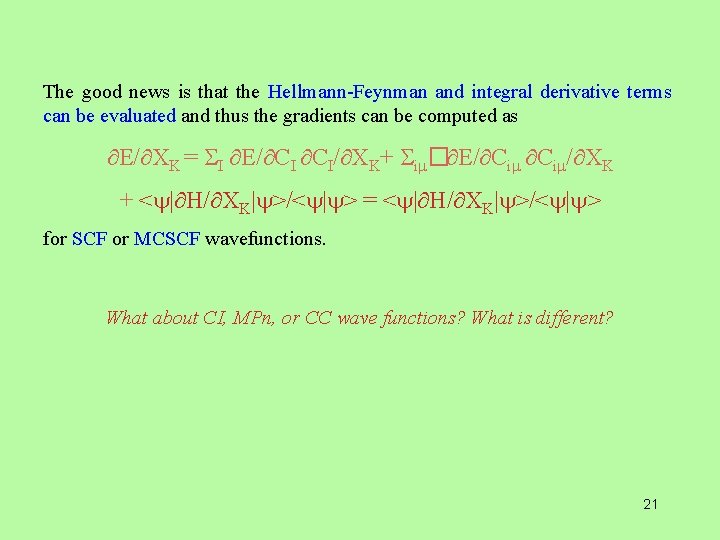
The good news is that the Hellmann-Feynman and integral derivative terms can be evaluated and thus the gradients can be computed as E/ XK = I E/ CI CI/ XK+ i � E/ Ci / XK + <y| H/ XK|y>/<y|y> = <y| H/ XK|y>/<y|y> for SCF or MCSCF wavefunctions. What about CI, MPn, or CC wave functions? What is different? 21
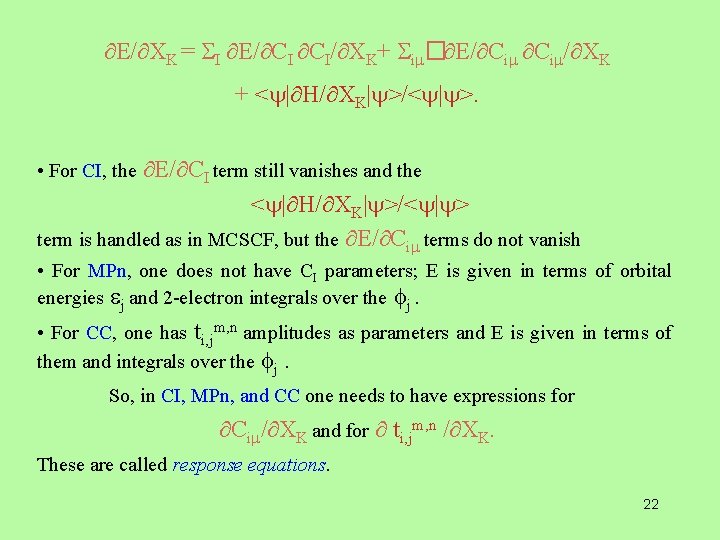
E/ XK = I E/ CI CI/ XK+ i � E/ Ci / XK + <y| H/ XK|y>/<y|y>. • For CI, the E/ CI term still vanishes and the <y| H/ XK|y>/<y|y> term is handled as in MCSCF, but the E/ Ci terms do not vanish • For MPn, one does not have CI parameters; E is given in terms of orbital energies j and 2 -electron integrals over the j. • For CC, one has ti, jm, n amplitudes as parameters and E is given in terms of them and integrals over the j. So, in CI, MPn, and CC one needs to have expressions for Ci / XK and for ti, jm, n / XK. These are called response equations. 22
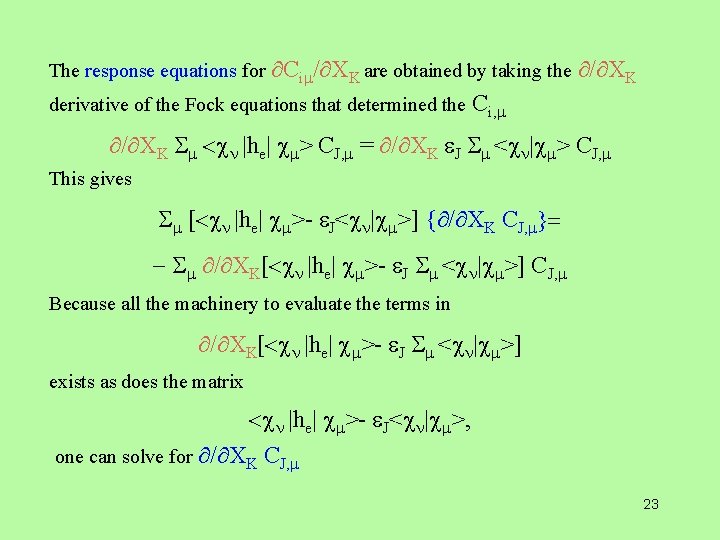
Ci / XK are obtained by taking the / XK derivative of the Fock equations that determined the Ci, The response equations for / XK |he| > CJ, = / XK J < | > CJ, This gives [ |he| >- J< | >] { / XK CJ, } / XK[ |he| >- J < | >] CJ, Because all the machinery to evaluate the terms in / XK[ |he| >- J < | >] exists as does the matrix |he| >- J< | >, one can solve for / XK CJ, 23
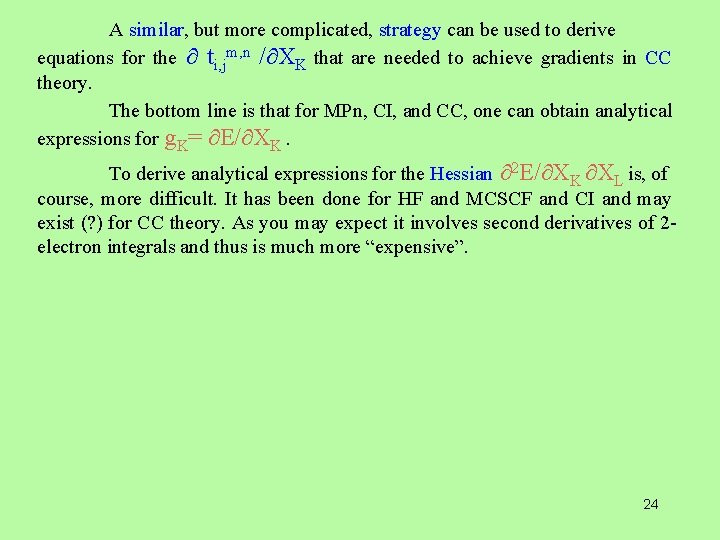
A similar, but more complicated, strategy can be used to derive equations for the ti, jm, n / XK that are needed to achieve gradients in CC theory. The bottom line is that for MPn, CI, and CC, one can obtain analytical expressions for g. K= E/ XK. To derive analytical expressions for the Hessian 2 E/ XK XL is, of course, more difficult. It has been done for HF and MCSCF and CI and may exist (? ) for CC theory. As you may expect it involves second derivatives of 2 electron integrals and thus is much more “expensive”. 24
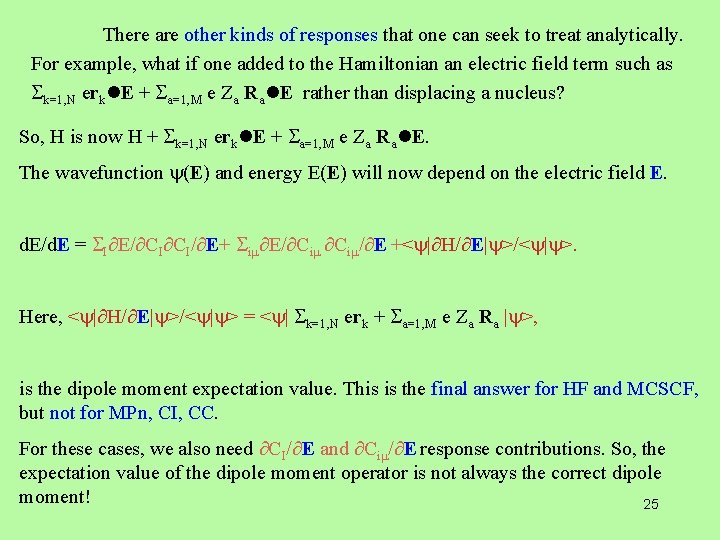
There are other kinds of responses that one can seek to treat analytically. For example, what if one added to the Hamiltonian an electric field term such as k=1, N erk E + a=1, M e Za Ra E rather than displacing a nucleus? So, H is now H + k=1, N erk E + a=1, M e Za Ra E. The wavefunction y(E) and energy E(E) will now depend on the electric field E. d. E/d. E = I E/ CI CI/ E+ i E/ Ci / E +<y| H/ E|y>/<y|y>. Here, <y| H/ E|y>/<y|y> = <y| k=1, N erk + a=1, M e Za Ra |y>, is the dipole moment expectation value. This is the final answer for HF and MCSCF, but not for MPn, CI, CC. For these cases, we also need CI/ E and Ci / E response contributions. So, the expectation value of the dipole moment operator is not always the correct dipole moment! 25
- Slides: 26