
Electronic Structure of OxygenContaining Polyaromatic Hydrocarbon Molecules and
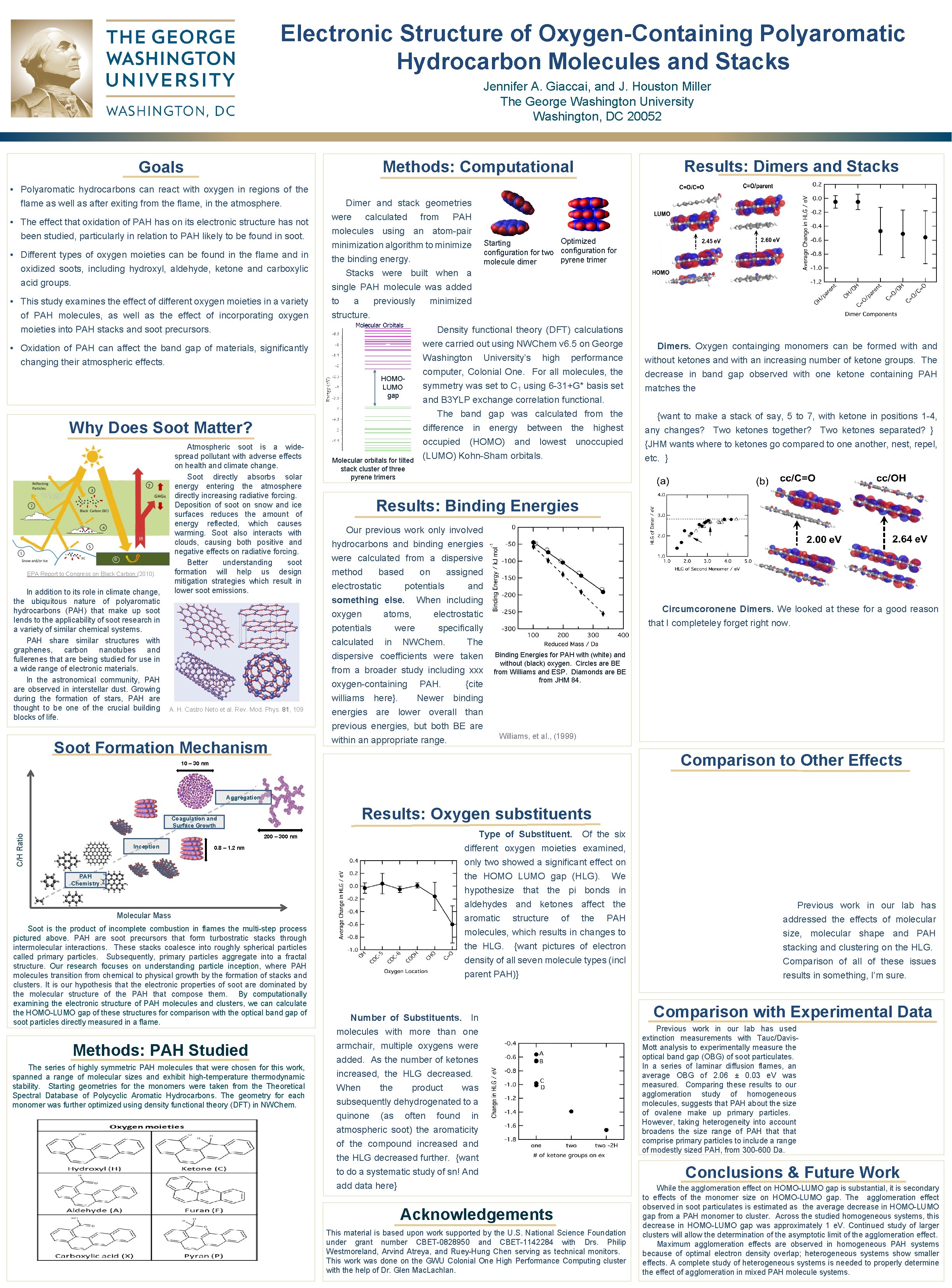
Electronic Structure of Oxygen-Containing Polyaromatic Hydrocarbon Molecules and Stacks Jennifer A. Giaccai, and J. Houston Miller The George Washington University Washington, DC 20052 Methods: Computational Goals • Polyaromatic hydrocarbons can react with oxygen in regions of the flame as well as after exiting from the flame, in the atmosphere. • The effect that oxidation of PAH has on its electronic structure has not been studied, particularly in relation to PAH likely to be found in soot. • Different types of oxygen moieties can be found in the flame and in oxidized soots, including hydroxyl, aldehyde, ketone and carboxylic acid groups. • This study examines the effect of different oxygen moieties in a variety of PAH molecules, as well as the effect of incorporating oxygen moieties into PAH stacks and soot precursors. Dimer and stack geometries were calculated from PAH molecules using an atom-pair minimization algorithm to minimize the binding energy. Stacks were built when a single PAH molecule was added to a previously minimized structure. • Oxidation of PAH can affect the band gap of materials, significantly changing their atmospheric effects. HOMOLUMO gap Why Does Soot Matter? Atmospheric soot is a widespread pollutant with adverse effects on health and climate change. Soot directly absorbs solar energy entering the atmosphere directly increasing radiative forcing. Deposition of soot on snow and ice surfaces reduces the amount of energy reflected, which causes warming. Soot also interacts with clouds, causing both positive and negative effects on radiative forcing. Better understanding soot formation will help us design mitigation strategies which result in lower soot emissions. EPA Report to Congress on Black Carbon (2010). In addition to its role in climate change, the ubiquitous nature of polyaromatic hydrocarbons (PAH) that make up soot lends to the applicability of soot research in a variety of similar chemical systems. PAH share similar structures with graphenes, carbon nanotubes and fullerenes that are being studied for use in a wide range of electronic materials. In the astronomical community, PAH are observed in interstellar dust. Growing during the formation of stars, PAH are thought to be one of the crucial building blocks of life. A. H. Castro Neto et al. Rev. Mod. Phys. 81, 109 Soot Formation Mechanism Molecular orbitals for tilted stack cluster of three pyrene trimers Results: Dimers and Stacks Optimized Starting configuration for two configuration for pyrene trimer molecule dimer Density functional theory (DFT) calculations were carried out using NWChem v 6. 5 on George Washington University’s high performance computer, Colonial One. For all molecules, the symmetry was set to C 1 using 6 -31+G* basis set and B 3 YLP exchange correlation functional. The band gap was calculated from the difference in energy between the highest occupied (HOMO) and lowest unoccupied (LUMO) Kohn-Sham orbitals. Dimers. Oxygen containging monomers can be formed with and without ketones and with an increasing number of ketone groups. The decrease in band gap observed with one ketone containing PAH matches the {want to make a stack of say, 5 to 7, with ketone in positions 1 -4, any changes? Two ketones together? Two ketones separated? } {JHM wants where to ketones go compared to one another, nest, repel, etc. } Rake and Results: Binding Energies Sampling Wire Our previous work only involved hydrocarbons and binding energies were calculated from a dispersive method based on assigned electrostatic potentials and something else. When including oxygen atoms, electrostatic potentials were specifically calculated in NWChem. The dispersive coefficients were taken from a broader study including xxx oxygen-containing PAH. {cite williams here}. Newer binding energies are lower overall than previous energies, but both BE are within an appropriate range. Circumcoronene Dimers. We looked at these for a good reason that I completeley forget right now. Binding Energies for PAH with (white) and without (black) oxygen. Circles are BE from Williams and ESP. Diamonds are BE from JHM 84. Williams, et al. , (1999) Comparison to Other Effects 10 – 30 nm Aggregation Results: Oxygen substituents C/H Ratio Coagulation and Surface Growth 200 – 300 nm Inception 0. 8 – 1. 2 nm PAH Chemistry Molecular Mass Soot is the product of incomplete combustion in flames the multi-step process pictured above. PAH are soot precursors that form turbostratic stacks through intermolecular interactions. These stacks coalesce into roughly spherical particles called primary particles. Subsequently, primary particles aggregate into a fractal structure. Our research focuses on understanding particle inception, where PAH molecules transition from chemical to physical growth by the formation of stacks and clusters. It is our hypothesis that the electronic properties of soot are dominated by the molecular structure of the PAH that compose them. By computationally examining the electronic structure of PAH molecules and clusters, we can calculate the HOMO-LUMO gap of these structures for comparison with the optical band gap of soot particles directly measured in a flame. Methods: PAH Studied The series of highly symmetric PAH molecules that were chosen for this work, spanned a range of molecular sizes and exhibit high-temperature thermodynamic stability. Starting geometries for the monomers were taken from the Theoretical Spectral Database of Polycyclic Aromatic Hydrocarbons. The geometry for each monomer was further optimized using density functional theory (DFT) in NWChem. Type of Substituent. Of the six different oxygen moieties examined, only two showed a significant effect on the HOMO LUMO gap (HLG). We hypothesize that the pi bonds in aldehydes and ketones affect the aromatic structure of the PAH molecules, which results in changes to the HLG. {want pictures of electron density of all seven molecule types (incl parent PAH)} Number of Substituents. In molecules with more than one armchair, multiple oxygens were added. As the number of ketones increased, the HLG decreased. When the product was subsequently dehydrogenated to a quinone (as often found in atmospheric soot) the aromaticity of the compound increased and the HLG decreased further. {want to do a systematic study of sn! And add data here} Acknowledgements This material is based upon work supported by the U. S. National Science Foundation under grant number CBET-0828950 and CBET-1142284 with Drs. Philip Westmoreland, Arvind Atreya, and Ruey-Hung Chen serving as technical monitors. This work was done on the GWU Colonial One High Performance Computing cluster with the help of Dr. Glen Mac. Lachlan. Previous work in our lab has addressed the effects of molecular size, molecular shape and PAH stacking and clustering on the HLG. Comparison of all of these issues results in something, I’m sure. Comparison with Experimental Data Previous work in our lab has used extinction measurements with Tauc/Davis. Mott analysis to experimentally measure the optical band gap (OBG) of soot particulates. In a series of laminar diffusion flames, an average OBG of 2. 06 ± 0. 03 e. V was measured. Comparing these results to our agglomeration study of homogeneous molecules, suggests that PAH about the size of ovalene make up primary particles. However, taking heterogeneity into account broadens the size range of PAH that comprise primary particles to include a range of modestly sized PAH, from 300 -600 Da. Conclusions & Future Work While the agglomeration effect on HOMO-LUMO gap is substantial, it is secondary to effects of the monomer size on HOMO-LUMO gap. The agglomeration effect observed in soot particulates is estimated as the average decrease in HOMO-LUMO gap from a PAH monomer to cluster. Across the studied homogeneous systems, this decrease in HOMO-LUMO gap was approximately 1 e. V. Continued study of larger clusters will allow the determination of the asymptotic limit of the agglomeration effect. Maximum agglomeration effects are observed in homogeneous PAH systems because of optimal electron density overlap; heterogeneous systems show smaller effects. A complete study of heterogeneous systems is needed to properly determine the effect of agglomeration in mixed PAH molecule systems.
- Slides: 1