
Electronic separation Clearance Enabling the Crossing of Traffic
Electronic separation Clearance Enabling the Crossing of Traffic under Instrument meteorological Conditions CENTRE D'ETUDES DE LA NAVIGATION AERIENNE ASAS-TN, 2 nd workshop - Malmö 6 ~ 8 october 2003 page 1
ECLECTIC: What is it? u To assess operational feasibility and acceptability of ASAS Crossing Procedures (ACP) Procedures which allow the flight crew to provide separation with respect to one aircraft designated by ATC m The controller remains responsible for separation of other aircraft m Airborne separation Minima m u A CENA Project : prospective study for Package 2 u European context : EEC, NUP II, MFF, MA-AFAS CENTRE D'ETUDES DE LA NAVIGATION AERIENNE ASAS-TN, 2 nd workshop - Malmö 6 ~ 8 october 2003 page 2
ECLECTIC: How? u First step m A demonstrator running on PC unit m Several scenarios of crossing Ø Different crossing angles Ø Different altitudes and speeds Ø Different horizontal separation at CPA before ASAS manoeuvre m Controller radar display m Flight deck MMI example (CDTI + control unit) m Automatic or manual initiation of ACP and piloting (through pseudo A/P) u Further steps m Experimentations with traffic simulator and real controllers m Traffic scenarios with several aircraft CENTRE D'ETUDES DE LA NAVIGATION AERIENNE ASAS-TN, 2 nd workshop - Malmö 6 ~ 8 october 2003 page 3
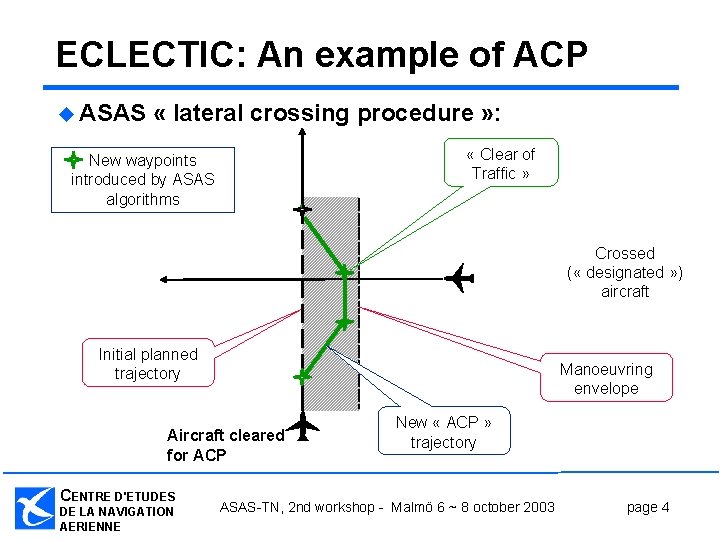
ECLECTIC: An example of ACP u ASAS « lateral crossing procedure » : « Clear of Traffic » New waypoints introduced by ASAS algorithms Crossed ( « designated » ) aircraft Initial planned trajectory Manoeuvring envelope Aircraft cleared for ACP CENTRE D'ETUDES DE LA NAVIGATION AERIENNE New « ACP » trajectory ASAS-TN, 2 nd workshop - Malmö 6 ~ 8 october 2003 page 4
Considerations & assumptions u ACP considered as a « standard » procedure m Proposed by ATC m If impossible, flight crew will advise ATC immediately u No monitoring by ATC m ACP is considered as safe as today’s procedures u Airborne separation value may be different from the radar one Radar separation minima are not the same everywhere m The airborne value may depend on the equipment m u Contingency in case of « ASAS unavailability » m The ACP abortion does not mean immediate risk of collision m ATC should be able to recover m ATC may use half vertical separation as a last resort m ACAS CENTRE D'ETUDES DE LA NAVIGATION AERIENNE ASAS-TN, 2 nd workshop - Malmö 6 ~ 8 october 2003 page 5
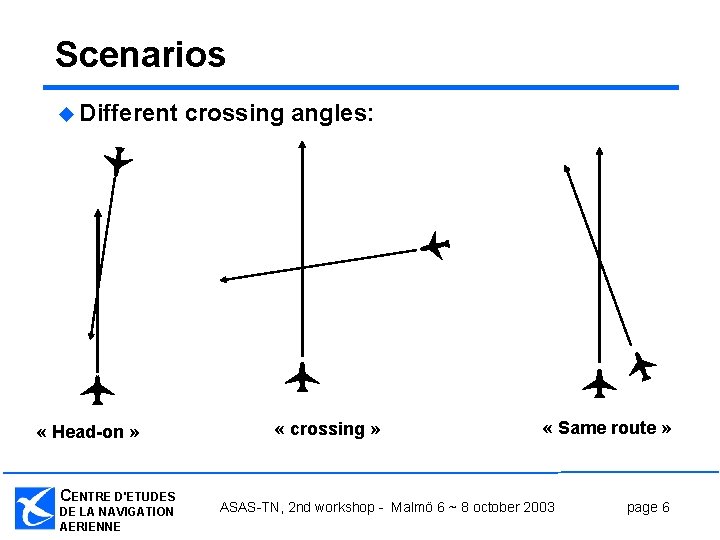
Scenarios u Different crossing angles: « Head-on » CENTRE D'ETUDES DE LA NAVIGATION AERIENNE « crossing » « Same route » ASAS-TN, 2 nd workshop - Malmö 6 ~ 8 october 2003 page 6
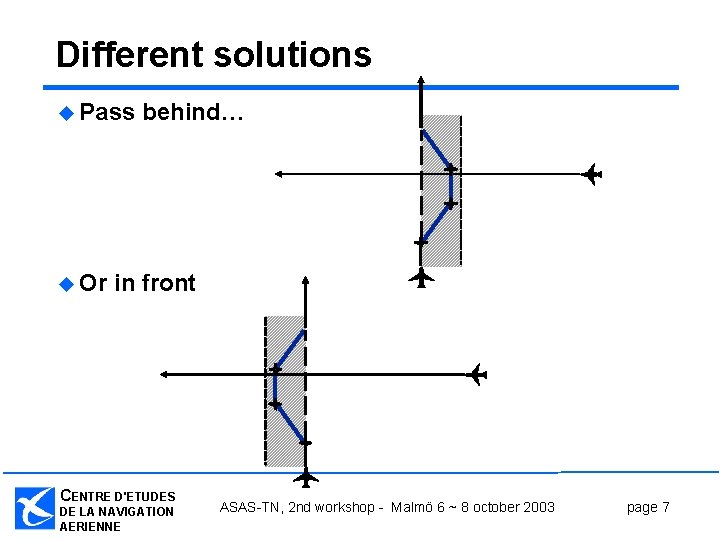
Different solutions u Pass behind… u Or in front CENTRE D'ETUDES DE LA NAVIGATION AERIENNE ASAS-TN, 2 nd workshop - Malmö 6 ~ 8 october 2003 page 7
Issues u The phraseology must remain simple and robust u The « other aircraft » designation is still an open issue Unambiguous m Must not generate confusion with traffic not involved m u The need to lock the navigation of the other aircraft and to advise it about the ASAS crossing, to be discussed u End of procedure: At « Clear of Traffic » , or m After resuming navigation? m CENTRE D'ETUDES DE LA NAVIGATION AERIENNE ASAS-TN, 2 nd workshop - Malmö 6 ~ 8 october 2003 page 8
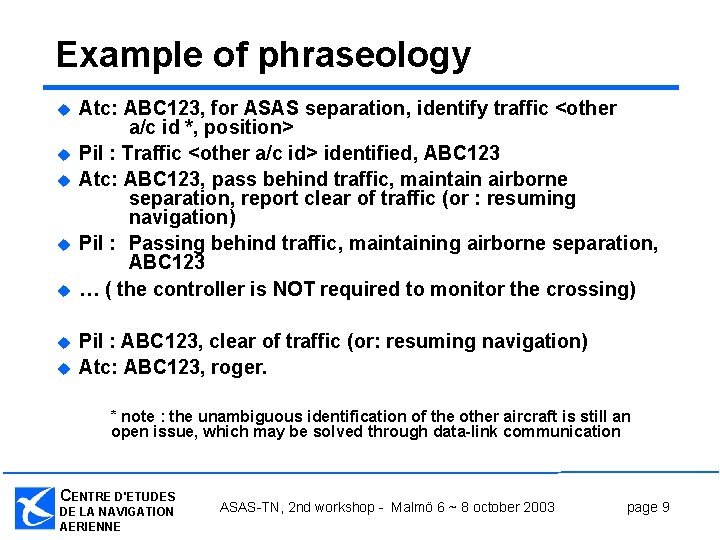
Example of phraseology u u u u Atc: ABC 123, for ASAS separation, identify traffic <other a/c id *, position> Pil : Traffic <other a/c id> identified, ABC 123 Atc: ABC 123, pass behind traffic, maintain airborne separation, report clear of traffic (or : resuming navigation) Pil : Passing behind traffic, maintaining airborne separation, ABC 123 … ( the controller is NOT required to monitor the crossing) Pil : ABC 123, clear of traffic (or: resuming navigation) Atc: ABC 123, roger. * note : the unambiguous identification of the other aircraft is still an open issue, which may be solved through data-link communication CENTRE D'ETUDES DE LA NAVIGATION AERIENNE ASAS-TN, 2 nd workshop - Malmö 6 ~ 8 october 2003 page 9
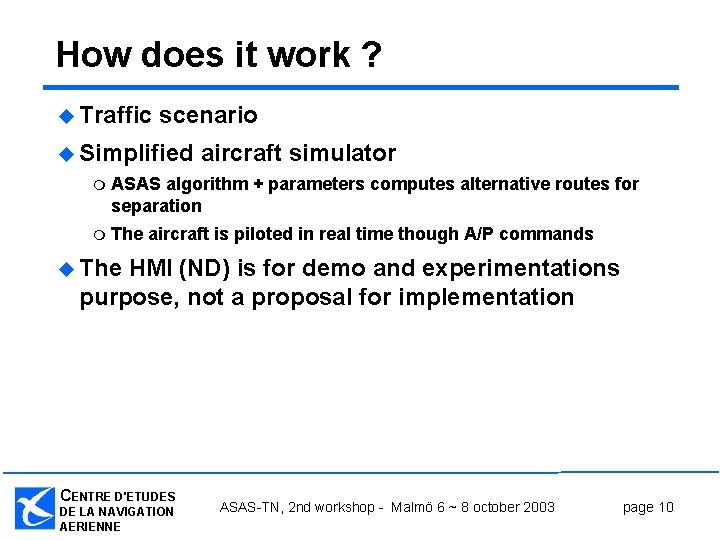
How does it work ? u Traffic scenario u Simplified aircraft simulator m ASAS algorithm + parameters computes alternative routes for separation m The aircraft is piloted in real time though A/P commands u The HMI (ND) is for demo and experimentations purpose, not a proposal for implementation CENTRE D'ETUDES DE LA NAVIGATION AERIENNE ASAS-TN, 2 nd workshop - Malmö 6 ~ 8 october 2003 page 10
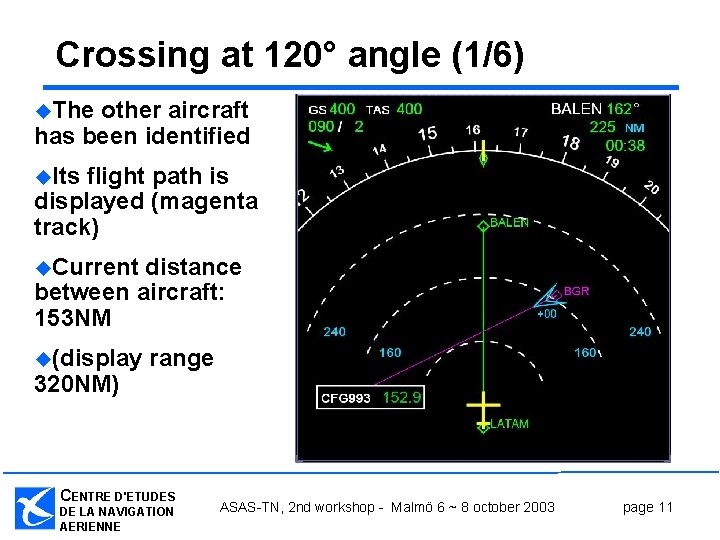
Crossing at 120° angle (1/6) u. The other aircraft has been identified u. Its flight path is displayed (magenta track) u. Current distance between aircraft: 153 NM u(display range 320 NM) CENTRE D'ETUDES DE LA NAVIGATION AERIENNE ASAS-TN, 2 nd workshop - Malmö 6 ~ 8 october 2003 page 11
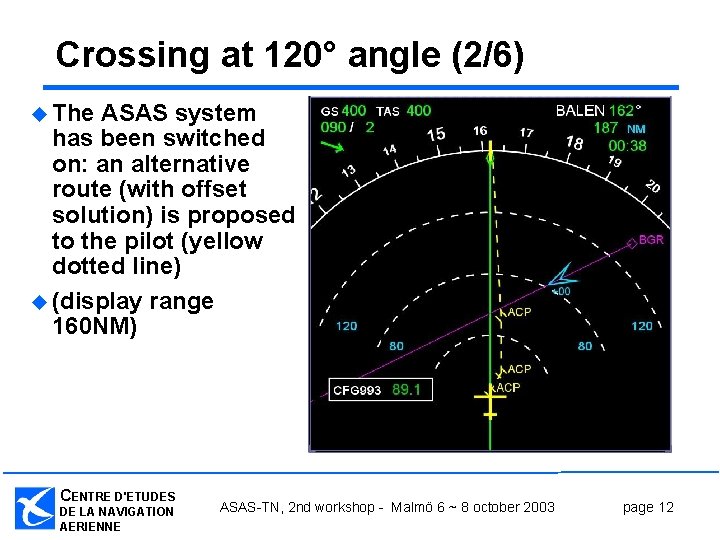
Crossing at 120° angle (2/6) u The ASAS system has been switched on: an alternative route (with offset solution) is proposed to the pilot (yellow dotted line) u (display range 160 NM) CENTRE D'ETUDES DE LA NAVIGATION AERIENNE ASAS-TN, 2 nd workshop - Malmö 6 ~ 8 october 2003 page 12
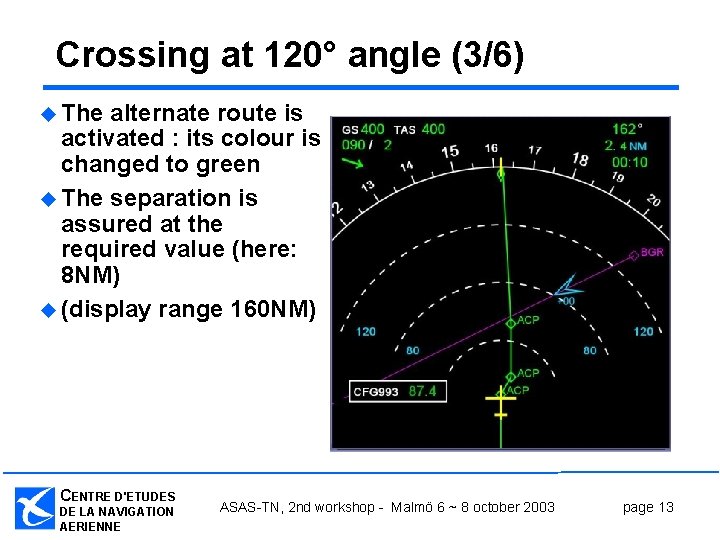
Crossing at 120° angle (3/6) u The alternate route is activated : its colour is changed to green u The separation is assured at the required value (here: 8 NM) u (display range 160 NM) CENTRE D'ETUDES DE LA NAVIGATION AERIENNE ASAS-TN, 2 nd workshop - Malmö 6 ~ 8 october 2003 page 13
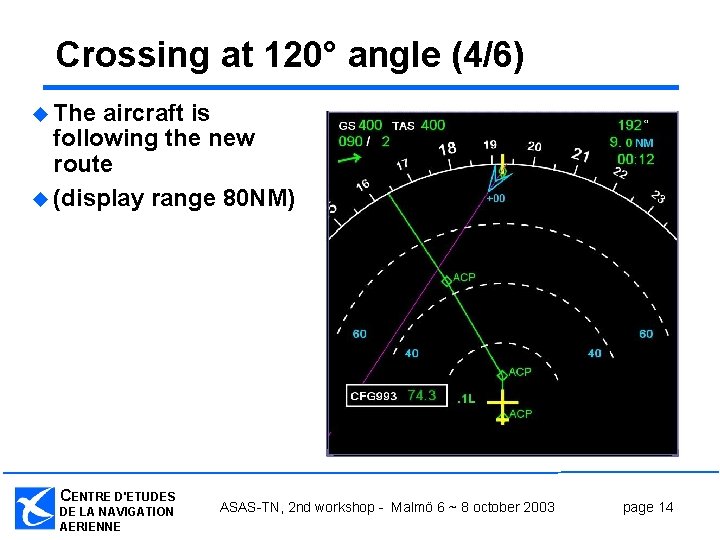
Crossing at 120° angle (4/6) u The aircraft is following the new route u (display range 80 NM) CENTRE D'ETUDES DE LA NAVIGATION AERIENNE ASAS-TN, 2 nd workshop - Malmö 6 ~ 8 october 2003 page 14
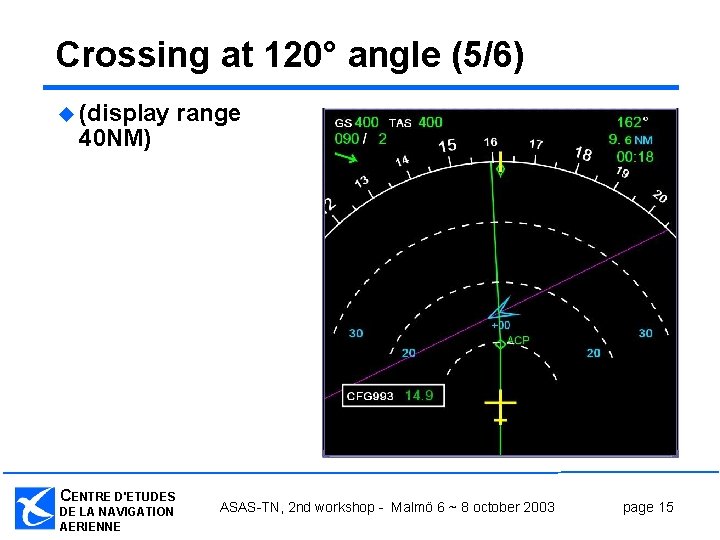
Crossing at 120° angle (5/6) u (display range 40 NM) CENTRE D'ETUDES DE LA NAVIGATION AERIENNE ASAS-TN, 2 nd workshop - Malmö 6 ~ 8 october 2003 page 15
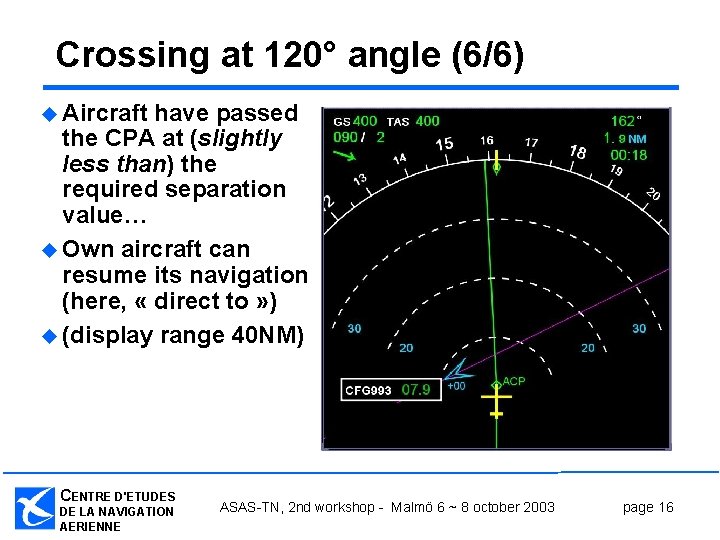
Crossing at 120° angle (6/6) u Aircraft have passed the CPA at (slightly less than) the required separation value… u Own aircraft can resume its navigation (here, « direct to » ) u (display range 40 NM) CENTRE D'ETUDES DE LA NAVIGATION AERIENNE ASAS-TN, 2 nd workshop - Malmö 6 ~ 8 october 2003 page 16
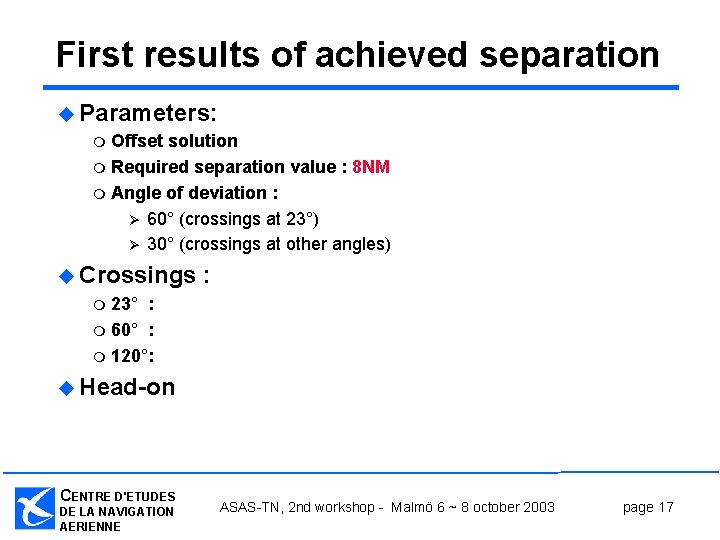
First results of achieved separation u Parameters: m Offset solution m Required separation value : 8 NM m Angle of deviation : Ø 60° (crossings at 23°) Ø 30° (crossings at other angles) u Crossings : m 23° : m 60° : m 120°: u Head-on CENTRE D'ETUDES DE LA NAVIGATION AERIENNE ASAS-TN, 2 nd workshop - Malmö 6 ~ 8 october 2003 page 17
Further work u Other parameter values m 5 NM, 3 NM as examples for separation m Other angles of deviation m « Pass in front » u Other algorithms m One waypoint solution m Open angle of deviation u Manoeuvring Envelope u Simulations CENTRE D'ETUDES DE LA NAVIGATION AERIENNE ASAS-TN, 2 nd workshop - Malmö 6 ~ 8 october 2003 page 18
- Slides: 18